• Name : SOHOMGHOSH
• Roll No: 35001621017
• Registration No: 213500101610024
• Dept: ELECTRICAL ENGINEERING
• Subject: Artificial Intelligence
• Subject Code: OE-EE 701 A
• Semester: 7th
sem
• Session: 2021-2025
• College: Ramkrishna Mahato Government Engineering College, Purulia
• Year: 4th
year
Topic: The Steps of Natural Language
Processing (NLP)
• Name : SOHOMGHOSH
• Roll No: 35001621017
• Registration No: 213500101610024
• Dept: ELECTRICAL ENGINEERING
• Subject: Artificial Intelligence
• Subject Code: OE-EE 701 A
• Semester: 7th
sem
Topic: The Steps of Natural Language
Processing (NLP)
Introduction to NLP
 Definition:
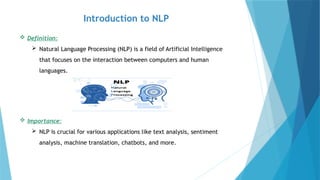
 Natural Language Processing (NLP) is a field of Artificial Intelligence
that focuses on the interaction between computers and human
languages.
 Importance:
 NLP is crucial for various applications like text analysis, sentiment
analysis, machine translation, chatbots, and more.
Step 1: Text Preprocessing
 Purpose: Clean and prepare raw text data.
 Key Processes:
 Tokenization: Splitting text into words/tokens.
 Lowercasing & Stop Word Removal: Ensuring uniformity and removing common
words.
 Stemming/Lemmatization: Reducing words to their base forms.
Step 2: Text Representation & Feature Engineering
 Text Representation:
 Bag of Words (BoW), TF-IDF: Basic word frequency-based methods.
 Word Embeddings: Advanced methods capturing semantic meaning
(e.g., Word2Vec, BERT).
 Feature Engineering:
 N-grams & POS Tagging: Capturing context and grammatical structure.
 Named Entity Recognition (NER): Identifying key entities like names,
dates.
Step 3: Model Selection, Training & Evaluation
 Model Selection:
 Algorithms: Choose from Naive Bayes, SVM, RNNs, Transformers, etc.
 Training:
 Feeding the processed data into the model for learning.
 Evaluation:
 Metrics: Accuracy, precision, recall, F1-score.
 Cross-Validation: Ensuring the model generalizes well.
Step 4: Tuning, Optimization & Deployment
 Tuning & Optimization:
 Hyperparameter Tuning: Adjusting learning rate, batch size, etc.
 Regularization: Techniques to prevent overfitting.
 Deployment:
 API Development & Monitoring: Integrating the model into production and
ensuring its ongoing performance.
Referance:
• https://www.geeksforgeeks.org/natural-language-processing-over
view/
• https://aws.amazon.com/what-is/nlp/#:~:text=Natural%20langua
ge%20processing%20(NLP)%20is,manipulate%2C%20and%20compreh
end%20human%20language
.
• https://www.ibm.com/topics/natural-language-processing
Thankyou

Natural Language Processing(NLP) for beginner

  • 1.
    • Name :SOHOMGHOSH • Roll No: 35001621017 • Registration No: 213500101610024 • Dept: ELECTRICAL ENGINEERING • Subject: Artificial Intelligence • Subject Code: OE-EE 701 A • Semester: 7th sem • Session: 2021-2025 • College: Ramkrishna Mahato Government Engineering College, Purulia • Year: 4th year Topic: The Steps of Natural Language Processing (NLP) • Name : SOHOMGHOSH • Roll No: 35001621017 • Registration No: 213500101610024 • Dept: ELECTRICAL ENGINEERING • Subject: Artificial Intelligence • Subject Code: OE-EE 701 A • Semester: 7th sem Topic: The Steps of Natural Language Processing (NLP)
  • 2.
    Introduction to NLP Definition:  Natural Language Processing (NLP) is a field of Artificial Intelligence that focuses on the interaction between computers and human languages.  Importance:  NLP is crucial for various applications like text analysis, sentiment analysis, machine translation, chatbots, and more.
  • 3.
    Step 1: TextPreprocessing  Purpose: Clean and prepare raw text data.  Key Processes:  Tokenization: Splitting text into words/tokens.  Lowercasing & Stop Word Removal: Ensuring uniformity and removing common words.  Stemming/Lemmatization: Reducing words to their base forms.
  • 4.
    Step 2: TextRepresentation & Feature Engineering  Text Representation:  Bag of Words (BoW), TF-IDF: Basic word frequency-based methods.  Word Embeddings: Advanced methods capturing semantic meaning (e.g., Word2Vec, BERT).  Feature Engineering:  N-grams & POS Tagging: Capturing context and grammatical structure.  Named Entity Recognition (NER): Identifying key entities like names, dates.
  • 5.
    Step 3: ModelSelection, Training & Evaluation  Model Selection:  Algorithms: Choose from Naive Bayes, SVM, RNNs, Transformers, etc.  Training:  Feeding the processed data into the model for learning.  Evaluation:  Metrics: Accuracy, precision, recall, F1-score.  Cross-Validation: Ensuring the model generalizes well.
  • 6.
    Step 4: Tuning,Optimization & Deployment  Tuning & Optimization:  Hyperparameter Tuning: Adjusting learning rate, batch size, etc.  Regularization: Techniques to prevent overfitting.  Deployment:  API Development & Monitoring: Integrating the model into production and ensuring its ongoing performance.
  • 7.
  • 8.