HandyMan
On-Demand App
Native or Cross-platform Development Explained For
Introduction
Understanding the mechanics of a mobile app doesn’t have to be so
complex when you only need to decide which development approach
you are willing to go for. Depending on the programming language
and a set of required toolsets coupled with the available budget,
native and cross-development each have their pros and cons. Let’s
understand them in detail from the perspective of Handyman on
Demand service.
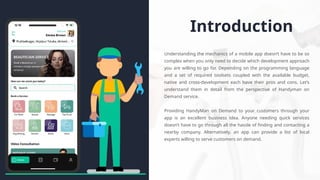
Providing HandyMan on Demand to your customers through your
app is an excellent business idea. Anyone needing quick services
doesn’t have to go through all the hassle of finding and contacting a
nearby company. Alternatively, an app can provide a list of local
experts willing to serve customers on demand.
O V E R V I E W
ABOUT US
General Overview
Native and Cross-platform
The term native is all about being true and specific to the
nature of the operating system and programming
language. Whereas, if the same programming language
can be used for different operating systems, then it’s
called cross-platform development.
Native Development
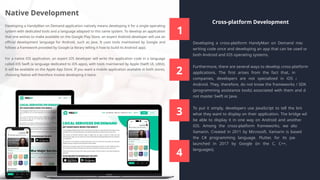
Developing a HandyMan on Demand application natively means developing it for a single operating
system with dedicated tools and a language adapted to this same system. To develop an application
that one wishes to make available on the Google Play Store, an expert Android developer will use an
official development language for Android, such as Java. It uses tools maintained by Google and
follows a framework provided by Google (a library telling it how to build its Android app).
For a native iOS application, an expert iOS developer will write the application code in a language
called iOS Swift (a language dedicated to iOS apps), with tools maintained by Apple (Swift UI, UIKit).
It will be available on the Apple App Store. If you want a mobile application available in both stores,
choosing Native will therefore involve developing it twice.
Cross-platform Development
Developing a cross-platform HandyMan on Demand means
writing code once and developing an app that can be used on
both Android and iOS operating systems.
Furthermore, there are several ways to develop cross-platform
applications. The first arises from the fact that, in many
companies, developers are not specialized in iOS and/or
Android. They, therefore, do not know the frameworks / SDKs
(programming assistance tools) associated with them and do
not master Swift or Java.
To put it simply, developers use JavaScript to tell the bridge
what they want to display on their application. The bridge will
be able to display it in one way on Android and another on
iOS. Among the cross-platform frameworks, we also find
Xamarin. Created in 2011 by Microsoft, Xamarin is based on
the C# programming language. Flutter, for its part, was
launched in 2017 by Google (in the C, C++, and Dart
languages).
1
2
3
4
Who are the Developers?
One of the first differences between cross-platform apps and
native apps is the type of skills required. For a cross-platform
app using, for example, React Native, only a cross-platform
technology developer proficient in JavaScript is needed.
However, this person must know about iOS and Android
systems, which is particularly necessary for maintaining the
mobile app.
Developing a hybrid application, which only uses one web
language, also only requires one developer. Anyone who knows
how to make a website can create such an application.
When you want a native application to be present on the Apple App
Store and the Google Play Store, it is necessary to have it developed
twice: on one side by an iOS expert and on the other by an Android
expert. This dual development justifies the higher cost of a native
application compared to a multiplatform application (hybrid/web
applications being the least expensive).
Which is better for a Handyman on Demand
Application?
By exploiting the specifics of
the system, a native
application will be richer
overall, with higher levels of
efficiency and security. The app
will be able to more easily
access all the phone's features:
camera, microphone, etc.
Furthermore, the app can also
run in the background, as well
as in offline mode.
A native application follows
the system guidelines. These
are visual and technical rules
that optimize the operation of
the app and the user
experience by standardizing
the design of all applications
on the OS. Moreover, it is more
difficult for a cross-platform
app developed only once (a
single source code) to
perfectly match the guidelines
of several operating systems
simultaneously.
Following the guidelines means
respecting users' browsing
habits. They allow immediate
visual recognition, helping
them easily find what they are
looking for. Whether they
prefer iOS or Android, they are
accustomed to the operating
system codes. For example,
using the navigation bar
located at the bottom of
screens on Android has become
a reflex for many users.
Developing an application in
native code allows you to
better consider this automation
and thus offer them a fluid and
pleasant navigation experience.
The Best Performance of the Native
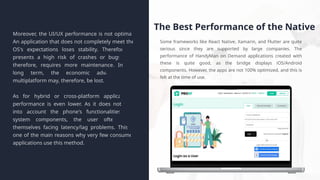
Some frameworks like React Native, Xamarin, and Flutter are quite
serious since they are supported by large companies. The
performance of HandyMan on Demand applications created with
these is quite good, as the bridge displays iOS/Android
components. However, the apps are not 100% optimized, and this is
felt at the time of use.
Moreover, the UI/UX performance is not optimal.
An application that does not completely meet the
OS's expectations loses stability. Therefore, it
presents a high risk of crashes or bugs and,
therefore, requires more maintenance. In the
long term, the economic advantage of
multiplatform may, therefore, be lost.
As for hybrid or cross-platform applications,
performance is even lower. As it does not take
into account the phone's functionalities and
system components, the user often finds
themselves facing latency/lag problems. This is
one of the main reasons why very few consumer
applications use this method.
Native Application
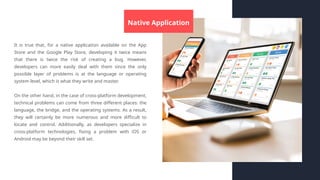
It is true that, for a native application available on the App
Store and the Google Play Store, developing it twice means
that there is twice the risk of creating a bug. However,
developers can more easily deal with them since the only
possible layer of problems is at the language or operating
system level, which is what they write and master.
On the other hand, in the case of cross-platform development,
technical problems can come from three different places: the
language, the bridge, and the operating systems. As a result,
they will certainly be more numerous and more difficult to
locate and control. Additionally, as developers specialize in
cross-platform technologies, fixing a problem with iOS or
Android may be beyond their skill set.
Get in touch with us
C O N TA C T U S
+1 (858) 427-0668
sales@v3cube.com
https://www.v3cube.com/on-demand-handyman-app-like-uber/

Native or cross-platform development explained for a HandyMan on Demand app

  • 1.
    HandyMan On-Demand App Native orCross-platform Development Explained For
  • 2.
    Introduction Understanding the mechanicsof a mobile app doesn’t have to be so complex when you only need to decide which development approach you are willing to go for. Depending on the programming language and a set of required toolsets coupled with the available budget, native and cross-development each have their pros and cons. Let’s understand them in detail from the perspective of Handyman on Demand service. Providing HandyMan on Demand to your customers through your app is an excellent business idea. Anyone needing quick services doesn’t have to go through all the hassle of finding and contacting a nearby company. Alternatively, an app can provide a list of local experts willing to serve customers on demand.
  • 3.
    O V ER V I E W ABOUT US General Overview Native and Cross-platform The term native is all about being true and specific to the nature of the operating system and programming language. Whereas, if the same programming language can be used for different operating systems, then it’s called cross-platform development.
  • 4.
    Native Development Developing aHandyMan on Demand application natively means developing it for a single operating system with dedicated tools and a language adapted to this same system. To develop an application that one wishes to make available on the Google Play Store, an expert Android developer will use an official development language for Android, such as Java. It uses tools maintained by Google and follows a framework provided by Google (a library telling it how to build its Android app). For a native iOS application, an expert iOS developer will write the application code in a language called iOS Swift (a language dedicated to iOS apps), with tools maintained by Apple (Swift UI, UIKit). It will be available on the Apple App Store. If you want a mobile application available in both stores, choosing Native will therefore involve developing it twice. Cross-platform Development Developing a cross-platform HandyMan on Demand means writing code once and developing an app that can be used on both Android and iOS operating systems. Furthermore, there are several ways to develop cross-platform applications. The first arises from the fact that, in many companies, developers are not specialized in iOS and/or Android. They, therefore, do not know the frameworks / SDKs (programming assistance tools) associated with them and do not master Swift or Java. To put it simply, developers use JavaScript to tell the bridge what they want to display on their application. The bridge will be able to display it in one way on Android and another on iOS. Among the cross-platform frameworks, we also find Xamarin. Created in 2011 by Microsoft, Xamarin is based on the C# programming language. Flutter, for its part, was launched in 2017 by Google (in the C, C++, and Dart languages). 1 2 3 4
  • 5.
    Who are theDevelopers? One of the first differences between cross-platform apps and native apps is the type of skills required. For a cross-platform app using, for example, React Native, only a cross-platform technology developer proficient in JavaScript is needed. However, this person must know about iOS and Android systems, which is particularly necessary for maintaining the mobile app. Developing a hybrid application, which only uses one web language, also only requires one developer. Anyone who knows how to make a website can create such an application. When you want a native application to be present on the Apple App Store and the Google Play Store, it is necessary to have it developed twice: on one side by an iOS expert and on the other by an Android expert. This dual development justifies the higher cost of a native application compared to a multiplatform application (hybrid/web applications being the least expensive).
  • 6.
    Which is betterfor a Handyman on Demand Application? By exploiting the specifics of the system, a native application will be richer overall, with higher levels of efficiency and security. The app will be able to more easily access all the phone's features: camera, microphone, etc. Furthermore, the app can also run in the background, as well as in offline mode. A native application follows the system guidelines. These are visual and technical rules that optimize the operation of the app and the user experience by standardizing the design of all applications on the OS. Moreover, it is more difficult for a cross-platform app developed only once (a single source code) to perfectly match the guidelines of several operating systems simultaneously. Following the guidelines means respecting users' browsing habits. They allow immediate visual recognition, helping them easily find what they are looking for. Whether they prefer iOS or Android, they are accustomed to the operating system codes. For example, using the navigation bar located at the bottom of screens on Android has become a reflex for many users. Developing an application in native code allows you to better consider this automation and thus offer them a fluid and pleasant navigation experience.
  • 7.
    The Best Performanceof the Native Some frameworks like React Native, Xamarin, and Flutter are quite serious since they are supported by large companies. The performance of HandyMan on Demand applications created with these is quite good, as the bridge displays iOS/Android components. However, the apps are not 100% optimized, and this is felt at the time of use. Moreover, the UI/UX performance is not optimal. An application that does not completely meet the OS's expectations loses stability. Therefore, it presents a high risk of crashes or bugs and, therefore, requires more maintenance. In the long term, the economic advantage of multiplatform may, therefore, be lost. As for hybrid or cross-platform applications, performance is even lower. As it does not take into account the phone's functionalities and system components, the user often finds themselves facing latency/lag problems. This is one of the main reasons why very few consumer applications use this method.
  • 8.
    Native Application It istrue that, for a native application available on the App Store and the Google Play Store, developing it twice means that there is twice the risk of creating a bug. However, developers can more easily deal with them since the only possible layer of problems is at the language or operating system level, which is what they write and master. On the other hand, in the case of cross-platform development, technical problems can come from three different places: the language, the bridge, and the operating systems. As a result, they will certainly be more numerous and more difficult to locate and control. Additionally, as developers specialize in cross-platform technologies, fixing a problem with iOS or Android may be beyond their skill set.
  • 9.
    Get in touchwith us C O N TA C T U S +1 (858) 427-0668 sales@v3cube.com https://www.v3cube.com/on-demand-handyman-app-like-uber/