By: Kaitlyn GlennEgypt:A Central Nation
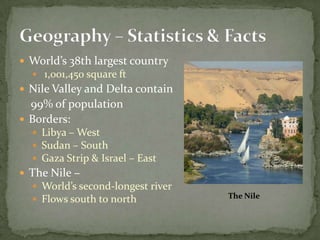
Geography – Statistics & FactsWorld’s 38th largest country 1,001,450 square ftNile Valley and Delta contain     99% of population	Borders:Libya – WestSudan – SouthGaza Strip & Israel – EastThe Nile – World’s second-longest riverFlows south to north The Nile
Rainfall: Averages 2 – 5 mm per year (south of Cairo)Up to 410 mm per year on small strip of northern coastSnow:Sinai mountainsSome northern cities (such as Damietta, Baltim…etc)Temperature:80 °F – 90 °F  in summer (up to 109 °F on Red Sea Coast) 55 °F – 70 °F in winterThe Khamaseen (wind blowing from the south) can raise the temperature in the desert to above 100 °F in the springGeography - Climate
People – Demographics Most populated country in the Middle East78,866,635 people (July 2009 est.)Religion:90% IslamThe rest are mostly Christian (Coptic Orthodox)Ethnicity:91% EgyptianMinorities include:Abazas, Turks, Greeks, Bedouin Arab tribes of Sinai Peninsula, the Siwis of the Siwa Oasis, Nubian communities that live along the Nile, and the tribal communities of Beja
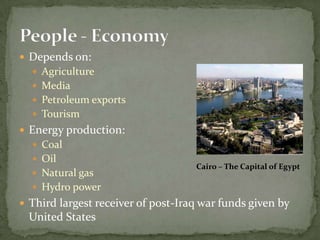
People - Economy Depends on:AgricultureMediaPetroleum exportsTourismEnergy production:CoalOilNatural gasHydro powerThird largest receiver of post-Iraq war funds given by United StatesCairo – The Capital of Egypt
Among the earliest civilizationsInfluenced European, Middle Eastern, and some African culturesOne of the first Arab-speaking nationsEgypt’s ancient culture influenced:Modern Western cultureArab culture LiteratureMusicFilmTelevisionEgyptian civilization is renowned for its architecture:The Temples of Abu SimbelValley of the KingsThe Great Sphinx of Giza…etcAncient Culture
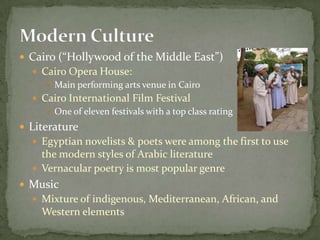
Cairo (“Hollywood of the Middle East”)Cairo Opera House:Main performing arts venue in CairoCairo International Film FestivalOne of eleven festivals with a top class ratingLiteratureEgyptian novelists & poets were among the first to use the modern styles of Arabic literatureVernacular poetry is most popular genreMusicMixture of indigenous, Mediterranean, African, and Western elementsModern Culture
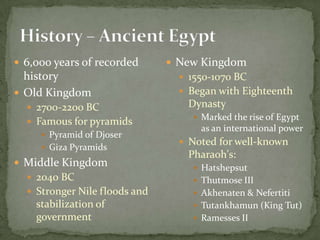
History – Ancient Egypt6,000 years of recorded historyOld Kingdom2700-2200 BCFamous for pyramidsPyramid of DjoserGiza PyramidsMiddle Kingdom2040 BCStronger Nile floods and stabilization of governmentNew Kingdom1550-1070 BCBegan with Eighteenth DynastyMarked the rise of Egypt as an international powerNoted for well-known Pharaoh's:HatshepsutThutmose IIIAkhenaten& NefertitiTutankhamun (King Tut)Ramesses II
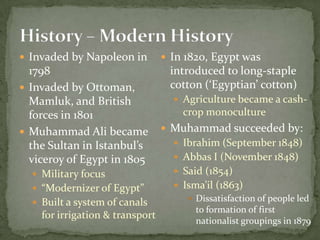
History – Modern History Invaded by Napoleon in 1798Invaded by Ottoman, Mamluk, and British forces in 1801Muhammad Ali became the Sultan in Istanbul’s viceroy of Egypt in 1805Military focus“Modernizer of Egypt”Built a system of canals for irrigation & transportIn 1820, Egypt was introduced to long-staple cotton (‘Egyptian’ cotton)Agriculture became a cash-crop monocultureMuhammad succeeded by:Ibrahim (September 1848)Abbas I (November 1848)Said (1854)Isma’il (1863)Dissatisfaction of people led to formation of first nationalist groupings in 1879
SourcesWikipedia: Egypthttp://en.wikipedia.org/wiki/EgyptWikipedia: Geography of Egypthttp://en.wikipedia.org/wiki/Egypt#GeographyWikipedia: Demographics of Egypthttp://en.wikipedia.org/wiki/Egypt#DemographicsWikipedia: Economy of Egypthttp://en.wikipedia.org/wiki/Egypt#EconomyWikipedia: Culture of Egypthttp://en.wikipedia.org/wiki/Egypt#CultureWikipedia: History of Egypthttp://en.wikipedia.org/wiki/Egypt#HistoryBook: The Second WorldKhanna, Parag. The Second World. New York: Random House Trade Paperbacks, 2008

Nations assignment egypt

  • 1.
  • 2.
    Geography – Statistics& FactsWorld’s 38th largest country 1,001,450 square ftNile Valley and Delta contain 99% of population Borders:Libya – WestSudan – SouthGaza Strip & Israel – EastThe Nile – World’s second-longest riverFlows south to north The Nile
  • 3.
    Rainfall: Averages 2– 5 mm per year (south of Cairo)Up to 410 mm per year on small strip of northern coastSnow:Sinai mountainsSome northern cities (such as Damietta, Baltim…etc)Temperature:80 °F – 90 °F in summer (up to 109 °F on Red Sea Coast) 55 °F – 70 °F in winterThe Khamaseen (wind blowing from the south) can raise the temperature in the desert to above 100 °F in the springGeography - Climate
  • 4.
    People – DemographicsMost populated country in the Middle East78,866,635 people (July 2009 est.)Religion:90% IslamThe rest are mostly Christian (Coptic Orthodox)Ethnicity:91% EgyptianMinorities include:Abazas, Turks, Greeks, Bedouin Arab tribes of Sinai Peninsula, the Siwis of the Siwa Oasis, Nubian communities that live along the Nile, and the tribal communities of Beja
  • 5.
    People - EconomyDepends on:AgricultureMediaPetroleum exportsTourismEnergy production:CoalOilNatural gasHydro powerThird largest receiver of post-Iraq war funds given by United StatesCairo – The Capital of Egypt
  • 6.
    Among the earliestcivilizationsInfluenced European, Middle Eastern, and some African culturesOne of the first Arab-speaking nationsEgypt’s ancient culture influenced:Modern Western cultureArab culture LiteratureMusicFilmTelevisionEgyptian civilization is renowned for its architecture:The Temples of Abu SimbelValley of the KingsThe Great Sphinx of Giza…etcAncient Culture
  • 7.
    Cairo (“Hollywood ofthe Middle East”)Cairo Opera House:Main performing arts venue in CairoCairo International Film FestivalOne of eleven festivals with a top class ratingLiteratureEgyptian novelists & poets were among the first to use the modern styles of Arabic literatureVernacular poetry is most popular genreMusicMixture of indigenous, Mediterranean, African, and Western elementsModern Culture
  • 8.
    History – AncientEgypt6,000 years of recorded historyOld Kingdom2700-2200 BCFamous for pyramidsPyramid of DjoserGiza PyramidsMiddle Kingdom2040 BCStronger Nile floods and stabilization of governmentNew Kingdom1550-1070 BCBegan with Eighteenth DynastyMarked the rise of Egypt as an international powerNoted for well-known Pharaoh's:HatshepsutThutmose IIIAkhenaten& NefertitiTutankhamun (King Tut)Ramesses II
  • 9.
    History – ModernHistory Invaded by Napoleon in 1798Invaded by Ottoman, Mamluk, and British forces in 1801Muhammad Ali became the Sultan in Istanbul’s viceroy of Egypt in 1805Military focus“Modernizer of Egypt”Built a system of canals for irrigation & transportIn 1820, Egypt was introduced to long-staple cotton (‘Egyptian’ cotton)Agriculture became a cash-crop monocultureMuhammad succeeded by:Ibrahim (September 1848)Abbas I (November 1848)Said (1854)Isma’il (1863)Dissatisfaction of people led to formation of first nationalist groupings in 1879
  • 10.
    SourcesWikipedia: Egypthttp://en.wikipedia.org/wiki/EgyptWikipedia: Geographyof Egypthttp://en.wikipedia.org/wiki/Egypt#GeographyWikipedia: Demographics of Egypthttp://en.wikipedia.org/wiki/Egypt#DemographicsWikipedia: Economy of Egypthttp://en.wikipedia.org/wiki/Egypt#EconomyWikipedia: Culture of Egypthttp://en.wikipedia.org/wiki/Egypt#CultureWikipedia: History of Egypthttp://en.wikipedia.org/wiki/Egypt#HistoryBook: The Second WorldKhanna, Parag. The Second World. New York: Random House Trade Paperbacks, 2008