The National Consensus Project for Quality 
Palliative Care 
Promoting Quality and Excellence: The 3rd edition 
of Clinical Practice Guidelines for Quality 
Palliative Care 
Betty Ferrell, PhD, RN, MA, FAAN, FPCN, CHPN 
Professor and Director 
Department of Nursing Research and Education 
City of Hope, CA
2
1. Create clinical guidelines that improve quality of 
palliative care in the United States. 
2. Promote quality palliative care. 
3. Foster consistent and high standards in palliative 
care. 
4. Encourage continuity of care across settings. 
The Clinical Practice Guidelines serve as manual or 
blueprint to create new programs, guide 
developing programs, and set high expectations 
for excellence for existing programs.
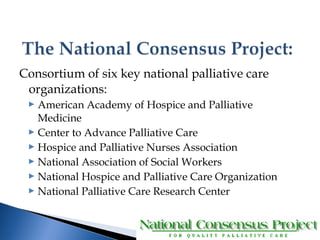
Consortium of six key national palliative care 
organizations: 
 American Academy of Hospice and Palliative 
Medicine 
 Center to Advance Palliative Care 
 Hospice and Palliative Nurses Association 
 National Association of Social Workers 
 National Hospice and Palliative Care Organization 
 National Palliative Care Research Center
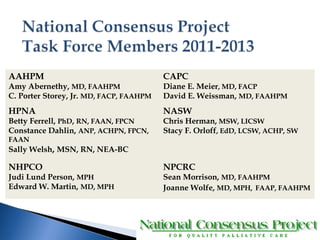
AAHPM 
Amy Abernethy, MD, FAAHPM 
C. Porter Storey, Jr. MD, FACP, FAAHPM 
CAPC 
Diane E. Meier, MD, FACP 
David E. Weissman, MD, FAAHPM 
HPNA 
Betty Ferrell, PhD, RN, FAAN, FPCN 
Constance Dahlin, ANP, ACHPN, FPCN, 
FAAN 
Sally Welsh, MSN, RN, NEA-BC 
NASW 
Chris Herman, MSW, LICSW 
Stacy F. Orloff, EdD, LCSW, ACHP, SW 
NHPCO 
Judi Lund Person, MPH 
Edward W. Martin, MD, MPH 
NPCRC 
Sean Morrison, MD, FAAHPM 
Joanne Wolfe, MD, MPH, FAAP, FAAHPM
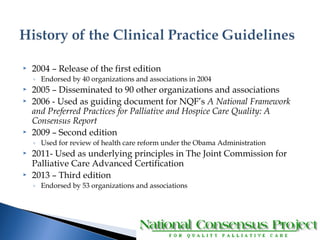
 2004 – Release of the first edition 
◦ Endorsed by 40 organizations and associations in 2004 
 2005 – Disseminated to 90 other organizations and associations 
 2006 - Used as guiding document for NQF’s A National Framework 
and Preferred Practices for Palliative and Hospice Care Quality: A 
Consensus Report 
 2009 – Second edition 
◦ Used for review of health care reform under the Obama Administration 
 2011- Used as underlying principles in The Joint Commission for 
Palliative Care Advanced Certification 
 2013 – Third edition 
◦ Endorsed by 53 organizations and associations
 Palliative care is patient and family centered care. 
 There is comprehensive palliative care with continuity across 
health settings. 
 Early introduction of palliative care should begin at diagnosis of a 
serious or life threatening illness. 
 Palliative care is interdisciplinary and collaborative. 
 Palliative care team members have clinical and communication 
expertise. 
 The goal of palliative care is the relief of physical, psychological, 
emotional, and spiritual suffering of patients and families. 
 Palliative care should focus on quality care. 
 There should be equitable access to palliative care services.
Palliative Care means patient and family-centered 
care that optimizes quality of life by anticipating, 
preventing, and treating suffering. Palliative care 
throughout the continuum of illness involves 
addressing physical, intellectual, emotional, social 
and spiritual needs and to facilitate patient 
autonomy, access to information and choice. 
National Quality Forum 2006 
Federal Register 2008
 Care is provided and services are coordinated by an 
interdisciplinary team. 
 Patients, families, palliative and non-palliative health 
care providers collaborate and communicate about 
care needs. 
 Services are available concurrently with or 
independent of curative or life-prolonging care. 
 Patient and family hopes for peace and dignity are 
supported throughout the course of illness, during 
the dying process, and after death.
Palliative care is operationalized through effective 
management of pain and other distressing symptoms, 
while incorporating psychosocial and spiritual care with 
consideration of patient/family needs, preferences, values, 
beliefs, and culture. Evaluation and treatment should be 
comprehensive and patient-centered with a focus on the 
central role of the family unit in decision making. 
NCP 2004
Palliative care affirms life by supporting the patient and 
family’s goals for the future, including their hopes for 
cure or life-prolongation, as well as their hopes for 
peace and dignity throughout the course of illness, the 
dying process, and death. 
NCP 2004
 Necessitated by maturation of the field: 
◦ Increased numbers of hospice and palliative care 
programs since 2009 
◦ Increased palliative care representation across the health 
care system 
◦ Developments in the palliative care evidence base over 
the last five years 
 Morrison RS, Dietrich J, Ladwig S, et al. Palliative care consultation teams 
cut hospital costs for Medicaid beneficiaries. Health Affairs. 2011;30(3):454- 
463. 
 Taylor D. Effect of hospice on Medicare and informal care costs: The United 
States experience. Journal of Pain & Symptom Management. 2009;38:110-114.
 Essential to reflect seminal events since 2009 
◦ Health Care Reform (Patient Protection and Affordable 
Care Act of 2010) which has critical elements of palliative 
care 
◦ Advanced Palliative Care Certification by The Joint 
Commission initiated in 2011 
◦ New Quality Measures designed in 2010, 2011, and 2012
 Indicate the significant research in the field 
◦ Early intervention palliative care in the Bakitas Study of 
2009 and the Temel Study of 2010 
◦ Work with special populations and non-cancer diagnoses
 A broader and more inclusive document, 
applicable to all health settings.
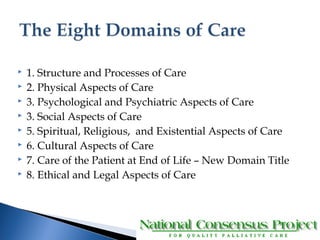
 1. Structure and Processes of Care 
 2. Physical Aspects of Care 
 3. Psychological and Psychiatric Aspects of Care 
 3. Social Aspects of Care 
 5. Spiritual, Religious, and Existential Aspects of Care 
 6. Cultural Aspects of Care 
 7. Care of the Patient at End of Life – New Domain Title 
 8. Ethical and Legal Aspects of Care
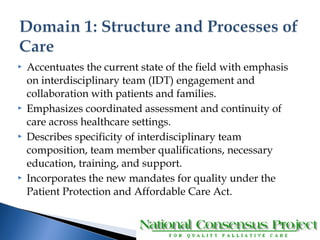
 Accentuates the current state of the field with emphasis 
on interdisciplinary team (IDT) engagement and 
collaboration with patients and families. 
 Emphasizes coordinated assessment and continuity of 
care across healthcare settings. 
 Describes specificity of interdisciplinary team 
composition, team member qualifications, necessary 
education, training, and support. 
 Incorporates the new mandates for quality under the 
Patient Protection and Affordable Care Act.
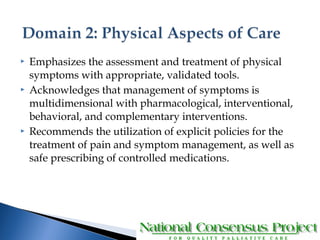
 Emphasizes the assessment and treatment of physical 
symptoms with appropriate, validated tools. 
 Acknowledges that management of symptoms is 
multidimensional with pharmacological, interventional, 
behavioral, and complementary interventions. 
 Recommends the utilization of explicit policies for the 
treatment of pain and symptom management, as well as 
safe prescribing of controlled medications.
 Significant revisions on the collaborative assessment 
process of psychological concerns and psychiatric 
diagnoses. 
 Defines essential elements include patient-family 
communication on assessment, diagnosis, and 
treatment options for common conditions in context of 
respect for goals of care of the patient and family. 
 Describes required elements of a bereavement program.
 Emphasizes interdisciplinary engagement and 
collaboration with patients and families to identify, 
support, and capitalize on patient and family strengths. 
 Defines essential elements of a palliative care social 
assessment. 
 Describes the role of the professional social worker with 
a bachelor’s or master’s degree in social work.
 Includes a definition of spirituality, stressing assessment, 
access, and staff collaboration in attending to spiritual 
concerns throughout the illness trajectory. 
 Offers requirements for staff training and education in 
provision of spiritual care. 
 Emphasizes the responsibility of the interdisciplinary team, 
inclusive of an appropriately trained chaplain, to explore, 
assess, and attend to spiritual issues of the patient and 
family. 
 Promotes spiritual and religious rituals and practices for 
comfort and relief.
 Defines culture and cultural competence for the 
interdisciplinary team, underscoring culture as a source 
of resilience and strength for the patient and family. 
 Accentuates cultural and linguistic competence including 
plain language, literacy, and linguistically appropriate 
service delivery.
 Highlights communication and documentation of signs and 
symptoms of the dying process in the circle of care: the 
patient, the family, and all other involved health providers. 
 Underscores the importance of meticulous assessment and 
management of pain and other symptoms. 
 Emphasizes the essential attention to family guidance as to 
what to expect in the dying process and the post death 
period. 
 Stresses bereavement support. 
 Underscores social, spiritual, and cultural aspects of care 
throughout the process.
 Separates into three sections: advance care planning, 
ethics, and the legal aspects of care. 
 Emphasizes the responsibility of the palliative care 
team to promote ongoing discussion about goals of care 
along with completion and documentation of advance 
care planning documents. 
 Affirms and acknowledges the frequency and 
complexity of ethical issues in palliative care. Offers 
team competencies in ethics and counsel from ethics 
committees.
 Under legal issues, acknowledgement of the complex 
legal and regulatory issues that arise in palliative care 
that require team members to understand their 
respective scope of practice within the provision of 
palliative care. 
 Emphasizes access to expert legal counsel, essential for 
navigating the intricate and sensitive legal and 
regulatory issues in palliative care.
30
 Centers for Medicare & Medicaid Services. Accountable Care 
Organizations. 2012; http://www.cms.gov/aco/01/ 
 Patient Protection and Affordable Care Act (PPACA), Public Law 
111-148, §2702, 124 Stat. 119, 318-319,Title III (B)(III) Section 3140, 
Consolidating amendments made by Title X of the Act and the 
Health Care and Education Reconciliation Act of 2010 Washington, 
DC 2010. 
 The Joint Commission. Palliative Care Certification Manual. 
Oakbrook Terrace, IL: The Joint Commission; 2012. 
31
 National Institutes of Health. Research Portfolio Online Reporting 
Tools (RePORT). 2012; http://projectreporter.nih.gov/reporter.cfm 
 National Quality Forum. Palliative Care and End-of-Life Care-A 
Consensus Report. Washington, DC: NQF 2012. 
http://www.qualityforum.org/Publications/2012/04/Palliative_Care 
_and_End-of-Life_Care%2%80%94A_Consensus_Report.aspx 
 National Quality Forum. Measure Applications Partnership - Performance 
Measurement Coordination Strategies for Hospice and Palliative Care Final 
Report. Washington, DC: National Quality Forum; 2012. 
32
HHooww ccaann tthhee NNaattiioonnaall 
CCoonnsseennssuuss PPrroojjeecctt CClliinniiccaall 
PPrraaccttiiccee GGuuiiddeelliinneess bbee 
uuttiilliizzeedd??
 National Consensus Project for Quality Palliative 
Care Clinical Practice Guidelines are part of the 
application. 
 Programs must discuss how they meet the Clinical 
Practice Guidelines, and in particular the domain 
which is the most challenging. 
 This is reviewed in the application.
 National Consensus Project for Quality 
Palliative Care Clinical Practice Guidelines are 
part of the framework, education, and 
benchmarking when the PCLCs train 
palliative programs seeking guidance.
 Distributes the Clinical Practice Guidelines to 
participants and uses them to reference the 
curriculum.
WWhhyy AAddoopptt tthhee 
NNaattiioonnaall CCoonnsseennssuuss PPrroojjeecctt 
CClliinniiccaall PPrraaccttiiccee GGuuiiddeelliinneess??
 Palliative care plays a crucial role in healthcare 
value. It reduces the need for high intensity, high 
cost services, such as hospital and home care stays. 
 Palliative care has repeatedly been demonstrated to 
improve quality of care. Specifically, it improves 
quality of life for the person and their family in terms 
of symptom burden, family well being and practical 
supports, communication about what to expect in the 
future and treatment options concordant with 
person and family-determined goals for care.
 The Clinical Practice Guidelines serve as a manual or 
blueprint to create new and guide developing 
programs that can achieve important health 
system objectives.
 Endorsed by 53 professional associations and 
organizations. 
 Supported by 4 professional associations and 
organizations. 
 Endorsements represent the diverse health 
disciplines.
 Represents varied disciplines 
◦ Chaplaincy 
◦ Nursing 
◦ Medicine 
◦ Social Work 
 Reflects varied constituents 
◦ Cancer community 
◦ Education community 
◦ Ethics community 
◦ Insurers 
◦ Research
WWhhoo SShhoouulldd AAddoopptt tthhee 
NNaattiioonnaall CCoonnsseennssuuss PPrroojjeecctt 
CClliinniiccaall PPrraaccttiiccee GGuuiiddeelliinneess??
 Acute Care Programs 
 Ambulatory Care Programs 
 Rehabilitation Facility Programs 
 Long Term Care Facility Programs 
 Community Programs 
 Home Care Programs 
 Hospice Programs 
 Health Care Systems planning Accountable Care 
Organizations and Patient Medical Homes
 Guides program development in all the domains. 
 Validates necessary program elements to administration. 
 Ensures quality clinical outcomes in terms management 
of physical, psychological and psychiatric pain and 
symptoms. 
 Facilitates achievement of The Joint Commission (JCO) 
quality and pain management standards and ANCC 
(American Nurses Credentialing Center) Magnet status. 
44
 Ensures highest standards of care as they reflect the 
maturation of the field, changes in practice, and 
developments in the palliative care evidence base. 
 Reflects new perspectives on the role of palliative 
care in quality as mandated by health care reform. 
 Promotes newest evidence base in outcomes 
research.
 Fosters improved patient outcomes in compliance with 
state and federal regulations. 
 Facilitates partnerships for caring for patients with 
debilitating and life limiting illnesses. 
 Promotes improved patient and family satisfaction in 
pain and symptom control. 
 Cultivates staff support in delivering care for long term 
patients. 
 Encourages improved staff education. 
46
 Promotes quality metrics to the hospice program which 
are now an essential aspect of reporting as mandated 
by the Patient Protection and Affordable Care Act. 
 Adds additional aspects of care beyond hospice 
standards of participation. 
 Promotes the field to move upstream. 
47
 Facilitates quality care for patients with serious and life 
limiting illnesses. 
 Promotes patient and family satisfaction in pain and 
symptom control. 
48
For more information and 
Free download of the Clinical Practice Guidelines 
available at: 
www.nationalconsensusproject.org

National Consensus Project Clinical Practice Guidelines Dissemination

  • 1.
    The National ConsensusProject for Quality Palliative Care Promoting Quality and Excellence: The 3rd edition of Clinical Practice Guidelines for Quality Palliative Care Betty Ferrell, PhD, RN, MA, FAAN, FPCN, CHPN Professor and Director Department of Nursing Research and Education City of Hope, CA
  • 2.
  • 4.
    1. Create clinicalguidelines that improve quality of palliative care in the United States. 2. Promote quality palliative care. 3. Foster consistent and high standards in palliative care. 4. Encourage continuity of care across settings. The Clinical Practice Guidelines serve as manual or blueprint to create new programs, guide developing programs, and set high expectations for excellence for existing programs.
  • 5.
    Consortium of sixkey national palliative care organizations:  American Academy of Hospice and Palliative Medicine  Center to Advance Palliative Care  Hospice and Palliative Nurses Association  National Association of Social Workers  National Hospice and Palliative Care Organization  National Palliative Care Research Center
  • 6.
    AAHPM Amy Abernethy,MD, FAAHPM C. Porter Storey, Jr. MD, FACP, FAAHPM CAPC Diane E. Meier, MD, FACP David E. Weissman, MD, FAAHPM HPNA Betty Ferrell, PhD, RN, FAAN, FPCN Constance Dahlin, ANP, ACHPN, FPCN, FAAN Sally Welsh, MSN, RN, NEA-BC NASW Chris Herman, MSW, LICSW Stacy F. Orloff, EdD, LCSW, ACHP, SW NHPCO Judi Lund Person, MPH Edward W. Martin, MD, MPH NPCRC Sean Morrison, MD, FAAHPM Joanne Wolfe, MD, MPH, FAAP, FAAHPM
  • 8.
     2004 –Release of the first edition ◦ Endorsed by 40 organizations and associations in 2004  2005 – Disseminated to 90 other organizations and associations  2006 - Used as guiding document for NQF’s A National Framework and Preferred Practices for Palliative and Hospice Care Quality: A Consensus Report  2009 – Second edition ◦ Used for review of health care reform under the Obama Administration  2011- Used as underlying principles in The Joint Commission for Palliative Care Advanced Certification  2013 – Third edition ◦ Endorsed by 53 organizations and associations
  • 9.
     Palliative careis patient and family centered care.  There is comprehensive palliative care with continuity across health settings.  Early introduction of palliative care should begin at diagnosis of a serious or life threatening illness.  Palliative care is interdisciplinary and collaborative.  Palliative care team members have clinical and communication expertise.  The goal of palliative care is the relief of physical, psychological, emotional, and spiritual suffering of patients and families.  Palliative care should focus on quality care.  There should be equitable access to palliative care services.
  • 10.
    Palliative Care meanspatient and family-centered care that optimizes quality of life by anticipating, preventing, and treating suffering. Palliative care throughout the continuum of illness involves addressing physical, intellectual, emotional, social and spiritual needs and to facilitate patient autonomy, access to information and choice. National Quality Forum 2006 Federal Register 2008

  • 11.
     Care isprovided and services are coordinated by an interdisciplinary team.  Patients, families, palliative and non-palliative health care providers collaborate and communicate about care needs.  Services are available concurrently with or independent of curative or life-prolonging care.  Patient and family hopes for peace and dignity are supported throughout the course of illness, during the dying process, and after death.
  • 12.
    Palliative care isoperationalized through effective management of pain and other distressing symptoms, while incorporating psychosocial and spiritual care with consideration of patient/family needs, preferences, values, beliefs, and culture. Evaluation and treatment should be comprehensive and patient-centered with a focus on the central role of the family unit in decision making. NCP 2004
  • 13.
    Palliative care affirmslife by supporting the patient and family’s goals for the future, including their hopes for cure or life-prolongation, as well as their hopes for peace and dignity throughout the course of illness, the dying process, and death. NCP 2004
  • 15.
     Necessitated bymaturation of the field: ◦ Increased numbers of hospice and palliative care programs since 2009 ◦ Increased palliative care representation across the health care system ◦ Developments in the palliative care evidence base over the last five years  Morrison RS, Dietrich J, Ladwig S, et al. Palliative care consultation teams cut hospital costs for Medicaid beneficiaries. Health Affairs. 2011;30(3):454- 463.  Taylor D. Effect of hospice on Medicare and informal care costs: The United States experience. Journal of Pain & Symptom Management. 2009;38:110-114.
  • 16.
     Essential toreflect seminal events since 2009 ◦ Health Care Reform (Patient Protection and Affordable Care Act of 2010) which has critical elements of palliative care ◦ Advanced Palliative Care Certification by The Joint Commission initiated in 2011 ◦ New Quality Measures designed in 2010, 2011, and 2012
  • 17.
     Indicate thesignificant research in the field ◦ Early intervention palliative care in the Bakitas Study of 2009 and the Temel Study of 2010 ◦ Work with special populations and non-cancer diagnoses
  • 18.
     A broaderand more inclusive document, applicable to all health settings.
  • 20.
     1. Structureand Processes of Care  2. Physical Aspects of Care  3. Psychological and Psychiatric Aspects of Care  3. Social Aspects of Care  5. Spiritual, Religious, and Existential Aspects of Care  6. Cultural Aspects of Care  7. Care of the Patient at End of Life – New Domain Title  8. Ethical and Legal Aspects of Care
  • 21.
     Accentuates thecurrent state of the field with emphasis on interdisciplinary team (IDT) engagement and collaboration with patients and families.  Emphasizes coordinated assessment and continuity of care across healthcare settings.  Describes specificity of interdisciplinary team composition, team member qualifications, necessary education, training, and support.  Incorporates the new mandates for quality under the Patient Protection and Affordable Care Act.
  • 22.
     Emphasizes theassessment and treatment of physical symptoms with appropriate, validated tools.  Acknowledges that management of symptoms is multidimensional with pharmacological, interventional, behavioral, and complementary interventions.  Recommends the utilization of explicit policies for the treatment of pain and symptom management, as well as safe prescribing of controlled medications.
  • 23.
     Significant revisionson the collaborative assessment process of psychological concerns and psychiatric diagnoses.  Defines essential elements include patient-family communication on assessment, diagnosis, and treatment options for common conditions in context of respect for goals of care of the patient and family.  Describes required elements of a bereavement program.
  • 24.
     Emphasizes interdisciplinaryengagement and collaboration with patients and families to identify, support, and capitalize on patient and family strengths.  Defines essential elements of a palliative care social assessment.  Describes the role of the professional social worker with a bachelor’s or master’s degree in social work.
  • 25.
     Includes adefinition of spirituality, stressing assessment, access, and staff collaboration in attending to spiritual concerns throughout the illness trajectory.  Offers requirements for staff training and education in provision of spiritual care.  Emphasizes the responsibility of the interdisciplinary team, inclusive of an appropriately trained chaplain, to explore, assess, and attend to spiritual issues of the patient and family.  Promotes spiritual and religious rituals and practices for comfort and relief.
  • 26.
     Defines cultureand cultural competence for the interdisciplinary team, underscoring culture as a source of resilience and strength for the patient and family.  Accentuates cultural and linguistic competence including plain language, literacy, and linguistically appropriate service delivery.
  • 27.
     Highlights communicationand documentation of signs and symptoms of the dying process in the circle of care: the patient, the family, and all other involved health providers.  Underscores the importance of meticulous assessment and management of pain and other symptoms.  Emphasizes the essential attention to family guidance as to what to expect in the dying process and the post death period.  Stresses bereavement support.  Underscores social, spiritual, and cultural aspects of care throughout the process.
  • 28.
     Separates intothree sections: advance care planning, ethics, and the legal aspects of care.  Emphasizes the responsibility of the palliative care team to promote ongoing discussion about goals of care along with completion and documentation of advance care planning documents.  Affirms and acknowledges the frequency and complexity of ethical issues in palliative care. Offers team competencies in ethics and counsel from ethics committees.
  • 29.
     Under legalissues, acknowledgement of the complex legal and regulatory issues that arise in palliative care that require team members to understand their respective scope of practice within the provision of palliative care.  Emphasizes access to expert legal counsel, essential for navigating the intricate and sensitive legal and regulatory issues in palliative care.
  • 30.
  • 31.
     Centers forMedicare & Medicaid Services. Accountable Care Organizations. 2012; http://www.cms.gov/aco/01/  Patient Protection and Affordable Care Act (PPACA), Public Law 111-148, §2702, 124 Stat. 119, 318-319,Title III (B)(III) Section 3140, Consolidating amendments made by Title X of the Act and the Health Care and Education Reconciliation Act of 2010 Washington, DC 2010.  The Joint Commission. Palliative Care Certification Manual. Oakbrook Terrace, IL: The Joint Commission; 2012. 31
  • 32.
     National Institutesof Health. Research Portfolio Online Reporting Tools (RePORT). 2012; http://projectreporter.nih.gov/reporter.cfm  National Quality Forum. Palliative Care and End-of-Life Care-A Consensus Report. Washington, DC: NQF 2012. http://www.qualityforum.org/Publications/2012/04/Palliative_Care _and_End-of-Life_Care%2%80%94A_Consensus_Report.aspx  National Quality Forum. Measure Applications Partnership - Performance Measurement Coordination Strategies for Hospice and Palliative Care Final Report. Washington, DC: National Quality Forum; 2012. 32
  • 33.
    HHooww ccaann tthheeNNaattiioonnaall CCoonnsseennssuuss PPrroojjeecctt CClliinniiccaall PPrraaccttiiccee GGuuiiddeelliinneess bbee uuttiilliizzeedd??
  • 34.
     National ConsensusProject for Quality Palliative Care Clinical Practice Guidelines are part of the application.  Programs must discuss how they meet the Clinical Practice Guidelines, and in particular the domain which is the most challenging.  This is reviewed in the application.
  • 35.
     National ConsensusProject for Quality Palliative Care Clinical Practice Guidelines are part of the framework, education, and benchmarking when the PCLCs train palliative programs seeking guidance.
  • 36.
     Distributes theClinical Practice Guidelines to participants and uses them to reference the curriculum.
  • 37.
    WWhhyy AAddoopptt tthhee NNaattiioonnaall CCoonnsseennssuuss PPrroojjeecctt CClliinniiccaall PPrraaccttiiccee GGuuiiddeelliinneess??
  • 38.
     Palliative careplays a crucial role in healthcare value. It reduces the need for high intensity, high cost services, such as hospital and home care stays.  Palliative care has repeatedly been demonstrated to improve quality of care. Specifically, it improves quality of life for the person and their family in terms of symptom burden, family well being and practical supports, communication about what to expect in the future and treatment options concordant with person and family-determined goals for care.
  • 39.
     The ClinicalPractice Guidelines serve as a manual or blueprint to create new and guide developing programs that can achieve important health system objectives.
  • 40.
     Endorsed by53 professional associations and organizations.  Supported by 4 professional associations and organizations.  Endorsements represent the diverse health disciplines.
  • 41.
     Represents varieddisciplines ◦ Chaplaincy ◦ Nursing ◦ Medicine ◦ Social Work  Reflects varied constituents ◦ Cancer community ◦ Education community ◦ Ethics community ◦ Insurers ◦ Research
  • 42.
    WWhhoo SShhoouulldd AAddoopptttthhee NNaattiioonnaall CCoonnsseennssuuss PPrroojjeecctt CClliinniiccaall PPrraaccttiiccee GGuuiiddeelliinneess??
  • 43.
     Acute CarePrograms  Ambulatory Care Programs  Rehabilitation Facility Programs  Long Term Care Facility Programs  Community Programs  Home Care Programs  Hospice Programs  Health Care Systems planning Accountable Care Organizations and Patient Medical Homes
  • 44.
     Guides programdevelopment in all the domains.  Validates necessary program elements to administration.  Ensures quality clinical outcomes in terms management of physical, psychological and psychiatric pain and symptoms.  Facilitates achievement of The Joint Commission (JCO) quality and pain management standards and ANCC (American Nurses Credentialing Center) Magnet status. 44
  • 45.
     Ensures higheststandards of care as they reflect the maturation of the field, changes in practice, and developments in the palliative care evidence base.  Reflects new perspectives on the role of palliative care in quality as mandated by health care reform.  Promotes newest evidence base in outcomes research.
  • 46.
     Fosters improvedpatient outcomes in compliance with state and federal regulations.  Facilitates partnerships for caring for patients with debilitating and life limiting illnesses.  Promotes improved patient and family satisfaction in pain and symptom control.  Cultivates staff support in delivering care for long term patients.  Encourages improved staff education. 46
  • 47.
     Promotes qualitymetrics to the hospice program which are now an essential aspect of reporting as mandated by the Patient Protection and Affordable Care Act.  Adds additional aspects of care beyond hospice standards of participation.  Promotes the field to move upstream. 47
  • 48.
     Facilitates qualitycare for patients with serious and life limiting illnesses.  Promotes patient and family satisfaction in pain and symptom control. 48
  • 49.
    For more informationand Free download of the Clinical Practice Guidelines available at: www.nationalconsensusproject.org