F E B R U A R Y 2 0 1 5 • ` 1 5 0 • V O L . 3 I S S U E 8
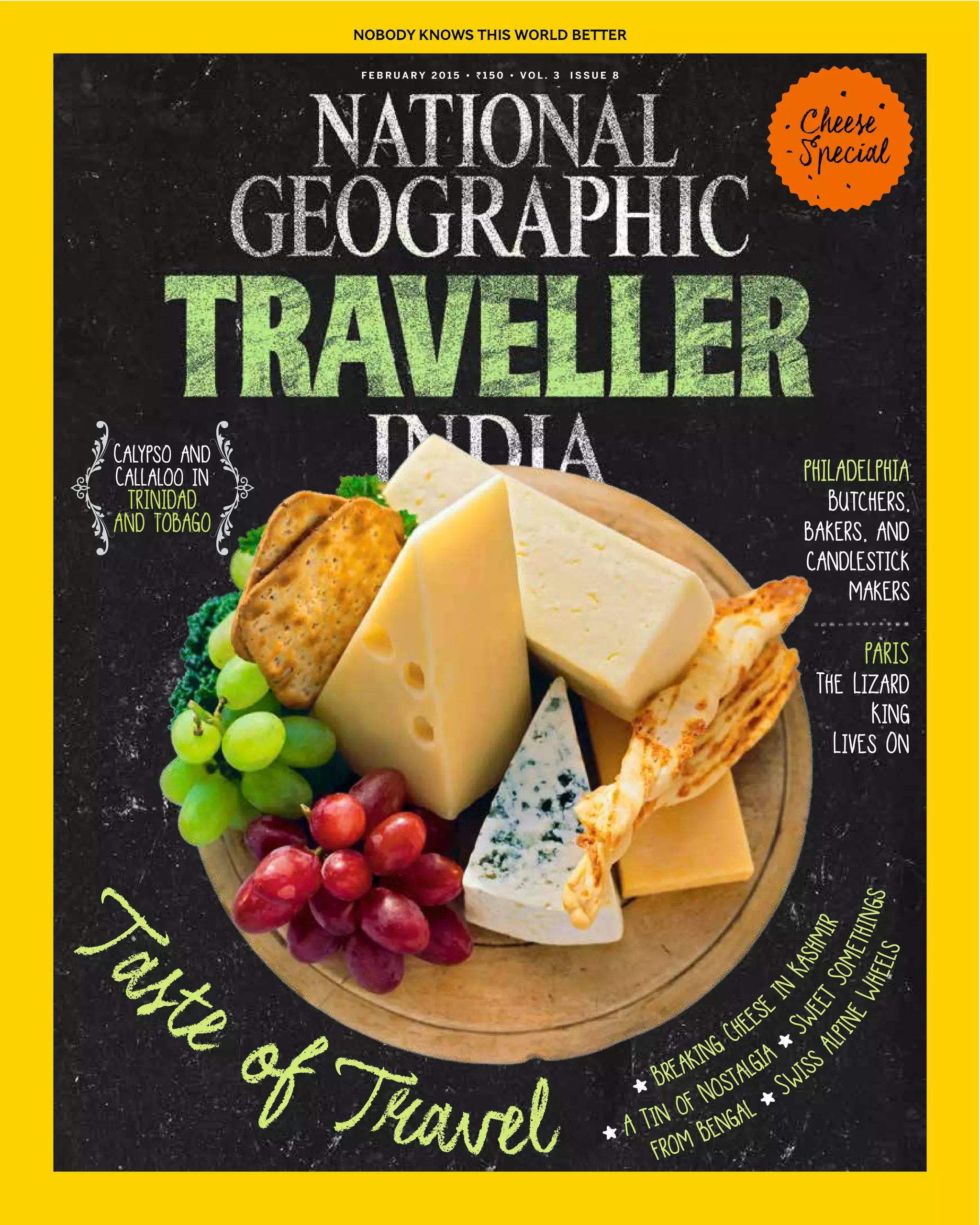
PHILADELPHIA
Butchers,
bakers, and
candlestick
makers
PARIS
The Lizard
King
Lives On
Breaking Cheese
in
Kashmir
from Bengal
Swiss
AlpineWheels
A Tin of Nostalgia
SweetSomethings
Calypso and
Callaloo in
TRINIDAD
AND TOBAGO
BIJU SUKUMARAN
Voices | SLOW TRAVEL
28 NATIONAL GEOGRAPHIC TRAVELLER INDIA | FEBRUARY 2015
Biju Sukumaran is
a travel writer
currently based in
Barcelona, Spain.
LUCASVALLECILLOS/AGEFOTOSTOCK/DINODIA
I
n my first year of living in China, with non-
existent language skills, only a few select res-
taurants were approachable to me. If an eatery
had pictures on the menu, I was sold. But the
most interesting places to my mind were the ones
where Chinese characters marched down pages
in indecipherable lines, where the same old-
timers sat at the same table year after year. Places
like hotpot restaurants, where you get all the
adventurous bits—brains, testicles, intestines and
then some. When I finally mustered the courage
to dine at these establishments, I would sit
fumbling with the all-Chinese menu. I was often
saved by other bilingual customers, who helped
me order. With time, I learnt to eat at places that
were previously inaccessible to outsiders like me
who didn’t know the language.
I evolved slowly. I’d walk into restaurants
and glance at other patrons’ tables. I’d order by
gesturing to another customer’s dish: “That one,”
I’d say in childish Chinese. And if I was feeling
particularly adventurous I’d slam my finger with
false bravado on a random item, whose descrip-
tion I couldn’t read, and hope for the best.
Luckily a number of organisations and compa-
nies are now bridging this gap between truly local
food experiences and the surface-level dining
available to tourists. My breakthrough came from
Couchsurfing. Though it started as a free alterna-
tive to hostels, the online community has become
much more, with hosts forming groups that make
insider information available to travellers. We, a
group of Couchsurfing friends, formed a foodie
group to explore the city of Xiamen through food.
Half of our crew consisted of native speakers and
our first visit was an eye-opening trip to a back-
street crab shop mentioned on a city food blog—a
place I couldn’t possibly have found by myself,
much less ordered at.
In other countries I’ve also discovered the
option of specialised tours. In Bogotá, Colombia,
for instance, Mike’s Bogotá Bike Tours gave me
a chance to cycle through the city and visit local
markets, where Mike explained the startling ar-
ray of exotic fruits native to the country—fruits
I never knew existed. In Thailand, a Chiang Mai
cooking school had me attempting pad thai and
curry after a tour of the local market. And in
Buenos Aires where underground dining is all
the rage, a few supper clubs, like the Argentine
Experience, are opening up to the public. Part
cooking class, part exploratorium, it gave me a
fun, hands-on way to learn about wine, cocktails,
and local culinary customs.
And though I like the explanations locals offer,
I also think there is great charm—and excite-
ment, nervousness, and luck—in stumbling
around on your own to discover foods while
travelling. You never quite know what you’ll get.
In 2012, while living in China, I was lucky to
be invited to a friend’s hometown in Longyan,
Fujian Province for Chinese New Year. The fire-
works in that town were so riotous, I could hardly
hear or see through the smoke while walking in
the streets. I was excited because I was going to
witness my friend’s dad making Chinese egg-
plant—and eggplant in China is a glorious thing.
I had sampled it everywhere in Xiamen, and
it was always on my must-eat-dishes list in
any new restaurant I visited. Now I was going
to learn how to make it.
The demo, however, was too fast for me, and
it was impossible to figure out which of the
similar mounds of white powder—salt, sugar,
or MSG—was being used at each point. The
dish itself was delicious; there is something
ineffably enriching about eating with locals in
their own home.
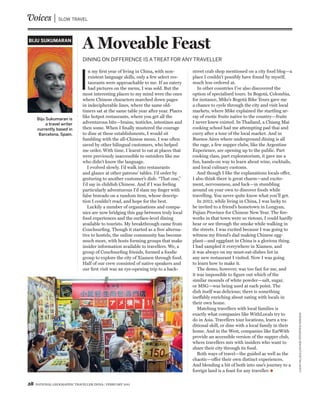
Matching travellers with local families is
exactly what companies like WithLocals try to
do in Asia. Travellers tour locations, learn a tra-
ditional skill, or dine with a local family in their
home. And in the West, companies like EatWith
provide an accessible version of the supper club,
where travellers mix with insiders who want to
share their city through its food.
Both ways of travel—the guided as well as the
chaotic—offer their own distinct experiences.
And blending a bit of both into one’s journey to a
foreign land is a feast for any traveller.
DINING ON DIFFERENCE IS A TREAT FOR ANY TRAVELLER
A Moveable Feast

NatGeoTravInFeast

  • 1.
    F E BR U A R Y 2 0 1 5 • ` 1 5 0 • V O L . 3 I S S U E 8 PHILADELPHIA Butchers, bakers, and candlestick makers PARIS The Lizard King Lives On Breaking Cheese in Kashmir from Bengal Swiss AlpineWheels A Tin of Nostalgia SweetSomethings Calypso and Callaloo in TRINIDAD AND TOBAGO
  • 2.
    BIJU SUKUMARAN Voices |SLOW TRAVEL 28 NATIONAL GEOGRAPHIC TRAVELLER INDIA | FEBRUARY 2015 Biju Sukumaran is a travel writer currently based in Barcelona, Spain. LUCASVALLECILLOS/AGEFOTOSTOCK/DINODIA I n my first year of living in China, with non- existent language skills, only a few select res- taurants were approachable to me. If an eatery had pictures on the menu, I was sold. But the most interesting places to my mind were the ones where Chinese characters marched down pages in indecipherable lines, where the same old- timers sat at the same table year after year. Places like hotpot restaurants, where you get all the adventurous bits—brains, testicles, intestines and then some. When I finally mustered the courage to dine at these establishments, I would sit fumbling with the all-Chinese menu. I was often saved by other bilingual customers, who helped me order. With time, I learnt to eat at places that were previously inaccessible to outsiders like me who didn’t know the language. I evolved slowly. I’d walk into restaurants and glance at other patrons’ tables. I’d order by gesturing to another customer’s dish: “That one,” I’d say in childish Chinese. And if I was feeling particularly adventurous I’d slam my finger with false bravado on a random item, whose descrip- tion I couldn’t read, and hope for the best. Luckily a number of organisations and compa- nies are now bridging this gap between truly local food experiences and the surface-level dining available to tourists. My breakthrough came from Couchsurfing. Though it started as a free alterna- tive to hostels, the online community has become much more, with hosts forming groups that make insider information available to travellers. We, a group of Couchsurfing friends, formed a foodie group to explore the city of Xiamen through food. Half of our crew consisted of native speakers and our first visit was an eye-opening trip to a back- street crab shop mentioned on a city food blog—a place I couldn’t possibly have found by myself, much less ordered at. In other countries I’ve also discovered the option of specialised tours. In Bogotá, Colombia, for instance, Mike’s Bogotá Bike Tours gave me a chance to cycle through the city and visit local markets, where Mike explained the startling ar- ray of exotic fruits native to the country—fruits I never knew existed. In Thailand, a Chiang Mai cooking school had me attempting pad thai and curry after a tour of the local market. And in Buenos Aires where underground dining is all the rage, a few supper clubs, like the Argentine Experience, are opening up to the public. Part cooking class, part exploratorium, it gave me a fun, hands-on way to learn about wine, cocktails, and local culinary customs. And though I like the explanations locals offer, I also think there is great charm—and excite- ment, nervousness, and luck—in stumbling around on your own to discover foods while travelling. You never quite know what you’ll get. In 2012, while living in China, I was lucky to be invited to a friend’s hometown in Longyan, Fujian Province for Chinese New Year. The fire- works in that town were so riotous, I could hardly hear or see through the smoke while walking in the streets. I was excited because I was going to witness my friend’s dad making Chinese egg- plant—and eggplant in China is a glorious thing. I had sampled it everywhere in Xiamen, and it was always on my must-eat-dishes list in any new restaurant I visited. Now I was going to learn how to make it. The demo, however, was too fast for me, and it was impossible to figure out which of the similar mounds of white powder—salt, sugar, or MSG—was being used at each point. The dish itself was delicious; there is something ineffably enriching about eating with locals in their own home. Matching travellers with local families is exactly what companies like WithLocals try to do in Asia. Travellers tour locations, learn a tra- ditional skill, or dine with a local family in their home. And in the West, companies like EatWith provide an accessible version of the supper club, where travellers mix with insiders who want to share their city through its food. Both ways of travel—the guided as well as the chaotic—offer their own distinct experiences. And blending a bit of both into one’s journey to a foreign land is a feast for any traveller. DINING ON DIFFERENCE IS A TREAT FOR ANY TRAVELLER A Moveable Feast