How to Narrow Down What to Test
                                        by
                                   Zsolt Fabok
                                   2012.09.28


                  Not sure if I have to check out this problem


                    Or just wait for the customer feedback
@ZsoltFabok                                                                 #agilecam
http://zsoltfabok.com/                           http://www.agilecambridge.net/ac2012/
“I get paid for code that works, not for tests, so my
philosophy is to test as little as possible to reach a given
level of confidence (I suspect this level of confidence is
high compared to industry standards, but that could just
be hubris). If I don’t typically make a kind of mistake (like
setting the wrong variables in a constructor), I don’t test
for it. I do tend to make sense of test errors, so I’m extra
careful when I have logic with complicated conditionals.
When coding on a team, I modify my strategy to carefully
test code that we, collectively, tend to get wrong.”

                         Kent Beck - September 10, 2010


                             http://stackoverflow.com/questions/153234/how-deep-are-your-unit-tests/153565#153565
I’d like to [re]start working on this old application
My “where to start” list
#1 Determine which parts of
  the code are really used
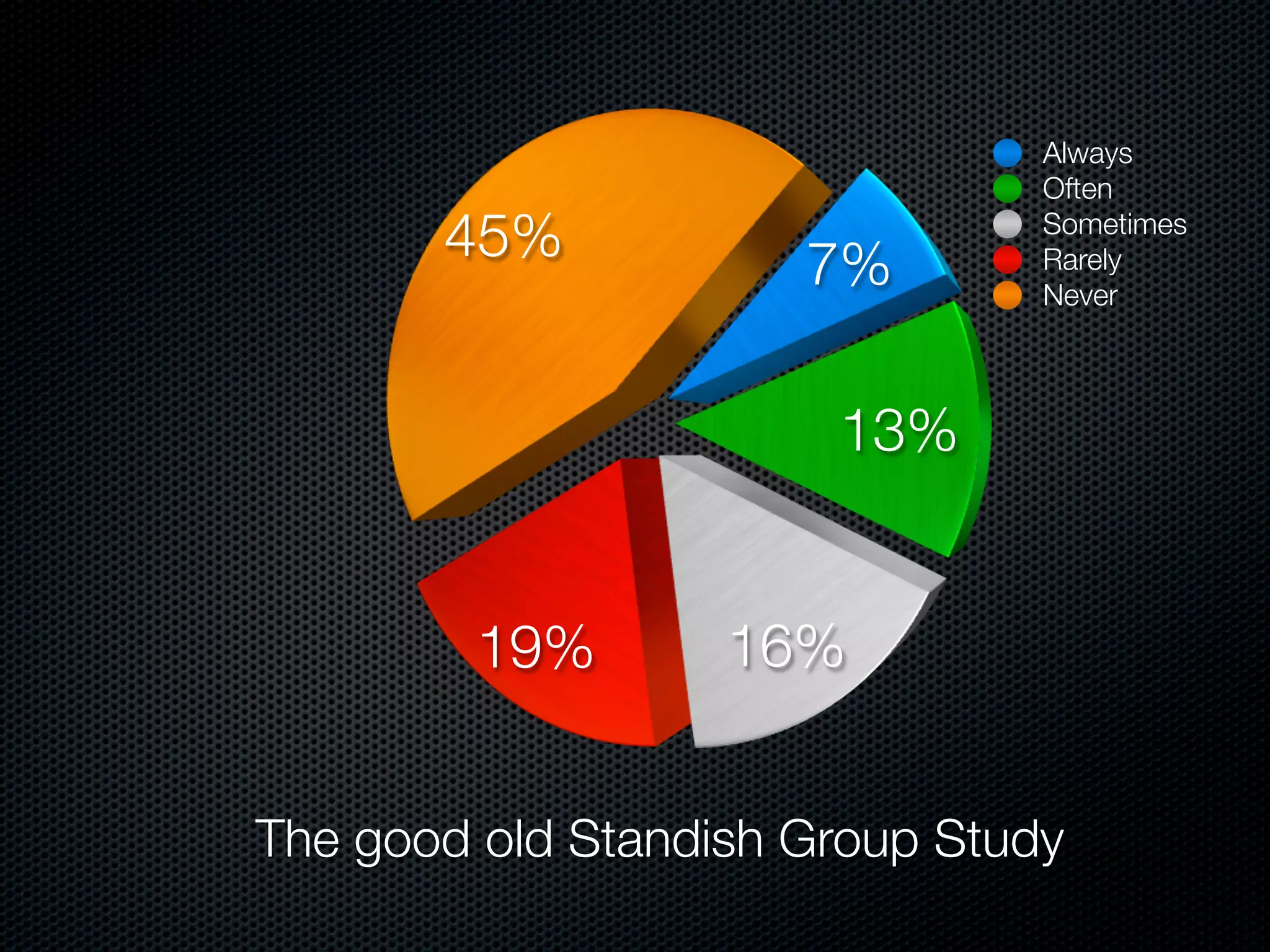
Always
                                Often
       45%            7%
                                Sometimes
                                Rarely
                                Never


                       13%


         19%       16%


The good old Standish Group Study
The goal is to find those features
which are always or often used


           By studying coverage, access logs,
        traces, web analytics, heat maps, etc.
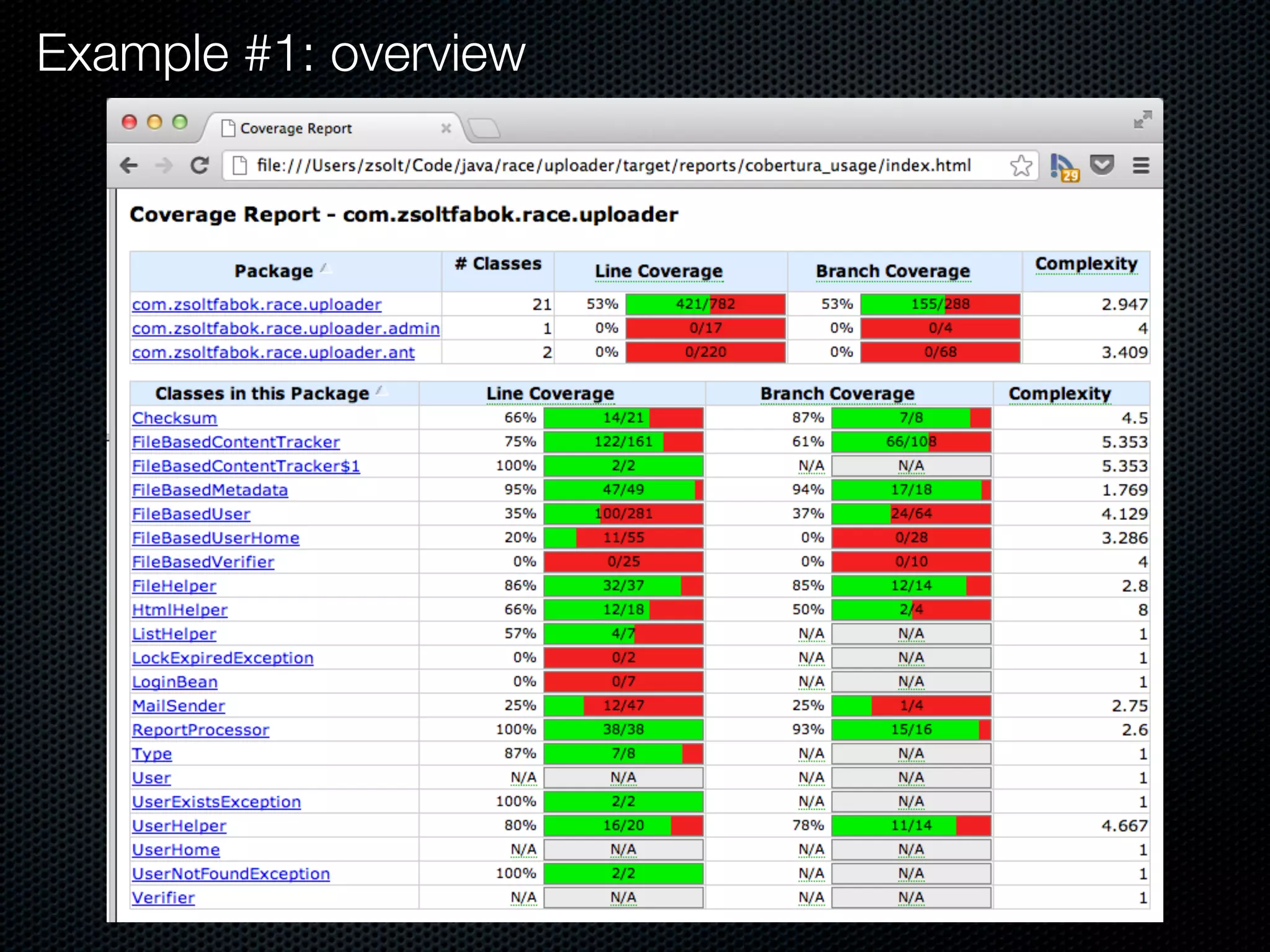
Let’s have a look at the coverage
(using instrumented class files):


% cp jetty/cobertura.ser web.ser
% cp uploader/cobertura.ser ant.ser
% ant usage_coverage

usage_coverage:
[cobertura-merge] Cobertura: Loaded information on 12 classes.
[cobertura-merge] Cobertura: Loaded information on 11 classes.
[cobertura-merge] Cobertura: Saved information on 16 classes.
[cobertura-report] Cobertura: Loaded information on 16 classes.
[cobertura-report] Report time: 600ms

BUILD SUCCESSFUL
Total time: 2 seconds
Example #1: overview
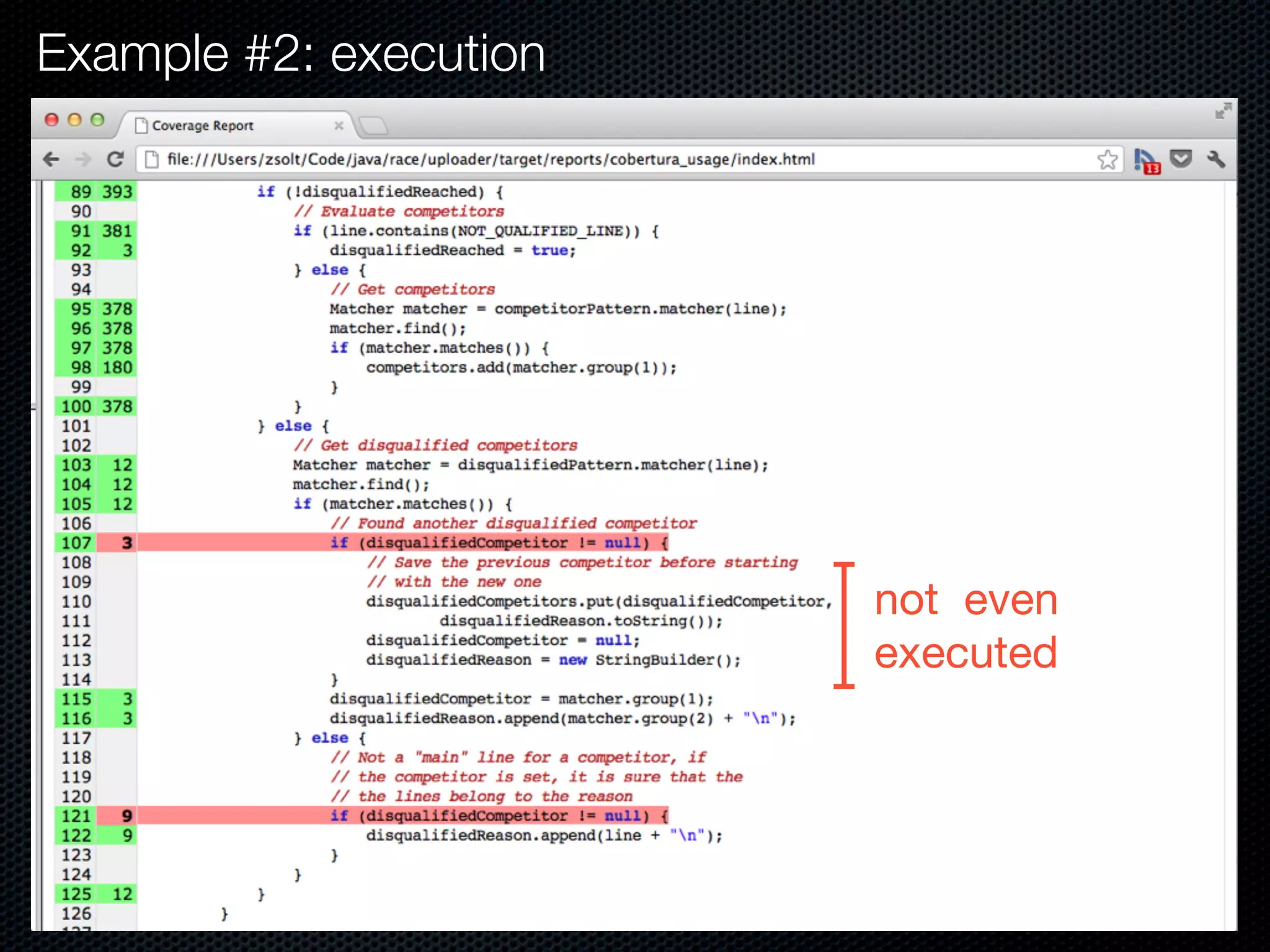
Example #2: execution


                        not even
                        executed
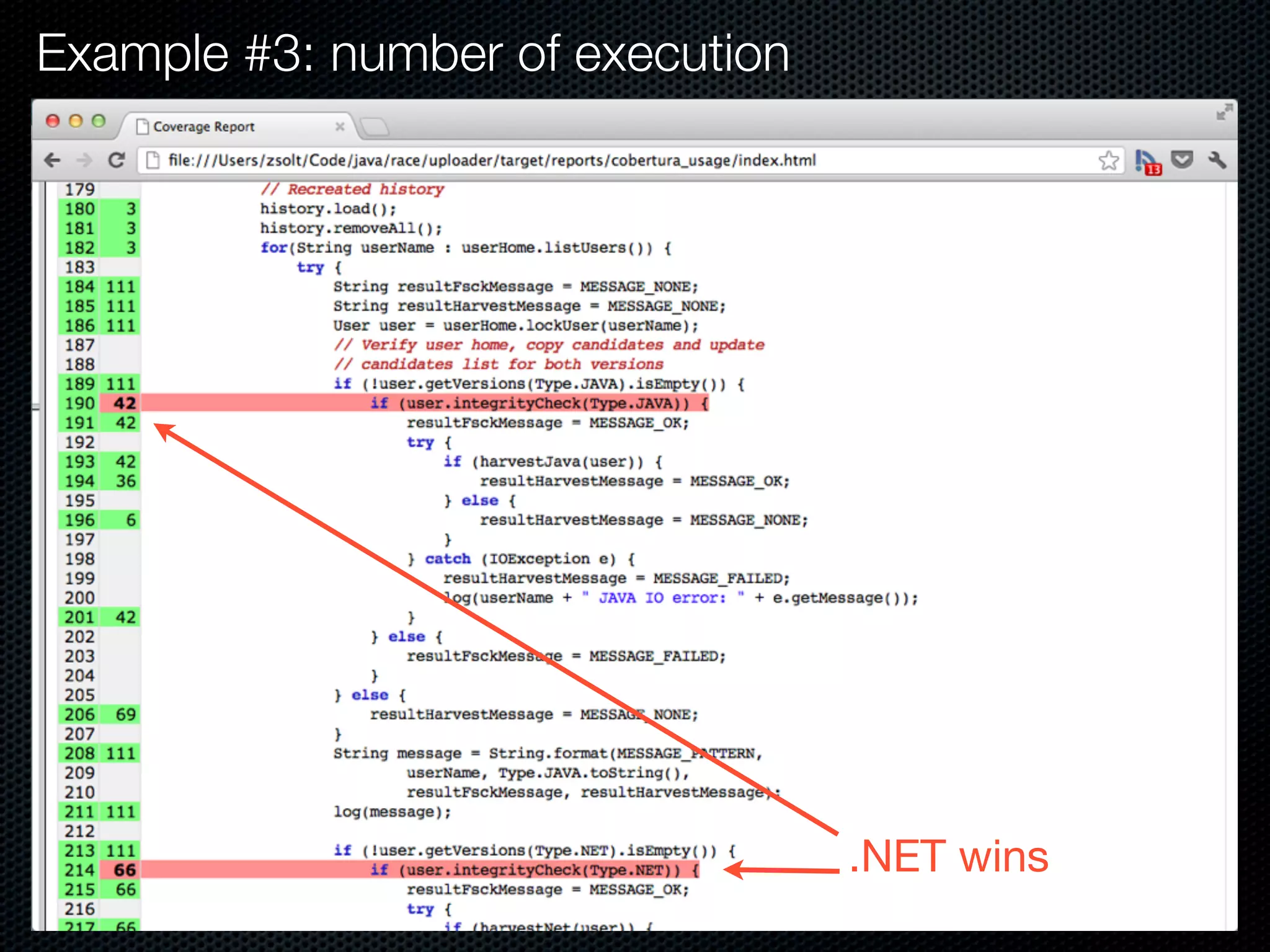
Example #3: number of execution


                                  .NET wins
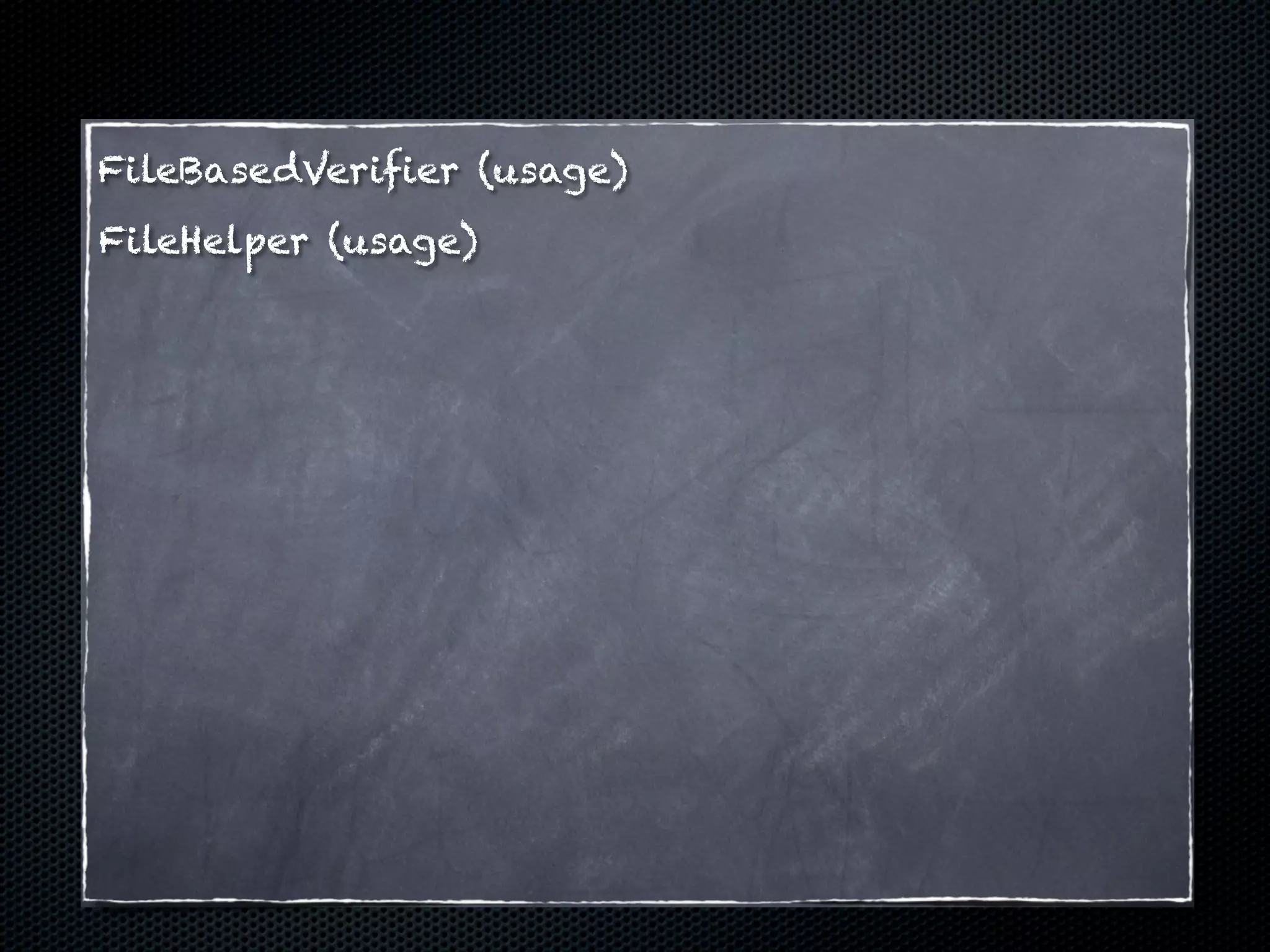
FileBasedVerifier (usage)
FileHelper (usage)
#2 Find out which parts of
 the code change often
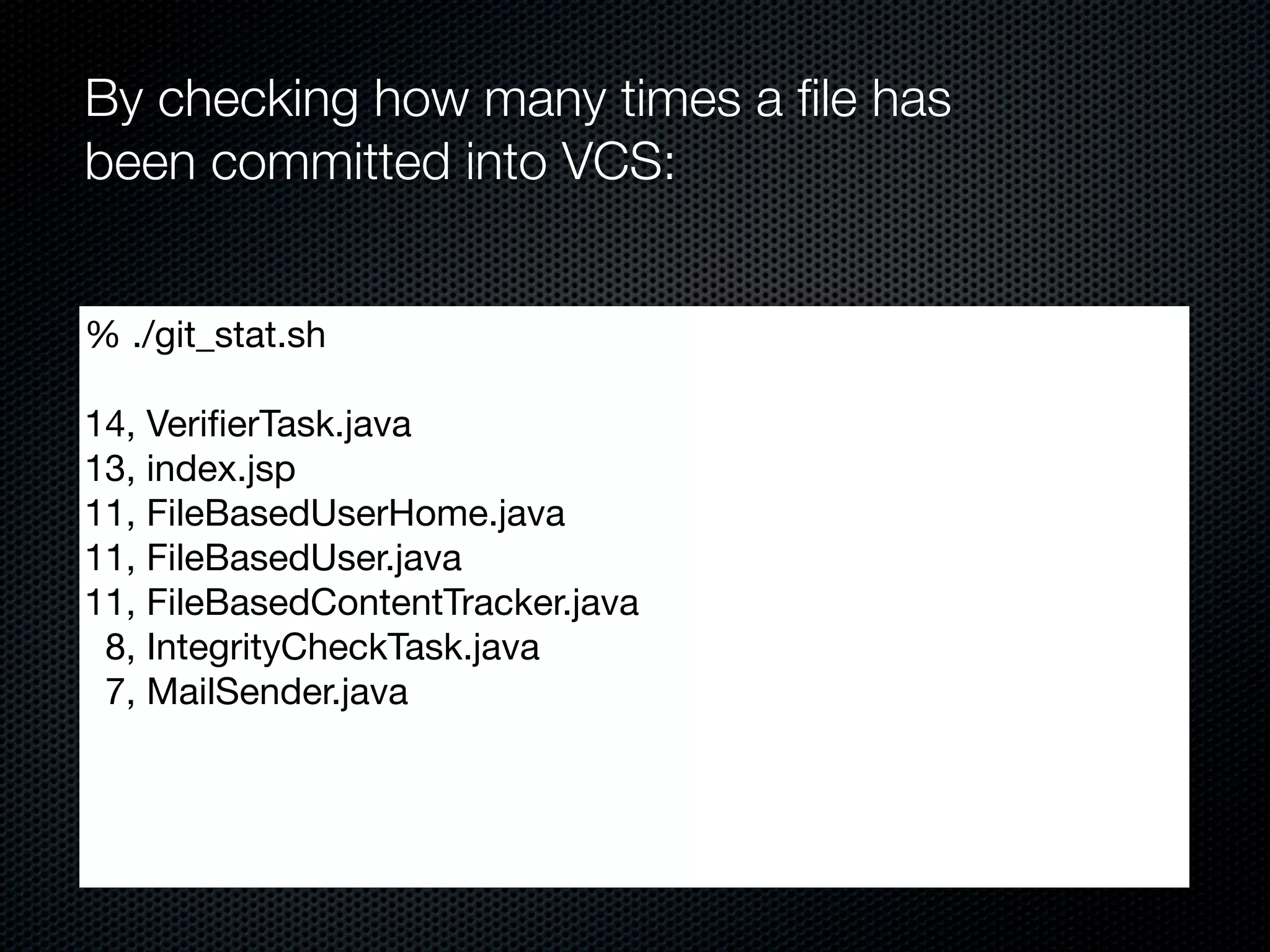
By checking how many times a file has
been committed into VCS:


% ./git_stat.sh

14, VerifierTask.java
13, index.jsp
11, FileBasedUserHome.java
11, FileBasedUser.java
11, FileBasedContentTracker.java
 8, IntegrityCheckTask.java
 7, MailSender.java
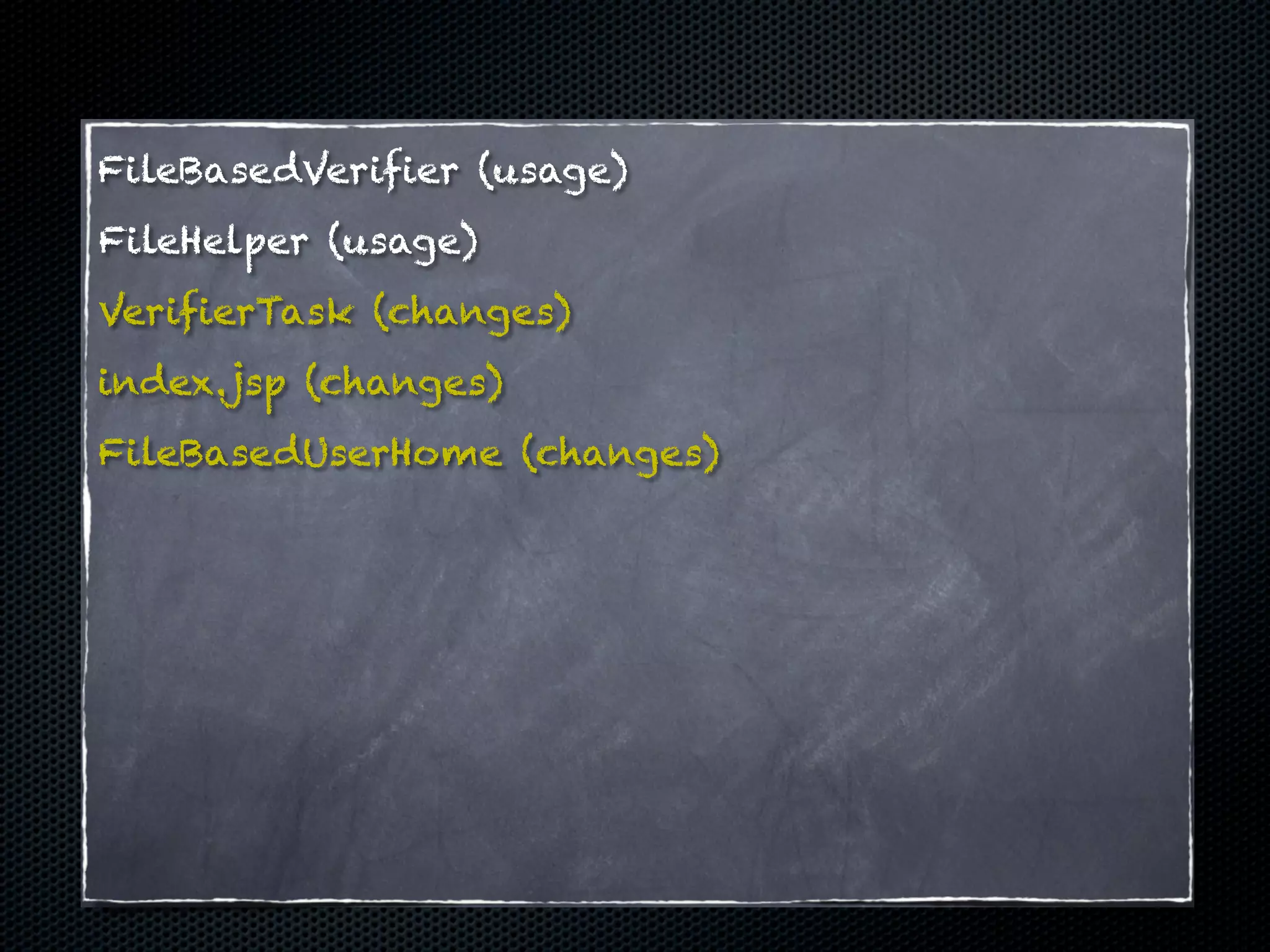
FileBasedVerifier (usage)
FileHelper (usage)
VerifierTask (changes)
index.jsp (changes)
FileBasedUserHome (changes)
#3 Determine which part of
  the code changes data
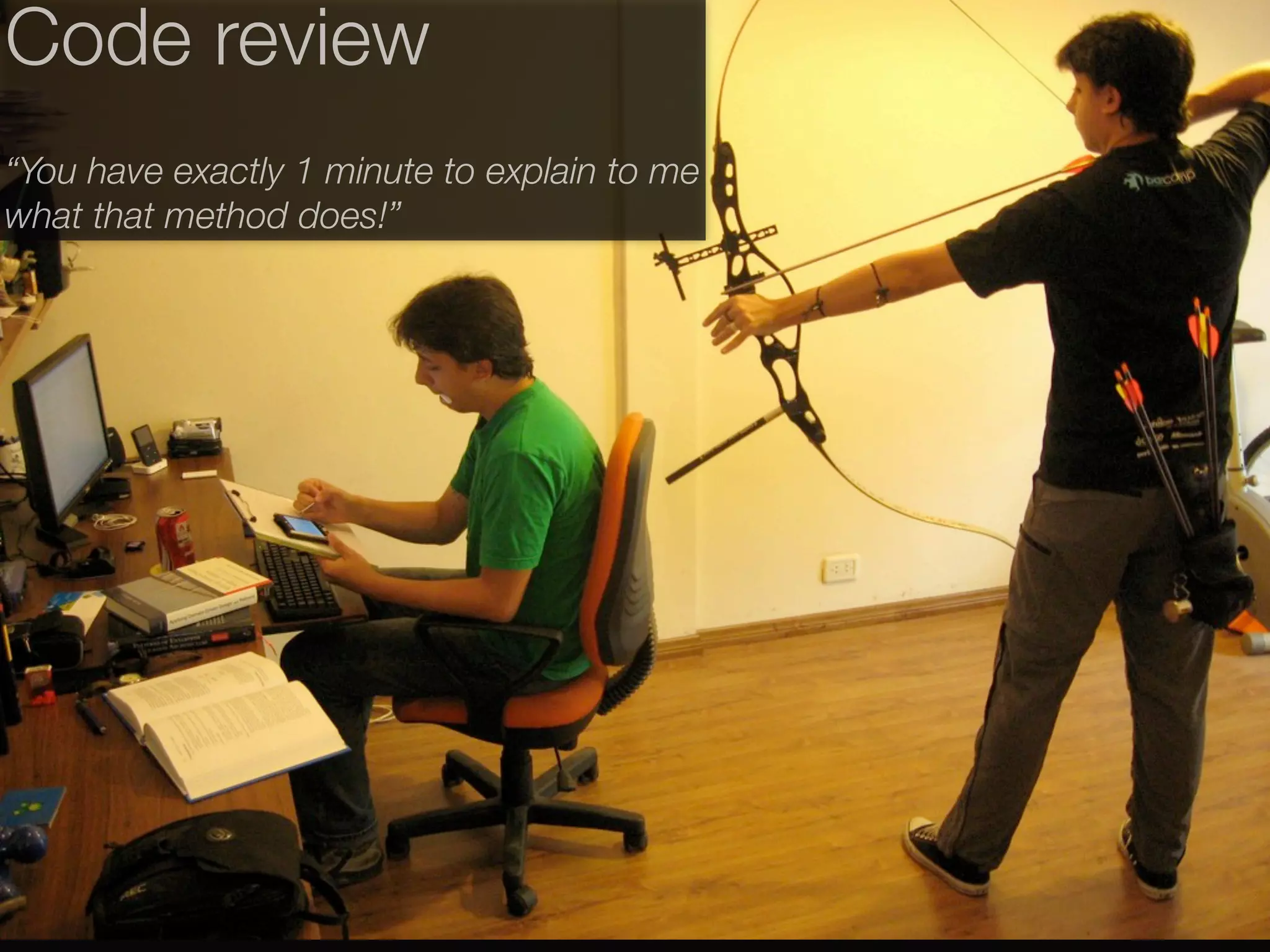
Code review
“You have exactly 1 minute to explain to me
what that method does!”
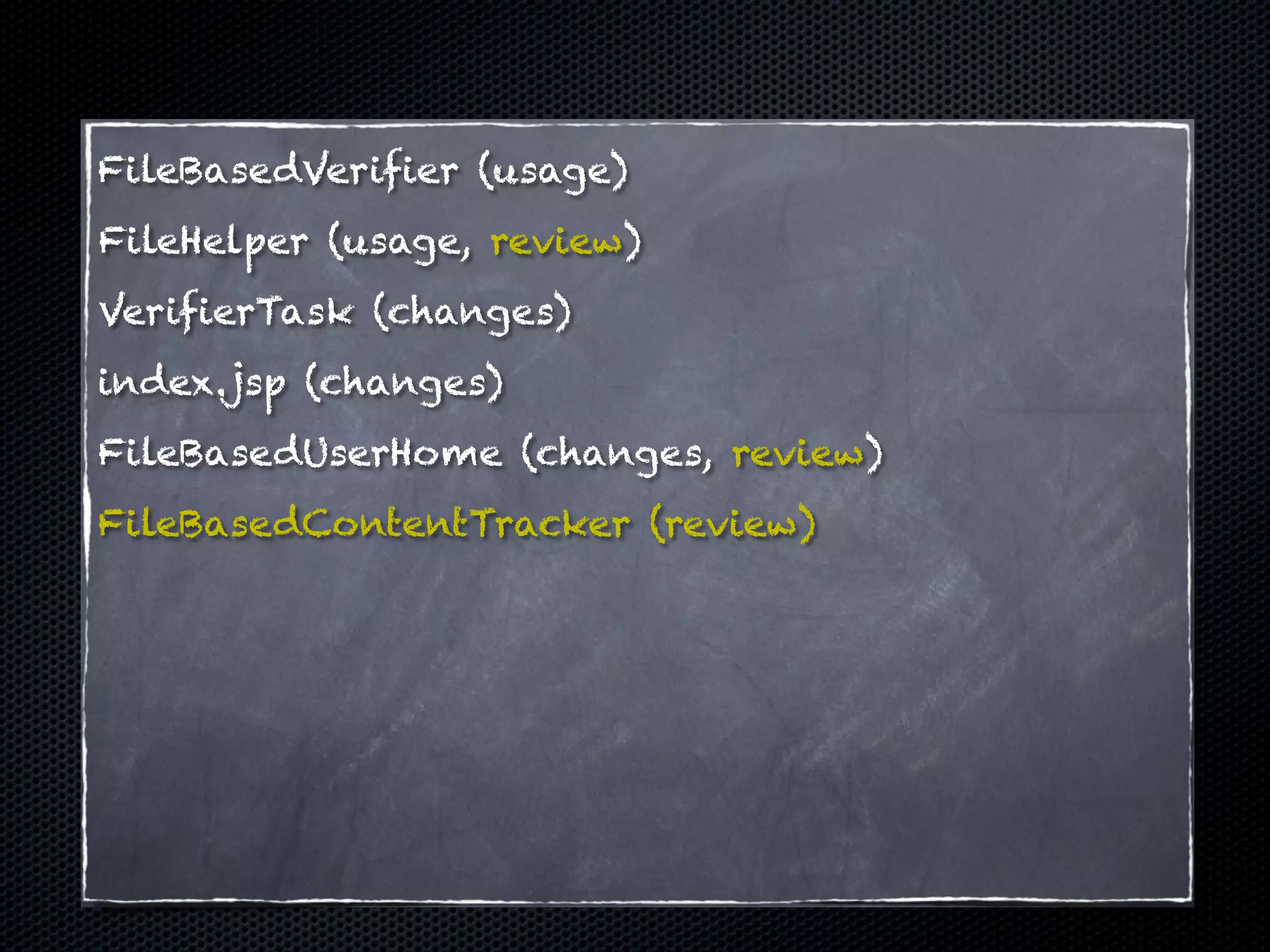
FileBasedVerifier (usage)
FileHelper (usage, review)
VerifierTask (changes)
index.jsp (changes)
FileBasedUserHome (changes, review)
FileBasedContentTracker (review)
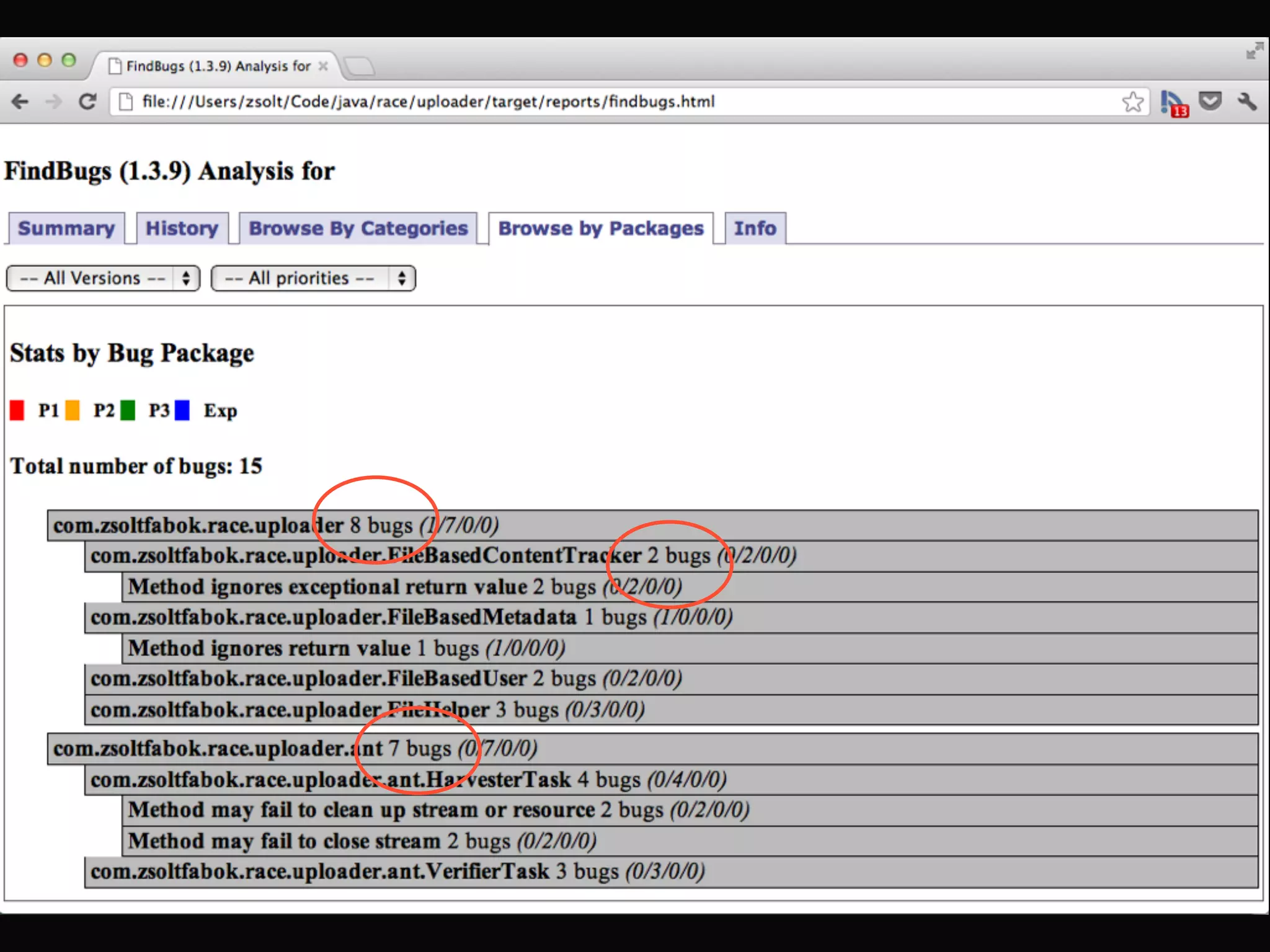
#4 Determine where the code
  is most likely going to fail
Static code checkers


            http://www.aucklandpestcontrol.net.nz/
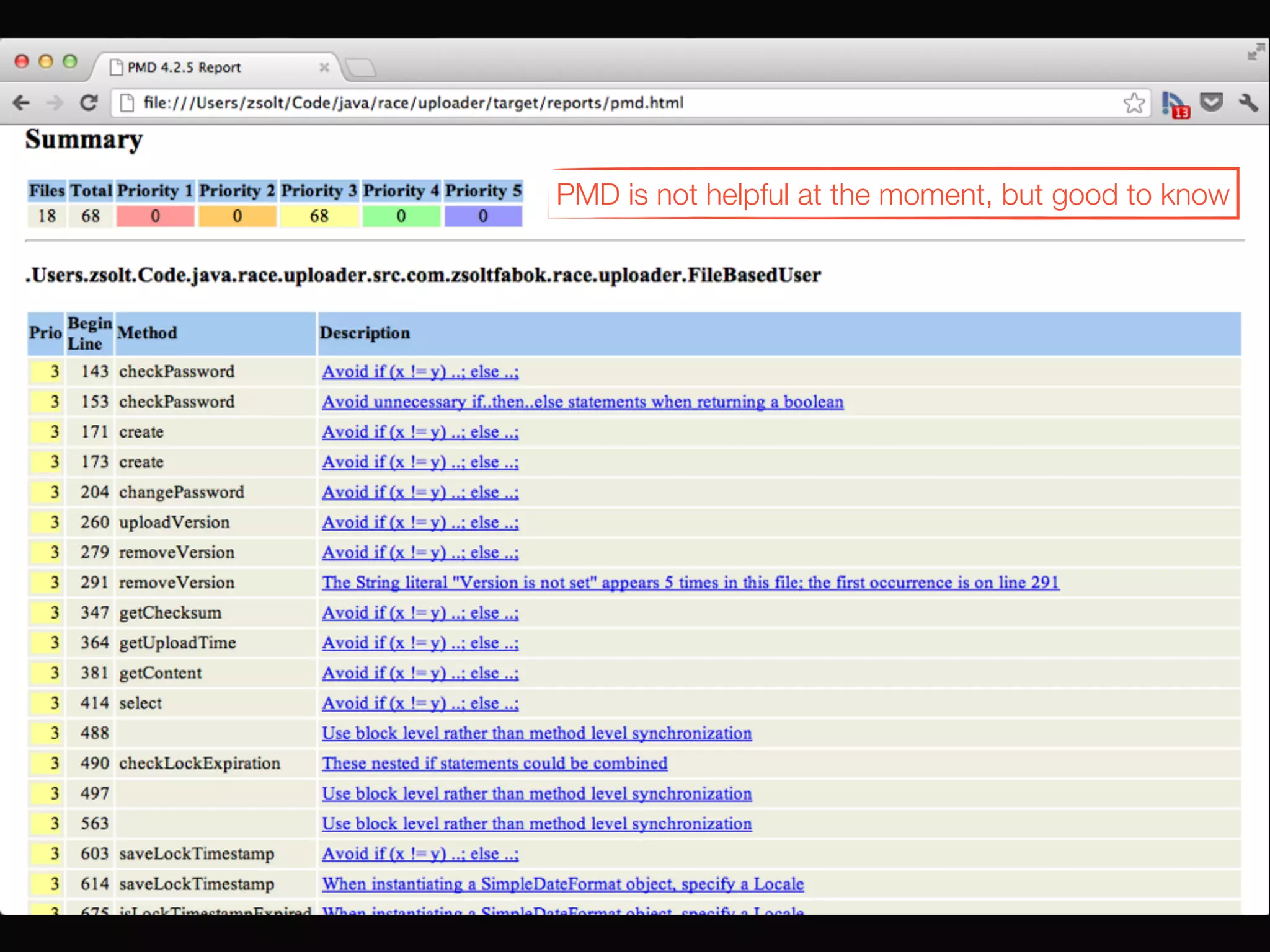
PMD is not helpful at the moment, but good to know
FileBasedVerifier (usage)
FileHelper (usage, review, bugs)
VerifierTask (changes)
index.jsp (changes)
FileBasedUserHome (changes, review)
FileBasedContentTracker (review, bugs)
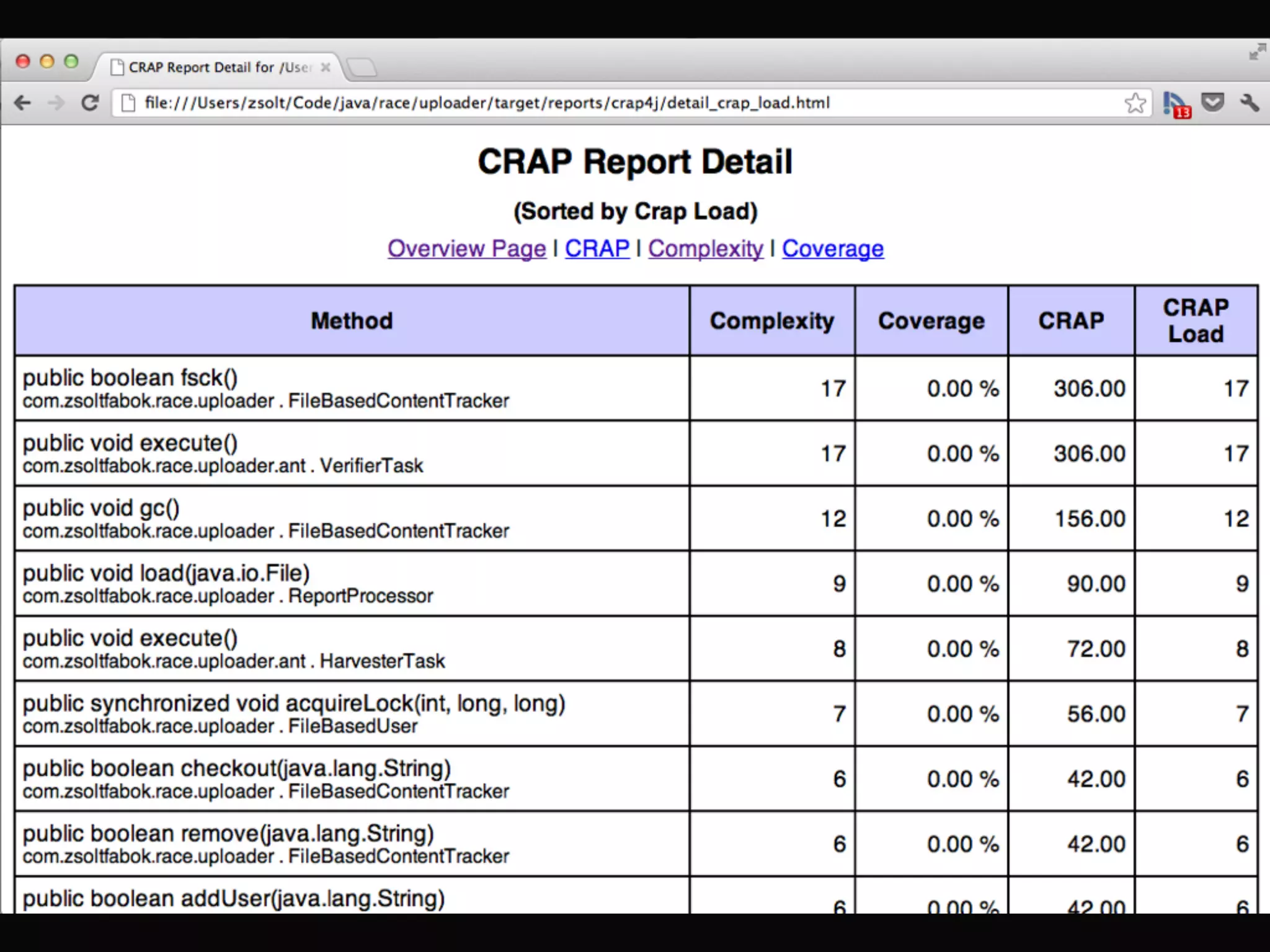
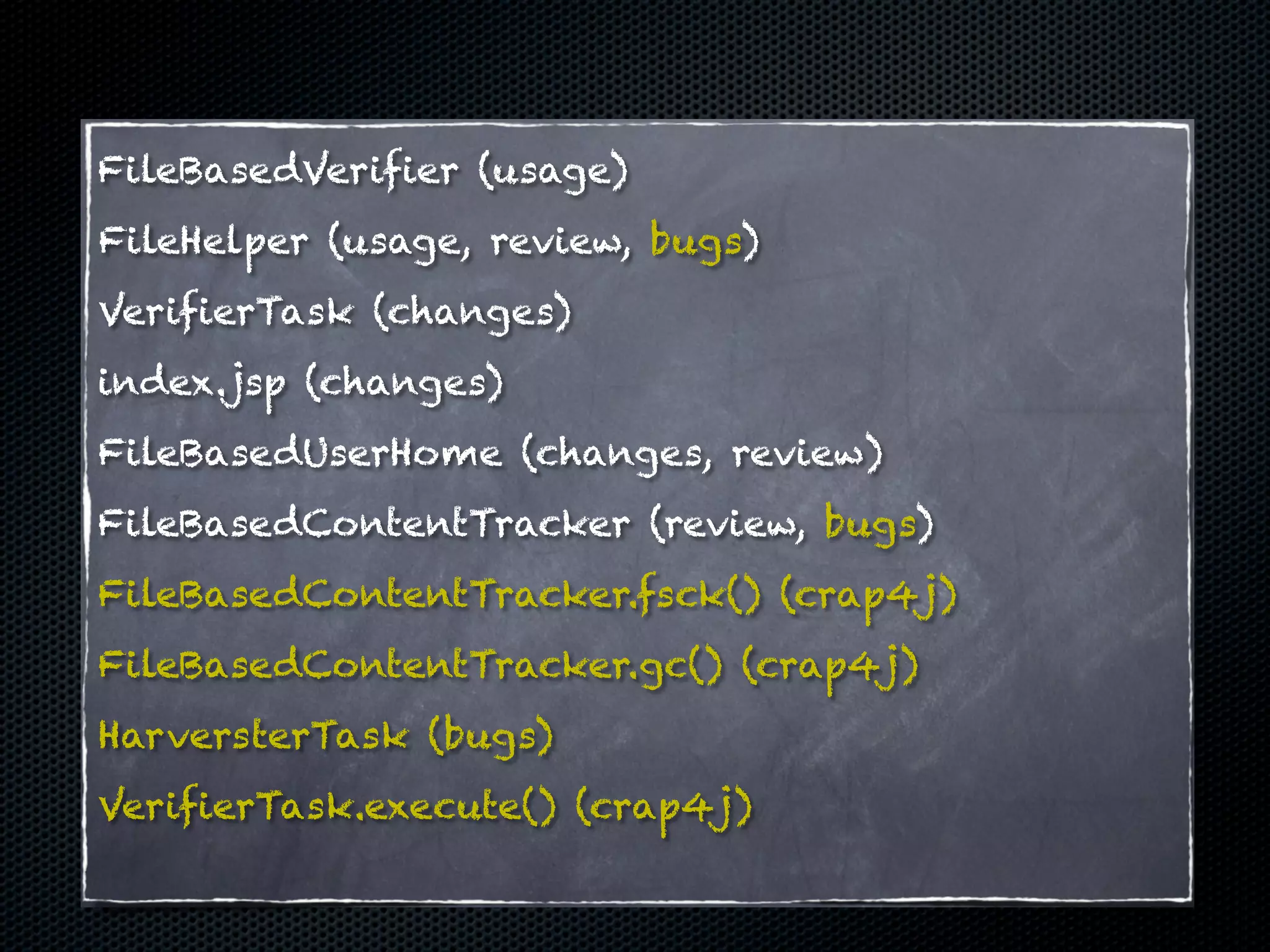
FileBasedContentTracker.fsck() (crap4j)
FileBasedContentTracker.gc() (crap4j)
HarversterTask (bugs)
VerifierTask.execute() (crap4j)
Let’s order our list and
     we are done!
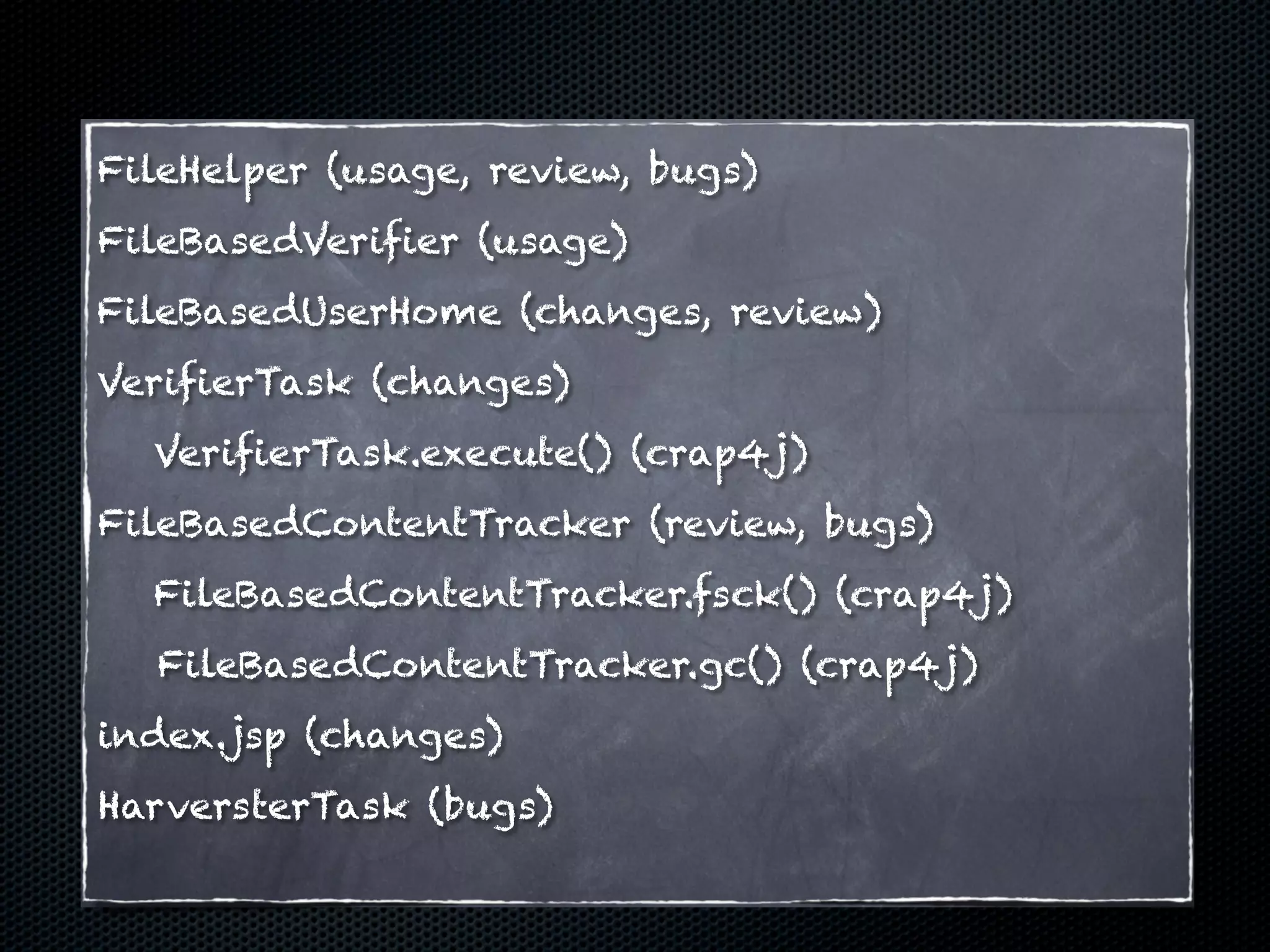
FileHelper (usage, review, bugs)
FileBasedVerifier (usage)
FileBasedUserHome (changes, review)
VerifierTask (changes)
  VerifierTask.execute() (crap4j)
FileBasedContentTracker (review, bugs)
  FileBasedContentTracker.fsck() (crap4j)
  FileBasedContentTracker.gc() (crap4j)
index.jsp (changes)
HarversterTask (bugs)
Now we know where to start,
  but we’re not sure how?
Before we continue, let’s talk about the
   “mythical 80% test coverage”...
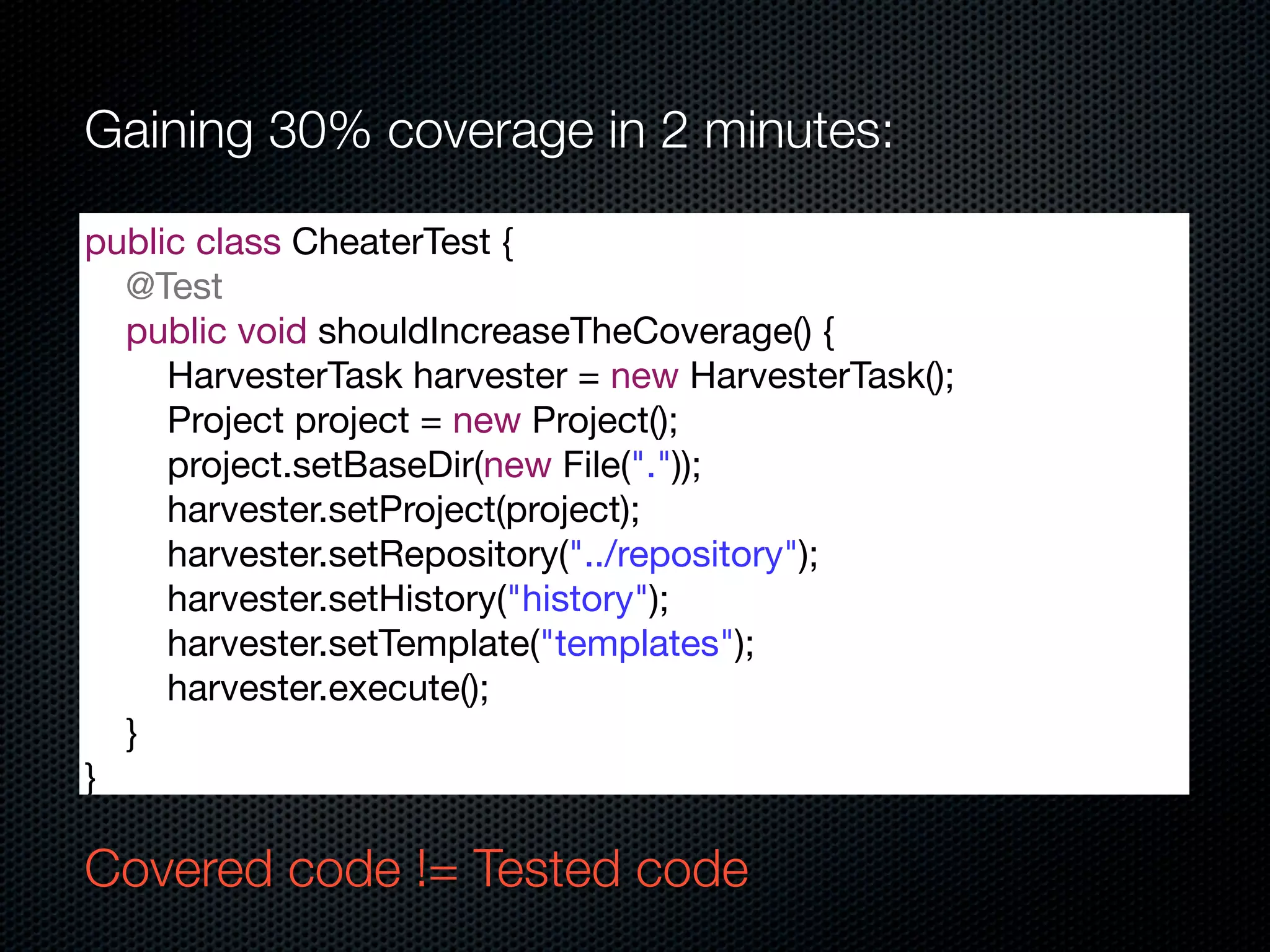
Gaining 30% coverage in 2 minutes:

public class CheaterTest {
  @Test
  public void shouldIncreaseTheCoverage() {
     HarvesterTask harvester = new HarvesterTask();
     Project project = new Project();
     project.setBaseDir(new File("."));
     harvester.setProject(project);
     harvester.setRepository("../repository");
     harvester.setHistory("history");
     harvester.setTemplate("templates");
     harvester.execute();
  }
}

Covered code != Tested code
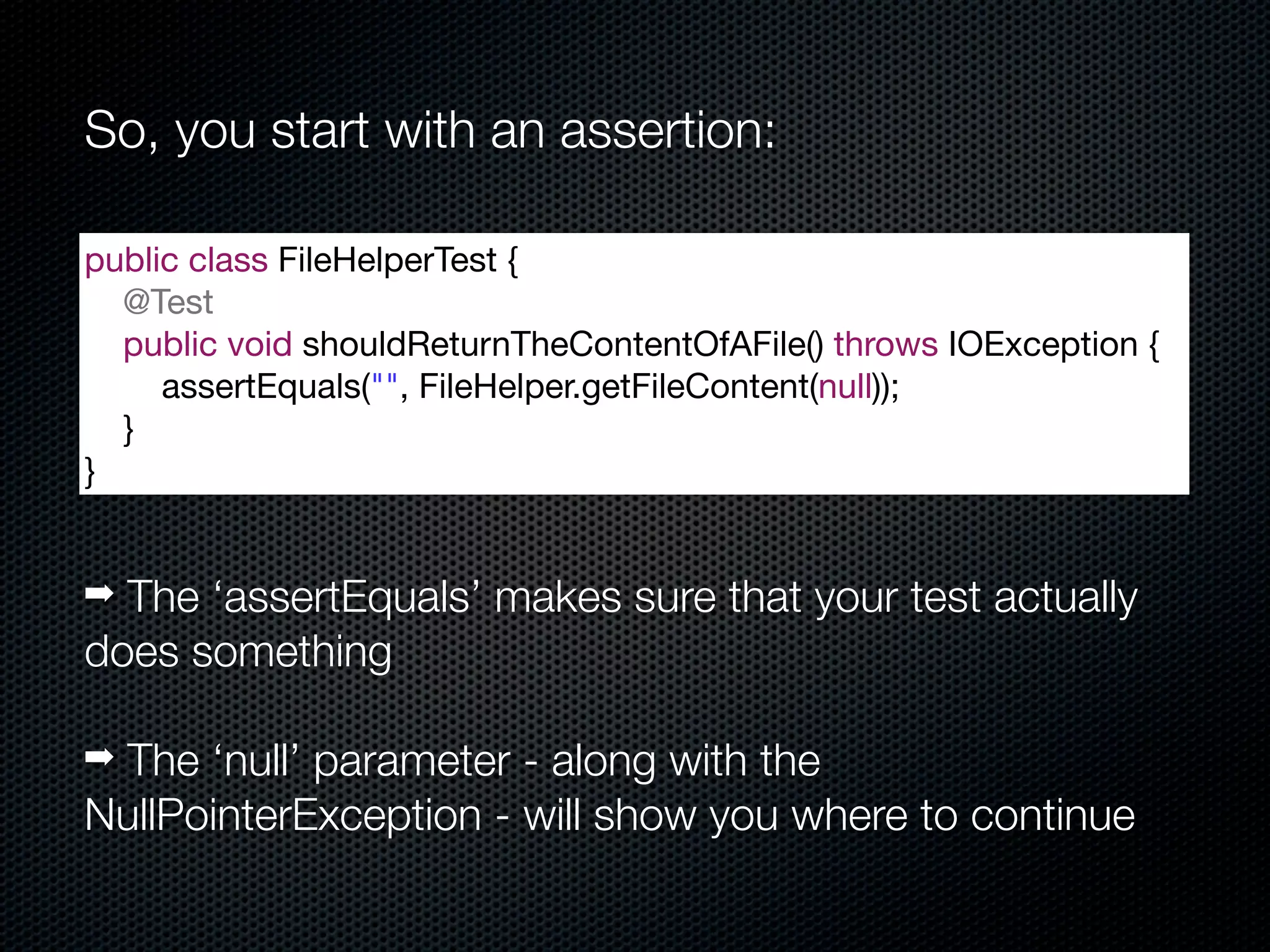
So, you start with an assertion:

public class FileHelperTest {
  @Test
  public void shouldReturnTheContentOfAFile() throws IOException {
     assertEquals("", FileHelper.getFileContent(null));
  }
}


➡ The ‘assertEquals’ makes sure that your test actually
does something

➡ The ‘null’ parameter - along with the
NullPointerException - will show you where to continue
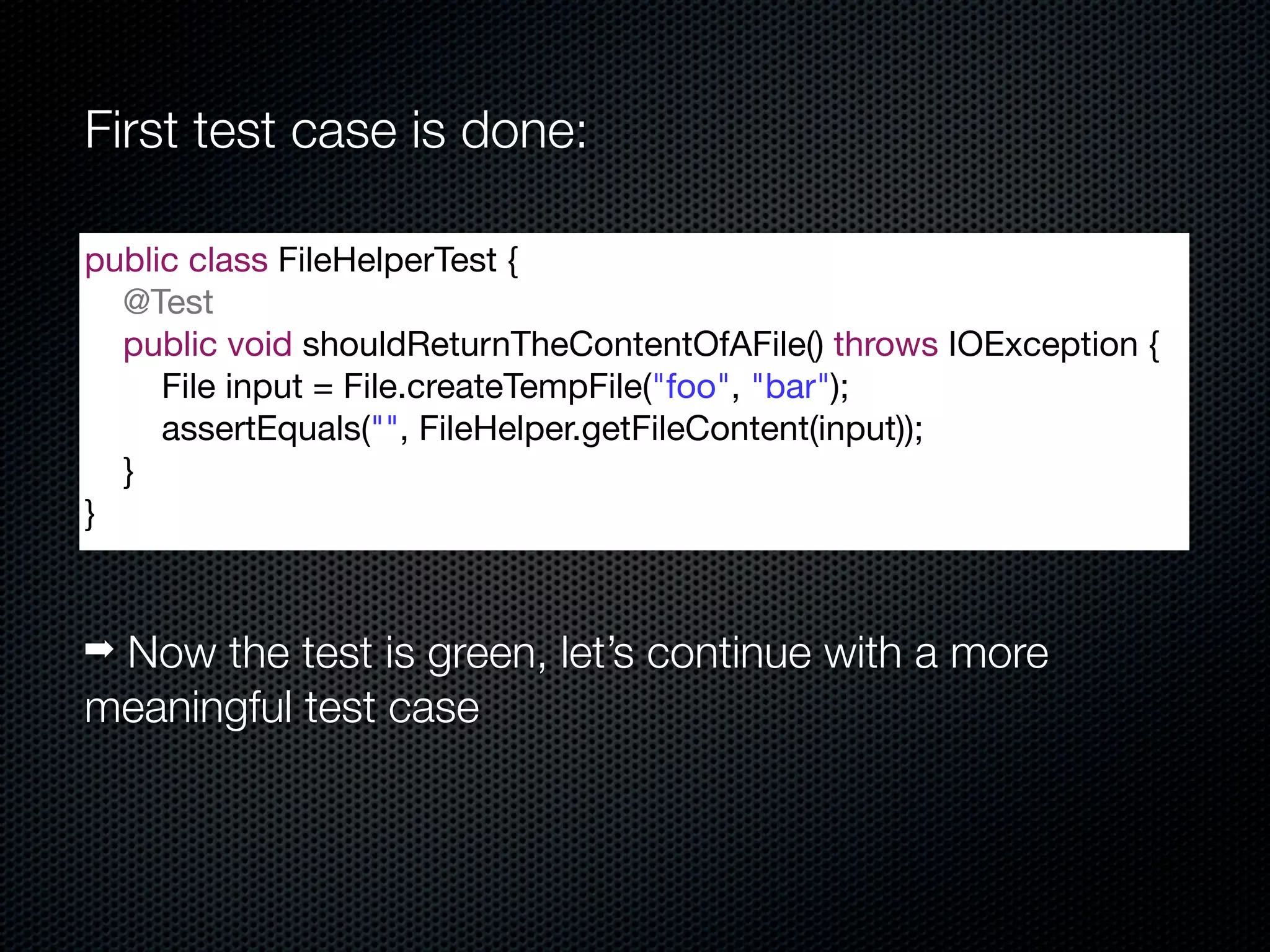
First test case is done:

public class FileHelperTest {
  @Test
  public void shouldReturnTheContentOfAFile() throws IOException {
     File input = File.createTempFile("foo", "bar");
     assertEquals("", FileHelper.getFileContent(input));
  }
}


➡ Now the test is green, let’s continue with a more
meaningful test case
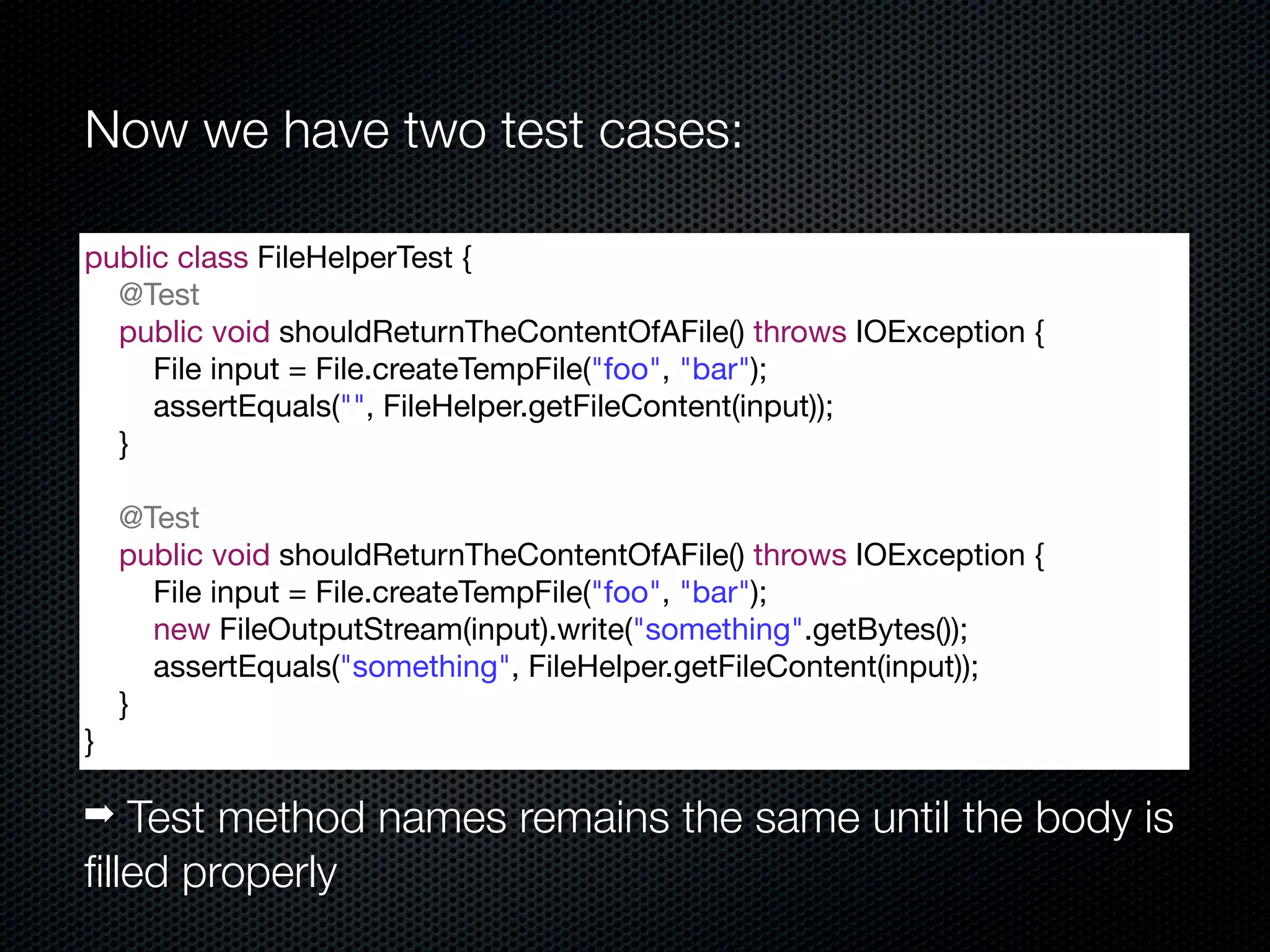
Now we have two test cases:

public class FileHelperTest {
  @Test
  public void shouldReturnTheContentOfAFile() throws IOException {
     File input = File.createTempFile("foo", "bar");
     assertEquals("", FileHelper.getFileContent(input));
  }

    @Test
    public void shouldReturnTheContentOfAFile() throws IOException {
      File input = File.createTempFile("foo", "bar");
      new FileOutputStream(input).write("something".getBytes());
      assertEquals("something", FileHelper.getFileContent(input));
    }
}

➡ Test method names remains the same until the body is
filled properly
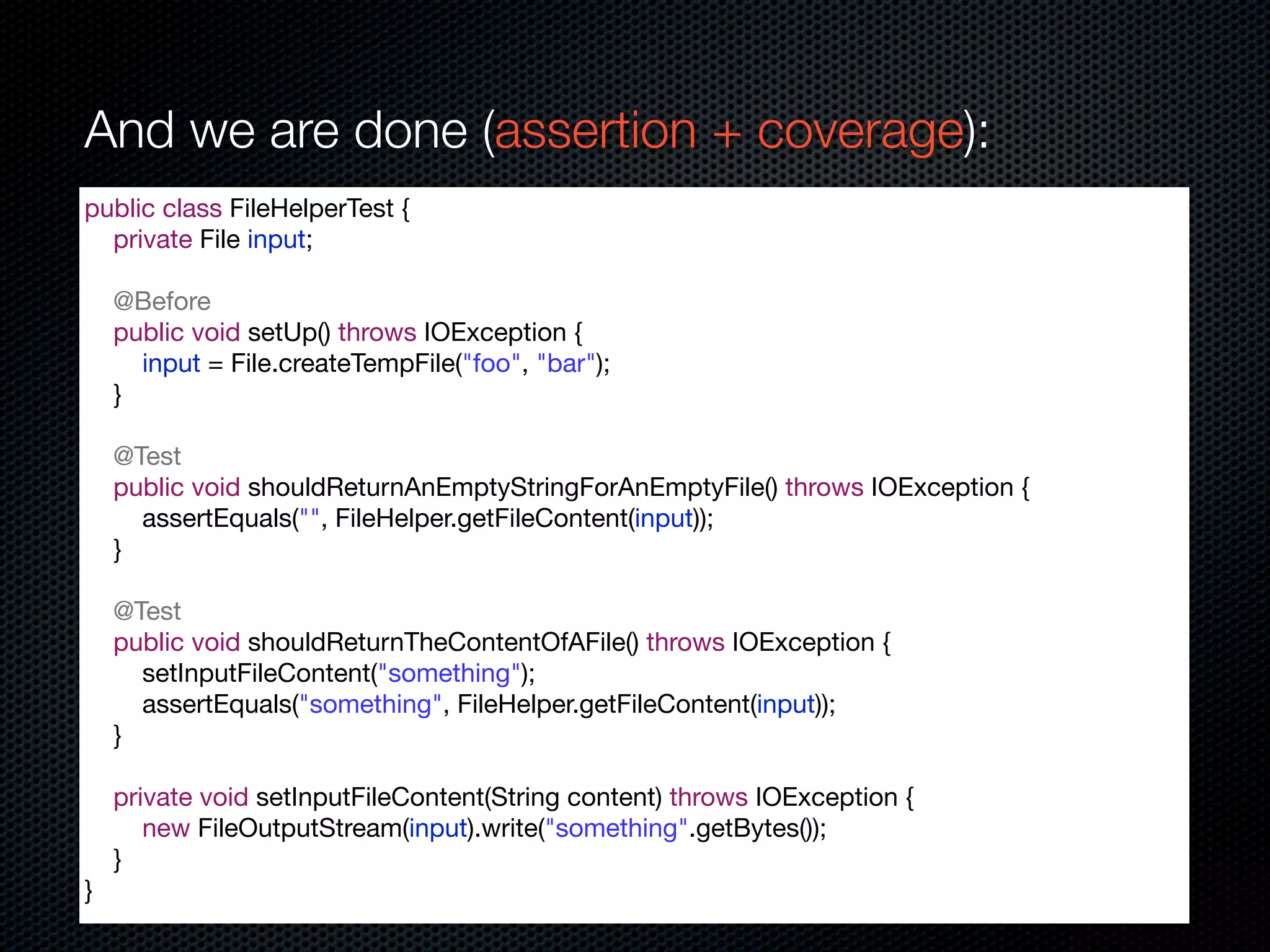
And we are done (assertion + coverage):
public class FileHelperTest {
  private File input;

    @Before
    public void setUp() throws IOException {
      input = File.createTempFile("foo", "bar");
    }

    @Test
    public void shouldReturnAnEmptyStringForAnEmptyFile() throws IOException {
      assertEquals("", FileHelper.getFileContent(input));
    }

    @Test
    public void shouldReturnTheContentOfAFile() throws IOException {
      setInputFileContent("something");
      assertEquals("something", FileHelper.getFileContent(input));
    }

    private void setInputFileContent(String content) throws IOException {
       new FileOutputStream(input).write("something".getBytes());
    }
}
Well tested code


Well tested code everywhere
Thank you very much for your attention!


http://zsoltfabok.com/                   @ZsoltFabok

Narrow Down What to Test

  • 1.
    How to NarrowDown What to Test by Zsolt Fabok 2012.09.28 Not sure if I have to check out this problem Or just wait for the customer feedback @ZsoltFabok #agilecam http://zsoltfabok.com/ http://www.agilecambridge.net/ac2012/
  • 2.
    “I get paidfor code that works, not for tests, so my philosophy is to test as little as possible to reach a given level of confidence (I suspect this level of confidence is high compared to industry standards, but that could just be hubris). If I don’t typically make a kind of mistake (like setting the wrong variables in a constructor), I don’t test for it. I do tend to make sense of test errors, so I’m extra careful when I have logic with complicated conditionals. When coding on a team, I modify my strategy to carefully test code that we, collectively, tend to get wrong.” Kent Beck - September 10, 2010 http://stackoverflow.com/questions/153234/how-deep-are-your-unit-tests/153565#153565
  • 3.
    I’d like to[re]start working on this old application
  • 4.
    My “where tostart” list
  • 5.
    #1 Determine whichparts of the code are really used
  • 6.
    Always Often 45% 7% Sometimes Rarely Never 13% 19% 16% The good old Standish Group Study
  • 7.
    The goal isto find those features which are always or often used By studying coverage, access logs, traces, web analytics, heat maps, etc.
  • 8.
    Let’s have alook at the coverage (using instrumented class files): % cp jetty/cobertura.ser web.ser % cp uploader/cobertura.ser ant.ser % ant usage_coverage usage_coverage: [cobertura-merge] Cobertura: Loaded information on 12 classes. [cobertura-merge] Cobertura: Loaded information on 11 classes. [cobertura-merge] Cobertura: Saved information on 16 classes. [cobertura-report] Cobertura: Loaded information on 16 classes. [cobertura-report] Report time: 600ms BUILD SUCCESSFUL Total time: 2 seconds
  • 9.
  • 10.
    Example #2: execution not even executed
  • 11.
    Example #3: numberof execution .NET wins
  • 12.
  • 13.
    #2 Find outwhich parts of the code change often
  • 14.
    By checking howmany times a file has been committed into VCS: % ./git_stat.sh 14, VerifierTask.java 13, index.jsp 11, FileBasedUserHome.java 11, FileBasedUser.java 11, FileBasedContentTracker.java 8, IntegrityCheckTask.java 7, MailSender.java
  • 15.
    FileBasedVerifier (usage) FileHelper (usage) VerifierTask(changes) index.jsp (changes) FileBasedUserHome (changes)
  • 16.
    #3 Determine whichpart of the code changes data
  • 17.
    Code review “You haveexactly 1 minute to explain to me what that method does!”
  • 18.
    FileBasedVerifier (usage) FileHelper (usage,review) VerifierTask (changes) index.jsp (changes) FileBasedUserHome (changes, review) FileBasedContentTracker (review)
  • 19.
    #4 Determine wherethe code is most likely going to fail
  • 20.
    Static code checkers http://www.aucklandpestcontrol.net.nz/
  • 22.
    PMD is nothelpful at the moment, but good to know
  • 24.
    FileBasedVerifier (usage) FileHelper (usage,review, bugs) VerifierTask (changes) index.jsp (changes) FileBasedUserHome (changes, review) FileBasedContentTracker (review, bugs) FileBasedContentTracker.fsck() (crap4j) FileBasedContentTracker.gc() (crap4j) HarversterTask (bugs) VerifierTask.execute() (crap4j)
  • 25.
    Let’s order ourlist and we are done!
  • 26.
    FileHelper (usage, review,bugs) FileBasedVerifier (usage) FileBasedUserHome (changes, review) VerifierTask (changes) VerifierTask.execute() (crap4j) FileBasedContentTracker (review, bugs) FileBasedContentTracker.fsck() (crap4j) FileBasedContentTracker.gc() (crap4j) index.jsp (changes) HarversterTask (bugs)
  • 27.
    Now we knowwhere to start, but we’re not sure how?
  • 28.
    Before we continue,let’s talk about the “mythical 80% test coverage”...
  • 29.
    Gaining 30% coveragein 2 minutes: public class CheaterTest { @Test public void shouldIncreaseTheCoverage() { HarvesterTask harvester = new HarvesterTask(); Project project = new Project(); project.setBaseDir(new File(".")); harvester.setProject(project); harvester.setRepository("../repository"); harvester.setHistory("history"); harvester.setTemplate("templates"); harvester.execute(); } } Covered code != Tested code
  • 30.
    So, you startwith an assertion: public class FileHelperTest { @Test public void shouldReturnTheContentOfAFile() throws IOException { assertEquals("", FileHelper.getFileContent(null)); } } ➡ The ‘assertEquals’ makes sure that your test actually does something ➡ The ‘null’ parameter - along with the NullPointerException - will show you where to continue
  • 31.
    First test caseis done: public class FileHelperTest { @Test public void shouldReturnTheContentOfAFile() throws IOException { File input = File.createTempFile("foo", "bar"); assertEquals("", FileHelper.getFileContent(input)); } } ➡ Now the test is green, let’s continue with a more meaningful test case
  • 32.
    Now we havetwo test cases: public class FileHelperTest { @Test public void shouldReturnTheContentOfAFile() throws IOException { File input = File.createTempFile("foo", "bar"); assertEquals("", FileHelper.getFileContent(input)); } @Test public void shouldReturnTheContentOfAFile() throws IOException { File input = File.createTempFile("foo", "bar"); new FileOutputStream(input).write("something".getBytes()); assertEquals("something", FileHelper.getFileContent(input)); } } ➡ Test method names remains the same until the body is filled properly
  • 33.
    And we aredone (assertion + coverage): public class FileHelperTest { private File input; @Before public void setUp() throws IOException { input = File.createTempFile("foo", "bar"); } @Test public void shouldReturnAnEmptyStringForAnEmptyFile() throws IOException { assertEquals("", FileHelper.getFileContent(input)); } @Test public void shouldReturnTheContentOfAFile() throws IOException { setInputFileContent("something"); assertEquals("something", FileHelper.getFileContent(input)); } private void setInputFileContent(String content) throws IOException { new FileOutputStream(input).write("something".getBytes()); } }
  • 34.
    Well tested code Welltested code everywhere
  • 35.
    Thank you verymuch for your attention! http://zsoltfabok.com/ @ZsoltFabok