Narrow complex tachycardia
algorithm
• The narrow complex tachycardias (NCTs) are defined by the presence
in a 12-lead electrocardiogram (ECG) of a QRS complex duration less
than 120 ms and a heart rate greater than 100 beats per minute
(bpm)
• those are typically of supraventricular origin,
• Sinus tachyacardia ( sinys rate >100)
• Physiological sinus tachycardia ( nonparoxysmal in response to appropriate
physiological stimulus. Pathological causes and drugs).
• Inappropriate sinus tachycardia(persistent nonparoxysmal tachycardia during the
day, without secondary systemic causes, due to enhanced automaticity and/or to
abnormal autonomic regulation of sinus node).
• Sinus node re-entry tachycardia ( often nonsustained that are due to re-entry circuit
that incorporates the SA node.)
• Atrial fibrillation ( uncordianted atrial activation with consequent
deterioration of atrial mechanical function )
• Atrial flutter ( organized atrial rhythm with a rate btw 250 and 350 bpm)
• Focal atrial tachycardia
• Unifocal
• Multifical ( MAT) three or more dif- ferent morphologic patterns of P waves
and an irregular atrial rate averaging 100 bpm or more (generally lower than
250 bpm). Variations in the PR, PP, and RR intervals are common
• Junctional tachycardia (due to either abnormal automaticity or
triggered activity of the AV node or of the His bundle. regular NCT
with either AV dissociation or one-to-one retrograde conduction AV).
• Automatic junctional tachycardia.
• Nonparoxysmal junctional tachycardia.
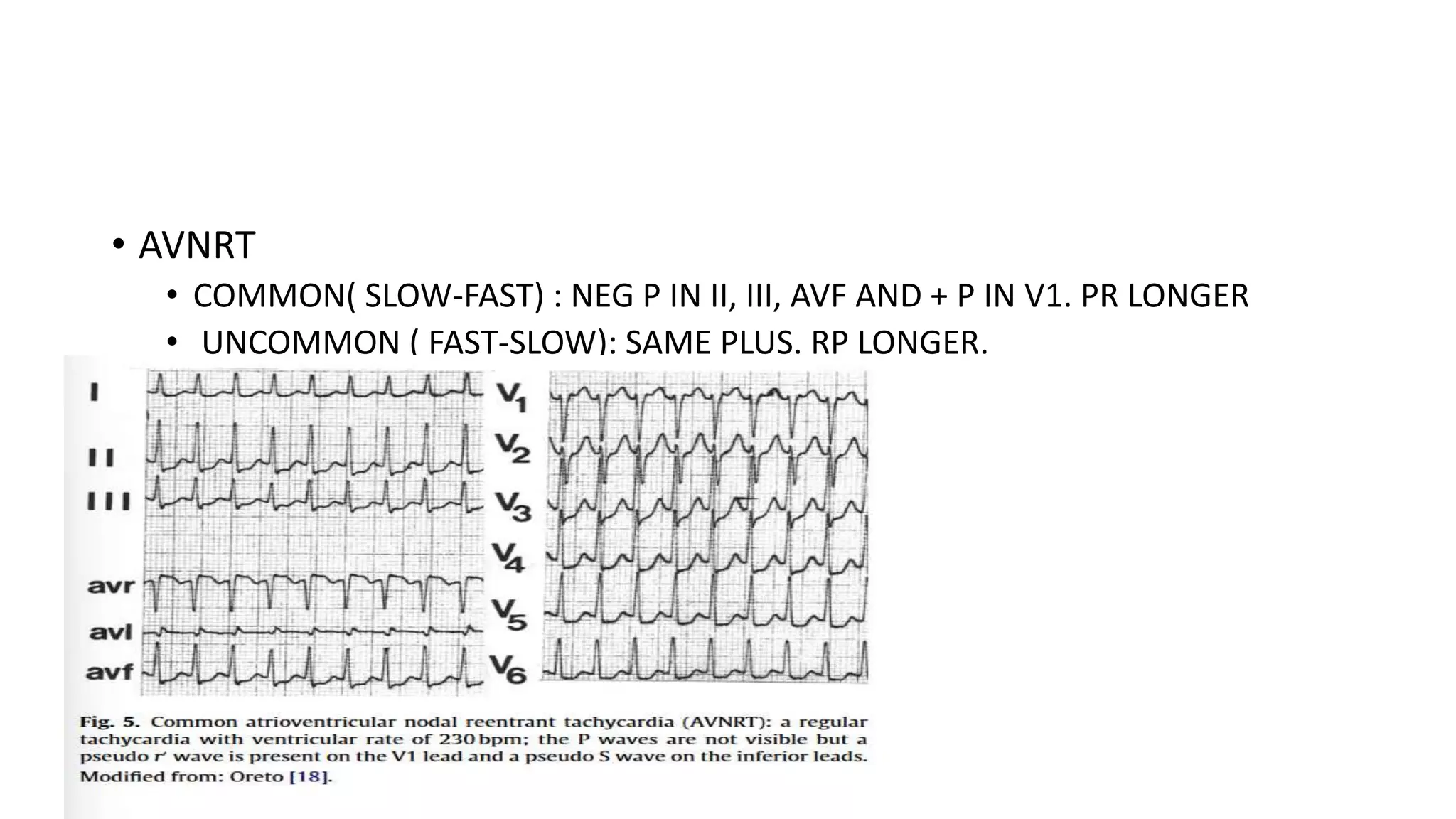
• AVNRT
• COMMON( SLOW-FAST) : NEG P IN II, III, AVF AND + P IN V1. PR LONGER
• UNCOMMON ( FAST-SLOW): SAME PLUS. RP LONGER.
• AVRT
Narrow complex tachycardia algorithm.pptx

Narrow complex tachycardia algorithm.pptx

  • 1.
  • 2.
    • The narrowcomplex tachycardias (NCTs) are defined by the presence in a 12-lead electrocardiogram (ECG) of a QRS complex duration less than 120 ms and a heart rate greater than 100 beats per minute (bpm) • those are typically of supraventricular origin,
  • 3.
    • Sinus tachyacardia( sinys rate >100) • Physiological sinus tachycardia ( nonparoxysmal in response to appropriate physiological stimulus. Pathological causes and drugs). • Inappropriate sinus tachycardia(persistent nonparoxysmal tachycardia during the day, without secondary systemic causes, due to enhanced automaticity and/or to abnormal autonomic regulation of sinus node). • Sinus node re-entry tachycardia ( often nonsustained that are due to re-entry circuit that incorporates the SA node.) • Atrial fibrillation ( uncordianted atrial activation with consequent deterioration of atrial mechanical function ) • Atrial flutter ( organized atrial rhythm with a rate btw 250 and 350 bpm)
  • 4.
    • Focal atrialtachycardia • Unifocal • Multifical ( MAT) three or more dif- ferent morphologic patterns of P waves and an irregular atrial rate averaging 100 bpm or more (generally lower than 250 bpm). Variations in the PR, PP, and RR intervals are common • Junctional tachycardia (due to either abnormal automaticity or triggered activity of the AV node or of the His bundle. regular NCT with either AV dissociation or one-to-one retrograde conduction AV). • Automatic junctional tachycardia. • Nonparoxysmal junctional tachycardia.
  • 5.
    • AVNRT • COMMON(SLOW-FAST) : NEG P IN II, III, AVF AND + P IN V1. PR LONGER • UNCOMMON ( FAST-SLOW): SAME PLUS. RP LONGER.
  • 6.