NANOTECHNOLOGY
Dr.Suhad A.Yasin
Nanotechnology is the study of extremely small structures.
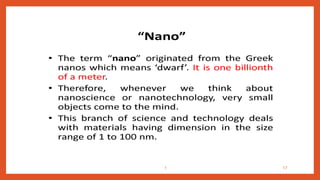
The prefix “nano” is a Greek word which means “dwarf ”.
The word “nano” means very small.
Nanotechnology deals with materials in the size of (0.1 to 100 nm).
Nanotechnology works on matter at dimensions in the nanometer scale
length (1-100 nm), and thus can be used for a broad range of
applications.
1 4
1 5
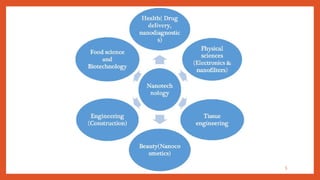
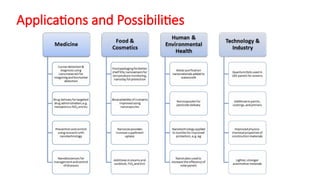
Applications and Possibilities
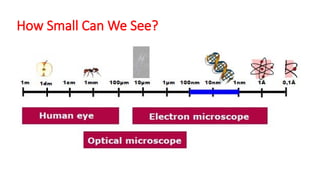
How Small Can We See?
1 10
Nanotechnology :
is the science and engineering of manipulating matter at
the atomic or molecular scale, typically between 1 and 100
nanometers, to create new materials, devices, and systems
with unique properties and functions. At this nanoscale,
materials often exhibit different physical, chemical, and
biological properties compared to their larger-scale
counterparts, enabling innovations in various fields such
as medicine, electronics, energy, and materials science.
1 11
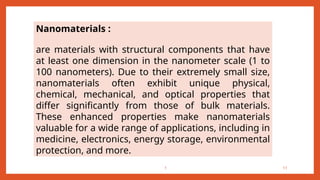
Nanomaterials :
are materials with structural components that have
at least one dimension in the nanometer scale (1 to
100 nanometers). Due to their extremely small size,
nanomaterials often exhibit unique physical,
chemical, mechanical, and optical properties that
differ significantly from those of bulk materials.
These enhanced properties make nanomaterials
valuable for a wide range of applications, including in
medicine, electronics, energy storage, environmental
protection, and more.
1 12
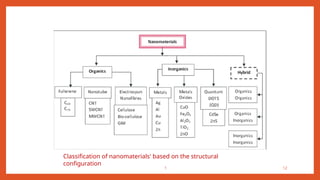
Classification of nanomaterials' based on the structural
configuration
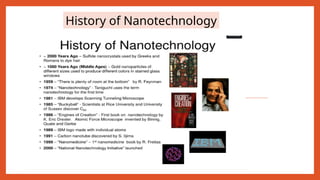
History of Nanotechnology
1 14
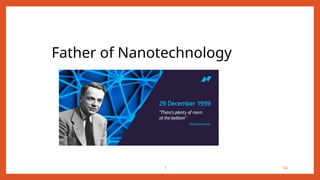
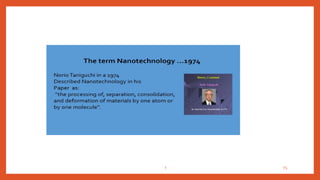
Father of Nanotechnology
1 15
1 16
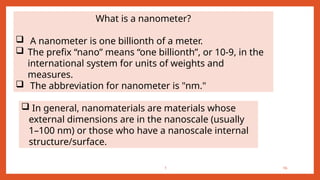
 In general, nanomaterials are materials whose
external dimensions are in the nanoscale (usually
1–100 nm) or those who have a nanoscale internal
structure/surface.
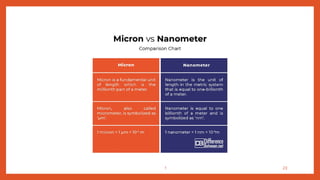
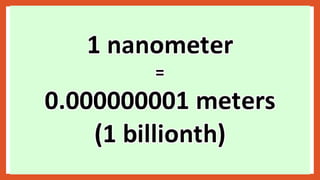
What is a nanometer?
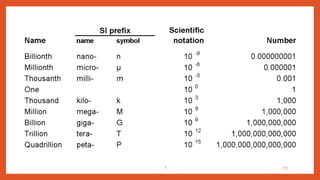
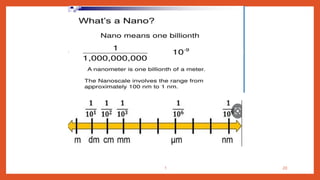
 A nanometer is one billionth of a meter.
 The prefix “nano” means “one billionth”, or 10-9, in the
international system for units of weights and
measures.
 The abbreviation for nanometer is "nm."
1 17
1 18
1 19
1 20
1 21
1 22
1 23
1 24
1 25
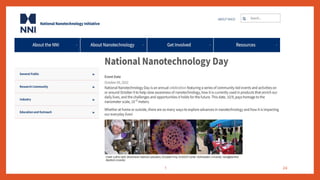
 Definition of Nanotechnology is given by the US National
Nanotechnology Initiative (NNI) as:
(i) Research and technology development at the atomic, molecular or
macromolecular levels, approximately 1–100 nano-meters in length.
(ii) Creation and use of structures, devices, and systems that have novel
properties and functions because of their small and intermediate
size.
(iii) Ability to control or manipulate on the atomic scale.
1 26
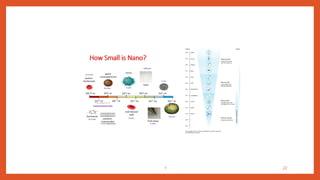
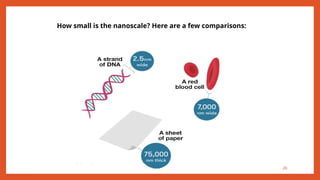
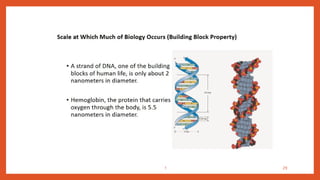
How small is the nanoscale? Here are a few comparisons:
1 27
Research on nanomaterials is driven by two motivating
factors:
1)They exhibit interesting properties at nanometer size
scale which is different from bulk material and
2) Applications of these properties in devices
1 28
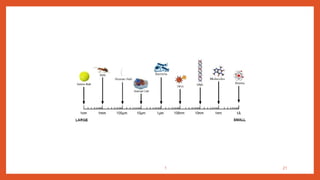
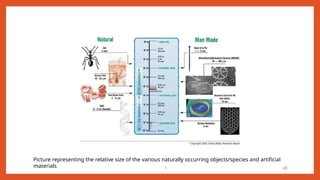
Picture representing the relative size of the various naturally occurring objects/species and artificial
materials
1 29

NANOTECHNOLOGY LECTURE 1... .. (1).pptx

  • 1.
  • 3.
    Nanotechnology is thestudy of extremely small structures. The prefix “nano” is a Greek word which means “dwarf ”. The word “nano” means very small. Nanotechnology deals with materials in the size of (0.1 to 100 nm). Nanotechnology works on matter at dimensions in the nanometer scale length (1-100 nm), and thus can be used for a broad range of applications.
  • 4.
  • 5.
  • 6.
  • 9.
  • 10.
    1 10 Nanotechnology : isthe science and engineering of manipulating matter at the atomic or molecular scale, typically between 1 and 100 nanometers, to create new materials, devices, and systems with unique properties and functions. At this nanoscale, materials often exhibit different physical, chemical, and biological properties compared to their larger-scale counterparts, enabling innovations in various fields such as medicine, electronics, energy, and materials science.
  • 11.
    1 11 Nanomaterials : arematerials with structural components that have at least one dimension in the nanometer scale (1 to 100 nanometers). Due to their extremely small size, nanomaterials often exhibit unique physical, chemical, mechanical, and optical properties that differ significantly from those of bulk materials. These enhanced properties make nanomaterials valuable for a wide range of applications, including in medicine, electronics, energy storage, environmental protection, and more.
  • 12.
    1 12 Classification ofnanomaterials' based on the structural configuration
  • 13.
  • 14.
    1 14 Father ofNanotechnology
  • 15.
  • 16.
    1 16  Ingeneral, nanomaterials are materials whose external dimensions are in the nanoscale (usually 1–100 nm) or those who have a nanoscale internal structure/surface. What is a nanometer?  A nanometer is one billionth of a meter.  The prefix “nano” means “one billionth”, or 10-9, in the international system for units of weights and measures.  The abbreviation for nanometer is "nm."
  • 17.
  • 18.
  • 19.
  • 20.
  • 21.
  • 22.
  • 23.
  • 24.
  • 25.
    1 25  Definitionof Nanotechnology is given by the US National Nanotechnology Initiative (NNI) as: (i) Research and technology development at the atomic, molecular or macromolecular levels, approximately 1–100 nano-meters in length. (ii) Creation and use of structures, devices, and systems that have novel properties and functions because of their small and intermediate size. (iii) Ability to control or manipulate on the atomic scale.
  • 26.
    1 26 How smallis the nanoscale? Here are a few comparisons:
  • 27.
    1 27 Research onnanomaterials is driven by two motivating factors: 1)They exhibit interesting properties at nanometer size scale which is different from bulk material and 2) Applications of these properties in devices
  • 28.
    1 28 Picture representingthe relative size of the various naturally occurring objects/species and artificial materials
  • 29.