Presentation submitted
By:
Muhammad Zubaid
Rasool
(MCSE-16-37)
 Muhammad Akhtar
(MCSE-16-10)
 Farhan Shaffi
(MCSE-16-31)
To:Sir. Imran
Our topics are
• NAND and NOR implementation
• Other two level implementation
We will discuss
• Basic logic gates implementation by
universal gates.
• Boolean function implementation by
universal gates.
• Wired Logic
• Non-degenerate forms
NAND and NOR implementation
In this topic we will discuss the following
things:
• Implementation of Basic gates using
Universal gate
• Implementation of Boolean functions
using Universal gates.
Universal Gates
• A gate that can be used to create any logic
gate is called universal gate. Hence NAND
and NOR are universal gates.
• Any Boolean function can be created
using AND OR and NOT gates.
• AND OR and NOT gates can be
implemented using NAND and NOR gates.
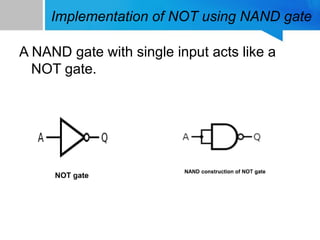
Implementation of NOT using NAND gate
A NAND gate with single input acts like a
NOT gate.
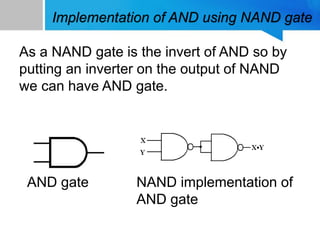
Implementation of AND using NAND gate
As a NAND gate is the invert of AND so by
putting an inverter on the output of NAND
we can have AND gate.
NAND implementation of
AND gate
AND gate
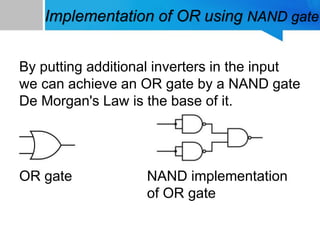
Implementation of OR using NAND gate
By putting additional inverters in the input
we can achieve an OR gate by a NAND gate
De Morgan's Law is the base of it.
OR gate NAND implementation
of OR gate
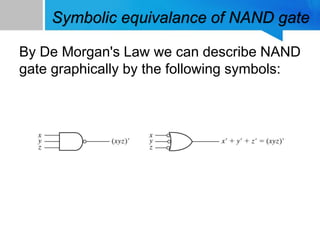
Symbolic equivalance of NAND gate
By De Morgan's Law we can describe NAND
gate graphically by the following symbols:
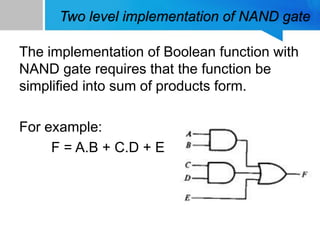
Two level implementation of NAND gate
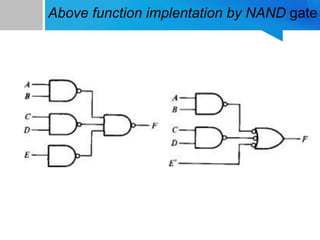
The implementation of Boolean function with
NAND gate requires that the function be
simplified into sum of products form.
For example:
F = A.B + C.D + E
Above function implentation by NAND gate
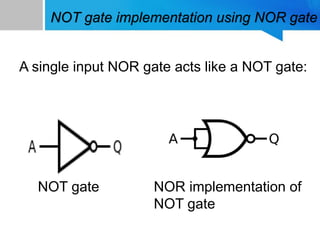
NOT gate implementation using NOR gate
A single input NOR gate acts like a NOT gate:
NOT gate NOR implementation of
NOT gate
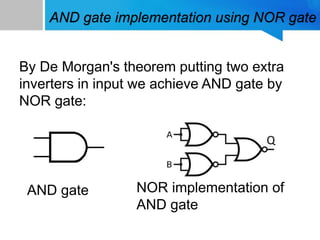
AND gate implementation using NOR gate
By De Morgan's theorem putting two extra
inverters in input we achieve AND gate by
NOR gate:
AND gate NOR implementation of
AND gate
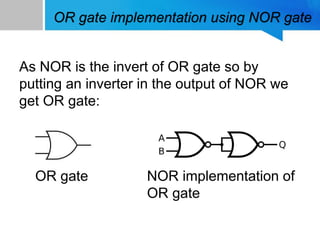
OR gate implementation using NOR gate
As NOR is the invert of OR gate so by
putting an inverter in the output of NOR we
get OR gate:
OR gate NOR implementation of
OR gate
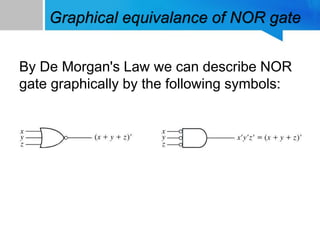
Graphical equivalance of NOR gate
By De Morgan's Law we can describe NOR
gate graphically by the following symbols:
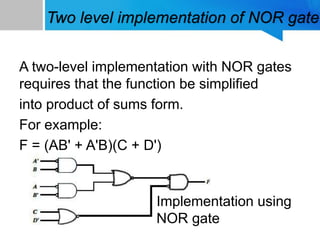
Two level implementation of NOR gate
A two-level implementation with NOR gates
requires that the function be simplified
into product of sums form.
For example:
F = (AB' + A'B)(C + D')
Implementation using
NOR gate
Our 2nd Topic is
Other Two Level Implementation
We will discuss the following things in this
topic:
• Wired Logic.
• Non-degenerate Form
Other Two Level Implementations
• NAND and NOR gates are widely used in
the ICs.
• A few NAND or NOR gates allow the wire
connection between the outputs of two gates
for specific functionality.
• This wire connection is called the “wired
logic”.
Wired Logic gate
• A wired logic gate does not produce a
physical second level gate.
• It is a wire connection.
• For discussion we will assume the
following circuits as two level
implementation.
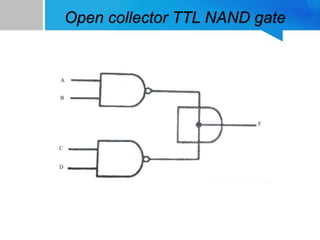
Open collector TTL NAND gate
• The most common example for AND wired logic
by NAND gate is open collector TTL NAND
gate.
• TTL stands for transistor-transistor logic.
• When open collector TTL NAND gate is tied
together it performs wired AND logic.
• AND gate is drawn with the lines going through
the center of the gate.
Open collector TTL NAND gate
• It means that wired AND gate is not a physical gate
but only a symbol to describe the functionality done
by the wired connection.
• The following logic implemented by circuit is called
AND-OR-Invert function.
F = (A.B)'...(C.D)' = (A.B+C.D)' = (A'+B').(C'+D')
Open collector TTL NAND gate
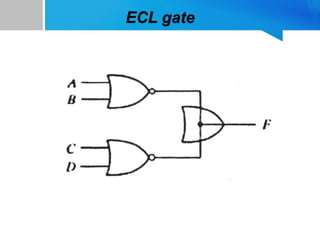
ECL gate
• ECL stands for Emitter Coupled Logic
• The NOR outputs of the ECL gate are tied
together to perform a wired-OR function.
• The following logic implemented by the circuit is
called OR-AND-Invert function.
F = (A+B)'+(C+D)' = [(A+B).(C+D)]'
ECL gate
Non-degenrate form
• There are 16 possible combinations of two
level forms.
• 8 of these are degenrate form because
they degenrate to a single operation.
• The remaining 8 are non-degenrate forms.
Non-degenrate form
• These forms are implemented in sum of products form or
product of sums form.
• The 8 nondegenrate forms are:
1.AND-OR 2.OR-AND
3.NAND-NAND 4.NOR-NOR
5.NOR-OR 6.NAND-AND
7.OR-NAND 8.AND-NOR
• The 1st gate listed in each of the forms
constitute first level while the 2nd gate
constitute the second level.
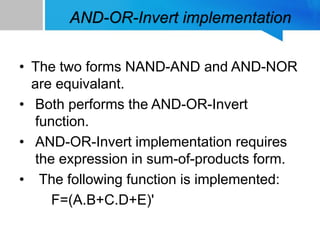
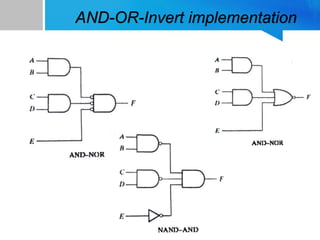
AND-OR-Invert implementation
• The two forms NAND-AND and AND-NOR
are equivalant.
• Both performs the AND-OR-Invert
function.
• AND-OR-Invert implementation requires
the expression in sum-of-products form.
• The following function is implemented:
F=(A.B+C.D+E)'
AND-OR-Invert implementation
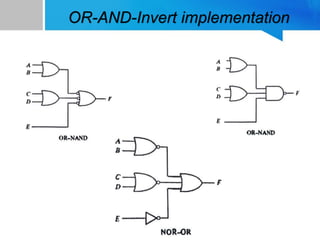
OR-AND-Invert implementation
• The OR-NAND and NOR-OR forms are
equivalant.
• Both performs OR-AND-Invert function.
• OR-AND-Invert implementation requires the
expression in product of sums form.
• The following function is implemented:
F=[(A+B).(C+D).E]'
OR-AND-Invert implementation
NAND and NOR implementation and  Other two level implementation

NAND and NOR implementation and Other two level implementation

  • 2.
    Presentation submitted By: Muhammad Zubaid Rasool (MCSE-16-37) Muhammad Akhtar (MCSE-16-10)  Farhan Shaffi (MCSE-16-31) To:Sir. Imran
  • 3.
    Our topics are •NAND and NOR implementation • Other two level implementation
  • 4.
    We will discuss •Basic logic gates implementation by universal gates. • Boolean function implementation by universal gates. • Wired Logic • Non-degenerate forms
  • 5.
    NAND and NORimplementation In this topic we will discuss the following things: • Implementation of Basic gates using Universal gate • Implementation of Boolean functions using Universal gates.
  • 6.
    Universal Gates • Agate that can be used to create any logic gate is called universal gate. Hence NAND and NOR are universal gates. • Any Boolean function can be created using AND OR and NOT gates. • AND OR and NOT gates can be implemented using NAND and NOR gates.
  • 7.
    Implementation of NOTusing NAND gate A NAND gate with single input acts like a NOT gate.
  • 8.
    Implementation of ANDusing NAND gate As a NAND gate is the invert of AND so by putting an inverter on the output of NAND we can have AND gate. NAND implementation of AND gate AND gate
  • 9.
    Implementation of ORusing NAND gate By putting additional inverters in the input we can achieve an OR gate by a NAND gate De Morgan's Law is the base of it. OR gate NAND implementation of OR gate
  • 10.
    Symbolic equivalance ofNAND gate By De Morgan's Law we can describe NAND gate graphically by the following symbols:
  • 11.
    Two level implementationof NAND gate The implementation of Boolean function with NAND gate requires that the function be simplified into sum of products form. For example: F = A.B + C.D + E
  • 12.
  • 13.
    NOT gate implementationusing NOR gate A single input NOR gate acts like a NOT gate: NOT gate NOR implementation of NOT gate
  • 14.
    AND gate implementationusing NOR gate By De Morgan's theorem putting two extra inverters in input we achieve AND gate by NOR gate: AND gate NOR implementation of AND gate
  • 15.
    OR gate implementationusing NOR gate As NOR is the invert of OR gate so by putting an inverter in the output of NOR we get OR gate: OR gate NOR implementation of OR gate
  • 16.
    Graphical equivalance ofNOR gate By De Morgan's Law we can describe NOR gate graphically by the following symbols:
  • 17.
    Two level implementationof NOR gate A two-level implementation with NOR gates requires that the function be simplified into product of sums form. For example: F = (AB' + A'B)(C + D') Implementation using NOR gate
  • 18.
    Our 2nd Topicis Other Two Level Implementation We will discuss the following things in this topic: • Wired Logic. • Non-degenerate Form
  • 19.
    Other Two LevelImplementations • NAND and NOR gates are widely used in the ICs. • A few NAND or NOR gates allow the wire connection between the outputs of two gates for specific functionality. • This wire connection is called the “wired logic”.
  • 20.
    Wired Logic gate •A wired logic gate does not produce a physical second level gate. • It is a wire connection. • For discussion we will assume the following circuits as two level implementation.
  • 21.
    Open collector TTLNAND gate • The most common example for AND wired logic by NAND gate is open collector TTL NAND gate. • TTL stands for transistor-transistor logic. • When open collector TTL NAND gate is tied together it performs wired AND logic. • AND gate is drawn with the lines going through the center of the gate.
  • 22.
    Open collector TTLNAND gate • It means that wired AND gate is not a physical gate but only a symbol to describe the functionality done by the wired connection. • The following logic implemented by circuit is called AND-OR-Invert function. F = (A.B)'...(C.D)' = (A.B+C.D)' = (A'+B').(C'+D')
  • 23.
  • 24.
    ECL gate • ECLstands for Emitter Coupled Logic • The NOR outputs of the ECL gate are tied together to perform a wired-OR function. • The following logic implemented by the circuit is called OR-AND-Invert function. F = (A+B)'+(C+D)' = [(A+B).(C+D)]'
  • 25.
  • 26.
    Non-degenrate form • Thereare 16 possible combinations of two level forms. • 8 of these are degenrate form because they degenrate to a single operation. • The remaining 8 are non-degenrate forms.
  • 27.
    Non-degenrate form • Theseforms are implemented in sum of products form or product of sums form. • The 8 nondegenrate forms are: 1.AND-OR 2.OR-AND 3.NAND-NAND 4.NOR-NOR 5.NOR-OR 6.NAND-AND 7.OR-NAND 8.AND-NOR • The 1st gate listed in each of the forms constitute first level while the 2nd gate constitute the second level.
  • 28.
    AND-OR-Invert implementation • Thetwo forms NAND-AND and AND-NOR are equivalant. • Both performs the AND-OR-Invert function. • AND-OR-Invert implementation requires the expression in sum-of-products form. • The following function is implemented: F=(A.B+C.D+E)'
  • 29.
  • 30.
    OR-AND-Invert implementation • TheOR-NAND and NOR-OR forms are equivalant. • Both performs OR-AND-Invert function. • OR-AND-Invert implementation requires the expression in product of sums form. • The following function is implemented: F=[(A+B).(C+D).E]'
  • 31.