IMPLEMENTATION OF LOGICGATES USING NAND GATE
Seminar on:
Prepared by:
255U5A0501 Bandela Vijayendraprasad
2.
INTRODUCTION
• Logic gates: Logic gates are the basic building blocks of digital electronics.
• Logic gates are classified into three categories:
1.Basic gates
2.Universal gates
3.Special gates
• Basic Gates: These are the fundamental gates from which others can be built. They are:
1.AND gate
2.OR gate
3.NOT gate
• Universal Gates: These Gates can be used to construct all other logic gates, including
the basic ones.The Universal gates are:
1.NAND gate
2.NOR gate
• Special Gates: These gates are often derived from combinations of the basic gates to
perform specific function. The Special gates are:
1.EXOR gate
2.EXNOR gate
3.
IMPLEMENTATION OF BASICGATES USING NAND GATE
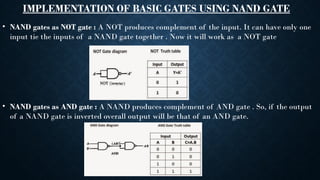
• NAND gates as NOT gate : A NOT produces complement of the input. It can have only one
input tie the inputs of a NAND gate together . Now it will work as a NOT gate
• NAND gates as AND gate : A NAND produces complement of AND gate . So, if the output
of a NAND gate is inverted overall output will be that of an AND gate.
4.
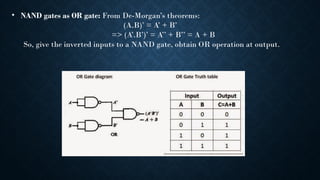
• NAND gatesas OR gate: From De-Morgan’s theorems:
(A.B)’ = A’ + B’
=> (A’.B’)’ = A’’ + B’’ = A + B
So, give the inverted inputs to a NAND gate, obtain OR operation at output.
5.
IMPLEMENTATION OF UNIVERSALGATES USING NAND GATE
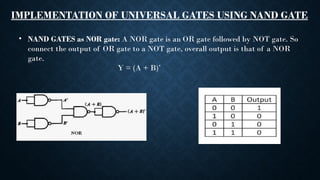
• NAND GATES as NOR gate: A NOR gate is an OR gate followed by NOT gate. So
connect the output of OR gate to a NOT gate, overall output is that of a NOR
gate.
Y = (A + B)’
6.
IMPLEMENTATION OF SPECIALSGATES USING NAND GATE
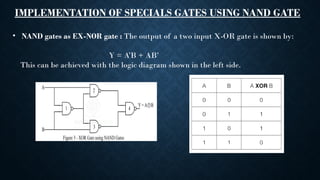
• NAND gates as EX-NOR gate : The output of a two input X-OR gate is shown by:
Y = A’B + AB’
This can be achieved with the logic diagram shown in the left side.
7.
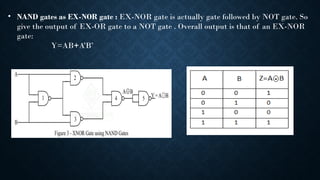
• NAND gatesas EX-NOR gate : EX-NOR gate is actually gate followed by NOT gate. So
give the output of EX-OR gate to a NOT gate . Overall output is that of an EX-NOR
gate:
Y=AB+A’B’
8.
CONCLUSION
• Universal gatesare powerful because they can replicate all other
gates.
• NAND and NOR gates simplify hardware design.
• Understanding these conversions is fundamental in digital
electronics



![Universal gates ppt jatin 1_st_sem[1]](https://cdn.slidesharecdn.com/ss_thumbnails/universalgatespptjatin1stsem1-190523132951-thumbnail.jpg?width=640&height=640&fit=bounds)


