6 Interesting Facts About
Nainital
Uttarakhand
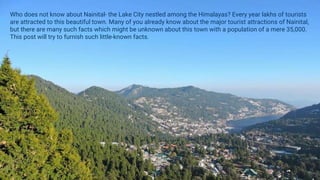
Who does not know about Nainital- the Lake City nestled among the Himalayas? Every year lakhs of tourists
are attracted to this beautiful town. Many of you already know about the major tourist attractions of Nainital,
but there are many such facts which might be unknown about this town with a population of a mere 35,000.
This post will try to furnish such little-known facts.
Reason behind the name
According to Hindu scriptures, Sati, the daughter of the King Daksha, was married to Mahadeva or
Shiva. Daksha did not approve of Shiva as a son-in-law, so when he arranged for a huge ‘yagna’ or fire
sacrifice, he invited all the Gods except Lord Shiva and Sati. Sati disobeyed Shiva’s command and
went to her father’s house, where Daksha insulted Shiva. Sati could not bear it, so she jumped into
the ceremonial fire to make the ‘yagna’ unsuccessful. Shiva flew into a rage on hearing of Sati’s
sacrifice- so he reached the ‘yagna’ with his ‘Ganas’ and destroyed Daksha’s ‘yagna’, picked up Sati’s
burnt body and started roaming around the world. Wherever any part of Sati’s body fell to the earth,
‘Shaktipeeths’ were put up. Sati’s left eye had fallen in the place where Nainital is now situated. It is
believed that the Naini Lake was formed out of Sati’s tears.
Upper Mall and Lower Mall
There is a Mall Road in every hill station. Nainital has two Mall Roads- Upper Mall and Lower Mall
Road, constructed during British times. Upper Mall road was for the use of the British while the Lower
Mall Road was permitted to be used by ordinary Indians. If an Indian went to the Upper Mall Road, he
was punished.
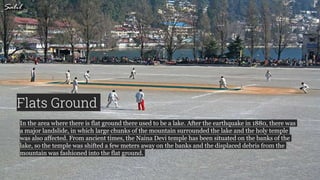
Flats Ground
In the area where there is flat ground there used to be a lake. After the earthquake in 1880, there was
a major landslide, in which large chunks of the mountain surrounded the lake and the holy temple
was also affected. From ancient times, the Naina Devi temple has been situated on the banks of the
lake, so the temple was shifted a few meters away on the banks and the displaced debris from the
mountain was fashioned into the flat ground.
Religious Harmony
Nainital as well as Uttarakhand is an example of religious harmony. It is an example of the ancient
Indian traditions. It has never been subjected to Mughal domination, so religious tolerance is a way of
life there. The locals welcome the people of all religions and communities. It is a town where a temple,
a mosque, a gurudwara and a church are situated within a radius of 1 kilometer. Each religious festival
is celebrated according to its traditions, but no untoward incident has been reported.
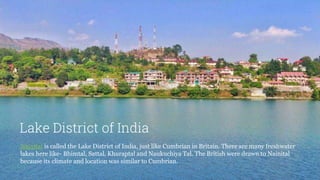
Lake District of India
Nainital is called the Lake District of India, just like Cumbrian in Britain. There are many freshwater
lakes here like- Bhimtal, Sattal, Khuraptal and Naukuchiya Tal. The British were drawn to Nainital
because its climate and location was similar to Cumbrian.
Founder of the Modern City
The founder of the modern town of Nainital was an English trader called P. Baron. He dealt in sugar
and loved to wander around in the beautiful hills and valleys. Once, on his travels, he stopped to rest in
a place called Khairna, where he met a local boy, who informed him of a beautiful lake on the other side
of the hill. The locals helped Baron to reach the Naini Lake and he was mesmerized by its beauty and
decided to establish a town there.

Nainital

  • 1.
    6 Interesting FactsAbout Nainital Uttarakhand
  • 2.
    Who does notknow about Nainital- the Lake City nestled among the Himalayas? Every year lakhs of tourists are attracted to this beautiful town. Many of you already know about the major tourist attractions of Nainital, but there are many such facts which might be unknown about this town with a population of a mere 35,000. This post will try to furnish such little-known facts.
  • 3.
    Reason behind thename According to Hindu scriptures, Sati, the daughter of the King Daksha, was married to Mahadeva or Shiva. Daksha did not approve of Shiva as a son-in-law, so when he arranged for a huge ‘yagna’ or fire sacrifice, he invited all the Gods except Lord Shiva and Sati. Sati disobeyed Shiva’s command and went to her father’s house, where Daksha insulted Shiva. Sati could not bear it, so she jumped into the ceremonial fire to make the ‘yagna’ unsuccessful. Shiva flew into a rage on hearing of Sati’s sacrifice- so he reached the ‘yagna’ with his ‘Ganas’ and destroyed Daksha’s ‘yagna’, picked up Sati’s burnt body and started roaming around the world. Wherever any part of Sati’s body fell to the earth, ‘Shaktipeeths’ were put up. Sati’s left eye had fallen in the place where Nainital is now situated. It is believed that the Naini Lake was formed out of Sati’s tears.
  • 4.
    Upper Mall andLower Mall There is a Mall Road in every hill station. Nainital has two Mall Roads- Upper Mall and Lower Mall Road, constructed during British times. Upper Mall road was for the use of the British while the Lower Mall Road was permitted to be used by ordinary Indians. If an Indian went to the Upper Mall Road, he was punished.
  • 5.
    Flats Ground In thearea where there is flat ground there used to be a lake. After the earthquake in 1880, there was a major landslide, in which large chunks of the mountain surrounded the lake and the holy temple was also affected. From ancient times, the Naina Devi temple has been situated on the banks of the lake, so the temple was shifted a few meters away on the banks and the displaced debris from the mountain was fashioned into the flat ground.
  • 6.
    Religious Harmony Nainital aswell as Uttarakhand is an example of religious harmony. It is an example of the ancient Indian traditions. It has never been subjected to Mughal domination, so religious tolerance is a way of life there. The locals welcome the people of all religions and communities. It is a town where a temple, a mosque, a gurudwara and a church are situated within a radius of 1 kilometer. Each religious festival is celebrated according to its traditions, but no untoward incident has been reported.
  • 7.
    Lake District ofIndia Nainital is called the Lake District of India, just like Cumbrian in Britain. There are many freshwater lakes here like- Bhimtal, Sattal, Khuraptal and Naukuchiya Tal. The British were drawn to Nainital because its climate and location was similar to Cumbrian.
  • 8.
    Founder of theModern City The founder of the modern town of Nainital was an English trader called P. Baron. He dealt in sugar and loved to wander around in the beautiful hills and valleys. Once, on his travels, he stopped to rest in a place called Khairna, where he met a local boy, who informed him of a beautiful lake on the other side of the hill. The locals helped Baron to reach the Naini Lake and he was mesmerized by its beauty and decided to establish a town there.