Heath’s Montessori Learning Center Inc. Computer ProjectPrepared by: Dian Gabrielle Ferreras
“CAMBODIA”~Geography, ~History, ~Language, ~Transportation system, ~Economy, ~People, ~Religions, ~Literature
Flag of Cambodia
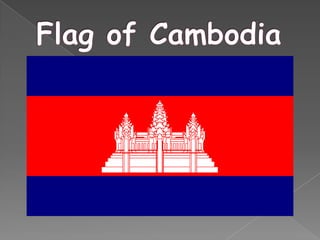
The national flag of Cambodia was readopted in 1993, after elections returned the monarchy to rule.Since around 1850, the Cambodian flag has featured a depiction of Angkor Wat in the center. The current flag, with a blue border and red central (the stripes are in the ratio 1:2:1) was adopted following Cambodia's independence in 1948. It was used until October 9, 1970, when a new flag was introduced for Lon nol’s Khmer Republic that lasted until the takeover of the Khmer Rouge in 1975. The subsequent state of Democratic Kampuchea, which existed from 1975 to 1979, used a red flag with a three-towered Angkor Watdesign retained in yellow.  
The Geography of Cambodia
Cambodia, also known as Kampochea, is a country located in Southeast Asia that is bordered by Laos, Vietnam, and Thailand.  Covering an area of about 181,035 sq km, Cambodia is about half the size of Vietnam.  The capital of Cambodia is Phnom Penh and has the distinction of also being the largest city. A low-lying alluvial plain in the center of Cambodia makes up most of the country, although in the South there is the Mekong Delta.  There are several mountainous regions, one of which forms a border along the coastline with another separating Cambodia from Thailand. The tenth largest river in the world, the Mekong River, is the longest river in Southeast Asia and the most important river in Cambodia.  One of its important uses is that it is navigable for most of its "run" through the country, as well as the Mekong delta in the South.
Cambodia is also home to the largest lake in Southeast Asia, the Tonle Sap (Great Lake), which connects with the Mekong River in Phnom Penh.  The Tonle Sap enlarges to four times its normal size when the Mekong rises during the monsoon season thus causing the Tonle Sap River to flow northward into the Lake.During the dry season it reverses its flow and goes back into the Mekong River.  As a result of this, The Tonle Sap Lake is a great resource for freshwater fish, actually being one of the richest sources in the world.
There are two monsoons which make up Cambodia's climate, a cool, dry, north-eastern one that is rather dry and comes from November to March and a south-western one which brings with it heavy rain, high winds and high humidity from May to early October.December and January are considered to be the coolest months and fall in the dry monsoon season.   Annually, Cambodia gets about 1,400 mm (55 in) and the temp averages around 27 degrees C (80 degrees F).
Cambodia’ s History
The Funan Kingdom, believed to have started around the first century BC, is the first known kingdom of Cambodia.  The kingdom was strongly influenced by Indian culture by  shaping the culture, art and political system.An alphabetical system, religions and architectural styles were also Indian contributions to the Funan Kingdom.  There is archeological evidence of a commercial society in the Mekong Delta that prospered from the 1st to 6th centuries.
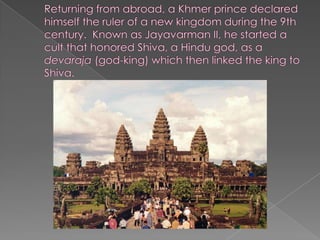
Returning from abroad, a Khmer prince declared himself the ruler of a new kingdom during the 9th century.  Known as Jayavarman II, he started a cult that honored Shiva, a Hindu god, as a devaraja (god-king) which then linked the king to Shiva.
He also began the great achievements in architecture and sculpture while his successors built an immense irrigation system around Angkor..  His successors (26 from the early 9th to the early 15th century), built a tremendous number of temples - of which there are over a thousand sites and stone inscriptions (on temple walls). By the 12th century, Cambodia had spread into other areas, now known as Thailand, Laos, Myanmar and Malaysia (the peninsula).  There is actually still evidence of Khmer inhabitance in Thailand and Laos to this day.  
The Language of Cambodia
Cambodia's official language is Cambodian, or Khmer.  This language belongs to the Mon-Khmer (Austro-Asiatic) language family and is relatively confusing and difficult for Westerners to manage.French had been the second most popular language until the 1990s, when English made an introduction.  Vietnamese and South Chinese dialects are other languages spoken.
The Transportation System in              Cambodia
In 1997, only 8% of the roads in Cambodia were paved out of 35,769 km of roadway.  In Phnom Penh, a modern highway links it to Kampong Saom (a deepwater port).Other improvements in roadways are made possible with donations from other countries, namely Japan.  In spite of this, most roadways in Cambodia are not passable for passenger cars.Transportation by bus around Cambodia has been forbidden, but travel is possible by other methods, such as air travel and by train.  There are still many un-detonated mines and other military paraphernalia, so straying from "the beaten path" is not recommended, even in popular areas.
The civil war and neglect severely damaged Cambodia's transport system, but with assistance and equipment from other countries Cambodia has been upgrading the mainhighways to international standards and most are vastly improved from 2006. Most main roads are now paved.Cambodia has two rail lines, totalling about 612 kilometers (380 mi) of single, one meter gauge track. The lines run from the capital to Sihanoukville on the southern coast, and from Phnom Penh to Sisophon (although trains often run only as far as Battambang). Currently only one passenger train per week operates, between Phnom Penh and Battambang.
Besides the main interprovincial traffic artery connecting the capital Phnom Penh with Sihanoukville, resurfacing a former dirt road with concrete / asphalt and implementation of 5 major river crossings by means of bridges have now permanently connected Phnom Penh with Koh Kong and hence there is now uninterrupted road access to neighboring Thailand and their vast road system.
The nation's extensive inland waterways were important historically in international trade. The Mekong and the Tonle Sap River, their numerous tributaries, and the Tonle Sap provided avenues of considerable length, including 3,700 kilometers (2,300 mi) navigable all year by craft drawing 0.6 meters (2 ft) and another 282 kilometers (175 mi) navigable to craft drawing 1.8 meters (6 ft).
The Cambodian Economy
From 2004 to 2007, the economy grew about 10% per year, driven largely by an expansion in the garment sector, construction, agriculture, and tourism. GDP dropped to below 7% growth in 2008 and probably contracted in 2009 as a result of the global economic slowdown. With the January 2005 expiration of a WTO Agreement on Textiles and Clothing, Cambodian textile producers were forced to compete directly with lower-priced countries such as China, India, Vietnam, and Bangladesh.
The garment industry currently employs more than 280,000 people -about 5% of the work force - and contributes more than 70% of Cambodia's exports. In 2005, exploitable oil deposits were found beneath Cambodia's territorial waters, representing a new revenue stream for the government if commercial extraction begins. Mining also is attracting significant investor interest, particularly in the northern parts of the country. The government has said opportunities exist for mining bauxite, gold, iron and gems. In 2006, a US-Cambodia bilateral Trade and Investment Framework Agreement (TIFA) was signed, and several rounds of discussions have been held since 2007.
Rubber exports increased about 25% in 2009 due to rising global demand. The tourism industry has continued to grow rapidly, with foreign arrivals exceeding 2 million per year in 2007-08, however, economic troubles abroad dampened growth in 2009. The global financial crisis is weakening demand for Cambodian exports, and construction is declining due to a shortage of credit. The long-term development of the economy remains a daunting challenge.
The Cambodian government is working with bilateral and multilateral donors, including the World Bank and IMF, to address the country's many pressing needs. The major economic challenge for Cambodia over the next decade will be fashioning an economic environment in which the private sector can create enough jobs to handle Cambodia's demographic imbalance. More than 50% of the population is less than 21 years old. The population lacks education and productive skills, particularly in the poverty-ridden countryside, which suffers from an almost total lack of basic infrastructure.
People
Most of the people who live in Cambodia are ethnic Cambodian, averaging between 90-95% of the total population making Cambodia the most homogenous country in South-East Asia.Vietnamese make up the largest minority group with about five percent of the population and Chinese make up another one percent.  With one of the highest population growth rates in Asia (2.5% per year), Cambodia had a population of a little over 11million in 1998.   Due to the Khmer Rouge rule during which residents were forced to move out of the cities, most of the population lives in rural areas, with only about a tenth living in urban areas. 90% of its population is of Khmer origin and speaks the Khmer language, the country's official language. The remainder include Chinese, Vietnamese, Cham and Khmer Loeu.
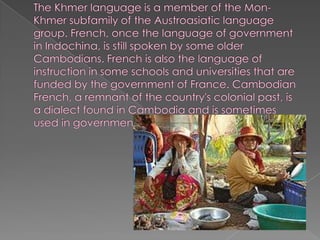
The Khmer language is a member of the Mon-Khmer subfamily of the Austroasiatic language group. French, once the language of government in Indochina, is still spoken by some older Cambodians. French is also the language of instruction in some schools and universities that are funded by the government of France. Cambodian French, a remnant of the country's colonial past, is a dialect found in Cambodia and is sometimes used in government.
The Religions of Cambodia
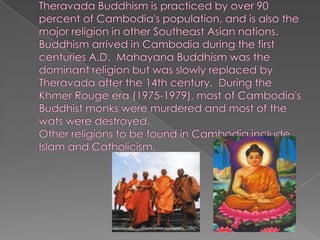
Theravada Buddhism is practiced by over 90 percent of Cambodia's population, and is also the major religion in other Southeast Asian nations.Buddhism arrived in Cambodia during the first centuries A.D.  Mahayana Buddhism was the dominant religion but was slowly replaced by Theravada after the 14th century.  During the Khmer Rouge era (1975-1979), most of Cambodia's Buddhist monks were murdered and most of the wats were destroyed.Other religions to be found in Cambodia include Islam and Catholicism.
Cambodian Literature
The center of Cambodian literature consists of myths and legends passed down orally from generation to generation.  Most of these are based on stories about Buddha's previous lives (Jataka tales), and epics of India (Mahabharata and Ramayana).Stone slabs that give the genealogy of Khmer kings and their contributions to the temples are the earliest written documents (in Khmer and Sanskrit) in Cambodia.In 1938, the first novel was published after printing techniques were introduced to Cambodia by the French. The Khmer Rouge's influence on Cambodian literature was to limit it to poems on agriculture, peasants and revolutionary songs.
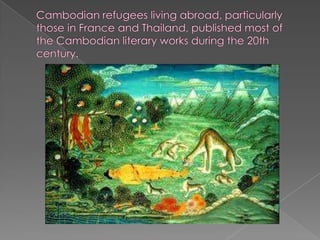
Cambodian refugees living abroad, particularly those in France and Thailand, published most of the Cambodian literary works during the 20th century.
That’s all and thank you for watching!!

My simple presentetion..by dian gabrielle

  • 1.
    Heath’s Montessori LearningCenter Inc. Computer ProjectPrepared by: Dian Gabrielle Ferreras
  • 2.
    “CAMBODIA”~Geography, ~History, ~Language,~Transportation system, ~Economy, ~People, ~Religions, ~Literature
  • 3.
  • 4.
    The national flagof Cambodia was readopted in 1993, after elections returned the monarchy to rule.Since around 1850, the Cambodian flag has featured a depiction of Angkor Wat in the center. The current flag, with a blue border and red central (the stripes are in the ratio 1:2:1) was adopted following Cambodia's independence in 1948. It was used until October 9, 1970, when a new flag was introduced for Lon nol’s Khmer Republic that lasted until the takeover of the Khmer Rouge in 1975. The subsequent state of Democratic Kampuchea, which existed from 1975 to 1979, used a red flag with a three-towered Angkor Watdesign retained in yellow.  
  • 5.
  • 6.
    Cambodia, also knownas Kampochea, is a country located in Southeast Asia that is bordered by Laos, Vietnam, and Thailand.  Covering an area of about 181,035 sq km, Cambodia is about half the size of Vietnam.  The capital of Cambodia is Phnom Penh and has the distinction of also being the largest city. A low-lying alluvial plain in the center of Cambodia makes up most of the country, although in the South there is the Mekong Delta.  There are several mountainous regions, one of which forms a border along the coastline with another separating Cambodia from Thailand. The tenth largest river in the world, the Mekong River, is the longest river in Southeast Asia and the most important river in Cambodia.  One of its important uses is that it is navigable for most of its "run" through the country, as well as the Mekong delta in the South.
  • 7.
    Cambodia is alsohome to the largest lake in Southeast Asia, the Tonle Sap (Great Lake), which connects with the Mekong River in Phnom Penh.  The Tonle Sap enlarges to four times its normal size when the Mekong rises during the monsoon season thus causing the Tonle Sap River to flow northward into the Lake.During the dry season it reverses its flow and goes back into the Mekong River.  As a result of this, The Tonle Sap Lake is a great resource for freshwater fish, actually being one of the richest sources in the world.
  • 8.
    There are twomonsoons which make up Cambodia's climate, a cool, dry, north-eastern one that is rather dry and comes from November to March and a south-western one which brings with it heavy rain, high winds and high humidity from May to early October.December and January are considered to be the coolest months and fall in the dry monsoon season.   Annually, Cambodia gets about 1,400 mm (55 in) and the temp averages around 27 degrees C (80 degrees F).
  • 9.
  • 10.
    The Funan Kingdom,believed to have started around the first century BC, is the first known kingdom of Cambodia.  The kingdom was strongly influenced by Indian culture by  shaping the culture, art and political system.An alphabetical system, religions and architectural styles were also Indian contributions to the Funan Kingdom.  There is archeological evidence of a commercial society in the Mekong Delta that prospered from the 1st to 6th centuries.
  • 11.
    Returning from abroad,a Khmer prince declared himself the ruler of a new kingdom during the 9th century.  Known as Jayavarman II, he started a cult that honored Shiva, a Hindu god, as a devaraja (god-king) which then linked the king to Shiva.
  • 12.
    He also beganthe great achievements in architecture and sculpture while his successors built an immense irrigation system around Angkor..  His successors (26 from the early 9th to the early 15th century), built a tremendous number of temples - of which there are over a thousand sites and stone inscriptions (on temple walls). By the 12th century, Cambodia had spread into other areas, now known as Thailand, Laos, Myanmar and Malaysia (the peninsula).  There is actually still evidence of Khmer inhabitance in Thailand and Laos to this day.  
  • 13.
  • 14.
    Cambodia's official languageis Cambodian, or Khmer.  This language belongs to the Mon-Khmer (Austro-Asiatic) language family and is relatively confusing and difficult for Westerners to manage.French had been the second most popular language until the 1990s, when English made an introduction.  Vietnamese and South Chinese dialects are other languages spoken.
  • 15.
  • 16.
    In 1997, only8% of the roads in Cambodia were paved out of 35,769 km of roadway.  In Phnom Penh, a modern highway links it to Kampong Saom (a deepwater port).Other improvements in roadways are made possible with donations from other countries, namely Japan.  In spite of this, most roadways in Cambodia are not passable for passenger cars.Transportation by bus around Cambodia has been forbidden, but travel is possible by other methods, such as air travel and by train.  There are still many un-detonated mines and other military paraphernalia, so straying from "the beaten path" is not recommended, even in popular areas.
  • 17.
    The civil warand neglect severely damaged Cambodia's transport system, but with assistance and equipment from other countries Cambodia has been upgrading the mainhighways to international standards and most are vastly improved from 2006. Most main roads are now paved.Cambodia has two rail lines, totalling about 612 kilometers (380 mi) of single, one meter gauge track. The lines run from the capital to Sihanoukville on the southern coast, and from Phnom Penh to Sisophon (although trains often run only as far as Battambang). Currently only one passenger train per week operates, between Phnom Penh and Battambang.
  • 18.
    Besides the maininterprovincial traffic artery connecting the capital Phnom Penh with Sihanoukville, resurfacing a former dirt road with concrete / asphalt and implementation of 5 major river crossings by means of bridges have now permanently connected Phnom Penh with Koh Kong and hence there is now uninterrupted road access to neighboring Thailand and their vast road system.
  • 19.
    The nation's extensiveinland waterways were important historically in international trade. The Mekong and the Tonle Sap River, their numerous tributaries, and the Tonle Sap provided avenues of considerable length, including 3,700 kilometers (2,300 mi) navigable all year by craft drawing 0.6 meters (2 ft) and another 282 kilometers (175 mi) navigable to craft drawing 1.8 meters (6 ft).
  • 20.
  • 21.
    From 2004 to2007, the economy grew about 10% per year, driven largely by an expansion in the garment sector, construction, agriculture, and tourism. GDP dropped to below 7% growth in 2008 and probably contracted in 2009 as a result of the global economic slowdown. With the January 2005 expiration of a WTO Agreement on Textiles and Clothing, Cambodian textile producers were forced to compete directly with lower-priced countries such as China, India, Vietnam, and Bangladesh.
  • 22.
    The garment industrycurrently employs more than 280,000 people -about 5% of the work force - and contributes more than 70% of Cambodia's exports. In 2005, exploitable oil deposits were found beneath Cambodia's territorial waters, representing a new revenue stream for the government if commercial extraction begins. Mining also is attracting significant investor interest, particularly in the northern parts of the country. The government has said opportunities exist for mining bauxite, gold, iron and gems. In 2006, a US-Cambodia bilateral Trade and Investment Framework Agreement (TIFA) was signed, and several rounds of discussions have been held since 2007.
  • 23.
    Rubber exports increasedabout 25% in 2009 due to rising global demand. The tourism industry has continued to grow rapidly, with foreign arrivals exceeding 2 million per year in 2007-08, however, economic troubles abroad dampened growth in 2009. The global financial crisis is weakening demand for Cambodian exports, and construction is declining due to a shortage of credit. The long-term development of the economy remains a daunting challenge.
  • 24.
    The Cambodian governmentis working with bilateral and multilateral donors, including the World Bank and IMF, to address the country's many pressing needs. The major economic challenge for Cambodia over the next decade will be fashioning an economic environment in which the private sector can create enough jobs to handle Cambodia's demographic imbalance. More than 50% of the population is less than 21 years old. The population lacks education and productive skills, particularly in the poverty-ridden countryside, which suffers from an almost total lack of basic infrastructure.
  • 25.
  • 26.
    Most of thepeople who live in Cambodia are ethnic Cambodian, averaging between 90-95% of the total population making Cambodia the most homogenous country in South-East Asia.Vietnamese make up the largest minority group with about five percent of the population and Chinese make up another one percent.  With one of the highest population growth rates in Asia (2.5% per year), Cambodia had a population of a little over 11million in 1998.   Due to the Khmer Rouge rule during which residents were forced to move out of the cities, most of the population lives in rural areas, with only about a tenth living in urban areas. 90% of its population is of Khmer origin and speaks the Khmer language, the country's official language. The remainder include Chinese, Vietnamese, Cham and Khmer Loeu.
  • 27.
    The Khmer languageis a member of the Mon-Khmer subfamily of the Austroasiatic language group. French, once the language of government in Indochina, is still spoken by some older Cambodians. French is also the language of instruction in some schools and universities that are funded by the government of France. Cambodian French, a remnant of the country's colonial past, is a dialect found in Cambodia and is sometimes used in government.
  • 28.
  • 29.
    Theravada Buddhism ispracticed by over 90 percent of Cambodia's population, and is also the major religion in other Southeast Asian nations.Buddhism arrived in Cambodia during the first centuries A.D.  Mahayana Buddhism was the dominant religion but was slowly replaced by Theravada after the 14th century.  During the Khmer Rouge era (1975-1979), most of Cambodia's Buddhist monks were murdered and most of the wats were destroyed.Other religions to be found in Cambodia include Islam and Catholicism.
  • 30.
  • 31.
    The center ofCambodian literature consists of myths and legends passed down orally from generation to generation.  Most of these are based on stories about Buddha's previous lives (Jataka tales), and epics of India (Mahabharata and Ramayana).Stone slabs that give the genealogy of Khmer kings and their contributions to the temples are the earliest written documents (in Khmer and Sanskrit) in Cambodia.In 1938, the first novel was published after printing techniques were introduced to Cambodia by the French. The Khmer Rouge's influence on Cambodian literature was to limit it to poems on agriculture, peasants and revolutionary songs.
  • 32.
    Cambodian refugees livingabroad, particularly those in France and Thailand, published most of the Cambodian literary works during the 20th century.
  • 33.
    That’s all andthank you for watching!!