Download as PDF, PPTX
![A
Abacus:[noun] /ˈæb.Ə.Kəs/ it’s a tool
for counting and calculating.
Add/addition :[noun]
/æd/or/əˈdɪʃ.Ən/ to put two or more
numbers or amounts together to get a
total.](https://image.slidesharecdn.com/myownmath27sdictionary-161124003041/85/My-own-math-s-dictionary-2-320.jpg)
![Addend: [Noun]/ ăd′ĕnd′ / any of a group of
numbers or terms added together to form a sum.
Angle: [Noun]/ˈæŋ.ɡəl/ the space between two
lines or surfaces at the point at which they touch
each other, measured in degrees.](https://image.slidesharecdn.com/myownmath27sdictionary-161124003041/85/My-own-math-s-dictionary-3-320.jpg)
![Annual: [adjective] /ˈæn.Ju.Əl/
relating to a period of one year.
Approximation: [noun]
/əˌprɑːk.Səˈmeɪ.Ʃən/ a guess of a number
that is not exact but that is close.
Arithmetic: [Noun] /əˈrɪθ.Mə.Tɪk/
calculations involving adding and
multiplying, etc. Numbers.](https://image.slidesharecdn.com/myownmath27sdictionary-161124003041/85/My-own-math-s-dictionary-4-320.jpg)
![B
Balance: [noun]/ˈbæl.Əns/ having the same weight (mass) on
either side.
Base: [noun] /beɪs/ the bottom part of an object.
Billion:[Noun] /ˈbɪl.Jən/ a thousand millions.
Brackets: [Noun] a part of symbols used to enclose a section of a
mathematical expression.
Balance](https://image.slidesharecdn.com/myownmath27sdictionary-161124003041/85/My-own-math-s-dictionary-5-320.jpg)
![C Calculator:[noun] /ˈkæl.Kjə.Leɪ.T̬ɚ/ a
small electronic device that is used for
doing calculations.
Calendar:[noun] /ˈkæl.Ən.Dɚ/ a printed
table showing all the days, weeks, and
months of a year.
Celsius:[noun] /ˈsel.Si.Əs/ a temperature
measurement scale used in the metric
system.
CALCULATOR](https://image.slidesharecdn.com/myownmath27sdictionary-161124003041/85/My-own-math-s-dictionary-6-320.jpg)
![Century:[noun] /ˈsen.Tʃər.I/ one
hundred years.
Circle: [noun]/ˈsɝː.Kəl/ a
continuous curved line.
Coefficient: [noun] /ˌkoʊ.ɪˈfɪʃ.Ənt/ a
number which multiplies a variable.](https://image.slidesharecdn.com/myownmath27sdictionary-161124003041/85/My-own-math-s-dictionary-7-320.jpg)
![• Corner: [noun] /ˈkɔːr.Nɚ/ points where the
edges of a solid figure meet.
• Cube: [noun]/kjuːb/ a solid object with six
squares sides of equal size.
• Curve: [noun]/kɝːv/ a line tha is not straight.
Corner
CURVE](https://image.slidesharecdn.com/myownmath27sdictionary-161124003041/85/My-own-math-s-dictionary-8-320.jpg)
![D Date: [noun] /deɪt/ record showing a
given day, month and year.
Day: [noun] /deɪ/ a period of 24
hours, it’s a period of time when the
earth turns around itself.
Decade: [noun] /ˈdek.Eɪd/ a period
of ten years.](https://image.slidesharecdn.com/myownmath27sdictionary-161124003041/85/My-own-math-s-dictionary-9-320.jpg)
![• Denominator:
[noun]/dɪˈnɑː.Mə.Neɪ.T̬ɚ/ the
number below the line of a
fraction.
• Digit: [noun] /ˈdɪdʒ.ɪt/ any one
of the ten numbers 0 to 9.
• Distance: [noun]/ˈdɪs.Təns/ the
length between two
points(objects)](https://image.slidesharecdn.com/myownmath27sdictionary-161124003041/85/My-own-math-s-dictionary-10-320.jpg)
![• Division: [noun] /dɪˈvɪʒ.Ən/ sharing or
grouping a number into equal parts.
• Divisor: [noun] /dɪˈvaɪ.Zɚ/ a number by
which another number is divided in a
calculation.
• Dividend: [noun] /ˈdɪv.Ə.Dend/ the
number being divided.](https://image.slidesharecdn.com/myownmath27sdictionary-161124003041/85/My-own-math-s-dictionary-11-320.jpg)
![• Double: [adjective]/ˈdʌb.Əl/
multiplied by 2, twice as much.
• Dozen: [noun] /ˈdʌz.Ən/ a
group or set of 12.](https://image.slidesharecdn.com/myownmath27sdictionary-161124003041/85/My-own-math-s-dictionary-12-320.jpg)
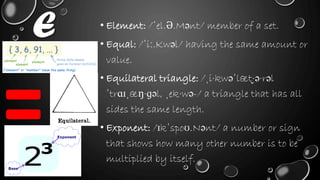
![F Factor:[noun] /ˈfæk.Tɚ/ a
whole number that divides
exactly into another number.
Finite: [adjective]/ˈfaɪ.Naɪt/
able to be counted, limited.
Flashcard:[noun] /ˈflæʃ
ˌkɑːrd/ series of cards used for
practice.](https://image.slidesharecdn.com/myownmath27sdictionary-161124003041/85/My-own-math-s-dictionary-14-320.jpg)
![Fortnight: [noun]/ˈfɔːrt.Naɪt/ two weeks or fourteen days.
Fraction: [noun]/ˈfræk.Ʃən/ any part of a group, number or
whole.
Frequency: [noun]/ˈfriː.Kwən.Si/ the number of times a
particular item appears in a set of data.
Function: [noun]/ˈfʌŋk.Ʃən/ a mathematical relationship
between two values.
Fraction Frequency](https://image.slidesharecdn.com/myownmath27sdictionary-161124003041/85/My-own-math-s-dictionary-15-320.jpg)
![• Geometry:[noun] /dʒiˈɑː.Mə.Tri/ area of
mathematics dealing with solids, surfaces,
points, lines, curves and angles, and their
relationships in space.
• Gram (g):[noun] /ɡræm/ a standard
metric unit for measuring mass.
• Grouping: [noun]/ˈɡruː.Pɪŋ/ dividing
things into equal groups (sets)
• GMT: [noun]/ˌdʒiː.Emˈtiː/ standard time
measured at greenwich, england.
G](https://image.slidesharecdn.com/myownmath27sdictionary-161124003041/85/My-own-math-s-dictionary-16-320.jpg)
![H
Half:[adjective] /hɑːf/ one of two equal
parts.
Heptagon:[noun] /ˈhep.Tə.ɡɑːn/ a
polygon with 7 sides.
Horizontal:[adjective] /ˌhɔːr.ɪˈzɑːn.T̬əl/
parallel to the horizon
Hour:[noun] /aʊr/ a period of 60
minutes.
Hundred:[number] /ˈhʌn.Drəd/ whole
number equal to 10x10.](https://image.slidesharecdn.com/myownmath27sdictionary-161124003041/85/My-own-math-s-dictionary-17-320.jpg)
![I,i Impossible:[adjective] /ɪmˈpɑː.Sə.Bəl/
no chance- will not happen.
Increase: [verb]/ɪnˈkriːs/ get larger in
size or number.
Inequality:[noun] /ˌɪn.ɪˈkwɑː.Lə.T̬i/
not equal in size, amount or value.
Infinite: [adjective]/ˈɪn.Fə.Nət/ unable
to be counted, unlimited.](https://image.slidesharecdn.com/myownmath27sdictionary-161124003041/85/My-own-math-s-dictionary-18-320.jpg)
![Interval:[noun] /ˈɪn.T̬ɚ.Vəl/ distance
between two points.
Irrational number:[noun] /ɪˌræʃ.Ən.Əl
ˈnʌm.Bɚ/ a real number that can be
written as: a nonrepeating or
nonterminating decimal but not as a
fraction.
Irregular:[adjective] /ɪˈreɡ.Jə.Lɚ/ a shape or
mathematical object which is not regular.
INTERVAL
Irrational Number](https://image.slidesharecdn.com/myownmath27sdictionary-161124003041/85/My-own-math-s-dictionary-19-320.jpg)
![K Keyword:[noun] /ˈkiː.Wɝːd/ it can help us
solve mathematical word problems.
Kilogram:[noun] /ˈkɪl.Ə.ɡræm/ a unit of
mass equal to 1000 grams.
Kilometer:[noun] /kɪˈlɑː.Mə.T̬ɚ/ standard
metric unit for measuring distance.
Kite:[noun] /kaɪt/ plane shape having two sets
of equal sides and one of opposite angles that
are equal.
Keyword
Kite](https://image.slidesharecdn.com/myownmath27sdictionary-161124003041/85/My-own-math-s-dictionary-20-320.jpg)
![L Least:[adverb] /liːst/ the smallest in a
group.
Length:[noun] /leŋθ/ distance from
one end to the other.
Less:[adverb] /les/ not as many as.
Likely:[adjective] /ˈlaɪ.Kli/ will
probably happen.
Least](https://image.slidesharecdn.com/myownmath27sdictionary-161124003041/85/My-own-math-s-dictionary-21-320.jpg)
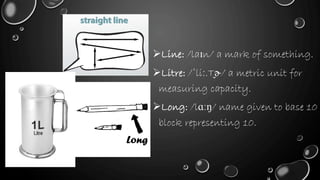
![MMass: [adjective]/mæs/ quantity of matter
in an object.
Mathematics: [noun]/ˌmæθˈmæt̬.ɪks/ the
study of numbers, quantities, shapes and
space using mathematical processes, riles
and symbols.
Maximum:[adjective] /ˈmæk.Sə.Məm/
highest or greatest amount or value.](https://image.slidesharecdn.com/myownmath27sdictionary-161124003041/85/My-own-math-s-dictionary-23-320.jpg)
![Mean:[verb] /miːn/ average of a
number of different amounts.
Member:[noun] /ˈmem.Bɚ/ element of
a set.
Meter:[noun] /ˈmiː.T̬ɚ/ a metric unit
for measuring length, equal to 100
centimeters.
Member](https://image.slidesharecdn.com/myownmath27sdictionary-161124003041/85/My-own-math-s-dictionary-24-320.jpg)
![Millennium:[noun] /mɪˈlen.I.Əm/
a period of 1000 years.
Million:[number] /ˈmɪl.Jən/ one
followed by 6 zeros. Equal to one
thousand thousands.
Minimum:[noun] /ˈmɪn.Ə.Məm/
lowest or least amount or value.](https://image.slidesharecdn.com/myownmath27sdictionary-161124003041/85/My-own-math-s-dictionary-25-320.jpg)
![Minus:[preposition] /ˈmaɪ.Nəs/ to substract.
Minute:[noun] /ˈmɪn.ɪt/ a unit of time is
equal to 60 seconds.
Month:[noun] /mʌnθ/ a period of about four
weeks.
Minus](https://image.slidesharecdn.com/myownmath27sdictionary-161124003041/85/My-own-math-s-dictionary-26-320.jpg)
![Multiplication:
[noun]/ˌmʌl·tə·plɪˈkeɪ·ʃən/ the
process of multiplying numbers.
Multiple:[noun] /ˈmʌl.Tə.Pəl/
the number doing the
multiplying.
Multiplicand: [noun]the
number being multiplied.](https://image.slidesharecdn.com/myownmath27sdictionary-161124003041/85/My-own-math-s-dictionary-27-320.jpg)
![NNatural number:[noun] a counting number from
one to infinity.
Negative number:[noun] a number less than zero.
Number: [noun]/ˈnʌm.Bɚ/ describes quantities or
values.
Numeral:[noun] /ˈnuː.Mə.Rəl/ a symbol that
represents a number.
Numerator: [noun]/ˈnuː.Mə.Reɪ.T̬ɚ/ the number
above the line in a fraction.](https://image.slidesharecdn.com/myownmath27sdictionary-161124003041/85/My-own-math-s-dictionary-28-320.jpg)
![O • Octagon:[noun] /ɑk·təˌɡɑn/ a polygon
having eight angles.
• Operations:[noun] / ˌɑp·əˈreɪ·ʃən/ a process
of a practical or mechanical nature in some
form or work.
• Ordinal:[noun] / ˈɔr·dən·əl/ a number such
as 1st, 2nd, 3rd, 4th, that shows the position of
something in a list of things.
• One:[number] /wʌn/ the number 1](https://image.slidesharecdn.com/myownmath27sdictionary-161124003041/85/My-own-math-s-dictionary-29-320.jpg)
![P
Pyramid:[noun] /ˈpɪr.Ə.Mɪd/ a solid object
with a square base and fourtriangular sides
that form a point at the top.
Polynomial: [noun] /ˌpɑl·əˈnoʊ·mi·əl/ the
result or adding or substracting two or more
numbers or variables.
Parallel:[adjective] /ˈpær.Ə.Lel/if two or
more lines are parallel, the distance between
them is the same all long their length.](https://image.slidesharecdn.com/myownmath27sdictionary-161124003041/85/My-own-math-s-dictionary-30-320.jpg)
![Proportion: [noun]/prəˈpɔː.Ʃən/ the
number or amount of a group or part of
something when compared to the whole.
Problem:[noun] /ˈprɒb.Ləm/ a
situation, person, or thing that needs
attention and needs to be deal with or
solved.
Proportion](https://image.slidesharecdn.com/myownmath27sdictionary-161124003041/85/My-own-math-s-dictionary-31-320.jpg)
![QQuarter: [noun]/ˈkwɔː.Tər/ one of four equal or
almost equal parts of something.
Quantity:[noun] /ˈkwɔː.Tər/ the amount or
number of something, especially that can be
measured.
Quadrilateral:[noun] /ˌkwɒd.Rɪˈlæt.Ər.Əl/ a
flat shape with pour straight sides.
Quantitative:[adjective]/ˈkwɒn.Tɪ.Tə.Tɪv/
relating to numbers or amounts.](https://image.slidesharecdn.com/myownmath27sdictionary-161124003041/85/My-own-math-s-dictionary-32-320.jpg)
![R Raise:[verb] /reɪz/ to lift something to a
higher position.
Rectangle: [noun]/ˈrek.Tæŋ.ɡəl/ a flat
shape with four angles and four sides, with
opposite sides of equal length.
Radius: [noun] /ˈreɪ.Di.Əs/ a straight line
joining the center of a circle to its edge or the
center of a sphere to its surface.
Raise](https://image.slidesharecdn.com/myownmath27sdictionary-161124003041/85/My-own-math-s-dictionary-33-320.jpg)
![Rhombus: [noun]/ˈrɒm.Bəs/ a flat
shape that has four sides that are all
of equal length.
Rotation: [noun]/rəʊˈteɪ.Ʃən/
movement in a circle around a fixed
point.](https://image.slidesharecdn.com/myownmath27sdictionary-161124003041/85/My-own-math-s-dictionary-34-320.jpg)
![S
Second: [predeterminer] /ˈsek.Ənd/
immediately after the first and before
any others.
Semicircle: [noun] /ˈsem.Iˌsɜː.Kəl/
half a circle.
Score:[verb] /skɔːr/ to win or get a
point, goal, etc. In a competition, sport,
game or test.
Sequence:[noun] /ˈsiː.Kwəns/ a series
of related things or events, or the order
in which they follor each other.Sequence](https://image.slidesharecdn.com/myownmath27sdictionary-161124003041/85/My-own-math-s-dictionary-35-320.jpg)
![T Third: [ordinal number] /θɜːd/ 3rd
written as a word
Triangle: [noun] /ˈtraɪ.Æŋ.ɡəl/ a flat
shape with three straight sides.
Trinomial:[noun] /traɪˈnoʊ.Mi.Əl/ a
mathematical statement with three
numbers or variables.](https://image.slidesharecdn.com/myownmath27sdictionary-161124003041/85/My-own-math-s-dictionary-36-320.jpg)
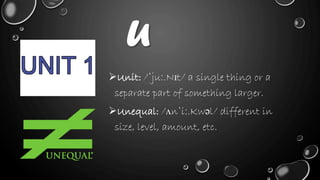
![V
Value:[noun] /ˈvæl.Juː/ the amount
of money that can be received for
something
Variable: [adjective] /ˈveə.Ri.Ə.Bəl/
likely to change often.](https://image.slidesharecdn.com/myownmath27sdictionary-161124003041/85/My-own-math-s-dictionary-38-320.jpg)
![W Week:[noun] /wiːk/ unit of
time equal to 7 days.
Whole:[adjective] /hoʊl/ all,
everything, total amount, all the
parts.](https://image.slidesharecdn.com/myownmath27sdictionary-161124003041/85/My-own-math-s-dictionary-39-320.jpg)


This document contains definitions for mathematical terms from A to V in both English and Spanish. It includes definitions for common terms like addition, angle, calculator, and variable. It also defines less common terms like abacus, approximaton, and trinomial. The purpose is to serve as the author's personal math dictionary to define key terms in both languages. It provides concise, simple explanations of mathematical concepts in a reference format.


