MUTUAL FUNDS IN INDIA
By,
Mohammed Sameer,
II nd, MBA (gen).
UNDER THE GUIDANCE OF
Dr. Vasantha MBA, M. Com, M. Phil, Phd, DSCM.
SCHOOL OF MANAGEMENT STUDIES
VELS UNIVERSITY
CONCEPT OF MUTUAL FUNDS
• According to Pierce, James L, it is a non depositary financial intermediaries
which acts an important vehicle for bringing wealth holders and deficit units
together directly.
• Weston, J. Fred & Brigham, Eugene. F in their looks of managerial finance
state that MF are corporations that accepts dollars from savers & then use the
dollars to buy a stock, LT & ST. Instruments issued by business. These corporation
pool funds & thus reduce risk by diversification.
HISTORY
• Introduced in the yr 1963 by Unit trust of India (1963).
• Growth was slow.
• Accelerated in 1987.
• When non UTI players entered, In both aspect Quality & Quantity.
• Before the monopoly of the market had seen an ending phase.
• Growth was not familiarised
MUTUAL FUND PHASES
• There are totally four phases
1. First Phase (1964-87).
2. Second Phase (1987-93) Entry of public sector.
3. Third Phase (1993-03) Entry of private sector
4. Fourth Phase.
FIRST PHASE (1964-87)
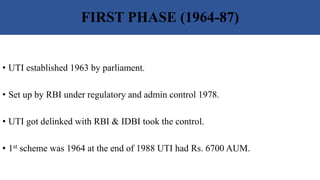
• UTI established 1963 by parliament.
• Set up by RBI under regulatory and admin control 1978.
• UTI got delinked with RBI & IDBI took the control.
• 1st scheme was 1964 at the end of 1988 UTI had Rs. 6700 AUM.
II PHASE (1987-93) ENTRY OF PUBLIC SECTOR
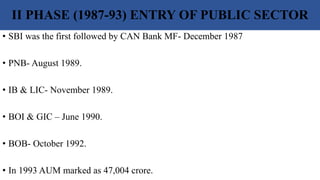
• SBI was the first followed by CAN Bank MF- December 1987
• PNB- August 1989.
• IB & LIC- November 1989.
• BOI & GIC – June 1990.
• BOB- October 1992.
• In 1993 AUM marked as 47,004 crore.
THIRD PHASE 1993-03 ENTRY OF PRIVATE
SECTOR
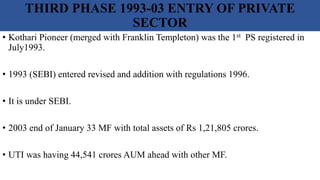
• Kothari Pioneer (merged with Franklin Templeton) was the 1st PS registered in
July1993.
• 1993 (SEBI) entered revised and addition with regulations 1996.
• It is under SEBI.
• 2003 end of January 33 MF with total assets of Rs 1,21,805 crores.
• UTI was having 44,541 crores AUM ahead with other MF.
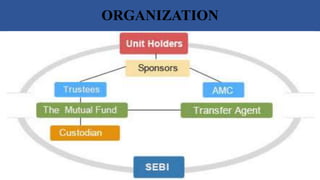
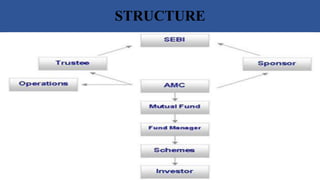
ORGANIZATION
STRUCTURE
Mutual fiunds
Mutual fiunds
Mutual fiunds
Mutual fiunds

Mutual fiunds

  • 1.
  • 2.
    By, Mohammed Sameer, II nd,MBA (gen). UNDER THE GUIDANCE OF Dr. Vasantha MBA, M. Com, M. Phil, Phd, DSCM. SCHOOL OF MANAGEMENT STUDIES VELS UNIVERSITY
  • 3.
    CONCEPT OF MUTUALFUNDS • According to Pierce, James L, it is a non depositary financial intermediaries which acts an important vehicle for bringing wealth holders and deficit units together directly. • Weston, J. Fred & Brigham, Eugene. F in their looks of managerial finance state that MF are corporations that accepts dollars from savers & then use the dollars to buy a stock, LT & ST. Instruments issued by business. These corporation pool funds & thus reduce risk by diversification.
  • 6.
    HISTORY • Introduced inthe yr 1963 by Unit trust of India (1963). • Growth was slow. • Accelerated in 1987. • When non UTI players entered, In both aspect Quality & Quantity. • Before the monopoly of the market had seen an ending phase. • Growth was not familiarised
  • 7.
    MUTUAL FUND PHASES •There are totally four phases 1. First Phase (1964-87). 2. Second Phase (1987-93) Entry of public sector. 3. Third Phase (1993-03) Entry of private sector 4. Fourth Phase.
  • 8.
    FIRST PHASE (1964-87) •UTI established 1963 by parliament. • Set up by RBI under regulatory and admin control 1978. • UTI got delinked with RBI & IDBI took the control. • 1st scheme was 1964 at the end of 1988 UTI had Rs. 6700 AUM.
  • 9.
    II PHASE (1987-93)ENTRY OF PUBLIC SECTOR • SBI was the first followed by CAN Bank MF- December 1987 • PNB- August 1989. • IB & LIC- November 1989. • BOI & GIC – June 1990. • BOB- October 1992. • In 1993 AUM marked as 47,004 crore.
  • 10.
    THIRD PHASE 1993-03ENTRY OF PRIVATE SECTOR • Kothari Pioneer (merged with Franklin Templeton) was the 1st PS registered in July1993. • 1993 (SEBI) entered revised and addition with regulations 1996. • It is under SEBI. • 2003 end of January 33 MF with total assets of Rs 1,21,805 crores. • UTI was having 44,541 crores AUM ahead with other MF.
  • 11.
  • 16.