Definition and
Importance ofCRM
Strategic Customer Engagement
Effective CRM systems enable culinary
businesses to create personalized experiences
by analyzing customer data, which fosters
loyalty and enhances customer satisfaction
through tailored services and targeted
marketing strategies.
4.
01 02 03
KeyComponents of CRM
Data-Driven Decision
Making
Enhanced Customer
Engagement
Targeted Marketing
Strategies
Utilizing customer data analytics
allows culinary businesses to identify
trends and preferences, enabling
informed decisions that enhance
menu offerings and marketing
strategies tailored to customer
needs.
By implementing effective interaction
tracking, culinary professionals can
respond promptly to customer
inquiries and feedback, fostering a
more engaging and satisfying dining
experience.
Customer segmentation enables
culinary establishments to develop
specific marketing campaigns that
resonate with distinct customer
groups, improving outreach and
increasing customer loyalty through
personalized promotions.
5.
Benefits of EffectiveCRM
Enhanced
Customer Insights
Optimized
Operational
Efficiency
Effective CRM systems provide culinary
businesses with deep insights into
customer preferences and behaviors,
allowing for the development of tailored
experiences. This data-driven approach
not only improves customer satisfaction
but also fosters loyalty, as patrons feel
valued and understood through
personalized interactions and services.
By automating routine tasks and
streamlining processes, effective CRM
enhances productivity within culinary
establishments. This efficiency allows
staff to focus on delivering exceptional
service, ultimately leading to improved
customer experiences and increased
operational effectiveness, which are
crucial for maintaining a competitive
edge in the culinary industry.
6.
CRM in theCulinary
Industry
Customer-Centric Approach
Implementing CRM in the culinary industry
allows businesses to prioritize customer
preferences and feedback, leading to enhanced
dining experiences that not only meet but
anticipate customer needs, thereby fostering
long-term loyalty and repeat patronage.
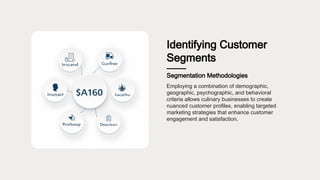
Identifying Customer
Segments
Segmentation Methodologies
Employinga combination of demographic,
geographic, psychographic, and behavioral
criteria allows culinary businesses to create
nuanced customer profiles, enabling targeted
marketing strategies that enhance customer
engagement and satisfaction.
9.
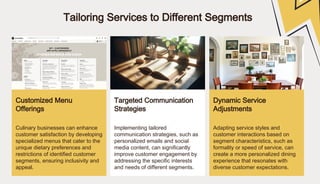
Tailoring Services toDifferent Segments
Customized Menu
Offerings
Targeted Communication
Strategies
Dynamic Service
Adjustments
Culinary businesses can enhance
customer satisfaction by developing
specialized menus that cater to the
unique dietary preferences and
restrictions of identified customer
segments, ensuring inclusivity and
appeal.
Implementing tailored
communication strategies, such as
personalized emails and social
media content, can significantly
improve customer engagement by
addressing the specific interests
and needs of different segments.
Adapting service styles and
customer interactions based on
segment characteristics, such as
formality or speed of service, can
create a more personalized dining
experience that resonates with
diverse customer expectations.
10.
01 02 03
Toolsfor Customer Segmentation
Data Visualization
Techniques
Qualitative Insights from
Feedback
Integration of Multiple
Data Sources
Utilizing advanced data
visualization techniques
helps culinary businesses
to interpret complex
customer data effectively,
revealing patterns and
trends that inform
segmentation strategies
and enhance targeted
marketing efforts.
Analyzing qualitative
feedback from customer
surveys provides deeper
insights into customer
motivations and
preferences, allowing
culinary professionals to
refine their offerings and
better meet the needs of
specific segments.
Combining data from
various sources, such as
CRM systems and social
media analytics, enables
a comprehensive
understanding of
customer behavior,
facilitating more accurate
segmentation and
personalized marketing
initiatives.
11.
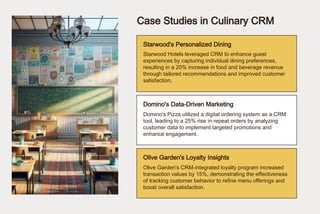
Case Studies inCulinary CRM
Starwood's Personalized Dining
Domino's Data-Driven Marketing
Olive Garden's Loyalty Insights
Starwood Hotels leveraged CRM to enhance guest
experiences by capturing individual dining preferences,
resulting in a 20% increase in food and beverage revenue
through tailored recommendations and improved customer
satisfaction.
Domino's Pizza utilized a digital ordering system as a CRM
tool, leading to a 25% rise in repeat orders by analyzing
customer data to implement targeted promotions and
enhance engagement.
Olive Garden's CRM-integrated loyalty program increased
transaction values by 15%, demonstrating the effectiveness
of tracking customer behavior to refine menu offerings and
boost overall satisfaction.
01 02 03
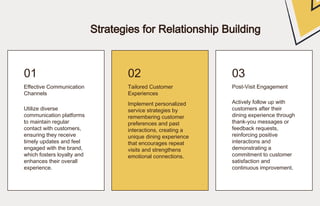
Strategiesfor Relationship Building
Effective Communication
Channels
Tailored Customer
Experiences
Post-Visit Engagement
Utilize diverse
communication platforms
to maintain regular
contact with customers,
ensuring they receive
timely updates and feel
engaged with the brand,
which fosters loyalty and
enhances their overall
experience.
Implement personalized
service strategies by
remembering customer
preferences and past
interactions, creating a
unique dining experience
that encourages repeat
visits and strengthens
emotional connections.
Actively follow up with
customers after their
dining experience through
thank-you messages or
feedback requests,
reinforcing positive
interactions and
demonstrating a
commitment to customer
satisfaction and
continuous improvement.
14.
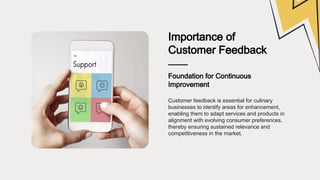
Importance of
Customer Feedback
Foundationfor Continuous
Improvement
Customer feedback is essential for culinary
businesses to identify areas for enhancement,
enabling them to adapt services and products in
alignment with evolving consumer preferences,
thereby ensuring sustained relevance and
competitiveness in the market.
15.
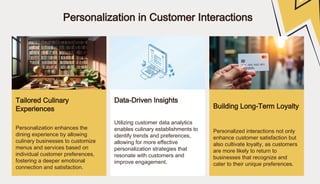
Personalization in CustomerInteractions
Tailored Culinary
Experiences
Data-Driven Insights
Building Long-Term Loyalty
Personalization enhances the
dining experience by allowing
culinary businesses to customize
menus and services based on
individual customer preferences,
fostering a deeper emotional
connection and satisfaction.
Utilizing customer data analytics
enables culinary establishments to
identify trends and preferences,
allowing for more effective
personalization strategies that
resonate with customers and
improve engagement.
Personalized interactions not only
enhance customer satisfaction but
also cultivate loyalty, as customers
are more likely to return to
businesses that recognize and
cater to their unique preferences.
16.
01 02 03
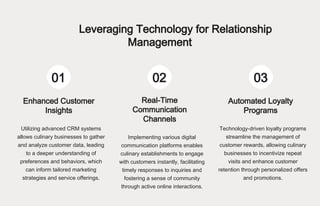
LeveragingTechnology for Relationship
Management
Enhanced Customer
Insights
Real-Time
Communication
Channels
Automated Loyalty
Programs
Utilizing advanced CRM systems
allows culinary businesses to gather
and analyze customer data, leading
to a deeper understanding of
preferences and behaviors, which
can inform tailored marketing
strategies and service offerings.
Implementing various digital
communication platforms enables
culinary establishments to engage
with customers instantly, facilitating
timely responses to inquiries and
fostering a sense of community
through active online interactions.
Technology-driven loyalty programs
streamline the management of
customer rewards, allowing culinary
businesses to incentivize repeat
visits and enhance customer
retention through personalized offers
and promotions.
Overview of PopularCRM Software
Diverse
Functionality
Across Platforms
Scalability and
Customization
Options
Popular CRM software such as
Salesforce, HubSpot, and Zoho offer a
range of functionalities tailored to the
culinary industry, including sales
management, customer service
automation, and marketing tools,
enabling businesses to enhance
customer engagement and streamline
operations effectively.
Many CRM solutions provide scalable
features that cater to culinary
establishments of varying sizes, allowing
for customization based on specific
business needs, which is essential for
adapting to market changes and
improving customer relationship
management strategies.
19.
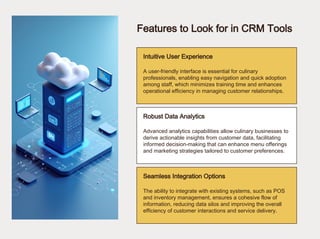
Features to Lookfor in CRM Tools
Intuitive User Experience
Robust Data Analytics
Seamless Integration Options
A user-friendly interface is essential for culinary
professionals, enabling easy navigation and quick adoption
among staff, which minimizes training time and enhances
operational efficiency in managing customer relationships.
Advanced analytics capabilities allow culinary businesses to
derive actionable insights from customer data, facilitating
informed decision-making that can enhance menu offerings
and marketing strategies tailored to customer preferences.
The ability to integrate with existing systems, such as POS
and inventory management, ensures a cohesive flow of
information, reducing data silos and improving the overall
efficiency of customer interactions and service delivery.
20.
Integrating CRM with
CulinaryOperations
Streamlined Customer Interactions
The integration of CRM systems in culinary
operations allows for the automation of
customer interactions, enabling staff to
efficiently manage reservations, track customer
preferences, and personalize communication,
which significantly enhances the overall dining
experience and fosters long-term customer
loyalty.
21.
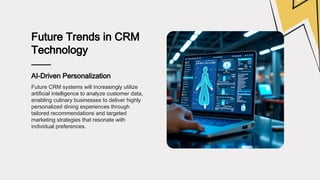
Future Trends inCRM
Technology
AI-Driven Personalization
Future CRM systems will increasingly utilize
artificial intelligence to analyze customer data,
enabling culinary businesses to deliver highly
personalized dining experiences through
tailored recommendations and targeted
marketing strategies that resonate with
individual preferences.
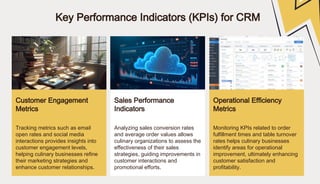
Key Performance Indicators(KPIs) for CRM
Customer Engagement
Metrics
Sales Performance
Indicators
Operational Efficiency
Metrics
Tracking metrics such as email
open rates and social media
interactions provides insights into
customer engagement levels,
helping culinary businesses refine
their marketing strategies and
enhance customer relationships.
Analyzing sales conversion rates
and average order values allows
culinary organizations to assess the
effectiveness of their sales
strategies, guiding improvements in
customer interactions and
promotional efforts.
Monitoring KPIs related to order
fulfillment times and table turnover
rates helps culinary businesses
identify areas for operational
improvement, ultimately enhancing
customer satisfaction and
profitability.
24.
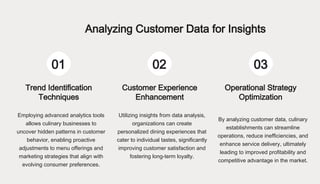
01 02 03
AnalyzingCustomer Data for Insights
Trend Identification
Techniques
Customer Experience
Enhancement
Operational Strategy
Optimization
Employing advanced analytics tools
allows culinary businesses to
uncover hidden patterns in customer
behavior, enabling proactive
adjustments to menu offerings and
marketing strategies that align with
evolving consumer preferences.
Utilizing insights from data analysis,
organizations can create
personalized dining experiences that
cater to individual tastes, significantly
improving customer satisfaction and
fostering long-term loyalty.
By analyzing customer data, culinary
establishments can streamline
operations, reduce inefficiencies, and
enhance service delivery, ultimately
leading to improved profitability and
competitive advantage in the market.
25.
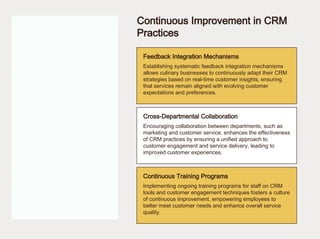
Continuous Improvement inCRM
Practices
Feedback Integration Mechanisms
Cross-Departmental Collaboration
Continuous Training Programs
Establishing systematic feedback integration mechanisms
allows culinary businesses to continuously adapt their CRM
strategies based on real-time customer insights, ensuring
that services remain aligned with evolving customer
expectations and preferences.
Encouraging collaboration between departments, such as
marketing and customer service, enhances the effectiveness
of CRM practices by ensuring a unified approach to
customer engagement and service delivery, leading to
improved customer experiences.
Implementing ongoing training programs for staff on CRM
tools and customer engagement techniques fosters a culture
of continuous improvement, empowering employees to
better meet customer needs and enhance overall service
quality.










![Customer-Relationship-Management-CRM-Systems-Enhancing-Customer-Service[1].pptx](https://cdn.slidesharecdn.com/ss_thumbnails/customer-relationship-management-crm-systems-enhancing-customer-service1-241010064732-2247457a-thumbnail.jpg?width=640&height=640&fit=bounds)


