Rigor mortis occurs after death. How do
the muscles remain contracted without
ATP?
Thinker & Communicator
Title: Muscle contraction
Date: 29 March 2023
 Understand the process of contraction of skeletal muscle in terms of the sliding filament
theory, including the role of actin, myosin, troponin, tropomyosin, calcium ions (Ca2+), ATP
and ATPase.
Homework: Complete
Class Notebook
First things first…!
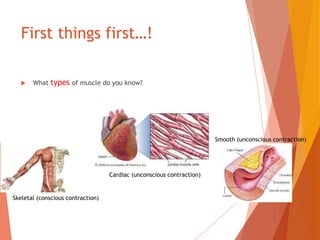
 What types of muscle do you know?
Skeletal (conscious contraction)
Smooth (unconscious contraction)
Cardiac (unconscious contraction)
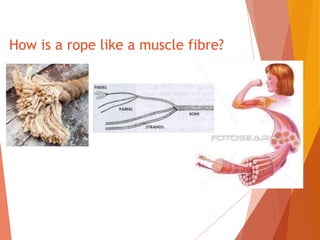
How is a rope like a muscle fibre?
The structure of striated skeletal
muscle.
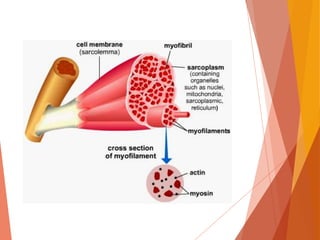
 Each muscle is called a fibre. Each fibre
made up of a bundle of myofibrils.
 Each myofibril is made of myofilaments -
actin and myosin.
 The myofilaments are arranged so that
each myosin is surrounded by 6 actins
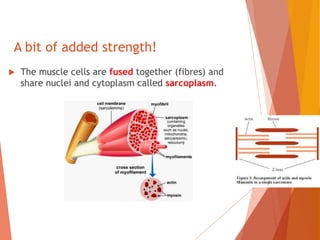
A bit of added strength!
 The muscle cells are fused together (fibres) and
share nuclei and cytoplasm called sarcoplasm.
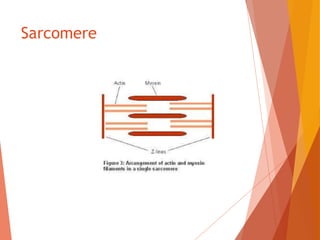
Sarcomere
Microscopic structure

The lighter bands are called I
bands (isotropic). They are
lighter because the actin and
myosin filaments are not
overlapping
The darker bands are called A
bands (anisotropic). They are
darker because the actin and
myosin filaments are
overlapping
Task: Add labels to
your sarcomere and draw
a diagram to represent
the actin and myosin
filaments
H Zone
Note: STRIATED MUSCLE. : muscle tissue that is marked by transverse
dark and light bands
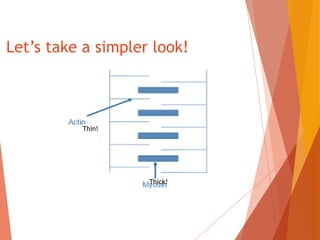
Let’s take a simpler look!
Thin!
Thick!
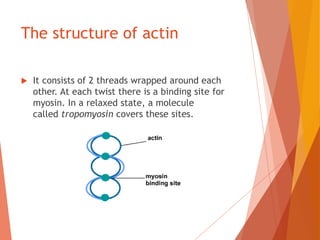
The structure of actin
 It consists of 2 threads wrapped around each
other. At each twist there is a binding site for
myosin. In a relaxed state, a molecule
called tropomyosin covers these sites.
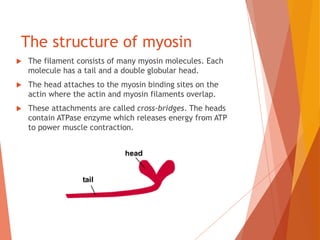
The structure of myosin
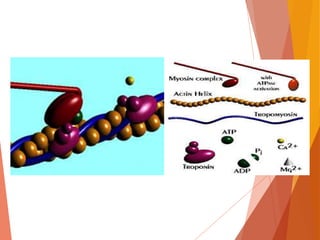
 The filament consists of many myosin molecules. Each
molecule has a tail and a double globular head.
 The head attaches to the myosin binding sites on the
actin where the actin and myosin filaments overlap.
 These attachments are called cross-bridges. The heads
contain ATPase enzyme which releases energy from ATP
to power muscle contraction.
Muscle contraction
 Contraction occurs when an impulses from
a motor neurone reaches the synapse at
the junction with the muscle.
Sliding filament Hypothesis.
 Acetylcholine, a neurotransmitter substance, is released into the synapse,
diffuses across and attaches to specific receptors on the sarcolemma (the outer
membrane of the muscle fibre).
 The muscle sarcolemma is depolarised.
 Depolarisation spreads along the fibre.
 This causes calcium to be released from the sarcoplasmic reticulum into the
sarcoplasm.
 Calcium displaces tropomyosin, thus uncovering the myosin binding sites on the
actin filaments.
 ATP attached to the myosin heads cause them to flex and attach to the actin in
the overlapping areas.
 ATP is hydrolysed to ADP + P. The energy released causes the heads to alter their
angle to their tails. This pulls the actin filament past the myosin filament.
 The cross-bridges detach and reattach, this time further along the actin
filament.
https://www.youtube.com/watch?v=aUc3h6LvdJ
4
Sliding filament theory
Rigor mortis occurs after death. How do the
muscles remain contracted without ATP?
 Understand the process of contraction of skeletal muscle in terms of the sliding filament
theory, including the role of actin, myosin, troponin, tropomyosin, calcium ions (Ca2+), ATP
and ATPase.
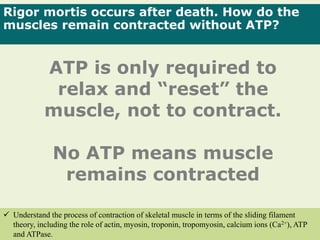
ATP is only required to
relax and “reset” the
muscle, not to contract.
No ATP means muscle
remains contracted

Muscle contraction.pptx

  • 1.
    Rigor mortis occursafter death. How do the muscles remain contracted without ATP? Thinker & Communicator Title: Muscle contraction Date: 29 March 2023  Understand the process of contraction of skeletal muscle in terms of the sliding filament theory, including the role of actin, myosin, troponin, tropomyosin, calcium ions (Ca2+), ATP and ATPase. Homework: Complete Class Notebook
  • 2.
    First things first…! What types of muscle do you know? Skeletal (conscious contraction) Smooth (unconscious contraction) Cardiac (unconscious contraction)
  • 3.
    How is arope like a muscle fibre?
  • 5.
    The structure ofstriated skeletal muscle.  Each muscle is called a fibre. Each fibre made up of a bundle of myofibrils.  Each myofibril is made of myofilaments - actin and myosin.  The myofilaments are arranged so that each myosin is surrounded by 6 actins
  • 6.
    A bit ofadded strength!  The muscle cells are fused together (fibres) and share nuclei and cytoplasm called sarcoplasm.
  • 7.
  • 8.
    Microscopic structure  The lighterbands are called I bands (isotropic). They are lighter because the actin and myosin filaments are not overlapping The darker bands are called A bands (anisotropic). They are darker because the actin and myosin filaments are overlapping Task: Add labels to your sarcomere and draw a diagram to represent the actin and myosin filaments H Zone Note: STRIATED MUSCLE. : muscle tissue that is marked by transverse dark and light bands
  • 9.
    Let’s take asimpler look! Thin! Thick!
  • 10.
    The structure ofactin  It consists of 2 threads wrapped around each other. At each twist there is a binding site for myosin. In a relaxed state, a molecule called tropomyosin covers these sites.
  • 11.
    The structure ofmyosin  The filament consists of many myosin molecules. Each molecule has a tail and a double globular head.  The head attaches to the myosin binding sites on the actin where the actin and myosin filaments overlap.  These attachments are called cross-bridges. The heads contain ATPase enzyme which releases energy from ATP to power muscle contraction.
  • 12.
    Muscle contraction  Contractionoccurs when an impulses from a motor neurone reaches the synapse at the junction with the muscle.
  • 13.
    Sliding filament Hypothesis. Acetylcholine, a neurotransmitter substance, is released into the synapse, diffuses across and attaches to specific receptors on the sarcolemma (the outer membrane of the muscle fibre).  The muscle sarcolemma is depolarised.  Depolarisation spreads along the fibre.  This causes calcium to be released from the sarcoplasmic reticulum into the sarcoplasm.  Calcium displaces tropomyosin, thus uncovering the myosin binding sites on the actin filaments.  ATP attached to the myosin heads cause them to flex and attach to the actin in the overlapping areas.  ATP is hydrolysed to ADP + P. The energy released causes the heads to alter their angle to their tails. This pulls the actin filament past the myosin filament.  The cross-bridges detach and reattach, this time further along the actin filament. https://www.youtube.com/watch?v=aUc3h6LvdJ 4
  • 15.
  • 16.
    Rigor mortis occursafter death. How do the muscles remain contracted without ATP?  Understand the process of contraction of skeletal muscle in terms of the sliding filament theory, including the role of actin, myosin, troponin, tropomyosin, calcium ions (Ca2+), ATP and ATPase. ATP is only required to relax and “reset” the muscle, not to contract. No ATP means muscle remains contracted