MURDERS
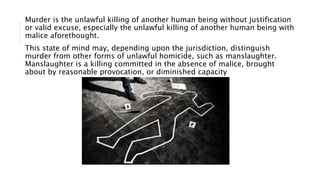
Murder is the unlawful killing of another human being without justification
or valid excuse, especially the unlawful killing of another human being with
malice aforethought.
This state of mind may, depending upon the jurisdiction, distinguish
murder from other forms of unlawful homicide, such as manslaughter.
Manslaughter is a killing committed in the absence of malice, brought
about by reasonable provocation, or diminished capacity
Punishments and laws are different in all countries. In Chile killing
another person is one of worst crimes but it's a complex issue. Some
people get sentenced to only 10 or 15 years for murder! Had justice
been more incompetent? It's so sad when think in family, friends,
lover of the victim.
But some people get sentenced life imprisonment, this is very difficult
to happen.
CREEPY MURDERERS
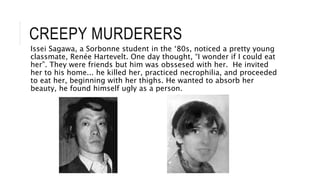
Issei Sagawa, a Sorbonne student in the ‘80s, noticed a pretty young
classmate, Renée Hartevelt. One day thought, “I wonder if I could eat
her”. They were friends but him was obssesed with her. He invited
her to his home... he killed her, practiced necrophilia, and proceeded
to eat her, beginning with her thighs. He wanted to absorb her
beauty, he found himself ugly as a person.
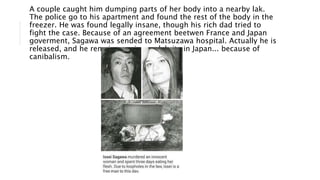
A couple caught him dumping parts of her body into a nearby lak.
The police go to his apartment and found the rest of the body in the
freezer. He was found legally insane, though his rich dad tried to
fight the case. Because of an agreement beetwen France and Japan
goverment, Sagawa was sended to Matsuzawa hospital. Actually he is
released, and he remains a minor celebrity in Japan... because of
canibalism.
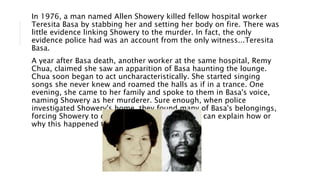
In 1976, a man named Allen Showery killed fellow hospital worker
Teresita Basa by stabbing her and setting her body on fire. There was
little evidence linking Showery to the murder. In fact, the only
evidence police had was an account from the only witness...Teresita
Basa.
A year after Basa death, another worker at the same hospital, Remy
Chua, claimed she saw an apparition of Basa haunting the lounge.
Chua soon began to act uncharacteristically. She started singing
songs she never knew and roamed the halls as if in a trance. One
evening, she came to her family and spoke to them in Basa's voice,
naming Showery as her murderer. Sure enough, when police
investigated Showery's home, they found many of Basa's belongings,
forcing Showery to confess. To this day, no one can explain how or
why this happened to Remy Chua.
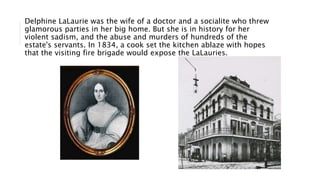
Delphine LaLaurie was the wife of a doctor and a socialite who threw
glamorous parties in her big home. But she is in history for her
violent sadism, and the abuse and murders of hundreds of the
estate's servants. In 1834, a cook set the kitchen ablaze with hopes
that the visiting fire brigade would expose the LaLauries.
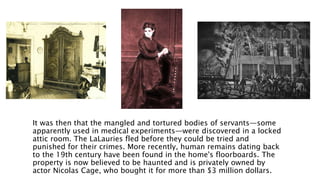
It was then that the mangled and tortured bodies of servants—some
apparently used in medical experiments—were discovered in a locked
attic room. The LaLauries fled before they could be tried and
punished for their crimes. More recently, human remains dating back
to the 19th century have been found in the home's floorboards. The
property is now believed to be haunted and is privately owned by
actor Nicolas Cage, who bought it for more than $3 million dollars.
STRANGE EVENTS
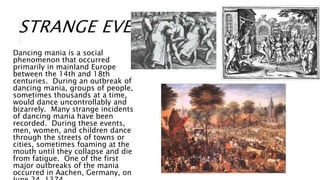
Dancing mania is a social
phenomenon that occurred
primarily in mainland Europe
between the 14th and 18th
centuries. During an outbreak of
dancing mania, groups of people,
sometimes thousands at a time,
would dance uncontrollably and
bizarrely. Many strange incidents
of dancing mania have been
recorded. During these events,
men, women, and children dance
through the streets of towns or
cities, sometimes foaming at the
mouth until they collapse and die
from fatigue. One of the first
major outbreaks of the mania
occurred in Aachen, Germany, on
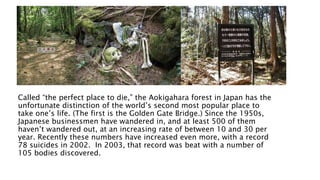
Called “the perfect place to die,” the Aokigahara forest in Japan has the
unfortunate distinction of the world’s second most popular place to
take one’s life. (The first is the Golden Gate Bridge.) Since the 1950s,
Japanese businessmen have wandered in, and at least 500 of them
haven’t wandered out, at an increasing rate of between 10 and 30 per
year. Recently these numbers have increased even more, with a record
78 suicides in 2002. In 2003, that record was beat with a number of
105 bodies discovered.
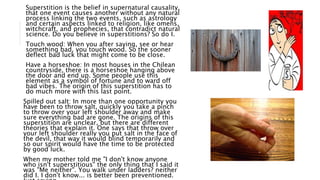
Superstition is the belief in supernatural causality,
that one event causes another without any natural
process linking the two events, such as astrology
and certain aspects linked to religion, like omens,
witchcraft, and prophecies, that contradict natural
science. Do you believe in superstitions? So do I.
Touch wood: When you after saying, see or hear
something bad, you touch wood. So the sooner
deflect bad luck that might come to be close.
Have a horseshoe: In most houses in the Chilean
countryside, there is a horseshoe hanging above
the door and end up. Some people use this
element as a symbol of fortune and to ward off
bad vibes. The origin of this superstition has to
do much more with this last point.
Spilled out salt: In more than one opportunity you
have been to throw salt, quickly you take a pinch
to throw over your left shoulder away and make
sure everything bad are gone. The origins of this
superstition are unclear, but there are different
theories that explain it. One says that throw over
your left shoulder really you put salt in the face of
the devil, that way it would blind temporarily and
so our spirit would have the time to be protected
by good luck.
When my mother told me "I don't know anyone
who isn't superstitious" the only thing that I said it
was "Me neither". You walk under ladders? neither
did I. I don't know... is better been preventioned.

Murders

  • 1.
  • 2.
    Murder is theunlawful killing of another human being without justification or valid excuse, especially the unlawful killing of another human being with malice aforethought. This state of mind may, depending upon the jurisdiction, distinguish murder from other forms of unlawful homicide, such as manslaughter. Manslaughter is a killing committed in the absence of malice, brought about by reasonable provocation, or diminished capacity
  • 3.
    Punishments and lawsare different in all countries. In Chile killing another person is one of worst crimes but it's a complex issue. Some people get sentenced to only 10 or 15 years for murder! Had justice been more incompetent? It's so sad when think in family, friends, lover of the victim. But some people get sentenced life imprisonment, this is very difficult to happen.
  • 4.
    CREEPY MURDERERS Issei Sagawa,a Sorbonne student in the ‘80s, noticed a pretty young classmate, Renée Hartevelt. One day thought, “I wonder if I could eat her”. They were friends but him was obssesed with her. He invited her to his home... he killed her, practiced necrophilia, and proceeded to eat her, beginning with her thighs. He wanted to absorb her beauty, he found himself ugly as a person.
  • 5.
    A couple caughthim dumping parts of her body into a nearby lak. The police go to his apartment and found the rest of the body in the freezer. He was found legally insane, though his rich dad tried to fight the case. Because of an agreement beetwen France and Japan goverment, Sagawa was sended to Matsuzawa hospital. Actually he is released, and he remains a minor celebrity in Japan... because of canibalism.
  • 6.
    In 1976, aman named Allen Showery killed fellow hospital worker Teresita Basa by stabbing her and setting her body on fire. There was little evidence linking Showery to the murder. In fact, the only evidence police had was an account from the only witness...Teresita Basa. A year after Basa death, another worker at the same hospital, Remy Chua, claimed she saw an apparition of Basa haunting the lounge. Chua soon began to act uncharacteristically. She started singing songs she never knew and roamed the halls as if in a trance. One evening, she came to her family and spoke to them in Basa's voice, naming Showery as her murderer. Sure enough, when police investigated Showery's home, they found many of Basa's belongings, forcing Showery to confess. To this day, no one can explain how or why this happened to Remy Chua.
  • 7.
    Delphine LaLaurie wasthe wife of a doctor and a socialite who threw glamorous parties in her big home. But she is in history for her violent sadism, and the abuse and murders of hundreds of the estate's servants. In 1834, a cook set the kitchen ablaze with hopes that the visiting fire brigade would expose the LaLauries.
  • 8.
    It was thenthat the mangled and tortured bodies of servants—some apparently used in medical experiments—were discovered in a locked attic room. The LaLauries fled before they could be tried and punished for their crimes. More recently, human remains dating back to the 19th century have been found in the home's floorboards. The property is now believed to be haunted and is privately owned by actor Nicolas Cage, who bought it for more than $3 million dollars.
  • 9.
    STRANGE EVENTS Dancing maniais a social phenomenon that occurred primarily in mainland Europe between the 14th and 18th centuries. During an outbreak of dancing mania, groups of people, sometimes thousands at a time, would dance uncontrollably and bizarrely. Many strange incidents of dancing mania have been recorded. During these events, men, women, and children dance through the streets of towns or cities, sometimes foaming at the mouth until they collapse and die from fatigue. One of the first major outbreaks of the mania occurred in Aachen, Germany, on
  • 10.
    Called “the perfectplace to die,” the Aokigahara forest in Japan has the unfortunate distinction of the world’s second most popular place to take one’s life. (The first is the Golden Gate Bridge.) Since the 1950s, Japanese businessmen have wandered in, and at least 500 of them haven’t wandered out, at an increasing rate of between 10 and 30 per year. Recently these numbers have increased even more, with a record 78 suicides in 2002. In 2003, that record was beat with a number of 105 bodies discovered.
  • 11.
    Superstition is thebelief in supernatural causality, that one event causes another without any natural process linking the two events, such as astrology and certain aspects linked to religion, like omens, witchcraft, and prophecies, that contradict natural science. Do you believe in superstitions? So do I. Touch wood: When you after saying, see or hear something bad, you touch wood. So the sooner deflect bad luck that might come to be close. Have a horseshoe: In most houses in the Chilean countryside, there is a horseshoe hanging above the door and end up. Some people use this element as a symbol of fortune and to ward off bad vibes. The origin of this superstition has to do much more with this last point. Spilled out salt: In more than one opportunity you have been to throw salt, quickly you take a pinch to throw over your left shoulder away and make sure everything bad are gone. The origins of this superstition are unclear, but there are different theories that explain it. One says that throw over your left shoulder really you put salt in the face of the devil, that way it would blind temporarily and so our spirit would have the time to be protected by good luck. When my mother told me "I don't know anyone who isn't superstitious" the only thing that I said it was "Me neither". You walk under ladders? neither did I. I don't know... is better been preventioned.