21st November 2020
Mumbai MuleSoft Meetup Group
Sonar-Qube , RAML Best Practices , Data weave
Functions
Guidelines for Mumbai MuleSoft Meetup #15
[Virtual]
● Welcome to Mumbai MuleSoft Meetup! We will start our introduction session at 5 pm IST.
● Once you join write down your registered name in chat section so that we can provide you
audio/video access in Bevy.
● Please keep yourself muted unless you have any question.
● We encourage keeping your video on for making our meetup interactive.
● You'll can also write down your questions in chat section.
● We appreciate your valuable feedback. Thanks.
2
3
● Introductions
● Mulesoft Code Review Automation Using SonarQube
● RAML Best Practices
● Dataweave Functions – Mule 4.3
● Quiz
● Networking time
Agenda
4
●About the organizer:
○ Sudeshna Mitra
○ Manish Yadav
○ Akshata Sawant
●About the sponsor:
○ MuleSoft
Introductions
A SHOW OF HANDS:
Who is new to this Meetup?
Important Announcements
Latest Releases/News
● Reminder: The MuleSoft Hackathon ends Nov. 29, 2020
There is still time to register and submit a project for the MuleSoft Hackathon 2020! If you are
interested in participating, the deadline to register and submit is Nov. 29, 2020 at 11:59pm PT.
Register -> http://mulesoft.com/hackathon2020
● Anypoint Studio 7.7 release
Blog - Streamlining the development experience with Studio 7.7
6
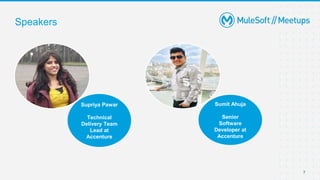
Speakers
7
Supriya Pawar
Technical
Delivery Team
Lead at
Accenture
Sumit Ahuja
Senior
Software
Developer at
Accenture
Mulesoft Code Review Automation
Using SonarQube
9
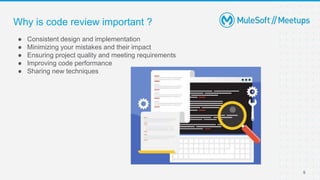
● Consistent design and implementation
● Minimizing your mistakes and their impact
● Ensuring project quality and meeting requirements
● Improving code performance
● Sharing new techniques
Why is code review important ?
10
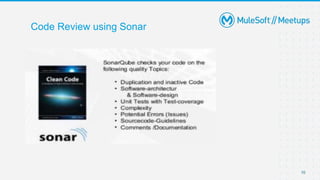
Code Review using Sonar
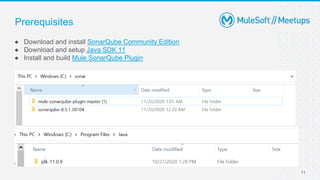
Prerequisites
● Download and install SonarQube Community Edition
● Download and setup Java SDK 11
● Install and build Mule SonarQube Plugin
11
12
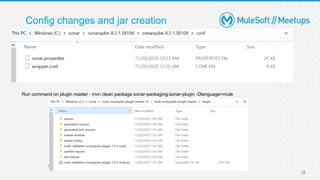
Run command on plugin master - mvn clean package sonar-packaging:sonar-plugin -Dlanguage=mule
Config changes and jar creation
13
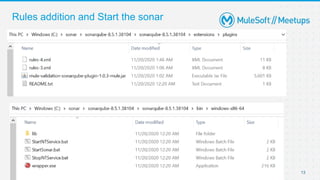
Rules addition and Start the sonar
14
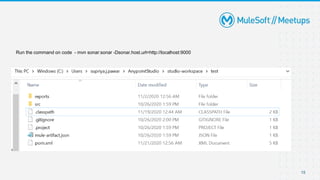
15
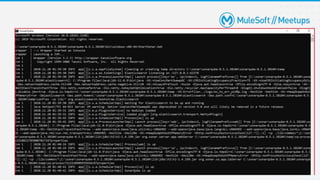
Run the command on code - mvn sonar:sonar -Dsonar.host.url=http://localhost:9000
16
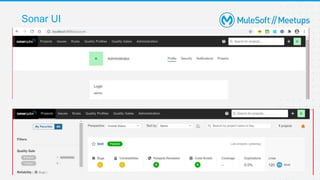
Sonar UI
17
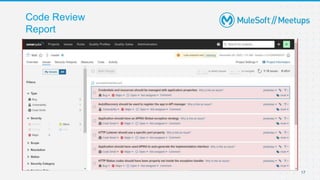
Code Review
Report
Conclusion
Automating the code review process reduces the delivery time and
human error and SonarQube is a good fit for the Mulesoft Automated
Code Review tool as it sets a collection of rules to analyze your
source code at compile time to identify potential vulnerabilities, bugs,
anti-patterns, refactoring, and poor coding practices.
18
RAML (API) Best Practices
20
What is RAML ? Why we use it ?
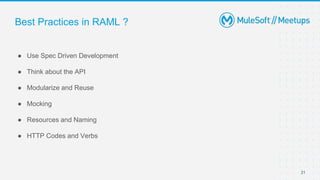
Best Practices in RAML ?
● Use Spec Driven Development
● Think about the API
● Modularize and Reuse
● Mocking
● Resources and Naming
● HTTP Codes and Verbs
21
22
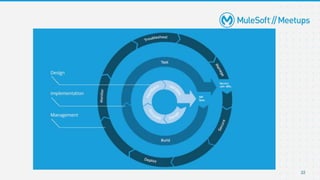
Use Spec Driven Development
● Use Design Patterns/ Code Reuse.
● Mock and get User Feedback.
● Make Necessary Changes.
● Start Coding to the Spec and don't deviate.
23
Benefits of Spec Driven
● Parallelize the development process
● Improves understanding of the whole
● Guide Development
24
Think about the API
25
Think of a Long term
● Your API is a Contract
● Versioning is not a Solution
● You can pay a little now , or much more Later.
● You need to think things through
● Mindset is everything
26
Think Things Through
● Who is your API for ?
● What type of API are you building ?
● How are you going to maintain your API ?
● How are you going to document your API ?
● How are you going to lets users interact with your API ?
● How are you going to manage authentication, provisioning and developer security ?
● How are going to protect your servers against attacks etc ?
● How are you going to manage support ?
27
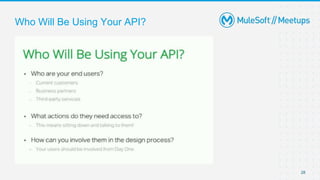
Who Will Be Using Your API?
28
Versioning – A Necessary Evil
● Problems with versioning :
○ Backward Incompatibilities
○ Multiple services to maintain
○ Multiple systems to support
○ Creates Confusion among developers
29
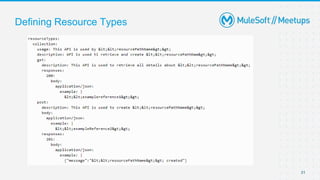
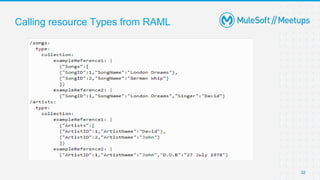
Modularize and Reuse (RAML Inheritance)
● This can be Best achieved using the below two features :
○ Resource Types
■ ResourceType is basically a template that is used to define the descriptions, methods, and parameters that
can be used by multiple resources without writing the duplicate code or repeating code.
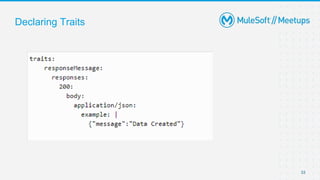
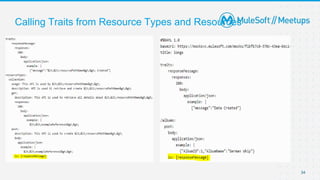
○ Traits
■ Traits is like function and is used to define common attributes for HTTP method (GET, PUT, POST,
PATCH, DELETE, etc) such as whether or not they are filterable, searchable, or pageable.
30
Defining Resource Types
31
Calling resource Types from RAML
32
Declaring Traits
33
Calling Traits from Resource Types and Resources
34
Mocking
● The API mocking service enables you simulate the behavior of an API specification. The
mocking service provides a test link to an API. The mocking service returns the responses
(both HTTP status codes and example payloads) that are defined in your API specification
and is valuable for testing or for simply exploring how your API behaves.
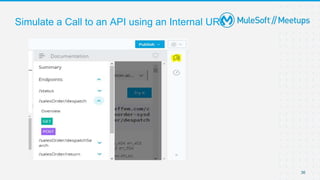
● Simulate a Call to an API using an Internal URL
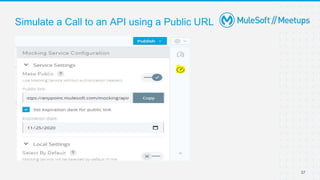
● Simulate a Call to an API using a Public URL
35
Simulate a Call to an API using an Internal URL
36
Simulate a Call to an API using a Public URL
37
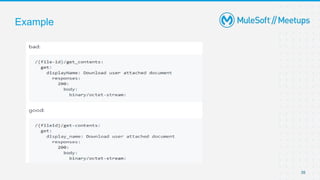
Resources and Naming
● Use of camelCase for placeholders in URL.
● Use nouns in lowercase to represent a resource, for resources with multiple words, use
lowercase for all the words or use '-' (dash) in between the words and make it readable.
● Use of Parameters:
○ URI Parameter
○ Query Parameter
38
Example
39
HTTP Codes
● 1xx : Informational
● 2xx : Success
● 3xx : Redirect
● 4xx : Client error
● 5xx : Server error
40
HTTP verbs
● GET
● PUT
● PATCH
● POST
● DELETE
41
Data weave Functions
Modules
● Core (dw::Core)
● Arrays (dw::core::Arrays)
● Crypto (dw::Crypto)
● Binaries (dw::core::Binaries)
● URL (dw::core::URL)
● Values (dw::util::Values)
43
Core (dw::Core)
● entriesOf
● keysOf
● namesOf
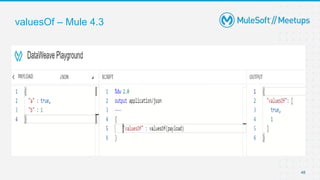
● valuesOf
44
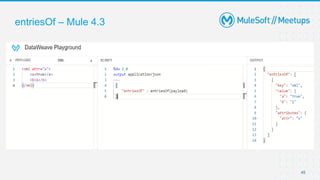
entriesOf – Mule 4.3
45
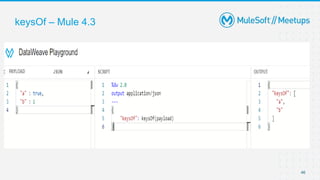
keysOf – Mule 4.3
46
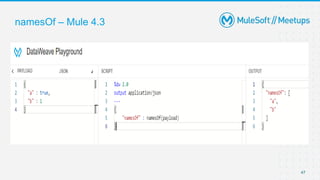
namesOf – Mule 4.3
47
valuesOf – Mule 4.3
48
Arrays (dw::core::Arrays)
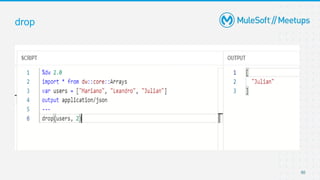
● drop
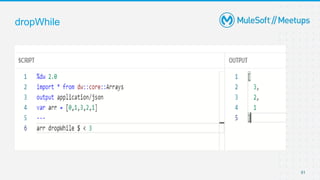
● dropWhile
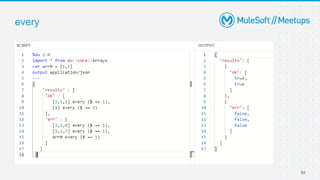
● every
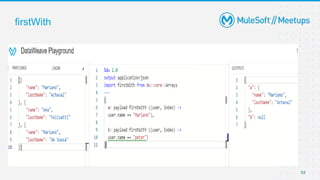
● firstWith
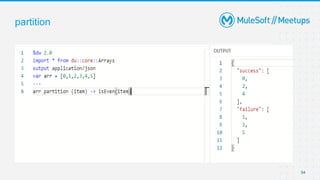
● partition
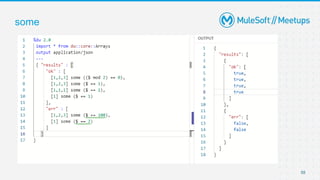
● some
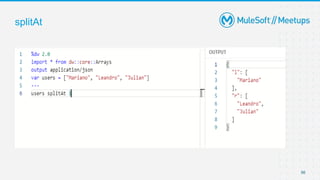
● splitAt
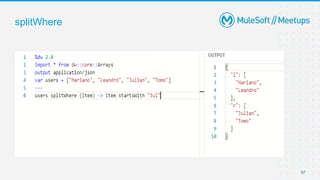
● splitWhere
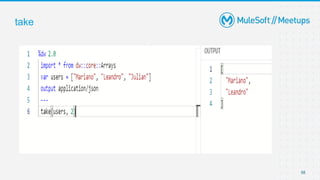
● take
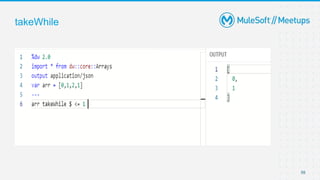
● takeWhile
49
drop
50
dropWhile
51
every
52
firstWith
53
partition
54
some
55
splitAt
56
splitWhere
57
take
58
takeWhile
59
Crypto (dw::Crypto)
60
● HMACBinary
● HMACWith
● MD5
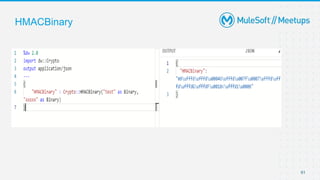
HMACBinary
61
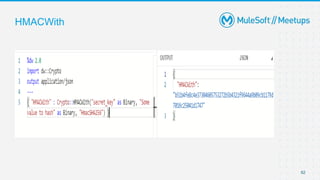
HMACWith
62
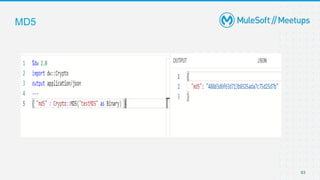
MD5
63
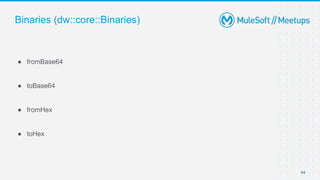
Binaries (dw::core::Binaries)
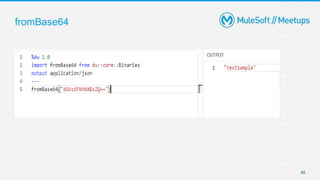
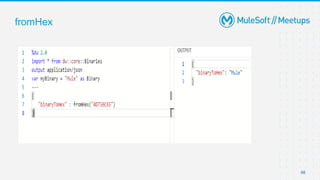
● fromBase64
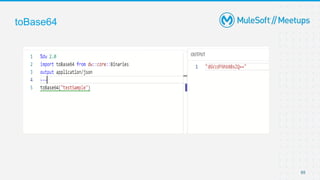
● toBase64
● fromHex
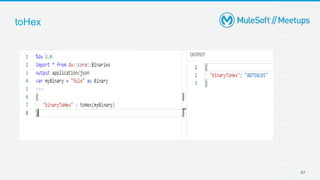
● toHex
64
toBase64
65
fromBase64
66
toHex
67
fromHex
68
URL (dw::core::URL)
69
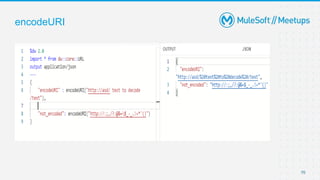
● encodeURI
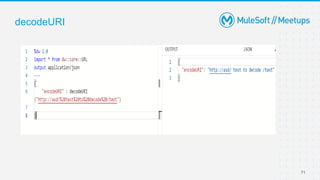
● decodeURI
encodeURI
70
decodeURI
71
Values (dw::util::Values)
72
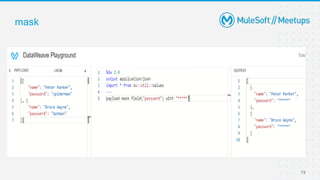
● mask
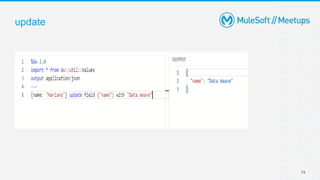
● update
mask
73
update
74
75
Nominate yourself for the next meetup
speaker and suggest a topic as well.
Take a stand!
76
● Share:
○ Tweet using the hashtag #MuleSoftMeetups
○ Invite your network to join: https://meetups.mulesoft.com/mumbai/
● Feedback:
○ Fill out the survey feedback and suggest topics for upcoming events
○ Contact MuleSoft at meetups@mulesoft.com for ways to improve the program
○ Contact your organizers Manish Yadav, Sudeshna Mitra and Akshata Sawant to
suggest topics
○ Tweet your organizers at @SudeshnaMitra14, @Manish_Kyadav,
@sawantakshata02
○ Follow us on Instagram (mumbai_mulesoftofficialpage)
○ Telegram: https://t.me/joinchat/Q6y-MgriEqyDicfZV9PIAg
What’s next?
Introduce yourself to your neighbor
Networking time
Thank you

Mumbai MuleSoft Meetup #15

  • 1.
    21st November 2020 MumbaiMuleSoft Meetup Group Sonar-Qube , RAML Best Practices , Data weave Functions
  • 2.
    Guidelines for MumbaiMuleSoft Meetup #15 [Virtual] ● Welcome to Mumbai MuleSoft Meetup! We will start our introduction session at 5 pm IST. ● Once you join write down your registered name in chat section so that we can provide you audio/video access in Bevy. ● Please keep yourself muted unless you have any question. ● We encourage keeping your video on for making our meetup interactive. ● You'll can also write down your questions in chat section. ● We appreciate your valuable feedback. Thanks. 2
  • 3.
    3 ● Introductions ● MulesoftCode Review Automation Using SonarQube ● RAML Best Practices ● Dataweave Functions – Mule 4.3 ● Quiz ● Networking time Agenda
  • 4.
    4 ●About the organizer: ○Sudeshna Mitra ○ Manish Yadav ○ Akshata Sawant ●About the sponsor: ○ MuleSoft Introductions A SHOW OF HANDS: Who is new to this Meetup?
  • 5.
  • 6.
    Latest Releases/News ● Reminder:The MuleSoft Hackathon ends Nov. 29, 2020 There is still time to register and submit a project for the MuleSoft Hackathon 2020! If you are interested in participating, the deadline to register and submit is Nov. 29, 2020 at 11:59pm PT. Register -> http://mulesoft.com/hackathon2020 ● Anypoint Studio 7.7 release Blog - Streamlining the development experience with Studio 7.7 6
  • 7.
    Speakers 7 Supriya Pawar Technical Delivery Team Leadat Accenture Sumit Ahuja Senior Software Developer at Accenture
  • 8.
    Mulesoft Code ReviewAutomation Using SonarQube
  • 9.
    9 ● Consistent designand implementation ● Minimizing your mistakes and their impact ● Ensuring project quality and meeting requirements ● Improving code performance ● Sharing new techniques Why is code review important ?
  • 10.
  • 11.
    Prerequisites ● Download andinstall SonarQube Community Edition ● Download and setup Java SDK 11 ● Install and build Mule SonarQube Plugin 11
  • 12.
    12 Run command onplugin master - mvn clean package sonar-packaging:sonar-plugin -Dlanguage=mule Config changes and jar creation
  • 13.
    13 Rules addition andStart the sonar
  • 14.
  • 15.
    15 Run the commandon code - mvn sonar:sonar -Dsonar.host.url=http://localhost:9000
  • 16.
  • 17.
  • 18.
    Conclusion Automating the codereview process reduces the delivery time and human error and SonarQube is a good fit for the Mulesoft Automated Code Review tool as it sets a collection of rules to analyze your source code at compile time to identify potential vulnerabilities, bugs, anti-patterns, refactoring, and poor coding practices. 18
  • 19.
    RAML (API) BestPractices
  • 20.
    20 What is RAML? Why we use it ?
  • 21.
    Best Practices inRAML ? ● Use Spec Driven Development ● Think about the API ● Modularize and Reuse ● Mocking ● Resources and Naming ● HTTP Codes and Verbs 21
  • 22.
  • 23.
    Use Spec DrivenDevelopment ● Use Design Patterns/ Code Reuse. ● Mock and get User Feedback. ● Make Necessary Changes. ● Start Coding to the Spec and don't deviate. 23
  • 24.
    Benefits of SpecDriven ● Parallelize the development process ● Improves understanding of the whole ● Guide Development 24
  • 25.
  • 26.
    Think of aLong term ● Your API is a Contract ● Versioning is not a Solution ● You can pay a little now , or much more Later. ● You need to think things through ● Mindset is everything 26
  • 27.
    Think Things Through ●Who is your API for ? ● What type of API are you building ? ● How are you going to maintain your API ? ● How are you going to document your API ? ● How are you going to lets users interact with your API ? ● How are you going to manage authentication, provisioning and developer security ? ● How are going to protect your servers against attacks etc ? ● How are you going to manage support ? 27
  • 28.
    Who Will BeUsing Your API? 28
  • 29.
    Versioning – ANecessary Evil ● Problems with versioning : ○ Backward Incompatibilities ○ Multiple services to maintain ○ Multiple systems to support ○ Creates Confusion among developers 29
  • 30.
    Modularize and Reuse(RAML Inheritance) ● This can be Best achieved using the below two features : ○ Resource Types ■ ResourceType is basically a template that is used to define the descriptions, methods, and parameters that can be used by multiple resources without writing the duplicate code or repeating code. ○ Traits ■ Traits is like function and is used to define common attributes for HTTP method (GET, PUT, POST, PATCH, DELETE, etc) such as whether or not they are filterable, searchable, or pageable. 30
  • 31.
  • 32.
  • 33.
  • 34.
    Calling Traits fromResource Types and Resources 34
  • 35.
    Mocking ● The APImocking service enables you simulate the behavior of an API specification. The mocking service provides a test link to an API. The mocking service returns the responses (both HTTP status codes and example payloads) that are defined in your API specification and is valuable for testing or for simply exploring how your API behaves. ● Simulate a Call to an API using an Internal URL ● Simulate a Call to an API using a Public URL 35
  • 36.
    Simulate a Callto an API using an Internal URL 36
  • 37.
    Simulate a Callto an API using a Public URL 37
  • 38.
    Resources and Naming ●Use of camelCase for placeholders in URL. ● Use nouns in lowercase to represent a resource, for resources with multiple words, use lowercase for all the words or use '-' (dash) in between the words and make it readable. ● Use of Parameters: ○ URI Parameter ○ Query Parameter 38
  • 39.
  • 40.
    HTTP Codes ● 1xx: Informational ● 2xx : Success ● 3xx : Redirect ● 4xx : Client error ● 5xx : Server error 40
  • 41.
    HTTP verbs ● GET ●PUT ● PATCH ● POST ● DELETE 41
  • 42.
  • 43.
    Modules ● Core (dw::Core) ●Arrays (dw::core::Arrays) ● Crypto (dw::Crypto) ● Binaries (dw::core::Binaries) ● URL (dw::core::URL) ● Values (dw::util::Values) 43
  • 44.
    Core (dw::Core) ● entriesOf ●keysOf ● namesOf ● valuesOf 44
  • 45.
  • 46.
  • 47.
  • 48.
  • 49.
    Arrays (dw::core::Arrays) ● drop ●dropWhile ● every ● firstWith ● partition ● some ● splitAt ● splitWhere ● take ● takeWhile 49
  • 50.
  • 51.
  • 52.
  • 53.
  • 54.
  • 55.
  • 56.
  • 57.
  • 58.
  • 59.
  • 60.
  • 61.
  • 62.
  • 63.
  • 64.
    Binaries (dw::core::Binaries) ● fromBase64 ●toBase64 ● fromHex ● toHex 64
  • 65.
  • 66.
  • 67.
  • 68.
  • 69.
  • 70.
  • 71.
  • 72.
  • 73.
  • 74.
  • 75.
    75 Nominate yourself forthe next meetup speaker and suggest a topic as well. Take a stand!
  • 76.
    76 ● Share: ○ Tweetusing the hashtag #MuleSoftMeetups ○ Invite your network to join: https://meetups.mulesoft.com/mumbai/ ● Feedback: ○ Fill out the survey feedback and suggest topics for upcoming events ○ Contact MuleSoft at meetups@mulesoft.com for ways to improve the program ○ Contact your organizers Manish Yadav, Sudeshna Mitra and Akshata Sawant to suggest topics ○ Tweet your organizers at @SudeshnaMitra14, @Manish_Kyadav, @sawantakshata02 ○ Follow us on Instagram (mumbai_mulesoftofficialpage) ○ Telegram: https://t.me/joinchat/Q6y-MgriEqyDicfZV9PIAg What’s next?
  • 77.
    Introduce yourself toyour neighbor Networking time
  • 78.