MUNDO, Juvy P.
10 Rules For Writing
Multiple Choice Questions
The rules covered here make tests more accurate, so the questions are
interpreted as intended and the answer options are clear and without
hints.
Just in case you’re not familiar with multiple choice terminology, it’s
explained in the visual below.
Rule #1: Test comprehension and critical thinking,
not just recall
Multiple choice questions are criticized for
testing the superficial recall of knowledge.
You can go beyond this by asking
learners to interpret facts, evaluate
situations, explain cause and effect, make
inferences, and predict results.
Rule #2: Use simple sentence structure and precise
wording
Write test questions in a simple
structure that is easy to
understand.
 And try to be as accurate as
possible in your word choices.
Words can have many
meanings depending on
colloquial usage and context.
Rule #3: Place most of the words in the question
stem
•If you’re using a question stem,
rather than an entire question,
ensure that most of the words are
in the stem.
•This way, the answer options can
be short, making them less
confusing and more legible.
Rule #4: Make all distractors plausible
All of the wrong answer choices should
be completely reasonable.
This can be very hard to accomplish, but
avoid throwing in those give-away
distractors as it detracts from the test’s
validity.
 If you’re really stuck, get help from your
friendly SME. (BTW, this word can also
be spelled as “distracter.”)
Rule #5: Keep all answer choices the same length
This can be difficult to achieve, but expert
test-takers can use answer length as a hint
to the correct answer.
 Often the longest answer is the correct
one.
When I can’t get all four answers to the
same length, I use two short and two long.
Rule #6: Avoid double negatives
No big news here, right? Don’t use combinations of these
words in the same question: not, no, nor, the -un prefix, etc.
For example, this type of question could confuse test-takers:
 ‘Which of the following comments would NOT be
unwelcome in a work situation?’ Flip it around and write it in
the positive form:
 ‘Which of the following comments are acceptable in a
work situation?’
Rule #7: Mix up the order of the correct answers
Make sure that most of your correct answers
aren’t in the “b” and “c” positions, which can
often happen.
Keep correct answers in random positions and
don’t let them fall into a pattern that can be
detected.
 When your test is written, go through and
reorder where the correct answers are placed, if
necessary.
Rule #8: Keep the number of options consistent
Did you ever have to convince a SME that he
or she can’t have answer choices that go to
‘h’ in one question and ‘c’ in the next?
It’s something of a user interface issue.
Making the number of options consistent
from question to question helps learners
know what to expect.
Research doesn’t seem to agree on whether
3 or 4 or 5 options is best.
Use 4 options. It feels fair.
Rule #9: Avoid tricking test-takers
As faulty as they are, tests exist to measure
knowledge.
 Never use questions or answer options that
could trick a learner.
If a question or its options can be interpreted in
two ways or if the difference between options is
too subtle, then find a way to rewrite it.
Rule #10: Use ‘All of the Above’ and ‘None of the
Above’ with caution
• I hate this rule because when you run out of distractors, All of
the Above and None of the Above can come in handy.
• But they may not promote good instruction. Here’s why?All of
the Above can be an obvious give-away answer when it’s not
used consistently.
• Also, the All of the Above option can encourage guessing if the
learner thinks one or two answers are correct.
• In addition, the downside to None of the Above is that you can’t
tell if the learner really knew the correct answer.
PARTS OF A MULTIPLE CHOICE QUESTION
(Bull & Mckenna, 2002)
A traditional multiple choice question (or item) is one in
which a student chooses one answer from a number of choices
supplied. A multiple choice question consists of a
• STEM - the text of the question
• OPTIONS - the choices provided after the stem (these include
the key and the distractors)
• THE KEY - the correct answer in the list of options
• DISTRACTERS - the incorrect answers in the list of options
Some examples of do’s and don’ts (Bull & Mckenna, 2002,
Kehoe, 1995, Zimmaro, 2004)
• Begin writing items well ahead of the time when they will be
used —this allows time for revision and peer review.
• Before writing the stem, identify the single idea to be tested
by that item. This should be about an important aspect of
the content area and not with trivia. In general, the stem
should not pose more than one problem, although the
solution to that problem may require more than one step.
• Be sure that each item is independent of all other items (i.e.
a hint to an answer should not be unintentionally embedded
in another item).
• Design each item/question so that it can be answered by
60-65% of the student cohort (Zimmaro, 2004:15)
WRITING STEMS
Present a single, definite statement or direct question to be
completed or answered by one of the several given choices .
A. original stem
Polysaccharide
a. are made up of
thousands of smaller
units called
monosaccharides
b. are NOT found in the
aloe vera leaf
c. are created during
photosynthesis
d. can be described by
the chemical formula:
CHHOH
B. improved stem
Polysaccharides of the plant
cell wall are synthesized
mainly in the
a. endoplasmic reticulum
b. cytosol
c. plasma membrane
d. Golgi complex
 In Example A, there is no sense
from the stem what the
question is asking.
 Example B more clearly
identifies the question and
offers the student a set of
homogeneous choices.
2. Avoid unnecessary and irrelevant material in the stem. It should be
clear and unambiguous
A. Original stem:
Paul Muldoon, an Irish
postmodern poet who
uses experimental and
playful language, uses
which poetic genre in
"Why Brownlee Left"?
a. sonnet
b. elegy
c. narrative poem
d. dramatic monologue
e. haiku
B. Improved stem
Paul Muldoon uses which
poetic genre in "Why
Brownlee Left"?
a. sonnet
b. elegy
c. narrative poem
d. dramatic
monologue
e. haiku
 Example A contains material
irrelevant to the question.
 This sort of material should not be
used to make the answer less
obvious.
 This tends to place too much
importance on reading
comprehension as a determiner of
the correct option
3. Use clear, straightforward language in the stem of the item.
A. Original stem
As the level of fertility
approaches its nadir, what is
the most likely ramification
for the citizenry of a
developing nation?
a. a decrease in the
workforce participation
rate of women
b. a dispersing effect on
population concentration
c. a downward trend in the
youth dependency ratio
d. a broader base in the
population pyramid
e. an increased infant
B. Improved stem
A major decline in fertility in a
developing nation is likely to
produce a
a. decrease in the workforce
participation rate of women
b. dispersing effect on
population concentration
c. downward trend in the youth
dependency ratio
d. broader base in the
population pyramid
e. increased infant
mortality rate
 Questions that are constructed
using complex or imprecise
wording may become a test of
reading comprehension rather
than an assessment of whether
the student knows the subject
matter.
4. Use negatives sparingly in the stem. If negatives must be used, capitalize,
underscore, embolden or otherwise highlight them. Negatives include ‘except’,
‘only’
A. original stem
Which one of the following is
not a symptom of
osteoporosis?
a. decreased bone density
b. frequent bone fractures
c. raised body temperature
d. lower back pain
B. improved stem
Which one of the following is
a symptom of osteoporosis?
a. decreased bone density
b. raised body temperature
c. hair loss
d. painful joints
 Negatives in the stem usually
require that the answer be a false
statement.
 Because students are likely in the
habit of searching for true
statements, this may introduce an
unwanted bias.
(v) Put as much of the question in the stem as possible, rather than duplicating
material in each of the options.
A. original stem
Theorists of pluralism have
asserted which of the following?
a. The maintenance of democracy
requires a large middle class.
b. The maintenance of democracy
requires autonomous centres of
contervailing power.
c. The maintenance of democracy
requires the existence of a
multiplicity of religious groups.
d. The maintenance of democracy
requires a predominantly urban
population.
e. The maintenance of democracy
requires the separation of
governmental powers.
B. improved stem
Theorists of pluralism have
asserted that the maintenance of
democracy requires
a. a large middle class
b. autonomous centres of
contervailing power
c. existence of a multiplicity of
religious groups
d. a predominantly urban
population
e. separation of governmental
powers
Another example:
 If the point of an item is to associate
a term with its definition, the
preferred format would be to present
the definition in the stem and ;
 several terms as options, rather than
to present the term in the stem and
several definitions as options.
6. Avoid irrelevant clues to the correct option in the stem.
Grammatical construction, for example, may lead students to reject
options which are grammatically incorrect as the stem is stated.
Perhaps more common and subtle, though, is the problem of common
elements in the stem and in the answer.
Consider the following item:
What led to the formation of the States’ Rights Party?
a. The level of federal taxation
b. The demand of states for the right to make their own laws
c. The industrialization of the South
d. The corruption of federal legislators on the issue of state taxation
One does not need to know U.S. history in order to be attracted to the answer, b.
WRITING DISTRACTORS
(Zimmaro D. 2004, Bull & Mckenna, 2002, Kehoe, 1995, Nitko, 2001, Parkes)
This is more difficult than writing stems.
They’re called distracters because they are strategically
designed to attract examinees who haven’t completely
mastered the content and skills.
This isn't tricky or deceptive or unfair. It is because the goal of
testing is to find out who has learned the content and can apply
skills and who has not, perhaps along a continuum between the
two.
 Students who mastered the material should recognize the key
(correct answer) and those who haven’t should not. (Parkes)
Decide on how many distractors to write
According to Nitko (2001) there is no magic number that you
should use. A 1987 study by Owen & Freeman suggests that
three choices are sufficient.
Clearly, the higher the number of distracters, the less likely it
is for the correct answer to be chosen through guessing
(providing all alternatives are of equal difficulty) (Bull &
Mckenna, 2002).
Be satisfied with three or four well constructed options.
Generally, the minimal improvement to the item due to that
hard-to-come-by fifth option is not worth the effort to construct
it (Kehoe, 1995).
Follow these hints to avoid test validity problems
1.Try to write items in which there is one and only one correct or clearly is the best
answer and one on which experts would agree.
2. Be sure wrong answer choices (distractors) are at least plausible.For example, a
distractor can be correct but not answer the question.
However, the distractor must not be so close to the correct answer that it
confuses students who really do know the answer.
3.Incorporate common student misunderstandings or errors in distractors.
4. The position of the correct answer should vary randomly from item to item.
 After the options are written, vary the location of the answer on as random a basis as
possible.
 A convenient method is to flip two (or three) coins at a time where each possible
Head-Tail combination is associated with a particular location for the answer.
 Students should be informed that the locations are randomized. (Testwise students
know that for some instructors the first option is rarely the answer.)
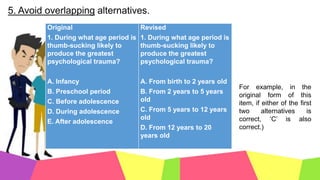
5. Avoid overlapping alternatives.
Original
1. During what age period is
thumb-sucking likely to
produce the greatest
psychological trauma?
A. Infancy
B. Preschool period
C. Before adolescence
D. During adolescence
E. After adolescence
Revised
1. During what age period is
thumb-sucking likely to
produce the greatest
psychological trauma?
A. From birth to 2 years old
B. From 2 years to 5 years
old
C. From 5 years to 12 years
old
D. From 12 years to 20
years old
For example, in the
original form of this
item, if either of the first
two alternatives is
correct, ‘C’ is also
correct.)
6.The length of the response options should be about the same within each
item (preferably short).
• Adherence to this rule avoids some of the more common
sources of biased cueing.
• For example, we sometimes find ourselves increasing the
length and specificity of the answer (relative to distractors)
in order to insure its truthfulness.
• This, however, becomes an easy-to-spot clue for the
testwise student.
• The number of students choosing a distractor should
depend only on deficits in the content area which the item
targets and should not depend on cue biases or reading
comprehension differences in ‘favour’ of the distractor
7. There should be no grammatical clues to the correct answer.
Original
1. Albert Eisenstein was a:
A. Anthropologist.
B. Astronomer.
C. Chemist.
D. Mathematician
Revised
1. Who was Albert
Einstein?
A. An anthropologist.
B. An Astronomer.
C. A chemist
D. A mathematician
8. Avoid excessive use of negatives and/or double negatives and words such as
‘always’, ‘never’, and ‘all’.
9. Avoid the use of ‘All of the above’, ‘both a. and e. above,’ and ‘None of the above’ in
the response alternatives, when students are asked to choose the best answer.
In the case of ‘All of the above’, students only need to have partial information in order
to answer the question.
* Students need to know that only two of the options are correct (in a four or more
option question) to determine that ‘All of the above’ is the correct answer choice.
* Conversely, students only need to eliminate one answer choice as implausible in
order to eliminate ‘All of the above’ as an answer choice.
* Similarly, with ‘None of the above’, when used as the correct answer choice,
information is gained about students’ ability to detect incorrect answers.
* However, the item does not reveal if students know the correct answer to the
question
REVIEWING THE MCQS: GUIDELINES (Cohen & Wollack, 2000)
Cohen and Wollack recommend these for reviewing individual
questions/items before students sit the test.
1. Consider the item as a whole and whether
• it measures knowledge or a skill component which is worthwhile and
appropriate for the examinees who will be tested
• there is a markedly better way to test what this item tests
• it is of the appropriate level of difficulty for the examinees who will be
tested
2. Consider the stem and whether it
• presents a clearly defined problem or task to the examinee
• contains unnecessary information
• could be worded more simply, clearly or concisely.
3. Consider the alternatives and whether
• they are parallel in structure
• they fit logically and grammatically with the stem
• they could be worded more simply, clearly or concisely
• any are so inclusive that they logically eliminate another more restricted
option from being a possible answer.
4. Consider the key and whether it
• is the best answer among the set of options for the item
• actually answers the question posed in the stem
• is too obvious relative to the other alternatives (i.e., should be
shortened, lengthened, given greater numbers of details, made less
concrete).
6. Consider the distractors and whether
• there is any way you could justify one or more as an
acceptable correct answer
• they are plausible enough to be attractive to examinees
who are misinformed or ill-prepared
• any one calls attention to the key (e.g., no distractor
should merely state the reverse of the key or resemble
the key very closely unless another pair of choices is
similarly parallel or involves opposites).
- Catherine Pulsifer
•“At the end of the day we
are accountable to
ourselves, Our Success is
a result of what we do”
Thank You and
God bless us all…
LEGAL CONSIDERATIONS
EMPLOYEE - a person employed for
wages or salary, especially at nonexecutive
level.
An individual who works part-time or full-time
under a contract of employment, whether oral or
written, express or implied, and has
recognized rights and duties.
MANAGER - a person responsible for
controlling or administering all or part
of a company or similar organization.
•is defined as those whose primary duty consists of
the management of the establishment in which they
are employed or of a department or subdivision
thereof, and to other officers or members of the
managerial staff. (As defined in Title I, Book Three,
of the Labor Code)
Stoner and Wankel (1987)
• Individuals who manage the work
of non-managerial employees.
• often called supervisors, but
may also be called shift
managers, district managers,
department managers, or office,
managers
Individuals who manage the work of
first-line managers.
Titles:
regional manager, project leader,
store manager, or division manager.
• Individuals who are responsible for
making organization-wide
decisions and establishing plans
and goals that affect the entire
organization.
TITLES:
executive vice president, president,
managing director, chief operating
officer, or chief executive officer.
Non-managerial Employees :
• As they are at the lowest level of the chain in an
organization, they do not have any subordinates
that are why they cannot be called managers.
•For this reason, they are not counted among
‘Level of Management’. They form the non-
managerial level.
DIFERENCES MANAGERIAL
EMPLOYEE
NON-MANAGERIAL
EMPLOYEE
Responsibilities Managers, at all levels, have
other employees directly
reporting to them. This is a
key responsibility associated
with the managerial role.
Another key responsibility
associated with the
managerial role is decision
making power. Managers are
required to make decisions
for groups of non-managerial
employees,
Employees in most non-
managerial positions do not
have supervisory duties
and the employees must follow
the manager's direction.
DIFFE-
RENCES
MANAGERIAL
EMPLOYEE
NON-MANAGERIAL
EMPLOYEE
PERKS Along with the managerial
employee's additional
responsibilities come added
benefits. Managers often receive
name-labeled parking spaces,
additional vacation time and a
corporate credit card. Managers
also tend to have larger office
spaces, as reported by the ERI
Distance Learning Center.
A non-managerial
employee generally
receives these perks
as he rises in his
career or if he is a top-
performer.
DIFFERENCES MANAGERIAL
EMPLOYEE
NON-MANAGERIAL
EMPLOYEE
SALARIES Managerial employees
generally earn higher wages
than non-managerial
employees.
Low wages
•Present:
• PUNO, C.J., Chairperson,
• CARPIO,
• CORONA,
• LEONARDO-DE CASTRO, and
• BERSAMIN, JJ.
M+W ZANDER PHILIPPINES, INC. and ROLF
WILTSCHEK,
Petitioners,
- versus -
TRINIDAD M. ENRIQUEZ,
Respondent
• The facts:
On June 4, 2001, respondent Enriquez was hired on
probationary basis as the Administration Manager and Executive
Assistant to the General Manager of petitioner M+W Zander
Philippines, Inc. (M+W Zander), a multi-national corporation
engaged in construction and facilities management. She was
confirmed as a permanent employee on December 4, 2001.
• As Administration Manager, respondents responsibilities include
taking charge of the management of administrative personnel
assigned to the head office, as well as the security of the company
staff and premises and the implementation of company rules.
• As Executive Assistant to the General Manager, respondent was in
charge of scheduling, monitoring and tracking all the General
Managers appointments and personal finances and serving as the
liaison among the General Manager, the Division Heads, the
Administrative Staff and external contacts.
• In January 2002, M+W Zander relieved its General Manager, Mr. Eric
Van Stiegeren, and in his place appointed Mr. Rolf Wiltschek
(Wiltschek). The appointment of Wiltschek as the Acting General
Manager was announced in a meeting held on January 31, 2002. On
the same day, a Letter of Appeal was signed by 29 employees of
M+W Zander, opposing the appointment of Wiltschek.
• Petitioners allege that after the announcement of Wiltschek as the
new General Manager, respondent actively solicited signatures for a
letter opposing the appointment of Wiltschek (Letter of Appeal).
• The petitioners claim that Enriquez used her influence and moral
ascendancy to coerce several employees into signing the letter of
appeal.
• They referred to Affidavits of Mark Joseph M. Amador (Amador), Randy R. Tecson (Tecson) and
Patrocinio R. Simpliciano, M+W Zanders Accounting Assistant, Network Administrator and
Contract Administrator, respectively, which state that respondent sought their signature for the
Letter of Appeal. Amador stated in his affidavit that on February 1, 2002 one Abelardo Tayag
asked him not to go to work and Enriquez only called him to confirm that he did not report for
work. In Tecsons affidavit, it was stated that on February 1, 2002, he received a call from
Enriquez in his mobile phone telling him not to report to work since other employees will not
report to work and that he should just file for a sick leave since they were doing the same. Tecson
said he was already on his way to the office and refused to follow Enriquez.
• Upon discovering respondent Enriquezs participation in drafting and in
circulating the Letter of Appeal, as well as in the alleged work stoppage that
occurred a day after the release of the Letter, M+W Zander sent a Notice to
respondent Enriquez, requiring her to explain within 48 hours from receipt of
the notice why no disciplinary action should be taken against her for willful
breach of trust and using her authority and/or influence as Administration
Manager of M+W Zander over her subordinates to stage a no work day on
February 1, 2002. It was indicated that willful breach of trust has a
corresponding penalty of dismissal. Meanwhile, respondent Enriquez was
placed under preventive suspension for 15 working days.
• Respondent Enriquez signed a statement, dated February 5, 2002,
denying that she used her authority and/or influence as
Administration Manager and Executive Assistant to the General
Manager to compel her co-employees to stage the illegal work
stoppage.
• She also denied that she performed any act to disrupt the vital
operations of the company.
• She said that when she arrived at work on February 2, 2002,
she was given a notice of suspension for 15 days and was
instructed to leave the premises without being given an
explanation. Her personal belongings were inspected and she
was escorted out of the premises like a criminal. Respondent
stated in her affidavit that her colleagues were given an order
that if she is seen in the premises of the company, the
administration should be informed immediately and that in no
case should respondent be allowed to enter the premises
• On February 14, 2002, an administrative investigation and an
administrative hearing were conducted by the petitioner. During
the administrative hearing, the respondent submitted several
signed statements from her subordinates, such as Cecilia
Benito, the receptionist; Michelle De Mesa, the Engineering
Administrative Assistant; Joy Esguerra, an Administrative
Assistant, and Christine Roma San Agustin; all saying that they
were never advised or prevailed upon by the respondent not to
report to work.
• Out of the eight subordinates who gave their statements during the
administrative investigation, it was only Stanley Mosende
(Mosende) who stated that he was influenced by respondent
Enriquez not to report for work.
• It appears, however, that Mosende was not absent from work
based on the signed attendance sheet, which showed that he
reported to the office at 5:00 p.m. and signed out at 7:00 p.m.
• The accounts of Mosende are incongruous with the statement of
Tecson, the Network Administrator. Tecson submitted a written
statement declaring that around 8:00 a.m. of February 1, 2002, he
received a text message from Mosende and from Wally Borja
asking him not to go to the office. He did not mention the
respondent. Later on, he contradicted his earlier statement when
he submitted another affidavit that was attached to the Petition for
Review of petitioner M+W Zander, this time stating that it was
respondent Enriquez who called him up in his mobile phone to tell
him not to report to work.
• On March 1, 2002, a Notice of Termination was received by
respondent informing her that her services as Administration
Manager and Executive Assistant to the General Manager of M+W
Zander are terminated effective the same day. The respondent
was found liable for willful breach of trust and confidence in using
[her] authority and/or influence as Administrative Manager of M+W
Zander Philippines over [her] subordinate to stage a no work day
last February 1, 2002, which in turn disrupted vital operations in
the Company.
• The NLRC reversed the decision of the Labor Arbiter and found
that respondent was not illegally dismissed because she
committed serious misconduct which destroyed the trust and
confidence of the management in her.
• The Court of Appeals reversed and set aside the decision of the
NLRC and reinstated the decision of the Labor Arbiter, declaring
that the dismissal
of respondent was illegal.
• The petitioners were ordered to reinstate respondent to her former
position without loss of seniority rights and privileges. The Court of
Appeals deleted the award of exemplary damages and reduced
the award of moral damages to P25,000.00. The award of
attorneys fees was also affirmed.
• The sole ground for respondents termination by petitioners is
willful breach of trust and confidence in using [her] authority
and/or influence as Administrative Manager of ZANDER over
[her] subordinate to stage a no work day last February 1, 2002.
• Article 282 (c) of the Labor Code allows an employer to terminate
the services of an employee for loss of trust and
confidence. Certain guidelines must be observed for the
employer to terminate an employee for loss of trust and
confidence. We held in General Bank and Trust Company v.
Court of Appeals,
• [L]oss of confidence should not be simulated. It should not be
used as a subterfuge for causes which are improper, illegal, or
unjustified. Loss of confidence may not be arbitrarily asserted in
the face of overwhelming evidence to the contrary. It must be
genuine, not a mere afterthought to justify earlier action taken in
bad faith.
• The first requisite for dismissal on the ground of loss of trust and
confidence is that the employee concerned must be one holding a
position of trust and confidence.
• In the case at bar, respondent was employed as the Administration Manager and the Executive Assistant to the
General Manager. The responsibilities of the Administration Manager include:
• - To take charge of the management of Administrative personnel assigned to the head office in so far as
administrative functions are concerned (Administrative Assistants assigned to the Division heads and other
managerial positions except HRD);
• - To take charge of the over-all security for the company staff, premises, and sensitive areas; to guard
against unauthorized entry in sensitive areas (as determined by the management committee);
• - To take charge of the implementation of company rules on housekeeping, cleanliness and security for
all occupants of the Head Office in coordination with the company Division Heads and HRD;
• - To monitor attendance of all administrative personnel and enforce applicable company rules pertaining
thereto;
• - To take charge of the maintenance, upkeep and inventory of all company property within the head
office;
• - To take charge of the timely provision of supplies and equipment covered by the proper requisition documents
within the head office;
• - To take charge of traffic, tracking, and distribution of all incoming and outgoing correspondence, packages
and facsimile messages;
• - To take care of all official travel arrangements and documentation by company personnel;
• - To ensure the proper allocation of company cars assigned to the Head Office; and
• - To coordinate schedule and documentation of regular staff meetings and one-on-one meetings as required by
EVS and the Division Heads.[35] (Emphasis supplied.)
• he duties of the Executive Assistant to the General Manager are as follows:
• - To take care of the scheduling, monitoring, and tracking of all the GMs
appointments;
• - To serve as liaison between the GM, the Division Heads, the
Administrative Staff and external contacts;
• - To take care of immigration concerns and corresponding documents for
the GM and the company expatriates;
• - To effectively handle, monitor, and document calls for the GM;
• - To handle personal financials (Banking/Bills) for the GM and
• - To perform any other tasks relative to the above functions which may be
assigned from time to time by the GM.
• Though respondents position is designated as the Administration Manager of M+W Zander, it
does not automatically mean that she occupies a position of trust and confidence. It is not the
job title but the actual work that the employee performs that determines whether he or she
occupies a position of trust and confidence. Respondents duties as the Administration
Manager include management of the administrative assistants who are assigned to the
division heads, in so far as their administrative functions are concerned. She also takes
charge of the implementation of company rules on housekeeping and cleanliness, oversees
the security of the premises and the sensitive areas of the company, monitors the inventory of
company property, and ensures the timely provision of supplies and equipment. The position
of an Administration Manager may thus be properly considered as a managerial position,
being a head of administrative assistants of other divisions, and because of the performance
of work directly related to management policies and company rules.
• The second requisite of terminating an employee for loss of trust
and confidence is that there must be an act that would justify the
loss of trust and confidence.
• To be a valid cause for dismissal, the loss of confidence must be
based on a willful breach of trust and founded on clearly
established facts.
• We find that it was not established that respondent used her
authority to influence her subordinates to stage a no work day;
and assuming that she performed this act as alleged by
petitioners, it does not satisfy the jurisprudential requirements for
valid termination due to loss of trust and confidence.
• Loss of trust and confidence stems from a breach of trust founded on a
dishonest, deceitful or fraudulent act. In the case at bar, respondent did not
commit any act which was dishonest or deceitful. She did not use her
authority as the Administration Manager to misappropriate company
property nor did she abuse the trust reposed in her by petitioners with
respect to her responsibility to implement company rules. The most that
can be attributed to respondent is that she influenced a single subordinate,
without exerting any force or making any threats, not to report to work. This
does not constitute dishonest or deceitful conduct which would justify the
conclusion of loss of trust and confidence.
• We are convinced that respondent's dismissal cannot justifiably be
sustained since the findings in this case and whatever
investigations may have been made by petitioners miserably fail to
establish culpability on respondents part. While dishonesty or
disloyalty of an employee is not to be condoned, neither should a
condemnation on that ground be tolerated on the basis of
suspicions spawned by speculative inferences.
• Petitioners anchored the termination of respondent on the
statement made by a single subordinate, Mosende, which was
made during the administrative investigation conducted by
petitioners. Mosende stated that respondent, as his superior, told
him not to report to work on February 1, 2002. It was only
Mosende who said that respondent forced him not to report to
work on February 1, 2002. During the administrative
investigation, the rest of respondents subordinates did not identify
respondent as the one who influenced them not to go to work on
February 1, 2002.
• We note that while 29 other employees signed the Letter of Appeal, and
several employees joined the alleged work stoppage, it was only
respondent who was singled out and dismissed. These protest activities
bear out the general sentiment of discontent within the company and
petitioners cannot pin the blame on respondent alone. Petitioners may not
terminate respondents employment on mere speculation and base her
dismissal on unclear and nebulous reasons, especially where a less
punitive penalty would suffice. The penalty must be commensurate with the
act, conduct or omission imputed to the employee and must be imposed in
connection with the disciplinary authority of the employer.
• We thus find the dismissal to be illegal. Consequently,
respondent is entitled to reinstatement without loss of seniority
rights and other privileges, and to full back wages, inclusive of
allowances, and other benefits or their monetary equivalent,
computed from the time of the withholding of the employee's
compensation up to the time of actual reinstatement. If
reinstatement is not possible due to the strained relations
between the employer and the employee, separation pay should
instead be paid the employee equivalent to one month salary for
every year of service, computed from the time of engagement up
to the finality of this decision.
• We find that based on the facts of the case, there is sufficient basis to award
moral damages and attorneys fees to respondent. We have consistently ruled
that in illegal dismissal cases, moral damages are recoverable only where the
dismissal of the employee was attended by bad faith or fraud, or constituted an
act oppressive to labor, or was done in a manner contrary to morals, good
customs or public policy. Such an award cannot be justified solely upon the
premise that the employer fired his employee without just cause or due
process. Additional facts must be pleaded and proven to warrant the grant of
moral damages under the Civil Code, i.e., that the act of dismissal was
attended by bad faith or fraud, or constituted an act oppressive to labor, or was
done in a manner contrary to morals, good customs or public policy; and, of
course, that social humiliation, wounded feelings, grave anxiety, and similar
injury resulted therefrom.
• Lastly, we come to the issue of whether Wiltschek, as the General
Manager, should be personally liable together with M+W
Zander. We agree with petitioners that he should not be made
personally liable. The general manager of a corporation should not
be made personally answerable for the payment of an illegally
dismissed employee's monetary claims arising from the
dismissal unless he had acted maliciously or in bad faith in
terminating the services of the employee. The employer
corporation has a separate and distinct personality from its officers
who merely act as its agents.
CATEGORIES:
1. PROBATIONARY
2. REGULAR OR PERMANENT
3. CONTRACTUAL
4. CASUAL
• 1. PROBATIONARY period refers to the length of time from he date
of actual hiring until the employee is given a regular appointment or
permanent status.
• Under the Labor Code , the probationary period is six – months,
which is the period needed to determine the employees fitness for
the job.
• It is not wise to extend the probationary employment if the
evaluation of the particular faculty is poor and he/she has not shown
any promise during the few months he/she is on the job.
• If the employment contract provides that the agreement is to take
effect for the period of one year from the date with the right to
renewal for another period of one year.
2. REGULAR OR PERMANENT STATUS
• Refers to one who has passed the stipulated period of probation
as a full – time member, has been recommended for permanency
board, and with whom the president of the university has signed a
permanent contract.
PRESIDENTIAL DECREE NO. 850
• Considers the nature of job that determines regularity and not the
employment contract.
• It provides that if the job is usually necessary or desirable to the
main business of the employer, then the employee is regular.
• Employment for a definite period which exceeds one year shall be
considered regular for the duration of the definite period.
3. CONTRACTUAL EMPLOYMENT
*A contractual employee is one hired on an individual employment
contract basis to perform work on a specific project or projects.
*The duration of such employment is indicated in the employment
contract.
*The relations of the parties shall be regulated by the provisions of the
NEW Civil Code on Contract for a Piece of Work; the party who goes into
such a contract is normally considered as an independent contractor.
* Here, the contractor binds himself to execute a piece of work for the
employer, in consideration of a certain piece of work or compensation,
who may either employ only his labor or skills or also furnish the material.
• 3.The independent contractor is responsible only for the result of his
work and is not under the supervision of the employer.
• On the other hand, professors and or instructors are not
independent contractors, because the university controls the work of
the members of the faculty.
• A university prescribes the course or subjects that professors teach,
and when and where to teach them; the professors work is
characterized by regularity and continuity for a fixed duration; the
professors are compensated for their services by wages and
salaries, rather than by profits.
• They cannot substitutes to their work without the consent
of the university, and they can laid off their work is found
unsatisfactory.
• All these indicate that university has control over the
professors’ work.
• Professors, therefore in this case, are EMPLOYEES not
independent contractors.
4. CASUAL EMPLOYMENT
PRESEDENTIAL DECREE NO. 850 in defining the
concept of CASUAL EMPLOYMENT gives emphasis to the nature
of the job by stating that if the job is usually necessary or desirable
to the main business of the employer, then employment is
REGULAR; if not then the employment is CASUAL.
By another definition, a CASUAL worker is one hired only for
a few days months at a time to perform a unit work or to fill a gap in
the absence of another employee or a worker who is hired
occasionally or intermittently, especially during peak production
periods.
• CASUAL WORKERS may or may not possess special
trade skills or qualifications; they are not on the
permanent payrolls of the same employer.
• The jobs usually filled by casual workers are clerical,
janitorial, or manual.
YOLANDA M. MERCADO,
CHARITO S. DE LEON, DIANA R. LACHICA, MARGARITO M.
ALBA, JR., and FELIX A. TONOG,
Petitioners
- versus -
AMA COMPUTER COLLEGE-PARANAQUE CITY, INC. ,
Respondent.
AMACC is an educational institution engaged in computer-based
education in the country. One of AMACCs biggest schools in the country is its
branch at Paranaque City. The petitioners were faculty members who started
teaching at AMACC on May 25, 1998. The petitioner Mercado was engaged
as a Professor 3, while petitioner Tonog was engaged as an Assistant
Professor 2. On the other hand, petitioners De Leon, Lachica and Alba, Jr.,
were all engaged as Instructor 1.[5] The petitioners executed individual
Teachers Contracts for each of the trimesters that they were engaged to teach,
with the following common stipulation:[6]
1. POSITION. The TEACHER has agreed to accept a non-tenured
appointment to work in the College of xxx effective xxx to xxx or for
the duration of the last term that the TEACHER is given a teaching
load based on the assignment duly approved by the DEAN.
• For the school year 2000-2001, AMACC implemented new faculty
screening guidelines, set forth in its Guidelines on the Implementation of
AMACC Faculty Plantilla.[7] Under the new screening guidelines,
teachers were to be hired or maintained based on extensive teaching
experience, capability, potential, high academic qualifications and
research background. The performance standards under the new
screening guidelines were also used to determine the present faculty
members entitlement to salary increases. The petitioners failed to
obtain a passing rating based on the performance standards;
hence AMACC did not give them any salary increase.[8]
• Because of AMACCs action on the salary increases, the petitioners filed
a complaint with the Arbitration Branch of the NLRC on July 25, 2000, for
underpayment of wages, non-payment of overtime and overload
compensation, 13th month pay, and for discriminatory practices.[9]
• On September 7, 2000, the petitioners individually received a
memorandum from AMACC, through Human Resources
Supervisor Mary Grace Beronia, informing them that with the
expiration of their contract to teach, their contract would no longer
be renewed.[10] The memorandum[11] entitled Notice of Non-
Renewal of Contract
• The petitioners amended their labor arbitration complaint to include
the charge of illegal dismissal against AMACC. In their Position
Paper, the petitioners claimed that their dismissal was illegal
because it was made in retaliation for their complaint for monetary
benefits and discriminatory practices against AMACC. The
petitioners also contended that AMACC failed to give them
adequate notice; hence, their dismissal was ineffectual.[12]
• AMACC contended in response that the petitioners worked under a
contracted term under a non-tenured appointment and were still
within the three-year probationary period for teachers. Their
contracts were not renewed for the following term because they
failed to pass the Performance Appraisal System for Teachers
(PAST) while others failed to comply with the other requirements
for regularization, promotion, or increase in salary. This move,
according to AMACC, was justified since the school has to
maintain its high academic standards.
THE LABOR ARBITER RULING
• On March 15, 2002, Labor Arbiter (LA) Florentino R. Darlucio declared in his
decision[14] that the petitioners had been illegally dismissed, and ordered AMACC to
reinstate them to their former positions without loss of seniority rights and to pay them
full backwages, attorneys fees and 13th month pay. The LA ruled that Article 281 of
the Labor Code on probationary employment applied to the case; that AMACC
allowed the petitioners to teach for the first semester of school year 2000-200; that
AMACC did not specify who among the petitioners failed to pass the PAST and who
among them did not comply with the other requirements of regularization, promotions
or increase in salary; and that the petitioners dismissal could not be sustained on the
basis of AMACCs vague and general allegations without substantial factual basis.[15]
• Significantly, the LA found no discrimination in the adjustments for the salary rate of
the faculty members based on the performance and other qualification which is an
exercise of management prerogative.[16] On this basis, the LA paid no heed to the
claims for salary increases.
The NLRC Ruling
• On appeal, the NLRC in a Resolution dated July 18, 2005[17] denied AMACCs appeal for lack of
merit and affirmed in toto the LAs ruling. The NLRC, however, observed that the applicable law is
Section 92 of the Manual of Regulations for Private Schools (which mandates a probationary
period of nine consecutive trimesters of satisfactory service for academic personnel in the tertiary
level where collegiate courses are offered on a trimester basis), not Article 281 of the Labor Code
(which prescribes a probationary period of six months) as the LA ruled. Despite this observation,
the NLRC affirmed the LAs finding of illegal dismissal since the petitioners were terminated on the
basis of standards that were only introduced near the end of their probationary period.
• The NLRC ruled that the new screening guidelines for the school year 2000-20001 cannot be
imposed on the petitioners and their employment contracts since the new guidelines were not
imposed when the petitioners were first employed in 1998. According to the NLRC, the imposition
of the new guidelines violates Section 6(d) of Rule I, Book VI of the Implementing Rules of the
Labor Code, which provides that in all cases of probationary employment, the employer shall
make known to the employee the standards under which he will qualify as a regular employee at
the time of his engagement. Citing our ruling in Orient Express Placement Philippines v.
NLRC,[18] the NLRC stressed that the rudiments of due process demand that employees should
be informed beforehand of the conditions of their employment as well as the basis for their
advancement.
The CA Ruling
• In a decision issued on November 29, 2007,[19] the CA granted AMACCs petition
for certiorari and dismissed the petitioners complaint for illegal dismissal.
• The CA ruled that under the Manual for Regulations for Private Schools, a teaching personnel in
a private educational institution (1) must be a full time teacher; (2) must have rendered three
consecutive years of service; and (3) such service must be satisfactory before he or she can
acquire permanent status.
• The CA noted that the petitioners had not completed three (3) consecutive years of service
(i.e. six regular semesters or nine consecutive trimesters of satisfactory service) and were still
within their probationary period; their teaching stints only covered a period of two (2) years and
three (3) months when AMACC decided not to renew their contracts on September 7, 2000.
• The CA effectively found reasonable basis for AMACC not to renew the petitioners contracts. To
the CA, the petitioners were not actually dismissed; their respective contracts merely expired and
were no longer renewed by AMACC because they failed to satisfy the schools standards for the
school year 2000-2001 that measured their fitness and aptitude to teach as regular faculty
members. The CA emphasized that in the absence of any evidence of bad faith on AMACCs part,
the court would not disturb or nullify its discretion to set standards and to select for regularization
only the teachers who qualify, based on reasonable and non-discriminatory guidelines.
• The CA disagreed with the NLRCs ruling that the new guidelines for the school
year 2000-20001 could not be imposed on the petitioners and their
employment contracts. The appellate court opined that AMACC has the
inherent right to upgrade the quality of computer education it offers to the
public; part of this pursuit is the implementation of continuing evaluation and
screening of its faculty members for academic excellence. The CA noted that
the nature of education AMACC offers demands that the school constantly
adopt progressive performance standards for its faculty to ensure that they
keep pace with the rapid developments in the field of information technology.
• Finally, the CA found that the petitioners were hired on a non-tenured basis
and for a fixed and predetermined term based on the Teaching Contract
exemplified by the contract between the petitioner Lachica and AMACC. The
CA ruled that the non-renewal of the petitioners teaching contracts is
sanctioned by the doctrine laid down in Brent School, Inc. v. Zamora[20] where
the Court recognized the validity of contracts providing for fixed-period
employment.
• The petitioners submit that the CA should not have disturbed the findings of the LA and
the NLRC that they were illegally dismissed; instead, the CA should have accorded
great respect, if not finality, to the findings of these specialized bodies as these findings
were supported by evidence on record. Citing our ruling in Soriano v. National Labor
Relations Commission,[22] the petitioners contend that in certiorari proceedings under
Rule 65 of the Rules of Court, the CA does not assess and weigh the sufficiency of
evidence upon which the Labor Arbiter and the NLRC based their conclusions. They
submit that the CA erred when it substituted its judgment for that of the Labor Arbiter
and the NLRC who were the triers of facts who had the opportunity to review the
evidence extensively.
• On the merits, the petitioners argue that the applicable law on probationary
employment, as explained by the LA, is Article 281 of the Labor Code which mandates
a period of six (6) months as the maximum duration of the probationary period unless
there is a stipulation to the contrary; that the CA should not have disturbed the LAs
conclusion that the AMACC failed to support its allegation that they did not qualify
under the new guidelines adopted for the school year 2000-2001; and that they were
illegally dismissed; their employment was terminated based on standards that were not
made known to them at the time of their engagement. On the whole, the petitioners
argue that the LA and the NLRC committed no grave abuse of discretion that the CA
can validly cite.
THE CASE FOR THE RESPONDENT
• In their Comment,[23] AMACC notes that the petitioners raised no substantial
argument in support of their petition and that the CA correctly found that the
petitioners were hired on a non-tenured basis and for a fixed or predetermined
term. AMACC stresses that the CA was correct in concluding that no actual
dismissal transpired; it simply did not renew the petitioners respective
employment contracts because of their poor performance and failure to satisfy
the schools standards.
• AMACC also asserts that the petitioners knew very well that the applicable
standards would be revised and updated from time to time given the nature of
the teaching profession. The petitioners also knew at the time of their
engagement that they must comply with the schools regularization policies as
stated in the Faculty Manual. Specifically, they must obtain a passing rating
on the Performance Appraisal for Teachers (PAST) the primary instrument
to measure the performance of faculty members.
• Since the petitioners were not actually dismissed, AMACC submits that the CA
correctly ruled that they are not entitled to reinstatement, full back wages and
attorneys fees.
• The CAs Review of Factual Findings under Rule 65
• We agree with the petitioners that, as a rule in certiorari proceedings under
Rule 65 of the Rules of Court, the CA does not assess and weigh each piece of
evidence introduced in the case. The CA only examines the factual findings of
the NLRC to determine whether or not the conclusions are supported by
substantial evidence whose absence points to grave abuse of discretion
amounting to lack or excess of jurisdiction.
• Based on the review of the records and of the CA decision shows that the CA
erred in recognizing that grave abuse of discretion attended the NLRCs
conclusion that the petitioners were illegally dismissed. Consistent with this
conclusion, the evidence on record show that AMACC failed to discharge its
burden of proving by substantial evidence the just cause for the non-renewal of
the petitioners contracts.
Following this approach, our task is to determine whether the CA correctly found that
the NLRC committed grave abuse of discretion in ruling that the petitioners were
illegally dismissed.
Legal Environment in the Employment of Teachers
a. Rule on Employment on Probationary Status
• A reality we have to face in the consideration of employment on probationary status of
teaching personnel is that they are not governed purely by the Labor Code. The Labor Code
is supplemented with respect to the period of probation by special rules found in the Manual
of Regulations for Private Schools.[27] On the matter of probationary period, Section 92 of
these regulations provides:
• Section 92. Probationary Period. Subject in all instances to compliance with the
Department and school requirements, the probationary period for academic personnel
shall not be more than three (3) consecutive years of satisfactory service for those in the
elementary and secondary levels, six (6) consecutive regular semesters of satisfactory
service for those in the tertiary level, and nine (9) consecutive trimesters of satisfactory
service for those in the tertiary level where collegiate courses are offered on a
trimester basis.
• The CA pointed this out in its decision (as the NLRC also did), and we confirm
the correctness of this conclusion. Other than on the period, the following
quoted portion of Article 281 of the Labor Code still fully applies:
• x x x The services of an employee who has been engaged on a probationary
basis may be terminated for a just cause when he fails to qualify as a regular
employee in accordance with reasonable standards made known by the
employer to the employee at the time of his engagement. An employee who
is allowed to work after a probationary period shall be considered a regular
employee. [Emphasis supplied]
b. FIXED-PERIOD EMPLOYMENT
• The use of employment for fixed periods during the teachers probationary period is likewise an
accepted practice in the teaching profession. We mentioned this in passing in Magis Young
Achievers Learning Center v. Adelaida P. Manalo,[28] albeit a case that involved elementary, not
tertiary, education, and hence spoke of a school year rather than a semester or a trimester. We
noted in this case:
• The common practice is for the employer and the teacher to enter into a contract,
effective for one school year. At the end of the school year, the employer has the option not to
renew the contract, particularly considering the teachers performance. If the contract is not
renewed, the employment relationship terminates. If the contract is renewed, usually for another
school year, the probationary employment continues. Again, at the end of that period, the parties
may opt to renew or not to renew the contract. If renewed, this second renewal of the contract for
another school year would then be the last year since it would be the third school year of
probationary employment. At the end of this third year, the employer may now decide
whether to extend a permanent appointment to the employee, primarily on the basis of
the employee having met the reasonable standards of competence and efficiency set by
the employer. For the entire duration of this three-year period, the teacher remains under
probation. Upon the expiration of his contract of employment, being simply on probation,
he cannot automatically claim security of tenure and compel the employer to renew his
employment contract. It is when the yearly contract is renewed for the third time that Section
93 of the Manual becomes operative, and the teacher then is entitled to regular or permanent
employment status.
• It is important that the contract of probationary employment specify
the period or term of its effectivity. The failure to stipulate its precise
duration could lead to the inference that the contract is binding for
the full three-year probationary period.
• We have long settled the validity of a fixed-term contract in the
case Brent School, Inc. v. Zamora[29] that AMACC
cited.Significantly, Brent happened in a school setting. Care should
be taken, however, in reading Brent in the context of this case
as Brentdid not involve any probationary employment issue; it dealt
purely and simply with the validity of a fixed-term employment under
the terms of the Labor Code, then newly issued and which does not
expressly contain a provision on fixed-term employment.
ACADEMIC AND MANAGEMENT PREROGATIVE
• Last but not the least factor in the academic world, is that a school enjoys academic freedom a
guarantee that enjoys protection from the Constitution no less. Section 5(2) Article XIV of the
Constitution guarantees all institutions of higher learning academic freedom.[30]
• The institutional academic freedom includes the right of the school or college to decide and
adopt its aims and objectives, and to determine how these objections can best be attained, free
from outside coercion or interference, save possibly when the overriding public welfare calls for
some restraint. The essential freedoms subsumed in the term academic freedom encompass
the freedom of the school or college to determine for itself: (1) who may teach; (2) who may be
taught; (3) how lessons shall be taught; and (4) who may be admitted to study.[31]
• AMACCs right to academic freedom is particularly important in the present case, because of the
new screening guidelines for AMACC faculty put in place for the school year 2000-2001. We
agree with the CA that AMACC has the inherent right to establish high standards of competency
and efficiency for its faculty members in order to achieve and maintain academic
excellence. The schools prerogative to provide standards for its teachers and to determine
whether or not these standards have been met is in accordance with academic freedom that
gives the educational institution the right to choose who should teach.[32] In Pea v. National
Labor Relations Commission,
• The same academic freedom grants the school the autonomy to decide
for itself the terms and conditions for hiring its teacher, subject of course
to the overarching limitations under the Labor Code. Academic freedom,
too, is not the only legal basis for AMACCs issuance of screening
guidelines. The authority to hire is likewise covered and protected by its
management prerogative the right of an employer to regulate all aspects
of employment, such as hiring, the freedom to prescribe work
assignments, working methods, process to be followed, regulation
regarding transfer of employees, supervision of their work, lay-off and
discipline, and dismissal and recall of workers.[34]
• Thus, AMACC has every right to determine for itself that it shall use fixed-
term employment contracts as its medium for hiring its teachers. It also
acted within the terms of the Manual of Regulations for Private Schools
when it recognized the petitioners to be merely on probationary status up
to a maximum of nine trimesters.
The Conflict: Probationary Status
and Fixed-term Employment
• The existence of the term-to-term contracts covering the petitioners employment
is not disputed, nor is it disputed that they were on probationary status not
permanent or regular status from the time they were employed on May 25, 1998
and until the expiration of their Teaching Contracts on September 7, 2000. As the
CA correctly found, their teaching stints only covered a period of at least seven (7)
consecutive trimesters or two (2) years and three (3) months of service. This
case, however, brings to the fore the essential question of which, between
the two factors affecting employment, should prevail given AMACCs
position that the teachers contracts expired and it had the right not to renew
them. In other words, should the teachers probationary status be disregarded
simply because the contracts were fixed-term?
• The provision on employment on probationary status under the Labor Code[35] is a
primary example of the fine balancing of interests between labor and
management that the Code has institutionalized pursuant to the underlying intent
of the Constitution.[36]
• On the one hand, employment on probationary status affords management the chance to
fully scrutinize the true worth of hired personnel before the full force of the security of
tenure guarantee of the Constitution comes into play.[37] Based on the standards set at
the start of the probationary period, management is given the widest opportunity during
the probationary period to reject hirees who fail to meet its own adopted but reasonable
standards.[38] These standards, together with the just[39] and authorized causes[40] for
termination of employment the Labor Code expressly provides, are the grounds available
to terminate the employment of a teacher on probationary status.
• For example, the school may impose reasonably stricter attendance or report compliance
records on teachers on probation, and reject a probationary teacher for failing in this
regard, although the same attendance or compliance record may not be required for a
teacher already on permanent status. At the same time, the same just and authorizes
causes for dismissal under the Labor Code apply to probationary teachers, so that they
may be the first to be laid-off if the school does not have enough students for a given
semester or trimester. Termination of employment on this basis is an authorized cause
under the Labor Code.[41]
• Labor, for its part, is given the protection during the probationary period of knowing the
company standards the new hires have to meet during the probationary period, and to be
judged on the basis of these standards, aside from the usual standards applicable to
employees after they achieve permanent status. Under the terms of the Labor Code, these
standards should be made known to the teachers on probationary status at the start of their
probationary period, or at the very least under the circumstances of the present case, at the
start of the semester or the trimester during which the probationary standards are to be
applied.
• Of critical importance in invoking a failure to meet the probationary standards, is that the
school should show as a matter of due process how these standards have been
applied. This is effectively the second notice in a dismissal situation that the law requires as a
due process guarantee supporting the security of tenure provision,[42] and is in furtherance,
too, of the basic rule in employee dismissal that the employer carries the burden of justifying a
dismissal.[43] These rules ensure compliance with the limited security of tenure guarantee the
law extends to probationary employees.[44]
• When fixed-term employment is brought into play under the above probationary period rules,
the situation as in the present case may at first blush look muddled as fixed-term employment
is in itself a valid employment mode under Philippine law and jurisprudence.[4
• The fixed-term character of employment essentially refers to the period agreed upon
between the employer and the employee; employment exists only for the duration of the
term and ends on its own when the term expires. In a sense, employment on
probationary status also refers to a period because of the technical
meaning probation carries in Philippine labor law a maximum period of six months, or in
the academe, a period of three years for those engaged in teaching jobs. Their similarity
ends there, however, because of the overriding meaning that being on
probation connotes, i.e., a process of testing and observing the character or abilities of
a person who is new to a role or job.[4
• Understood in the above sense, the essentially protective character of probationary
status for management can readily be appreciated. But this same protective character
gives rise to the countervailing but equally protective rule that the probationary period
can only last for a specific maximum period and under reasonable, well-laid and
properly communicated standards. Otherwise stated, within the period of the probation,
any employer move based on the probationary standards and affecting the continuity of
the employment must strictly conform to the probationary rules.
• Under the given facts where the school year is divided into trimesters, the school
apparently utilizes its fixed-term contracts as a convenient arrangement dictated by
the trimestral system and not because the workplace parties really intended to limit
the period of their relationship to any fixed term and to finish this relationship at the
end of that term. If we pierce the veil, so to speak, of the parties so-called fixed-term
employment contracts, what undeniably comes out at the core is a fixed-term contract
conveniently used by the school to define and regulate its relations with its
teachers during their probationary period.
• Given the clear constitutional and statutory intents, we cannot but conclude that in a
situation where the probationary status overlaps with a fixed-term contract not
specifically used for the fixed term it offers, Article 281 should assume primacy and
the fixed-period character of the contract must give way. This conclusion is
immeasurably strengthened by the petitioners and the AMACCs hardly concealed
expectation that the employment on probation could lead to permanent status, and
that the contracts are renewable unless the petitioners fail to pass the schools
standards.
• To highlight what we mean by a fixed-term contract specifically used for the fixed
term it offers, a replacement teacher, for example, may be contracted for a period of
one year to temporarily take the place of a permanent teacher on a one-year study
leave.The expiration of the replacement teachers contracted term, under the
circumstances, leads to no probationary status implications as she was never
employed on probationary basis; her employment is for a specific purpose with
particular focus on the term and with every intent to end her teaching relationship
with the school upon expiration of this term.
• If the school were to apply the probationary standards (as in fact it says it did in the
present case), these standards must not only be reasonable but must have also
been communicated to the teachers at the start of the probationary period, or at the
very least, at the start of the period when they were to be applied. These terms, in
addition to those expressly provided by the Labor Code, would serve as the just
cause for the termination of the probationary contract. As explained above, the
details of this finding of just cause must be communicated to the affected teachers as
a matter of due process.
• AMACC, by its submissions, admits that it did not renew the petitioners contracts
because they failed to pass the Performance Appraisal System for Teachers (PAST) and
other requirements for regularization that the school undertakes to maintain its high
academic standards.[47] The evidence is unclear on the exact terms of the standards,
although the school also admits that these were standards under the Guidelines on the
Implementation of AMACC Faculty Plantilla put in place at the start of school year 2000-
2001.
• While we can grant that the standards were duly communicated to the petitioners and
could be applied beginning the 1sttrimester of the school year 2000-2001, glaring and
very basic gaps in the schools evidence still exist. The exact terms of the standards were
never introduced as evidence; neither does the evidence show how these standards
were applied to the petitioners.[48] Without these pieces of evidence (effectively, the
finding of just cause for the non-renewal of the petitioners contracts), we have nothing to
consider and pass upon as valid or invalid for each of the petitioners. Inevitably, the non-
renewal (or effectively, the termination of employment of employees on probationary
status) lacks the supporting finding of just cause that the law requires and, hence, is
illegal
• In this light, the CA decision should be reversed. Thus, the LAs decision,
affirmed as to the results by the NLRC, should stand as the decision to be
enforced, appropriately re-computed to consider the period of appeal and
review of the case up to our level.
• Given the period that has lapsed and the inevitable change of circumstances
that must have taken place in the interim in the academic world and at AMACC,
which changes inevitably affect current school operations, we hold that - in lieu
of reinstatement - the petitioners should be paid separation pay computed on a
trimestral basis from the time of separation from service up to the end of the
complete trimester preceding the finality of this Decision.[49] The separation pay
shall be in addition to the other awards, properly recomputed, that the LA
originally decreed.
• WHEREFORE, premises considered, we hereby GRANT the
petition, and, consequently, REVERSE and SET ASIDE the Decision
of the Court of Appeals dated November 29, 2007 and its Resolution
dated June 20, 2008 in CA-G.R. SP No. 96599. The Labor Arbiters
decision of March 15, 2002, subsequently affirmed as to the results
by the National Labor Relations Commission, stands and should be
enforced with appropriate re-computation to take into account the
date of the finality of this Decision.
• In lieu of reinstatement, AMA Computer College-Paraaque City,
Inc. is hereby DIRECTED to pay separation pay computed on a
trimestral basis from the time of separation from service up to the
end of the complete trimester preceding the finality of this
Decision. For greater certainty, the petitioners are entitled to:
• (a) backwages and 13th month pay computed from September 7,
2000 (the date AMA Computer College-Paraaque City, Inc. illegally
dismissed the petitioners) up to the finality of this Decision;
• (b) monthly honoraria (if applicable) computed from September 7,
2000 (the time of separation from service) up to the finality of this
Decision; and
• (c) separation pay on a trimestral basis from September 7, 2000 (the
time of separation from service) up to the end of the complete
trimester preceding the finality of this Decision.
• The labor arbiter is hereby ORDERED to make another re-
computation according to the above directives.
Mr. Bridget E. Abalorio
Ph.D – Educational Management Student
Tenure
Tenure is the right to continue in
employment until the latter is
terminated for a valid and lawful
cause.
Tenure
Art. XIII, sec. 3 of the Philippine
Constitution declares that the State shall
afford full protection to labor, security of
tenure, humane conditions of work and a
living wage, and participation in policy
and decision-making process.
Tenure
Labor Code (Art. 279) prohibits
employers from terminating the services
of an employee without just cause; it
also provides for reinstatement without
loss of seniority rights and back wages
in case of termination without just
cause.
Tenure
The 2010 Manual of Regulations for
Private Schools also provides that no
teacher shall be suspended or separated
from the service during the pendency of
his/her contract or appointment except
for cause and after due process.
Tenure
The 2010 Manual of Regulations for
Private Schools Section 64 also provides
that stability and security of employment
shall be assured all private school
personnel shall be provided with a
contract or appointment in accordance
with their employment status in school.
Tenure
Art. 281, Labor Code, Book Six, Title I
provides that the services of an employee
who has been engaged on a probationary
basis may be terminated only for a just
cause or when he/she fails to qualify as a
regular employee in accordance with
reasonable standards made known to the
employee at the time of his/her
engagement.
Tenure
Administrative personnel may gain tenure
status only as classroom teachers, but
he/she has no tenure security as an
administrator.
Tenure
In the case of La Salette of Santiago, Inc. vs. NLRC and Clarita
Javier, (G.R. No. 82918, March 11, 1991)
Clarita Javier, private respondent, was first employed by the La Salette
School System as principal of the La Salette of Jones High School. She
was principal for three years.
Then for another period of three years, from 1969 to 1972, she was
Teacher and Subject Area Coordinator of a sister school, the La Salette of
Santiago, Inc.
Afterwards, and for some seven years, from 1972 to 1979, she was
a full-time college instructor of still another sister school, the La Salette
College. For two years of that period, from 1977 to 1978, she was the
Head of the College's Education and Liberal Arts Department.
In the same period, she was sent by La Salette College to the De
La Salle University in Manila on a study leave.
Clarita Javier returned to La Salette College in 1979 and continued as
Head of its Education and Liberal Arts Department.
Tenure
In 1980 she accepted an offer to go back to La Salette of
Santiago, Inc. as Assistant Principal. She however made known
that she said "did not intend to sever . . . (her) professional and
business relations with La Salette College . . . (expressing the
hope that her stay in the High School Department) will deepen .
. . (her) insight into the field of education and therefore be of
service to the La Salette College." It was no doubt pursuant to
that reservation, which the School System accepted, that while
serving as such assistant Principal, she retained her teaching
assignment as part-time instructor at La Salette College.
Tenure
After serving as Assistant Principal of La Salette of
Santiago Inc. for one year, and for another period of three
years, from 1981 to 1984, Clarita Javier returned to the La
Salette College. this time as a full time instructor. However,
during the second semester of school year 1983-1984, Clarita
Javier taught at La Salette College only on part-time because
she was at the same time completing her doctorate degree.
In school year 1984-1985, she transferred back to La
Salette of Santiago, Inc. as its High School Principal. She
served as Principal in school year 1985-1986, too
Tenure
It appears that in accordance with the rules of the petitioner's School
System, the term of a principal of a high school department is two years.
Thus, after Clarita Javier had served as principal for a year, 1984-1985, she
was extended a written appointment for another year, 1985-1986, to
complete the two-year term. The appointment specified her term as
Principal to be from June 1, 1985 to May 31, 1986." During her two-year
stint as high School Principal, Clarita Javier continued as professor on a
part-time basis at the Graduate School and College Department of La
Salette College.
On June 9, 1986, some days after the expiration of her term and
before the opening of classes for school year 1986-1987, Clarita Javier
received a letter from Executive Secretary of the Board of Trustees of
the La Salette School System instructing her to report to La Salette College.
Sister Saturnina Pascual was named to replace her as a principal.
Tenure
On June 20, 1986, she received a letter from the
President of La Salette College, Fr. Romeo Gonzales, assuring
her that there would be neither diminution of compensation nor
loss of seniority in her transfer from the high school to
department of education of the college. Nonetheless Clarita
refused to accept the termination of her services as principal;
she refused to report her teaching assignments at the
education department, choosing instead to litigate for
vindication of her right to retain the position of principal of the
High School of La Salette of Santiago.
Tenure
In the case of La Salette of Santiago, Inc. vs.
NLRC and Clarita Javier, the Supreme Court (G.R.
No. 82918, March 11, 1991) ruled that a teacher
may also be appointed as a department head or
administrative officer of the school. The
acceptance by a teacher of an administrative
position offered to him/her or to which he/she
might have aspired does not operate as a
relinquishment of loss by him/her of his/her tenure
as a teacher during all the time that he/she
occupies the additional position of the school.
Tenure
Teachers appointed to serve as administrative
officials do not normally, and should not expect
to, acquire a second or additional tenure. The
acquisition of such an additional tenure is not
normal, is the exception rather than the rule,
and should therefore be clearly and specifically
provided by law or contract.
Evaluation and Promotion
It is good management practice to assess
employees periodically in order to give
them feedback and to give them a chance
to correct themselves as not to be
separated.
Evaluation and Promotion
Promotions should be based on
clearly spelled out criteria stated in the
faculty manual with the procedures set
down.
Evaluation and Promotion
Performance appraisal is one of the
most important tasks any administration
has & perhaps the most difficult to handle
adequately and constructively.
Evaluation and Promotion
The important questions to ask in reference to
performance appraisal are:
1. Who shall conduct the performance
appraisal?
2. What kind of performance appraisal shall
be adopted?
3. How often shall performance appraisal be
made?
Evaluation and Promotion
Performance appraisal can be done
informally, perhaps on a day-to-day basis,
where the department head of the teacher
involved spontaneously mentions his/her
good or weak points as observed.
Evaluation and Promotion
Informal appraisal, has its buit-in
limitations. Everybody will agree that it is
not easy to judge or evaluate a
subordinate’s performance accurately
and to convey the result to him/her
constructively and without any taint of
bias or prejudice.
Evaluation and Promotion
The systematic evaluation for faculty can
be done each semester or annually
depending on the particular purposes of
the appraisal program. For probationary
faculty, performance appraisal should be
done every semester in order to keep
track of the faculty’s strengths and
weaknesses.
Evaluation and Promotion
One of the major incentives for
excellent employee performance is the
possibility of promotion to a higher rank
or level of work.
LIBRADA D. TAPISPISAN, G.R. No. 157950
Petitioner,
vs.
COURT OF APPEALS; CIVIL QUISUMBING,
SERVICE COMMISSION; HON. YNARES-SANTIAGO,
RICARDO T. GLORIA, Secretary, SANDOVAL-GUTIERREZ,
Department of Education, Culture CARPIO,
and Sports (DECS); DR. NILO L. AUSTRIA-MARTINEZ,
ROSAS, Regional Director, DECS- CORONA,
NCR; ATTY. RICARDO T. SIBUG, CARPIO MORALES,
Superintendent of Schools, Pasay CALLEJO, SR.,
City; MRS. ALICIA G. BENZON, AZCUNA,
Principal IV, Coordinating Principal, TINGA,
South District, Pasay City; MRS. CHICO-NAZARIO, and
MYRNA TEVES, Teacher, Gotamco GARCIA, JJ.**
Elementary School, Pasay City; and
MRS. AIDA RUMBAOA, Teacher,
Villanueva Elementary School, Promulgated:
Pasay City, Respondents.
June 8, 2005
Petitioner Tapispisan is a public school teacher and has
been occupying the position of Teacher III since September 1,
1992. She has been teaching for the last thirty (30) years and is
currently assigned at the Villamor Air Base Elementary School
in Pasay City.
On May 30, 1995, respondent Atty. Ricardo T. Sibug (Schools
Division Superintendent, Pasay City) issued Division Memorandum
No. 33 designating respondent Rumbaoa as OIC-Head Teacher of P.
Villanueva Elementary School and respondent Teves as OIC-
Principal of Don Carlos Elementary School, both schools are in
Pasay City. Feeling that she had been unduly by-passed, petitioner
Tapispisan filed with respondent Sibug a protest contesting such
designation. The latter, however, denied the protest. The petitioner
then brought the matter to respondent Dr. Nilo L. Rosas, Regional
Director of the Department of Education, Culture and Sports (DECS)
for National Capital Region (NCR) who, likewise, denied the protest.
On December 11, 1995, the petitioner filed with the DECS a
Complaint/Protest Against the Illegal and Indiscriminate Appointment
and Promotion of Aida Rumbaoa and Myrna Teves, docketed as
Adm. Case No. 96-001. Together with respondents Rumbaoa and
Teves, also named as respondents were Dr. Rosas, Atty. Sibug and
Mrs. Alicia G. Benzon (Principal IV, Coordinating Principal, South
District).
In her complaint/protest, petitioner Tapispisan alleged that the
designation of respondents Rumbaoa and Teves was made with
evident favoritism and in gross violation of Civil Service and DECS
rules and regulations on promotions. The petitioner claimed that she
was more qualified for promotion than respondents Rumbaoa and
Teves. She pointed out that in the 1994-1995 annual qualifying
examination conducted for both teachers and principals, she placed
No. 4 in the Division List of Promotables for Head Teachers while the
names of respondents Rumbaoa and Teves did not appear therein.
Nonetheless, they were the ones recommended and designated to
the subject positions.
The petitioner claimed that she completed her masters
degree long before respondents Rumbaoa and Teves
completed theirs and that she became Teacher III ahead of
them. However, in making their recommendation, respondents
Benzon and Sibug allegedly disregarded these objective factors
or criteria for promotion and instead resorted to personal or
relative factors, which are the weakest of the standards for
evaluation, to favor respondents Rumbaoa and Teves.
The petitioner thus prayed in her complaint/protest that
the promotions of respondents Rumbaoa and Teves be recalled
and that they be disallowed from occupying, in acting capacity,
the positions to which they were designated.
Even granting arguendo that a protest may be properly
lodged against a designation, petitioner Tapispisan’s protest against
the designation of respondents Rumbaoa and Teves on the ground
that she is more qualified must still fail. In her
4th Indorsement[22] dated August 10, 1995, respondent Benzon, as
Principal IV, Coordinating Principal of the South District, clarified that
respondent Teves was considered for designation as OIC-Principal
of Don Carlos Elementary School because of her orientation and
training. Aside from occupying the position of Master Teacher II,
respondent Teves carried with her three years of work experience
as officer-in-charge of the same school. Respondent Benzon,
likewise, justified the designation of respondent Rumbaoa as OIC-
Head Teacher of P. Villanueva Elementary School stating that she
was qualified there for having been duly appointed Head Teacher III
effective March 15, 1995. Further, she ranked No. 2 in the Division
List of Promotables for the school year 1993-1994.
Clearly, the designation of respondents Rumbaoa and Teves
was well within the prerogative of the said respondents DECS
officials. It behooves the Court to refrain from unduly interfering with
the exercise of such administrative prerogative. After all, it is well
settled that administrative decisions on matters within the jurisdiction
of administrative bodies are entitled to respect and can only be set
aside on proof of grave abuse of discretion, fraud or error of
law.[25] None of these vices has been shown as having attended the
designation of respondents Rumbaoa and Teves.
In fine, the appellate court committed no reversible error when
it affirmed the resolutions of the CSC dismissing the protest filed by
petitioner Tapispisan and upholding the designation of respondent
Rumbaoa as OIC-Head Teacher of P. Villanueva Elementary School
and respondent Teves as OIC-Principal of Don Carlos Elementary
School.
The teachers and employees in general remain
in their jobs not only because of the salaries or wages
they are paid, but also because of the promise of
certain faculty or employee benefits.
Under the 2010 MRPS, school personnel can enjoy,
Rest day, Overtime Pay for Holiday and Rest day,
retirement benefits, study leave, and other benefits
provided for by law.
Included under employee benefits are those required
by law under the SSS/GSIS, Medicare/PhilHealth,
PAG-IBIG, and retirement (under PERAA or CEAP),
health-care benefits, the thirteenth-month pay
mandated by law, and any other benefits specific to
the institution.
Benefits specific to the institution may include
longevity benefits, annual bonuses, special
anniversary gifts or benefits, and educational benefits
for the children. Others are economic or financial,
recreational, social, professional services, vacation,
sick, service leaves, service awards, retirement, and
scholarships.
The Labor Code provides for health, safety and
social welfare benefits. Under these provisions, it
becomes a duty of every employer to furnish his/her
employee with free medical and dental services and
facilities.
MAGIS YOUNG ACHIEVERS
LEARNING CENTER and
MRS. VIOLETA T. CARIO
Vs.
ADELAIDA P. MANALO
G.R. No. 178835
On April 4, 2003, respondent instituted against petitioner a
Complaint for illegal dismissal and non-payment of 13th month pay,
with a prayer for reinstatement, award of full backwages and moral
and exemplary damages.
In her position paper,[4] respondent claimed that her
termination violated the provisions of her employment
contract, and that the alleged abolition of the position of
Principal was not among the grounds for termination by an
employer under Article 282[5] of the Labor Code.
She further asserted that petitioner infringed Article
283[6] of the Labor Code, as the required 30-day notice to
the Department of Labor and Employment (DOLE) and to
her as the employee, and the payment of her separation pay
were not complied with. She also claimed that she was
terminated from service for the alleged expiration of her
employment, but that her contract did not provide for a fixed
term or period. She likewise prayed for the payment of her
13th month pay under Presidential Decree (PD) No. 851.
On December 3, 2003, Labor Arbiter (LA) Renell Joseph R.
dela Cruz rendered a Decision[8] dismissing the complaint for illegal
dismissal, including the other claims of respondent, for lack of merit,
except that it ordered the payment of her 13th month pay in the
amount of P3,750.00.
On appeal, on October 28, 2005, the National Labor Relations
Commission (NLRC), Third Division,[9] in its Decision[10] dated
October 28, 2005, reversed the Arbiters judgment. Petitioner was
ordered to reinstate respondent as a teacher, who shall be credited
with one-year service of probationary employment, and to pay her
the amounts ofP3,750.00 and P325,000.00 representing her
13th month pay and backwages, respectively. Petitioners motion for
reconsideration was denied in the NLRCs Resolution[11] dated
January 31, 2006.
Imputing grave abuse of discretion on the part of the NLRC,
petitioner went up to the CA via a petition for certiorari. The CA, in its
Decision dated January 31, 2007, affirmed the NLRC decision and
dismissed the petition. It likewise denied petitioners motion for
reconsideration in the Resolution dated June 29, 2007.
As above discussed, probationary employees enjoy security of
tenure during the term of their probationary employment such that
they may only be terminated for cause as provided for by law, or if at
the end of the probationary period, the employee failed to meet the
reasonable standards set by the employer at the time of the
employees engagement. Undeniably, respondent was hired as a
probationary teacher and, as such, it was incumbent upon petitioner
to show by competent evidence that she did not meet the standards
set by the school.
Finally, we rule on the propriety of the monetary
awards. Petitioner, as employer, is entitled to decide whether to
extend respondent a permanent status by renewing her contract
beyond the three-year period. Given the acrimony between the
parties which must have been generated by this controversy, it
can be said unequivocally that petitioner had opted not to extend
respondents employment beyond this period. Therefore, the
award of backwages as a consequence of the finding of illegal
dismissal in favor of respondent should be confined to the three-
year probationary period.
Computing her monthly salary of P15,000.00 for the
next two school years (P15,000.00 x 10 months x 2),
respondent already having received her full salaries for the
year 2002-2003, she is entitled to a total amount
of P300,000.00. Moreover, respondent is also entitled to
receive her 13th month pay correspondent to the said two
school years, computed as yearly salary, divided by 12 months
in a year, multiplied by 2, corresponding to the school years
2003-2004 and 2004-2005, or P150,000.00 / 12 months x 2
= P25,000.00. Thus, the NLRC was correct in awarding
respondent the amount of P325,000.00 as backwages,
inclusive of 13th month pay for the school years 2003-2004
and 2004-2005, and the amount of P3,750.00 as pro-rated
13th month pay.
A worker’s right to labor is recognized by the Constitution
as a property right. As such, an employee cannot be
deprived of his work without just cause or due process
(Esmalin vs. NLRC; Cocoland vs. NLRC).
DIOSELYN P. PATILUNA
Definition of Terms:
Separation/Termination- is cessation
of employment as a result
of resignation, layoff,
or discharge. Sison, 1981:342)
.
Retirement- withdrawal from work because of age.
Authorized Causes- lawful grounds for termination.
Just Causes- are based on acts attributable to the
employee’s own fault or negligence.
2 kinds of termination:
1. termination by employer
2. termination by employee
2 most commonly grounds for termination
by employer are:
a. Authorized Causes (Art. 283,284 LC)
b. Just Causes (Art. 282 LC)
DUE PROCESS & SUBSTANTIAL EVIDENCE
due process of law (dictionary.law.com)
- a fundamental principle of fairness in all legal
matters, both civil and criminal, especially in the
courts.
Substantial evidence (http://www.lectlaw.com)
-means "more than a mere scintilla. It means
such relevant evidence as a reasonable mind
might accept as adequate to support a
conclusion."
Procedural Due
Process
• A written notice of dismissal to the
employee specifying the grounds at least
30 days before the date of termination.
• A copy of the notice shall also be
furnished the Regional Office of the
Department of Labor and Employment
(DOLE) where the employer is located.
Procedural Due
Process
• First notice: Notice to Explain (NTE) or order to show
cause.
- specifies the ground/s for termination,
- opportunity within which to explain his side.
• Hearing or formal investigation.
- is given opportunity to respond to the charge,
present his evidence or rebut the evidence
presented against him.
• Second notice: Notice of decision. A written notice of
termination served on the employee indicating that upon
due consideration of all the circumstances, grounds have
been established to justify his termination. (See Art.
277[b] and Sec 2, Rule I, Book VI, IRR)
twin-notice
and hearing
Sanction if employer failed to observe
due process? (http://www.blr.dole.gov.ph/
• In cases of termination for just causes,
the employee is entitled to payment of
indemnity or nominal damages in a sum
of not more than 30,000 pesos (Agabon
vs. NLRC, 442 SCRA 573);
• in case of termination for authorized
causes, 50,000 pesos (Jaka Food
Processing vs. Darwin Pacot, 454
SCRA 119).
Rights afforded to an unjustly dismissed employee
http://www.blr.dole.gov.ph/
• a) reinstatement without loss of seniority
rights;
• b) separation pay of one month pay for
every year of service (Golden Ace
Builders, et. al vs. Jose Talde, May 5,
2010, GR No. 187200);
• c) full backwages, inclusive of allowances
and other benefits or their monetary
equivalent from the time compensation
was withheld up to the time of
reinstatement;
• d) damages if the dismissal was done in
bad faith (Aurora Land Project Corp. vs
NLRC, 266 SCRA 48)
Authorized Causes
(Art. 283,284 LC)
- an employee is terminated
based on lawful grounds
The law authorizes an employer
to terminate the employment of any
employee due to the installation of
labor saving devices.
The installation of labor-saving
devices contemplates the installation
of machinery to effect economy and
efficiency in the method of
production.
1. Installation of labor saving device=
FACTS:
Magnolia Dairy Products Corporation vs. NLRC, G.R. No.
114952, January 29, 1996.
Petitioner, a division of San Miguel
Corporation (SMC), entered into a contract
of service with Lippercon Services, a
corporation engaged in providing
manpower services to the public. On July
1987, Lippercon Services assigned private
respondent Jenny A. Calibo to petitioner's
Tetra Paster Division as a cleaning aid.
• In December 1987, she was terminated from
service due to petitioner's installation of
automated machines. July 11, 1989, private
respondent instituted a complaint for illegal
dismissal against petitioner. In answer thereto,
petitioner averred that it has no employer-
employee relationship with private respondent
and that the dismissal was prompted by the
installation of labor saving devices — an
authorized cause for dismissal under the
Labor Code, as amended.
•
-Calibo is an employee of SMC on a labor
only contract basis where SMC has the power to
discipline and suspend the respondent.
-SMC is not charged with illegal dismissal but
is be sanctioned for non-compliance with the
requirements of, or for failure to observe due
process in terminating from service its employee.
-petitioner is ordered to pay separation pay equivalent to
one (1) month pay for every year of serviceto pay the sum
of P5,000.00 as indemnification for its failure to serve
the required notice mandated by law.
Supreme Court’s Decision
2. Redundancy-
exists where the services of
an employee are in excess of
what is reasonably demanded
by the actual requirements of
the enterprise.
Are there other conditions before an employee
may be dismissed
on the ground
of redundancy?
a) Good faith in abolishing redundant
position; and
b) Fair and reasonable criteria in
selecting employees to be
dismissed, such as but not limited
to less preferred status
efficiency and seniority
c) A one-month prior notice is given to
the employee and DOLE Regional
Office as prescribed by law.
3. Retrenchment - to
prevent losses of a business
occasioned by lack of work
and considerable reduction
in the volume of business.
Proof of actual or imminent
financial losses that are substantive in
character must be proven by the
employer to justify retrenchment.
A pending case of Rebecca Anonueva
for illegal termination vs. Miriam College
(viability and long term sustainability) in
the NLRC. She worked for Miriam
College for 19 years. She did not await of
early retirement Package offered by the
school.
4. Closure or cessation
of operation-
The closure of a business
establishment is a ground for the
termination of the services of an
employee unless the closing is for
the purpose of circumventing
pertinent provisions of the Labor
Code.
5. Health- An employer may
terminate the services of an
employee who has been found to be
suffering from any disease and
whose continued employment is
prohibited by law or is prejudicial to
his health as well as the health of his
co-employees. (Art 284 LC)
The disease is of such nature and
at such a stage that it cannot be
cured within a period of six months
even with proper medical treatment.
(Sec. 8, Title I, Bk. VI, IRR)
Just Causes of
Termination
- are based on acts attributable to the
employee’s own fault or negligence.
1. Serious misconduct-
improper or wrong conduct, a
transgression of a definite rule of action,
a forbidden act or dereliction of duty
which is willful in character and implies
wrongful intent, and not mere error in
judgment.
- For misconduct or improper behavior to
be a just cause for dismissal, the same
must be related to the performance of
the employee’s duties and must show
that he has become unfit to continue
working for the employer.
JEFFREY ANINAG
CASE • Record show that sometime in September 2010, at around 3:00
in the afternoon, Mr. Aninag requested AAA to help him on
something and directed her to the school's clinic. AAA heeded
Aninag's request and while the two (2) were inside said clinic,
Aninag sexually grabbing and kissing her, even to the extent of
showing his genitalia.
• Sometime in January 2011, when AAA was about to go inside the
stockroom to borrow some books, Aninag invited her inside and,
right there and then, touched her private parts and then seduced
her to perform sexual communication with him.
• Thus, February 16, 2011, AAA filed a letter-Complaint addressed
to the XXX National High School Division Superintendent. SDS
transmitted together with her sworn statement to the Women and
Child Protection Desk of the Valenzuela City Police. ln said
complaint, AAA accused Aninag of committing acts of
lasciviousnoss pursuant to Republic Act No. 7610 (Special
Protection of Children Against Abuse, Exploitation and
Discrimination Act.)
• Subsequently, AAA was joined by some teachers in her school who filed their
respective complaint against Aninag before the School Principal. a scoundrel,
recidivist" and habitual offender, as he sexually harassed one AAA.
• Aninag on Aug. 11 filed his counteraffidavit denying vehemently and categorically
the accusations filed against him.
• Based on the said affidavits, the Regional Office conducted its preliminary
investigation and, after finding a prima facie case, issued a Formal Charge for
Grave Misconduct against
• After formal investigation, the DepEd National Capital Region issued its Resolution
dated April 2, 2013 finding Aninag guilty, as charged.
Pertinent portion of the said Decision thus reads as follows:
2. Gross Insubordination
Elements: (a) employee’s assailed conduct must be
willful or intentional; (b) willfulness characterized by
wrongful or perverse attitude; (c) the order violated
must be reasonable, lawful and made known to the
employee; and (d) the order must pertain to the
duties which the employee has been engaged to
discharge.
This is a petition for review on certiorari under Rule 45 of
the Rules of Court filed by petitioner Rebecca T. Arquero against
public respondents Edilberto C. De Jesus (De Jesus), in his
capacity as Secretary of Education, Dr. Paraluman Giron (Dr.
Giron), Department of Education (DepEd) Director, Regional Office
IV-MIMAROPA, Dr. Eduardo Lopez (Lopez), Schools Division
Superintendent, Puerto Princesa City, and private respondent
Norma Brillantes. Petitioner assails the Court of Appeals (CA)
Decision[1] dated December 15, 2004 and Resolution[2] dated May
2. Gross Insubordination
(a) employee’s assailed conduct must be
willful or intentional;
(b) willfulness characterized by wrongful or
perverse attitude;
(c) the order violated must be reasonable,
lawful and made known to the
employee; and
(d) the order must pertain to the duties which
the employee has been engaged to
discharge.
The facts of the case are as follows:
G.R. No. 168053 September 21, 2011
REBECCA T. ARQUERO,
Petitioner,vs.
COURT OF APPEALS (Former Thirteenth Division); EDILBERTO C. DE JESUS, in hiscapacity as
Secretary of the Department of Education; DR. PARALUMAN GIRON,Director, Regional Office IV-
MIMAROPA, Department of Education; DR. EDUARDOLOPEZ, Schools Division Superintendent,
Puerto Princesa City; and NORMABRILLANTES,
Respondents.Facts:
On October 13, 1989, a law was enacted converting schools into national schools andintegrated Palawan
National School (PNS) in the City of Puerto Prinsesa, Province of PuertoPrinsesa as branches
thereof. Section 2 of the said law provides that the PNS shall offer general secondary, post-secondary
technical-vocational educational program and other relevant courses to carry out its objectives. The PNS
shall be considered the "mother unit"and the integrated schools should benefit from a centralized curriculum
planning to eliminateduplication of functions and efforts relative to human resource development for
theprovince. The law also provides that the Palawan Integrated National Schools (PINS) shallbe headed by a
Vocational School Superintendent (VSS) who shall be chosen and appointedby the Secretary of the
Department of Education.However, no VSS was appointed. Instead, the DECS Region IV Office designated
then PNSPrincipal Eugenio J. dela Cuesta in a concurrent capacity as Officer-in-Charge (OIC) of thePINS.
After the retirement of Dela Cuesta, petitioner took over as Secondary SchoolPrincipal of the PNS. The
DECS-Region IV Director IV Desideria Rex (Director Rex)designated petitioner as OIC of the PINS. A
On December 1, 1994, Director Rexs successor, Pedro B. Trinidad placed all
satellite schools of the PINS under the direct supervision of the Schools Division
Superintendent for Palawan effective January 1, 1995.[10] This directive was later
approved by the DepEd in September 1996. Petitioner was instructed to turn
over the administration and supervision of the PINS branches or units.[11] In another
memorandum, Schools Division Superintendent Portia Gesilva was designated as OIC
of the PINS. These events prompted different parties to institute various actions
restraining the enforcement of the DepEd orders.
On May 14, 2002, then DECS Undersecretary Jaime D. Jacob issued an
Order[14] addressed to Dr. Giron, OIC, DepEd Regional Office No. 4, stating that there
being no more legal impediment to the integration, he ordered that the secondary
schools integrated with the PNS be under the direct administrative management and
supervision of the schools division superintendents of the divisions of Palawan and
Puerto Princesa City, as the case may be, according to their geographical and political
boundaries.
On September 19, 2002, Dr. Giron withdrew the designation of petitioner as OIC of the PINS, enjoining
her from submitting to the Regional Office all appointments and personnel movement involving the PNS and the
satellite schools. On November 7, 2002, petitioner appealed to the Civil Service Commission assailing the
withdrawal of her designation as OIC of the PINS.[16]
On September 18, 2003, Dr. Giron filed a formal charge[19] against petitioner who continued to defy the
orders issued by the Regional Office relative to the exercise of her functions as OIC of the PINS despite the
designation of private respondent as such. The administrative complaint charged petitioner with grave
misconduct, gross insubordination and conduct prejudicial to the best interest of the service. Petitioner was also
preventively suspended for ninety (90) days.[20]
On October 2, 2003, petitioner filed the Petition for Quo Warranto (A legal proceeding during which an
individual's right to hold an office or governmental privilege is challenged) with Prayer for Issuance of Temporary
Restraining Order and/or Injunctive Writ[21] before the RTC of Palawan[22] against public and private respondents.
The case was docketed as Civil Case No. 3854. Petitioner argued that the designation of private respondent
deprived her of her right to exercise her function and perform her duties in violation of her right to security of
tenure. Considering that petitioner was appointed in a permanent capacity, she insisted that private respondents
designation as OIC of the PNS is null and void there being no vacancy to the position.
On October 6, 2003, the Executive Judge issued a 72-Hour TRO[24] enjoining and restraining private
respondent from assuming the position of OIC and performing the functions of the Office of the Principal of the
PNS; and restraining public respondents from giving due course or recognizing the assailed designation of
private respondent. The RTC later issued the writ of preliminary injunction.[25]
On June 14, 2004, the RTC rendered a Judgment by Default,[28] the dispositive portion of
which reads:
WHEREFORE, premises considered and by preponderance of evidence, judgment is hereby
rendered:
1. Declaring petitioner Rebecca T. Arquero as the lawful Principal and Head of the
Palawan Integrated National High School who is lawfully entitled to manage the operation and
finances of the school subject to existing laws;
2. Declaring the formal charge against petitioner, the preventive suspension, the
investigating committee, the proceedings therein and any orders, rulings, judgments and
decisions that would arise there from as null, void and of no effect;
3. Ordering respondent Norma Brillantes, or any person acting in her behalf, to
cease and desist from assuming and exercising the functions of the Office of the Principal of
Palawan Integrated National High School, and respondents Edilberto C. De Jesus,
Paraluman R. Giron and Eduardo V. Lopez, or any person acting in their behalf, from giving
due course or recognizing the same; and
4. Making the writ of preliminary injunction issued in this case permanent.
CA held that the PINS and its satellite schools remain under the complete administrative
jurisdiction of the DepEd and not transferred to the Technical Education and Skills Development Authority
(TESDA). It also explained that by providing for a distinct position of VSS with a higher qualification,
specifically chosen and appointed by the DepEd Secretary that is separate from the school head of the PNS
offering general secondary education program, RA 6765 intended that the functions of a VSS and School
Principal of PNS be discharged by two separate persons.[33] The CA added that if we follow the RTC
conclusion, petitioner would assume the responsibilities and exercise the functions of a division schools
superintendent without appointment and compliance with the qualifications required by law.[34] The appellate
court likewise held that petitioner failed to establish her clear legal right to the position of OIC of the PINS as
she was not appointed but merely designated to the position in addition to her functions as incumbent
school principal of the PNS.[35]
The next question to be resolved is whether petitioner has the right to the contested public office
and to oust private respondent from its enjoyment. We answer in the negative.
In quo warranto, the petitioner who files the action in his name must prove that he is entitled to the
subject public office. In other words, the private person suing must show a clear right to the contested
position.[46] Otherwise, the person who holds the same has a right to undisturbed possession and the action
for quo warranto may be dismissed.[47] It is not even necessary to pass upon the right of the defendant who,
by virtue of his appointment, continues in the undisturbed possession of his office.[48]
• On the basis of the evidence presented solely by petitioner and without considering the arguments and
attachments made by respondents to rebut petitioners claims, we find that petitioner failed to prove that she
is entitled to the contested position.
• It is undisputed that petitioner was appointed as the principal of the PNS. In addition, she was designated as
the OIC of the PINS. Said designation was, however, withdrawn. Private respondent was, thereafter,
designated as the new OIC. This prompted petitioner to file the quo warranto petition before the court a quo.
• WHEREFORE, premises considered, the petition is DENIED for lack of merit. The Court of Appeals
Decision dated December 15, 2004 and Resolution dated May 3, 2005 in CA-G.R. SP No. 85899,
are AFFIRMED.
•
.gross negligence: connotes want of care in the
performance of one’s duties, or absence of
even slight care or diligence as to amount to a
reckless disregards of the safety of the person
or property.
• habitual neglect: implies repeated failure to
perform one’s duties over a period of time
Gross Habitual Neglect
of Duties
• On November 17, 1994, at around 1:30 in the afternoon inside St. Joseph
Colleges [SJCs] premises, the class to which [respondent Jayson Val Miranda]
belonged was conducting a science experiment about fusion of sulphur powder and
iron fillings under the tutelage of [petitioner] Rosalinda Tabugo, she being the
subject teacher and employee of [petitioner] SJC. The adviser of [Jaysons] class is
x x x Estefania Abdan.
• Tabugo left her class while it was doing the experiment without having
adequately secured it from any untoward incident or occurrence. In the middle of
the experiment, [Jayson], who was the assistant leader of one of the class groups,
checked the result of the experiment by looking into the test tube with magnifying
glass. At that instance, the compound in the test tube spurted out and several
particles of which hit [Jaysons] eye and the different parts of the bodies of some of
his group mates. [Jaysons] eyes were chemically burned, particularly his left eye,
for which he had to undergo surgery and had to spend for his medication. Upon
filing of this case [in] the lower court, [Jaysons] wound had not completely healed
and still had to undergo another surgery.
• Upon learning of the incident and because of the need for finances,
[Jaysons] mother, who was working abroad, had to rush back home for which she
spent P36,070.00 for her fares and had to forego her salary from November 23,
1994 to December 26, 1994, in the amount of at least P40,000.00.
• Then, too, [Jayson] and his parents also claim for moral damages because of
sleepless nights, mental anguish and wounded feelings, payment of his medical
expenses and litigation expenses, including attorneys fees.
•
Petitioners SJC, Sr. Josephini Ambatali, SFIC, and Tabugo] alleged
that strict instructions to follow the written procedure for the experiment and
not to look into the test tube until the heated compound had cooled off was
done. That it was the discretion [Jayson] to look at the test tube.
The school treat Jayson to the school clinic and transferred to St.
Lukes Medical Center for treatment. At the hospital, when Tabago visited
[Jayson], the latter cried and apologized to his teacher for violating her
instructions.
After the treatment, [Jayson] was pronounced ready for discharge
and an eye test showed that his vision had not been impaired or affected. In
order to avoid additional hospital charges due to the delay in [Jaysons]
discharge, Rodolfo S. Miranda, [Jaysons] father, requested SJC to advance
the amount of P26,176.35 representing [Jaysons] hospital bill until his wife
could arrive from abroad and pay back the money. SJC acceded to the
request.
However, the parents of [Jayson], through counsel, wrote SJC a letter
demanding that it should shoulder all the medical expenses of caused by the
science experiment.
Sr. Josephini Ambatali, SFIC, explained that the school cannot
accede to the demand because the accident occurred by reason of [Jaysons]
failure to comply with the written procedure and his teachers repeated
warnings and instruction.
WHEREFORE, premises considered, judgment is hereby rendered
in favor of [Jayson] and against [petitioners]. This Court orders and holds
the [petitioners] joint[ly] and solidarily liable to pay [Jayson] the following
amount:
1. To pay [Jayson] the amount of P77,338.25 as actual damages; However,
[Jayson] is ordered to reimburse [petitioner] St. Joseph College the amount
of P26,176.36 representing the advances given to pay [Jaysons] initial
hospital expenses or in the alternative to deduct said amount of P26,176.36
from the P77,338.25 actual damages herein awarded by way of legal
compensation;
2. To pay [Jayson] the sum of P50,000.00 as mitigated moral damages;
3. To pay [Jayson] the sum of P30,000.00 as reasonable attorneys fees;
4. To pay the costs of suit.
Aggrieved, petitioners appealed to the CA. However, as previously
adverted to, the CA affirmed in toto the ruling of the RTC, thus:
WHEREFORE, in view of the foregoing, the assailed decision of
the RTC of Quezon City, Branch 221 dated September 6, 2000 is
hereby AFFIRMED IN TOTO.
Article 218 of the Family Code, in relation to
Article 2180 of the Civil Code, bestows special parental
authority on the following persons with the corresponding
obligation, thus:
The school, its administrators and teachers, or
the individual, entity or institution engaged in child care
shall have special parental authority and responsibility
over the minor child while under their supervision,
instruction or custody.
Authority and responsibility shall apply to all authorized activities whether inside
or outside the premises of the school, entity or institution.
The obligation imposed by Article 2176 is demandable not only for ones own acts
or omissions, but also for those of persons for whom one is responsible.
Lastly, teachers or heads of establishments of arts and trades shall be liable for
damages caused by their pupils and students or apprentices, so long as they remain in
their custody.
Resignation by Employee
What should be done?
-Employee send a written notice to
the employer at least one month
in advance.
Employee can resign without any
notice for any of the following just
causes:
a. serious insult by the employer
or his representative on the honor of
the employee.
b. Inhuman and unbearable treatment
c. Commission of crime offense
d. other causes analogous to any of the
foregoing.
RETIREMENT
Retirement ( RA 7641)- All
employees regardless of their
position, designation, or status and
irrespective of the method by which
their wages are paid, are entitled to
retirement benefits upon
compulsory retirement at the age of
65 or upon optional retirement at
the age of 60 or more but not 65.
Minimum service requirement for
optional retirement is 5 years.
RA 7641 also allows extended
service of a retired employee on a
case to case basis agreed upon by
both parties.
COMPUTATION:
Min. Retirement Pay = No. in years x ½
mo. salary
½ month salary = (15daysx latest salary
per day) + (5 days leave x latest salary per day)
+ (1/12 of13th month pay)
Separation Pay for employee
terminated due to:
a. installation of labor saving device or
redundancy- 1 mo. pay or to at least 1 mo.
Pay for every year of service.
b. retrenchment/closure or cessation- ½ mo
for every year of service
c. disease- ½ mo for every year of service
d. just cause = not entitled to separation
pay
Voluntary resignations does not
legally compel employer to give
separation pay.
References:
1. LEGAL TRENDS AND ISSUES AFFECTING CATHOLIC EDUCATIONAL
INSTITUTIONS:
“THE SCHOOL, THE TEACHER AND THE STUDENT”.
CEAP National Assembly, Cebu Waterfront Hotel, Lahug City
23 September 2010, 2:00-4:00 p.m.
.ATTY. ADA D. ABAD
Managing Associate, Antonio H. Abad & Associates Law Offices
Former Vice-Dean, Lyceum College of Law
2. LEGAL TRENDS AND UPDATES ON SUPREME COURT CASES AFFECTING PRIVATE
HIGHER EDUCATION: MANAGEMENT PREROGATIVES, AND TERMINATION OF
EMPLOYMENT
Handouts for PACU HRD Cebu Seminar Jan2014 Updates for Schools: Supreme Court
cases on Management Prerogatives and Termination of Employment Atty. Ada D. Abad
January 2014
3. PHILIPPINE LABOR LAWS
www. Lawphil.net

Multiple Choice Item Test.pptx

  • 1.
  • 2.
    10 Rules ForWriting Multiple Choice Questions
  • 3.
    The rules coveredhere make tests more accurate, so the questions are interpreted as intended and the answer options are clear and without hints. Just in case you’re not familiar with multiple choice terminology, it’s explained in the visual below.
  • 4.
    Rule #1: Testcomprehension and critical thinking, not just recall Multiple choice questions are criticized for testing the superficial recall of knowledge. You can go beyond this by asking learners to interpret facts, evaluate situations, explain cause and effect, make inferences, and predict results.
  • 5.
    Rule #2: Usesimple sentence structure and precise wording Write test questions in a simple structure that is easy to understand.  And try to be as accurate as possible in your word choices. Words can have many meanings depending on colloquial usage and context.
  • 6.
    Rule #3: Placemost of the words in the question stem •If you’re using a question stem, rather than an entire question, ensure that most of the words are in the stem. •This way, the answer options can be short, making them less confusing and more legible.
  • 7.
    Rule #4: Makeall distractors plausible All of the wrong answer choices should be completely reasonable. This can be very hard to accomplish, but avoid throwing in those give-away distractors as it detracts from the test’s validity.  If you’re really stuck, get help from your friendly SME. (BTW, this word can also be spelled as “distracter.”)
  • 8.
    Rule #5: Keepall answer choices the same length This can be difficult to achieve, but expert test-takers can use answer length as a hint to the correct answer.  Often the longest answer is the correct one. When I can’t get all four answers to the same length, I use two short and two long.
  • 9.
    Rule #6: Avoiddouble negatives No big news here, right? Don’t use combinations of these words in the same question: not, no, nor, the -un prefix, etc. For example, this type of question could confuse test-takers:  ‘Which of the following comments would NOT be unwelcome in a work situation?’ Flip it around and write it in the positive form:  ‘Which of the following comments are acceptable in a work situation?’
  • 10.
    Rule #7: Mixup the order of the correct answers Make sure that most of your correct answers aren’t in the “b” and “c” positions, which can often happen. Keep correct answers in random positions and don’t let them fall into a pattern that can be detected.  When your test is written, go through and reorder where the correct answers are placed, if necessary.
  • 11.
    Rule #8: Keepthe number of options consistent Did you ever have to convince a SME that he or she can’t have answer choices that go to ‘h’ in one question and ‘c’ in the next? It’s something of a user interface issue. Making the number of options consistent from question to question helps learners know what to expect. Research doesn’t seem to agree on whether 3 or 4 or 5 options is best. Use 4 options. It feels fair.
  • 12.
    Rule #9: Avoidtricking test-takers As faulty as they are, tests exist to measure knowledge.  Never use questions or answer options that could trick a learner. If a question or its options can be interpreted in two ways or if the difference between options is too subtle, then find a way to rewrite it.
  • 13.
    Rule #10: Use‘All of the Above’ and ‘None of the Above’ with caution • I hate this rule because when you run out of distractors, All of the Above and None of the Above can come in handy. • But they may not promote good instruction. Here’s why?All of the Above can be an obvious give-away answer when it’s not used consistently. • Also, the All of the Above option can encourage guessing if the learner thinks one or two answers are correct. • In addition, the downside to None of the Above is that you can’t tell if the learner really knew the correct answer.
  • 14.
    PARTS OF AMULTIPLE CHOICE QUESTION (Bull & Mckenna, 2002) A traditional multiple choice question (or item) is one in which a student chooses one answer from a number of choices supplied. A multiple choice question consists of a • STEM - the text of the question • OPTIONS - the choices provided after the stem (these include the key and the distractors) • THE KEY - the correct answer in the list of options • DISTRACTERS - the incorrect answers in the list of options
  • 16.
    Some examples ofdo’s and don’ts (Bull & Mckenna, 2002, Kehoe, 1995, Zimmaro, 2004) • Begin writing items well ahead of the time when they will be used —this allows time for revision and peer review. • Before writing the stem, identify the single idea to be tested by that item. This should be about an important aspect of the content area and not with trivia. In general, the stem should not pose more than one problem, although the solution to that problem may require more than one step. • Be sure that each item is independent of all other items (i.e. a hint to an answer should not be unintentionally embedded in another item). • Design each item/question so that it can be answered by 60-65% of the student cohort (Zimmaro, 2004:15)
  • 17.
    WRITING STEMS Present asingle, definite statement or direct question to be completed or answered by one of the several given choices . A. original stem Polysaccharide a. are made up of thousands of smaller units called monosaccharides b. are NOT found in the aloe vera leaf c. are created during photosynthesis d. can be described by the chemical formula: CHHOH B. improved stem Polysaccharides of the plant cell wall are synthesized mainly in the a. endoplasmic reticulum b. cytosol c. plasma membrane d. Golgi complex  In Example A, there is no sense from the stem what the question is asking.  Example B more clearly identifies the question and offers the student a set of homogeneous choices.
  • 18.
    2. Avoid unnecessaryand irrelevant material in the stem. It should be clear and unambiguous A. Original stem: Paul Muldoon, an Irish postmodern poet who uses experimental and playful language, uses which poetic genre in "Why Brownlee Left"? a. sonnet b. elegy c. narrative poem d. dramatic monologue e. haiku B. Improved stem Paul Muldoon uses which poetic genre in "Why Brownlee Left"? a. sonnet b. elegy c. narrative poem d. dramatic monologue e. haiku  Example A contains material irrelevant to the question.  This sort of material should not be used to make the answer less obvious.  This tends to place too much importance on reading comprehension as a determiner of the correct option
  • 19.
    3. Use clear,straightforward language in the stem of the item. A. Original stem As the level of fertility approaches its nadir, what is the most likely ramification for the citizenry of a developing nation? a. a decrease in the workforce participation rate of women b. a dispersing effect on population concentration c. a downward trend in the youth dependency ratio d. a broader base in the population pyramid e. an increased infant B. Improved stem A major decline in fertility in a developing nation is likely to produce a a. decrease in the workforce participation rate of women b. dispersing effect on population concentration c. downward trend in the youth dependency ratio d. broader base in the population pyramid e. increased infant mortality rate  Questions that are constructed using complex or imprecise wording may become a test of reading comprehension rather than an assessment of whether the student knows the subject matter.
  • 20.
    4. Use negativessparingly in the stem. If negatives must be used, capitalize, underscore, embolden or otherwise highlight them. Negatives include ‘except’, ‘only’ A. original stem Which one of the following is not a symptom of osteoporosis? a. decreased bone density b. frequent bone fractures c. raised body temperature d. lower back pain B. improved stem Which one of the following is a symptom of osteoporosis? a. decreased bone density b. raised body temperature c. hair loss d. painful joints  Negatives in the stem usually require that the answer be a false statement.  Because students are likely in the habit of searching for true statements, this may introduce an unwanted bias.
  • 21.
    (v) Put asmuch of the question in the stem as possible, rather than duplicating material in each of the options. A. original stem Theorists of pluralism have asserted which of the following? a. The maintenance of democracy requires a large middle class. b. The maintenance of democracy requires autonomous centres of contervailing power. c. The maintenance of democracy requires the existence of a multiplicity of religious groups. d. The maintenance of democracy requires a predominantly urban population. e. The maintenance of democracy requires the separation of governmental powers. B. improved stem Theorists of pluralism have asserted that the maintenance of democracy requires a. a large middle class b. autonomous centres of contervailing power c. existence of a multiplicity of religious groups d. a predominantly urban population e. separation of governmental powers Another example:  If the point of an item is to associate a term with its definition, the preferred format would be to present the definition in the stem and ;  several terms as options, rather than to present the term in the stem and several definitions as options.
  • 22.
    6. Avoid irrelevantclues to the correct option in the stem. Grammatical construction, for example, may lead students to reject options which are grammatically incorrect as the stem is stated. Perhaps more common and subtle, though, is the problem of common elements in the stem and in the answer. Consider the following item: What led to the formation of the States’ Rights Party? a. The level of federal taxation b. The demand of states for the right to make their own laws c. The industrialization of the South d. The corruption of federal legislators on the issue of state taxation One does not need to know U.S. history in order to be attracted to the answer, b.
  • 23.
    WRITING DISTRACTORS (Zimmaro D.2004, Bull & Mckenna, 2002, Kehoe, 1995, Nitko, 2001, Parkes) This is more difficult than writing stems. They’re called distracters because they are strategically designed to attract examinees who haven’t completely mastered the content and skills. This isn't tricky or deceptive or unfair. It is because the goal of testing is to find out who has learned the content and can apply skills and who has not, perhaps along a continuum between the two.  Students who mastered the material should recognize the key (correct answer) and those who haven’t should not. (Parkes)
  • 24.
    Decide on howmany distractors to write According to Nitko (2001) there is no magic number that you should use. A 1987 study by Owen & Freeman suggests that three choices are sufficient. Clearly, the higher the number of distracters, the less likely it is for the correct answer to be chosen through guessing (providing all alternatives are of equal difficulty) (Bull & Mckenna, 2002). Be satisfied with three or four well constructed options. Generally, the minimal improvement to the item due to that hard-to-come-by fifth option is not worth the effort to construct it (Kehoe, 1995).
  • 25.
    Follow these hintsto avoid test validity problems 1.Try to write items in which there is one and only one correct or clearly is the best answer and one on which experts would agree. 2. Be sure wrong answer choices (distractors) are at least plausible.For example, a distractor can be correct but not answer the question. However, the distractor must not be so close to the correct answer that it confuses students who really do know the answer. 3.Incorporate common student misunderstandings or errors in distractors. 4. The position of the correct answer should vary randomly from item to item.  After the options are written, vary the location of the answer on as random a basis as possible.  A convenient method is to flip two (or three) coins at a time where each possible Head-Tail combination is associated with a particular location for the answer.  Students should be informed that the locations are randomized. (Testwise students know that for some instructors the first option is rarely the answer.)
  • 26.
    5. Avoid overlappingalternatives. Original 1. During what age period is thumb-sucking likely to produce the greatest psychological trauma? A. Infancy B. Preschool period C. Before adolescence D. During adolescence E. After adolescence Revised 1. During what age period is thumb-sucking likely to produce the greatest psychological trauma? A. From birth to 2 years old B. From 2 years to 5 years old C. From 5 years to 12 years old D. From 12 years to 20 years old For example, in the original form of this item, if either of the first two alternatives is correct, ‘C’ is also correct.)
  • 27.
    6.The length ofthe response options should be about the same within each item (preferably short). • Adherence to this rule avoids some of the more common sources of biased cueing. • For example, we sometimes find ourselves increasing the length and specificity of the answer (relative to distractors) in order to insure its truthfulness. • This, however, becomes an easy-to-spot clue for the testwise student. • The number of students choosing a distractor should depend only on deficits in the content area which the item targets and should not depend on cue biases or reading comprehension differences in ‘favour’ of the distractor
  • 28.
    7. There shouldbe no grammatical clues to the correct answer. Original 1. Albert Eisenstein was a: A. Anthropologist. B. Astronomer. C. Chemist. D. Mathematician Revised 1. Who was Albert Einstein? A. An anthropologist. B. An Astronomer. C. A chemist D. A mathematician
  • 29.
    8. Avoid excessiveuse of negatives and/or double negatives and words such as ‘always’, ‘never’, and ‘all’. 9. Avoid the use of ‘All of the above’, ‘both a. and e. above,’ and ‘None of the above’ in the response alternatives, when students are asked to choose the best answer. In the case of ‘All of the above’, students only need to have partial information in order to answer the question. * Students need to know that only two of the options are correct (in a four or more option question) to determine that ‘All of the above’ is the correct answer choice. * Conversely, students only need to eliminate one answer choice as implausible in order to eliminate ‘All of the above’ as an answer choice. * Similarly, with ‘None of the above’, when used as the correct answer choice, information is gained about students’ ability to detect incorrect answers. * However, the item does not reveal if students know the correct answer to the question
  • 30.
    REVIEWING THE MCQS:GUIDELINES (Cohen & Wollack, 2000) Cohen and Wollack recommend these for reviewing individual questions/items before students sit the test. 1. Consider the item as a whole and whether • it measures knowledge or a skill component which is worthwhile and appropriate for the examinees who will be tested • there is a markedly better way to test what this item tests • it is of the appropriate level of difficulty for the examinees who will be tested 2. Consider the stem and whether it • presents a clearly defined problem or task to the examinee • contains unnecessary information • could be worded more simply, clearly or concisely.
  • 31.
    3. Consider thealternatives and whether • they are parallel in structure • they fit logically and grammatically with the stem • they could be worded more simply, clearly or concisely • any are so inclusive that they logically eliminate another more restricted option from being a possible answer. 4. Consider the key and whether it • is the best answer among the set of options for the item • actually answers the question posed in the stem • is too obvious relative to the other alternatives (i.e., should be shortened, lengthened, given greater numbers of details, made less concrete).
  • 32.
    6. Consider thedistractors and whether • there is any way you could justify one or more as an acceptable correct answer • they are plausible enough to be attractive to examinees who are misinformed or ill-prepared • any one calls attention to the key (e.g., no distractor should merely state the reverse of the key or resemble the key very closely unless another pair of choices is similarly parallel or involves opposites).
  • 38.
    - Catherine Pulsifer •“Atthe end of the day we are accountable to ourselves, Our Success is a result of what we do”
  • 39.
    Thank You and Godbless us all…
  • 40.
  • 43.
    EMPLOYEE - aperson employed for wages or salary, especially at nonexecutive level. An individual who works part-time or full-time under a contract of employment, whether oral or written, express or implied, and has recognized rights and duties.
  • 44.
    MANAGER - aperson responsible for controlling or administering all or part of a company or similar organization.
  • 45.
    •is defined asthose whose primary duty consists of the management of the establishment in which they are employed or of a department or subdivision thereof, and to other officers or members of the managerial staff. (As defined in Title I, Book Three, of the Labor Code)
  • 46.
  • 48.
    • Individuals whomanage the work of non-managerial employees. • often called supervisors, but may also be called shift managers, district managers, department managers, or office, managers
  • 49.
    Individuals who managethe work of first-line managers. Titles: regional manager, project leader, store manager, or division manager.
  • 50.
    • Individuals whoare responsible for making organization-wide decisions and establishing plans and goals that affect the entire organization. TITLES: executive vice president, president, managing director, chief operating officer, or chief executive officer.
  • 53.
    Non-managerial Employees : •As they are at the lowest level of the chain in an organization, they do not have any subordinates that are why they cannot be called managers. •For this reason, they are not counted among ‘Level of Management’. They form the non- managerial level.
  • 55.
    DIFERENCES MANAGERIAL EMPLOYEE NON-MANAGERIAL EMPLOYEE Responsibilities Managers,at all levels, have other employees directly reporting to them. This is a key responsibility associated with the managerial role. Another key responsibility associated with the managerial role is decision making power. Managers are required to make decisions for groups of non-managerial employees, Employees in most non- managerial positions do not have supervisory duties and the employees must follow the manager's direction.
  • 56.
    DIFFE- RENCES MANAGERIAL EMPLOYEE NON-MANAGERIAL EMPLOYEE PERKS Along withthe managerial employee's additional responsibilities come added benefits. Managers often receive name-labeled parking spaces, additional vacation time and a corporate credit card. Managers also tend to have larger office spaces, as reported by the ERI Distance Learning Center. A non-managerial employee generally receives these perks as he rises in his career or if he is a top- performer.
  • 57.
    DIFFERENCES MANAGERIAL EMPLOYEE NON-MANAGERIAL EMPLOYEE SALARIES Managerialemployees generally earn higher wages than non-managerial employees. Low wages
  • 58.
    •Present: • PUNO, C.J.,Chairperson, • CARPIO, • CORONA, • LEONARDO-DE CASTRO, and • BERSAMIN, JJ.
  • 59.
    M+W ZANDER PHILIPPINES,INC. and ROLF WILTSCHEK, Petitioners, - versus - TRINIDAD M. ENRIQUEZ, Respondent
  • 60.
    • The facts: OnJune 4, 2001, respondent Enriquez was hired on probationary basis as the Administration Manager and Executive Assistant to the General Manager of petitioner M+W Zander Philippines, Inc. (M+W Zander), a multi-national corporation engaged in construction and facilities management. She was confirmed as a permanent employee on December 4, 2001.
  • 61.
    • As AdministrationManager, respondents responsibilities include taking charge of the management of administrative personnel assigned to the head office, as well as the security of the company staff and premises and the implementation of company rules. • As Executive Assistant to the General Manager, respondent was in charge of scheduling, monitoring and tracking all the General Managers appointments and personal finances and serving as the liaison among the General Manager, the Division Heads, the Administrative Staff and external contacts.
  • 62.
    • In January2002, M+W Zander relieved its General Manager, Mr. Eric Van Stiegeren, and in his place appointed Mr. Rolf Wiltschek (Wiltschek). The appointment of Wiltschek as the Acting General Manager was announced in a meeting held on January 31, 2002. On the same day, a Letter of Appeal was signed by 29 employees of M+W Zander, opposing the appointment of Wiltschek. • Petitioners allege that after the announcement of Wiltschek as the new General Manager, respondent actively solicited signatures for a letter opposing the appointment of Wiltschek (Letter of Appeal).
  • 63.
    • The petitionersclaim that Enriquez used her influence and moral ascendancy to coerce several employees into signing the letter of appeal. • They referred to Affidavits of Mark Joseph M. Amador (Amador), Randy R. Tecson (Tecson) and Patrocinio R. Simpliciano, M+W Zanders Accounting Assistant, Network Administrator and Contract Administrator, respectively, which state that respondent sought their signature for the Letter of Appeal. Amador stated in his affidavit that on February 1, 2002 one Abelardo Tayag asked him not to go to work and Enriquez only called him to confirm that he did not report for work. In Tecsons affidavit, it was stated that on February 1, 2002, he received a call from Enriquez in his mobile phone telling him not to report to work since other employees will not report to work and that he should just file for a sick leave since they were doing the same. Tecson said he was already on his way to the office and refused to follow Enriquez.
  • 64.
    • Upon discoveringrespondent Enriquezs participation in drafting and in circulating the Letter of Appeal, as well as in the alleged work stoppage that occurred a day after the release of the Letter, M+W Zander sent a Notice to respondent Enriquez, requiring her to explain within 48 hours from receipt of the notice why no disciplinary action should be taken against her for willful breach of trust and using her authority and/or influence as Administration Manager of M+W Zander over her subordinates to stage a no work day on February 1, 2002. It was indicated that willful breach of trust has a corresponding penalty of dismissal. Meanwhile, respondent Enriquez was placed under preventive suspension for 15 working days.
  • 65.
    • Respondent Enriquezsigned a statement, dated February 5, 2002, denying that she used her authority and/or influence as Administration Manager and Executive Assistant to the General Manager to compel her co-employees to stage the illegal work stoppage. • She also denied that she performed any act to disrupt the vital operations of the company.
  • 66.
    • She saidthat when she arrived at work on February 2, 2002, she was given a notice of suspension for 15 days and was instructed to leave the premises without being given an explanation. Her personal belongings were inspected and she was escorted out of the premises like a criminal. Respondent stated in her affidavit that her colleagues were given an order that if she is seen in the premises of the company, the administration should be informed immediately and that in no case should respondent be allowed to enter the premises
  • 67.
    • On February14, 2002, an administrative investigation and an administrative hearing were conducted by the petitioner. During the administrative hearing, the respondent submitted several signed statements from her subordinates, such as Cecilia Benito, the receptionist; Michelle De Mesa, the Engineering Administrative Assistant; Joy Esguerra, an Administrative Assistant, and Christine Roma San Agustin; all saying that they were never advised or prevailed upon by the respondent not to report to work.
  • 68.
    • Out ofthe eight subordinates who gave their statements during the administrative investigation, it was only Stanley Mosende (Mosende) who stated that he was influenced by respondent Enriquez not to report for work. • It appears, however, that Mosende was not absent from work based on the signed attendance sheet, which showed that he reported to the office at 5:00 p.m. and signed out at 7:00 p.m.
  • 69.
    • The accountsof Mosende are incongruous with the statement of Tecson, the Network Administrator. Tecson submitted a written statement declaring that around 8:00 a.m. of February 1, 2002, he received a text message from Mosende and from Wally Borja asking him not to go to the office. He did not mention the respondent. Later on, he contradicted his earlier statement when he submitted another affidavit that was attached to the Petition for Review of petitioner M+W Zander, this time stating that it was respondent Enriquez who called him up in his mobile phone to tell him not to report to work.
  • 70.
    • On March1, 2002, a Notice of Termination was received by respondent informing her that her services as Administration Manager and Executive Assistant to the General Manager of M+W Zander are terminated effective the same day. The respondent was found liable for willful breach of trust and confidence in using [her] authority and/or influence as Administrative Manager of M+W Zander Philippines over [her] subordinate to stage a no work day last February 1, 2002, which in turn disrupted vital operations in the Company.
  • 71.
    • The NLRCreversed the decision of the Labor Arbiter and found that respondent was not illegally dismissed because she committed serious misconduct which destroyed the trust and confidence of the management in her. • The Court of Appeals reversed and set aside the decision of the NLRC and reinstated the decision of the Labor Arbiter, declaring that the dismissal of respondent was illegal.
  • 72.
    • The petitionerswere ordered to reinstate respondent to her former position without loss of seniority rights and privileges. The Court of Appeals deleted the award of exemplary damages and reduced the award of moral damages to P25,000.00. The award of attorneys fees was also affirmed.
  • 73.
    • The soleground for respondents termination by petitioners is willful breach of trust and confidence in using [her] authority and/or influence as Administrative Manager of ZANDER over [her] subordinate to stage a no work day last February 1, 2002. • Article 282 (c) of the Labor Code allows an employer to terminate the services of an employee for loss of trust and confidence. Certain guidelines must be observed for the employer to terminate an employee for loss of trust and confidence. We held in General Bank and Trust Company v. Court of Appeals,
  • 74.
    • [L]oss ofconfidence should not be simulated. It should not be used as a subterfuge for causes which are improper, illegal, or unjustified. Loss of confidence may not be arbitrarily asserted in the face of overwhelming evidence to the contrary. It must be genuine, not a mere afterthought to justify earlier action taken in bad faith. • The first requisite for dismissal on the ground of loss of trust and confidence is that the employee concerned must be one holding a position of trust and confidence.
  • 75.
    • In thecase at bar, respondent was employed as the Administration Manager and the Executive Assistant to the General Manager. The responsibilities of the Administration Manager include: • - To take charge of the management of Administrative personnel assigned to the head office in so far as administrative functions are concerned (Administrative Assistants assigned to the Division heads and other managerial positions except HRD); • - To take charge of the over-all security for the company staff, premises, and sensitive areas; to guard against unauthorized entry in sensitive areas (as determined by the management committee); • - To take charge of the implementation of company rules on housekeeping, cleanliness and security for all occupants of the Head Office in coordination with the company Division Heads and HRD; • - To monitor attendance of all administrative personnel and enforce applicable company rules pertaining thereto; • - To take charge of the maintenance, upkeep and inventory of all company property within the head office; • - To take charge of the timely provision of supplies and equipment covered by the proper requisition documents within the head office; • - To take charge of traffic, tracking, and distribution of all incoming and outgoing correspondence, packages and facsimile messages; • - To take care of all official travel arrangements and documentation by company personnel; • - To ensure the proper allocation of company cars assigned to the Head Office; and • - To coordinate schedule and documentation of regular staff meetings and one-on-one meetings as required by EVS and the Division Heads.[35] (Emphasis supplied.)
  • 76.
    • he dutiesof the Executive Assistant to the General Manager are as follows: • - To take care of the scheduling, monitoring, and tracking of all the GMs appointments; • - To serve as liaison between the GM, the Division Heads, the Administrative Staff and external contacts; • - To take care of immigration concerns and corresponding documents for the GM and the company expatriates; • - To effectively handle, monitor, and document calls for the GM; • - To handle personal financials (Banking/Bills) for the GM and • - To perform any other tasks relative to the above functions which may be assigned from time to time by the GM.
  • 77.
    • Though respondentsposition is designated as the Administration Manager of M+W Zander, it does not automatically mean that she occupies a position of trust and confidence. It is not the job title but the actual work that the employee performs that determines whether he or she occupies a position of trust and confidence. Respondents duties as the Administration Manager include management of the administrative assistants who are assigned to the division heads, in so far as their administrative functions are concerned. She also takes charge of the implementation of company rules on housekeeping and cleanliness, oversees the security of the premises and the sensitive areas of the company, monitors the inventory of company property, and ensures the timely provision of supplies and equipment. The position of an Administration Manager may thus be properly considered as a managerial position, being a head of administrative assistants of other divisions, and because of the performance of work directly related to management policies and company rules.
  • 78.
    • The secondrequisite of terminating an employee for loss of trust and confidence is that there must be an act that would justify the loss of trust and confidence. • To be a valid cause for dismissal, the loss of confidence must be based on a willful breach of trust and founded on clearly established facts. • We find that it was not established that respondent used her authority to influence her subordinates to stage a no work day; and assuming that she performed this act as alleged by petitioners, it does not satisfy the jurisprudential requirements for valid termination due to loss of trust and confidence.
  • 79.
    • Loss oftrust and confidence stems from a breach of trust founded on a dishonest, deceitful or fraudulent act. In the case at bar, respondent did not commit any act which was dishonest or deceitful. She did not use her authority as the Administration Manager to misappropriate company property nor did she abuse the trust reposed in her by petitioners with respect to her responsibility to implement company rules. The most that can be attributed to respondent is that she influenced a single subordinate, without exerting any force or making any threats, not to report to work. This does not constitute dishonest or deceitful conduct which would justify the conclusion of loss of trust and confidence.
  • 80.
    • We areconvinced that respondent's dismissal cannot justifiably be sustained since the findings in this case and whatever investigations may have been made by petitioners miserably fail to establish culpability on respondents part. While dishonesty or disloyalty of an employee is not to be condoned, neither should a condemnation on that ground be tolerated on the basis of suspicions spawned by speculative inferences.
  • 81.
    • Petitioners anchoredthe termination of respondent on the statement made by a single subordinate, Mosende, which was made during the administrative investigation conducted by petitioners. Mosende stated that respondent, as his superior, told him not to report to work on February 1, 2002. It was only Mosende who said that respondent forced him not to report to work on February 1, 2002. During the administrative investigation, the rest of respondents subordinates did not identify respondent as the one who influenced them not to go to work on February 1, 2002.
  • 82.
    • We notethat while 29 other employees signed the Letter of Appeal, and several employees joined the alleged work stoppage, it was only respondent who was singled out and dismissed. These protest activities bear out the general sentiment of discontent within the company and petitioners cannot pin the blame on respondent alone. Petitioners may not terminate respondents employment on mere speculation and base her dismissal on unclear and nebulous reasons, especially where a less punitive penalty would suffice. The penalty must be commensurate with the act, conduct or omission imputed to the employee and must be imposed in connection with the disciplinary authority of the employer.
  • 83.
    • We thusfind the dismissal to be illegal. Consequently, respondent is entitled to reinstatement without loss of seniority rights and other privileges, and to full back wages, inclusive of allowances, and other benefits or their monetary equivalent, computed from the time of the withholding of the employee's compensation up to the time of actual reinstatement. If reinstatement is not possible due to the strained relations between the employer and the employee, separation pay should instead be paid the employee equivalent to one month salary for every year of service, computed from the time of engagement up to the finality of this decision.
  • 84.
    • We findthat based on the facts of the case, there is sufficient basis to award moral damages and attorneys fees to respondent. We have consistently ruled that in illegal dismissal cases, moral damages are recoverable only where the dismissal of the employee was attended by bad faith or fraud, or constituted an act oppressive to labor, or was done in a manner contrary to morals, good customs or public policy. Such an award cannot be justified solely upon the premise that the employer fired his employee without just cause or due process. Additional facts must be pleaded and proven to warrant the grant of moral damages under the Civil Code, i.e., that the act of dismissal was attended by bad faith or fraud, or constituted an act oppressive to labor, or was done in a manner contrary to morals, good customs or public policy; and, of course, that social humiliation, wounded feelings, grave anxiety, and similar injury resulted therefrom.
  • 85.
    • Lastly, wecome to the issue of whether Wiltschek, as the General Manager, should be personally liable together with M+W Zander. We agree with petitioners that he should not be made personally liable. The general manager of a corporation should not be made personally answerable for the payment of an illegally dismissed employee's monetary claims arising from the dismissal unless he had acted maliciously or in bad faith in terminating the services of the employee. The employer corporation has a separate and distinct personality from its officers who merely act as its agents.
  • 87.
    CATEGORIES: 1. PROBATIONARY 2. REGULAROR PERMANENT 3. CONTRACTUAL 4. CASUAL
  • 88.
    • 1. PROBATIONARYperiod refers to the length of time from he date of actual hiring until the employee is given a regular appointment or permanent status. • Under the Labor Code , the probationary period is six – months, which is the period needed to determine the employees fitness for the job. • It is not wise to extend the probationary employment if the evaluation of the particular faculty is poor and he/she has not shown any promise during the few months he/she is on the job. • If the employment contract provides that the agreement is to take effect for the period of one year from the date with the right to renewal for another period of one year.
  • 89.
    2. REGULAR ORPERMANENT STATUS • Refers to one who has passed the stipulated period of probation as a full – time member, has been recommended for permanency board, and with whom the president of the university has signed a permanent contract. PRESIDENTIAL DECREE NO. 850 • Considers the nature of job that determines regularity and not the employment contract. • It provides that if the job is usually necessary or desirable to the main business of the employer, then the employee is regular. • Employment for a definite period which exceeds one year shall be considered regular for the duration of the definite period.
  • 90.
    3. CONTRACTUAL EMPLOYMENT *Acontractual employee is one hired on an individual employment contract basis to perform work on a specific project or projects. *The duration of such employment is indicated in the employment contract. *The relations of the parties shall be regulated by the provisions of the NEW Civil Code on Contract for a Piece of Work; the party who goes into such a contract is normally considered as an independent contractor. * Here, the contractor binds himself to execute a piece of work for the employer, in consideration of a certain piece of work or compensation, who may either employ only his labor or skills or also furnish the material.
  • 91.
    • 3.The independentcontractor is responsible only for the result of his work and is not under the supervision of the employer. • On the other hand, professors and or instructors are not independent contractors, because the university controls the work of the members of the faculty. • A university prescribes the course or subjects that professors teach, and when and where to teach them; the professors work is characterized by regularity and continuity for a fixed duration; the professors are compensated for their services by wages and salaries, rather than by profits.
  • 92.
    • They cannotsubstitutes to their work without the consent of the university, and they can laid off their work is found unsatisfactory. • All these indicate that university has control over the professors’ work. • Professors, therefore in this case, are EMPLOYEES not independent contractors.
  • 93.
    4. CASUAL EMPLOYMENT PRESEDENTIALDECREE NO. 850 in defining the concept of CASUAL EMPLOYMENT gives emphasis to the nature of the job by stating that if the job is usually necessary or desirable to the main business of the employer, then employment is REGULAR; if not then the employment is CASUAL. By another definition, a CASUAL worker is one hired only for a few days months at a time to perform a unit work or to fill a gap in the absence of another employee or a worker who is hired occasionally or intermittently, especially during peak production periods.
  • 94.
    • CASUAL WORKERSmay or may not possess special trade skills or qualifications; they are not on the permanent payrolls of the same employer. • The jobs usually filled by casual workers are clerical, janitorial, or manual.
  • 95.
    YOLANDA M. MERCADO, CHARITOS. DE LEON, DIANA R. LACHICA, MARGARITO M. ALBA, JR., and FELIX A. TONOG, Petitioners - versus - AMA COMPUTER COLLEGE-PARANAQUE CITY, INC. , Respondent.
  • 96.
    AMACC is aneducational institution engaged in computer-based education in the country. One of AMACCs biggest schools in the country is its branch at Paranaque City. The petitioners were faculty members who started teaching at AMACC on May 25, 1998. The petitioner Mercado was engaged as a Professor 3, while petitioner Tonog was engaged as an Assistant Professor 2. On the other hand, petitioners De Leon, Lachica and Alba, Jr., were all engaged as Instructor 1.[5] The petitioners executed individual Teachers Contracts for each of the trimesters that they were engaged to teach, with the following common stipulation:[6] 1. POSITION. The TEACHER has agreed to accept a non-tenured appointment to work in the College of xxx effective xxx to xxx or for the duration of the last term that the TEACHER is given a teaching load based on the assignment duly approved by the DEAN.
  • 97.
    • For theschool year 2000-2001, AMACC implemented new faculty screening guidelines, set forth in its Guidelines on the Implementation of AMACC Faculty Plantilla.[7] Under the new screening guidelines, teachers were to be hired or maintained based on extensive teaching experience, capability, potential, high academic qualifications and research background. The performance standards under the new screening guidelines were also used to determine the present faculty members entitlement to salary increases. The petitioners failed to obtain a passing rating based on the performance standards; hence AMACC did not give them any salary increase.[8] • Because of AMACCs action on the salary increases, the petitioners filed a complaint with the Arbitration Branch of the NLRC on July 25, 2000, for underpayment of wages, non-payment of overtime and overload compensation, 13th month pay, and for discriminatory practices.[9]
  • 98.
    • On September7, 2000, the petitioners individually received a memorandum from AMACC, through Human Resources Supervisor Mary Grace Beronia, informing them that with the expiration of their contract to teach, their contract would no longer be renewed.[10] The memorandum[11] entitled Notice of Non- Renewal of Contract • The petitioners amended their labor arbitration complaint to include the charge of illegal dismissal against AMACC. In their Position Paper, the petitioners claimed that their dismissal was illegal because it was made in retaliation for their complaint for monetary benefits and discriminatory practices against AMACC. The petitioners also contended that AMACC failed to give them adequate notice; hence, their dismissal was ineffectual.[12]
  • 99.
    • AMACC contendedin response that the petitioners worked under a contracted term under a non-tenured appointment and were still within the three-year probationary period for teachers. Their contracts were not renewed for the following term because they failed to pass the Performance Appraisal System for Teachers (PAST) while others failed to comply with the other requirements for regularization, promotion, or increase in salary. This move, according to AMACC, was justified since the school has to maintain its high academic standards.
  • 100.
    THE LABOR ARBITERRULING • On March 15, 2002, Labor Arbiter (LA) Florentino R. Darlucio declared in his decision[14] that the petitioners had been illegally dismissed, and ordered AMACC to reinstate them to their former positions without loss of seniority rights and to pay them full backwages, attorneys fees and 13th month pay. The LA ruled that Article 281 of the Labor Code on probationary employment applied to the case; that AMACC allowed the petitioners to teach for the first semester of school year 2000-200; that AMACC did not specify who among the petitioners failed to pass the PAST and who among them did not comply with the other requirements of regularization, promotions or increase in salary; and that the petitioners dismissal could not be sustained on the basis of AMACCs vague and general allegations without substantial factual basis.[15] • Significantly, the LA found no discrimination in the adjustments for the salary rate of the faculty members based on the performance and other qualification which is an exercise of management prerogative.[16] On this basis, the LA paid no heed to the claims for salary increases.
  • 101.
    The NLRC Ruling •On appeal, the NLRC in a Resolution dated July 18, 2005[17] denied AMACCs appeal for lack of merit and affirmed in toto the LAs ruling. The NLRC, however, observed that the applicable law is Section 92 of the Manual of Regulations for Private Schools (which mandates a probationary period of nine consecutive trimesters of satisfactory service for academic personnel in the tertiary level where collegiate courses are offered on a trimester basis), not Article 281 of the Labor Code (which prescribes a probationary period of six months) as the LA ruled. Despite this observation, the NLRC affirmed the LAs finding of illegal dismissal since the petitioners were terminated on the basis of standards that were only introduced near the end of their probationary period. • The NLRC ruled that the new screening guidelines for the school year 2000-20001 cannot be imposed on the petitioners and their employment contracts since the new guidelines were not imposed when the petitioners were first employed in 1998. According to the NLRC, the imposition of the new guidelines violates Section 6(d) of Rule I, Book VI of the Implementing Rules of the Labor Code, which provides that in all cases of probationary employment, the employer shall make known to the employee the standards under which he will qualify as a regular employee at the time of his engagement. Citing our ruling in Orient Express Placement Philippines v. NLRC,[18] the NLRC stressed that the rudiments of due process demand that employees should be informed beforehand of the conditions of their employment as well as the basis for their advancement.
  • 102.
    The CA Ruling •In a decision issued on November 29, 2007,[19] the CA granted AMACCs petition for certiorari and dismissed the petitioners complaint for illegal dismissal. • The CA ruled that under the Manual for Regulations for Private Schools, a teaching personnel in a private educational institution (1) must be a full time teacher; (2) must have rendered three consecutive years of service; and (3) such service must be satisfactory before he or she can acquire permanent status. • The CA noted that the petitioners had not completed three (3) consecutive years of service (i.e. six regular semesters or nine consecutive trimesters of satisfactory service) and were still within their probationary period; their teaching stints only covered a period of two (2) years and three (3) months when AMACC decided not to renew their contracts on September 7, 2000. • The CA effectively found reasonable basis for AMACC not to renew the petitioners contracts. To the CA, the petitioners were not actually dismissed; their respective contracts merely expired and were no longer renewed by AMACC because they failed to satisfy the schools standards for the school year 2000-2001 that measured their fitness and aptitude to teach as regular faculty members. The CA emphasized that in the absence of any evidence of bad faith on AMACCs part, the court would not disturb or nullify its discretion to set standards and to select for regularization only the teachers who qualify, based on reasonable and non-discriminatory guidelines.
  • 103.
    • The CAdisagreed with the NLRCs ruling that the new guidelines for the school year 2000-20001 could not be imposed on the petitioners and their employment contracts. The appellate court opined that AMACC has the inherent right to upgrade the quality of computer education it offers to the public; part of this pursuit is the implementation of continuing evaluation and screening of its faculty members for academic excellence. The CA noted that the nature of education AMACC offers demands that the school constantly adopt progressive performance standards for its faculty to ensure that they keep pace with the rapid developments in the field of information technology. • Finally, the CA found that the petitioners were hired on a non-tenured basis and for a fixed and predetermined term based on the Teaching Contract exemplified by the contract between the petitioner Lachica and AMACC. The CA ruled that the non-renewal of the petitioners teaching contracts is sanctioned by the doctrine laid down in Brent School, Inc. v. Zamora[20] where the Court recognized the validity of contracts providing for fixed-period employment.
  • 104.
    • The petitionerssubmit that the CA should not have disturbed the findings of the LA and the NLRC that they were illegally dismissed; instead, the CA should have accorded great respect, if not finality, to the findings of these specialized bodies as these findings were supported by evidence on record. Citing our ruling in Soriano v. National Labor Relations Commission,[22] the petitioners contend that in certiorari proceedings under Rule 65 of the Rules of Court, the CA does not assess and weigh the sufficiency of evidence upon which the Labor Arbiter and the NLRC based their conclusions. They submit that the CA erred when it substituted its judgment for that of the Labor Arbiter and the NLRC who were the triers of facts who had the opportunity to review the evidence extensively. • On the merits, the petitioners argue that the applicable law on probationary employment, as explained by the LA, is Article 281 of the Labor Code which mandates a period of six (6) months as the maximum duration of the probationary period unless there is a stipulation to the contrary; that the CA should not have disturbed the LAs conclusion that the AMACC failed to support its allegation that they did not qualify under the new guidelines adopted for the school year 2000-2001; and that they were illegally dismissed; their employment was terminated based on standards that were not made known to them at the time of their engagement. On the whole, the petitioners argue that the LA and the NLRC committed no grave abuse of discretion that the CA can validly cite.
  • 105.
    THE CASE FORTHE RESPONDENT • In their Comment,[23] AMACC notes that the petitioners raised no substantial argument in support of their petition and that the CA correctly found that the petitioners were hired on a non-tenured basis and for a fixed or predetermined term. AMACC stresses that the CA was correct in concluding that no actual dismissal transpired; it simply did not renew the petitioners respective employment contracts because of their poor performance and failure to satisfy the schools standards. • AMACC also asserts that the petitioners knew very well that the applicable standards would be revised and updated from time to time given the nature of the teaching profession. The petitioners also knew at the time of their engagement that they must comply with the schools regularization policies as stated in the Faculty Manual. Specifically, they must obtain a passing rating on the Performance Appraisal for Teachers (PAST) the primary instrument to measure the performance of faculty members. • Since the petitioners were not actually dismissed, AMACC submits that the CA correctly ruled that they are not entitled to reinstatement, full back wages and attorneys fees.
  • 106.
    • The CAsReview of Factual Findings under Rule 65 • We agree with the petitioners that, as a rule in certiorari proceedings under Rule 65 of the Rules of Court, the CA does not assess and weigh each piece of evidence introduced in the case. The CA only examines the factual findings of the NLRC to determine whether or not the conclusions are supported by substantial evidence whose absence points to grave abuse of discretion amounting to lack or excess of jurisdiction. • Based on the review of the records and of the CA decision shows that the CA erred in recognizing that grave abuse of discretion attended the NLRCs conclusion that the petitioners were illegally dismissed. Consistent with this conclusion, the evidence on record show that AMACC failed to discharge its burden of proving by substantial evidence the just cause for the non-renewal of the petitioners contracts.
  • 107.
    Following this approach,our task is to determine whether the CA correctly found that the NLRC committed grave abuse of discretion in ruling that the petitioners were illegally dismissed. Legal Environment in the Employment of Teachers a. Rule on Employment on Probationary Status • A reality we have to face in the consideration of employment on probationary status of teaching personnel is that they are not governed purely by the Labor Code. The Labor Code is supplemented with respect to the period of probation by special rules found in the Manual of Regulations for Private Schools.[27] On the matter of probationary period, Section 92 of these regulations provides: • Section 92. Probationary Period. Subject in all instances to compliance with the Department and school requirements, the probationary period for academic personnel shall not be more than three (3) consecutive years of satisfactory service for those in the elementary and secondary levels, six (6) consecutive regular semesters of satisfactory service for those in the tertiary level, and nine (9) consecutive trimesters of satisfactory service for those in the tertiary level where collegiate courses are offered on a trimester basis.
  • 108.
    • The CApointed this out in its decision (as the NLRC also did), and we confirm the correctness of this conclusion. Other than on the period, the following quoted portion of Article 281 of the Labor Code still fully applies: • x x x The services of an employee who has been engaged on a probationary basis may be terminated for a just cause when he fails to qualify as a regular employee in accordance with reasonable standards made known by the employer to the employee at the time of his engagement. An employee who is allowed to work after a probationary period shall be considered a regular employee. [Emphasis supplied]
  • 109.
    b. FIXED-PERIOD EMPLOYMENT •The use of employment for fixed periods during the teachers probationary period is likewise an accepted practice in the teaching profession. We mentioned this in passing in Magis Young Achievers Learning Center v. Adelaida P. Manalo,[28] albeit a case that involved elementary, not tertiary, education, and hence spoke of a school year rather than a semester or a trimester. We noted in this case: • The common practice is for the employer and the teacher to enter into a contract, effective for one school year. At the end of the school year, the employer has the option not to renew the contract, particularly considering the teachers performance. If the contract is not renewed, the employment relationship terminates. If the contract is renewed, usually for another school year, the probationary employment continues. Again, at the end of that period, the parties may opt to renew or not to renew the contract. If renewed, this second renewal of the contract for another school year would then be the last year since it would be the third school year of probationary employment. At the end of this third year, the employer may now decide whether to extend a permanent appointment to the employee, primarily on the basis of the employee having met the reasonable standards of competence and efficiency set by the employer. For the entire duration of this three-year period, the teacher remains under probation. Upon the expiration of his contract of employment, being simply on probation, he cannot automatically claim security of tenure and compel the employer to renew his employment contract. It is when the yearly contract is renewed for the third time that Section 93 of the Manual becomes operative, and the teacher then is entitled to regular or permanent employment status.
  • 110.
    • It isimportant that the contract of probationary employment specify the period or term of its effectivity. The failure to stipulate its precise duration could lead to the inference that the contract is binding for the full three-year probationary period. • We have long settled the validity of a fixed-term contract in the case Brent School, Inc. v. Zamora[29] that AMACC cited.Significantly, Brent happened in a school setting. Care should be taken, however, in reading Brent in the context of this case as Brentdid not involve any probationary employment issue; it dealt purely and simply with the validity of a fixed-term employment under the terms of the Labor Code, then newly issued and which does not expressly contain a provision on fixed-term employment.
  • 111.
    ACADEMIC AND MANAGEMENTPREROGATIVE • Last but not the least factor in the academic world, is that a school enjoys academic freedom a guarantee that enjoys protection from the Constitution no less. Section 5(2) Article XIV of the Constitution guarantees all institutions of higher learning academic freedom.[30] • The institutional academic freedom includes the right of the school or college to decide and adopt its aims and objectives, and to determine how these objections can best be attained, free from outside coercion or interference, save possibly when the overriding public welfare calls for some restraint. The essential freedoms subsumed in the term academic freedom encompass the freedom of the school or college to determine for itself: (1) who may teach; (2) who may be taught; (3) how lessons shall be taught; and (4) who may be admitted to study.[31] • AMACCs right to academic freedom is particularly important in the present case, because of the new screening guidelines for AMACC faculty put in place for the school year 2000-2001. We agree with the CA that AMACC has the inherent right to establish high standards of competency and efficiency for its faculty members in order to achieve and maintain academic excellence. The schools prerogative to provide standards for its teachers and to determine whether or not these standards have been met is in accordance with academic freedom that gives the educational institution the right to choose who should teach.[32] In Pea v. National Labor Relations Commission,
  • 112.
    • The sameacademic freedom grants the school the autonomy to decide for itself the terms and conditions for hiring its teacher, subject of course to the overarching limitations under the Labor Code. Academic freedom, too, is not the only legal basis for AMACCs issuance of screening guidelines. The authority to hire is likewise covered and protected by its management prerogative the right of an employer to regulate all aspects of employment, such as hiring, the freedom to prescribe work assignments, working methods, process to be followed, regulation regarding transfer of employees, supervision of their work, lay-off and discipline, and dismissal and recall of workers.[34] • Thus, AMACC has every right to determine for itself that it shall use fixed- term employment contracts as its medium for hiring its teachers. It also acted within the terms of the Manual of Regulations for Private Schools when it recognized the petitioners to be merely on probationary status up to a maximum of nine trimesters.
  • 113.
    The Conflict: ProbationaryStatus and Fixed-term Employment • The existence of the term-to-term contracts covering the petitioners employment is not disputed, nor is it disputed that they were on probationary status not permanent or regular status from the time they were employed on May 25, 1998 and until the expiration of their Teaching Contracts on September 7, 2000. As the CA correctly found, their teaching stints only covered a period of at least seven (7) consecutive trimesters or two (2) years and three (3) months of service. This case, however, brings to the fore the essential question of which, between the two factors affecting employment, should prevail given AMACCs position that the teachers contracts expired and it had the right not to renew them. In other words, should the teachers probationary status be disregarded simply because the contracts were fixed-term? • The provision on employment on probationary status under the Labor Code[35] is a primary example of the fine balancing of interests between labor and management that the Code has institutionalized pursuant to the underlying intent of the Constitution.[36]
  • 114.
    • On theone hand, employment on probationary status affords management the chance to fully scrutinize the true worth of hired personnel before the full force of the security of tenure guarantee of the Constitution comes into play.[37] Based on the standards set at the start of the probationary period, management is given the widest opportunity during the probationary period to reject hirees who fail to meet its own adopted but reasonable standards.[38] These standards, together with the just[39] and authorized causes[40] for termination of employment the Labor Code expressly provides, are the grounds available to terminate the employment of a teacher on probationary status. • For example, the school may impose reasonably stricter attendance or report compliance records on teachers on probation, and reject a probationary teacher for failing in this regard, although the same attendance or compliance record may not be required for a teacher already on permanent status. At the same time, the same just and authorizes causes for dismissal under the Labor Code apply to probationary teachers, so that they may be the first to be laid-off if the school does not have enough students for a given semester or trimester. Termination of employment on this basis is an authorized cause under the Labor Code.[41]
  • 115.
    • Labor, forits part, is given the protection during the probationary period of knowing the company standards the new hires have to meet during the probationary period, and to be judged on the basis of these standards, aside from the usual standards applicable to employees after they achieve permanent status. Under the terms of the Labor Code, these standards should be made known to the teachers on probationary status at the start of their probationary period, or at the very least under the circumstances of the present case, at the start of the semester or the trimester during which the probationary standards are to be applied. • Of critical importance in invoking a failure to meet the probationary standards, is that the school should show as a matter of due process how these standards have been applied. This is effectively the second notice in a dismissal situation that the law requires as a due process guarantee supporting the security of tenure provision,[42] and is in furtherance, too, of the basic rule in employee dismissal that the employer carries the burden of justifying a dismissal.[43] These rules ensure compliance with the limited security of tenure guarantee the law extends to probationary employees.[44] • When fixed-term employment is brought into play under the above probationary period rules, the situation as in the present case may at first blush look muddled as fixed-term employment is in itself a valid employment mode under Philippine law and jurisprudence.[4
  • 116.
    • The fixed-termcharacter of employment essentially refers to the period agreed upon between the employer and the employee; employment exists only for the duration of the term and ends on its own when the term expires. In a sense, employment on probationary status also refers to a period because of the technical meaning probation carries in Philippine labor law a maximum period of six months, or in the academe, a period of three years for those engaged in teaching jobs. Their similarity ends there, however, because of the overriding meaning that being on probation connotes, i.e., a process of testing and observing the character or abilities of a person who is new to a role or job.[4 • Understood in the above sense, the essentially protective character of probationary status for management can readily be appreciated. But this same protective character gives rise to the countervailing but equally protective rule that the probationary period can only last for a specific maximum period and under reasonable, well-laid and properly communicated standards. Otherwise stated, within the period of the probation, any employer move based on the probationary standards and affecting the continuity of the employment must strictly conform to the probationary rules.
  • 117.
    • Under thegiven facts where the school year is divided into trimesters, the school apparently utilizes its fixed-term contracts as a convenient arrangement dictated by the trimestral system and not because the workplace parties really intended to limit the period of their relationship to any fixed term and to finish this relationship at the end of that term. If we pierce the veil, so to speak, of the parties so-called fixed-term employment contracts, what undeniably comes out at the core is a fixed-term contract conveniently used by the school to define and regulate its relations with its teachers during their probationary period. • Given the clear constitutional and statutory intents, we cannot but conclude that in a situation where the probationary status overlaps with a fixed-term contract not specifically used for the fixed term it offers, Article 281 should assume primacy and the fixed-period character of the contract must give way. This conclusion is immeasurably strengthened by the petitioners and the AMACCs hardly concealed expectation that the employment on probation could lead to permanent status, and that the contracts are renewable unless the petitioners fail to pass the schools standards.
  • 118.
    • To highlightwhat we mean by a fixed-term contract specifically used for the fixed term it offers, a replacement teacher, for example, may be contracted for a period of one year to temporarily take the place of a permanent teacher on a one-year study leave.The expiration of the replacement teachers contracted term, under the circumstances, leads to no probationary status implications as she was never employed on probationary basis; her employment is for a specific purpose with particular focus on the term and with every intent to end her teaching relationship with the school upon expiration of this term. • If the school were to apply the probationary standards (as in fact it says it did in the present case), these standards must not only be reasonable but must have also been communicated to the teachers at the start of the probationary period, or at the very least, at the start of the period when they were to be applied. These terms, in addition to those expressly provided by the Labor Code, would serve as the just cause for the termination of the probationary contract. As explained above, the details of this finding of just cause must be communicated to the affected teachers as a matter of due process.
  • 119.
    • AMACC, byits submissions, admits that it did not renew the petitioners contracts because they failed to pass the Performance Appraisal System for Teachers (PAST) and other requirements for regularization that the school undertakes to maintain its high academic standards.[47] The evidence is unclear on the exact terms of the standards, although the school also admits that these were standards under the Guidelines on the Implementation of AMACC Faculty Plantilla put in place at the start of school year 2000- 2001. • While we can grant that the standards were duly communicated to the petitioners and could be applied beginning the 1sttrimester of the school year 2000-2001, glaring and very basic gaps in the schools evidence still exist. The exact terms of the standards were never introduced as evidence; neither does the evidence show how these standards were applied to the petitioners.[48] Without these pieces of evidence (effectively, the finding of just cause for the non-renewal of the petitioners contracts), we have nothing to consider and pass upon as valid or invalid for each of the petitioners. Inevitably, the non- renewal (or effectively, the termination of employment of employees on probationary status) lacks the supporting finding of just cause that the law requires and, hence, is illegal
  • 120.
    • In thislight, the CA decision should be reversed. Thus, the LAs decision, affirmed as to the results by the NLRC, should stand as the decision to be enforced, appropriately re-computed to consider the period of appeal and review of the case up to our level. • Given the period that has lapsed and the inevitable change of circumstances that must have taken place in the interim in the academic world and at AMACC, which changes inevitably affect current school operations, we hold that - in lieu of reinstatement - the petitioners should be paid separation pay computed on a trimestral basis from the time of separation from service up to the end of the complete trimester preceding the finality of this Decision.[49] The separation pay shall be in addition to the other awards, properly recomputed, that the LA originally decreed.
  • 121.
    • WHEREFORE, premisesconsidered, we hereby GRANT the petition, and, consequently, REVERSE and SET ASIDE the Decision of the Court of Appeals dated November 29, 2007 and its Resolution dated June 20, 2008 in CA-G.R. SP No. 96599. The Labor Arbiters decision of March 15, 2002, subsequently affirmed as to the results by the National Labor Relations Commission, stands and should be enforced with appropriate re-computation to take into account the date of the finality of this Decision. • In lieu of reinstatement, AMA Computer College-Paraaque City, Inc. is hereby DIRECTED to pay separation pay computed on a trimestral basis from the time of separation from service up to the end of the complete trimester preceding the finality of this Decision. For greater certainty, the petitioners are entitled to:
  • 122.
    • (a) backwagesand 13th month pay computed from September 7, 2000 (the date AMA Computer College-Paraaque City, Inc. illegally dismissed the petitioners) up to the finality of this Decision; • (b) monthly honoraria (if applicable) computed from September 7, 2000 (the time of separation from service) up to the finality of this Decision; and • (c) separation pay on a trimestral basis from September 7, 2000 (the time of separation from service) up to the end of the complete trimester preceding the finality of this Decision. • The labor arbiter is hereby ORDERED to make another re- computation according to the above directives.
  • 124.
    Mr. Bridget E.Abalorio Ph.D – Educational Management Student
  • 126.
    Tenure Tenure is theright to continue in employment until the latter is terminated for a valid and lawful cause.
  • 127.
    Tenure Art. XIII, sec.3 of the Philippine Constitution declares that the State shall afford full protection to labor, security of tenure, humane conditions of work and a living wage, and participation in policy and decision-making process.
  • 128.
    Tenure Labor Code (Art.279) prohibits employers from terminating the services of an employee without just cause; it also provides for reinstatement without loss of seniority rights and back wages in case of termination without just cause.
  • 129.
    Tenure The 2010 Manualof Regulations for Private Schools also provides that no teacher shall be suspended or separated from the service during the pendency of his/her contract or appointment except for cause and after due process.
  • 130.
    Tenure The 2010 Manualof Regulations for Private Schools Section 64 also provides that stability and security of employment shall be assured all private school personnel shall be provided with a contract or appointment in accordance with their employment status in school.
  • 131.
    Tenure Art. 281, LaborCode, Book Six, Title I provides that the services of an employee who has been engaged on a probationary basis may be terminated only for a just cause or when he/she fails to qualify as a regular employee in accordance with reasonable standards made known to the employee at the time of his/her engagement.
  • 132.
    Tenure Administrative personnel maygain tenure status only as classroom teachers, but he/she has no tenure security as an administrator.
  • 133.
    Tenure In the caseof La Salette of Santiago, Inc. vs. NLRC and Clarita Javier, (G.R. No. 82918, March 11, 1991) Clarita Javier, private respondent, was first employed by the La Salette School System as principal of the La Salette of Jones High School. She was principal for three years. Then for another period of three years, from 1969 to 1972, she was Teacher and Subject Area Coordinator of a sister school, the La Salette of Santiago, Inc. Afterwards, and for some seven years, from 1972 to 1979, she was a full-time college instructor of still another sister school, the La Salette College. For two years of that period, from 1977 to 1978, she was the Head of the College's Education and Liberal Arts Department. In the same period, she was sent by La Salette College to the De La Salle University in Manila on a study leave. Clarita Javier returned to La Salette College in 1979 and continued as Head of its Education and Liberal Arts Department.
  • 134.
    Tenure In 1980 sheaccepted an offer to go back to La Salette of Santiago, Inc. as Assistant Principal. She however made known that she said "did not intend to sever . . . (her) professional and business relations with La Salette College . . . (expressing the hope that her stay in the High School Department) will deepen . . . (her) insight into the field of education and therefore be of service to the La Salette College." It was no doubt pursuant to that reservation, which the School System accepted, that while serving as such assistant Principal, she retained her teaching assignment as part-time instructor at La Salette College.
  • 135.
    Tenure After serving asAssistant Principal of La Salette of Santiago Inc. for one year, and for another period of three years, from 1981 to 1984, Clarita Javier returned to the La Salette College. this time as a full time instructor. However, during the second semester of school year 1983-1984, Clarita Javier taught at La Salette College only on part-time because she was at the same time completing her doctorate degree. In school year 1984-1985, she transferred back to La Salette of Santiago, Inc. as its High School Principal. She served as Principal in school year 1985-1986, too
  • 136.
    Tenure It appears thatin accordance with the rules of the petitioner's School System, the term of a principal of a high school department is two years. Thus, after Clarita Javier had served as principal for a year, 1984-1985, she was extended a written appointment for another year, 1985-1986, to complete the two-year term. The appointment specified her term as Principal to be from June 1, 1985 to May 31, 1986." During her two-year stint as high School Principal, Clarita Javier continued as professor on a part-time basis at the Graduate School and College Department of La Salette College. On June 9, 1986, some days after the expiration of her term and before the opening of classes for school year 1986-1987, Clarita Javier received a letter from Executive Secretary of the Board of Trustees of the La Salette School System instructing her to report to La Salette College. Sister Saturnina Pascual was named to replace her as a principal.
  • 137.
    Tenure On June 20,1986, she received a letter from the President of La Salette College, Fr. Romeo Gonzales, assuring her that there would be neither diminution of compensation nor loss of seniority in her transfer from the high school to department of education of the college. Nonetheless Clarita refused to accept the termination of her services as principal; she refused to report her teaching assignments at the education department, choosing instead to litigate for vindication of her right to retain the position of principal of the High School of La Salette of Santiago.
  • 138.
    Tenure In the caseof La Salette of Santiago, Inc. vs. NLRC and Clarita Javier, the Supreme Court (G.R. No. 82918, March 11, 1991) ruled that a teacher may also be appointed as a department head or administrative officer of the school. The acceptance by a teacher of an administrative position offered to him/her or to which he/she might have aspired does not operate as a relinquishment of loss by him/her of his/her tenure as a teacher during all the time that he/she occupies the additional position of the school.
  • 139.
    Tenure Teachers appointed toserve as administrative officials do not normally, and should not expect to, acquire a second or additional tenure. The acquisition of such an additional tenure is not normal, is the exception rather than the rule, and should therefore be clearly and specifically provided by law or contract.
  • 141.
    Evaluation and Promotion Itis good management practice to assess employees periodically in order to give them feedback and to give them a chance to correct themselves as not to be separated.
  • 142.
    Evaluation and Promotion Promotionsshould be based on clearly spelled out criteria stated in the faculty manual with the procedures set down.
  • 143.
    Evaluation and Promotion Performanceappraisal is one of the most important tasks any administration has & perhaps the most difficult to handle adequately and constructively.
  • 144.
    Evaluation and Promotion Theimportant questions to ask in reference to performance appraisal are: 1. Who shall conduct the performance appraisal? 2. What kind of performance appraisal shall be adopted? 3. How often shall performance appraisal be made?
  • 145.
    Evaluation and Promotion Performanceappraisal can be done informally, perhaps on a day-to-day basis, where the department head of the teacher involved spontaneously mentions his/her good or weak points as observed.
  • 146.
    Evaluation and Promotion Informalappraisal, has its buit-in limitations. Everybody will agree that it is not easy to judge or evaluate a subordinate’s performance accurately and to convey the result to him/her constructively and without any taint of bias or prejudice.
  • 147.
    Evaluation and Promotion Thesystematic evaluation for faculty can be done each semester or annually depending on the particular purposes of the appraisal program. For probationary faculty, performance appraisal should be done every semester in order to keep track of the faculty’s strengths and weaknesses.
  • 148.
    Evaluation and Promotion Oneof the major incentives for excellent employee performance is the possibility of promotion to a higher rank or level of work.
  • 149.
    LIBRADA D. TAPISPISAN,G.R. No. 157950 Petitioner, vs. COURT OF APPEALS; CIVIL QUISUMBING, SERVICE COMMISSION; HON. YNARES-SANTIAGO, RICARDO T. GLORIA, Secretary, SANDOVAL-GUTIERREZ, Department of Education, Culture CARPIO, and Sports (DECS); DR. NILO L. AUSTRIA-MARTINEZ, ROSAS, Regional Director, DECS- CORONA, NCR; ATTY. RICARDO T. SIBUG, CARPIO MORALES, Superintendent of Schools, Pasay CALLEJO, SR., City; MRS. ALICIA G. BENZON, AZCUNA, Principal IV, Coordinating Principal, TINGA, South District, Pasay City; MRS. CHICO-NAZARIO, and MYRNA TEVES, Teacher, Gotamco GARCIA, JJ.** Elementary School, Pasay City; and MRS. AIDA RUMBAOA, Teacher, Villanueva Elementary School, Promulgated: Pasay City, Respondents. June 8, 2005
  • 150.
    Petitioner Tapispisan isa public school teacher and has been occupying the position of Teacher III since September 1, 1992. She has been teaching for the last thirty (30) years and is currently assigned at the Villamor Air Base Elementary School in Pasay City. On May 30, 1995, respondent Atty. Ricardo T. Sibug (Schools Division Superintendent, Pasay City) issued Division Memorandum No. 33 designating respondent Rumbaoa as OIC-Head Teacher of P. Villanueva Elementary School and respondent Teves as OIC- Principal of Don Carlos Elementary School, both schools are in Pasay City. Feeling that she had been unduly by-passed, petitioner Tapispisan filed with respondent Sibug a protest contesting such designation. The latter, however, denied the protest. The petitioner then brought the matter to respondent Dr. Nilo L. Rosas, Regional Director of the Department of Education, Culture and Sports (DECS) for National Capital Region (NCR) who, likewise, denied the protest.
  • 151.
    On December 11,1995, the petitioner filed with the DECS a Complaint/Protest Against the Illegal and Indiscriminate Appointment and Promotion of Aida Rumbaoa and Myrna Teves, docketed as Adm. Case No. 96-001. Together with respondents Rumbaoa and Teves, also named as respondents were Dr. Rosas, Atty. Sibug and Mrs. Alicia G. Benzon (Principal IV, Coordinating Principal, South District). In her complaint/protest, petitioner Tapispisan alleged that the designation of respondents Rumbaoa and Teves was made with evident favoritism and in gross violation of Civil Service and DECS rules and regulations on promotions. The petitioner claimed that she was more qualified for promotion than respondents Rumbaoa and Teves. She pointed out that in the 1994-1995 annual qualifying examination conducted for both teachers and principals, she placed No. 4 in the Division List of Promotables for Head Teachers while the names of respondents Rumbaoa and Teves did not appear therein. Nonetheless, they were the ones recommended and designated to the subject positions.
  • 152.
    The petitioner claimedthat she completed her masters degree long before respondents Rumbaoa and Teves completed theirs and that she became Teacher III ahead of them. However, in making their recommendation, respondents Benzon and Sibug allegedly disregarded these objective factors or criteria for promotion and instead resorted to personal or relative factors, which are the weakest of the standards for evaluation, to favor respondents Rumbaoa and Teves. The petitioner thus prayed in her complaint/protest that the promotions of respondents Rumbaoa and Teves be recalled and that they be disallowed from occupying, in acting capacity, the positions to which they were designated.
  • 153.
    Even granting arguendothat a protest may be properly lodged against a designation, petitioner Tapispisan’s protest against the designation of respondents Rumbaoa and Teves on the ground that she is more qualified must still fail. In her 4th Indorsement[22] dated August 10, 1995, respondent Benzon, as Principal IV, Coordinating Principal of the South District, clarified that respondent Teves was considered for designation as OIC-Principal of Don Carlos Elementary School because of her orientation and training. Aside from occupying the position of Master Teacher II, respondent Teves carried with her three years of work experience as officer-in-charge of the same school. Respondent Benzon, likewise, justified the designation of respondent Rumbaoa as OIC- Head Teacher of P. Villanueva Elementary School stating that she was qualified there for having been duly appointed Head Teacher III effective March 15, 1995. Further, she ranked No. 2 in the Division List of Promotables for the school year 1993-1994.
  • 154.
    Clearly, the designationof respondents Rumbaoa and Teves was well within the prerogative of the said respondents DECS officials. It behooves the Court to refrain from unduly interfering with the exercise of such administrative prerogative. After all, it is well settled that administrative decisions on matters within the jurisdiction of administrative bodies are entitled to respect and can only be set aside on proof of grave abuse of discretion, fraud or error of law.[25] None of these vices has been shown as having attended the designation of respondents Rumbaoa and Teves. In fine, the appellate court committed no reversible error when it affirmed the resolutions of the CSC dismissing the protest filed by petitioner Tapispisan and upholding the designation of respondent Rumbaoa as OIC-Head Teacher of P. Villanueva Elementary School and respondent Teves as OIC-Principal of Don Carlos Elementary School.
  • 156.
    The teachers andemployees in general remain in their jobs not only because of the salaries or wages they are paid, but also because of the promise of certain faculty or employee benefits.
  • 157.
    Under the 2010MRPS, school personnel can enjoy, Rest day, Overtime Pay for Holiday and Rest day, retirement benefits, study leave, and other benefits provided for by law.
  • 158.
    Included under employeebenefits are those required by law under the SSS/GSIS, Medicare/PhilHealth, PAG-IBIG, and retirement (under PERAA or CEAP), health-care benefits, the thirteenth-month pay mandated by law, and any other benefits specific to the institution.
  • 159.
    Benefits specific tothe institution may include longevity benefits, annual bonuses, special anniversary gifts or benefits, and educational benefits for the children. Others are economic or financial, recreational, social, professional services, vacation, sick, service leaves, service awards, retirement, and scholarships.
  • 160.
    The Labor Codeprovides for health, safety and social welfare benefits. Under these provisions, it becomes a duty of every employer to furnish his/her employee with free medical and dental services and facilities.
  • 161.
    MAGIS YOUNG ACHIEVERS LEARNINGCENTER and MRS. VIOLETA T. CARIO Vs. ADELAIDA P. MANALO G.R. No. 178835 On April 4, 2003, respondent instituted against petitioner a Complaint for illegal dismissal and non-payment of 13th month pay, with a prayer for reinstatement, award of full backwages and moral and exemplary damages.
  • 162.
    In her positionpaper,[4] respondent claimed that her termination violated the provisions of her employment contract, and that the alleged abolition of the position of Principal was not among the grounds for termination by an employer under Article 282[5] of the Labor Code. She further asserted that petitioner infringed Article 283[6] of the Labor Code, as the required 30-day notice to the Department of Labor and Employment (DOLE) and to her as the employee, and the payment of her separation pay were not complied with. She also claimed that she was terminated from service for the alleged expiration of her employment, but that her contract did not provide for a fixed term or period. She likewise prayed for the payment of her 13th month pay under Presidential Decree (PD) No. 851.
  • 163.
    On December 3,2003, Labor Arbiter (LA) Renell Joseph R. dela Cruz rendered a Decision[8] dismissing the complaint for illegal dismissal, including the other claims of respondent, for lack of merit, except that it ordered the payment of her 13th month pay in the amount of P3,750.00. On appeal, on October 28, 2005, the National Labor Relations Commission (NLRC), Third Division,[9] in its Decision[10] dated October 28, 2005, reversed the Arbiters judgment. Petitioner was ordered to reinstate respondent as a teacher, who shall be credited with one-year service of probationary employment, and to pay her the amounts ofP3,750.00 and P325,000.00 representing her 13th month pay and backwages, respectively. Petitioners motion for reconsideration was denied in the NLRCs Resolution[11] dated January 31, 2006.
  • 164.
    Imputing grave abuseof discretion on the part of the NLRC, petitioner went up to the CA via a petition for certiorari. The CA, in its Decision dated January 31, 2007, affirmed the NLRC decision and dismissed the petition. It likewise denied petitioners motion for reconsideration in the Resolution dated June 29, 2007. As above discussed, probationary employees enjoy security of tenure during the term of their probationary employment such that they may only be terminated for cause as provided for by law, or if at the end of the probationary period, the employee failed to meet the reasonable standards set by the employer at the time of the employees engagement. Undeniably, respondent was hired as a probationary teacher and, as such, it was incumbent upon petitioner to show by competent evidence that she did not meet the standards set by the school.
  • 165.
    Finally, we ruleon the propriety of the monetary awards. Petitioner, as employer, is entitled to decide whether to extend respondent a permanent status by renewing her contract beyond the three-year period. Given the acrimony between the parties which must have been generated by this controversy, it can be said unequivocally that petitioner had opted not to extend respondents employment beyond this period. Therefore, the award of backwages as a consequence of the finding of illegal dismissal in favor of respondent should be confined to the three- year probationary period.
  • 166.
    Computing her monthlysalary of P15,000.00 for the next two school years (P15,000.00 x 10 months x 2), respondent already having received her full salaries for the year 2002-2003, she is entitled to a total amount of P300,000.00. Moreover, respondent is also entitled to receive her 13th month pay correspondent to the said two school years, computed as yearly salary, divided by 12 months in a year, multiplied by 2, corresponding to the school years 2003-2004 and 2004-2005, or P150,000.00 / 12 months x 2 = P25,000.00. Thus, the NLRC was correct in awarding respondent the amount of P325,000.00 as backwages, inclusive of 13th month pay for the school years 2003-2004 and 2004-2005, and the amount of P3,750.00 as pro-rated 13th month pay.
  • 167.
    A worker’s rightto labor is recognized by the Constitution as a property right. As such, an employee cannot be deprived of his work without just cause or due process (Esmalin vs. NLRC; Cocoland vs. NLRC). DIOSELYN P. PATILUNA
  • 168.
    Definition of Terms: Separation/Termination-is cessation of employment as a result of resignation, layoff, or discharge. Sison, 1981:342) . Retirement- withdrawal from work because of age. Authorized Causes- lawful grounds for termination. Just Causes- are based on acts attributable to the employee’s own fault or negligence.
  • 169.
    2 kinds oftermination: 1. termination by employer 2. termination by employee 2 most commonly grounds for termination by employer are: a. Authorized Causes (Art. 283,284 LC) b. Just Causes (Art. 282 LC)
  • 170.
    DUE PROCESS &SUBSTANTIAL EVIDENCE due process of law (dictionary.law.com) - a fundamental principle of fairness in all legal matters, both civil and criminal, especially in the courts. Substantial evidence (http://www.lectlaw.com) -means "more than a mere scintilla. It means such relevant evidence as a reasonable mind might accept as adequate to support a conclusion."
  • 171.
    Procedural Due Process • Awritten notice of dismissal to the employee specifying the grounds at least 30 days before the date of termination. • A copy of the notice shall also be furnished the Regional Office of the Department of Labor and Employment (DOLE) where the employer is located.
  • 172.
    Procedural Due Process • Firstnotice: Notice to Explain (NTE) or order to show cause. - specifies the ground/s for termination, - opportunity within which to explain his side. • Hearing or formal investigation. - is given opportunity to respond to the charge, present his evidence or rebut the evidence presented against him. • Second notice: Notice of decision. A written notice of termination served on the employee indicating that upon due consideration of all the circumstances, grounds have been established to justify his termination. (See Art. 277[b] and Sec 2, Rule I, Book VI, IRR) twin-notice and hearing
  • 173.
    Sanction if employerfailed to observe due process? (http://www.blr.dole.gov.ph/ • In cases of termination for just causes, the employee is entitled to payment of indemnity or nominal damages in a sum of not more than 30,000 pesos (Agabon vs. NLRC, 442 SCRA 573); • in case of termination for authorized causes, 50,000 pesos (Jaka Food Processing vs. Darwin Pacot, 454 SCRA 119).
  • 174.
    Rights afforded toan unjustly dismissed employee http://www.blr.dole.gov.ph/ • a) reinstatement without loss of seniority rights; • b) separation pay of one month pay for every year of service (Golden Ace Builders, et. al vs. Jose Talde, May 5, 2010, GR No. 187200); • c) full backwages, inclusive of allowances and other benefits or their monetary equivalent from the time compensation was withheld up to the time of reinstatement; • d) damages if the dismissal was done in bad faith (Aurora Land Project Corp. vs NLRC, 266 SCRA 48)
  • 175.
    Authorized Causes (Art. 283,284LC) - an employee is terminated based on lawful grounds
  • 176.
    The law authorizesan employer to terminate the employment of any employee due to the installation of labor saving devices. The installation of labor-saving devices contemplates the installation of machinery to effect economy and efficiency in the method of production. 1. Installation of labor saving device=
  • 177.
    FACTS: Magnolia Dairy ProductsCorporation vs. NLRC, G.R. No. 114952, January 29, 1996. Petitioner, a division of San Miguel Corporation (SMC), entered into a contract of service with Lippercon Services, a corporation engaged in providing manpower services to the public. On July 1987, Lippercon Services assigned private respondent Jenny A. Calibo to petitioner's Tetra Paster Division as a cleaning aid.
  • 178.
    • In December1987, she was terminated from service due to petitioner's installation of automated machines. July 11, 1989, private respondent instituted a complaint for illegal dismissal against petitioner. In answer thereto, petitioner averred that it has no employer- employee relationship with private respondent and that the dismissal was prompted by the installation of labor saving devices — an authorized cause for dismissal under the Labor Code, as amended. •
  • 179.
    -Calibo is anemployee of SMC on a labor only contract basis where SMC has the power to discipline and suspend the respondent. -SMC is not charged with illegal dismissal but is be sanctioned for non-compliance with the requirements of, or for failure to observe due process in terminating from service its employee. -petitioner is ordered to pay separation pay equivalent to one (1) month pay for every year of serviceto pay the sum of P5,000.00 as indemnification for its failure to serve the required notice mandated by law. Supreme Court’s Decision
  • 180.
    2. Redundancy- exists wherethe services of an employee are in excess of what is reasonably demanded by the actual requirements of the enterprise.
  • 181.
    Are there otherconditions before an employee may be dismissed on the ground of redundancy? a) Good faith in abolishing redundant position; and b) Fair and reasonable criteria in selecting employees to be dismissed, such as but not limited to less preferred status efficiency and seniority c) A one-month prior notice is given to the employee and DOLE Regional Office as prescribed by law.
  • 182.
    3. Retrenchment -to prevent losses of a business occasioned by lack of work and considerable reduction in the volume of business. Proof of actual or imminent financial losses that are substantive in character must be proven by the employer to justify retrenchment. A pending case of Rebecca Anonueva for illegal termination vs. Miriam College (viability and long term sustainability) in the NLRC. She worked for Miriam College for 19 years. She did not await of early retirement Package offered by the school.
  • 183.
    4. Closure orcessation of operation- The closure of a business establishment is a ground for the termination of the services of an employee unless the closing is for the purpose of circumventing pertinent provisions of the Labor Code.
  • 184.
    5. Health- Anemployer may terminate the services of an employee who has been found to be suffering from any disease and whose continued employment is prohibited by law or is prejudicial to his health as well as the health of his co-employees. (Art 284 LC) The disease is of such nature and at such a stage that it cannot be cured within a period of six months even with proper medical treatment. (Sec. 8, Title I, Bk. VI, IRR)
  • 185.
    Just Causes of Termination -are based on acts attributable to the employee’s own fault or negligence.
  • 186.
    1. Serious misconduct- improperor wrong conduct, a transgression of a definite rule of action, a forbidden act or dereliction of duty which is willful in character and implies wrongful intent, and not mere error in judgment. - For misconduct or improper behavior to be a just cause for dismissal, the same must be related to the performance of the employee’s duties and must show that he has become unfit to continue working for the employer.
  • 187.
    JEFFREY ANINAG CASE •Record show that sometime in September 2010, at around 3:00 in the afternoon, Mr. Aninag requested AAA to help him on something and directed her to the school's clinic. AAA heeded Aninag's request and while the two (2) were inside said clinic, Aninag sexually grabbing and kissing her, even to the extent of showing his genitalia. • Sometime in January 2011, when AAA was about to go inside the stockroom to borrow some books, Aninag invited her inside and, right there and then, touched her private parts and then seduced her to perform sexual communication with him. • Thus, February 16, 2011, AAA filed a letter-Complaint addressed to the XXX National High School Division Superintendent. SDS transmitted together with her sworn statement to the Women and Child Protection Desk of the Valenzuela City Police. ln said complaint, AAA accused Aninag of committing acts of lasciviousnoss pursuant to Republic Act No. 7610 (Special Protection of Children Against Abuse, Exploitation and Discrimination Act.)
  • 188.
    • Subsequently, AAAwas joined by some teachers in her school who filed their respective complaint against Aninag before the School Principal. a scoundrel, recidivist" and habitual offender, as he sexually harassed one AAA. • Aninag on Aug. 11 filed his counteraffidavit denying vehemently and categorically the accusations filed against him. • Based on the said affidavits, the Regional Office conducted its preliminary investigation and, after finding a prima facie case, issued a Formal Charge for Grave Misconduct against • After formal investigation, the DepEd National Capital Region issued its Resolution dated April 2, 2013 finding Aninag guilty, as charged. Pertinent portion of the said Decision thus reads as follows:
  • 192.
    2. Gross Insubordination Elements:(a) employee’s assailed conduct must be willful or intentional; (b) willfulness characterized by wrongful or perverse attitude; (c) the order violated must be reasonable, lawful and made known to the employee; and (d) the order must pertain to the duties which the employee has been engaged to discharge. This is a petition for review on certiorari under Rule 45 of the Rules of Court filed by petitioner Rebecca T. Arquero against public respondents Edilberto C. De Jesus (De Jesus), in his capacity as Secretary of Education, Dr. Paraluman Giron (Dr. Giron), Department of Education (DepEd) Director, Regional Office IV-MIMAROPA, Dr. Eduardo Lopez (Lopez), Schools Division Superintendent, Puerto Princesa City, and private respondent Norma Brillantes. Petitioner assails the Court of Appeals (CA) Decision[1] dated December 15, 2004 and Resolution[2] dated May
  • 193.
    2. Gross Insubordination (a)employee’s assailed conduct must be willful or intentional; (b) willfulness characterized by wrongful or perverse attitude; (c) the order violated must be reasonable, lawful and made known to the employee; and (d) the order must pertain to the duties which the employee has been engaged to discharge.
  • 194.
    The facts ofthe case are as follows: G.R. No. 168053 September 21, 2011 REBECCA T. ARQUERO, Petitioner,vs. COURT OF APPEALS (Former Thirteenth Division); EDILBERTO C. DE JESUS, in hiscapacity as Secretary of the Department of Education; DR. PARALUMAN GIRON,Director, Regional Office IV- MIMAROPA, Department of Education; DR. EDUARDOLOPEZ, Schools Division Superintendent, Puerto Princesa City; and NORMABRILLANTES, Respondents.Facts: On October 13, 1989, a law was enacted converting schools into national schools andintegrated Palawan National School (PNS) in the City of Puerto Prinsesa, Province of PuertoPrinsesa as branches thereof. Section 2 of the said law provides that the PNS shall offer general secondary, post-secondary technical-vocational educational program and other relevant courses to carry out its objectives. The PNS shall be considered the "mother unit"and the integrated schools should benefit from a centralized curriculum planning to eliminateduplication of functions and efforts relative to human resource development for theprovince. The law also provides that the Palawan Integrated National Schools (PINS) shallbe headed by a Vocational School Superintendent (VSS) who shall be chosen and appointedby the Secretary of the Department of Education.However, no VSS was appointed. Instead, the DECS Region IV Office designated then PNSPrincipal Eugenio J. dela Cuesta in a concurrent capacity as Officer-in-Charge (OIC) of thePINS. After the retirement of Dela Cuesta, petitioner took over as Secondary SchoolPrincipal of the PNS. The DECS-Region IV Director IV Desideria Rex (Director Rex)designated petitioner as OIC of the PINS. A
  • 195.
    On December 1,1994, Director Rexs successor, Pedro B. Trinidad placed all satellite schools of the PINS under the direct supervision of the Schools Division Superintendent for Palawan effective January 1, 1995.[10] This directive was later approved by the DepEd in September 1996. Petitioner was instructed to turn over the administration and supervision of the PINS branches or units.[11] In another memorandum, Schools Division Superintendent Portia Gesilva was designated as OIC of the PINS. These events prompted different parties to institute various actions restraining the enforcement of the DepEd orders. On May 14, 2002, then DECS Undersecretary Jaime D. Jacob issued an Order[14] addressed to Dr. Giron, OIC, DepEd Regional Office No. 4, stating that there being no more legal impediment to the integration, he ordered that the secondary schools integrated with the PNS be under the direct administrative management and supervision of the schools division superintendents of the divisions of Palawan and Puerto Princesa City, as the case may be, according to their geographical and political boundaries.
  • 196.
    On September 19,2002, Dr. Giron withdrew the designation of petitioner as OIC of the PINS, enjoining her from submitting to the Regional Office all appointments and personnel movement involving the PNS and the satellite schools. On November 7, 2002, petitioner appealed to the Civil Service Commission assailing the withdrawal of her designation as OIC of the PINS.[16] On September 18, 2003, Dr. Giron filed a formal charge[19] against petitioner who continued to defy the orders issued by the Regional Office relative to the exercise of her functions as OIC of the PINS despite the designation of private respondent as such. The administrative complaint charged petitioner with grave misconduct, gross insubordination and conduct prejudicial to the best interest of the service. Petitioner was also preventively suspended for ninety (90) days.[20] On October 2, 2003, petitioner filed the Petition for Quo Warranto (A legal proceeding during which an individual's right to hold an office or governmental privilege is challenged) with Prayer for Issuance of Temporary Restraining Order and/or Injunctive Writ[21] before the RTC of Palawan[22] against public and private respondents. The case was docketed as Civil Case No. 3854. Petitioner argued that the designation of private respondent deprived her of her right to exercise her function and perform her duties in violation of her right to security of tenure. Considering that petitioner was appointed in a permanent capacity, she insisted that private respondents designation as OIC of the PNS is null and void there being no vacancy to the position. On October 6, 2003, the Executive Judge issued a 72-Hour TRO[24] enjoining and restraining private respondent from assuming the position of OIC and performing the functions of the Office of the Principal of the PNS; and restraining public respondents from giving due course or recognizing the assailed designation of private respondent. The RTC later issued the writ of preliminary injunction.[25]
  • 197.
    On June 14,2004, the RTC rendered a Judgment by Default,[28] the dispositive portion of which reads: WHEREFORE, premises considered and by preponderance of evidence, judgment is hereby rendered: 1. Declaring petitioner Rebecca T. Arquero as the lawful Principal and Head of the Palawan Integrated National High School who is lawfully entitled to manage the operation and finances of the school subject to existing laws; 2. Declaring the formal charge against petitioner, the preventive suspension, the investigating committee, the proceedings therein and any orders, rulings, judgments and decisions that would arise there from as null, void and of no effect; 3. Ordering respondent Norma Brillantes, or any person acting in her behalf, to cease and desist from assuming and exercising the functions of the Office of the Principal of Palawan Integrated National High School, and respondents Edilberto C. De Jesus, Paraluman R. Giron and Eduardo V. Lopez, or any person acting in their behalf, from giving due course or recognizing the same; and 4. Making the writ of preliminary injunction issued in this case permanent.
  • 198.
    CA held thatthe PINS and its satellite schools remain under the complete administrative jurisdiction of the DepEd and not transferred to the Technical Education and Skills Development Authority (TESDA). It also explained that by providing for a distinct position of VSS with a higher qualification, specifically chosen and appointed by the DepEd Secretary that is separate from the school head of the PNS offering general secondary education program, RA 6765 intended that the functions of a VSS and School Principal of PNS be discharged by two separate persons.[33] The CA added that if we follow the RTC conclusion, petitioner would assume the responsibilities and exercise the functions of a division schools superintendent without appointment and compliance with the qualifications required by law.[34] The appellate court likewise held that petitioner failed to establish her clear legal right to the position of OIC of the PINS as she was not appointed but merely designated to the position in addition to her functions as incumbent school principal of the PNS.[35] The next question to be resolved is whether petitioner has the right to the contested public office and to oust private respondent from its enjoyment. We answer in the negative. In quo warranto, the petitioner who files the action in his name must prove that he is entitled to the subject public office. In other words, the private person suing must show a clear right to the contested position.[46] Otherwise, the person who holds the same has a right to undisturbed possession and the action for quo warranto may be dismissed.[47] It is not even necessary to pass upon the right of the defendant who, by virtue of his appointment, continues in the undisturbed possession of his office.[48]
  • 199.
    • On thebasis of the evidence presented solely by petitioner and without considering the arguments and attachments made by respondents to rebut petitioners claims, we find that petitioner failed to prove that she is entitled to the contested position. • It is undisputed that petitioner was appointed as the principal of the PNS. In addition, she was designated as the OIC of the PINS. Said designation was, however, withdrawn. Private respondent was, thereafter, designated as the new OIC. This prompted petitioner to file the quo warranto petition before the court a quo. • WHEREFORE, premises considered, the petition is DENIED for lack of merit. The Court of Appeals Decision dated December 15, 2004 and Resolution dated May 3, 2005 in CA-G.R. SP No. 85899, are AFFIRMED. •
  • 200.
    .gross negligence: connoteswant of care in the performance of one’s duties, or absence of even slight care or diligence as to amount to a reckless disregards of the safety of the person or property. • habitual neglect: implies repeated failure to perform one’s duties over a period of time Gross Habitual Neglect of Duties
  • 201.
    • On November17, 1994, at around 1:30 in the afternoon inside St. Joseph Colleges [SJCs] premises, the class to which [respondent Jayson Val Miranda] belonged was conducting a science experiment about fusion of sulphur powder and iron fillings under the tutelage of [petitioner] Rosalinda Tabugo, she being the subject teacher and employee of [petitioner] SJC. The adviser of [Jaysons] class is x x x Estefania Abdan. • Tabugo left her class while it was doing the experiment without having adequately secured it from any untoward incident or occurrence. In the middle of the experiment, [Jayson], who was the assistant leader of one of the class groups, checked the result of the experiment by looking into the test tube with magnifying glass. At that instance, the compound in the test tube spurted out and several particles of which hit [Jaysons] eye and the different parts of the bodies of some of his group mates. [Jaysons] eyes were chemically burned, particularly his left eye, for which he had to undergo surgery and had to spend for his medication. Upon filing of this case [in] the lower court, [Jaysons] wound had not completely healed and still had to undergo another surgery. • Upon learning of the incident and because of the need for finances, [Jaysons] mother, who was working abroad, had to rush back home for which she spent P36,070.00 for her fares and had to forego her salary from November 23, 1994 to December 26, 1994, in the amount of at least P40,000.00. • Then, too, [Jayson] and his parents also claim for moral damages because of sleepless nights, mental anguish and wounded feelings, payment of his medical expenses and litigation expenses, including attorneys fees. •
  • 202.
    Petitioners SJC, Sr.Josephini Ambatali, SFIC, and Tabugo] alleged that strict instructions to follow the written procedure for the experiment and not to look into the test tube until the heated compound had cooled off was done. That it was the discretion [Jayson] to look at the test tube. The school treat Jayson to the school clinic and transferred to St. Lukes Medical Center for treatment. At the hospital, when Tabago visited [Jayson], the latter cried and apologized to his teacher for violating her instructions. After the treatment, [Jayson] was pronounced ready for discharge and an eye test showed that his vision had not been impaired or affected. In order to avoid additional hospital charges due to the delay in [Jaysons] discharge, Rodolfo S. Miranda, [Jaysons] father, requested SJC to advance the amount of P26,176.35 representing [Jaysons] hospital bill until his wife could arrive from abroad and pay back the money. SJC acceded to the request. However, the parents of [Jayson], through counsel, wrote SJC a letter demanding that it should shoulder all the medical expenses of caused by the science experiment. Sr. Josephini Ambatali, SFIC, explained that the school cannot accede to the demand because the accident occurred by reason of [Jaysons] failure to comply with the written procedure and his teachers repeated warnings and instruction.
  • 203.
    WHEREFORE, premises considered,judgment is hereby rendered in favor of [Jayson] and against [petitioners]. This Court orders and holds the [petitioners] joint[ly] and solidarily liable to pay [Jayson] the following amount: 1. To pay [Jayson] the amount of P77,338.25 as actual damages; However, [Jayson] is ordered to reimburse [petitioner] St. Joseph College the amount of P26,176.36 representing the advances given to pay [Jaysons] initial hospital expenses or in the alternative to deduct said amount of P26,176.36 from the P77,338.25 actual damages herein awarded by way of legal compensation; 2. To pay [Jayson] the sum of P50,000.00 as mitigated moral damages; 3. To pay [Jayson] the sum of P30,000.00 as reasonable attorneys fees; 4. To pay the costs of suit. Aggrieved, petitioners appealed to the CA. However, as previously adverted to, the CA affirmed in toto the ruling of the RTC, thus: WHEREFORE, in view of the foregoing, the assailed decision of the RTC of Quezon City, Branch 221 dated September 6, 2000 is hereby AFFIRMED IN TOTO.
  • 204.
    Article 218 ofthe Family Code, in relation to Article 2180 of the Civil Code, bestows special parental authority on the following persons with the corresponding obligation, thus: The school, its administrators and teachers, or the individual, entity or institution engaged in child care shall have special parental authority and responsibility over the minor child while under their supervision, instruction or custody. Authority and responsibility shall apply to all authorized activities whether inside or outside the premises of the school, entity or institution. The obligation imposed by Article 2176 is demandable not only for ones own acts or omissions, but also for those of persons for whom one is responsible. Lastly, teachers or heads of establishments of arts and trades shall be liable for damages caused by their pupils and students or apprentices, so long as they remain in their custody.
  • 205.
    Resignation by Employee Whatshould be done? -Employee send a written notice to the employer at least one month in advance. Employee can resign without any notice for any of the following just causes: a. serious insult by the employer or his representative on the honor of the employee.
  • 206.
    b. Inhuman andunbearable treatment c. Commission of crime offense d. other causes analogous to any of the foregoing.
  • 207.
  • 208.
    Retirement ( RA7641)- All employees regardless of their position, designation, or status and irrespective of the method by which their wages are paid, are entitled to retirement benefits upon compulsory retirement at the age of 65 or upon optional retirement at the age of 60 or more but not 65.
  • 209.
    Minimum service requirementfor optional retirement is 5 years. RA 7641 also allows extended service of a retired employee on a case to case basis agreed upon by both parties. COMPUTATION: Min. Retirement Pay = No. in years x ½ mo. salary ½ month salary = (15daysx latest salary per day) + (5 days leave x latest salary per day) + (1/12 of13th month pay)
  • 210.
    Separation Pay foremployee terminated due to: a. installation of labor saving device or redundancy- 1 mo. pay or to at least 1 mo. Pay for every year of service. b. retrenchment/closure or cessation- ½ mo for every year of service c. disease- ½ mo for every year of service d. just cause = not entitled to separation pay Voluntary resignations does not legally compel employer to give separation pay.
  • 211.
    References: 1. LEGAL TRENDSAND ISSUES AFFECTING CATHOLIC EDUCATIONAL INSTITUTIONS: “THE SCHOOL, THE TEACHER AND THE STUDENT”. CEAP National Assembly, Cebu Waterfront Hotel, Lahug City 23 September 2010, 2:00-4:00 p.m. .ATTY. ADA D. ABAD Managing Associate, Antonio H. Abad & Associates Law Offices Former Vice-Dean, Lyceum College of Law 2. LEGAL TRENDS AND UPDATES ON SUPREME COURT CASES AFFECTING PRIVATE HIGHER EDUCATION: MANAGEMENT PREROGATIVES, AND TERMINATION OF EMPLOYMENT Handouts for PACU HRD Cebu Seminar Jan2014 Updates for Schools: Supreme Court cases on Management Prerogatives and Termination of Employment Atty. Ada D. Abad January 2014 3. PHILIPPINE LABOR LAWS www. Lawphil.net