and its
Guess it Right!
Linguistic:
Visual:
Audio or Aural:
Gestural:
Spatial:
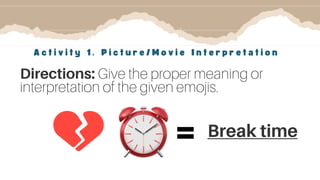
Directions:
Break time
Running late
Good luck
Party Time
Be Quiet
You Go Girl!
Coming Soon!
Be On Time
No Monkey Business
Laugh Out Loud
Call You Today
• Visual
• Aural or Audio
• Gestural
• Linguistic or Alphabetic
• Spatial
Visual:
Aural or Audio
Gestural
Linguistic/Alphabetic
Spatial
Spatial
Spatial
multimodals and its elements powerpointx

multimodals and its elements powerpointx

Editor's Notes

  • #10 Uses more than one system of communication. It often employ systems of visual, audial and textual communications. It increases audience level of engagement and interest.
  • #12 Communication is not only relaying messages through voice and letters. It does not limit its purpose to written and verbal text.
  • #13 Many texts are multimodal where meaning is communicated through combinations of two or more modes.
  • #14 where meaning is conveyed to the reader through varying combinations of visual (still image), written language, and spatial modes.
  • #15 convey meaning through combinations of written and spoken language, visual (still and moving image), audio, gestural and spatial modes.
  • #16 convey meaning through combinations of modes such as gestural, spatial, spoken language, and audio.
  • #17 A text may be defined as multimodal when it combines two or more semiotic systems
  • #22 Multimodal text can be print, physical or digital. Examples of types of Multimodal text are …
  • #29 For instance, the “No Guns” symbol has no alphabetic text and no sound. Like many signs, it relies for its meaning on visual information.
  • #30 An example of an aural mode — one that depends almost exclusively on sound — might be the recording of a public speech that was delivered orally to a live audience, such as President Rodrigo Roa Duterte “ State of the Nations Address 2020”
  • #32 Linguistic is probably the most widely used mode because it can be both read and heard on both paper or audio. The linguistic mode is the best way to express details and list.
  • #35 Here is a “traditional” classroom: Individual desks are arranged in orderly rows, facing the front of the room to make the teacher who would stand before the chalkboard the center of attention. The teacher also stands at a distance from the students; the students who sit in the back could hardly even see the board