Multimetallic Catalysis
Monometallic Catalysis Multimetallic Catalysis
Design Principles of Multimetallic Catalysis
Recent advances in multimetallic-catalyzed reactions for C−C bond formation reveal principles that can
be adopted in the design of new reactions.
Key considerations in devising multimetallic systems are
(1) choosing what metals to pair together,
(2) favoring cross-reactivity between catalysts to outcompete or prevent self-reactivity by one of
the catalysts, and
(3) optimizing more complex systems that contain multiple metals and multiple ligands.
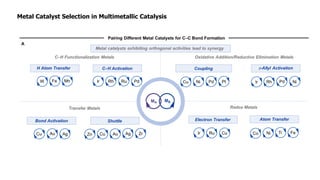
Metal Catalyst Selection in Multimetallic Catalysis
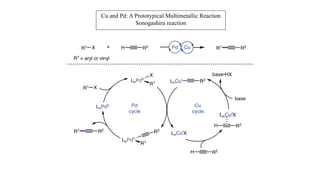
Cu and Pd: A Prototypical Multimetallic Reaction
Sonogashira reaction
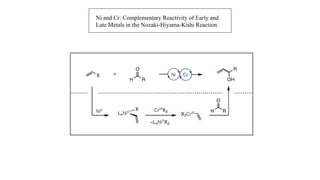
Ni and Cr: Complementary Reactivity of Early and
Late Metals in the Nozaki-Hiyama-Kishi Reaction
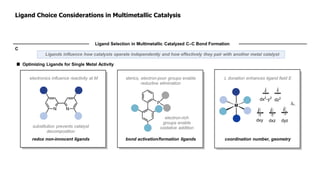
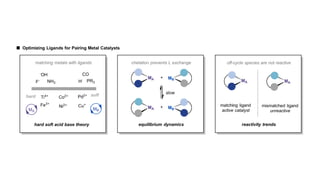
Ligand Choice Considerations in Multimetallic Catalysis
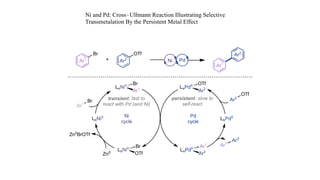
Ni and Pd: Cross−Ullmann Reaction Illustrating Selective
Transmetalation By the Persistent Metal Effect
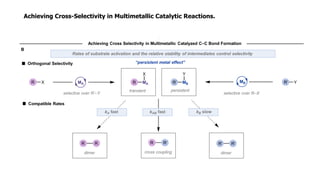
Achieving Cross-Selectivity in Multimetallic Catalytic Reactions.
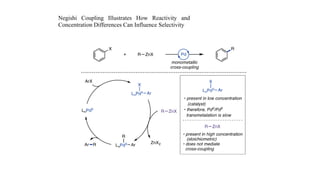
Negishi Coupling Illustrates How Reactivity and
Concentration Differences Can Influence Selectivity
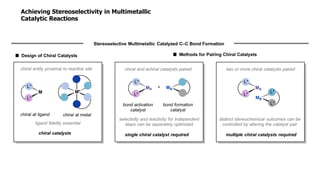
Achieving Stereoselectivity in Multimetallic
Catalytic Reactions
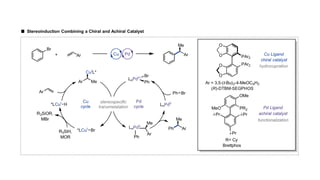
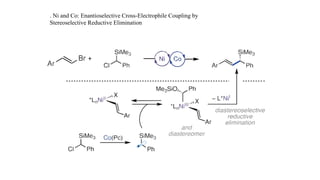
. Ni and Co: Enantioselective Cross-Electrophile Coupling by
Stereoselective Reductive Elimination
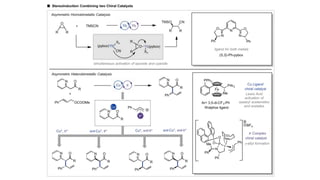
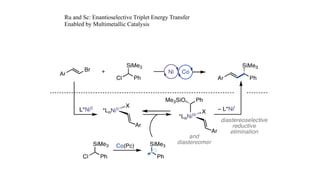
Ru and Sc: Enantioselective Triplet Energy Transfer
Enabled by Multimetallic Catalysis
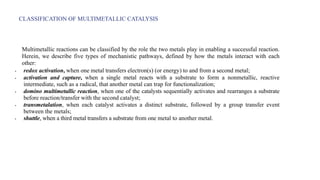
CLASSIFICATION OF MULTIMETALLIC CATALYSIS
Multimetallic reactions can be classified by the role the two metals play in enabling a successful reaction.
Herein, we describe five types of mechanistic pathways, defined by how the metals interact with each
other:
• redox activation, when one metal transfers electron(s) (or energy) to and from a second metal;
• activation and capture, when a single metal reacts with a substrate to form a nonmetallic, reactive
intermediate, such as a radical, that another metal can trap for functionalization;
• domino multimetallic reaction, when one of the catalysts sequentially activates and rearranges a substrate
before reaction/transfer with the second catalyst;
• transmetalation, when each catalyst activates a distinct substrate, followed by a group transfer event
between the metals;
• shuttle, when a third metal transfers a substrate from one metal to another metal.
FUTURE OUTLOOK
Multimetallic catalysis in organic synthesis .pptx

Multimetallic catalysis in organic synthesis .pptx

  • 1.
  • 2.
    Design Principles ofMultimetallic Catalysis Recent advances in multimetallic-catalyzed reactions for C−C bond formation reveal principles that can be adopted in the design of new reactions. Key considerations in devising multimetallic systems are (1) choosing what metals to pair together, (2) favoring cross-reactivity between catalysts to outcompete or prevent self-reactivity by one of the catalysts, and (3) optimizing more complex systems that contain multiple metals and multiple ligands.
  • 3.
    Metal Catalyst Selectionin Multimetallic Catalysis
  • 4.
    Cu and Pd:A Prototypical Multimetallic Reaction Sonogashira reaction
  • 5.
    Ni and Cr:Complementary Reactivity of Early and Late Metals in the Nozaki-Hiyama-Kishi Reaction
  • 6.
    Ligand Choice Considerationsin Multimetallic Catalysis
  • 8.
    Ni and Pd:Cross−Ullmann Reaction Illustrating Selective Transmetalation By the Persistent Metal Effect
  • 9.
    Achieving Cross-Selectivity inMultimetallic Catalytic Reactions.
  • 10.
    Negishi Coupling IllustratesHow Reactivity and Concentration Differences Can Influence Selectivity
  • 11.
    Achieving Stereoselectivity inMultimetallic Catalytic Reactions
  • 14.
    . Ni andCo: Enantioselective Cross-Electrophile Coupling by Stereoselective Reductive Elimination
  • 15.
    Ru and Sc:Enantioselective Triplet Energy Transfer Enabled by Multimetallic Catalysis
  • 16.
    CLASSIFICATION OF MULTIMETALLICCATALYSIS Multimetallic reactions can be classified by the role the two metals play in enabling a successful reaction. Herein, we describe five types of mechanistic pathways, defined by how the metals interact with each other: • redox activation, when one metal transfers electron(s) (or energy) to and from a second metal; • activation and capture, when a single metal reacts with a substrate to form a nonmetallic, reactive intermediate, such as a radical, that another metal can trap for functionalization; • domino multimetallic reaction, when one of the catalysts sequentially activates and rearranges a substrate before reaction/transfer with the second catalyst; • transmetalation, when each catalyst activates a distinct substrate, followed by a group transfer event between the metals; • shuttle, when a third metal transfers a substrate from one metal to another metal.
  • 17.