Multimedia
Table Contents
– Definition
– Introduction
– Categories of Multimedia
– Applications of Multimedia
– Components of Multimedia
– Conclusion
2
Introduction
– Multi
• Many, Multiple,
– Media
• Tools that is used to represent or do a certain
things, delivery medium, a form of mass
communication – newspaper, magazine / tv.
• Distribution tool & information presentation –
text, graphic, voice, images, music and etc.
"
3
Definition of Multimedia
• Multimedia is a combination of text, graphic,
sound, animation, and video that is delivered
interactively to the user by electronic or
digitally manipulated means.
TEXT
AUDIO
GRAPHIC
VIDEO
ANIMATION
5
Categories of Multimedia
• A Multimedia Project is identified as Linear when:
– It is not interactive
– User have no control over the content that is being
showed to them.
• Example:
– A movie
– A non-interactive lecture / demo show
LINEAR MULTIMEDIA
• A Multimedia Project is identified as Non-Linear when:
– It is interactive
– Users have control over the content that is being showed to
them.
– Users are given navigational control
• Example:
– Games
– Courseware
– Interactive CD
NON-LINEAR MULTIMEDIA
Categories of Multimedia
• There are a number of fields where multimedia
could be of use. Examples are:-
– Business
– Education
– Entertainment
– Home
– Public Places
Applications of Multimedia
• Business
– Use and Applications
• Sales / Marketing Presentation
• Trade show production
• Staff Training Application
• Company Kiosk
Applications of Multimedia
• Education
– Use and Applications
• Courseware / Simulations
• E-Learning / Distance Learning
• Information Searching
Applications of Multimedia
• Entertainment
– Use and Applications
• Games (Leisure / Educational)
• Movies
• Video on Demand
–Online
Applications of Multimedia
• Home
– Use and Applications
• Television
• Satellite TV
• SMS services (chats, voting, reality TV)
Applications of Multimedia
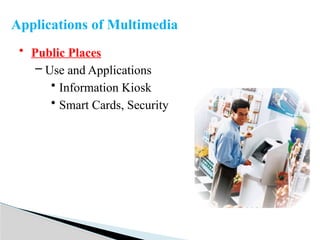
• Public Places
– Use and Applications
• Information Kiosk
• Smart Cards, Security
Applications of Multimedia
Technology & Science
• In the sphere of science and
technology, multimedia has a
wide range of applications.
• It can communicate audio,
films, and other multimedia
documents in a variety of
formats.
●●●
14
Applications of Multimedia
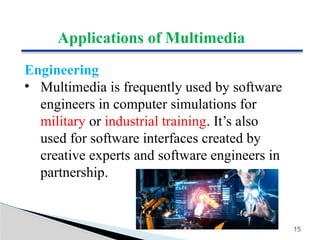
Engineering
• Multimedia is frequently used by software
engineers in computer simulations for
military or industrial training. It’s also
used for software interfaces created by
creative experts and software engineers in
partnership.
15
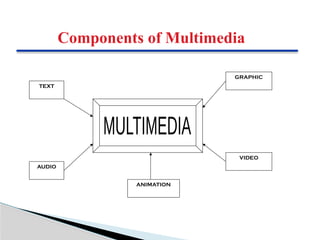
TEXT
AUDIO
GRAPHIC
VIDEO
ANIMATION
Components of Multimedia
MM BUILDING BLOCKS
Text
• Characters are used to form words,
phrases, and paragraphs in the text.
• Text appears in all multimedia creations of
some kind.
• The text can be in a variety of fonts and
sizes to match the multimedia software’s
professional presentation.
●●●
17
Components of Multimedia
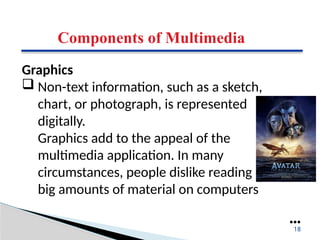
Graphics
 Non-text information, such as a sketch,
chart, or photograph, is represented
digitally.
Graphics add to the appeal of the
multimedia application. In many
circumstances, people dislike reading
big amounts of material on computers
●●●
18
Components of Multimedia
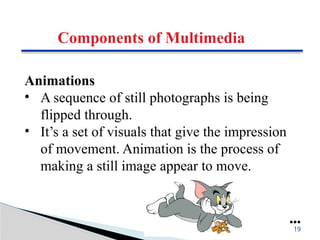
Animations
• A sequence of still photographs is being
flipped through.
• It’s a set of visuals that give the impression
of movement. Animation is the process of
making a still image appear to move.
●●●
19
Components of Multimedia
Video
 Photographic images that appear to be in
full motion and are played back at speeds of
15 to 30 frames per second.
 The term video refers to a moving image
that is accompanied by sound, such as a
television picture.
●●●
20
Components of Multimedia
Audio
• Any sound, whether it’s music, conversation,
or something else. Sound is the most serious
aspect of multimedia, delivering the joy of
music, special effects, and other forms of
entertainment.
• Decibels are a unit of measurement for volume
and sound pressure level.
21
Components of Multimedia
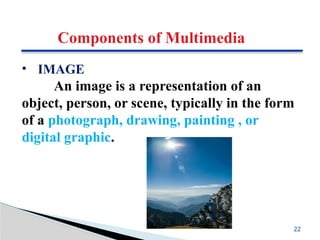
• IMAGE
An image is a representation of an
object, person, or scene, typically in the form
of a photograph, drawing, painting , or
digital graphic.
22
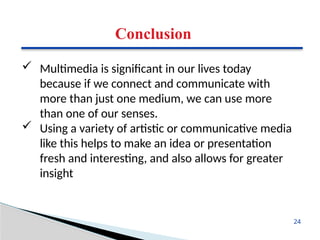
Conclusion
 Multimedia is significant in our lives today
because if we connect and communicate with
more than just one medium, we can use more
than one of our senses.
 Using a variety of artistic or communicative media
like this helps to make an idea or presentation
fresh and interesting, and also allows for greater
insight
24
Thanks
To
StudyMafia.org

Multimedidfsededdfedfefeerereeda ppt.pptx

  • 1.
  • 2.
    Table Contents – Definition –Introduction – Categories of Multimedia – Applications of Multimedia – Components of Multimedia – Conclusion 2
  • 3.
    Introduction – Multi • Many,Multiple, – Media • Tools that is used to represent or do a certain things, delivery medium, a form of mass communication – newspaper, magazine / tv. • Distribution tool & information presentation – text, graphic, voice, images, music and etc. " 3
  • 4.
    Definition of Multimedia •Multimedia is a combination of text, graphic, sound, animation, and video that is delivered interactively to the user by electronic or digitally manipulated means. TEXT AUDIO GRAPHIC VIDEO ANIMATION
  • 5.
  • 6.
    Categories of Multimedia •A Multimedia Project is identified as Linear when: – It is not interactive – User have no control over the content that is being showed to them. • Example: – A movie – A non-interactive lecture / demo show LINEAR MULTIMEDIA
  • 7.
    • A MultimediaProject is identified as Non-Linear when: – It is interactive – Users have control over the content that is being showed to them. – Users are given navigational control • Example: – Games – Courseware – Interactive CD NON-LINEAR MULTIMEDIA Categories of Multimedia
  • 8.
    • There area number of fields where multimedia could be of use. Examples are:- – Business – Education – Entertainment – Home – Public Places Applications of Multimedia
  • 9.
    • Business – Useand Applications • Sales / Marketing Presentation • Trade show production • Staff Training Application • Company Kiosk Applications of Multimedia
  • 10.
    • Education – Useand Applications • Courseware / Simulations • E-Learning / Distance Learning • Information Searching Applications of Multimedia
  • 11.
    • Entertainment – Useand Applications • Games (Leisure / Educational) • Movies • Video on Demand –Online Applications of Multimedia
  • 12.
    • Home – Useand Applications • Television • Satellite TV • SMS services (chats, voting, reality TV) Applications of Multimedia
  • 13.
    • Public Places –Use and Applications • Information Kiosk • Smart Cards, Security Applications of Multimedia
  • 14.
    Applications of Multimedia Technology& Science • In the sphere of science and technology, multimedia has a wide range of applications. • It can communicate audio, films, and other multimedia documents in a variety of formats. ●●● 14
  • 15.
    Applications of Multimedia Engineering •Multimedia is frequently used by software engineers in computer simulations for military or industrial training. It’s also used for software interfaces created by creative experts and software engineers in partnership. 15
  • 16.
  • 17.
    MM BUILDING BLOCKS Text •Characters are used to form words, phrases, and paragraphs in the text. • Text appears in all multimedia creations of some kind. • The text can be in a variety of fonts and sizes to match the multimedia software’s professional presentation. ●●● 17
  • 18.
    Components of Multimedia Graphics Non-text information, such as a sketch, chart, or photograph, is represented digitally. Graphics add to the appeal of the multimedia application. In many circumstances, people dislike reading big amounts of material on computers ●●● 18
  • 19.
    Components of Multimedia Animations •A sequence of still photographs is being flipped through. • It’s a set of visuals that give the impression of movement. Animation is the process of making a still image appear to move. ●●● 19
  • 20.
    Components of Multimedia Video Photographic images that appear to be in full motion and are played back at speeds of 15 to 30 frames per second.  The term video refers to a moving image that is accompanied by sound, such as a television picture. ●●● 20
  • 21.
    Components of Multimedia Audio •Any sound, whether it’s music, conversation, or something else. Sound is the most serious aspect of multimedia, delivering the joy of music, special effects, and other forms of entertainment. • Decibels are a unit of measurement for volume and sound pressure level. 21
  • 22.
    Components of Multimedia •IMAGE An image is a representation of an object, person, or scene, typically in the form of a photograph, drawing, painting , or digital graphic. 22
  • 24.
    Conclusion  Multimedia issignificant in our lives today because if we connect and communicate with more than just one medium, we can use more than one of our senses.  Using a variety of artistic or communicative media like this helps to make an idea or presentation fresh and interesting, and also allows for greater insight 24
  • 25.

Editor's Notes

  • #2 SAY: Before we wrap up the course, let’s review what we have learned today. During this course, we have <READ the bullets from the slide.> GO to next slide.
  • #3 SAY: Before we wrap up the course, let’s review what we have learned today. During this course, we have <READ the bullets from the slide.> GO to next slide.
  • #5 SAY: Before we wrap up the course, let’s review what we have learned today. During this course, we have <READ the bullets from the slide.> GO to next slide.
  • #14 SAY: The purpose of epidemiology in public health practice is to discover the agent, host, and environmental factors that affect health; determine the relative importance of causes of illness, disability, and death; identify those segments of the population that have the greatest risk from specific causes of ill health; and evaluate the effectiveness of health programs and services in improving population health. GO to next slide.
  • #15 SAY: The purpose of epidemiology in public health practice is to discover the agent, host, and environmental factors that affect health; determine the relative importance of causes of illness, disability, and death; identify those segments of the population that have the greatest risk from specific causes of ill health; and evaluate the effectiveness of health programs and services in improving population health. GO to next slide.
  • #17 SAY: The purpose of epidemiology in public health practice is to discover the agent, host, and environmental factors that affect health; determine the relative importance of causes of illness, disability, and death; identify those segments of the population that have the greatest risk from specific causes of ill health; and evaluate the effectiveness of health programs and services in improving population health. GO to next slide.
  • #18 SAY: The purpose of epidemiology in public health practice is to discover the agent, host, and environmental factors that affect health; determine the relative importance of causes of illness, disability, and death; identify those segments of the population that have the greatest risk from specific causes of ill health; and evaluate the effectiveness of health programs and services in improving population health. GO to next slide.
  • #19 SAY: The purpose of epidemiology in public health practice is to discover the agent, host, and environmental factors that affect health; determine the relative importance of causes of illness, disability, and death; identify those segments of the population that have the greatest risk from specific causes of ill health; and evaluate the effectiveness of health programs and services in improving population health. GO to next slide.
  • #20 SAY: The purpose of epidemiology in public health practice is to discover the agent, host, and environmental factors that affect health; determine the relative importance of causes of illness, disability, and death; identify those segments of the population that have the greatest risk from specific causes of ill health; and evaluate the effectiveness of health programs and services in improving population health. GO to next slide.
  • #21 SAY: The purpose of epidemiology in public health practice is to discover the agent, host, and environmental factors that affect health; determine the relative importance of causes of illness, disability, and death; identify those segments of the population that have the greatest risk from specific causes of ill health; and evaluate the effectiveness of health programs and services in improving population health. GO to next slide.
  • #22 SAY: The purpose of epidemiology in public health practice is to discover the agent, host, and environmental factors that affect health; determine the relative importance of causes of illness, disability, and death; identify those segments of the population that have the greatest risk from specific causes of ill health; and evaluate the effectiveness of health programs and services in improving population health. GO to next slide.
  • #24 SAY: The purpose of epidemiology in public health practice is to discover the agent, host, and environmental factors that affect health; determine the relative importance of causes of illness, disability, and death; identify those segments of the population that have the greatest risk from specific causes of ill health; and evaluate the effectiveness of health programs and services in improving population health. GO to next slide.