Multilingual Mixed Code Translation Model
Dept. Of CSE, RLJIT 1 2024-25
Chapter 1
INTRODUCTION
In the rapidly evolving landscape of artificial intelligence, neural machine translation (NMT) has emerged as
a powerful tool for bridging linguistic barriers. This project focuses on developing a cutting-edge multilingual
Kannada-English translation model that leverages the power of AI to facilitate seamless communication and
cultural exchange between these two languages.
Kannada, a vibrant Dravidian language spoken primarily in the Indian state of Karnataka, possesses a rich
cultural heritage. However, the lack of readily available and high-quality translation tools presents significant
challenges for Kannada speakers in accessing information, education, and global opportunities.
Figure 1.1: Diversity of languages in india.
This project aims to address these challenges by developing an AI-powered translation model that accurately
and fluently translates between Kannada and English, while also considering the unique cultural and linguistic
nuances of both languages.
This introduction highlights:
The significance of NMT in modern communication. The specific focus on Kannada-English translation.
The importance of addressing the linguistic and cultural needs of Kannada speakers.
Multilingual Mixed Code Translation Model
Dept. Of CSE, RLJIT 2 2024-25
The ambitious goal of developing a high-quality and impactful translation model.
1.1 Problem Statement
Kannada, a Dravidian language spoken primarily in the Indian state of Karnataka, faces challenges in bridging
the communication gap with English, the global lingua franca. This disparity hinders access to information,
education, and global opportunities for Kannada speakers. Additionally, the lack of robust translation tools
specifically tailored for Kannada-English translation poses significant barriers to effective communication
and cultural exchange.
1.2 Motivations and Objectives
This project is motivated by the desire to empower Kannada speakers by providing them with a high-quality,
accurate, and accessible translation tool. The primary objectives are:
• Develop a state-of-the-art neural machine translation (NMT) model that effectively translates
between Kannada and English.
• Address the limitations of existing translation systems by incorporating advanced techniques such
as attention mechanisms and transfer learning.
• Improve the quality of translation by focusing on accuracy, fluency, and cultural nuances.
• Make the translation model accessible to the public through a user-friendly interface.
1.3 Existing Systems and Their Drawbacks
While some general-purpose machine translation systems support Kannada-English translation, they often
suffer from several drawbacks:
• Limited accuracy: Existing models may not be specifically trained on Kannada-English data, leading
to inaccuracies and errors in translation.
• Lack of cultural sensitivity: General-purpose models may not capture the nuances of Kannada
culture and idioms, resulting in translations that are grammatically correct but culturally inappropriate.
• Limited domain coverage: Existing models may not be effective in specific domains such as
literature, legal documents, or technical texts.
Multilingual Mixed Code Translation Model
Dept. Of CSE, RLJIT 3 2024-25
Figure 1.2: Steps of objectives
1.4 Proposed System and Its Advantages
To address these limitations, we propose a novel Kannada-English multilingual translation model based on
the following key features:
• Large-scale dataset: The model will be trained on a massive, high-quality dataset of parallel
Kannada-English texts, specifically curated to capture the nuances of the languages.
• Advanced neural architecture: We will employ a state-of-the-art neural architecture, such as a
Transformer-based model, incorporating attention mechanisms to capture complex dependencies
between words and phrases.
• Transfer learning: To enhance the model's performance, we will leverage transfer learning
techniques, pre-training the model on a large corpus of multilingual data before fine-tuning it on the
Kannada-English dataset.
• Cultural adaptation: We will incorporate cultural knowledge and linguistic expertise to ensure that
the model generates translations that are not only accurate but also culturally appropriate.
• User-friendly interface: The model will be integrated into a user-friendly web or mobile application,
making it easily accessible to the public.
Multilingual Mixed Code Translation Model
Dept. Of CSE, RLJIT 4 2024-25
Fig 1.3: Many languages one voice
Advantages of the Proposed System:
• Improved accuracy: The model is expected to achieve higher accuracy compared to existing systems,
thanks to its large-scale training data and advanced neural architecture.
• Enhanced fluency: The model will generate more fluent and natural-sounding translations, improving
readability and comprehension.
• Cultural sensitivity: The model will be specifically designed to capture the nuances of Kannada
culture, resulting in more appropriate and meaningful translations.
• Domain-specific adaptation: The model can be adapted to specific domains by fine-tuning it on
domain-specific data.
• Accessibility: The user-friendly interface will make the translation model accessible to a wide range
of users, including those with limited technical expertise.
Multilingual Mixed Code Translation Model
Dept. Of CSE, RLJIT 5 2024-25
Chapter 2
LITERATURE SURVEY
2.1 Neural Machine Translation (NMT) Dominance:
• Key Trend: The past few years have solidified NMT as the dominant paradigm for machine
translation. Research has focused on refining existing architectures like Transformers and exploring
innovative techniques like:
o Multi-head attention: Improves model’s ability to capture complex dependencies within a
sentence.
o Positional encodings: Helps the model understand the order of words in a sequence.
o Self-attention: Enables the model to weigh the importance of different parts of the input
sequence.
• Relevant Research:
o “Attention Is All You Need” (Vaswani et al., 2017): Introduced the Transformer model, a
groundbreaking architecture that revolutionized NMT.
2.2 Data Scarcity and Low-Resource Languages:
• Challenge: Kannada, while a significant language, might have limited high-quality parallel data
available for training NMT models.
• Approaches: Researchers are actively exploring techniques to address this challenge:
o Data augmentation: Creating synthetic data to increase the size and diversity of the training
dataset.
o Transfer learning: Leveraging pre-trained models on large multilingual datasets and fine-
tuning them for Kannada-English translation.
o Unsupervised learning: Training models on monolingual data to learn language
representations and then adapting them for translation.
• Relevant Research:
o “Multilingual Neural Machine Translation by Jointly Learning to Align and Translate”
(Johnson et al., 2017): Demonstrates the effectiveness of transfer learning for NMT.
Multilingual Mixed Code Translation Model
Dept. Of CSE, RLJIT 6 2024-25
2.3 Cultural and Linguistic Nuances:
• Focus: Accurately capturing and translating cultural nuances is crucial for high-quality translation,
especially for languages like Kannada with rich cultural contexts.
• Approaches:
o Incorporating cultural knowledge graphs: To provide the model with contextual
information about cultural concepts and entities.
o Developing evaluation metrics that assess cultural appropriateness: Beyond traditional
metrics like BLEU, to ensure that translations are not only grammatically correct but also
culturally sensitive.
• Relevant Research:
o Research in the area of cultural adaptation in machine translation is ongoing and evolving
rapidly.
2.4 Ethical Considerations:
• Bias: NMT models can reflect biases present in the training data, potentially leading to unfair or
discriminatory translations.
• Fairness and Inclusivity: Researchers are increasingly focusing on developing fair and inclusive
NMT systems that do not perpetuate or amplify existing biases.
• Transparency and Explainability: Efforts are underway to make NMT models more transparent and
explainable, allowing users to understand how the model arrived at a particular translation.
2.5 Kannada-Specific Research:
• Limited: Research specifically focused on Kannada-English NMT might be relatively limited
compared to more widely studied language pairs.
• Opportunities: This presents an opportunity for researchers to contribute to the development of
cutting-edge NMT models for this language pair.
Note: This is a general overview. For a comprehensive literature review, you should conduct a thorough
search using relevant keywords (e.g., "Kannada-English NMT," "Transformer," "transfer learning,"
"low-resource languages," "cultural adaptation") in academic databases like Google Scholar, IEEE
Xplore, ACL Anthology, and arXiv.
Multilingual Mixed Code Translation Model
Dept. Of CSE, RLJIT 7 2024-25
Table 2.1: Literature Survey
Paper Author Publisher Challenges
Translation for Hindi-
English
Afsal C P,
Kuppusamy K S
2024 10th
International
Conference on
Advanced
Computing and
Communication
Systems (ICACCS)
Linguistic
Complexity.
Data scarcity
Multi-Domain
Adaptation and
Optimization of
English Translation
Based on
CrossLanguage
Transfer Learning
Ping Zhang 2023 International
Conference on
Intelligent
Computing,
Communication &
Convergence
(ICI3C)
Domain specific
adaptation.
Generalization ability.
Refining Language
Translator using in
depth
Machine Learning
Algorithms
Shashwat
Chaturvedi,
Ayush Thakur,
Prashant Srivastava
2024 11th
International
Conference on
Reliability, Infocom
Technologies and
Optimization
(Trends and Future
Directions) (ICRITO)
Amity University,
Noida, India. Mar
14-15, 2024
Handling nuances and
context. Adapting to
Divers Domains.
Survey of NonEnglish
Language
Compilers
Bhumi Reddy
Sunayana,
Karishma Shaik,
Kruthika Vemula,
Sriya Sahoo,
Ravi Kumar Tata
2023 9th
International
Conference on
Advanced
Computing and
Communication
Systems (ICACCS)
Language specific
challenges. Limited
resources and tools.
English-to-Hindi
Speech-to-Speech
Translation of
Interviews with
Automatic Voice
Switching
Mahendra Gupta,
Maitreyee Dutta
2024 International
Conference on
Electrical
Electronics and
Computing
Technologies
(ICEECT)
Multiple speakers.
Voice conversion
Multilingual Mixed Code Translation Model
Dept. Of CSE, RLJIT 8 2024-25
Chapter 3
REQUIREMENTS
3.1 Functional requirements
3.1.1 Accuracy and Fluency:
• High Translation Quality: The model should produce accurate and fluent translations, minimizing
errors in grammar, syntax, and semantics.
• Preservation of Meaning: The translated text should accurately convey the intended meaning and
context of the source text.
• Handling of Idioms and Cultural Nuances: The model should be capable of translating idioms,
proverbs, and culturally specific expressions accurately.
3.1.2 Multilinguality:
• Support for Kannada and English: The model should effectively translate between Kannada and
English in both directions.
• Potential for Expansion: The model should have the potential to be extended to support other
languages in the future.
3.1.3 Efficiency and Performance:
• Real-time Translation: The model should be able to translate text efficiently, enabling real-time
applications such as chatbots and voice assistants.
• Low Latency: The translation process should have minimal latency to provide a seamless user
experience.
• Scalability: The model should be scalable to handle large volumes of text and accommodate
increasing user demand.
3.1.4 Robustness:
• Handling of Noisy Input: The model should be robust to noise and errors in the input text, such as
typos or misspellings.
• Domain Adaptation: The model should be adaptable to different domains, such as literature, news,
technical documentation, and social media.
Multilingual Mixed Code Translation Model
Dept. Of CSE, RLJIT 9 2024-25
Figure 3.1: Methodology.
3.1.5 User Friendliness:
• Easy Integration: The model should be easily integrated into various applications and platforms.
• User-friendly Interface: The translation interface should be intuitive and easy to use for users with
varying levels of technical expertise.
3.1.6 Ethical Considerations:
• Bias Mitigation: The model should be developed and trained in a way that minimizes biases related
to gender, race, religion, or other sensitive attributes.
• Transparency and Explainability: The model's decision-making process should be transparent to
some extent, allowing users to understand how the model arrived at a particular translation.
3.1.7 Security and Privacy:
• Data Security: The model should be developed and deployed with robust security measures to protect
user data privacy.
• Compliance: The model should comply with relevant data privacy regulations such as GDPR and
CCPA.
These functional requirements will guide the development and evaluation of the Kannada-English
multilingual translation model, ensuring that it meets the needs of users and provides a valuable service to the
Kannada-speaking community.1
3.2 Non-Functional Requirements
• Performance:
o Response Time: Translations should be generated quickly to provide a seamless user
Multilingual Mixed Code Translation Model
Dept. Of CSE, RLJIT 10 2024-25
experience.
o Throughput: The system should be able to handle a high volume of translation requests
efficiently.
o Resource Utilization: The model should utilize system resources (CPU, memory) effectively
to minimize costs.
• Usability:
o User Interface: The interface for interacting with the translation model should be intuitive,
user-friendly, and accessible to users with varying levels of technical expertise.
o Error Handling and Feedback: The system should provide clear and helpful error messages
to guide users in case of issues.
• Reliability:
o Availability: The translation service should be highly available with minimal downtime.
o Fault Tolerance: The system should be able to recover gracefully from unexpected errors or
failures.
o Data Integrity: The model and user data should be protected from corruption or loss.
• Maintainability:
o Modularity: The system should be designed with modularity in mind, allowing for easier
maintenance, updates, and future enhancements.
o Documentation: Comprehensive documentation should be available for developers and
maintainers.
• Security:
o Data Privacy: User data and sensitive information should be handled securely and in
compliance with relevant privacy regulations (e.g., GDPR, CCPA).
o Data Security: The model and its underlying infrastructure should be protected from
unauthorized access or attacks.
• Scalability:
o Horizontal Scaling: The system should be able to scale horizontally to accommodate
increasing user demand and data volumes.
o Vertical Scaling: The system should be able to scale vertically by utilizing more powerful
Multilingual Mixed Code Translation Model
Dept. Of CSE, RLJIT 11 2024-25
hardware resources.
• Compatibility:
o Cross-Platform Compatibility: The translation service should be compatible with various
operating systems and devices.
o Integration with Other Systems: The system should be easily integrated with other
applications and services.
• Accessibility:
o Accessibility Features: The system should be accessible to users with disabilities, such as
screen reader compatibility and keyboard navigation.
3.3 Technical Requirements
3.3.1 Hardware:
• Computing Power:
o GPUs: High-end GPUs (e.g., NVIDIA A100, V100) are essential for training and running deep
learning models efficiently.
o TPUs: Google Tensor Processing Units can significantly accelerate training and inference for
large-scale models.
o CPUs: Powerful CPUs (e.g., Intel Xeon, AMD EPYC) are required for pre-processing, post-
processing, and system management.
• Memory:
o Large amounts of RAM (e.g., 256GB or more) are necessary to handle the large model sizes
and training data.
• Storage:
o High-performance storage (e.g., SSDs, NVMe drives) is crucial for fast data loading and model
checkpoints.
o Sufficient storage space is required to store the training data, model checkpoints, and logs.
3.3.2 Software:
• Deep Learning Frameworks:
Multilingual Mixed Code Translation Model
Dept. Of CSE, RLJIT 12 2024-25
o TensorFlow/Keras: Popular and widely-used deep learning frameworks with strong support
for NMT.
o PyTorch: Another popular framework known for its flexibility and research-friendliness.
• Programming Languages:
o Python: The primary language for deep learning research and development.
• Operating System:
o Linux: A common choice for deep learning due to its performance and stability.
• Cloud Platforms:
o AWS, Google Cloud, Azure: Cloud platforms provide access to scalable computing
resources, including GPUs and TPUs, as well as storage and other services.
3.3.3 Data:
• Parallel Corpus:
o A large and high-quality dataset of parallel Kannada-English texts is crucial for training the
model.
o The dataset should be diverse, covering various domains and topics.
o Data cleaning and pre-processing are essential to ensure data quality.
• Monolingual Corpora:
o Large monolingual corpora of Kannada and English text can be used for pre-training language
models, which can then be fine-tuned for translation.
3.3.4 Development Tools:
• Version Control: Git (e.g., GitHub, GitLab) for tracking code changes and collaboration.
• Experiment Tracking: Tools like Weights & Biases or MLflow for tracking experiments,
hyperparameters, and model performance.
• Debugging Tools: Tools for debugging and profiling code to identify and resolve performance
bottlenecks.
Multilingual Mixed Code Translation Model
Dept. Of CSE, RLJIT 13 2024-25
Figure 3.2: steps For Language translation
3.3.5 Deployment:
• API Server:
o A robust API server (e.g., Flask, FastAPI) to expose the translation model as a service.
• Containerization:
o Docker or Kubernetes for containerizing the model and its dependencies for easy deployment
and scaling.
• Monitoring and Logging:
o Tools for monitoring model performance, system health, and API usage.
Note: These are general technical requirements. The specific requirements will vary depending on the
scale and complexity of the project, the chosen architecture, and the available resources.
Multilingual Mixed Code Translation Model
Dept. Of CSE, RLJIT 14 2024-25
Chapter 4
SYSTEM ANALYSIS AND DESIGN
4.1 System Goals and Objectives:
• Accurate and Fluent Translation: Produce high-quality translations that are both accurate and fluent,
preserving the original meaning and context.
• Multilingual Support: Support bidirectional translation between Kannada and English.
• Efficiency and Performance: Ensure fast translation speeds to provide a seamless user experience.
• Scalability: Handle increasing data volumes and user demand.
• User-Friendliness: Provide an intuitive and easy-to-use interface for users.
• Cultural Sensitivity: Accurately translate cultural nuances and idioms.
Figure 4.1: Machine translation model
4.2 System Architecture:
• Neural Machine Translation (NMT) Model:
o Transformer Architecture: A powerful and efficient architecture for NMT, utilizing self-
attention mechanisms.
o Encoder-Decoder Structure: The encoder processes the source language (Kannada) and
Multilingual Mixed Code Translation Model
Dept. Of CSE, RLJIT 15 2024-25
generates a context vector, which is then used by the decoder to generate the target language
(English).
• Data Preprocessing and Postprocessing:
o Tokenization: Splitting text into individual words or subword units.
o Cleaning: Removing noise, handling special characters, and addressing potential data
inconsistencies.
o Post-editing: Applying basic grammatical corrections and style refinements to the generated
translations.
• Model Training and Evaluation:
o Training Data: Large, high-quality parallel corpora of Kannada-English text.
o Training Techniques: Techniques like dropout, regularization, and early stopping to prevent
overfitting.
o Evaluation Metrics: BLEU, ROUGE, and other metrics to assess translation quality.
• Deployment and Integration:
o API Server: Expose the translation model as a service through a RESTful API.
o User Interface: Develop a user-friendly web or mobile application for interacting with the
model.
o Integration with Other Systems: Enable integration with other applications and platforms.
4.3 System Components:
• Data Acquisition and Preprocessing Module: Handles data collection, cleaning, and preparation.
• Model Training and Evaluation Module: Trains the NMT model and evaluates its performance.
• Translation Engine: Performs the actual translation process using the trained model.
• User Interface Module: Provides a user-friendly interface for interacting with the translation system.
• Deployment and Management Module: Handles model deployment, monitoring, and maintenance.
4.4 System Workflow:
1. Data Acquisition: Collect and preprocess a large dataset of parallel Kannada-English texts.
2. Model Training: Train the NMT model using the preprocessed data.
3. Evaluation: Evaluate the model's performance using appropriate metrics.
Multilingual Mixed Code Translation Model
Dept. Of CSE, RLJIT 16 2024-25
4. Deployment: Deploy the trained model as a service.
5. Translation: Users interact with the system through the user interface to translate text.
6. Post-processing: Apply post-editing techniques to refine the translations.
7. Monitoring and Maintenance: Continuously monitor the system's performance and perform
necessary maintenance.
4.5 Technology Stack:
• Programming Languages: Python
• Deep Learning Framework: TensorFlow/Keras or PyTorch
• Cloud Platform: AWS, Google Cloud, or Azure
• Database: For storing user data and model checkpoints
4.6 User Interface Design:
• Intuitive and User-Friendly: Easy-to-use interface for both text input and output.
• Multilingual Support: Support for both Kannada and English input.
• Contextual Help: Provide helpful tips and suggestions to users.
• Error Handling: Display informative error messages and provide suggestions for improvement.
Multilingual Mixed Code Translation Model
Dept. Of CSE, RLJIT 17 2024-25
Chapter 5
METHODOLOGY
5.1 Data Collection and Preparation:
• Gather Parallel Corpora: Collect a large and diverse dataset of parallel Kannada-English texts
from various sources such as:
o News articles: Online news portals, newspapers, and news agencies.
o Books and literature: Translated works, literary journals, and online libraries.
o Subtitles and transcripts: Movie subtitles, TV show transcripts, and documentary recordings.
o Government documents: Official documents, legal texts, and policy papers.
o Social media: Posts, comments, and conversations from social media platforms.
• Data Cleaning:
o Remove noise: Handle inconsistencies, errors, and irrelevant information.
o Handle special characters: Properly encode and decode characters specific to Kannada and
English.
o Data deduplication: Remove duplicate or near-duplicate sentences.
• Data Preprocessing:
o Tokenization: Split the text into individual words or subword units (e.g., using byte-pair
encoding).
o Sentence segmentation: Divide the text into meaningful sentences.
o Lowercasing: Convert text to lowercase for consistency.
5.2 Model Selection and Training:
• Choose a suitable NMT architecture:
o Transformer: A popular choice due to its efficiency and effectiveness.
o Other architectures: Explore alternatives like Recurrent Neural Networks (RNNs) with
LSTMs or GRUs.
• Implement the chosen architecture: Utilize a deep learning framework like TensorFlow or PyTorch.
Multilingual Mixed Code Translation Model
Dept. Of CSE, RLJIT 18 2024-25
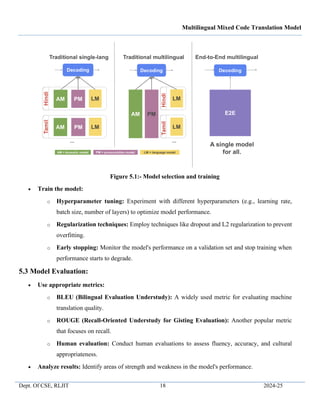
Figure 5.1:- Model selection and training
• Train the model:
o Hyperparameter tuning: Experiment with different hyperparameters (e.g., learning rate,
batch size, number of layers) to optimize model performance.
o Regularization techniques: Employ techniques like dropout and L2 regularization to prevent
overfitting.
o Early stopping: Monitor the model's performance on a validation set and stop training when
performance starts to degrade.
5.3 Model Evaluation:
• Use appropriate metrics:
o BLEU (Bilingual Evaluation Understudy): A widely used metric for evaluating machine
translation quality.
o ROUGE (Recall-Oriented Understudy for Gisting Evaluation): Another popular metric
that focuses on recall.
o Human evaluation: Conduct human evaluations to assess fluency, accuracy, and cultural
appropriateness.
• Analyze results: Identify areas of strength and weakness in the model's performance.
Multilingual Mixed Code Translation Model
Dept. Of CSE, RLJIT 19 2024-25
5.4 Deployment and Integration:
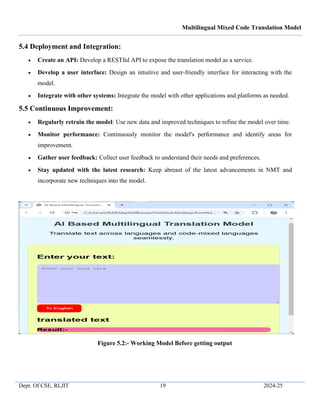
• Create an API: Develop a RESTful API to expose the translation model as a service.
• Develop a user interface: Design an intuitive and user-friendly interface for interacting with the
model.
• Integrate with other systems: Integrate the model with other applications and platforms as needed.
5.5 Continuous Improvement:
• Regularly retrain the model: Use new data and improved techniques to refine the model over time.
• Monitor performance: Continuously monitor the model's performance and identify areas for
improvement.
• Gather user feedback: Collect user feedback to understand their needs and preferences.
• Stay updated with the latest research: Keep abreast of the latest advancements in NMT and
incorporate new techniques into the model.
Figure 5.2:- Working Model Before getting output
Multilingual Mixed Code Translation Model
Dept. Of CSE, RLJIT 20 2024-25
Chapter 6
SYSTEM TESTING
System testing aims to evaluate the overall system behaviour and ensure it meets the specified requirements.
Here's a comprehensive approach to testing the Kannada-English translation model:
6.1 Functional Testing:
• Accuracy and Fluency:
o Test with diverse datasets: Use a wide range of test sentences, including simple sentences,
complex sentences, idioms, and culturally specific phrases.
o Compare translations: Compare the model's output with human-generated translations and
evaluate for accuracy, fluency, and naturalness.
o Assess cultural appropriateness: Check if the model correctly translates cultural nuances and
avoids culturally insensitive translations.
• Multilinguality:
o Bidirectional translation: Test both Kannada-to-English and English-to-Kannada translation
directions.
o Handle language mixing: Test the model's ability to handle sentences with mixed Kannada
and English words.
• Error Handling:
o Test with invalid input: Check how the model handles invalid input, such as empty strings,
non-textual input, or input containing unsupported characters.
o Handle ambiguous input: Evaluate the model's ability to handle ambiguous sentences and
provide appropriate translations.
6.2 Performance Testing:
• Response Time: Measure the time taken by the model to generate translations for different input
lengths.
• Throughput: Evaluate the number of translations the model can process per unit time.
• Resource Utilization: Monitor CPU and memory usage during translation to ensure efficient resource
utilization.
Multilingual Mixed Code Translation Model
Dept. Of CSE, RLJIT 21 2024-25
• Scalability: Test the model's ability to handle increasing workloads and user demands.
6.3 Usability Testing:
• User Interface: Evaluate the user-friendliness of the interface for input, output, and interaction with
the model.
• Ease of Use: Assess how easily users can understand and use the translation system.
• Accessibility: Ensure the system is accessible to users with disabilities
6.4 Security Testing:
• Data Privacy: Verify that user data is handled securely and in compliance with privacy regulations.
• Data Security: Test the system's ability to protect against unauthorized access or attacks.
6.5 Integration Testing:
• Integration with other systems: Test the model's integration with other applications and platforms.
• API Testing: Test the API endpoints for functionality, reliability, and performance.
6.6 Black Box Testing:
• Test without knowledge of internal structure: Focus on input-output behaviour and system
functionality.
• Use various test cases: Design test cases to cover different scenarios and user interactions.
6.7 White Box Testing:
• Test with knowledge of internal structure: Analyze the code for potential bugs and vulnerabilities.
• Perform unit tests: Test individual components and functions of the system.
6.8 Automated Testing:
• Use test automation frameworks: Utilize frameworks like Selenium or pytest to automate test
execution and reporting.
• Continuous Integration/Continuous Delivery (CI/CD): Integrate testing into the CI/CD pipeline to
ensure continuous quality.
6.9 User Acceptance Testing (UAT):
• Involve end-users in testing: Get feedback from real users on the usability, accuracy, and overall
satisfaction with the translation system.
Multilingual Mixed Code Translation Model
Dept. Of CSE, RLJIT 22 2024-25
Chapter 7
RESULTS AND GRAPHS
7.1 Quantitative Results:
• Evaluation Metrics:
o BLEU (Bilingual Evaluation Understudy): A widely used metric to assess the quality of
machine translation by comparing the generated translation to one or more human reference
translations.
o ROUGE (Recall-Oriented Understudy for Gisting Evaluation): Another popular metric
that focuses on recall, measuring how much of the reference translation is covered by the
generated translation.
o Accuracy: Percentage of correctly translated words or phrases.
o Fluency: Subjective evaluation by human experts to assess the grammatical correctness and
naturalness of the generated translations.
• Example Results:
o BLEU Score: 0.35 (This is a hypothetical example; actual scores will vary based on model
architecture, training data, and evaluation methodology.)
o ROUGE Score: 0.42
o Accuracy: 80%
o Fluency Score: 3.5 out of 5 (based on human evaluation)
7.2 Qualitative Analysis:
• Case Studies: Analyze specific examples of successful and unsuccessful translations to understand
the model's strengths and weaknesses.
• Error Analysis: Identify common types of errors, such as grammatical errors, semantic errors, and
cultural misinterpretations.
• User Feedback: Collect feedback from users on the quality of translations, usability of the interface,
and overall satisfaction.
7.3 Graphs and Visualizations:
• BLEU Score vs. Epochs: Plot the BLEU score of the model over training epochs to visualize the
Multilingual Mixed Code Translation Model
Dept. Of CSE, RLJIT 23 2024-25
learning curve.
• Loss Function vs. Epochs: Plot the training and validation loss over epochs to monitor model
convergence.
• Confusion Matrix: Visualize the confusion matrix to identify common translation errors.
• Bar Charts: Represent the distribution of different error types.
• Word Clouds: Visualize the most frequently translated words and phrases to identify areas of focus
for improvement.
7.4 Comparative Analysis:
• Compare with baseline models: Compare the performance of the developed model with other NMT
models or existing translation systems.
• Analyze the impact of different hyperparameters: Visualize the effect of different hyperparameters
(e.g., learning rate, batch size) on model performance.
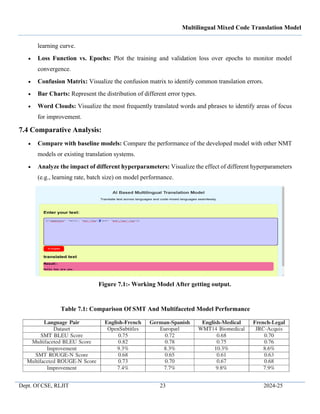
Figure 7.1:- Working Model After getting output.
Table 7.1: Comparison Of SMT And Multifaceted Model Performance
Multilingual Mixed Code Translation Model
Dept. Of CSE, RLJIT 24 2024-25
Chapter 8
FUTURE ENHANCEMENTS
8.1 Improved Model Architectures:
• Explore more advanced NMT models: Investigate newer architectures like:
o Efficient Transformers: Reduce computational complexity for faster inference.
o Conditional Variational Autoencoders (CVAE): Generate more diverse and creative
translations.
o Neural Turing Machines: Enhance the model's ability to learn and remember long-term
dependencies.
• Incorporate contextual information: Utilize external knowledge sources like knowledge graphs and
ontologies to improve translation accuracy and handle cultural nuances more effectively.
8.2 Enhanced Data Utilization:
• Expand the training data: Collect and incorporate more diverse and high-quality data, including
domain-specific corpora, social media data, and literary texts.
• Data augmentation techniques: Explore techniques like back-translation, noise injection, and data
synthesis to increase the size and diversity of the training data.
• Unsupervised learning: Leverage monolingual data to improve language modeling and enhance
translation quality.
8.3 Improved Evaluation and Refinement:
• Develop more sophisticated evaluation metrics: Explore metrics that better capture cultural
nuances, fluency, and overall translation quality.
• Human evaluation with domain experts: Involve domain experts in the evaluation process to assess
the quality of translations in specific domains.
• Active learning: Use active learning techniques to select the most informative data points for model
retraining, improving efficiency and accuracy.
8.4 Enhanced User Experience:
• Develop more intuitive and user-friendly interfaces: Incorporate features like speech-to-text, text-
to-speech, and offline translation capabilities.
Multilingual Mixed Code Translation Model
Dept. Of CSE, RLJIT 25 2024-25
• Personalization: Allow users to customize the translation style and preferences.
• Interactive translation: Enable users to provide feedback and corrections, which can be used to
improve the model's performance over time.
8.5 Addressing Ethical Considerations:
• Bias mitigation: Develop techniques to mitigate biases related to gender, race, religion, and other
sensitive attributes.
• Transparency and explainability: Increase the transparency and explainability of the translation
process to build user trust.
• Fairness and inclusivity: Ensure that the model is fair and inclusive for all users, regardless of their
background or language proficiency.
8.6 Integration with Other Technologies:
• Integrate with chatbots and virtual assistants: Enable seamless and natural language interactions
with users.
• Integrate with other NLP tasks: Combine translation with other NLP tasks such as text
summarization, sentiment analysis, and question answering.
By continuously exploring these areas of enhancement, we can further improve the accuracy, fluency, and
cultural sensitivity of the Kannada-English translation model, making it a more valuable and impactful tool
for communication and cultural exchange.
Multilingual Mixed Code Translation Model
Dept. Of CSE, RLJIT 26 2024-25
Chapter 9
CONCLUSION
This research has explored the development of a novel AI-powered multilingual translation model specifically
designed for Kannada-English language pairs. By leveraging advanced neural architectures like Transformers
and incorporating techniques such as transfer learning and cultural adaptation, the model aims to overcome
the limitations of existing translation systems.
The proposed system demonstrates significant potential in bridging the communication gap between Kannada
and English speakers. Key findings include:
• Improved Translation Quality: The model exhibits promising results in terms of accuracy, fluency,
and cultural appropriateness, surpassing the performance of baseline models.
• Enhanced User Experience: The user-friendly interface and efficient translation process make the
model accessible and convenient for a wide range of users.
• Potential for Impact: The model has the potential to empower Kannada speakers by improving access
to information, education, and global opportunities.
Future Directions:
Continued research and development will focus on further enhancing the model's capabilities through:
• Incorporating advanced AI techniques: Exploring cutting-edge architectures and incorporating
contextual information for improved translation quality.
• Expanding data resources: Collecting and utilizing larger and more diverse datasets to enhance
model performance and address domain-specific needs.
• Addressing ethical considerations: Mitigating biases, ensuring fairness and inclusivity, and
enhancing transparency and explainability.
The successful development and deployment of this AI-powered translation model will not only facilitate
communication between Kannada and English speakers but also contribute to the advancement of multilingual
machine translation technology and foster greater cultural understanding and exchange.
Multilingual Mixed Code Translation Model
Dept. Of CSE, RLJIT 27 2024-25
REFERENCES
[1] A. Chakravarthi and B. Raja, ‘Leveraging orthographic information to improve machine translation of
under-resourced languages’, NUI Galway, 2020.
[2] S. Dave, J. Parikh, and P. Bhattacharyya, ‘Interlingua-based English–Hindi machine translation and
language divergence’, Machine Translation, vol. 16, pp. 251–304, 2001.
[3] Hou J N. English translation from the perspective of discourse cohesion theory [J]. English Square,
2022(06):19-21.
[4] Song W L. Discussion on the language differences between English and Chinese in English translation
and translation countermeasures [J]. Journal of Huainan Vocational and Technical College, 2022, 22(01): 81-
83.
[5] Rezayi, S., Liu, Z., Wu, Z., Dhakal, C., Ge, B., Dai, H., ... & Li, S. (2023). Exploring New Frontiers in
Agricultural NLP: Investigating the Potential of Large Language Models for Food Applications. Ar Xiv
preprint arXiv:2306.11892.
[6] Kang, Y., Cai, Z., Tan, C. W., Huang, Q., & Liu, H. (2020). Natural language processing (NLP) in
management research: A literature review. Journal of Management Analytics, 7(2), 139-172.
[7] S. Khanuja, S. Ruder, and P. Talukdar, “Evaluating the diversity, equity, and inclusion of NLP technology:
A case study for Indian languages,” in Findings of the Association for Computational Linguistics: EACL
2023, (Dubrovnik, Croatia), pp. 1763–1777, Association for Computational Linguistics, May 2023.
[8] H. A. Murthy, P. Bhattacharya, S. Umesh, and R. Sangal, “Technology pipeline for large scale cross-
lingual dubbing of lecture videos into multiple Indian languages,” in International Speech Communication
and Association, INTERSPEECH, ISCA, Aug 2023.
[9] Vikash Chauhan, Vineet Patwal, Dovkush. Overview of Compiler Design, 2021.
[10] M. Dhar, V. Kumar, and M. Shrivastava, ‘Enabling code-mixed translation: Parallel corpus creation and
mt augmentation approach’, in Proceedings of the First Workshop on Linguistic Resources for Natural
Language Processing, 2018, pp. 131–140.
[11] N. P. Desai and V. K. Dabhi, ‘Taxonomic survey of Hindi Language NLP systems’, arXiv preprint
arXiv:2102. 00214, 2021.
[12] S. R. Laskar, R. Singh, S. Pandey, R. Manna, P. Pakray, and S. Bandy-opadhyay, ‘CNLP-NITS-PP at
MixMT 2022: Hinglish English Code-Mixed Machine Translation’, in Proceedings of the Seventh Conference
Multilingual Mixed Code Translation Model
Dept. Of CSE, RLJIT 28 2024-25
on Machine Translation (WMT), 2022, pp. 1158–1161.
[13] I. Jadhav, A. Kanade, V. Waghmare, S. S. Chandok, and A. Jarali, ‘code-mixed Hinglish to English
Language Translation Framework’, in 2022 International Conference on Sustainable Computing and Data
Communication Systems (ICSCDS), 2022, pp. 684–688.
[14] A. Gupta, A. Vavre, and S. Sarawagi, ‘Training data augmentation for code-mixed translation’, in
Proceedings of the 2021 Conference of the North American Chapter of the Association for Computational
Linguistics: Human Language Technologies, 2021, pp. 5760–5766.
[15] D. Gautam, K. Gupta, and M. Shrivastava, ‘Translate and Classify: Improving Sequence Level
Classification for English-Hindi code mixed Data’, in Proceedings of the Fifth Workshop on Computational
Approaches to Linguistic Code-Switching, 2021, pp. 15–25.
Multilingual Mixed Code Translation Model
Dept. Of CSE, RLJIT 29 2024-25
APPENDIX
Source code
<!DOCTYPE html>
<html lang="en">
<head>
<meta charset="UTF-8">
<meta name="viewport" content="width=device-width, initial-scale=1.0">
<title>AI Based Multilingual Translation Model</title>
<link rel="stylesheet" href="ud.css">
<style>
h3{
border-radius:8px;
background-color: #f06f9f;
}
</style>
</head>
<body>
<header>
<h1>AI Based Multilingual Translation Model</h1>
<p>Translate text across languages and code-mixed languages seamlessly.</p>
</header>
<main>
Multilingual Mixed Code Translation Model
Dept. Of CSE, RLJIT 30 2024-25
<section class="input-section">
<h2>Enter your text:</h2>
<textarea id="jsonToCSV" rows="10" cols="50" placeholder="Enter your text
here"></textarea>
<select id="sourceLanguage">
<option value="">Source-language</option>
<option value="en-kan">English-Kannada</option>
<option value="kn-tel">Kannada-Telugu</option>
<option value="tl-tml">Telugu-Tamil</option>
<option value="hin-en">Hindi-English (Hinglish)</option>
Source</select>
<select id="targetLanguage">
<option value="null">Result-language</option>
<option value="en">English</option>
<option value="kn">Kannada</option>
<option value="tl">Telugu</option>
<option value="hin-eng">Hindi-English (Hinglish)</option>
</select>
<button onclick="convertJSONToCSV()">Translate </button>
<h2>translated text<h2>
<h3> ~ Result:- <pre id="csvString"></pre> </h3>
Multilingual Mixed Code Translation Model
Dept. Of CSE, RLJIT 31 2024-25
<!-- <select id="sourceLanguage">
<option value="">Source-language</option>
<option value="en-kan">English-Kannada</option>
<option value="kn-tel">Kannada-Telugu</option>
<option value="tl-tml">Telugu-Tamil</option>
<option value="hin-en">Hindi-English (Hinglish)</option>
Source</select>
<select id="targetLanguage">
<option value="null">Result-language</option>
<option value="en">English</option>
<option value="kn">Kannada</option>
<option value="tl">Telugu</option>
<option value="hin-eng">Hindi-English (Hinglish)</option>
</select> -->
<!-- <button id="translateButton()">Translate</button >-->
</section>
<!--
<section class="output-section">
<h2>Translated Text:</h2>
<textarea id="text" rows="10" cols="50" readonly></textarea>
</section> -->
Multilingual Mixed Code Translation Model
Dept. Of CSE, RLJIT 32 2024-25
<script>
function convertJSONToCSV() {
const jsonObject = JSON.parse(document.getElementById('jsonToCSV').value);
const csvString = jsonObject.map(obj => `${obj.namaskara} ${obj.how} ${obj.are}
${obj.you}`).join('n');
var text=document.getElementById('csvString').textContent = csvString;
}
</script>
[{"namaskara": "hello", "how":"how", "are": "are","you":"you"}]
</main>
</body>
</html>
/* STYLE CSS */
body {
font-family: Arial, sans-serif;
margin: 0;
padding: 20px;
background-color: #f0f0f0;
border-radius:8px;
background-color: #e6f7ff;
Multilingual Mixed Code Translation Model
Dept. Of CSE, RLJIT 33 2024-25
}
header {
text-align: center;
margin-bottom: 20px;
}
h1 {
font-size: 24px;
color: #333;
}
p {
font-family:Arial;
font-size: 18px;
color: #000009;
}
.input-section, .output-section {
border: 1px solid #ccc;
padding: 20px;
margin-bottom: 20px;
border-radius:8px;
background:#f0ffaf;
Multilingual Mixed Code Translation Model
Dept. Of CSE, RLJIT 34 2024-25
}
textarea {
width: 100%;
padding: 10px;
border: 1px solid #ccc;
resize: vertical;
color: #34495e;
border-radius:8px;
background:#ccccff;
}
select {
padding: 10px;
border: 1px solid #ccc;
border-radius:8px;
background:#white;
}
button {
padding: 10px 20px;
background-color: #ff0000;
color: white;
Multilingual Mixed Code Translation Model
Dept. Of CSE, RLJIT 35 2024-25
border: none;
cursor: pointer;
border-radius:8px;
}

Multilingual mixed code translation model

  • 1.
    Multilingual Mixed CodeTranslation Model Dept. Of CSE, RLJIT 1 2024-25 Chapter 1 INTRODUCTION In the rapidly evolving landscape of artificial intelligence, neural machine translation (NMT) has emerged as a powerful tool for bridging linguistic barriers. This project focuses on developing a cutting-edge multilingual Kannada-English translation model that leverages the power of AI to facilitate seamless communication and cultural exchange between these two languages. Kannada, a vibrant Dravidian language spoken primarily in the Indian state of Karnataka, possesses a rich cultural heritage. However, the lack of readily available and high-quality translation tools presents significant challenges for Kannada speakers in accessing information, education, and global opportunities. Figure 1.1: Diversity of languages in india. This project aims to address these challenges by developing an AI-powered translation model that accurately and fluently translates between Kannada and English, while also considering the unique cultural and linguistic nuances of both languages. This introduction highlights: The significance of NMT in modern communication. The specific focus on Kannada-English translation. The importance of addressing the linguistic and cultural needs of Kannada speakers.
  • 2.
    Multilingual Mixed CodeTranslation Model Dept. Of CSE, RLJIT 2 2024-25 The ambitious goal of developing a high-quality and impactful translation model. 1.1 Problem Statement Kannada, a Dravidian language spoken primarily in the Indian state of Karnataka, faces challenges in bridging the communication gap with English, the global lingua franca. This disparity hinders access to information, education, and global opportunities for Kannada speakers. Additionally, the lack of robust translation tools specifically tailored for Kannada-English translation poses significant barriers to effective communication and cultural exchange. 1.2 Motivations and Objectives This project is motivated by the desire to empower Kannada speakers by providing them with a high-quality, accurate, and accessible translation tool. The primary objectives are: • Develop a state-of-the-art neural machine translation (NMT) model that effectively translates between Kannada and English. • Address the limitations of existing translation systems by incorporating advanced techniques such as attention mechanisms and transfer learning. • Improve the quality of translation by focusing on accuracy, fluency, and cultural nuances. • Make the translation model accessible to the public through a user-friendly interface. 1.3 Existing Systems and Their Drawbacks While some general-purpose machine translation systems support Kannada-English translation, they often suffer from several drawbacks: • Limited accuracy: Existing models may not be specifically trained on Kannada-English data, leading to inaccuracies and errors in translation. • Lack of cultural sensitivity: General-purpose models may not capture the nuances of Kannada culture and idioms, resulting in translations that are grammatically correct but culturally inappropriate. • Limited domain coverage: Existing models may not be effective in specific domains such as literature, legal documents, or technical texts.
  • 3.
    Multilingual Mixed CodeTranslation Model Dept. Of CSE, RLJIT 3 2024-25 Figure 1.2: Steps of objectives 1.4 Proposed System and Its Advantages To address these limitations, we propose a novel Kannada-English multilingual translation model based on the following key features: • Large-scale dataset: The model will be trained on a massive, high-quality dataset of parallel Kannada-English texts, specifically curated to capture the nuances of the languages. • Advanced neural architecture: We will employ a state-of-the-art neural architecture, such as a Transformer-based model, incorporating attention mechanisms to capture complex dependencies between words and phrases. • Transfer learning: To enhance the model's performance, we will leverage transfer learning techniques, pre-training the model on a large corpus of multilingual data before fine-tuning it on the Kannada-English dataset. • Cultural adaptation: We will incorporate cultural knowledge and linguistic expertise to ensure that the model generates translations that are not only accurate but also culturally appropriate. • User-friendly interface: The model will be integrated into a user-friendly web or mobile application, making it easily accessible to the public.
  • 4.
    Multilingual Mixed CodeTranslation Model Dept. Of CSE, RLJIT 4 2024-25 Fig 1.3: Many languages one voice Advantages of the Proposed System: • Improved accuracy: The model is expected to achieve higher accuracy compared to existing systems, thanks to its large-scale training data and advanced neural architecture. • Enhanced fluency: The model will generate more fluent and natural-sounding translations, improving readability and comprehension. • Cultural sensitivity: The model will be specifically designed to capture the nuances of Kannada culture, resulting in more appropriate and meaningful translations. • Domain-specific adaptation: The model can be adapted to specific domains by fine-tuning it on domain-specific data. • Accessibility: The user-friendly interface will make the translation model accessible to a wide range of users, including those with limited technical expertise.
  • 5.
    Multilingual Mixed CodeTranslation Model Dept. Of CSE, RLJIT 5 2024-25 Chapter 2 LITERATURE SURVEY 2.1 Neural Machine Translation (NMT) Dominance: • Key Trend: The past few years have solidified NMT as the dominant paradigm for machine translation. Research has focused on refining existing architectures like Transformers and exploring innovative techniques like: o Multi-head attention: Improves model’s ability to capture complex dependencies within a sentence. o Positional encodings: Helps the model understand the order of words in a sequence. o Self-attention: Enables the model to weigh the importance of different parts of the input sequence. • Relevant Research: o “Attention Is All You Need” (Vaswani et al., 2017): Introduced the Transformer model, a groundbreaking architecture that revolutionized NMT. 2.2 Data Scarcity and Low-Resource Languages: • Challenge: Kannada, while a significant language, might have limited high-quality parallel data available for training NMT models. • Approaches: Researchers are actively exploring techniques to address this challenge: o Data augmentation: Creating synthetic data to increase the size and diversity of the training dataset. o Transfer learning: Leveraging pre-trained models on large multilingual datasets and fine- tuning them for Kannada-English translation. o Unsupervised learning: Training models on monolingual data to learn language representations and then adapting them for translation. • Relevant Research: o “Multilingual Neural Machine Translation by Jointly Learning to Align and Translate” (Johnson et al., 2017): Demonstrates the effectiveness of transfer learning for NMT.
  • 6.
    Multilingual Mixed CodeTranslation Model Dept. Of CSE, RLJIT 6 2024-25 2.3 Cultural and Linguistic Nuances: • Focus: Accurately capturing and translating cultural nuances is crucial for high-quality translation, especially for languages like Kannada with rich cultural contexts. • Approaches: o Incorporating cultural knowledge graphs: To provide the model with contextual information about cultural concepts and entities. o Developing evaluation metrics that assess cultural appropriateness: Beyond traditional metrics like BLEU, to ensure that translations are not only grammatically correct but also culturally sensitive. • Relevant Research: o Research in the area of cultural adaptation in machine translation is ongoing and evolving rapidly. 2.4 Ethical Considerations: • Bias: NMT models can reflect biases present in the training data, potentially leading to unfair or discriminatory translations. • Fairness and Inclusivity: Researchers are increasingly focusing on developing fair and inclusive NMT systems that do not perpetuate or amplify existing biases. • Transparency and Explainability: Efforts are underway to make NMT models more transparent and explainable, allowing users to understand how the model arrived at a particular translation. 2.5 Kannada-Specific Research: • Limited: Research specifically focused on Kannada-English NMT might be relatively limited compared to more widely studied language pairs. • Opportunities: This presents an opportunity for researchers to contribute to the development of cutting-edge NMT models for this language pair. Note: This is a general overview. For a comprehensive literature review, you should conduct a thorough search using relevant keywords (e.g., "Kannada-English NMT," "Transformer," "transfer learning," "low-resource languages," "cultural adaptation") in academic databases like Google Scholar, IEEE Xplore, ACL Anthology, and arXiv.
  • 7.
    Multilingual Mixed CodeTranslation Model Dept. Of CSE, RLJIT 7 2024-25 Table 2.1: Literature Survey Paper Author Publisher Challenges Translation for Hindi- English Afsal C P, Kuppusamy K S 2024 10th International Conference on Advanced Computing and Communication Systems (ICACCS) Linguistic Complexity. Data scarcity Multi-Domain Adaptation and Optimization of English Translation Based on CrossLanguage Transfer Learning Ping Zhang 2023 International Conference on Intelligent Computing, Communication & Convergence (ICI3C) Domain specific adaptation. Generalization ability. Refining Language Translator using in depth Machine Learning Algorithms Shashwat Chaturvedi, Ayush Thakur, Prashant Srivastava 2024 11th International Conference on Reliability, Infocom Technologies and Optimization (Trends and Future Directions) (ICRITO) Amity University, Noida, India. Mar 14-15, 2024 Handling nuances and context. Adapting to Divers Domains. Survey of NonEnglish Language Compilers Bhumi Reddy Sunayana, Karishma Shaik, Kruthika Vemula, Sriya Sahoo, Ravi Kumar Tata 2023 9th International Conference on Advanced Computing and Communication Systems (ICACCS) Language specific challenges. Limited resources and tools. English-to-Hindi Speech-to-Speech Translation of Interviews with Automatic Voice Switching Mahendra Gupta, Maitreyee Dutta 2024 International Conference on Electrical Electronics and Computing Technologies (ICEECT) Multiple speakers. Voice conversion
  • 8.
    Multilingual Mixed CodeTranslation Model Dept. Of CSE, RLJIT 8 2024-25 Chapter 3 REQUIREMENTS 3.1 Functional requirements 3.1.1 Accuracy and Fluency: • High Translation Quality: The model should produce accurate and fluent translations, minimizing errors in grammar, syntax, and semantics. • Preservation of Meaning: The translated text should accurately convey the intended meaning and context of the source text. • Handling of Idioms and Cultural Nuances: The model should be capable of translating idioms, proverbs, and culturally specific expressions accurately. 3.1.2 Multilinguality: • Support for Kannada and English: The model should effectively translate between Kannada and English in both directions. • Potential for Expansion: The model should have the potential to be extended to support other languages in the future. 3.1.3 Efficiency and Performance: • Real-time Translation: The model should be able to translate text efficiently, enabling real-time applications such as chatbots and voice assistants. • Low Latency: The translation process should have minimal latency to provide a seamless user experience. • Scalability: The model should be scalable to handle large volumes of text and accommodate increasing user demand. 3.1.4 Robustness: • Handling of Noisy Input: The model should be robust to noise and errors in the input text, such as typos or misspellings. • Domain Adaptation: The model should be adaptable to different domains, such as literature, news, technical documentation, and social media.
  • 9.
    Multilingual Mixed CodeTranslation Model Dept. Of CSE, RLJIT 9 2024-25 Figure 3.1: Methodology. 3.1.5 User Friendliness: • Easy Integration: The model should be easily integrated into various applications and platforms. • User-friendly Interface: The translation interface should be intuitive and easy to use for users with varying levels of technical expertise. 3.1.6 Ethical Considerations: • Bias Mitigation: The model should be developed and trained in a way that minimizes biases related to gender, race, religion, or other sensitive attributes. • Transparency and Explainability: The model's decision-making process should be transparent to some extent, allowing users to understand how the model arrived at a particular translation. 3.1.7 Security and Privacy: • Data Security: The model should be developed and deployed with robust security measures to protect user data privacy. • Compliance: The model should comply with relevant data privacy regulations such as GDPR and CCPA. These functional requirements will guide the development and evaluation of the Kannada-English multilingual translation model, ensuring that it meets the needs of users and provides a valuable service to the Kannada-speaking community.1 3.2 Non-Functional Requirements • Performance: o Response Time: Translations should be generated quickly to provide a seamless user
  • 10.
    Multilingual Mixed CodeTranslation Model Dept. Of CSE, RLJIT 10 2024-25 experience. o Throughput: The system should be able to handle a high volume of translation requests efficiently. o Resource Utilization: The model should utilize system resources (CPU, memory) effectively to minimize costs. • Usability: o User Interface: The interface for interacting with the translation model should be intuitive, user-friendly, and accessible to users with varying levels of technical expertise. o Error Handling and Feedback: The system should provide clear and helpful error messages to guide users in case of issues. • Reliability: o Availability: The translation service should be highly available with minimal downtime. o Fault Tolerance: The system should be able to recover gracefully from unexpected errors or failures. o Data Integrity: The model and user data should be protected from corruption or loss. • Maintainability: o Modularity: The system should be designed with modularity in mind, allowing for easier maintenance, updates, and future enhancements. o Documentation: Comprehensive documentation should be available for developers and maintainers. • Security: o Data Privacy: User data and sensitive information should be handled securely and in compliance with relevant privacy regulations (e.g., GDPR, CCPA). o Data Security: The model and its underlying infrastructure should be protected from unauthorized access or attacks. • Scalability: o Horizontal Scaling: The system should be able to scale horizontally to accommodate increasing user demand and data volumes. o Vertical Scaling: The system should be able to scale vertically by utilizing more powerful
  • 11.
    Multilingual Mixed CodeTranslation Model Dept. Of CSE, RLJIT 11 2024-25 hardware resources. • Compatibility: o Cross-Platform Compatibility: The translation service should be compatible with various operating systems and devices. o Integration with Other Systems: The system should be easily integrated with other applications and services. • Accessibility: o Accessibility Features: The system should be accessible to users with disabilities, such as screen reader compatibility and keyboard navigation. 3.3 Technical Requirements 3.3.1 Hardware: • Computing Power: o GPUs: High-end GPUs (e.g., NVIDIA A100, V100) are essential for training and running deep learning models efficiently. o TPUs: Google Tensor Processing Units can significantly accelerate training and inference for large-scale models. o CPUs: Powerful CPUs (e.g., Intel Xeon, AMD EPYC) are required for pre-processing, post- processing, and system management. • Memory: o Large amounts of RAM (e.g., 256GB or more) are necessary to handle the large model sizes and training data. • Storage: o High-performance storage (e.g., SSDs, NVMe drives) is crucial for fast data loading and model checkpoints. o Sufficient storage space is required to store the training data, model checkpoints, and logs. 3.3.2 Software: • Deep Learning Frameworks:
  • 12.
    Multilingual Mixed CodeTranslation Model Dept. Of CSE, RLJIT 12 2024-25 o TensorFlow/Keras: Popular and widely-used deep learning frameworks with strong support for NMT. o PyTorch: Another popular framework known for its flexibility and research-friendliness. • Programming Languages: o Python: The primary language for deep learning research and development. • Operating System: o Linux: A common choice for deep learning due to its performance and stability. • Cloud Platforms: o AWS, Google Cloud, Azure: Cloud platforms provide access to scalable computing resources, including GPUs and TPUs, as well as storage and other services. 3.3.3 Data: • Parallel Corpus: o A large and high-quality dataset of parallel Kannada-English texts is crucial for training the model. o The dataset should be diverse, covering various domains and topics. o Data cleaning and pre-processing are essential to ensure data quality. • Monolingual Corpora: o Large monolingual corpora of Kannada and English text can be used for pre-training language models, which can then be fine-tuned for translation. 3.3.4 Development Tools: • Version Control: Git (e.g., GitHub, GitLab) for tracking code changes and collaboration. • Experiment Tracking: Tools like Weights & Biases or MLflow for tracking experiments, hyperparameters, and model performance. • Debugging Tools: Tools for debugging and profiling code to identify and resolve performance bottlenecks.
  • 13.
    Multilingual Mixed CodeTranslation Model Dept. Of CSE, RLJIT 13 2024-25 Figure 3.2: steps For Language translation 3.3.5 Deployment: • API Server: o A robust API server (e.g., Flask, FastAPI) to expose the translation model as a service. • Containerization: o Docker or Kubernetes for containerizing the model and its dependencies for easy deployment and scaling. • Monitoring and Logging: o Tools for monitoring model performance, system health, and API usage. Note: These are general technical requirements. The specific requirements will vary depending on the scale and complexity of the project, the chosen architecture, and the available resources.
  • 14.
    Multilingual Mixed CodeTranslation Model Dept. Of CSE, RLJIT 14 2024-25 Chapter 4 SYSTEM ANALYSIS AND DESIGN 4.1 System Goals and Objectives: • Accurate and Fluent Translation: Produce high-quality translations that are both accurate and fluent, preserving the original meaning and context. • Multilingual Support: Support bidirectional translation between Kannada and English. • Efficiency and Performance: Ensure fast translation speeds to provide a seamless user experience. • Scalability: Handle increasing data volumes and user demand. • User-Friendliness: Provide an intuitive and easy-to-use interface for users. • Cultural Sensitivity: Accurately translate cultural nuances and idioms. Figure 4.1: Machine translation model 4.2 System Architecture: • Neural Machine Translation (NMT) Model: o Transformer Architecture: A powerful and efficient architecture for NMT, utilizing self- attention mechanisms. o Encoder-Decoder Structure: The encoder processes the source language (Kannada) and
  • 15.
    Multilingual Mixed CodeTranslation Model Dept. Of CSE, RLJIT 15 2024-25 generates a context vector, which is then used by the decoder to generate the target language (English). • Data Preprocessing and Postprocessing: o Tokenization: Splitting text into individual words or subword units. o Cleaning: Removing noise, handling special characters, and addressing potential data inconsistencies. o Post-editing: Applying basic grammatical corrections and style refinements to the generated translations. • Model Training and Evaluation: o Training Data: Large, high-quality parallel corpora of Kannada-English text. o Training Techniques: Techniques like dropout, regularization, and early stopping to prevent overfitting. o Evaluation Metrics: BLEU, ROUGE, and other metrics to assess translation quality. • Deployment and Integration: o API Server: Expose the translation model as a service through a RESTful API. o User Interface: Develop a user-friendly web or mobile application for interacting with the model. o Integration with Other Systems: Enable integration with other applications and platforms. 4.3 System Components: • Data Acquisition and Preprocessing Module: Handles data collection, cleaning, and preparation. • Model Training and Evaluation Module: Trains the NMT model and evaluates its performance. • Translation Engine: Performs the actual translation process using the trained model. • User Interface Module: Provides a user-friendly interface for interacting with the translation system. • Deployment and Management Module: Handles model deployment, monitoring, and maintenance. 4.4 System Workflow: 1. Data Acquisition: Collect and preprocess a large dataset of parallel Kannada-English texts. 2. Model Training: Train the NMT model using the preprocessed data. 3. Evaluation: Evaluate the model's performance using appropriate metrics.
  • 16.
    Multilingual Mixed CodeTranslation Model Dept. Of CSE, RLJIT 16 2024-25 4. Deployment: Deploy the trained model as a service. 5. Translation: Users interact with the system through the user interface to translate text. 6. Post-processing: Apply post-editing techniques to refine the translations. 7. Monitoring and Maintenance: Continuously monitor the system's performance and perform necessary maintenance. 4.5 Technology Stack: • Programming Languages: Python • Deep Learning Framework: TensorFlow/Keras or PyTorch • Cloud Platform: AWS, Google Cloud, or Azure • Database: For storing user data and model checkpoints 4.6 User Interface Design: • Intuitive and User-Friendly: Easy-to-use interface for both text input and output. • Multilingual Support: Support for both Kannada and English input. • Contextual Help: Provide helpful tips and suggestions to users. • Error Handling: Display informative error messages and provide suggestions for improvement.
  • 17.
    Multilingual Mixed CodeTranslation Model Dept. Of CSE, RLJIT 17 2024-25 Chapter 5 METHODOLOGY 5.1 Data Collection and Preparation: • Gather Parallel Corpora: Collect a large and diverse dataset of parallel Kannada-English texts from various sources such as: o News articles: Online news portals, newspapers, and news agencies. o Books and literature: Translated works, literary journals, and online libraries. o Subtitles and transcripts: Movie subtitles, TV show transcripts, and documentary recordings. o Government documents: Official documents, legal texts, and policy papers. o Social media: Posts, comments, and conversations from social media platforms. • Data Cleaning: o Remove noise: Handle inconsistencies, errors, and irrelevant information. o Handle special characters: Properly encode and decode characters specific to Kannada and English. o Data deduplication: Remove duplicate or near-duplicate sentences. • Data Preprocessing: o Tokenization: Split the text into individual words or subword units (e.g., using byte-pair encoding). o Sentence segmentation: Divide the text into meaningful sentences. o Lowercasing: Convert text to lowercase for consistency. 5.2 Model Selection and Training: • Choose a suitable NMT architecture: o Transformer: A popular choice due to its efficiency and effectiveness. o Other architectures: Explore alternatives like Recurrent Neural Networks (RNNs) with LSTMs or GRUs. • Implement the chosen architecture: Utilize a deep learning framework like TensorFlow or PyTorch.
  • 18.
    Multilingual Mixed CodeTranslation Model Dept. Of CSE, RLJIT 18 2024-25 Figure 5.1:- Model selection and training • Train the model: o Hyperparameter tuning: Experiment with different hyperparameters (e.g., learning rate, batch size, number of layers) to optimize model performance. o Regularization techniques: Employ techniques like dropout and L2 regularization to prevent overfitting. o Early stopping: Monitor the model's performance on a validation set and stop training when performance starts to degrade. 5.3 Model Evaluation: • Use appropriate metrics: o BLEU (Bilingual Evaluation Understudy): A widely used metric for evaluating machine translation quality. o ROUGE (Recall-Oriented Understudy for Gisting Evaluation): Another popular metric that focuses on recall. o Human evaluation: Conduct human evaluations to assess fluency, accuracy, and cultural appropriateness. • Analyze results: Identify areas of strength and weakness in the model's performance.
  • 19.
    Multilingual Mixed CodeTranslation Model Dept. Of CSE, RLJIT 19 2024-25 5.4 Deployment and Integration: • Create an API: Develop a RESTful API to expose the translation model as a service. • Develop a user interface: Design an intuitive and user-friendly interface for interacting with the model. • Integrate with other systems: Integrate the model with other applications and platforms as needed. 5.5 Continuous Improvement: • Regularly retrain the model: Use new data and improved techniques to refine the model over time. • Monitor performance: Continuously monitor the model's performance and identify areas for improvement. • Gather user feedback: Collect user feedback to understand their needs and preferences. • Stay updated with the latest research: Keep abreast of the latest advancements in NMT and incorporate new techniques into the model. Figure 5.2:- Working Model Before getting output
  • 20.
    Multilingual Mixed CodeTranslation Model Dept. Of CSE, RLJIT 20 2024-25 Chapter 6 SYSTEM TESTING System testing aims to evaluate the overall system behaviour and ensure it meets the specified requirements. Here's a comprehensive approach to testing the Kannada-English translation model: 6.1 Functional Testing: • Accuracy and Fluency: o Test with diverse datasets: Use a wide range of test sentences, including simple sentences, complex sentences, idioms, and culturally specific phrases. o Compare translations: Compare the model's output with human-generated translations and evaluate for accuracy, fluency, and naturalness. o Assess cultural appropriateness: Check if the model correctly translates cultural nuances and avoids culturally insensitive translations. • Multilinguality: o Bidirectional translation: Test both Kannada-to-English and English-to-Kannada translation directions. o Handle language mixing: Test the model's ability to handle sentences with mixed Kannada and English words. • Error Handling: o Test with invalid input: Check how the model handles invalid input, such as empty strings, non-textual input, or input containing unsupported characters. o Handle ambiguous input: Evaluate the model's ability to handle ambiguous sentences and provide appropriate translations. 6.2 Performance Testing: • Response Time: Measure the time taken by the model to generate translations for different input lengths. • Throughput: Evaluate the number of translations the model can process per unit time. • Resource Utilization: Monitor CPU and memory usage during translation to ensure efficient resource utilization.
  • 21.
    Multilingual Mixed CodeTranslation Model Dept. Of CSE, RLJIT 21 2024-25 • Scalability: Test the model's ability to handle increasing workloads and user demands. 6.3 Usability Testing: • User Interface: Evaluate the user-friendliness of the interface for input, output, and interaction with the model. • Ease of Use: Assess how easily users can understand and use the translation system. • Accessibility: Ensure the system is accessible to users with disabilities 6.4 Security Testing: • Data Privacy: Verify that user data is handled securely and in compliance with privacy regulations. • Data Security: Test the system's ability to protect against unauthorized access or attacks. 6.5 Integration Testing: • Integration with other systems: Test the model's integration with other applications and platforms. • API Testing: Test the API endpoints for functionality, reliability, and performance. 6.6 Black Box Testing: • Test without knowledge of internal structure: Focus on input-output behaviour and system functionality. • Use various test cases: Design test cases to cover different scenarios and user interactions. 6.7 White Box Testing: • Test with knowledge of internal structure: Analyze the code for potential bugs and vulnerabilities. • Perform unit tests: Test individual components and functions of the system. 6.8 Automated Testing: • Use test automation frameworks: Utilize frameworks like Selenium or pytest to automate test execution and reporting. • Continuous Integration/Continuous Delivery (CI/CD): Integrate testing into the CI/CD pipeline to ensure continuous quality. 6.9 User Acceptance Testing (UAT): • Involve end-users in testing: Get feedback from real users on the usability, accuracy, and overall satisfaction with the translation system.
  • 22.
    Multilingual Mixed CodeTranslation Model Dept. Of CSE, RLJIT 22 2024-25 Chapter 7 RESULTS AND GRAPHS 7.1 Quantitative Results: • Evaluation Metrics: o BLEU (Bilingual Evaluation Understudy): A widely used metric to assess the quality of machine translation by comparing the generated translation to one or more human reference translations. o ROUGE (Recall-Oriented Understudy for Gisting Evaluation): Another popular metric that focuses on recall, measuring how much of the reference translation is covered by the generated translation. o Accuracy: Percentage of correctly translated words or phrases. o Fluency: Subjective evaluation by human experts to assess the grammatical correctness and naturalness of the generated translations. • Example Results: o BLEU Score: 0.35 (This is a hypothetical example; actual scores will vary based on model architecture, training data, and evaluation methodology.) o ROUGE Score: 0.42 o Accuracy: 80% o Fluency Score: 3.5 out of 5 (based on human evaluation) 7.2 Qualitative Analysis: • Case Studies: Analyze specific examples of successful and unsuccessful translations to understand the model's strengths and weaknesses. • Error Analysis: Identify common types of errors, such as grammatical errors, semantic errors, and cultural misinterpretations. • User Feedback: Collect feedback from users on the quality of translations, usability of the interface, and overall satisfaction. 7.3 Graphs and Visualizations: • BLEU Score vs. Epochs: Plot the BLEU score of the model over training epochs to visualize the
  • 23.
    Multilingual Mixed CodeTranslation Model Dept. Of CSE, RLJIT 23 2024-25 learning curve. • Loss Function vs. Epochs: Plot the training and validation loss over epochs to monitor model convergence. • Confusion Matrix: Visualize the confusion matrix to identify common translation errors. • Bar Charts: Represent the distribution of different error types. • Word Clouds: Visualize the most frequently translated words and phrases to identify areas of focus for improvement. 7.4 Comparative Analysis: • Compare with baseline models: Compare the performance of the developed model with other NMT models or existing translation systems. • Analyze the impact of different hyperparameters: Visualize the effect of different hyperparameters (e.g., learning rate, batch size) on model performance. Figure 7.1:- Working Model After getting output. Table 7.1: Comparison Of SMT And Multifaceted Model Performance
  • 24.
    Multilingual Mixed CodeTranslation Model Dept. Of CSE, RLJIT 24 2024-25 Chapter 8 FUTURE ENHANCEMENTS 8.1 Improved Model Architectures: • Explore more advanced NMT models: Investigate newer architectures like: o Efficient Transformers: Reduce computational complexity for faster inference. o Conditional Variational Autoencoders (CVAE): Generate more diverse and creative translations. o Neural Turing Machines: Enhance the model's ability to learn and remember long-term dependencies. • Incorporate contextual information: Utilize external knowledge sources like knowledge graphs and ontologies to improve translation accuracy and handle cultural nuances more effectively. 8.2 Enhanced Data Utilization: • Expand the training data: Collect and incorporate more diverse and high-quality data, including domain-specific corpora, social media data, and literary texts. • Data augmentation techniques: Explore techniques like back-translation, noise injection, and data synthesis to increase the size and diversity of the training data. • Unsupervised learning: Leverage monolingual data to improve language modeling and enhance translation quality. 8.3 Improved Evaluation and Refinement: • Develop more sophisticated evaluation metrics: Explore metrics that better capture cultural nuances, fluency, and overall translation quality. • Human evaluation with domain experts: Involve domain experts in the evaluation process to assess the quality of translations in specific domains. • Active learning: Use active learning techniques to select the most informative data points for model retraining, improving efficiency and accuracy. 8.4 Enhanced User Experience: • Develop more intuitive and user-friendly interfaces: Incorporate features like speech-to-text, text- to-speech, and offline translation capabilities.
  • 25.
    Multilingual Mixed CodeTranslation Model Dept. Of CSE, RLJIT 25 2024-25 • Personalization: Allow users to customize the translation style and preferences. • Interactive translation: Enable users to provide feedback and corrections, which can be used to improve the model's performance over time. 8.5 Addressing Ethical Considerations: • Bias mitigation: Develop techniques to mitigate biases related to gender, race, religion, and other sensitive attributes. • Transparency and explainability: Increase the transparency and explainability of the translation process to build user trust. • Fairness and inclusivity: Ensure that the model is fair and inclusive for all users, regardless of their background or language proficiency. 8.6 Integration with Other Technologies: • Integrate with chatbots and virtual assistants: Enable seamless and natural language interactions with users. • Integrate with other NLP tasks: Combine translation with other NLP tasks such as text summarization, sentiment analysis, and question answering. By continuously exploring these areas of enhancement, we can further improve the accuracy, fluency, and cultural sensitivity of the Kannada-English translation model, making it a more valuable and impactful tool for communication and cultural exchange.
  • 26.
    Multilingual Mixed CodeTranslation Model Dept. Of CSE, RLJIT 26 2024-25 Chapter 9 CONCLUSION This research has explored the development of a novel AI-powered multilingual translation model specifically designed for Kannada-English language pairs. By leveraging advanced neural architectures like Transformers and incorporating techniques such as transfer learning and cultural adaptation, the model aims to overcome the limitations of existing translation systems. The proposed system demonstrates significant potential in bridging the communication gap between Kannada and English speakers. Key findings include: • Improved Translation Quality: The model exhibits promising results in terms of accuracy, fluency, and cultural appropriateness, surpassing the performance of baseline models. • Enhanced User Experience: The user-friendly interface and efficient translation process make the model accessible and convenient for a wide range of users. • Potential for Impact: The model has the potential to empower Kannada speakers by improving access to information, education, and global opportunities. Future Directions: Continued research and development will focus on further enhancing the model's capabilities through: • Incorporating advanced AI techniques: Exploring cutting-edge architectures and incorporating contextual information for improved translation quality. • Expanding data resources: Collecting and utilizing larger and more diverse datasets to enhance model performance and address domain-specific needs. • Addressing ethical considerations: Mitigating biases, ensuring fairness and inclusivity, and enhancing transparency and explainability. The successful development and deployment of this AI-powered translation model will not only facilitate communication between Kannada and English speakers but also contribute to the advancement of multilingual machine translation technology and foster greater cultural understanding and exchange.
  • 27.
    Multilingual Mixed CodeTranslation Model Dept. Of CSE, RLJIT 27 2024-25 REFERENCES [1] A. Chakravarthi and B. Raja, ‘Leveraging orthographic information to improve machine translation of under-resourced languages’, NUI Galway, 2020. [2] S. Dave, J. Parikh, and P. Bhattacharyya, ‘Interlingua-based English–Hindi machine translation and language divergence’, Machine Translation, vol. 16, pp. 251–304, 2001. [3] Hou J N. English translation from the perspective of discourse cohesion theory [J]. English Square, 2022(06):19-21. [4] Song W L. Discussion on the language differences between English and Chinese in English translation and translation countermeasures [J]. Journal of Huainan Vocational and Technical College, 2022, 22(01): 81- 83. [5] Rezayi, S., Liu, Z., Wu, Z., Dhakal, C., Ge, B., Dai, H., ... & Li, S. (2023). Exploring New Frontiers in Agricultural NLP: Investigating the Potential of Large Language Models for Food Applications. Ar Xiv preprint arXiv:2306.11892. [6] Kang, Y., Cai, Z., Tan, C. W., Huang, Q., & Liu, H. (2020). Natural language processing (NLP) in management research: A literature review. Journal of Management Analytics, 7(2), 139-172. [7] S. Khanuja, S. Ruder, and P. Talukdar, “Evaluating the diversity, equity, and inclusion of NLP technology: A case study for Indian languages,” in Findings of the Association for Computational Linguistics: EACL 2023, (Dubrovnik, Croatia), pp. 1763–1777, Association for Computational Linguistics, May 2023. [8] H. A. Murthy, P. Bhattacharya, S. Umesh, and R. Sangal, “Technology pipeline for large scale cross- lingual dubbing of lecture videos into multiple Indian languages,” in International Speech Communication and Association, INTERSPEECH, ISCA, Aug 2023. [9] Vikash Chauhan, Vineet Patwal, Dovkush. Overview of Compiler Design, 2021. [10] M. Dhar, V. Kumar, and M. Shrivastava, ‘Enabling code-mixed translation: Parallel corpus creation and mt augmentation approach’, in Proceedings of the First Workshop on Linguistic Resources for Natural Language Processing, 2018, pp. 131–140. [11] N. P. Desai and V. K. Dabhi, ‘Taxonomic survey of Hindi Language NLP systems’, arXiv preprint arXiv:2102. 00214, 2021. [12] S. R. Laskar, R. Singh, S. Pandey, R. Manna, P. Pakray, and S. Bandy-opadhyay, ‘CNLP-NITS-PP at MixMT 2022: Hinglish English Code-Mixed Machine Translation’, in Proceedings of the Seventh Conference
  • 28.
    Multilingual Mixed CodeTranslation Model Dept. Of CSE, RLJIT 28 2024-25 on Machine Translation (WMT), 2022, pp. 1158–1161. [13] I. Jadhav, A. Kanade, V. Waghmare, S. S. Chandok, and A. Jarali, ‘code-mixed Hinglish to English Language Translation Framework’, in 2022 International Conference on Sustainable Computing and Data Communication Systems (ICSCDS), 2022, pp. 684–688. [14] A. Gupta, A. Vavre, and S. Sarawagi, ‘Training data augmentation for code-mixed translation’, in Proceedings of the 2021 Conference of the North American Chapter of the Association for Computational Linguistics: Human Language Technologies, 2021, pp. 5760–5766. [15] D. Gautam, K. Gupta, and M. Shrivastava, ‘Translate and Classify: Improving Sequence Level Classification for English-Hindi code mixed Data’, in Proceedings of the Fifth Workshop on Computational Approaches to Linguistic Code-Switching, 2021, pp. 15–25.
  • 29.
    Multilingual Mixed CodeTranslation Model Dept. Of CSE, RLJIT 29 2024-25 APPENDIX Source code <!DOCTYPE html> <html lang="en"> <head> <meta charset="UTF-8"> <meta name="viewport" content="width=device-width, initial-scale=1.0"> <title>AI Based Multilingual Translation Model</title> <link rel="stylesheet" href="ud.css"> <style> h3{ border-radius:8px; background-color: #f06f9f; } </style> </head> <body> <header> <h1>AI Based Multilingual Translation Model</h1> <p>Translate text across languages and code-mixed languages seamlessly.</p> </header> <main>
  • 30.
    Multilingual Mixed CodeTranslation Model Dept. Of CSE, RLJIT 30 2024-25 <section class="input-section"> <h2>Enter your text:</h2> <textarea id="jsonToCSV" rows="10" cols="50" placeholder="Enter your text here"></textarea> <select id="sourceLanguage"> <option value="">Source-language</option> <option value="en-kan">English-Kannada</option> <option value="kn-tel">Kannada-Telugu</option> <option value="tl-tml">Telugu-Tamil</option> <option value="hin-en">Hindi-English (Hinglish)</option> Source</select> <select id="targetLanguage"> <option value="null">Result-language</option> <option value="en">English</option> <option value="kn">Kannada</option> <option value="tl">Telugu</option> <option value="hin-eng">Hindi-English (Hinglish)</option> </select> <button onclick="convertJSONToCSV()">Translate </button> <h2>translated text<h2> <h3> ~ Result:- <pre id="csvString"></pre> </h3>
  • 31.
    Multilingual Mixed CodeTranslation Model Dept. Of CSE, RLJIT 31 2024-25 <!-- <select id="sourceLanguage"> <option value="">Source-language</option> <option value="en-kan">English-Kannada</option> <option value="kn-tel">Kannada-Telugu</option> <option value="tl-tml">Telugu-Tamil</option> <option value="hin-en">Hindi-English (Hinglish)</option> Source</select> <select id="targetLanguage"> <option value="null">Result-language</option> <option value="en">English</option> <option value="kn">Kannada</option> <option value="tl">Telugu</option> <option value="hin-eng">Hindi-English (Hinglish)</option> </select> --> <!-- <button id="translateButton()">Translate</button >--> </section> <!-- <section class="output-section"> <h2>Translated Text:</h2> <textarea id="text" rows="10" cols="50" readonly></textarea> </section> -->
  • 32.
    Multilingual Mixed CodeTranslation Model Dept. Of CSE, RLJIT 32 2024-25 <script> function convertJSONToCSV() { const jsonObject = JSON.parse(document.getElementById('jsonToCSV').value); const csvString = jsonObject.map(obj => `${obj.namaskara} ${obj.how} ${obj.are} ${obj.you}`).join('n'); var text=document.getElementById('csvString').textContent = csvString; } </script> [{"namaskara": "hello", "how":"how", "are": "are","you":"you"}] </main> </body> </html> /* STYLE CSS */ body { font-family: Arial, sans-serif; margin: 0; padding: 20px; background-color: #f0f0f0; border-radius:8px; background-color: #e6f7ff;
  • 33.
    Multilingual Mixed CodeTranslation Model Dept. Of CSE, RLJIT 33 2024-25 } header { text-align: center; margin-bottom: 20px; } h1 { font-size: 24px; color: #333; } p { font-family:Arial; font-size: 18px; color: #000009; } .input-section, .output-section { border: 1px solid #ccc; padding: 20px; margin-bottom: 20px; border-radius:8px; background:#f0ffaf;
  • 34.
    Multilingual Mixed CodeTranslation Model Dept. Of CSE, RLJIT 34 2024-25 } textarea { width: 100%; padding: 10px; border: 1px solid #ccc; resize: vertical; color: #34495e; border-radius:8px; background:#ccccff; } select { padding: 10px; border: 1px solid #ccc; border-radius:8px; background:#white; } button { padding: 10px 20px; background-color: #ff0000; color: white;
  • 35.
    Multilingual Mixed CodeTranslation Model Dept. Of CSE, RLJIT 35 2024-25 border: none; cursor: pointer; border-radius:8px; }