Evaluation of one compound on 
NMDA receptors 
September, 2013 
www.neuroservice.com
www.neuroservice.com 
SUMMARY 
Introduc*on 
Aim 
of 
the 
study 
Materials 
& 
Methods 
Prepara*on 
of 
acute 
rat 
hippocampal 
slices 
Slice 
perfusion 
and 
temperature 
control 
S*mula*on 
protocols 
Experiments 
Determina*on 
of 
LTP/ 
Neutral/LTD 
protocols 
in 
the 
CA1 
region 
of 
rat 
hippocampal 
slices 
(crossover 
point) 
Dose-­‐concentra*on 
curve 
of 
Compound 
X 
on 
NMDA-­‐mediated 
EPSP 
in 
the 
CA1 
region 
of 
rat 
hippocampal 
slices 
Evalua*on 
of 
a 
range 
of 
concentra*ons 
of 
Compound 
X 
on 
the 
crossover 
point 
in 
the 
CA1 
region 
of 
rat 
hippocampal 
slices
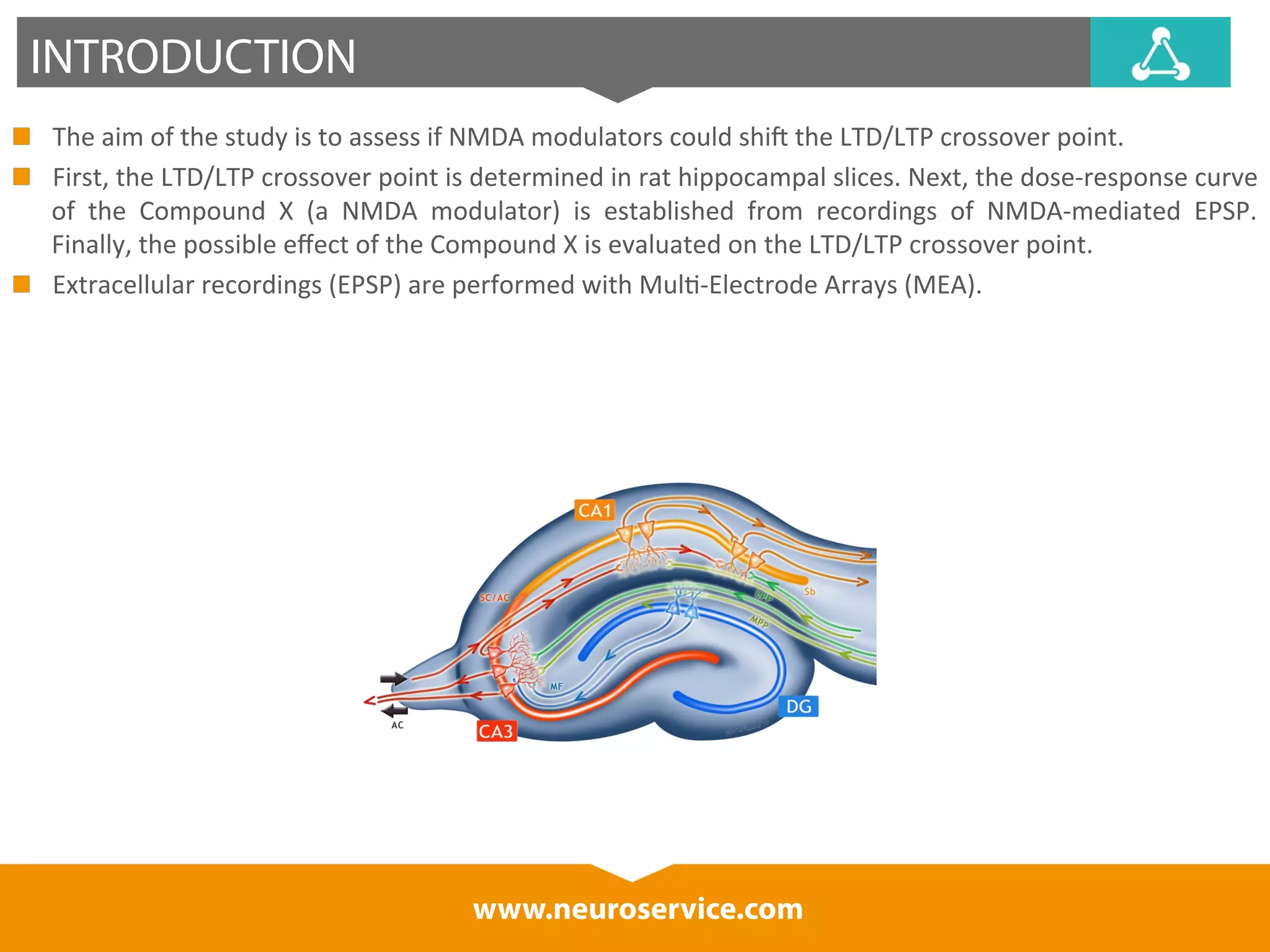
INTRODUCTION 
The 
aim 
of 
the 
study 
is 
to 
assess 
if 
NMDA 
modulators 
could 
shiI 
the 
LTD/LTP 
crossover 
point. 
First, 
the 
LTD/LTP 
crossover 
point 
is 
determined 
in 
rat 
hippocampal 
slices. 
Next, 
the 
dose-­‐response 
curve 
of 
the 
Compound 
X 
(a 
NMDA 
modulator) 
is 
established 
from 
recordings 
of 
NMDA-­‐mediated 
EPSP. 
Finally, 
the 
possible 
effect 
of 
the 
Compound 
X 
is 
evaluated 
on 
the 
LTD/LTP 
crossover 
point. 
Extracellular 
recordings 
(EPSP) 
are 
performed 
with 
Mul*-­‐Electrode 
Arrays 
(MEA). 
www.neuroservice.com
MATERIALS & METHODS 
Prepara*on 
of 
acute 
rat 
hippocampal 
slices 
Experiments 
are 
carried 
out 
with 
Sprague 
Dawley 
rats 
between 
3 
and 
4 
weeks 
of 
age 
provided 
by 
Elevage 
Janvier. 
Hippocampal 
slices 
(400 
μm 
thickness) 
are 
cut 
with 
a 
MacIIwain 
*ssue 
chopper 
in 
a 
ice-­‐cold 
oxygenated 
sucrose 
solu*on 
(Saccharose 
250, 
Glucose 
11, 
www.neuroservice.com 
NaHCO3 
26, 
KCl 
2, 
NaH2PO4 
1.2, 
MgCl2 
7 
and 
CaCl2 
0.5 
in 
mM). 
Then, 
slices 
are 
incubated 
at 
room 
temperature 
for 
at 
least 
1h 
in 
ACSF 
of 
the 
following 
composi*on: 
Glucose 
11, 
NaHCO3 
25, 
NaCl 
126, 
KCl 
3.5, 
NaH2PO4 
1.2, 
MgCl2 
1.3, 
CaCl2 
2 
in 
mM. 
Slice 
perfusion 
and 
temperature 
control 
During 
experiments, 
the 
slices 
are 
con*nuously 
perfused 
with 
the 
ACSF 
(bubbled 
with 
95% 
O2–5% 
CO2) 
at 
the 
rate 
of 
3 
mL/min 
with 
a 
peristal*c 
pump 
(MEA 
chamber 
volume: 
~1 
mL). 
Complete 
solu*on 
exchange 
in 
the 
MEA 
chamber 
is 
achieved 
20 
s 
aIer 
the 
switch 
of 
solu*ons. 
The 
perfusion 
liquid 
is 
con*nuously 
pre-­‐heated 
at 
37°C 
just 
before 
reaching 
the 
MEA 
chamber 
with 
a 
heated-­‐perfusion 
cannula 
(PH01, 
Mul*Channel 
Systems, 
Reutlingen, 
Germany). 
The 
temperature 
of 
the 
MEA 
chamber 
is 
maintained 
at 
37 
± 
0.1°C 
with 
a 
hea*ng 
element 
located 
in 
the 
MEA 
amplifier 
headstage. 
S*mula*on 
protocols 
Basal 
synap*c 
transmission: 
The 
s*mulus 
intensity 
is 
set 
to 
300 
μA 
at 
0.033Hz. 
Long-­‐Term 
Poten*a*on 
(LTP)/Neutral/Long-­‐Term 
Depression 
(LTD) 
protocols: 
S*mula*on 
trains 
from 
1 
to 
200 
Hz.
EXPERIMENTS – PHASE I 
Determination of LTP/Neutral/LTD protocols in the CA1 region of rat hippocampal slices (crossover point) 
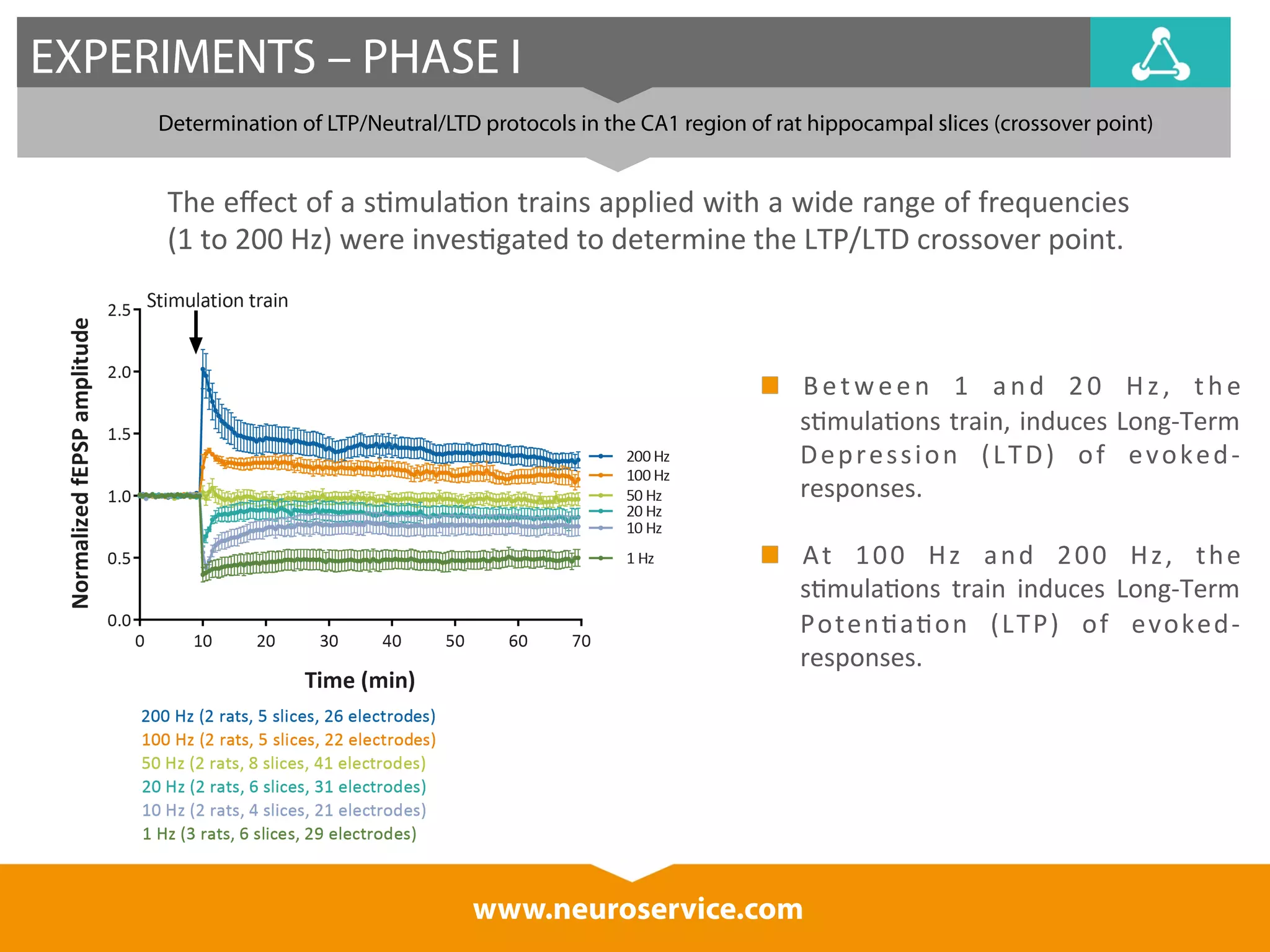
The 
effect 
of 
a 
s*mula*on 
trains 
applied 
with 
a 
wide 
range 
of 
frequencies 
(1 
to 
200 
Hz) 
were 
inves*gated 
to 
determine 
the 
LTP/LTD 
crossover 
point. 
Between 
1 
and 
20 
H z , 
the 
s*mula*ons 
train, 
induces 
Long-­‐Term 
Depression 
(LTD) 
of 
evoked-­‐ 
responses. 
At 
100 
Hz 
and 
200 
Hz, 
the 
s*mula*ons 
train 
induces 
Long-­‐Term 
Poten*a*on 
(LTP) 
of 
evoked-­‐ 
responses. 
www.neuroservice.com
EXPERIMENTS – PHASE I 
Determination of LTP/Neutral/LTD protocols in the CA1 region of rat hippocampal slices (crossover point) 
The 
effect 
of 
a 
s*mula*on 
trains 
applied 
with 
a 
wide 
range 
of 
frequencies 
(1 
to 
200 
Hz) 
were 
inves*gated 
to 
determine 
the 
LTP/LTD 
crossover 
point. 
H z 
H z 
L T P 
C ro s s o v e r 
www.neuroservice.com 
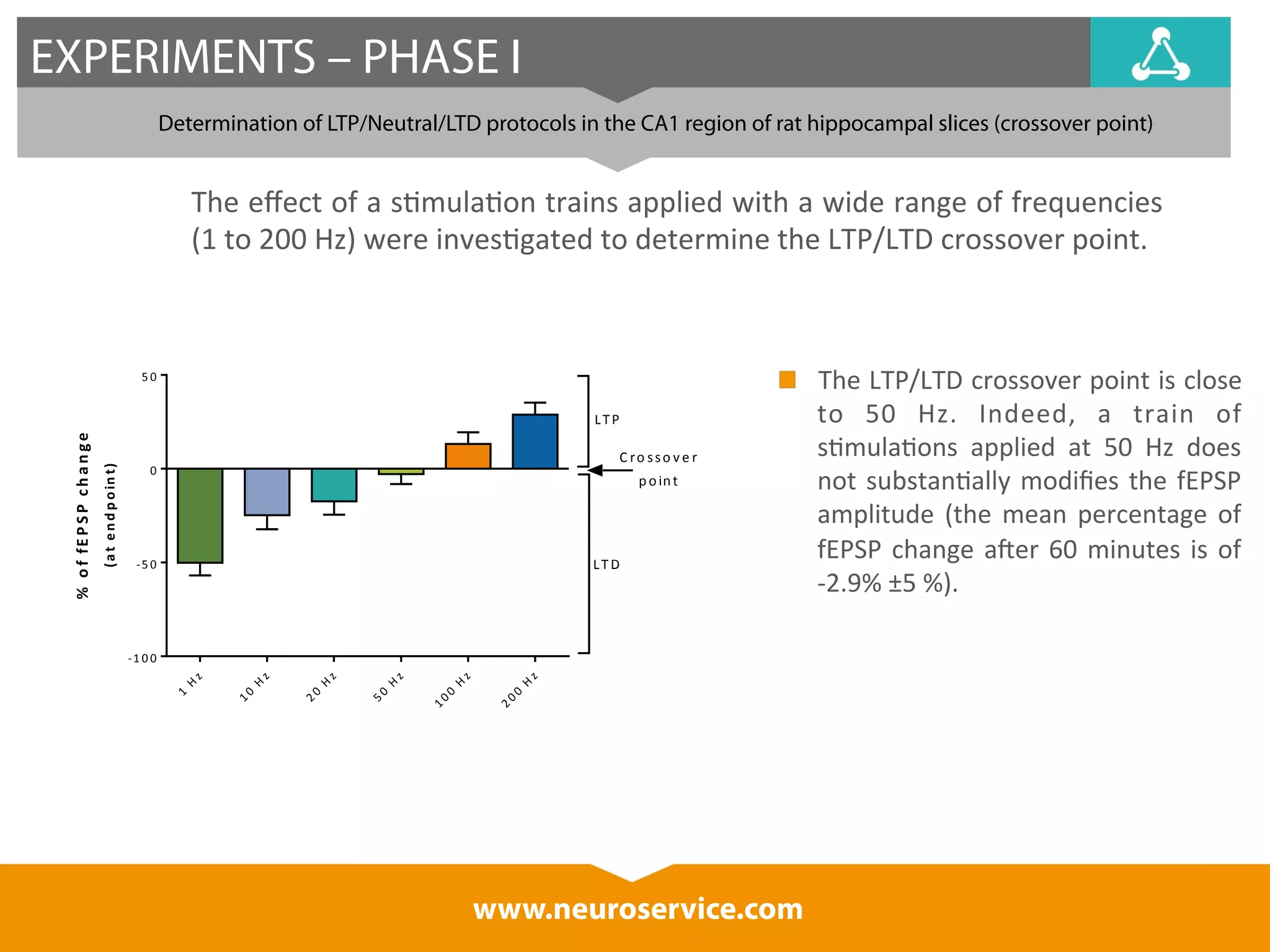
The 
LTP/LTD 
crossover 
point 
is 
close 
to 
50 
Hz. 
Indeed, 
a 
train 
of 
s*mula*ons 
applied 
at 
50 
Hz 
does 
not 
substan*ally 
modifies 
the 
fEPSP 
amplitude 
(the 
mean 
percentage 
of 
fEPSP 
change 
aIer 
60 
minutes 
is 
of 
-­‐2.9% 
±5 
%). 
H z 
1 
H z 
10 
H z 
2 0 
H z 
50 
1 00 
2 00 
5 0 
0 
-­‐5 0 
-­‐1 0 0 
% o f fE P S P c h a n g e 
(a t e n d p o in t) 
L TD 
p o in t
EXPERIMENTS – PHASE II 
Evaluation of a dose-concentration curve of Compound X on NMDA-mediated EPSP in the CA1 region of rat hippocampal 
slices 
1.5 0.1 
μM 
Compound 
X 
1.5 0.3 
μM 
Compound 
X 
1.0 
0.5 
1.5 
1.0 
0.5 
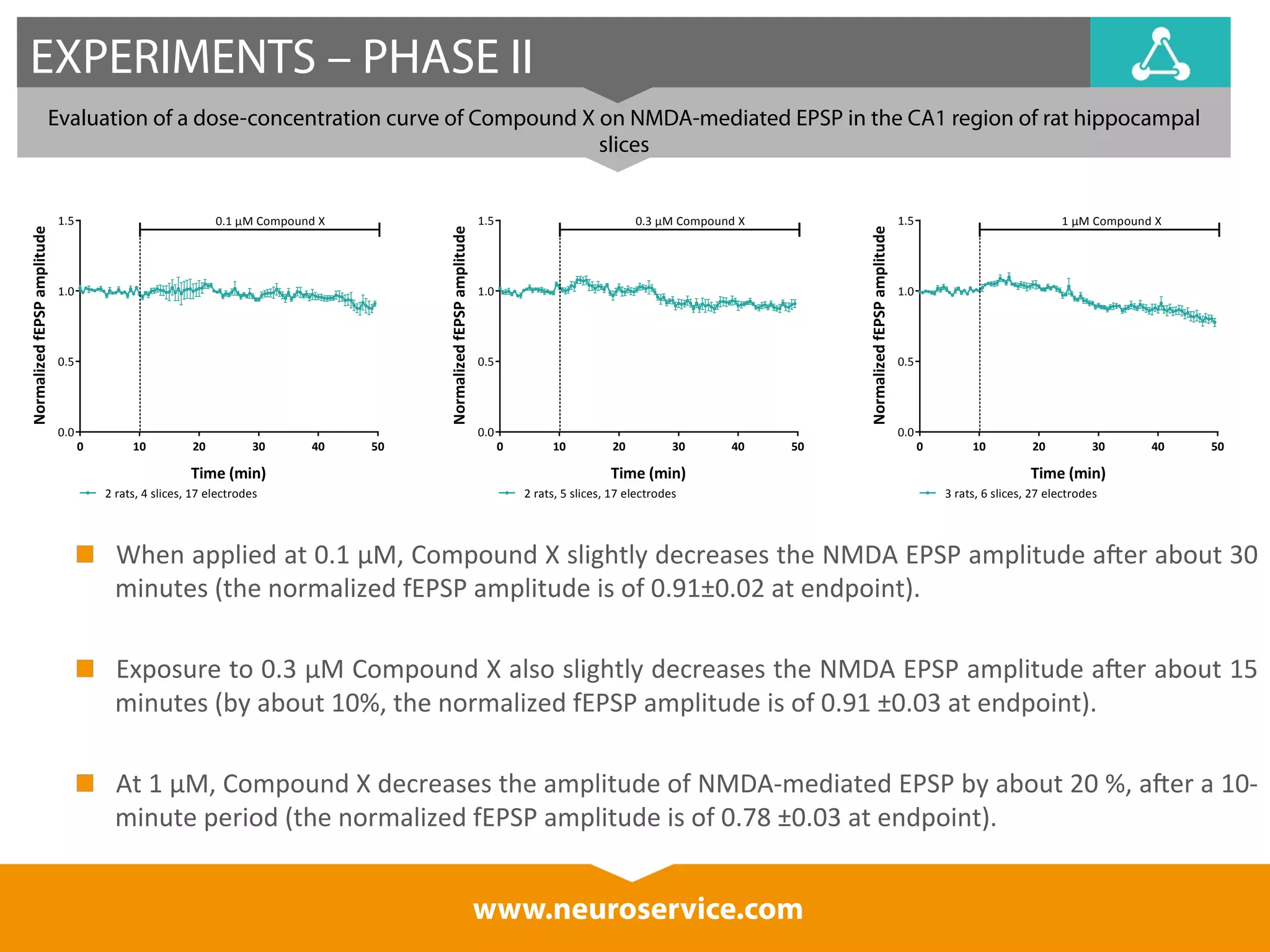
When 
applied 
at 
0.1 
μM, 
Compound 
X 
slightly 
decreases 
the 
NMDA 
EPSP 
amplitude 
aIer 
about 
30 
minutes 
(the 
normalized 
fEPSP 
amplitude 
is 
of 
0.91±0.02 
at 
endpoint). 
Exposure 
to 
0.3 
μM 
Compound 
X 
also 
slightly 
decreases 
the 
NMDA 
EPSP 
amplitude 
aIer 
about 
15 
minutes 
(by 
about 
10%, 
the 
normalized 
fEPSP 
amplitude 
is 
of 
0.91 
±0.03 
at 
endpoint). 
At 
1 
μM, 
Compound 
X 
decreases 
the 
amplitude 
of 
NMDA-­‐mediated 
EPSP 
by 
about 
20 
%, 
aIer 
a 
10-­‐ 
minute 
period 
(the 
normalized 
fEPSP 
amplitude 
is 
of 
0.78 
±0.03 
at 
endpoint). 
www.neuroservice.com 
Time (min) 
Normalized fEPSP amplitude 
0 10 20 30 40 50 
1.0 
0.5 
0.0 
2 
rats, 
4 
slices, 
17 
electrodes 
Time (min) 
Normalized fEPSP amplitude 
0 10 20 30 40 50 
0.0 
2 
rats, 
5 
slices, 
17 
electrodes 
Time (min) 
Normalized fEPSP amplitude 
0 10 20 30 40 50 
0.0 
1 
μM 
Compound 
X 
3 
rats, 
6 
slices, 
27 
electrodes
EXPERIMENTS – PHASE II 
Evaluation of a dose-concentration curve of Compound X on NMDA-mediated EPSP in the CA1 region of rat hippocampal 
slices 
1 .5 3 
μM 
C o m p o u n d 
X 
1 .5 1 0 
μM 
C o m p o u n d 
X 
1 .0 
0 .5 
1 .5 3 0 
μM 
C o m p o u n d 
X 
1 .0 
0 .5 
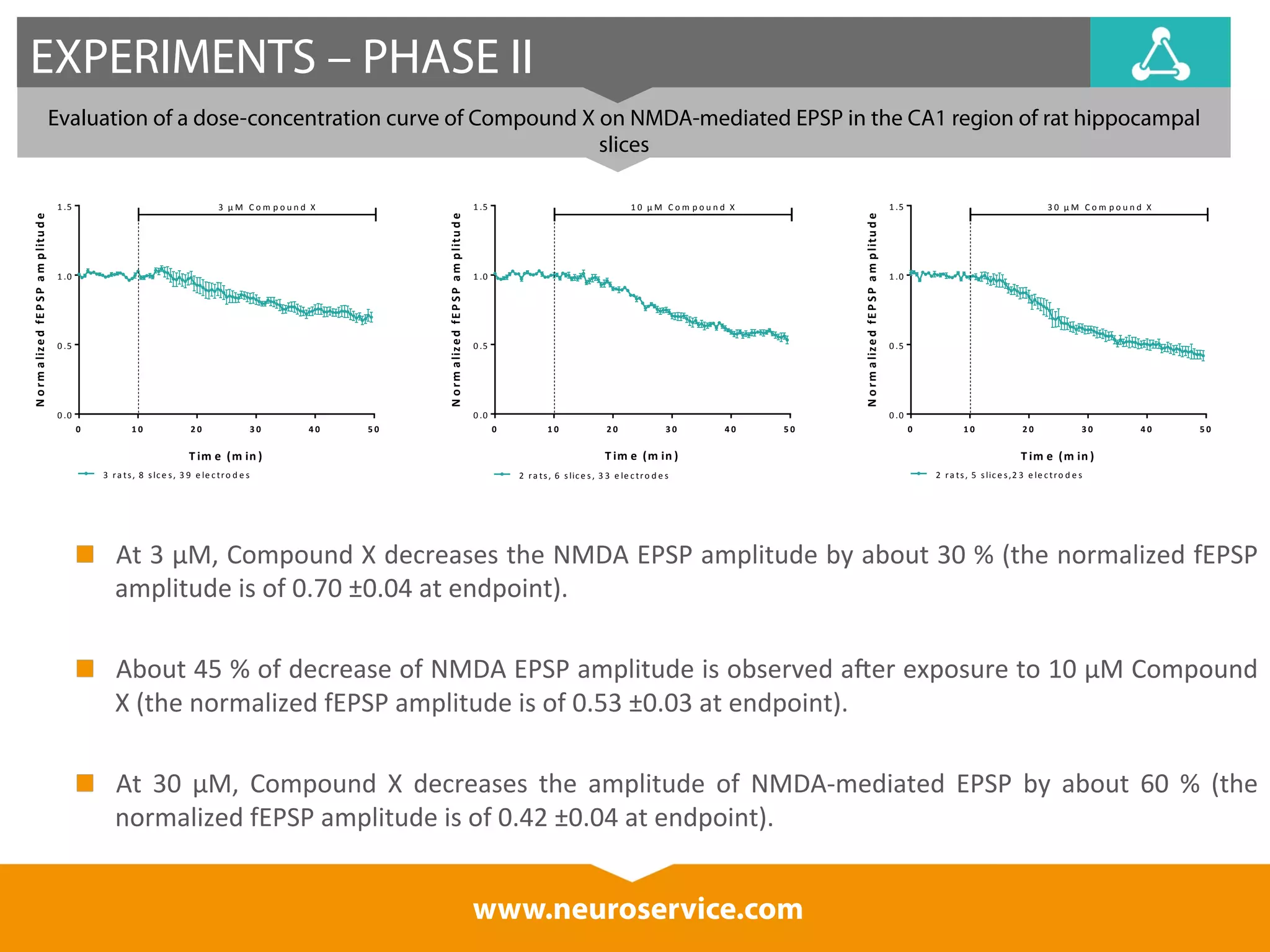
At 
3 
μM, 
Compound 
X 
decreases 
the 
NMDA 
EPSP 
amplitude 
by 
about 
30 
% 
(the 
normalized 
fEPSP 
amplitude 
is 
of 
0.70 
±0.04 
at 
endpoint). 
About 
45 
% 
of 
decrease 
of 
NMDA 
EPSP 
amplitude 
is 
observed 
aIer 
exposure 
to 
10 
μM 
Compound 
X 
(the 
normalized 
fEPSP 
amplitude 
is 
of 
0.53 
±0.03 
at 
endpoint). 
At 
30 
μM, 
Compound 
X 
decreases 
the 
amplitude 
of 
NMDA-­‐mediated 
EPSP 
by 
about 
60 
% 
(the 
normalized 
fEPSP 
amplitude 
is 
of 
0.42 
±0.04 
at 
endpoint). 
www.neuroservice.com 
T im e (m in ) 
N o rm a liz e d fE P S P am p litu d e 
0 1 0 2 0 3 0 4 0 5 0 
1 .0 
0 .5 
0 .0 
3 
r a t s , 
8 
s lc e s , 
3 9 
e le c t ro d e s 
T im e (m in ) 
N o rm a liz e d fE P S P am p litu d e 
0 1 0 2 0 3 0 4 0 5 0 
0 .0 
2 
r a t s , 
6 
s lic e s , 
3 3 
e le c t ro d e s 
T im e (m in ) 
N o rm a liz e d fE P S P am p litu d e 
0 1 0 2 0 3 0 4 0 5 0 
0 .0 
2 
r a t s , 
5 
s lic e s ,2 3 
e le c t ro d e s
EXPERIMENTS – PHASE II 
Evaluation of a dose-concentration curve of Compound X on NMDA-mediated EPSP in the CA1 region of rat hippocampal 
slices 
1 .5 5 0 
μM 
C o m p o u n d 
X 
T im e (m in ) 
1 .0 
0 .5 
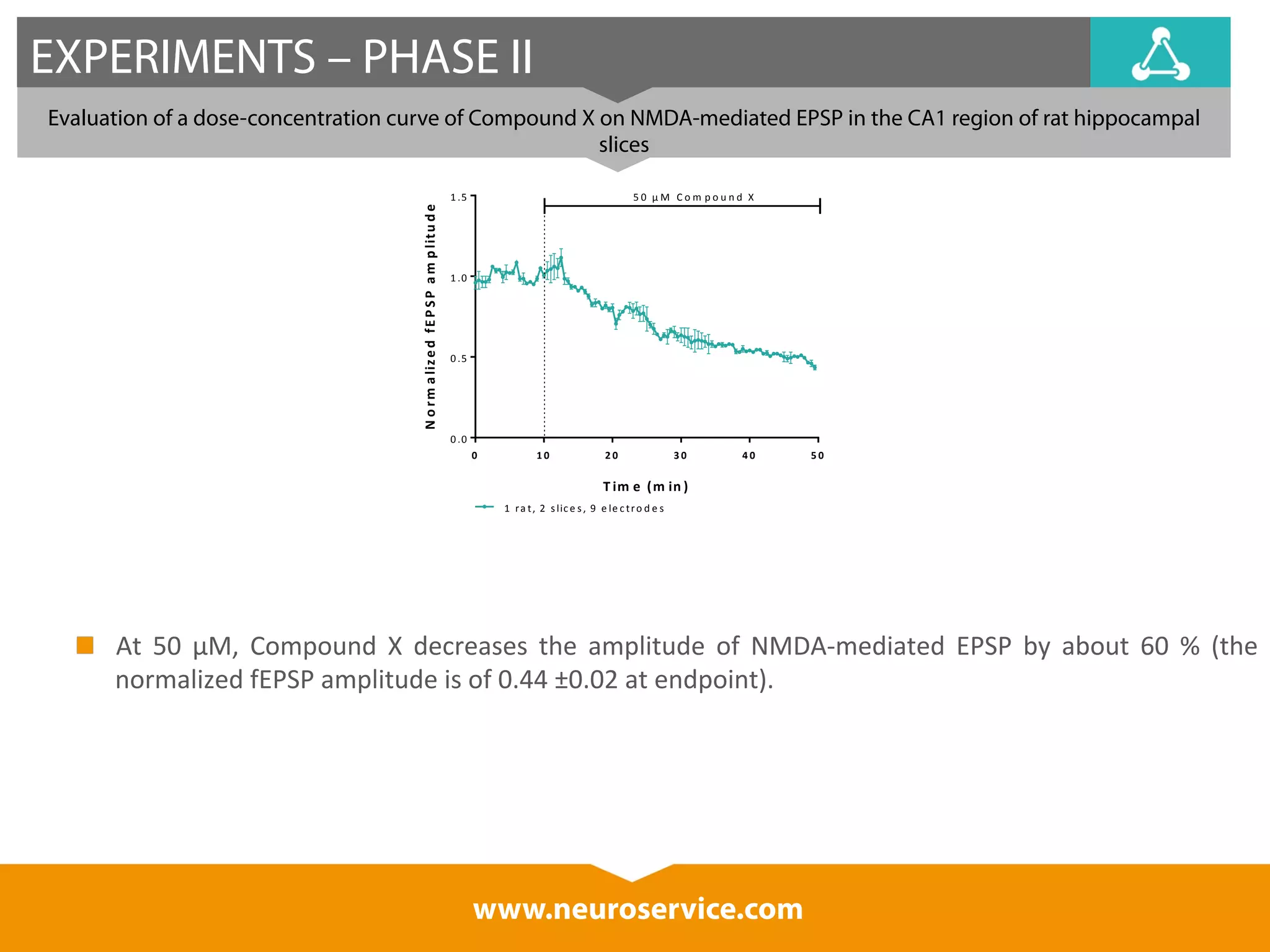
At 
50 
μM, 
Compound 
X 
decreases 
the 
amplitude 
of 
NMDA-­‐mediated 
EPSP 
by 
about 
60 
% 
(the 
normalized 
fEPSP 
amplitude 
is 
of 
0.44 
±0.02 
at 
endpoint). 
www.neuroservice.com 
N o rm a liz e d fE P S P am p litu d e 
0 1 0 2 0 3 0 4 0 5 0 
0 .0 
1 
r a t , 
2 
s lic e s , 
9 
e le c t ro d e s
EXPERIMENTS – PHASE II 
Evaluation of a dose-concentration curve of Compound X on NMDA-mediated EPSP in the CA1 region of rat hippocampal 
1 .0 
0 .8 
0 .6 
0 .4 
0 .2 
Compound 
X 
dose-­‐dependently 
decreases 
the 
amplitude 
of 
NMDA-­‐mediated 
EPSP, 
with 
an 
www.neuroservice.com 
IC50 
of 
3.6 
μM. 
The 
top 
of 
the 
concentra*on-­‐response 
curve 
seems 
reached 
with 
30-­‐50 
μM 
Compound 
X. 
slices 
1 .5 C o m p o u n d 
X 
T im e (m in ) 
N o rm a liz e d fE P S P am p litu d e 
0 1 0 2 0 3 0 4 0 5 0 
1 .0 
0 .5 
0 .0 
0 .1 
μ M 
0 .3 
μ M 
1 
μ M 
3 
μ M 
1 0 
μ M 
3 0 
μ M 
5 0 
μ M 
L o g [C om p o u n d X ] (M ) 
% o f b a s e lin e fE P S P 
a fte r 4 0 ' e x p o su re 
-­‐7 -­‐6 -­‐5 -­‐4 
0 .0
EXPERIMENTS – PHASE III 
Evaluation of Compound X on LTP induced by a 100 Hz train of stimulations 
2 .5 
2 .0 
1 .5 
1 .0 
0 .5 
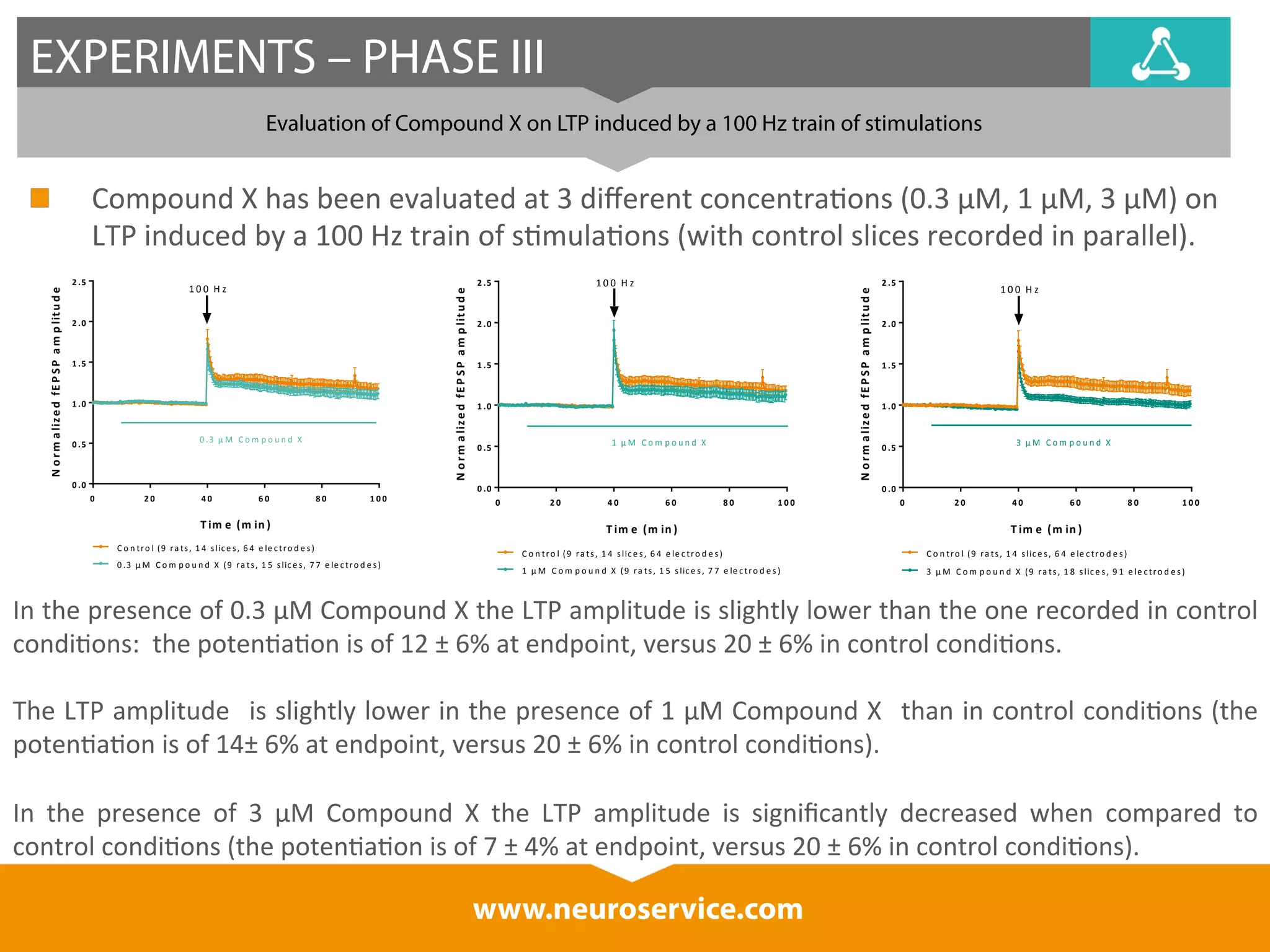
Compound 
X 
has 
been 
evaluated 
at 
3 
different 
concentra*ons 
(0.3 
μM, 
1 
μM, 
3 
μM) 
on 
LTP 
induced 
by 
a 
100 
Hz 
train 
of 
s*mula*ons 
(with 
control 
slices 
recorded 
in 
parallel). 
1 0 0 
H z 
0 .3 
μM 
C o m p o u n d 
X 
2 .5 
2 .0 
1 .5 
1 .0 
0 .5 
1 0 0 
H z 
1 
μM 
C o m p o u n d 
X 
C o n t ro l 
(9 
r a t s , 
1 4 
s lic e s , 
6 4 
e le c t ro d e s ) 
2 .5 
2 .0 
1 .5 
1 .0 
0 .5 
1 0 0 
H z 
3 
μM 
C o m p o u n d 
X 
In 
the 
presence 
of 
0.3 
μM 
Compound 
X 
the 
LTP 
amplitude 
is 
slightly 
lower 
than 
the 
one 
recorded 
in 
control 
condi*ons: 
the 
poten*a*on 
is 
of 
12 
± 
6% 
at 
endpoint, 
versus 
20 
± 
6% 
in 
control 
condi*ons. 
The 
LTP 
amplitude 
is 
slightly 
lower 
in 
the 
presence 
of 
1 
μM 
Compound 
X 
than 
in 
control 
condi*ons 
(the 
poten*a*on 
is 
of 
14± 
6% 
at 
endpoint, 
versus 
20 
± 
6% 
in 
control 
condi*ons). 
In 
the 
presence 
of 
3 
μM 
Compound 
X 
the 
LTP 
amplitude 
is 
significantly 
decreased 
when 
compared 
to 
control 
condi*ons 
(the 
poten*a*on 
is 
of 
7 
± 
4% 
at 
endpoint, 
versus 
20 
± 
6% 
in 
control 
condi*ons). 
www.neuroservice.com 
0 2 0 4 0 6 0 8 0 1 0 0 
0 .0 
T im e (m in ) 
N o rm a liz e d fE P S P am p litu d e 
C o n t ro l 
(9 
r a t s , 
1 4 
s lic e s , 
6 4 
e le c t ro d e s ) 
0 .3 
μM 
C o m p o u n d 
X 
(9 
r a t s , 
1 5 
s lic e s , 
7 7 
e le c t ro d e s ) 
0 2 0 4 0 6 0 8 0 1 0 0 
0 .0 
T im e (m in ) 
N o rm a liz e d fE P S P am p litu d e 
1 
μM 
C om p o u n d 
X 
(9 
r a t s , 
1 5 
s lic e s , 
7 7 
e le c t ro d e s ) 
0 2 0 4 0 6 0 8 0 1 0 0 
0 .0 
T im e (m in ) 
N o rm a liz e d fE P S P am p litu d e 
C o n t ro l 
(9 
r a t s , 
1 4 
s lic e s , 
6 4 
e le c t ro d e s ) 
3 
μM 
C om p o u n d 
X 
(9 
r a t s , 
1 8 
s lic e s , 
9 1 
e le c t ro d e s )
EXPERIMENTS – PHASE III 
Evaluation of Compound X on LTP induced by a 100 Hz train of stimulations 
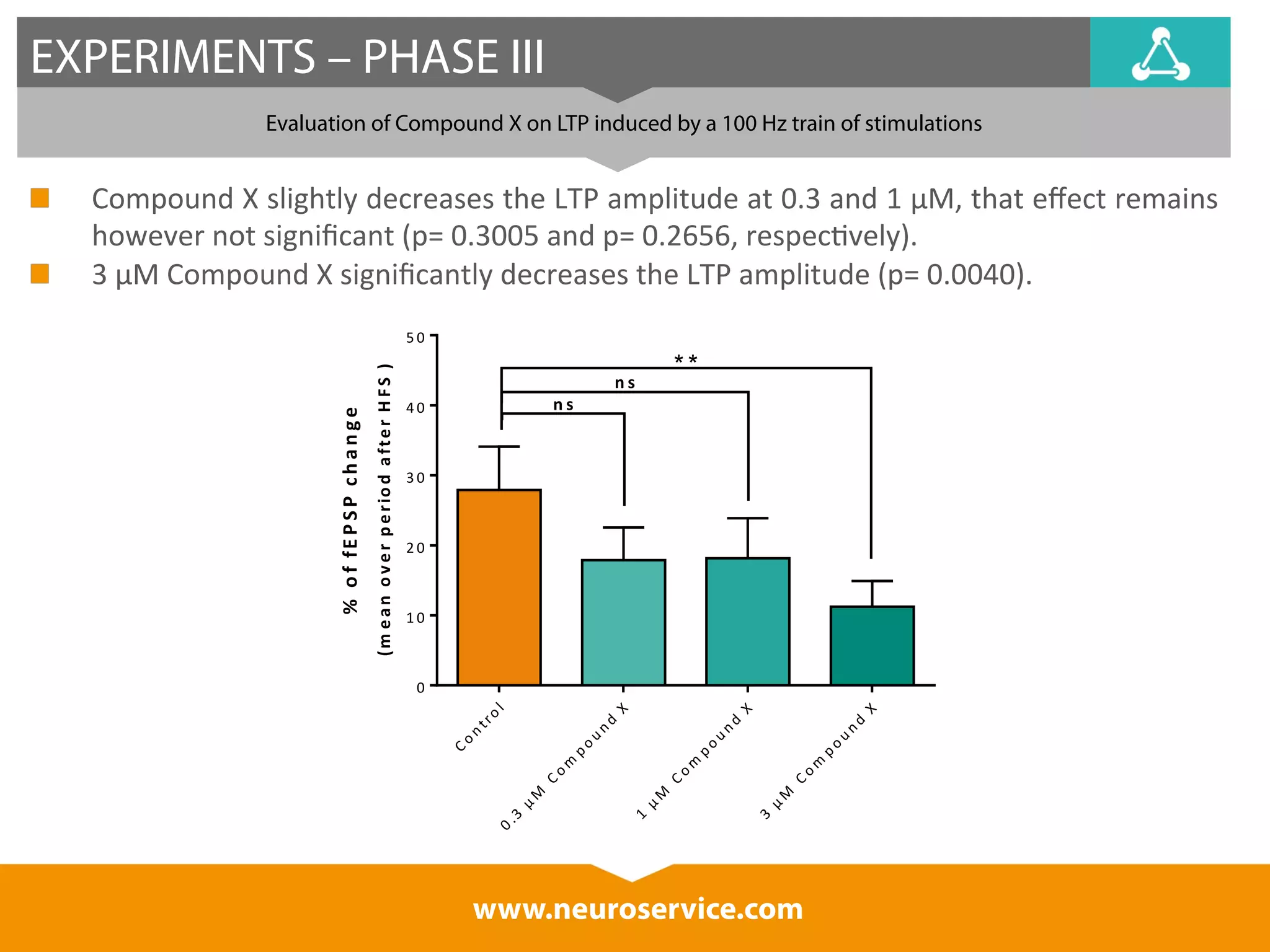
Compound 
X 
slightly 
decreases 
the 
LTP 
amplitude 
at 
0.3 
and 
1 
μM, 
that 
effect 
remains 
however 
not 
significant 
(p= 
0.3005 
and 
p= 
0.2656, 
respec*vely). 
3 
μM 
Compound 
X 
significantly 
decreases 
the 
LTP 
amplitude 
(p= 
0.0040). 
C o n tr o l 
X 
C o m p o u n d 
μ M 
0 .3 
X 
C o m p o u n d 
μ M 
1 
C o m p o u n d 
μ M 
3 
www.neuroservice.com 
X 
5 0 
4 0 
3 0 
2 0 
1 0 
0 
% o f fE P S P c h a n g e 
(m e a n o v e r p e r io d a fte r H F S ) 
* * n s 
n s
www.neuroservice.com 
CONCLUSION 
Phase 
I 
The 
LTP/LTD 
crossover 
point 
is 
close 
to 
50 
Hz. 
S*mula*ons 
below 
50 
Hz 
trigger 
a 
LTD 
of 
the 
evoked-­‐responses, 
whereas 
s*mula*ons 
above 
50 
Hz 
trigger 
a 
LTP 
of 
the 
evoked-­‐ 
responses. 
Phase 
II 
Compound 
X 
dose-­‐dependently 
decreases 
the 
NMDA 
EPSP 
amplitude. 
The 
IC50 
of 
Compound 
X 
is 
3.6 
μM, 
and 
the 
top 
of 
the 
concentra*on-­‐response 
curve 
seems 
reached 
at 
30-­‐50 
μM. 
Phase 
III 
Compound 
X 
at 
0.3, 
1 
and 
3 
μM 
decreases 
the 
LTP 
amplitude, 
however 
its 
effect 
is 
significant 
only 
at 
3 
μM.
Domaine de St Hilaire 
595, rue Pierre CS 30531 
13 593 Aix-en-Provence Cedex 3 
FRANCE 
Tel : +33 (0)442 991 220 
contact@neuroservice.com 
www.neuroservice.com 
www.neuroservice.com

Multi-Electrode Array technique -Evaluation of compounds on NMDA receptors

  • 1.
    Evaluation of onecompound on NMDA receptors September, 2013 www.neuroservice.com
  • 2.
    www.neuroservice.com SUMMARY Introduc*on Aim of the study Materials & Methods Prepara*on of acute rat hippocampal slices Slice perfusion and temperature control S*mula*on protocols Experiments Determina*on of LTP/ Neutral/LTD protocols in the CA1 region of rat hippocampal slices (crossover point) Dose-­‐concentra*on curve of Compound X on NMDA-­‐mediated EPSP in the CA1 region of rat hippocampal slices Evalua*on of a range of concentra*ons of Compound X on the crossover point in the CA1 region of rat hippocampal slices
  • 3.
    INTRODUCTION The aim of the study is to assess if NMDA modulators could shiI the LTD/LTP crossover point. First, the LTD/LTP crossover point is determined in rat hippocampal slices. Next, the dose-­‐response curve of the Compound X (a NMDA modulator) is established from recordings of NMDA-­‐mediated EPSP. Finally, the possible effect of the Compound X is evaluated on the LTD/LTP crossover point. Extracellular recordings (EPSP) are performed with Mul*-­‐Electrode Arrays (MEA). www.neuroservice.com
  • 4.
    MATERIALS & METHODS Prepara*on of acute rat hippocampal slices Experiments are carried out with Sprague Dawley rats between 3 and 4 weeks of age provided by Elevage Janvier. Hippocampal slices (400 μm thickness) are cut with a MacIIwain *ssue chopper in a ice-­‐cold oxygenated sucrose solu*on (Saccharose 250, Glucose 11, www.neuroservice.com NaHCO3 26, KCl 2, NaH2PO4 1.2, MgCl2 7 and CaCl2 0.5 in mM). Then, slices are incubated at room temperature for at least 1h in ACSF of the following composi*on: Glucose 11, NaHCO3 25, NaCl 126, KCl 3.5, NaH2PO4 1.2, MgCl2 1.3, CaCl2 2 in mM. Slice perfusion and temperature control During experiments, the slices are con*nuously perfused with the ACSF (bubbled with 95% O2–5% CO2) at the rate of 3 mL/min with a peristal*c pump (MEA chamber volume: ~1 mL). Complete solu*on exchange in the MEA chamber is achieved 20 s aIer the switch of solu*ons. The perfusion liquid is con*nuously pre-­‐heated at 37°C just before reaching the MEA chamber with a heated-­‐perfusion cannula (PH01, Mul*Channel Systems, Reutlingen, Germany). The temperature of the MEA chamber is maintained at 37 ± 0.1°C with a hea*ng element located in the MEA amplifier headstage. S*mula*on protocols Basal synap*c transmission: The s*mulus intensity is set to 300 μA at 0.033Hz. Long-­‐Term Poten*a*on (LTP)/Neutral/Long-­‐Term Depression (LTD) protocols: S*mula*on trains from 1 to 200 Hz.
  • 5.
    EXPERIMENTS – PHASEI Determination of LTP/Neutral/LTD protocols in the CA1 region of rat hippocampal slices (crossover point) The effect of a s*mula*on trains applied with a wide range of frequencies (1 to 200 Hz) were inves*gated to determine the LTP/LTD crossover point. Between 1 and 20 H z , the s*mula*ons train, induces Long-­‐Term Depression (LTD) of evoked-­‐ responses. At 100 Hz and 200 Hz, the s*mula*ons train induces Long-­‐Term Poten*a*on (LTP) of evoked-­‐ responses. www.neuroservice.com
  • 6.
    EXPERIMENTS – PHASEI Determination of LTP/Neutral/LTD protocols in the CA1 region of rat hippocampal slices (crossover point) The effect of a s*mula*on trains applied with a wide range of frequencies (1 to 200 Hz) were inves*gated to determine the LTP/LTD crossover point. H z H z L T P C ro s s o v e r www.neuroservice.com The LTP/LTD crossover point is close to 50 Hz. Indeed, a train of s*mula*ons applied at 50 Hz does not substan*ally modifies the fEPSP amplitude (the mean percentage of fEPSP change aIer 60 minutes is of -­‐2.9% ±5 %). H z 1 H z 10 H z 2 0 H z 50 1 00 2 00 5 0 0 -­‐5 0 -­‐1 0 0 % o f fE P S P c h a n g e (a t e n d p o in t) L TD p o in t
  • 7.
    EXPERIMENTS – PHASEII Evaluation of a dose-concentration curve of Compound X on NMDA-mediated EPSP in the CA1 region of rat hippocampal slices 1.5 0.1 μM Compound X 1.5 0.3 μM Compound X 1.0 0.5 1.5 1.0 0.5 When applied at 0.1 μM, Compound X slightly decreases the NMDA EPSP amplitude aIer about 30 minutes (the normalized fEPSP amplitude is of 0.91±0.02 at endpoint). Exposure to 0.3 μM Compound X also slightly decreases the NMDA EPSP amplitude aIer about 15 minutes (by about 10%, the normalized fEPSP amplitude is of 0.91 ±0.03 at endpoint). At 1 μM, Compound X decreases the amplitude of NMDA-­‐mediated EPSP by about 20 %, aIer a 10-­‐ minute period (the normalized fEPSP amplitude is of 0.78 ±0.03 at endpoint). www.neuroservice.com Time (min) Normalized fEPSP amplitude 0 10 20 30 40 50 1.0 0.5 0.0 2 rats, 4 slices, 17 electrodes Time (min) Normalized fEPSP amplitude 0 10 20 30 40 50 0.0 2 rats, 5 slices, 17 electrodes Time (min) Normalized fEPSP amplitude 0 10 20 30 40 50 0.0 1 μM Compound X 3 rats, 6 slices, 27 electrodes
  • 8.
    EXPERIMENTS – PHASEII Evaluation of a dose-concentration curve of Compound X on NMDA-mediated EPSP in the CA1 region of rat hippocampal slices 1 .5 3 μM C o m p o u n d X 1 .5 1 0 μM C o m p o u n d X 1 .0 0 .5 1 .5 3 0 μM C o m p o u n d X 1 .0 0 .5 At 3 μM, Compound X decreases the NMDA EPSP amplitude by about 30 % (the normalized fEPSP amplitude is of 0.70 ±0.04 at endpoint). About 45 % of decrease of NMDA EPSP amplitude is observed aIer exposure to 10 μM Compound X (the normalized fEPSP amplitude is of 0.53 ±0.03 at endpoint). At 30 μM, Compound X decreases the amplitude of NMDA-­‐mediated EPSP by about 60 % (the normalized fEPSP amplitude is of 0.42 ±0.04 at endpoint). www.neuroservice.com T im e (m in ) N o rm a liz e d fE P S P am p litu d e 0 1 0 2 0 3 0 4 0 5 0 1 .0 0 .5 0 .0 3 r a t s , 8 s lc e s , 3 9 e le c t ro d e s T im e (m in ) N o rm a liz e d fE P S P am p litu d e 0 1 0 2 0 3 0 4 0 5 0 0 .0 2 r a t s , 6 s lic e s , 3 3 e le c t ro d e s T im e (m in ) N o rm a liz e d fE P S P am p litu d e 0 1 0 2 0 3 0 4 0 5 0 0 .0 2 r a t s , 5 s lic e s ,2 3 e le c t ro d e s
  • 9.
    EXPERIMENTS – PHASEII Evaluation of a dose-concentration curve of Compound X on NMDA-mediated EPSP in the CA1 region of rat hippocampal slices 1 .5 5 0 μM C o m p o u n d X T im e (m in ) 1 .0 0 .5 At 50 μM, Compound X decreases the amplitude of NMDA-­‐mediated EPSP by about 60 % (the normalized fEPSP amplitude is of 0.44 ±0.02 at endpoint). www.neuroservice.com N o rm a liz e d fE P S P am p litu d e 0 1 0 2 0 3 0 4 0 5 0 0 .0 1 r a t , 2 s lic e s , 9 e le c t ro d e s
  • 10.
    EXPERIMENTS – PHASEII Evaluation of a dose-concentration curve of Compound X on NMDA-mediated EPSP in the CA1 region of rat hippocampal 1 .0 0 .8 0 .6 0 .4 0 .2 Compound X dose-­‐dependently decreases the amplitude of NMDA-­‐mediated EPSP, with an www.neuroservice.com IC50 of 3.6 μM. The top of the concentra*on-­‐response curve seems reached with 30-­‐50 μM Compound X. slices 1 .5 C o m p o u n d X T im e (m in ) N o rm a liz e d fE P S P am p litu d e 0 1 0 2 0 3 0 4 0 5 0 1 .0 0 .5 0 .0 0 .1 μ M 0 .3 μ M 1 μ M 3 μ M 1 0 μ M 3 0 μ M 5 0 μ M L o g [C om p o u n d X ] (M ) % o f b a s e lin e fE P S P a fte r 4 0 ' e x p o su re -­‐7 -­‐6 -­‐5 -­‐4 0 .0
  • 11.
    EXPERIMENTS – PHASEIII Evaluation of Compound X on LTP induced by a 100 Hz train of stimulations 2 .5 2 .0 1 .5 1 .0 0 .5 Compound X has been evaluated at 3 different concentra*ons (0.3 μM, 1 μM, 3 μM) on LTP induced by a 100 Hz train of s*mula*ons (with control slices recorded in parallel). 1 0 0 H z 0 .3 μM C o m p o u n d X 2 .5 2 .0 1 .5 1 .0 0 .5 1 0 0 H z 1 μM C o m p o u n d X C o n t ro l (9 r a t s , 1 4 s lic e s , 6 4 e le c t ro d e s ) 2 .5 2 .0 1 .5 1 .0 0 .5 1 0 0 H z 3 μM C o m p o u n d X In the presence of 0.3 μM Compound X the LTP amplitude is slightly lower than the one recorded in control condi*ons: the poten*a*on is of 12 ± 6% at endpoint, versus 20 ± 6% in control condi*ons. The LTP amplitude is slightly lower in the presence of 1 μM Compound X than in control condi*ons (the poten*a*on is of 14± 6% at endpoint, versus 20 ± 6% in control condi*ons). In the presence of 3 μM Compound X the LTP amplitude is significantly decreased when compared to control condi*ons (the poten*a*on is of 7 ± 4% at endpoint, versus 20 ± 6% in control condi*ons). www.neuroservice.com 0 2 0 4 0 6 0 8 0 1 0 0 0 .0 T im e (m in ) N o rm a liz e d fE P S P am p litu d e C o n t ro l (9 r a t s , 1 4 s lic e s , 6 4 e le c t ro d e s ) 0 .3 μM C o m p o u n d X (9 r a t s , 1 5 s lic e s , 7 7 e le c t ro d e s ) 0 2 0 4 0 6 0 8 0 1 0 0 0 .0 T im e (m in ) N o rm a liz e d fE P S P am p litu d e 1 μM C om p o u n d X (9 r a t s , 1 5 s lic e s , 7 7 e le c t ro d e s ) 0 2 0 4 0 6 0 8 0 1 0 0 0 .0 T im e (m in ) N o rm a liz e d fE P S P am p litu d e C o n t ro l (9 r a t s , 1 4 s lic e s , 6 4 e le c t ro d e s ) 3 μM C om p o u n d X (9 r a t s , 1 8 s lic e s , 9 1 e le c t ro d e s )
  • 12.
    EXPERIMENTS – PHASEIII Evaluation of Compound X on LTP induced by a 100 Hz train of stimulations Compound X slightly decreases the LTP amplitude at 0.3 and 1 μM, that effect remains however not significant (p= 0.3005 and p= 0.2656, respec*vely). 3 μM Compound X significantly decreases the LTP amplitude (p= 0.0040). C o n tr o l X C o m p o u n d μ M 0 .3 X C o m p o u n d μ M 1 C o m p o u n d μ M 3 www.neuroservice.com X 5 0 4 0 3 0 2 0 1 0 0 % o f fE P S P c h a n g e (m e a n o v e r p e r io d a fte r H F S ) * * n s n s
  • 13.
    www.neuroservice.com CONCLUSION Phase I The LTP/LTD crossover point is close to 50 Hz. S*mula*ons below 50 Hz trigger a LTD of the evoked-­‐responses, whereas s*mula*ons above 50 Hz trigger a LTP of the evoked-­‐ responses. Phase II Compound X dose-­‐dependently decreases the NMDA EPSP amplitude. The IC50 of Compound X is 3.6 μM, and the top of the concentra*on-­‐response curve seems reached at 30-­‐50 μM. Phase III Compound X at 0.3, 1 and 3 μM decreases the LTP amplitude, however its effect is significant only at 3 μM.
  • 14.
    Domaine de StHilaire 595, rue Pierre CS 30531 13 593 Aix-en-Provence Cedex 3 FRANCE Tel : +33 (0)442 991 220 contact@neuroservice.com www.neuroservice.com www.neuroservice.com