Testpassport real exam questions can make sure you pass any IT exam.
Exam Code: MuleSoft Certified Platform Architect-Level 1
Exam Name: MuleSoft Certified Platform Architect - Level 1
Full version: 58 Q&As
Visit more information about MuleSoft Certified Platform Architect-Level 1
exam:
MuleSoft Certified Platform Architect-Level 1 Real Questions
Share some MuleSoft Certified Platform Architect-Level 1 questions and
answers below.
1. An organization is implementing a Quote of the Day API that caches today's quote.
What scenario can use the CloudHub Object Store via the Object Store connector to persist the
cache's state?
A. When there are three CloudHub deployments of the API implementation to three separate
CloudHub regions that must share the cache state.
B. When there are two CloudHub deployments of the API implementation by two Anypoint
Platform business groups to the same CloudHub region that must share the cache state.
C. When there is one deployment of the API implementation to CloudHub and another
deployment to a customer-hosted Mule runtime that must share the cache state.
D. When there is one CloudHub deployment of the API implementation to three CloudHub
workers that must share the cache state.
Answer: C
2. What is true about the technology architecture of Anypoint VPCs?
A. The private IP address range of an Anypoint VPC is automatically chosen by CloudHub.
B. Traffic between Mule applications deployed to an Anypoint VPC and on-premises systems
can stay within a private network.
Testpassport real exam questions can make sure you pass any IT exam.
C. Each CloudHub environment requires a separate Anypoint VPC.
D. VPC peering can be used to link the underlying AWS VPC to an on-premises (non AWS)
private network.
Answer: B
Explanation:
Reference: https://docs.mulesoft.com/runtime-manager/vpc-connectivity-methods-concept
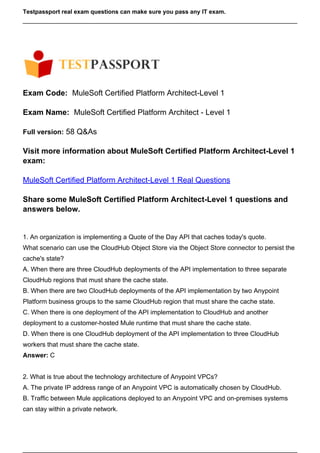
3. Refer to the exhibit.
An organization needs to enable access to their customer data from both a mobile app and a
web application, which each need access to common fields as well as certain unique fields.
The data is available partially in a database and partially in a 3rd-party CRM system.
What APIs should be created to best fit these design requirements?
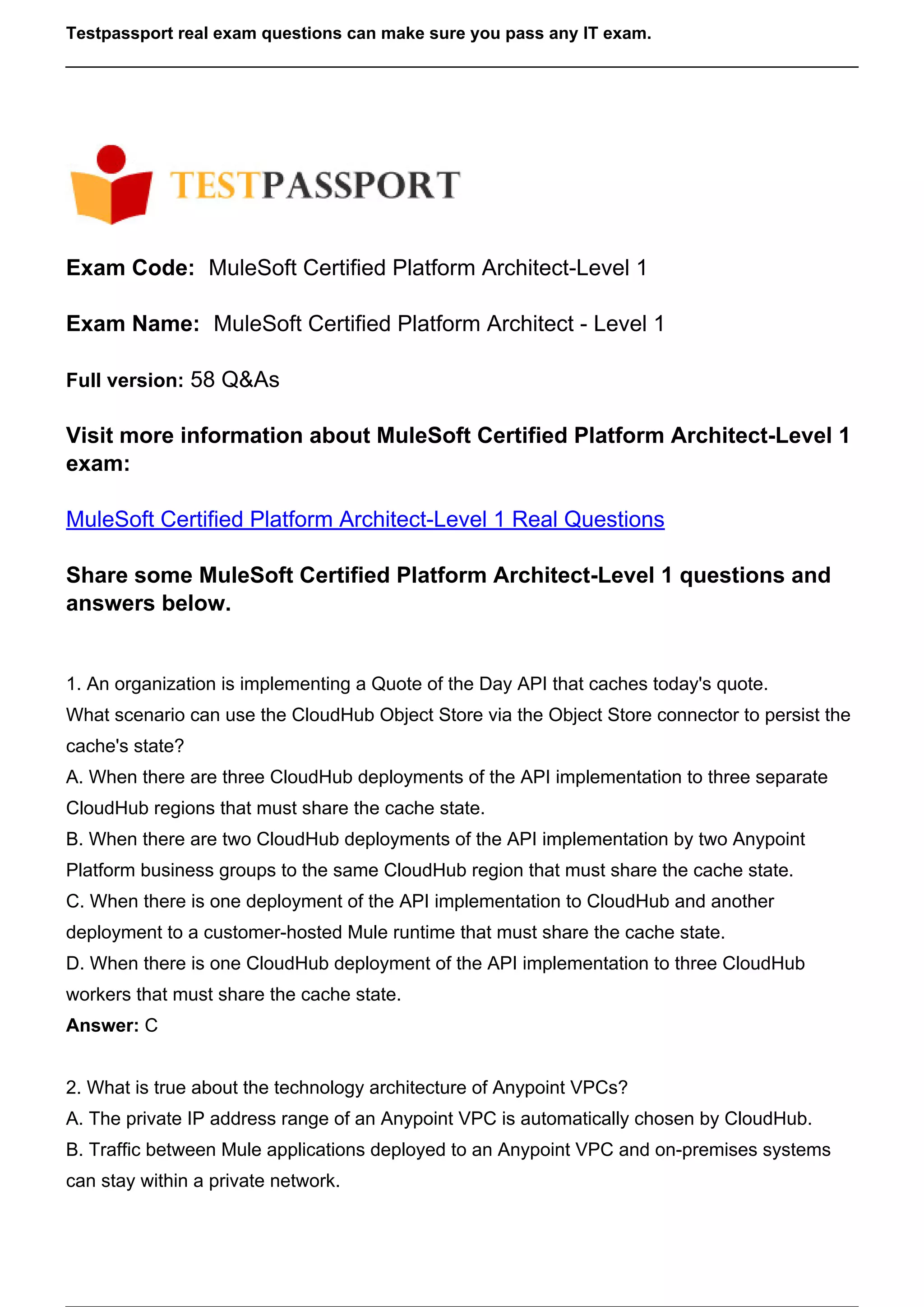
A. A Process API that contains the data required by both the web and mobile apps, allowing
these applications to invoke it directly and access the data they need thereby providing the
flexibility to add more fields in the future without needing API changes.
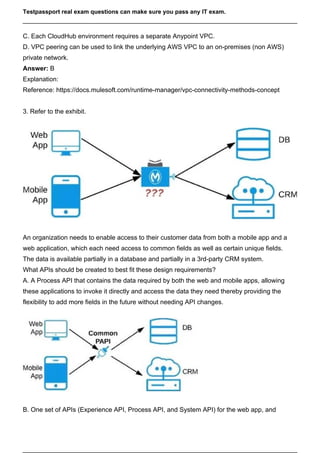
B. One set of APIs (Experience API, Process API, and System API) for the web app, and
Testpassport real exam questions can make sure you pass any IT exam.
another set for the mobile app.
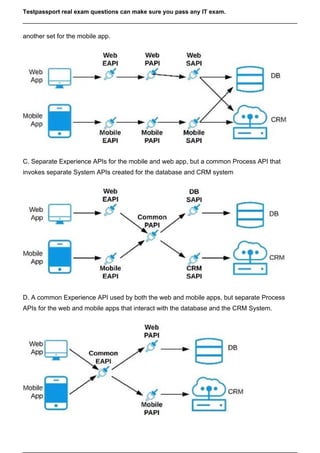
C. Separate Experience APIs for the mobile and web app, but a common Process API that
invokes separate System APIs created for the database and CRM system
D. A common Experience API used by both the web and mobile apps, but separate Process
APIs for the web and mobile apps that interact with the database and the CRM System.
Testpassport real exam questions can make sure you pass any IT exam.
Answer: C
4. What API policy would LEAST likely be applied to a Process API?
A. Custom circuit breaker
B. Client ID enforcement
C. Rate limiting
D. JSON threat protection
Answer: A
Explanation:
Reference: https://docs.mulesoft.com/api-manager/2.x/policy-mule3-provided-policies
5. What condition requires using a CloudHub Dedicated Load Balancer?
A. When cross-region load balancing is required between separate deployments of the same
Mule application
B. When custom DNS names are required for API implementations deployed to customer-
hosted Mule runtimes
C. When API invocations across multiple CloudHub workers must be load balanced
D. When server-side load-balanced TLS mutual authentication is required between API
implementations and API clients
Answer: B
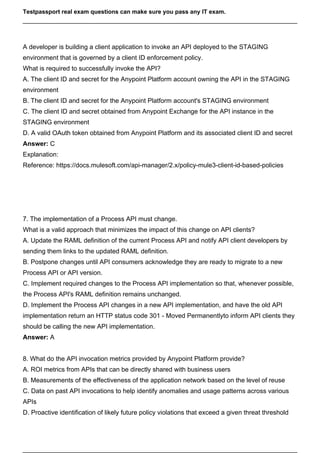
6. Refer to the exhibit.
Testpassport real exam questions can make sure you pass any IT exam.
A developer is building a client application to invoke an API deployed to the STAGING
environment that is governed by a client ID enforcement policy.
What is required to successfully invoke the API?
A. The client ID and secret for the Anypoint Platform account owning the API in the STAGING
environment
B. The client ID and secret for the Anypoint Platform account's STAGING environment
C. The client ID and secret obtained from Anypoint Exchange for the API instance in the
STAGING environment
D. A valid OAuth token obtained from Anypoint Platform and its associated client ID and secret
Answer: C
Explanation:
Reference: https://docs.mulesoft.com/api-manager/2.x/policy-mule3-client-id-based-policies
7. The implementation of a Process API must change.
What is a valid approach that minimizes the impact of this change on API clients?
A. Update the RAML definition of the current Process API and notify API client developers by
sending them links to the updated RAML definition.
B. Postpone changes until API consumers acknowledge they are ready to migrate to a new
Process API or API version.
C. Implement required changes to the Process API implementation so that, whenever possible,
the Process API's RAML definition remains unchanged.
D. Implement the Process API changes in a new API implementation, and have the old API
implementation return an HTTP status code 301 - Moved Permanentlyto inform API clients they
should be calling the new API implementation.
Answer: A
8. What do the API invocation metrics provided by Anypoint Platform provide?
A. ROI metrics from APIs that can be directly shared with business users
B. Measurements of the effectiveness of the application network based on the level of reuse
C. Data on past API invocations to help identify anomalies and usage patterns across various
APIs
D. Proactive identification of likely future policy violations that exceed a given threat threshold
Testpassport real exam questions can make sure you pass any IT exam.
Answer: C
Explanation:
Reference:
https://usermanual.wiki/Document/APAAppNetstudentManual02may2018.991784750.pdf
9. What is a key performance indicator (KPI) that measures the success of a typical C4E that is
immediately apparent in responses from the Anypoint Platform APIs?
A. The number of production outage incidents reported in the last 24 hours
B. The number of API implementations that have a publicly accessible HTTP endpoint and are
being managed by Anypoint Platform
C. The fraction of API implementations deployed manually relative to those deployed using a
CI/CD tool
D. The number of API specifications in RAML or OAS format published to Anypoint Exchange
Answer: B
Explanation:
Reference: https://help.mulesoft.com/s/question/0D52T00004mXSTUSA4/how-should-a-
companymeasure-c4e-success
10. An API implementation is deployed on a single worker on CloudHub and invoked by
external API clients (outside of CloudHub).
How can an alert be set up that is guaranteed to trigger AS SOON AS that API implementation
stops responding to API invocations?
A. Implement a heartbeat/health check within the API and invoke it from outside the Anypoint
Platform and alert when the heartbeat does not respond.
B. Configure a “worker not responding” alert in Anypoint Runtime Manager.
C. Handle API invocation exceptions within the calling API client and raise an alert from that API
client when the API is unavailable.
D. Create an alert for when the API receives no requests within a specified time period.
Answer: A
Testpasport provides valid exam questions for many IT certification exams,
such as Oracle, Microsoft, IBM, Huawei, CompTIA, Dell, and others.
Testpassport real exam questions can make sure you pass any IT exam.
Practice FREE Online Questions of Hot Exams below.
CAMS FREE Online Questions
MS-700 FREE Online Questions
AZ-203 FREE Online Questions
350-401 FREE Online Questions
350-801 FREE Online Questions
350-601 FREE Online Questions
NACE-CIP2-001 FREE Online Questions
H13-621-ENU FREE Online Questions

MuleSoft certified platform architect-level 1 Real Exam Questions

  • 1.
    Testpassport real examquestions can make sure you pass any IT exam. Exam Code: MuleSoft Certified Platform Architect-Level 1 Exam Name: MuleSoft Certified Platform Architect - Level 1 Full version: 58 Q&As Visit more information about MuleSoft Certified Platform Architect-Level 1 exam: MuleSoft Certified Platform Architect-Level 1 Real Questions Share some MuleSoft Certified Platform Architect-Level 1 questions and answers below. 1. An organization is implementing a Quote of the Day API that caches today's quote. What scenario can use the CloudHub Object Store via the Object Store connector to persist the cache's state? A. When there are three CloudHub deployments of the API implementation to three separate CloudHub regions that must share the cache state. B. When there are two CloudHub deployments of the API implementation by two Anypoint Platform business groups to the same CloudHub region that must share the cache state. C. When there is one deployment of the API implementation to CloudHub and another deployment to a customer-hosted Mule runtime that must share the cache state. D. When there is one CloudHub deployment of the API implementation to three CloudHub workers that must share the cache state. Answer: C 2. What is true about the technology architecture of Anypoint VPCs? A. The private IP address range of an Anypoint VPC is automatically chosen by CloudHub. B. Traffic between Mule applications deployed to an Anypoint VPC and on-premises systems can stay within a private network.
  • 2.
    Testpassport real examquestions can make sure you pass any IT exam. C. Each CloudHub environment requires a separate Anypoint VPC. D. VPC peering can be used to link the underlying AWS VPC to an on-premises (non AWS) private network. Answer: B Explanation: Reference: https://docs.mulesoft.com/runtime-manager/vpc-connectivity-methods-concept 3. Refer to the exhibit. An organization needs to enable access to their customer data from both a mobile app and a web application, which each need access to common fields as well as certain unique fields. The data is available partially in a database and partially in a 3rd-party CRM system. What APIs should be created to best fit these design requirements? A. A Process API that contains the data required by both the web and mobile apps, allowing these applications to invoke it directly and access the data they need thereby providing the flexibility to add more fields in the future without needing API changes. B. One set of APIs (Experience API, Process API, and System API) for the web app, and
  • 3.
    Testpassport real examquestions can make sure you pass any IT exam. another set for the mobile app. C. Separate Experience APIs for the mobile and web app, but a common Process API that invokes separate System APIs created for the database and CRM system D. A common Experience API used by both the web and mobile apps, but separate Process APIs for the web and mobile apps that interact with the database and the CRM System.
  • 4.
    Testpassport real examquestions can make sure you pass any IT exam. Answer: C 4. What API policy would LEAST likely be applied to a Process API? A. Custom circuit breaker B. Client ID enforcement C. Rate limiting D. JSON threat protection Answer: A Explanation: Reference: https://docs.mulesoft.com/api-manager/2.x/policy-mule3-provided-policies 5. What condition requires using a CloudHub Dedicated Load Balancer? A. When cross-region load balancing is required between separate deployments of the same Mule application B. When custom DNS names are required for API implementations deployed to customer- hosted Mule runtimes C. When API invocations across multiple CloudHub workers must be load balanced D. When server-side load-balanced TLS mutual authentication is required between API implementations and API clients Answer: B 6. Refer to the exhibit.
  • 5.
    Testpassport real examquestions can make sure you pass any IT exam. A developer is building a client application to invoke an API deployed to the STAGING environment that is governed by a client ID enforcement policy. What is required to successfully invoke the API? A. The client ID and secret for the Anypoint Platform account owning the API in the STAGING environment B. The client ID and secret for the Anypoint Platform account's STAGING environment C. The client ID and secret obtained from Anypoint Exchange for the API instance in the STAGING environment D. A valid OAuth token obtained from Anypoint Platform and its associated client ID and secret Answer: C Explanation: Reference: https://docs.mulesoft.com/api-manager/2.x/policy-mule3-client-id-based-policies 7. The implementation of a Process API must change. What is a valid approach that minimizes the impact of this change on API clients? A. Update the RAML definition of the current Process API and notify API client developers by sending them links to the updated RAML definition. B. Postpone changes until API consumers acknowledge they are ready to migrate to a new Process API or API version. C. Implement required changes to the Process API implementation so that, whenever possible, the Process API's RAML definition remains unchanged. D. Implement the Process API changes in a new API implementation, and have the old API implementation return an HTTP status code 301 - Moved Permanentlyto inform API clients they should be calling the new API implementation. Answer: A 8. What do the API invocation metrics provided by Anypoint Platform provide? A. ROI metrics from APIs that can be directly shared with business users B. Measurements of the effectiveness of the application network based on the level of reuse C. Data on past API invocations to help identify anomalies and usage patterns across various APIs D. Proactive identification of likely future policy violations that exceed a given threat threshold
  • 6.
    Testpassport real examquestions can make sure you pass any IT exam. Answer: C Explanation: Reference: https://usermanual.wiki/Document/APAAppNetstudentManual02may2018.991784750.pdf 9. What is a key performance indicator (KPI) that measures the success of a typical C4E that is immediately apparent in responses from the Anypoint Platform APIs? A. The number of production outage incidents reported in the last 24 hours B. The number of API implementations that have a publicly accessible HTTP endpoint and are being managed by Anypoint Platform C. The fraction of API implementations deployed manually relative to those deployed using a CI/CD tool D. The number of API specifications in RAML or OAS format published to Anypoint Exchange Answer: B Explanation: Reference: https://help.mulesoft.com/s/question/0D52T00004mXSTUSA4/how-should-a- companymeasure-c4e-success 10. An API implementation is deployed on a single worker on CloudHub and invoked by external API clients (outside of CloudHub). How can an alert be set up that is guaranteed to trigger AS SOON AS that API implementation stops responding to API invocations? A. Implement a heartbeat/health check within the API and invoke it from outside the Anypoint Platform and alert when the heartbeat does not respond. B. Configure a “worker not responding” alert in Anypoint Runtime Manager. C. Handle API invocation exceptions within the calling API client and raise an alert from that API client when the API is unavailable. D. Create an alert for when the API receives no requests within a specified time period. Answer: A Testpasport provides valid exam questions for many IT certification exams, such as Oracle, Microsoft, IBM, Huawei, CompTIA, Dell, and others.
  • 7.
    Testpassport real examquestions can make sure you pass any IT exam. Practice FREE Online Questions of Hot Exams below. CAMS FREE Online Questions MS-700 FREE Online Questions AZ-203 FREE Online Questions 350-401 FREE Online Questions 350-801 FREE Online Questions 350-601 FREE Online Questions NACE-CIP2-001 FREE Online Questions H13-621-ENU FREE Online Questions