2015 Graduation and Dropout Report
MT’sgraduation
rate increases
to
million
annualboost
toeconomy
Graduates’lifetime
earningsincrease$90million
86%!
2015 GRADUATION AND DROPOUT REPORT
More Montana students are graduating from high school than ever before. That translates
into a stronger economy, higher wages, and more opportunities for Montana’s young people.
When Superintendent of Public Instruction Denise Juneau took office in 2009, nearly 2,300
students were dropping out of school, and the graduation rate was 80.7 percent.
“I saw those numbers and knew that we could do better – that we must do better,”Juneau
said.“That’s why I launched Graduation Matters Montana, a statewide initiative built on
business and community support, to make sure more Montana students were graduating
from high school prepared to succeed in the rest of their lives.”
Since 2009, Montana’s dropout rate has been cut by more than a third. The state’s
graduation rate reached another historic high in 2014-2015 at 86 percent.
2015 Graduation and Dropout Report 1
The improvement hasn’t happened by accident. In 53 Montana communities, Graduation
Matters Montana has taken hold in ways that are easy to see. Students now participate in
“I Pledge to Graduate”events. Graduation Matters banners decorate their hallways. Teachers,
parents and community leaders are reinforcing the message that a high school diploma is
indeed the first step on the path to success. A common language has developed among
Montana’s 53 Graduation Matters communities, placing an emphasis on the importance of a
high school diploma that prepares students for life.
Montana’s Graduation and Dropout Rate Data 2008-2015
GRADUATION MATTERS MONTANA
Graduation Matters Missoula was the seed from which Graduation Matters Montana grew.
The statewide initiative started with the support of Montana’s seven-largest school systems,
and today includes 53 communities.
The idea was simple: make sure more Montana students are graduating from high school
prepared for college and careers. But the challenge was, and continues to be, developing
enough community support to sustain a project that lives beyond one school year, or one
graduating class. For real systemic change to take hold, Graduation Matters Montana needs
to become engrained in classrooms and dinner tables across the state.
Superintendent Juneau has built a lasting community-based model by partnering with
local businesses, schools, and influential leaders to implement best practices and unique
strategies.
For example, Graduation Matters Hardin has developed a Freshman Academy for at-risk
students and a peer-mentoring program. Graduation Matters Laurel is using the Office
of Public Instruction’s Early Warning System to better identify students who are at risk of
2015 Graduation and Dropout Report 2
2015 Graduation and Dropout Report 3
dropping out. Graduation Matters Stevensville students
host monthly school assemblies meant to give teens a
forum to talk about strategies for succeeding.
“Many of the schools I visit feel different today than
they did five years ago,”Juneau said.“The emphasis on
engaging student voice, and using data tools to make
sure kids aren’t falling through the cracks, has made
such a positive change.”
As part of Graduation Matters Montana, Juneau has
convened Student Advisory Boards over each of the
last five years, bringing together a diverse group of
high school students to help shape state policy goals
and engage with students on the issues that matter most to them. Since 2010, 185 high
school students have sat on Juneau’s Student Advisory Board.
BUSINESS AND COMMUNITY SUPPORT
Building a statewide initiative like Graduation Matters Montana not only takes a significant
investment of time, but also money. Over the last five years, Montana businesses and
foundations have generously donated more than $1.3 million to help Graduation Matters
Montana communities launch their local efforts.
The Dennis and Phyllis Washington Foundation has been a major financial supporter of
Graduation Matters Montana, gifting $900,000 over the last few years. Financial support
has also come from Student Assistance Foundation, BNSF Railway, AT&T, State Farm, D.A.
Davidson, Northwestern Energy, Steele-Reese Foundation, First Interstate Bank, Charter
Communications, MEA-MFT, and Applied Materials.
The money from these organizations has seed-funded local Graduation Matters Montana
efforts through a competitive grant process. Graduation Matters communities have used
the money to launch unique programs, including a career and college readiness center now
located at Bozeman High School.
Superintendent Juneau was able to partner with some of Montana’s most well-known
businesses to build a lasting framework that will be able to live beyond her time in office.
2015 Graduation and Dropout Report 4
PREPARING THE NEXT GENERATION FOR SUCCESS
Since 2010, more than 11,000 Montana students have taken the pledge to graduate from
high school. It may seem like a simple exercise, but when a student is asked to make a
commitment in front of their friends, family, school and community, that student is suddenly
surrounded by a group of people who want to hold them accountable.
Many of Montana’s 53 Graduation Matters communities host annual“I Pledge”events for
their incoming freshman. Some schools pair high school students with elementary-aged
students and work on pledges at a very early age.
“This year I visited a Billings elementary school and watched as nearly 300 young children
pledged to graduate from high school,”Juneau said.“All of Montana is rooting for those
students, and it’s that kind of community support that’s required to support our public
school students.”
In 2008-2009, 2,272 high school students dropped out, that equaled a 5 percent dropout
rate. The dropout rate has been cut by more than a third, with 1,421 high school
students dropping out in 2014-2015 for a rate of 3.4 percent.
Montana’s graduation rate has steadily increased from 80.7 percent in 2008-2009,
to 86 percent in 2014-2015. Montana can now boast its highest graduation rate ever
recorded since the Office of Public Instruction began keeping track in 2000.
Montana Statewide Dropout and Graduate Report 2015 School Year 5
Many of Montana’s 53 Graduation Matters communities host annual “I Pledge”
events for their incoming freshman. Some schools pair high school students with
elementary-aged students and work on pledges at a very early age.
2015 Graduation and Dropout Report 6
“There is still more work to be done,”Superintendent Juneau said.“But I’m confident that
we’re on the right track and communities now have better tools to continue this important
work.”
Not only are more students walking across the graduation stage, they’re also better prepared
for college and careers. Since 2010, Montana’s English and math standards were revised to be
more rigorous, and the Office of Public Instruction is also working to increase the standards
for a handful of other subject areas.
All high school juniors now take the ACT college entrance exam free-of-cost, opening the
door to higher education for more of Montana’s students. And thanks to Graduation Matters
Montana’s partnership with the Student Assistance Foundation, more students are now
completing the Free Application for Federal Student Aid (FAFSA), ensuring more teens have
access to college.
Graduation and Dropout Data by AA District
UNDERSTANDING MONTANA’S DROPOUT RATE
The dropout count includes students who were enrolled in school on the date of the
previous year’s fall enrollment count, or at some time during the previous school year, and
were not enrolled on the date of the current school year’s fall count. The dropout rate is
calculated as the number of dropouts divided by the enrollment for the previous year.
Montana Statewide Dropout and Graduate Report 2015 School Year 7
Not only are more students walking across the
graduation stage, they’re also better prepared for
college and careers.
Definitions
Dropout Rate: Counts students who
were enrolled in school on the date of
the previous year’s October enrollment
count or at some time during the previous
school year and were not enrolled on the
date of the current school year’s October
count.
Graduation Rate: Prior to the 2010-2011
school year, the graduation rate included
the number of students who completed
a district’s graduation requirements
in four years or less from the time the
student enrolled in the 9th grade or had
an Individualized Education Program
(IEP) allowing for more than four years
to graduate. Beginning in the 2010-2011
school year, the graduation rate has been
calculated using the four-year adjusted
cohort graduation rate calculation.
Four-Year Adjusted Cohort Graduation
Rate: The four-year adjusted cohort
graduation rate is the number of students
who graduate in four years with a
regular high school diploma divided by
the number of students who form the
adjusted cohort for the graduating class.
From the beginning of 9th grade, students
who are entering that grade for the first
time form a cohort that is subsequently
“adjusted”by adding any students who
transfer into the cohort later during the
9th grade and the next three years and
subtracting any students who transfer
out, emigrate to another country, or pass
away during that same period.
Completion Rate: Counts students who
complete the high school graduation
requirements of a school district,
including early graduates, during the
previous school year, or complete the
high school graduation requirements of a
school district at the end of summer prior
to the current school year.
Migrant Student: Migrant students
are those participating in the migrant
education program under Title I Part C.
Economically Disadvantaged: These
are students who are eligible for free
or reduced lunch. Students are in this
category for the graduation rate only if
they’re identified as eligible for free or
reduced lunch at any time during high
school.
2015 Graduation and Dropout Report 8
2015 Montana Dropout Rate Summary
The number of Montana students dropping out has been cut by a third since 2009. Over the
last seven years, the dropout rate has declined from 5 percent to 3.4 percent, resulting in 851
fewer dropouts in 2015 compared to 2009.
High school seniors are far more likely to drop out of school than freshmen. Males are more
likely to drop out that females.
CREATING OPPORTUNITIES FOR ALL STUDENTS
It’s true more Montana students now have access to a wider range of post-high-school
opportunities, but a disproportionate share of low income and minority students aren’t
completing their high school education.
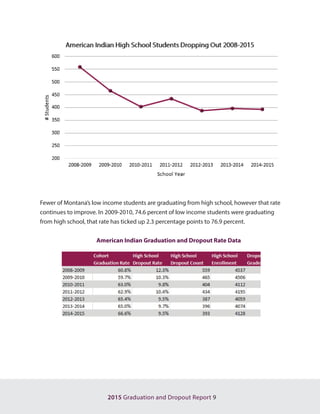
Twenty-nine percent of Montana’s dropouts are American Indian, while American Indian
students make up only 10 percent of the state’s public school population. Montana’s Ameri-
can Indian dropout rate continues to improve, but it remains far behind the rate of white
students. Still, the number of American Indian students dropping out of high school has
dropped by nearly a third since 2008.
2015 Graduation and Dropout Report 9
Fewer of Montana’s low income students are graduating from high school, however that rate
continues to improve. In 2009-2010, 74.6 percent of low income students were graduating
from high school, that rate has ticked up 2.3 percentage points to 76.9 percent.
			 American Indian Graduation and Dropout Rate Data
2015 Graduation and Dropout Report 10
2015 4-Year Cohort Graduation Rate
A HIGH SCHOOL DIPLOMA OPENS DOORS TO SUCCESS
The U.S. Census Bureau’s American Community Survey finds Montanans who did not
graduate from high school earn on-average $18,384 annually, that’s $6,734 less than
someone with a high school diploma and $18,863 less than someone with a college degree.
Montanans without a high school diploma are more likely to live in poverty. The poverty rate
for someone who didn’t graduate from high school is nearly twice that of someone with a
high school diploma.
According to calculations made by the Alliance for Excellent Education, Montana is likely
to see significant economic gains as a result of increases in its high school graduation rate
from 2009 to 2015, which resulted in 540 additional high school graduates. Because more
students are graduating from high school, the Alliance estimates Montana will see a $6
million annual boost to the state’s economy. Those graduates will contribute an additional
$10.3 million in spending on homes, and a $700,000 increase in automobile sales.
Collectively, those added graduates will likely earn an additional $90 million over the course
of their lifetimes, compared to if they had not graduated from high school.
Raising Montana’s graduation rate has never been just about a number. It’s about making
sure every student in Montana, no matter their zip code, has an equal shot at success.
Graduation Matters Montana is rooted in the idea that each of us has a stake in our public
education system. When Montana kids succeed, we all benefit.
Montana Statewide Dropout and Graduate Report 2015 School Year 11
“There is still more work to be done,” Superintendent Juneau said. “But I’m
confident that we’re on the right track and communities now have better tools
to continue this important work.”

MT_statewide_graduate_2015

  • 1.
    2015 Graduation andDropout Report
  • 2.
  • 3.
    2015 GRADUATION ANDDROPOUT REPORT More Montana students are graduating from high school than ever before. That translates into a stronger economy, higher wages, and more opportunities for Montana’s young people. When Superintendent of Public Instruction Denise Juneau took office in 2009, nearly 2,300 students were dropping out of school, and the graduation rate was 80.7 percent. “I saw those numbers and knew that we could do better – that we must do better,”Juneau said.“That’s why I launched Graduation Matters Montana, a statewide initiative built on business and community support, to make sure more Montana students were graduating from high school prepared to succeed in the rest of their lives.” Since 2009, Montana’s dropout rate has been cut by more than a third. The state’s graduation rate reached another historic high in 2014-2015 at 86 percent. 2015 Graduation and Dropout Report 1
  • 4.
    The improvement hasn’thappened by accident. In 53 Montana communities, Graduation Matters Montana has taken hold in ways that are easy to see. Students now participate in “I Pledge to Graduate”events. Graduation Matters banners decorate their hallways. Teachers, parents and community leaders are reinforcing the message that a high school diploma is indeed the first step on the path to success. A common language has developed among Montana’s 53 Graduation Matters communities, placing an emphasis on the importance of a high school diploma that prepares students for life. Montana’s Graduation and Dropout Rate Data 2008-2015 GRADUATION MATTERS MONTANA Graduation Matters Missoula was the seed from which Graduation Matters Montana grew. The statewide initiative started with the support of Montana’s seven-largest school systems, and today includes 53 communities. The idea was simple: make sure more Montana students are graduating from high school prepared for college and careers. But the challenge was, and continues to be, developing enough community support to sustain a project that lives beyond one school year, or one graduating class. For real systemic change to take hold, Graduation Matters Montana needs to become engrained in classrooms and dinner tables across the state. Superintendent Juneau has built a lasting community-based model by partnering with local businesses, schools, and influential leaders to implement best practices and unique strategies. For example, Graduation Matters Hardin has developed a Freshman Academy for at-risk students and a peer-mentoring program. Graduation Matters Laurel is using the Office of Public Instruction’s Early Warning System to better identify students who are at risk of 2015 Graduation and Dropout Report 2
  • 5.
    2015 Graduation andDropout Report 3 dropping out. Graduation Matters Stevensville students host monthly school assemblies meant to give teens a forum to talk about strategies for succeeding. “Many of the schools I visit feel different today than they did five years ago,”Juneau said.“The emphasis on engaging student voice, and using data tools to make sure kids aren’t falling through the cracks, has made such a positive change.” As part of Graduation Matters Montana, Juneau has convened Student Advisory Boards over each of the last five years, bringing together a diverse group of high school students to help shape state policy goals and engage with students on the issues that matter most to them. Since 2010, 185 high school students have sat on Juneau’s Student Advisory Board. BUSINESS AND COMMUNITY SUPPORT Building a statewide initiative like Graduation Matters Montana not only takes a significant investment of time, but also money. Over the last five years, Montana businesses and foundations have generously donated more than $1.3 million to help Graduation Matters Montana communities launch their local efforts. The Dennis and Phyllis Washington Foundation has been a major financial supporter of Graduation Matters Montana, gifting $900,000 over the last few years. Financial support has also come from Student Assistance Foundation, BNSF Railway, AT&T, State Farm, D.A. Davidson, Northwestern Energy, Steele-Reese Foundation, First Interstate Bank, Charter Communications, MEA-MFT, and Applied Materials. The money from these organizations has seed-funded local Graduation Matters Montana efforts through a competitive grant process. Graduation Matters communities have used the money to launch unique programs, including a career and college readiness center now located at Bozeman High School. Superintendent Juneau was able to partner with some of Montana’s most well-known businesses to build a lasting framework that will be able to live beyond her time in office.
  • 6.
    2015 Graduation andDropout Report 4 PREPARING THE NEXT GENERATION FOR SUCCESS Since 2010, more than 11,000 Montana students have taken the pledge to graduate from high school. It may seem like a simple exercise, but when a student is asked to make a commitment in front of their friends, family, school and community, that student is suddenly surrounded by a group of people who want to hold them accountable. Many of Montana’s 53 Graduation Matters communities host annual“I Pledge”events for their incoming freshman. Some schools pair high school students with elementary-aged students and work on pledges at a very early age. “This year I visited a Billings elementary school and watched as nearly 300 young children pledged to graduate from high school,”Juneau said.“All of Montana is rooting for those students, and it’s that kind of community support that’s required to support our public school students.” In 2008-2009, 2,272 high school students dropped out, that equaled a 5 percent dropout rate. The dropout rate has been cut by more than a third, with 1,421 high school students dropping out in 2014-2015 for a rate of 3.4 percent. Montana’s graduation rate has steadily increased from 80.7 percent in 2008-2009, to 86 percent in 2014-2015. Montana can now boast its highest graduation rate ever recorded since the Office of Public Instruction began keeping track in 2000.
  • 7.
    Montana Statewide Dropoutand Graduate Report 2015 School Year 5 Many of Montana’s 53 Graduation Matters communities host annual “I Pledge” events for their incoming freshman. Some schools pair high school students with elementary-aged students and work on pledges at a very early age.
  • 8.
    2015 Graduation andDropout Report 6 “There is still more work to be done,”Superintendent Juneau said.“But I’m confident that we’re on the right track and communities now have better tools to continue this important work.” Not only are more students walking across the graduation stage, they’re also better prepared for college and careers. Since 2010, Montana’s English and math standards were revised to be more rigorous, and the Office of Public Instruction is also working to increase the standards for a handful of other subject areas. All high school juniors now take the ACT college entrance exam free-of-cost, opening the door to higher education for more of Montana’s students. And thanks to Graduation Matters Montana’s partnership with the Student Assistance Foundation, more students are now completing the Free Application for Federal Student Aid (FAFSA), ensuring more teens have access to college. Graduation and Dropout Data by AA District UNDERSTANDING MONTANA’S DROPOUT RATE The dropout count includes students who were enrolled in school on the date of the previous year’s fall enrollment count, or at some time during the previous school year, and were not enrolled on the date of the current school year’s fall count. The dropout rate is calculated as the number of dropouts divided by the enrollment for the previous year.
  • 9.
    Montana Statewide Dropoutand Graduate Report 2015 School Year 7 Not only are more students walking across the graduation stage, they’re also better prepared for college and careers. Definitions Dropout Rate: Counts students who were enrolled in school on the date of the previous year’s October enrollment count or at some time during the previous school year and were not enrolled on the date of the current school year’s October count. Graduation Rate: Prior to the 2010-2011 school year, the graduation rate included the number of students who completed a district’s graduation requirements in four years or less from the time the student enrolled in the 9th grade or had an Individualized Education Program (IEP) allowing for more than four years to graduate. Beginning in the 2010-2011 school year, the graduation rate has been calculated using the four-year adjusted cohort graduation rate calculation. Four-Year Adjusted Cohort Graduation Rate: The four-year adjusted cohort graduation rate is the number of students who graduate in four years with a regular high school diploma divided by the number of students who form the adjusted cohort for the graduating class. From the beginning of 9th grade, students who are entering that grade for the first time form a cohort that is subsequently “adjusted”by adding any students who transfer into the cohort later during the 9th grade and the next three years and subtracting any students who transfer out, emigrate to another country, or pass away during that same period. Completion Rate: Counts students who complete the high school graduation requirements of a school district, including early graduates, during the previous school year, or complete the high school graduation requirements of a school district at the end of summer prior to the current school year. Migrant Student: Migrant students are those participating in the migrant education program under Title I Part C. Economically Disadvantaged: These are students who are eligible for free or reduced lunch. Students are in this category for the graduation rate only if they’re identified as eligible for free or reduced lunch at any time during high school.
  • 10.
    2015 Graduation andDropout Report 8 2015 Montana Dropout Rate Summary The number of Montana students dropping out has been cut by a third since 2009. Over the last seven years, the dropout rate has declined from 5 percent to 3.4 percent, resulting in 851 fewer dropouts in 2015 compared to 2009. High school seniors are far more likely to drop out of school than freshmen. Males are more likely to drop out that females. CREATING OPPORTUNITIES FOR ALL STUDENTS It’s true more Montana students now have access to a wider range of post-high-school opportunities, but a disproportionate share of low income and minority students aren’t completing their high school education. Twenty-nine percent of Montana’s dropouts are American Indian, while American Indian students make up only 10 percent of the state’s public school population. Montana’s Ameri- can Indian dropout rate continues to improve, but it remains far behind the rate of white students. Still, the number of American Indian students dropping out of high school has dropped by nearly a third since 2008.
  • 11.
    2015 Graduation andDropout Report 9 Fewer of Montana’s low income students are graduating from high school, however that rate continues to improve. In 2009-2010, 74.6 percent of low income students were graduating from high school, that rate has ticked up 2.3 percentage points to 76.9 percent. American Indian Graduation and Dropout Rate Data
  • 12.
    2015 Graduation andDropout Report 10 2015 4-Year Cohort Graduation Rate A HIGH SCHOOL DIPLOMA OPENS DOORS TO SUCCESS The U.S. Census Bureau’s American Community Survey finds Montanans who did not graduate from high school earn on-average $18,384 annually, that’s $6,734 less than someone with a high school diploma and $18,863 less than someone with a college degree. Montanans without a high school diploma are more likely to live in poverty. The poverty rate for someone who didn’t graduate from high school is nearly twice that of someone with a high school diploma. According to calculations made by the Alliance for Excellent Education, Montana is likely to see significant economic gains as a result of increases in its high school graduation rate from 2009 to 2015, which resulted in 540 additional high school graduates. Because more students are graduating from high school, the Alliance estimates Montana will see a $6 million annual boost to the state’s economy. Those graduates will contribute an additional $10.3 million in spending on homes, and a $700,000 increase in automobile sales. Collectively, those added graduates will likely earn an additional $90 million over the course of their lifetimes, compared to if they had not graduated from high school. Raising Montana’s graduation rate has never been just about a number. It’s about making sure every student in Montana, no matter their zip code, has an equal shot at success. Graduation Matters Montana is rooted in the idea that each of us has a stake in our public education system. When Montana kids succeed, we all benefit.
  • 13.
    Montana Statewide Dropoutand Graduate Report 2015 School Year 11 “There is still more work to be done,” Superintendent Juneau said. “But I’m confident that we’re on the right track and communities now have better tools to continue this important work.”