Storage and Data
Challenges for Production
Machine Learning
Nisha Talagala
CEO, Pyxeda AI
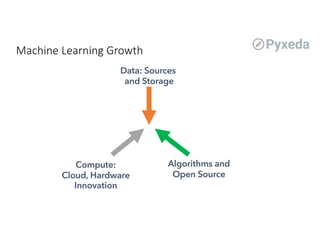
Machine Learning Growth
Data: Sources
and Storage
Compute:
Cloud, Hardware
Innovation
Algorithms and
Open Source
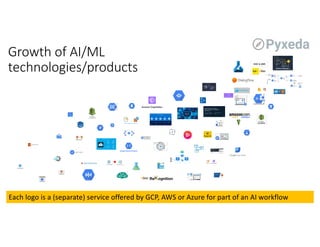
Growth of AI/ML
technologies/products
Each logo is a (separate) service offered by GCP, AWS or Azure for part of an AI workflow
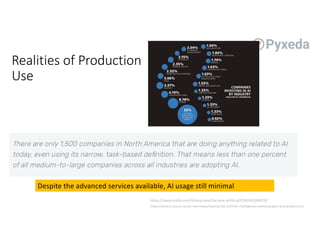
Realities of Production
Use
https://www.oreilly.com/library/view/the-new-artificial/9781492048978/
https://emerj.com/ai-sector-overviews/valuing-the-artificial-intelligence-market-graphs-and-predictions/
Despite the advanced services available, AI usage still minimal
In This Talk:
• AI and ML: A quick overview
• Trends as relevant for Storage
• Workloads
• Trust, Governance and Data Management
• Edge
• The users
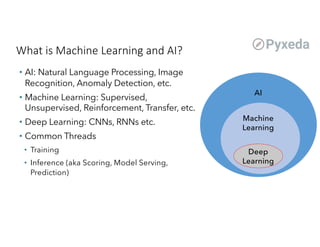
What is Machine Learning and AI?
• AI: Natural Language Processing, Image
Recognition, Anomaly Detection, etc.
• Machine Learning: Supervised,
Unsupervised, Reinforcement, Transfer, etc.
• Deep Learning: CNNs, RNNs etc.
• Common Threads
• Training
• Inference (aka Scoring, Model Serving,
Prediction)
AI
Machine
Learning
Deep
Learning
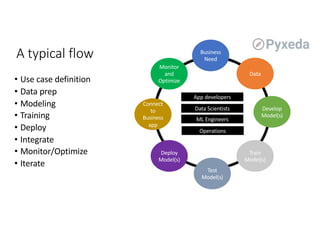
A typical flow
• Use case definition
• Data prep
• Modeling
• Training
• Deploy
• Integrate
• Monitor/Optimize
• Iterate
Data
Train
Model(s)
Develop
Model(s)
Test
Model(s)
Deploy
Model(s)
Connect
to
Business
app
App developers
Data Scientists
ML Engineers
Operations
Business
Need
Monitor
and
Optimize
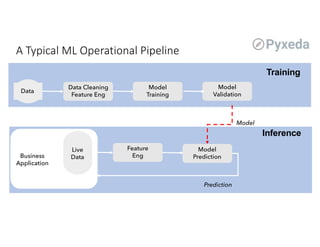
A Typical ML Operational Pipeline
Data
Data Cleaning
Feature Eng
Model
Training
Model
Validation
Model
Prediction
Feature
Eng
Live
DataBusiness
Application
Model
Prediction
Training
Inference
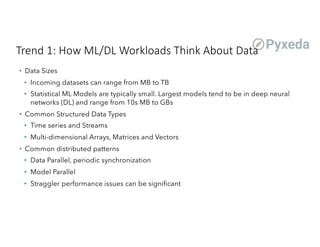
Trend 1: How ML/DL Workloads Think About Data
• Data Sizes
• Incoming datasets can range from MB to TB
• Statistical ML Models are typically small. Largest models tend to be in deep neural
networks (DL) and range from 10s MB to GBs
• Common Structured Data Types
• Time series and Streams
• Multi-dimensional Arrays, Matrices and Vectors
• Common distributed patterns
• Data Parallel, periodic synchronization
• Model Parallel
• Straggler performance issues can be significant
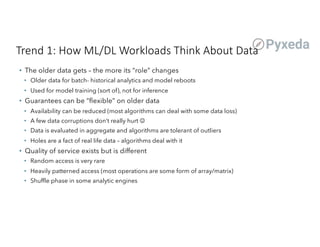
Trend 1: How ML/DL Workloads Think About Data
• The older data gets – the more its “role” changes
• Older data for batch- historical analytics and model reboots
• Used for model training (sort of), not for inference
• Guarantees can be “flexible” on older data
• Availability can be reduced (most algorithms can deal with some data loss)
• A few data corruptions don’t really hurt J
• Data is evaluated in aggregate and algorithms are tolerant of outliers
• Holes are a fact of real life data – algorithms deal with it
• Quality of service exists but is different
• Random access is very rare
• Heavily patterned access (most operations are some form of array/matrix)
• Shuffle phase in some analytic engines
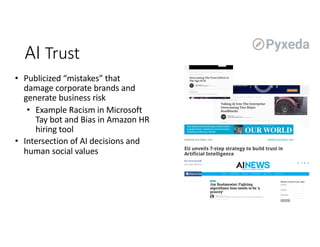
• Publicized “mistakes” that
damage corporate brands and
generate business risk
• Example Racism in Microsoft
Tay bot and Bias in Amazon HR
hiring tool
• Intersection of AI decisions and
human social values
AI Trust
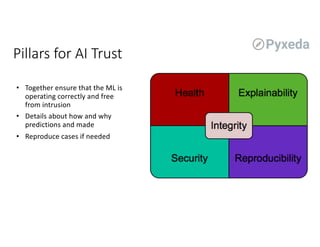
Pillars for AI Trust
• Together ensure that the ML is
operating correctly and free
from intrusion
• Details about how and why
predictions and made
• Reproduce cases if needed
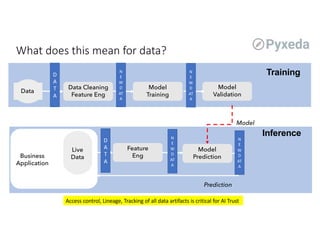
What does this mean for data?
Data
Data Cleaning
Feature Eng
Model
Training
Model
Validation
Model
Prediction
Feature
Eng
Live
DataBusiness
Application
Model
Prediction
Training
Inference
D
A
T
A
N
E
W
D
AT
A
N
E
W
D
AT
A
N
E
W
D
AT
A
N
E
W
D
AT
A
D
A
T
A
Access control, Lineage, Tracking of all data artifacts is critical for AI Trust
Trend 2: Need for Governance
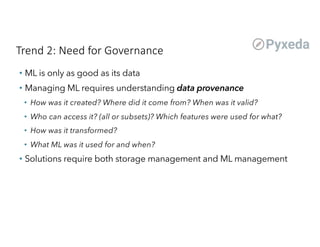
• ML is only as good as its data
• Managing ML requires understanding data provenance
• How was it created? Where did it come from? When was it valid?
• Who can access it? (all or subsets)? Which features were used for what?
• How was it transformed?
• What ML was it used for and when?
• Solutions require both storage management and ML management
Trend 2: Need for Governance
• Examples
• Established: Example: Model Risk Management in Financial Services
• https://www.federalreserve.gov/supervisionreg/srletters/sr1107a1.pdf
• Example GDPR/CCPA on Data, Reproducing and Explaining ML
Decisions
• https://iapp.org/news/a/is-there-a-right-to-explanation-for-machine-learning-in-
the-gdpr/
• Example: New York City Algorithm Fairness Monitoring
• https://techcrunch.com/2017/12/12/new-york-city-moves-to-establish-
algorithm-monitoring-task-force/
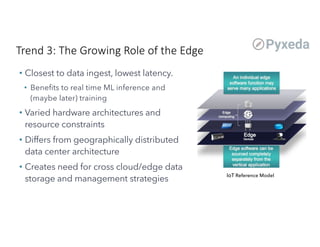
Trend 3: The Growing Role of the Edge
• Closest to data ingest, lowest latency.
• Benefits to real time ML inference and
(maybe later) training
• Varied hardware architectures and
resource constraints
• Differs from geographically distributed
data center architecture
• Creates need for cross cloud/edge data
storage and management strategies IoT Reference Model
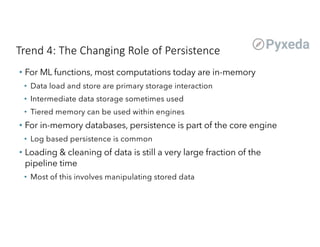
Trend 4: The Changing Role of Persistence
• For ML functions, most computations today are in-memory
• Data load and store are primary storage interaction
• Intermediate data storage sometimes used
• Tiered memory can be used within engines
• For in-memory databases, persistence is part of the core engine
• Log based persistence is common
• Loading & cleaning of data is still a very large fraction of the
pipeline time
• Most of this involves manipulating stored data
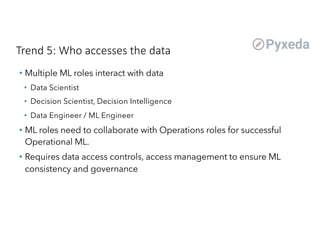
Trend 5: Who accesses the data
• Multiple ML roles interact with data
• Data Scientist
• Decision Scientist, Decision Intelligence
• Data Engineer / ML Engineer
• ML roles need to collaborate with Operations roles for successful
Operational ML.
• Requires data access controls, access management to ensure ML
consistency and governance
Storage for ML: Challenges and Opportunities
• Data access Speeds (Particularly for Deep Learning Workloads)
• Data Management
• Reproducibility and Lineage
• Governance and the Challenges of Regulation, Data Access Control
and Access Management
• The Edge
• The new data managers
Storage for ML: Example systems
• Databricks Delta
• Apache Atlas
• RDMA data acceleration for Deep Learning (Ex. from Mellanox)
• Time series optimized databases (Ex. BTrDB, GorrillaDB)
• API pushdown techniques and Native RDD Access APIs (Ex. Iguaz.io)
• Lineage: Link data and compute history (Ex. Alluxio/formerly Tachyon)
• Memory expansion (Ex. Many studies on DRAM/Persistent Memory/Flash
tiering for analytics)
Takeaways
• The use of ML/DL in enterprise is at its infancy
• The first and most obvious storage challenge is performance
• The larger challenge is likely data management and governance
• Edge and distribution are also emerging challenges
• Opportunities exist to significantly improve storage and memory for
these use cases
Additional Resources
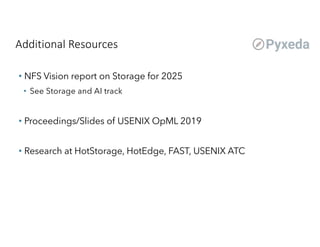
• NFS Vision report on Storage for 2025
• See Storage and AI track
• Proceedings/Slides of USENIX OpML 2019
• Research at HotStorage, HotEdge, FAST, USENIX ATC
Thank You
Nisha Talagala
nisha@pyxeda.ai
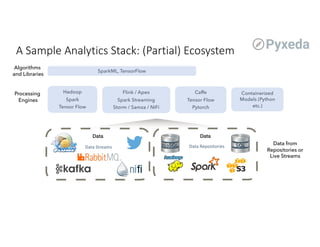
Data
Data Repositories SQL
Data
Data Streams NoSQL
A Sample Analytics Stack: (Partial) Ecosystem
Data from
Repositories or
Live Streams
Flink / Apex
Spark Streaming
Storm / Samza / NiFi
Caffe
Tensor Flow
Pytorch
Hadoop
Spark
Tensor Flow
SparkML, TensorFlow
Processing
Engines
Algorithms
and Libraries
Containerized
Models (Python
etc.)
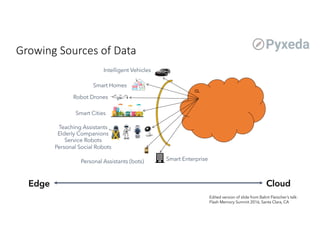
Edited version of slide from Balint Fleischer’s talk:
Flash Memory Summit 2016, Santa Clara, CA
CL
Teaching Assistants
Elderly Companions
Service Robots
Personal Social Robots
Smart Cities
Robot Drones
Smart Homes
Intelligent Vehicles
Personal Assistants (bots) Smart Enterprise
X
Growing Sources of Data
Edge Cloud

Msst 2019 v4

  • 1.
    Storage and Data Challengesfor Production Machine Learning Nisha Talagala CEO, Pyxeda AI
  • 2.
    Machine Learning Growth Data:Sources and Storage Compute: Cloud, Hardware Innovation Algorithms and Open Source
  • 3.
    Growth of AI/ML technologies/products Eachlogo is a (separate) service offered by GCP, AWS or Azure for part of an AI workflow
  • 4.
  • 5.
    In This Talk: •AI and ML: A quick overview • Trends as relevant for Storage • Workloads • Trust, Governance and Data Management • Edge • The users
  • 6.
    What is MachineLearning and AI? • AI: Natural Language Processing, Image Recognition, Anomaly Detection, etc. • Machine Learning: Supervised, Unsupervised, Reinforcement, Transfer, etc. • Deep Learning: CNNs, RNNs etc. • Common Threads • Training • Inference (aka Scoring, Model Serving, Prediction) AI Machine Learning Deep Learning
  • 7.
    A typical flow •Use case definition • Data prep • Modeling • Training • Deploy • Integrate • Monitor/Optimize • Iterate Data Train Model(s) Develop Model(s) Test Model(s) Deploy Model(s) Connect to Business app App developers Data Scientists ML Engineers Operations Business Need Monitor and Optimize
  • 8.
    A Typical MLOperational Pipeline Data Data Cleaning Feature Eng Model Training Model Validation Model Prediction Feature Eng Live DataBusiness Application Model Prediction Training Inference
  • 9.
    Trend 1: HowML/DL Workloads Think About Data • Data Sizes • Incoming datasets can range from MB to TB • Statistical ML Models are typically small. Largest models tend to be in deep neural networks (DL) and range from 10s MB to GBs • Common Structured Data Types • Time series and Streams • Multi-dimensional Arrays, Matrices and Vectors • Common distributed patterns • Data Parallel, periodic synchronization • Model Parallel • Straggler performance issues can be significant
  • 10.
    Trend 1: HowML/DL Workloads Think About Data • The older data gets – the more its “role” changes • Older data for batch- historical analytics and model reboots • Used for model training (sort of), not for inference • Guarantees can be “flexible” on older data • Availability can be reduced (most algorithms can deal with some data loss) • A few data corruptions don’t really hurt J • Data is evaluated in aggregate and algorithms are tolerant of outliers • Holes are a fact of real life data – algorithms deal with it • Quality of service exists but is different • Random access is very rare • Heavily patterned access (most operations are some form of array/matrix) • Shuffle phase in some analytic engines
  • 11.
    • Publicized “mistakes”that damage corporate brands and generate business risk • Example Racism in Microsoft Tay bot and Bias in Amazon HR hiring tool • Intersection of AI decisions and human social values AI Trust
  • 12.
    Pillars for AITrust • Together ensure that the ML is operating correctly and free from intrusion • Details about how and why predictions and made • Reproduce cases if needed
  • 13.
    What does thismean for data? Data Data Cleaning Feature Eng Model Training Model Validation Model Prediction Feature Eng Live DataBusiness Application Model Prediction Training Inference D A T A N E W D AT A N E W D AT A N E W D AT A N E W D AT A D A T A Access control, Lineage, Tracking of all data artifacts is critical for AI Trust
  • 14.
    Trend 2: Needfor Governance • ML is only as good as its data • Managing ML requires understanding data provenance • How was it created? Where did it come from? When was it valid? • Who can access it? (all or subsets)? Which features were used for what? • How was it transformed? • What ML was it used for and when? • Solutions require both storage management and ML management
  • 15.
    Trend 2: Needfor Governance • Examples • Established: Example: Model Risk Management in Financial Services • https://www.federalreserve.gov/supervisionreg/srletters/sr1107a1.pdf • Example GDPR/CCPA on Data, Reproducing and Explaining ML Decisions • https://iapp.org/news/a/is-there-a-right-to-explanation-for-machine-learning-in- the-gdpr/ • Example: New York City Algorithm Fairness Monitoring • https://techcrunch.com/2017/12/12/new-york-city-moves-to-establish- algorithm-monitoring-task-force/
  • 16.
    Trend 3: TheGrowing Role of the Edge • Closest to data ingest, lowest latency. • Benefits to real time ML inference and (maybe later) training • Varied hardware architectures and resource constraints • Differs from geographically distributed data center architecture • Creates need for cross cloud/edge data storage and management strategies IoT Reference Model
  • 17.
    Trend 4: TheChanging Role of Persistence • For ML functions, most computations today are in-memory • Data load and store are primary storage interaction • Intermediate data storage sometimes used • Tiered memory can be used within engines • For in-memory databases, persistence is part of the core engine • Log based persistence is common • Loading & cleaning of data is still a very large fraction of the pipeline time • Most of this involves manipulating stored data
  • 18.
    Trend 5: Whoaccesses the data • Multiple ML roles interact with data • Data Scientist • Decision Scientist, Decision Intelligence • Data Engineer / ML Engineer • ML roles need to collaborate with Operations roles for successful Operational ML. • Requires data access controls, access management to ensure ML consistency and governance
  • 19.
    Storage for ML:Challenges and Opportunities • Data access Speeds (Particularly for Deep Learning Workloads) • Data Management • Reproducibility and Lineage • Governance and the Challenges of Regulation, Data Access Control and Access Management • The Edge • The new data managers
  • 20.
    Storage for ML:Example systems • Databricks Delta • Apache Atlas • RDMA data acceleration for Deep Learning (Ex. from Mellanox) • Time series optimized databases (Ex. BTrDB, GorrillaDB) • API pushdown techniques and Native RDD Access APIs (Ex. Iguaz.io) • Lineage: Link data and compute history (Ex. Alluxio/formerly Tachyon) • Memory expansion (Ex. Many studies on DRAM/Persistent Memory/Flash tiering for analytics)
  • 21.
    Takeaways • The useof ML/DL in enterprise is at its infancy • The first and most obvious storage challenge is performance • The larger challenge is likely data management and governance • Edge and distribution are also emerging challenges • Opportunities exist to significantly improve storage and memory for these use cases
  • 22.
    Additional Resources • NFSVision report on Storage for 2025 • See Storage and AI track • Proceedings/Slides of USENIX OpML 2019 • Research at HotStorage, HotEdge, FAST, USENIX ATC
  • 23.
  • 24.
    Data Data Repositories SQL Data DataStreams NoSQL A Sample Analytics Stack: (Partial) Ecosystem Data from Repositories or Live Streams Flink / Apex Spark Streaming Storm / Samza / NiFi Caffe Tensor Flow Pytorch Hadoop Spark Tensor Flow SparkML, TensorFlow Processing Engines Algorithms and Libraries Containerized Models (Python etc.)
  • 25.
    Edited version ofslide from Balint Fleischer’s talk: Flash Memory Summit 2016, Santa Clara, CA CL Teaching Assistants Elderly Companions Service Robots Personal Social Robots Smart Cities Robot Drones Smart Homes Intelligent Vehicles Personal Assistants (bots) Smart Enterprise X Growing Sources of Data Edge Cloud