MSME
Factors affecting the growth
of Entrepreneurship
Mr. Sathish V
Assistant Professor
PES Institute of Advanced Management Studies
NH- 206 Sagar Road, Shivamogga
Entrepreneurship is influenced by four distinct factors:
economic development, culture, technological
development and education. In areas where these
factors are present, you can expect to see strong
and consistent entrepreneurial growth.
FACTORS AFFECTING ENTREPRENEURIAL
GROWTH
 Economic Factors
 Non-Economic Factors
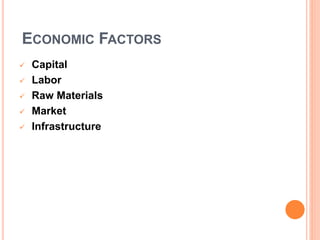
ECONOMIC FACTORS
 Capital
 Labor
 Raw Materials
 Market
 Infrastructure
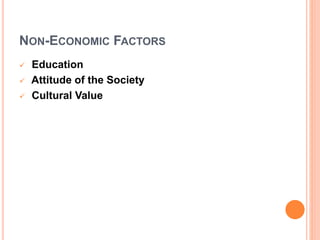
NON-ECONOMIC FACTORS
 Education
 Attitude of the Society
 Cultural Value
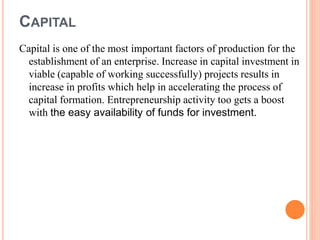
CAPITAL
Capital is one of the most important factors of production for the
establishment of an enterprise. Increase in capital investment in
viable (capable of working successfully) projects results in
increase in profits which help in accelerating the process of
capital formation. Entrepreneurship activity too gets a boost
with the easy availability of funds for investment.
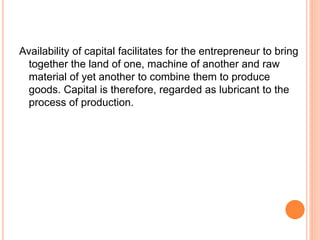
Availability of capital facilitates for the entrepreneur to bring
together the land of one, machine of another and raw
material of yet another to combine them to produce
goods. Capital is therefore, regarded as lubricant to the
process of production.
LABOR
Easy availability of right type of workers also effect
entrepreneurship. The quality rather than quantity
of labor influences the emergence and growth of
entrepreneurship. The problem of labor immobility
can be solved by providing infrastructural facilities
including efficient transportation.
The quality rather quantity of labor is another factor
which influences the emergence of
entrepreneurship. Most less developed countries
are labor rich nations owing to a dense and even
increasing population. But entrepreneurship is
encouraged if there is a mobile and flexible labor
force.
RAW MATERIALS
The necessity of raw materials hardly needs any
emphasis for establishing any industrial activity
and its influence in the emergence of
entrepreneurship. In the absence of raw
materials, neither any enterprise can be
established nor can an entrepreneur be
emerged.
It is one of the basic ingredients required for
production. Shortage of raw material can
adversely affect entrepreneurial environment.
Without adequate supply of raw materials no
industry can function properly and emergence of
entrepreneurship to is adversely affected.
MARKET
The role and importance of market and marketing is very
important for the growth of entrepreneurship. In modern
competitive world no entrepreneur can think of surviving
in the absence of latest knowledge about market and
various marketing techniques.
The fact remains that the potential of the market
constitutes the major determinant of probable rewards
from entrepreneurial function. Frankly speaking, if the
proof of pudding lies in eating, the proof of all production
lies in consumption, i.e., marketing.
INFRASTRUCTURE
Expansion of entrepreneurship presupposes properly
developed communication and transportation facilities. It not
only helps to enlarge the market, but expand the horizons of
business too. Take for instance, the establishment of post
and telegraph system and construction of roads and
highways in India. It helped considerable entrepreneurial
activities which took place in the 1850s.
Apart from the above factors, institutions like trade/
business associations, business schools, libraries,
etc. also make valuable contribution towards
promoting and sustaining entrepreneurship’ in the
economy
NON-ECONOMIC FACTORS
Education:
Education enables one to understand the
outside world and equips him with the basic
knowledge and skills to deal with day-to-day
problems. In any society, the system of education
has a significant role to play in inculcating
entrepreneurial values.
 In India, the system of education prior to the 20th century
was based on religion. In this rigid system, critical and
questioning attitudes towards society were discouraged.
The caste system and the resultant occupational structure
were reinforced by such education. It promoted the idea that
business is not a respectable occupation. Later, when the
British came to our country, they introduced an education
system, just to produce clerks and accountants for the East
India Company, The base of such a system, as you can well
see, is very anti-entrepreneurial.
 Our educational methods have not changed much even
today. The emphasis is till on preparing students for
standard jobs, rather than marking them capable enough to
stand on their feet.
ATTITUDE OF THE SOCIETY
A related aspect to these is the attitude of the society
towards entrepreneurship. Certain societies encourage
innovations and novelties, and thus approve
entrepreneurs’ actions and rewards like profits. Certain
others do not tolerate changes and in such
circumstances, entrepreneurship cannot take root and
grow. Similarly, some societies have an inherent dislike
for any money-making activity. It is said, that in Russia, in
the nineteenth century, the upper classes did not like
entrepreneurs. For them, cultivating the land meant a
good life.
CULTURAL VALUE
Motives impel men to action. Entrepreneurial growth requires
proper motives like profit-making, acquisition of prestige and
attainment of social status. Ambitious and talented men
would take risks and innovate if these motives are strong.
The strength of these motives depends upon the culture of
the society. If the culture is economically or monetarily
oriented, entrepreneurship would be applauded and
praised; wealth accumulation as a way of life would be
appreciated. In the less developed countries, people are not
economically motivated. Monetary incentives have relatively
less attraction. People have ample opportunities of attaining
social distinction by non-economic pursuits. Men with
organizational abilities are, therefore, not dragged into
business. They use their talents for non-economic end.

MSME Unit-2

  • 1.
    MSME Factors affecting thegrowth of Entrepreneurship Mr. Sathish V Assistant Professor PES Institute of Advanced Management Studies NH- 206 Sagar Road, Shivamogga
  • 2.
    Entrepreneurship is influencedby four distinct factors: economic development, culture, technological development and education. In areas where these factors are present, you can expect to see strong and consistent entrepreneurial growth.
  • 3.
    FACTORS AFFECTING ENTREPRENEURIAL GROWTH Economic Factors  Non-Economic Factors
  • 4.
    ECONOMIC FACTORS  Capital Labor  Raw Materials  Market  Infrastructure
  • 5.
    NON-ECONOMIC FACTORS  Education Attitude of the Society  Cultural Value
  • 6.
    CAPITAL Capital is oneof the most important factors of production for the establishment of an enterprise. Increase in capital investment in viable (capable of working successfully) projects results in increase in profits which help in accelerating the process of capital formation. Entrepreneurship activity too gets a boost with the easy availability of funds for investment.
  • 7.
    Availability of capitalfacilitates for the entrepreneur to bring together the land of one, machine of another and raw material of yet another to combine them to produce goods. Capital is therefore, regarded as lubricant to the process of production.
  • 8.
    LABOR Easy availability ofright type of workers also effect entrepreneurship. The quality rather than quantity of labor influences the emergence and growth of entrepreneurship. The problem of labor immobility can be solved by providing infrastructural facilities including efficient transportation.
  • 9.
    The quality ratherquantity of labor is another factor which influences the emergence of entrepreneurship. Most less developed countries are labor rich nations owing to a dense and even increasing population. But entrepreneurship is encouraged if there is a mobile and flexible labor force.
  • 10.
    RAW MATERIALS The necessityof raw materials hardly needs any emphasis for establishing any industrial activity and its influence in the emergence of entrepreneurship. In the absence of raw materials, neither any enterprise can be established nor can an entrepreneur be emerged. It is one of the basic ingredients required for production. Shortage of raw material can adversely affect entrepreneurial environment. Without adequate supply of raw materials no industry can function properly and emergence of entrepreneurship to is adversely affected.
  • 11.
    MARKET The role andimportance of market and marketing is very important for the growth of entrepreneurship. In modern competitive world no entrepreneur can think of surviving in the absence of latest knowledge about market and various marketing techniques. The fact remains that the potential of the market constitutes the major determinant of probable rewards from entrepreneurial function. Frankly speaking, if the proof of pudding lies in eating, the proof of all production lies in consumption, i.e., marketing.
  • 12.
    INFRASTRUCTURE Expansion of entrepreneurshippresupposes properly developed communication and transportation facilities. It not only helps to enlarge the market, but expand the horizons of business too. Take for instance, the establishment of post and telegraph system and construction of roads and highways in India. It helped considerable entrepreneurial activities which took place in the 1850s.
  • 13.
    Apart from theabove factors, institutions like trade/ business associations, business schools, libraries, etc. also make valuable contribution towards promoting and sustaining entrepreneurship’ in the economy
  • 14.
    NON-ECONOMIC FACTORS Education: Education enablesone to understand the outside world and equips him with the basic knowledge and skills to deal with day-to-day problems. In any society, the system of education has a significant role to play in inculcating entrepreneurial values.
  • 15.
     In India,the system of education prior to the 20th century was based on religion. In this rigid system, critical and questioning attitudes towards society were discouraged. The caste system and the resultant occupational structure were reinforced by such education. It promoted the idea that business is not a respectable occupation. Later, when the British came to our country, they introduced an education system, just to produce clerks and accountants for the East India Company, The base of such a system, as you can well see, is very anti-entrepreneurial.  Our educational methods have not changed much even today. The emphasis is till on preparing students for standard jobs, rather than marking them capable enough to stand on their feet.
  • 16.
    ATTITUDE OF THESOCIETY A related aspect to these is the attitude of the society towards entrepreneurship. Certain societies encourage innovations and novelties, and thus approve entrepreneurs’ actions and rewards like profits. Certain others do not tolerate changes and in such circumstances, entrepreneurship cannot take root and grow. Similarly, some societies have an inherent dislike for any money-making activity. It is said, that in Russia, in the nineteenth century, the upper classes did not like entrepreneurs. For them, cultivating the land meant a good life.
  • 17.
    CULTURAL VALUE Motives impelmen to action. Entrepreneurial growth requires proper motives like profit-making, acquisition of prestige and attainment of social status. Ambitious and talented men would take risks and innovate if these motives are strong. The strength of these motives depends upon the culture of the society. If the culture is economically or monetarily oriented, entrepreneurship would be applauded and praised; wealth accumulation as a way of life would be appreciated. In the less developed countries, people are not economically motivated. Monetary incentives have relatively less attraction. People have ample opportunities of attaining social distinction by non-economic pursuits. Men with organizational abilities are, therefore, not dragged into business. They use their talents for non-economic end.