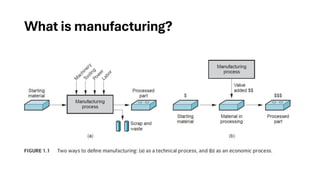
What is manufacturing?
•Definition:
• Process of material selection and transforming them into valuable
products
• Manufacturing is creating value at large scale
7.
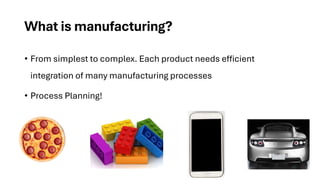
What is manufacturing?
•From simplest to complex. Each product needs efficient
integration of many manufacturing processes
• Process Planning!
8.
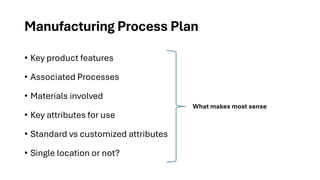
Manufacturing Process Plan
•Key product features
• Associated Processes
• Materials involved
• Key attributes for use
• Standard vs customized attributes
• Single location or not?
What makes most sense
9.
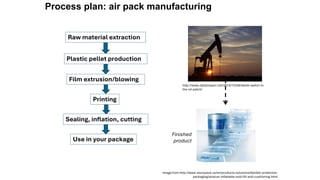
Process plan: airpack manufacturing
Raw material extraction
Plastic pellet production
Film extrusion/blowing
Printing
Sealing, inflation, cutting
Use in your package
Image from http://www.storopack.us/en/products-solutions/flexible-protective-
packaging/airplusr-inflatable-void-fill-and-cushioning.html
Finished
product
http://www.dailyimpact.net/2015/10/28/death-watch-in-
the-oil-patch/
10.
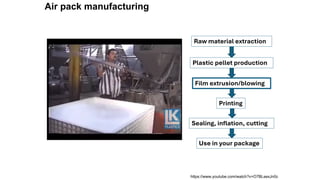
Air pack manufacturing
Rawmaterial extraction
Plastic pellet production
Film extrusion/blowing
Printing
Sealing, inflation, cutting
Use in your package
https://www.youtube.com/watch?v=O7BLsexJn0c
11.
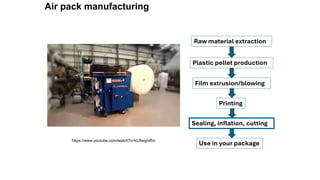
Air pack manufacturing
Rawmaterial extraction
Plastic pellet production
Film extrusion/blowing
Printing
Sealing, inflation, cutting
Use in your package
https://www.youtube.com/watch?v=kUfiwgrsfhc
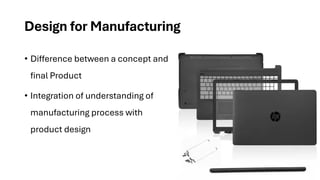
Design for Manufacturing
•Difference between a concept and
final Product
• Integration of understanding of
manufacturing process with
product design
19.
Design for Manufacturing
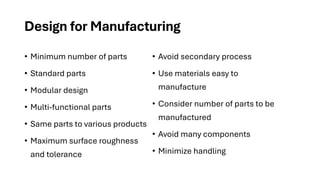
•Minimum number of parts
• Standard parts
• Modular design
• Multi-functional parts
• Same parts to various products
• Maximum surface roughness
and tolerance
• Avoid secondary process
• Use materials easy to
manufacture
• Consider number of parts to be
manufactured
• Avoid many components
• Minimize handling
20.
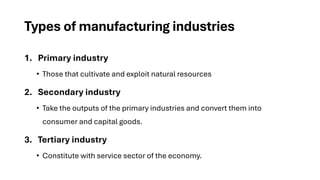
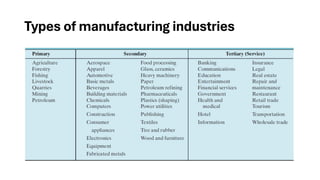
Types of manufacturingindustries
1. Primary industry
• Those that cultivate and exploit natural resources
2. Secondary industry
• Take the outputs of the primary industries and convert them into
consumer and capital goods.
3. Tertiary industry
• Constitute with service sector of the economy.
Types of manufacturingoperations
Project – 1 to 10 units. [Low production]
Job shop – 10 to 100 units. [Low production]
Batch – 100 to 10,000 units. [Medium production]
Mass – Above 10,000 units. [High production]
• Production quantity: number of unit produced
annually of a particular product type.
• Product variety: different product designs or
types that are produced in the plant.
23.
Types of manufacturingoperations
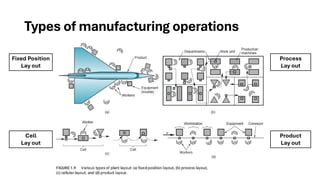
Fixed Position
Lay out
Cell
Lay out
Process
Lay out
Product
Lay out
24.
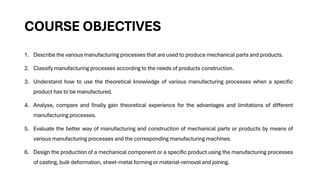
COURSE OBJECTIVES
1. Describethe various manufacturing processes that are used to produce mechanical parts and products.
2. Classify manufacturing processes according to the needs of products construction.
3. Understand how to use the theoretical knowledge of various manufacturing processes when a specific
product has to be manufactured.
4. Analyse, compare and finally gain theoretical experience for the advantages and limitations of different
manufacturing processes.
5. Evaluate the better way of manufacturing and construction of mechanical parts or products by means of
various manufacturing processes and the corresponding manufacturing machines.
6. Design the production of a mechanical component or a specific product using the manufacturing processes
of casting, bulk deformation, sheet-metal forming or material-removal and joining.


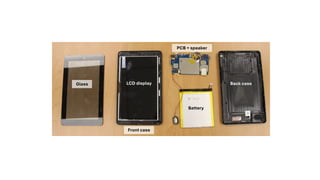
![Amazon Fire LCD display
Color filter
(rotated 45 deg)
[1]
[2]
[3]
1 mm
LCD
Display
LCD display
Glass + touch sensors
19](https://image.slidesharecdn.com/mse314manufacturingprocess-intro-250301184514-8785736d/85/MSE-314-Manufacturing-Process-Intro-pdf-15-320.jpg)
![Types of manufacturing operations
Project – 1 to 10 units. [Low production]
Job shop – 10 to 100 units. [Low production]
Batch – 100 to 10,000 units. [Medium production]
Mass – Above 10,000 units. [High production]
• Production quantity: number of unit produced
annually of a particular product type.
• Product variety: different product designs or
types that are produced in the plant.](https://image.slidesharecdn.com/mse314manufacturingprocess-intro-250301184514-8785736d/85/MSE-314-Manufacturing-Process-Intro-pdf-22-320.jpg)



![Chaer_view[1].pptjfggggggggggggggggggkkkk](https://cdn.slidesharecdn.com/ss_thumbnails/chapteronemfgoverview1-231220141532-3da93097-thumbnail.jpg?width=640&height=640&fit=bounds)


