Taiz
University
TOPIC OUTLINE
 What is manufacturing?
 Historical development of manufacturing
technology
 Economic role of manufacturing
 Manufacturing as a technical activity
 Manufacturing organization and enterprise
 Standard measurement and measurement
inspection
Taiz
University
LESSON OUTCOMES
1. Able to describe what the manufacturing
technology is and its role in a country economy
2. Able to explain the interconnected activities
involved in product realization
3. Able to identify the use and method to take
reading of basic measuring instruments
Taiz
University
What is manufacturing?
• • Literal: Manufacture = Manus (hand) + Factus
(make)  Made by hand
• • Technological: Application of physical and chemical
• processes to make parts or products,
• including assembly of products.
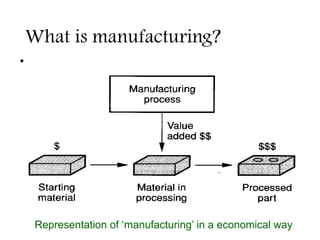
• • Economical: Transformation of materials into items
of greater value by means of processing
and/or assembly operations.
• • CIRP definition: Design + production + assembly
• (CIRP = International Academy for Production Eng.)
Taiz
University
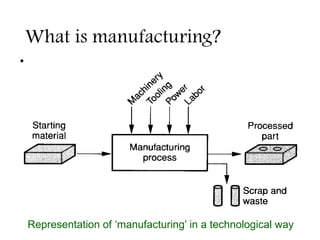
What is manufacturing?
•
Representation of ‘manufacturing’ in a technological way
Taiz
University
What is manufacturing?
•
Representation of ‘manufacturing’ in a economical way
Taiz
University
Importance of Manufacturing
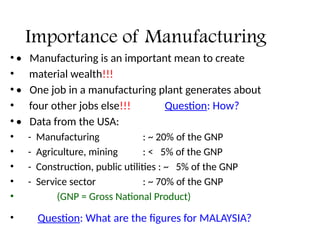
• • Manufacturing is an important mean to create
• material wealth!!!
• • One job in a manufacturing plant generates about
• four other jobs else!!! Question: How?
• • Data from the USA:
• - Manufacturing : ~ 20% of the GNP
• - Agriculture, mining : < 5% of the GNP
• - Construction, public utilities : ~ 5% of the GNP
• - Service sector : ~ 70% of the GNP
• (GNP = Gross National Product)
• Question: What are the figures for MALAYSIA?
Taiz
University
Historical Perspective (1)
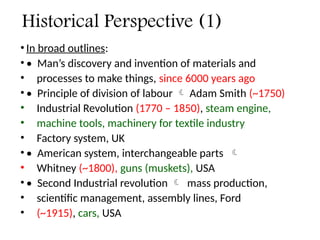
• In broad outlines:
• • Man’s discovery and invention of materials and
• processes to make things, since 6000 years ago
• • Principle of division of labour  Adam Smith (~1750)
• Industrial Revolution (1770 – 1850), steam engine,
• machine tools, machinery for textile industry
• Factory system, UK
• • American system, interchangeable parts 
• Whitney (~1800), guns (muskets), USA
• • Second Industrial revolution  mass production,
• scientific management, assembly lines, Ford
• (~1915), cars, USA
Taiz
University
Historical Perspective (2)
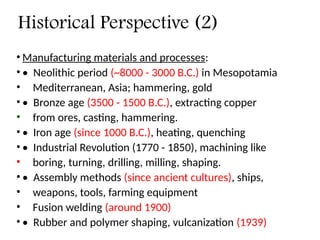
• Manufacturing materials and processes:
• • Neolithic period (~8000 - 3000 B.C.) in Mesopotamia
• Mediterranean, Asia; hammering, gold
• • Bronze age (3500 - 1500 B.C.), extracting copper
• from ores, casting, hammering.
• • Iron age (since 1000 B.C.), heating, quenching
• • Industrial Revolution (1770 - 1850), machining like
• boring, turning, drilling, milling, shaping.
• • Assembly methods (since ancient cultures), ships,
• weapons, tools, farming equipment
• Fusion welding (around 1900)
• • Rubber and polymer shaping, vulcanization (1939)
Taiz
University
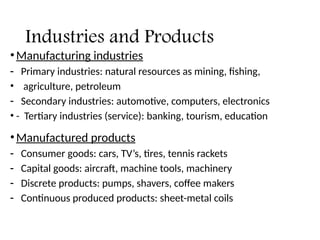
Industries and Products
•Manufacturing industries
- Primary industries: natural resources as mining, fishing,
• agriculture, petroleum
- Secondary industries: automotive, computers, electronics
• - Tertiary industries (service): banking, tourism, education
•Manufactured products
- Consumer goods: cars, TV’s, tires, tennis rackets
- Capital goods: aircraft, machine tools, machinery
- Discrete products: pumps, shavers, coffee makers
- Continuous produced products: sheet-metal coils
Taiz
University
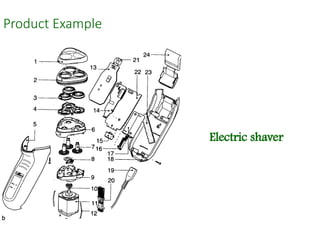
Product Example
Electric shaver
Taiz
University
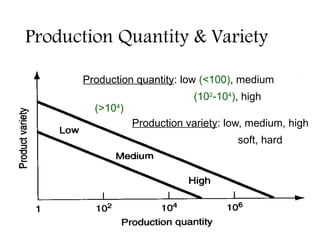
Production variety: low, medium, high
soft, hard
Production quantity: low (<100), medium
(102
-104
), high
(>104
)
Production Quantity & Variety
Taiz
University
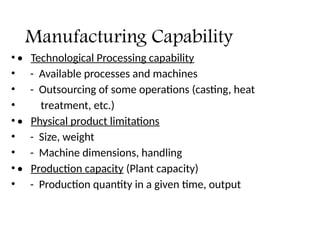
Manufacturing Capability
• • Technological Processing capability
• - Available processes and machines
• - Outsourcing of some operations (casting, heat
• treatment, etc.)
• • Physical product limitations
• - Size, weight
• - Machine dimensions, handling
• • Production capacity (Plant capacity)
• - Production quantity in a given time, output
Taiz
University
Materials in Manufacturing
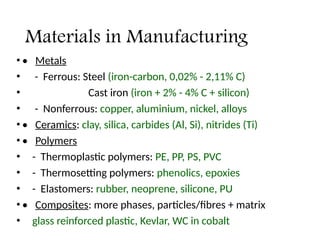
• • Metals
• - Ferrous: Steel (iron-carbon, 0,02% - 2,11% C)
• Cast iron (iron + 2% - 4% C + silicon)
• - Nonferrous: copper, aluminium, nickel, alloys
• • Ceramics: clay, silica, carbides (Al, Si), nitrides (Ti)
• • Polymers
• - Thermoplastic polymers: PE, PP, PS, PVC
• - Thermosetting polymers: phenolics, epoxies
• - Elastomers: rubber, neoprene, silicone, PU
• • Composites: more phases, particles/fibres + matrix
• glass reinforced plastic, Kevlar, WC in cobalt
Taiz
University
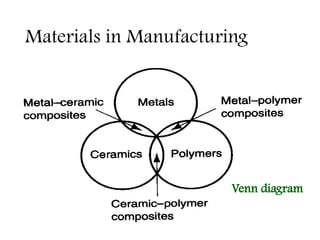
Venn diagram
Materials in Manufacturing
Taiz
University
Master Engineering & Management
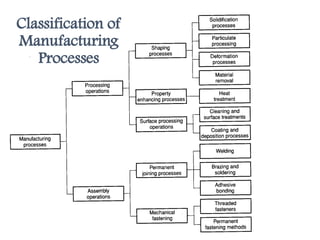
Manufacturing processes
Classification of
Manufacturing
Processes
Taiz
University
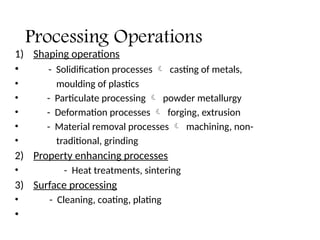
Processing Operations
1) Shaping operations
• - Solidification processes  casting of metals,
• moulding of plastics
• - Particulate processing  powder metallurgy
• - Deformation processes  forging, extrusion
• - Material removal processes  machining, non-
• traditional, grinding
2) Property enhancing processes
• - Heat treatments, sintering
3) Surface processing
• - Cleaning, coating, plating
•
Taiz
University
Manufacturing Processes
• 1) Processing operations
2) Assembly operations
• - Permanent joining: welding, brazing, adhesives
• - Mechanical assembly: bolts, screws, rivets, etc.
3) Production machines and tooling
• - Machine tools: lathe, milling machine, etc.
• - Presses, forge hammers, rolling mills
• - Welding machines and equipment
• - General and special purpose equipment
• - Tooling
Taiz
University
Production Systems
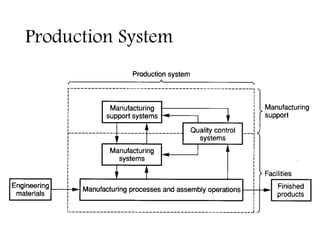
• • Consist of people, equipment and procedures
• • Production facilities: factory, production equipment
• material handling equipment
•  Plant layout + Manufacturing systems
•  Influence of production quantity (low, medium,
• high)
• • Manufacturing support systems
• - Manufacturing engineering  process planning
• - Production planning and control  logistics,
• ordering materials and parts, scheduling
• - Quality control
Taiz
University
Influence of Production Quantity
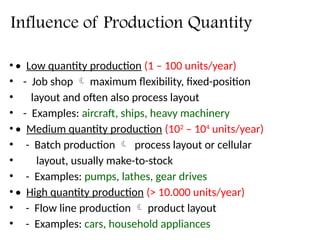
• • Low quantity production (1 – 100 units/year)
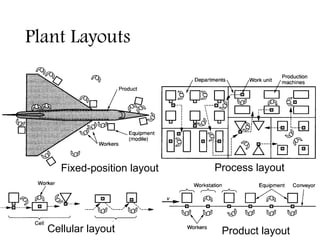
• - Job shop  maximum flexibility, fixed-position
• layout and often also process layout
• - Examples: aircraft, ships, heavy machinery
• • Medium quantity production (102
– 104
units/year)
• - Batch production  process layout or cellular
• layout, usually make-to-stock
• - Examples: pumps, lathes, gear drives
• • High quantity production (> 10.000 units/year)
• - Flow line production  product layout
• - Examples: cars, household appliances
Taiz
University
Master Engineering & Management
Plant Layouts
Fixed-position layout Process layout
Cellular layout Product layout
Taiz
University
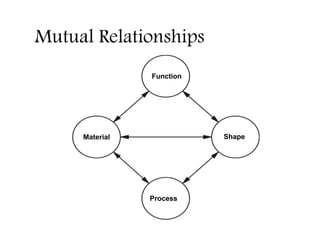
Function
Shape
Process
Material
Mutual Relationships
Taiz
University
Product Attributes
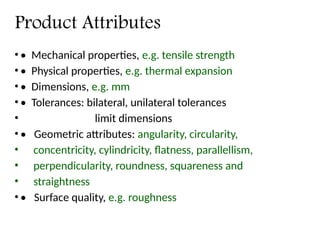
• • Mechanical properties, e.g. tensile strength
• • Physical properties, e.g. thermal expansion
• • Dimensions, e.g. mm
• • Tolerances: bilateral, unilateral tolerances
• limit dimensions
• • Geometric attributes: angularity, circularity,
• concentricity, cylindricity, flatness, parallellism,
• perpendicularity, roundness, squareness and
• straightness
• • Surface quality, e.g. roughness
Taiz
University
Manufacturing Process Selection
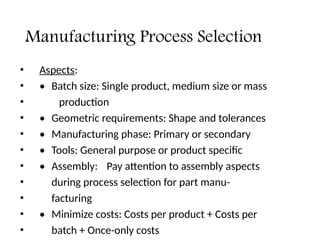
• Aspects:
• • Batch size: Single product, medium size or mass
• production
• • Geometric requirements: Shape and tolerances
• • Manufacturing phase: Primary or secondary
• • Tools: General purpose or product specific
• • Assembly: Pay attention to assembly aspects
• during process selection for part manu-
• facturing
• • Minimize costs: Costs per product + Costs per
• batch + Once-only costs
Taiz
University
Production System
Taiz
University
Interfaces with Other Courses
• • Product design: Selection of the product material
• and the manufacturing process is related to the
• product shape and product function.
• • Production systems: Selection of a manufacturing
• process is related to the optimum batch size and
• has consequences for the plant layout.
• • Management and cost accounting: If more manu-
• facturing scenarios are possible, the final choice
• will be made based on minimum costs.
• • Total Quality Management: All decisions related to
• manufacturing are dealing with quality aspects.