A critical evaluation of the financial incentives available for the
sustainable redevelopment of brownfield sites and the legislation and
policy that governs such development
by
Glynnis L. K. Poole
Dissertation presented for the Degree of
MRes in Contaminated Land Management
Land Quality Management Group
School of Geography
University of Nottingham
2007
Approximate number of words 25,500
I am aware of the University’s policy on plagiarism and I confirm that the
work presented in this dissertation is entirely my own.
Signed.............………..... Date..............
Acknowledgments
I would like to thank my employer Midas Homes Ltd for their continuing support
throughout the last 12 months without which I would not have been able to
complete the course.
Thanks you also to my tutor Paul Nathanail for his guidance throughout the last 2
years and without which I would not be the hopeful contaminated land
professional I have become.
Lastly huge thanks must go to my colleagues on the MRes 2005 cohort who have
been ‘rocks’ through difficult and stressful times. I have had the pleasure of
making some very good friends who I have no doubt will remain good friends in
the future.
And it goes without saying that my family, friends, long-suffering partner, 2 cats
and a dog have made a massive difference and provided the much needed
support away from work and university.
ABSTRACT
This thesis aims critically evaluate whether the overall effect of government policy
is to encourage or hinder sustainable brownfield redevelopment in Cornwall. It
includes an examination of the views and attitudes of the residential development
industry in the South West of England’s towards brownfield development in
Cornwall
The research consisted of a two-stage process involving:
• Literature review of sustainable and brownfield policy, legislation and
financial incentives
• A survey of residential developers with an office base within South West
England carried out in mid-2007
The literature review indicates that brownfield development is encouraged
through legislation and policy at a national, regional and Cornwall level. The
provision of financial incentives encourages brownfield development although the
results of the survey indicate that they are not frequently used and knowledge of
them is limited. There does however, seem to be a lack of encouragement for
sustainable brownfield development.
The results suggest that the housebuilding industry in the South West of England
is routinely developing brownfield sites and there does not appear to be any
specific barriers to brownfield development in Cornwall. The results suggest that
the implications of national policies such PPS 3 for Housing are now being
implemented at a local level and due to the use of the residual land valuation
process are having an impact on land values.
The survey was based on a sample which represents 13% of annual house
building completions in the South West of England and the responses were
provided by a range of company sizes. Non-response was an issue and further
research is required to obtain a truly representative view on this subject from the
house building industry.
The research suggests that Government policy needs to reinforce the concepts of
sustainability in brownfield development. It also recommends that a set of
sustainability indicators/criteria should be provided for the allocation of funding to
focus support towards sustainable brownfield redevelopment
i
TABLE OF CONTENTS
Acknowledgements
Abstract
Table of Contents (i)
List of Figures (iv)
List of Tables (v)
Glossary of Terms (vii)
1 Chapter 1 Introduction
1.1 Introduction and Background to this Research……………………………… 1
1.2 Aim of the Project…………………………………………………………………………… 2
1.3 Objectives………………………………………………………………………………………… 3
1.4 Research Methodology……………………………………………………………………… 3
1.5 Report Structure………………………………………………………………………………. 4
2 Chapter 2 The Development of Sustainable Brownfield Development
2.1 Housing Development and the Growth of the Planning System pre-
1940s……………………………………………………………………………………………….. 6
2.2 Housing and the Development of the Planning System post-1940s. 7
2.3 Defining sustainable brownfield development………………………………… 11
2.3.1 Definition of ‘Brownfield’ Land……………………………………………….. 11
2.3.2 Definition and Growth of the term sustainable’…………………….. 13
2.3.3 Definition of ‘Sustainable Brownfield Development’……………… 15
2.4 The Quantity and Use of Previously Developed Land in the UK……. 16
2.5 Sustainable brownfield development in Cornwall…………………………… 18
2.5.1 National Land Use Database Statistics and Cornwall……………. 23
3 Chapter 3 Review of the Legislation, Policy and Guidance controlling Brownfield
Development
3.1 Introduction……………………………………………………………………………………… 27
3.2 National Documents………………………………………………………………………… 28
3.2.1 The Role of Planning………………………………………………………………. 28
3.2.2 Building Act, 1984 and Building Regulations………………………… 43
3.2.3 Waste Management Legislation, Policy and Guidance………….. 44
3.2.4 Pollution Control/Remediation Permits and Technical
Guidance……………………………………………………………………….. 46
3.3 Regional Documents……………………………………………………………………….. 47
ii
3.3.1 Regional Planning Guidance…………………………………………………… 47
3.3.2 Regional Spatial Strategy for the South West……………………… 48
3.4 Cornwall Documents………………………………………………………………………. 50
3.4.1 Cornwall Structure Plan, 2004……………………………………………… 50
3.4.2 Local Development Documents……………………………………………. 52
4 Chapter 4 Review of the Financial Incentives and Provisions available for
Sustainable Brownfield Development in Cornwall
4.1 European Structural and Cohesion Funds……………………………………… 55
4.2 Finance Act, 1996 & 2001 and the Urban White Paper, 2000……… 61
4.2.1 Landfill Tax Exemption…………………………………………………………. 61
4.2.2 Land Remediation Tax Relief……………………………………………….. 62
4.2.3 Stamp Duty Exempt Areas…………………………………………………… 63
4.3 State Aid………………………………………………………………………………………… 64
4.4 Investments Frameworks for Regeneration…………………………………… 65
4.4.1 Public Private Partnerships………………………………………….………… 65
4.4.2 Joint Ventures………………………………………………………………………… 66
4.4.3 English Cities Fund…………………………………………………………………. 66
4.4.4 Urban Regeneration Companies……………………………………………. 67
5 Chapter 5 Data Collection
5.1 Introduction……………………………………………………………………………………. 68
5.2 Methodology…………………………………………………………………………………… 68
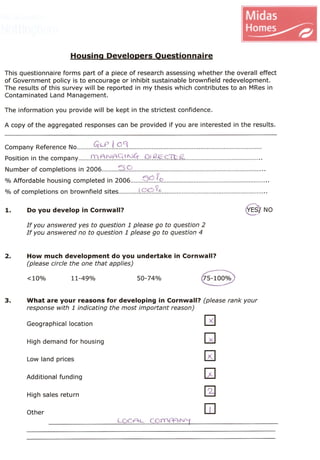
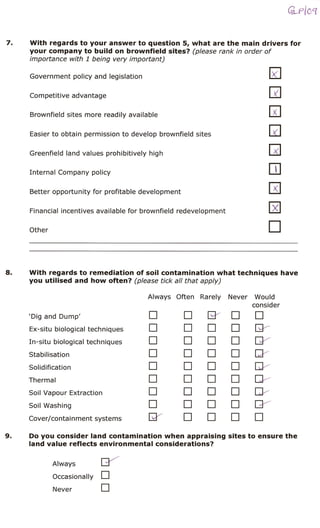
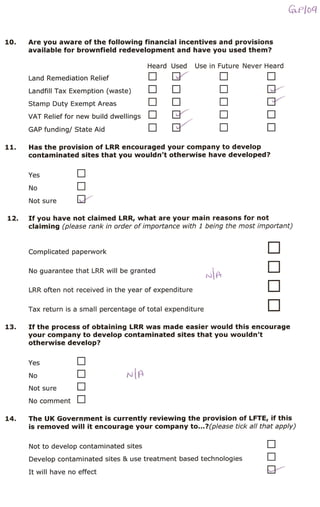
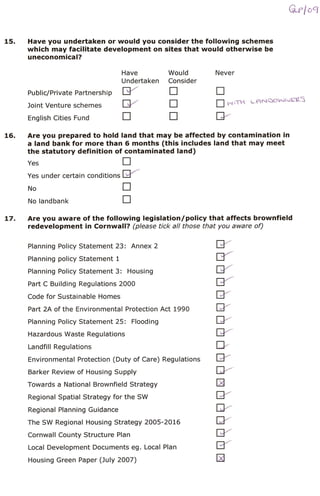
5.3 Housing Developers Questionnaire………………………………………………… 70
6 Chapter 6 Analysis of Survey Data
6.1 Introduction……………………………………………………………………………………. 78
6.2 Survey Response Rate…………………………………………………………………… 78
6.3 Detailed Analysis of Questions……………………………………………………… 79
7 Chapter 7 Discussion of Survey Results
7.1 Introduction…………………………………………………………………………………… 89
7.2 Does the legislation and policy promote sustainable brownfield
development?................................................................... 89
7.3 Does the provision of financial incentives and provisions promote
sustainable brownfield development?.................................... 92
iii
8 Chapter 8 Conclusions
8.1 Limitations of Research…………………………………………………………………… 97
8.2 Conclusions of Research…………………………………………………………………. 98
8.3 Further Research……………………………………………………………………………. 101
8.4 Recommendations…………………………………………………………………………… 101
References
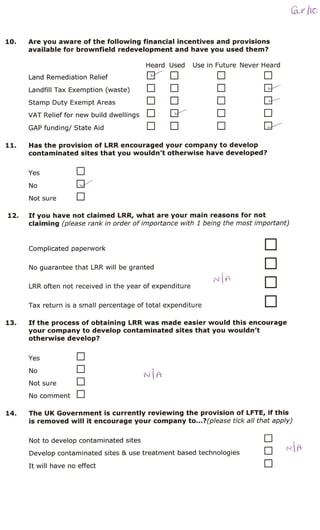
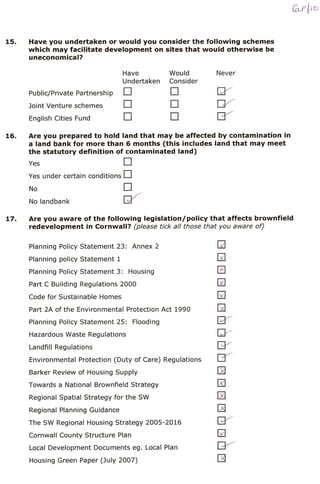
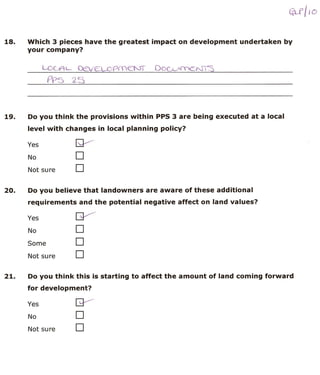
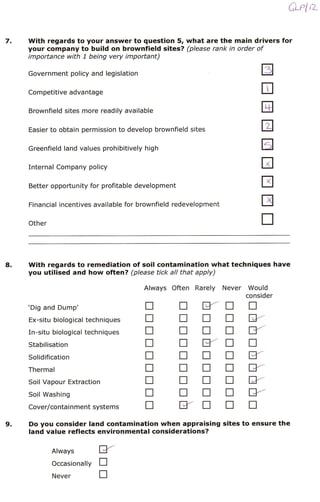
Appendix 1 Example of the Questionnaire
Appendix 2 Questionnaire Results
iv
LIST OF FIGURES
Figure 1: Number and Composition of Households: England: 1971-2016 (ODPM, 2003)
Figure 2: The Dimensions of Sustainability (RESCUE, 2005b)
Figure 3: Brownfield Regeneration: Bath Model (Cabernet, 2007)
Figure 4: Proportion of new dwellings on previously developed land (DCLG, 2007)
Figure 5: Map indicating the location of Cornwall in the South West region and the extent
of operations of the SWRDA (SWRDA, 2007a)
Figure 6: Map indicating the Local District Authority areas in Cornwall (GOSW, 2007)
Figure 7: The Nature Map for Cornwall indicating types and location of habitats
(SWENVO, 2007)
Figure 8: House building in Cornwall between 1976-2006 (Cornwall County Council, 2006)
Figure 9: Spatial distribution of previously developed land in the SW England (English
Partnerships, 2004)
Figure 10: Previously Developed Land by Type for England 2006 (DCLG, 2007d)
Figure 11: Previously Developed Land by Type in Cornwall 2005 (summarised from NLUD,
2005)
Figure 12: Previously developed land by type for each Local Authority area in Cornwall in
2005 (summarised from NLUD, 2005)
Figure 13: Illustrative map of institutional congestion in the control of sustainable
brownfield development (adapted from Catney et al, 2006)
Figure 14: Case Study Example of the Costs of providing Affordable Housing
Figure 15: The Five inter-linking aims of the Draft RSS (RSS, 2006)
Figure 16: Relationship between remediation costs and end-use value at economically
viable, marginally viable and non-viable brownfield sites (Nathanail et al, 2005)
Figure 17: Indicates the Funding Status of Regions within the UK between 2000-2006 and
2007-2013
Figure 18: UK Vision for Structural Funds Spending (DTI, 2006)
Figure 19: Respondents preference for land type
Figure 20: Respondents knowledge of financial incentives and provision available for
brownfield development (given as a percentage of the total number of respondents)
Figure 21: Response to whether the provision of Land Remediation Relief has encouraged
the responding company to develop contaminated sites
Figure 22: Respondents reaction if Landfill Tax Exemption was removed
Figure 23: Summary of legislation and policy currently having a significant impact on
development as provided by survey respondents
Figure 24: Respondents views on whether additional legislative requirements will impact
on future land availability (given as a percentage of the total)
v
LIST OF TABLES
Table 1: Regional targets for housing on Previously Developed Land
Table 2: Indicating the increase in the average house price between 1996-2006 (HBOS,
2006)
Table 3: Summary of key policy changes in The Planning and Compulsory Purchase Act,
2004 and their relevance to sustainable brownfield development
Table 4: List of Planning Policy Statements/Planning Policy Guidance notes and their
relevance to sustainable brownfield development
Table 5: Key Policies and objectives of PPS3 and their relevance to Sustainable
Brownfield Development (SBD) (summarised from PPS 3:2006)
Table 6: Summarised parts of Building Regulations relating to sustainable brownfield
development
Table 7: List of Waste Management legislation and policy and the impact on sustainable
brownfield redevelopment in England
Table 8: CCC Structure Plan policies and their relevance to sustainable brownfield
development
Table 9: % Affordable Housing Provision per development
Table 10: European Funding Programmes applicable in Cornwall 2007-2013
Table 11: Summary of Territorial Cooperation Programme and their Funding Institutions
(SWRDA, 2007b)
Table 12: Cornwall wards identified as Disadvantaged Areas and therefore exempt from
Stamp Duty (Table G, The Stamp Duty (Disadvantaged Areas) Regulations 2001)
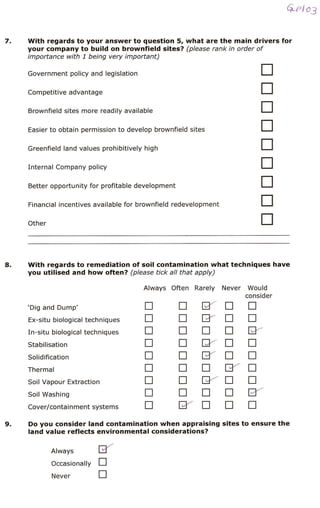
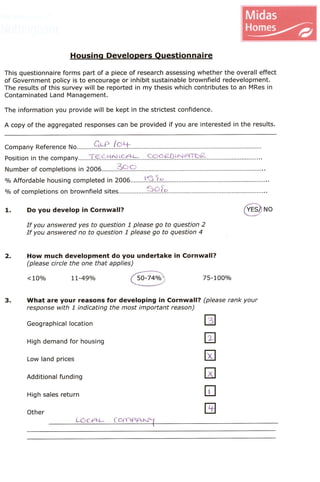
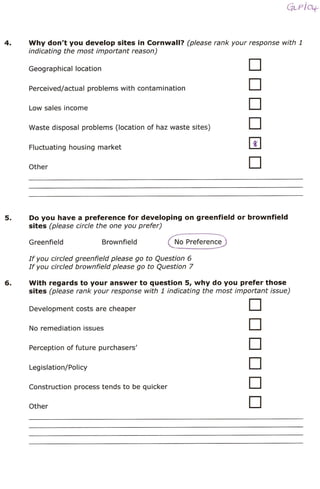
Table 12: Questions 1-2 Taken from Housing Developer Questionnaire
Table 13: Questions 3-4 Taken from Housing Developer Questionnaire
Table 14: Question 5 Taken from Housing Developer Questionnaire
Table 15: Questions 6-7 Taken from Housing Developer Questionnaire
Table 16: Question 8 Taken from Housing Developer Questionnaire
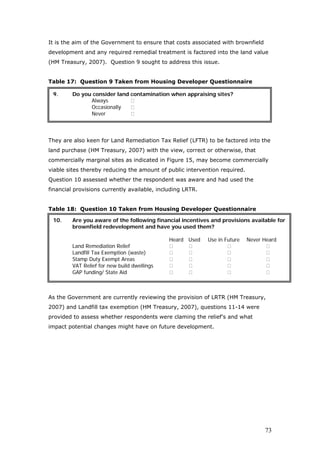
Table 17: Question 9 Taken from Housing Developer Questionnaire
Table 18: Question 10 Taken from Housing Developer Questionnaire
Table 19: Questions 11-13 Taken from Housing Developer Questionnaire
Table 20: Question 14 Taken from Housing Developer Questionnaire
Table 21: Question 15 Taken from Housing Developer Questionnaire
Table 22: Questions 16-17 Taken from Housing Developer Questionnaire
Table 23: Questions 18-20 Taken from Housing Developer Questionnaire
Table 24: Summaries of the responding companies and their annual output
Table 25: Respondents preference for Remediation Technique (given as a percentage of
the total number of respondents)
vi
Table 26: Indicates the type and scale of partnership development undertaken by
respondents (given as a percentage of the total response)
Table 27: Indicates respondents awareness of legislation and policy affecting brownfield
development
vii
GLOSSARY OF TERMS
Affordable Housing
This includes social rented and intermediate housing, provided to specified eligible
households whose needs are not met by the market.
CABERNET Concerted Action on Brownfield and Economic Regeneration Network Aim is to
enhance the rehabilitation of brownfield sites within the context of sustainable
development by sharing experiences across Europe
CCC Cornwall County Council
CLARINET Contaminated Land Rehabilitation Network for Environmental Technologies in
Europe
Primary objective is to develop technical recommendations for sound decision making
concerning the rehabilitation of contaminated sites in Europe
DCLG Department of Communities and Local Government
Government department with the vision of prosperous and cohesive communities, offering
a safe, healthy and sustainable environment for all
DEFRA Department of the Environment, Food and Rural Affairs
Government department with the vision of improving the current and future quality of life
GOSW Government Office for the South West
Represent the work and interests of national Government departments within the South
West region of England
The Housing Corporation
The Government Agency who fund and regulate Registered Social Landlords (including
housing associations) in England
Non-Speculative Housing
See definition of affordable housing
Redevelopment
The physical process of developing a site that has had a previous use
viii
Regeneration
The process of renewing or reinvigorating a site or area
Regeneration of European Sites in Cities and Urban Environments (RESCUE)
European 3 year research project with the intention to improve the quality of derelict land
recycling in terms of sustainability of the build environment and the quality of urban life
Registered Social Landlord
Independent housing organisations that are registered with the Housing Corporation
under the Housing Act, 1996
SWRDA South West Regional Development Agency
Objective is to increase sustainable prosperity and productivity for the South West region
of England
Speculative Housing
Private housing for sale or rent where the price is set in the open market
Volume House Builder
A development company that constructs greater than 200 units per annum
CHAPTER 1 INTRODUCTION
1.1 Introduction and Background to this Research
This research has been developed due to a personal and professional interest in
sustainable brownfield redevelopment. It is a current issue for the following
reasons:
• Growth of the Government’s sustainable development and environment
agenda particularly in relation to climate change which in 2004 was
announced as the worlds greatest environmental challenge by the Prime
Minister (Blair, 2004),
• Proposed reform of the planning system following the Barker Review of
Housing Supply (Barker, 2004) and the Barker Review of Land Use
Planning (Barker, 2006),
• Merger of English Partnerships and the Housing Corporation into
‘Communities England’ to reform the delivery of regeneration and housing
programmes,
• An increase in housing supply targets proposed by the Government,
• Review of the current tax incentive system available for contaminated land
remediation (HM Treasury, 2007).
Dixon et al, 2006 reviewed the UK development industry’s role in brownfield
redevelopment. The research upon which this thesis is based has also included a
survey of housebuilders but is specifically targeted at sustainable brownfield
development in Cornwall. It evaluates current legislation and policy controlling
this type of development and evaluates the financial incentives and provisions
available for brownfield development in Cornwall and assesses whether they
promote principles of sustainable development. Similar research into financial
incentives and provisions available for brownfield development has been
undertaken by Ulster University in 2006 (DCLG, 2006b).
Cornwall is located in the peninsula of south west England and as a consequence
is geographically isolated. It is one of the poorest regions within the UK with a
large proportion of district and wards listed on the Index of Multiple Deprivation
(DETR, 2000a). Cornwall has historically had a narrow economic base and the
strength of the economy of the County has declined with the closure of the tin
mining industry and the loss of traditional industries. Within recent years the
1
County has relied heavily on the tourism and leisure industry with the growth of
attractions such as the Eden Project, National Maritime Museum and Tate St Ives
and exploiting the attractive coastline.
Based on the 2005 Value of Tourism (Cornwall Tourist Board, 2005), an average
of 21% of the total numbers employed in the County were employed in tourism
related industry compared with 13% in Devon. The seasonal nature of this
industry has resulted in seasonal employment problems and the low wages
generated by this type of employment has resulted in low household incomes. It
also has the potential to cause environmental problems such as traffic congestion
and requires a large proportion of holiday accommodation and second home
ownership (80% in some Cornish communities, Cornwall County Council 2006).
Although Kerrier is no longer included as one of the top 50 most deprived Local
Authorities in the Index of Multiple Deprivation (ODPM, 2004h) the patterns of
multiple deprivation are still prevalent in the former tin mining areas such as
Penwith, Cornwall (ODPM, 2004h). House prices have continued to rise with the
UK annual house price inflation in June 2007 at 12.1% (DCLG, 2007b) and these
rises have also been seen in Cornwall where the average house price has
increased by 9.5% annual average 2007 to £207,754 (Land Registry, 2007).
These issues have combined to create a population with increased requirements
for affordable housing in an area where increasing house prices are increasing the
value of developable sites.
This research considers current policy and will review sustainable brownfield
development of residential housing and mixed use communities – it does not
therefore consider development with a commercial or industrial land use.
1.2 Aim of the Project
Government policies both hinder and encourage brownfield redevelopment and
sustainable development. The aim of this thesis is to critically evaluate whether
the overall effect of government policy is to encourage or hinder sustainable
brownfield redevelopment in Cornwall.
2
1.3 Objectives
a) To define the concepts of ‘brownfield’, ‘sustainable’ and sustainable
brownfield redevelopment’ in ways that can be measured (if only
qualitatively)
b) To complete a review of the financial incentives and provisions
currently available in England and specifically Cornwall, evaluate
whether they encourage or hinder sustainable brownfield
redevelopment and consider their effect at an individual project level
c) To complete a review and evaluation of the current legislation, policy
and technical guidance for England, south-west region and Cornwall
responsible for regulating sustainable brownfield development
d) To review the current level of brownfield development in Cornwall
e) To survey housing development companies who have developed within
south west England to assess the level of brownfield development, the
amount and reasons for developing or not developing in Cornwall, the
use of financial provisions and the knowledge and understanding of the
regulating legislation
f) To provide recommendations for housing policy in Cornwall and the
provision of financial incentives for sustainable brownfield development
1.4 Research Methodology
The following methodology has been proposed to achieve the aim and objectives
detailed in section 1.3.
a. Review the history of housing development, planning policy system and
growth of brownfield development utilising internet websites and research
papers.
b. Undertake a review internet websites such as;
Department of Communities and Local Government,
Department for Business, Enterprise and Regulatory Reform,
3
Department for Environment, Food and Rural Affairs,
HM Treasury,
Office for National Statistics,
HM Revenue and Customs,
European Union,
Environmental Agency,
South west Regional Development Agency,
Government Office for the South west,
Cornwall County Council,
Local District Councils in Cornwall,
English Partnerships.
c. Undertake a review of research papers into the concepts of sustainability,
brownfield and sustainable brownfield development.
d. Undertake a review of research papers into survey and questionnaire
design and implementation to assess the most appropriate type for this
thesis.
e. Design a questionnaire based on the findings of part c above, to assess
the knowledge, understanding and use of financial incentives and
legislative controls by the housing development industry.
f. Provide graphical and tabular summaries of the responses to the
questionnaire using computer packages such as Microsoft Excel.
1.5 Report Structure
This Chapter has provided an introduction into the background of this thesis and
the aim and objectives hoped to be achieved by undertaking this research.
Chapter 2 provides a background to the development of planning policy pre and
post-1940s. It proposes definitions for sustainable brownfield development and
assesses the quantity and use of brownfield sites in the UK and Cornwall.
Chapter 3 is a literature review of the legislation, policy and guidance currently
controlling sustainable brownfield development in England with specific reference
to Cornwall. This only refers to the development of housing and mixed
4
communities. It includes an evaluation of the key planning policy documents and
assesses whether they are relevant and promote to sustainable brownfield
development in Cornwall.
Chapter 4 is a literature review of the financial incentives and provisions available
to support sustainable brownfield development in England with specific reference
to Cornwall. It includes an evaluation of these frameworks and whether they
support sustainable brownfield development in Cornwall.
Chapter 5 details the methodology used to design the questionnaire and survey
housing development companies in south west England. It reviews the theory of
questionnaire surveys and details the reasoning behind each question.
Chapter 6 comprises of an analysis of the data collected during the survey. It
assesses the response rate and provides graphical and tabular summaries of the
responses to each of the questions.
Chapter 7 is a discussion of the results this thesis and compares the results to
previous research and discusses the impact of the responses in light of the
literature reviews contained in chapters 3 and 4.
Chapter 8 provides conclusions to the research, including limitations and
problems associated with the questionnaire design and implementation. It also
provides suggestions for further and extended research.
5
CHAPTER 2 THE DEVELOPMENT OF SUSTAINABLE BROWNFIELD
DEVELOPMENT
2.1 Housing Development and the Growth of the Planning System
Pre-1940s
Urban renewal, redevelopment and regeneration have been occurring for several
hundred years in one form or another but have historically lacked forward and
strategic planning and control. As Booth, 1999 recognises that with regards to
development and redevelopment there was no “proper administration of public
control except in the aftermath of the Great Fire of London” (Booth, 1999).
Indeed public control over development was not apparent until the 1774 London
Building Act which included the “use of dimensional constructional standards”
(Booth, 1999) or specific building standards.
It was the legislation that followed the Great Fire that informed the development
of The London Building Act, 1774 and the Metropolitan Building Act, 1844. Until
1844 control of building and implementation of the previous Acts would appear to
have been left largely to the private sector. As Booth, 1999 explains it was the
“1848 and 1858 Public Health Acts which enabled Local Authorities to make by-
laws to control the construction of new housing” (Booth, 1999) resulting in the
public control of building.
Britain was a wealthy nation and part of the modern industrial age. It was during
this time the economy was strong and as Matthews et al, 1982 note “the
highwater mark of Britain’s industrial prosperity was in the boom of 1872-73”
(Matthews et al, 1982). Housing construction continued although it would appear
that the “preoccupation of the late Victorian period had been the provision of a
sufficient quantity of good quality, cheap housing for the working classes” (Booth,
1999). It was during this Victorian period that the concept of ‘unfit for human
habitation’ was developed and as Yelling, 2000 suggests the “origins of slum
clearance in Britain lie in the Victorian period” (Yelling, 2000).
The first specific planning legislation was contained within The Housing, Town
Planning etc. Act, 1909 which “allowed (although did not require) Local
Authorities to prepare plans for undeveloped land or land in the course of
development” (Booth, 1999). However the preparation of these plans was not a
6
quick process and as a consequence a housing shortage began to manifest
throughout the early 1900s.
The JCLPW, 1917 suggested that the shortage was due to a number of reasons
including,
• The Country’s housing was already overcrowded after the war. “The 1901
census indicated that 2,667,506 people in England and Wales were living
more than 2 to a room” (JCLPW, 1917).
• The speculative house builder had ceased building working class homes
therefore “affordable housing decreased” (JCLPW, 1917).
• “During the 3 years of war all building ceased – in fact it was prohibited”
(JCLPW, 1917).
Few schemes were authorised during the first world war although there was an
“increasing concern at the number of new houses needed to be built after the
war…needs of returning servicemen and their families…remedy the appalling
housing legacy of uncontrolled growth” (Crow, 1996). The Town and Country
Planning Act, 1932 extended the 1909 plan-making provisions to all parts of local
authority areas, built or unbuilt in an attempt to increase the level of controlled
development.
However, development throughout the 1930s led to “widespread concern about
loss of countryside and urban sprawl” (Crow, 1996) which also coincided with the
first national slum clearance campaigns. Following the outbreak of war in 1939
the “pre-war loss of agricultural land” (Crow, 1996) began to be regretted.
2.2 Housing and the Development of the Planning System Post-1940s
The foundations of post-war planning were laid down in the Town and Country
Planning Acts of 1943, 1944 and 1947 (Cullingworth, 1962). These Acts created
statutory development plans thereby controlling development by reference to a
land use plan and also created the requirement to apply for planning permission.
The political control within the Government interchanged between Labour and the
Conservatives through the post-war years. Following the end of WWII a Labour
government took control and were responsible for the early policies which
instigated regeneration following the destruction of the war. Decisions regarding
social reform and the production of the Beveridge Report in 1942 were the early
7
beginnings of regeneration with the provision of social security, a National Health
Service and a full employment policy. Housing was a significant issue especially
for the voting public due to the destruction of homes during the war and it
therefore became one of the campaign issues for the Labour party during the
1945 election. The New Towns Act, 1947 and The Town and Country Planning
Act, 1947 were introduced by the Labour Government as part of the housing and
regeneration campaign.
The economic situation was remarkably strong considering the aftermath of World
War II. During the immediate aftermath “the steady closure over 1946 and
1947 of the huge wartime deficit, producing a few years of surplus as government
expenditure was reined in by demobilisation” (Clark and Dilnot, 2002).
The growth of the planning system coincided with the renewed slum clearances
that had been stopped during the war years. These slum clearances continued
vigorously through the 1950s and 1960s, however “the balance between
demolitions and public sector building had dangerously narrowed” (Yelling, 2000)
and the “higher levels of public sector housing expected in the mid-1960s….could
not be achieved” (Yelling, 2000). Yelling, 1999 believes that the revival of the
large-scale slum clearance from 1955 was the “most important public intervention
in British cities” (Yelling, 1999).
Through the 1960s and 1970s areas were re-built with cost-effective housing
often including inner city tower blocks and suburban development lacking
infrastructure. Unfortunately this contributed to the creation of social problems
and urban decay such as those seen in the Gorbals estate in Glasgow. This
resulted in the launch of the Urban Aid programme under the Labour Government
in the 1970s. This was followed by The Community Development and Urban
Programmes to fund social regeneration. It was during the 1970s that demolition
was curtailed and Housing Action Areas created in 1974 to take over from slum
clearance areas.
Regeneration policy continued to evolve with the introduction of Urban
Development Corporations and Enterprise Zones by the Conservative Government
of the 1980s. They were intended to revive urban markets and promote urban
renewal through commercial/industrial activity, creation of attractive
environments and provide adequate housing and social facilities. The 1970s and
early 1980s involved periods of significant private housing development and were
8
“accompanied by government encouragement of grant-aided improvement”
(Yelling, 2000).
All regeneration funding programmes were subsequently merged into the Single
Regeneration Budget (SRB) in the early 1990s. The aim of the SRB Programme
was to improve the quality of life for communities in disadvantaged areas and
was the first programme to promote sustainable regeneration.
The political ambition of the labour government since 1997 has been to provide a
strong economy by reducing unemployment and building sustainable
communities. They have driven society towards home ownership and the
provision of ‘homes for all’ through affordable and low-cost housing. To facilitate
this ambition they have introduced over the last 10 years, Regional Development
Agencies, Urban Regeneration Companies and Regional Housing Boards.
In 1999 the Urban Task Force, created by the Government, published their
Mission Statement:
‘The Urban Task Force will identify causes of urban decline in England and
recommend practical solutions to bring people back into our cities, towns and
urban neighbourhoods. It will establish a new vision for urban regeneration
founded on the principles of design excellence, social well-being an environmental
responsibility within a viable economic and legislative framework.’
(DETR Urban Taskforce, 1999c)
The report provided radical recommendations as to how provide homes whilst
creating a quality of life to make towns and cities desirable. This agenda-setting
report was independently revised in 2005 with the publication of Towards a
Strong Urban Renaissance (DETR, 2005). Lord Rogers believed the revision was
required as the Government had overlooked several key recommendations within
the Urban White Paper Our Towns and Cities (ODPM, 2000) and that focusing on
sustainable communities had weakened the stance on urban regeneration.
Publication of the Sustainable Communities Plan (ODPM, 2003) signalled further
evolution of urban policy. This has been followed by the Barker Reviews of
Housing Supply, Delivering Stability: Securing Our Future Housing Needs (Barker,
2004) and Land Use Planning (Barker, 2006).
9
Following these reports the 2005 pre-budget report by the Chancellor set out an
ambition to increase housing supply by 200,000 net additional homes per year by
2016. This target was revised in July 2007 to 240,000 net additions by 2016 with
the aim of delivering 2 million new homes by 2016 and 3 million by 2020 (Brown,
2007).
The requirement for additional housing supply is due to the projected increase of
households from 21.1 million in 2004 to 26.0 million in 2026 and to reach 26.5
million in 2029 (DCLGc, 2007). As figure 1 demonstrates the increasing number
of households is predominantly as a result of the increasing number of single
person households which will affect the type of development and property type
required.
Figure 1: Number and Composition of Households: England: 1971-2016
(ODPM, 2003)
An important issue to consider is the number of empty properties available which
could be utilised to minimise the requirement for new development. DLCG
suggest that in England there are 680,412 empty properties with 585,539 owned
by the private sector (DCLG, 2005a) which could be occupied. Since 2006 local
authorities have been able to issue Empty Dwelling Management Orders (DCLG,
2007) which allows them to manage the property. No statistics are currently
available to assess whether this policy has been applied or successful in reducing
the number of empty properties.
10
Redevelopment and wider regeneration processes are inevitable and reflect the
changing needs and requirements of society and the creation of brownfield sites
is a product of this change.
2.3 Defining Sustainable Brownfield Development
2.3.1 Definition of ‘Brownfield’ Land
It is crucial to define the term ‘brownfield’ as the interpretation is often
dependant on the users’ role in society and there currently remains no agreed
common European definition.
Alker et al, 2000 discussed the growing need for a robust and accepted definition
of ‘brownfield’ and noted that the term ‘brownland’ had been used in the UK since
the early 1990s by a group of landowners with sites requiring some form of
clean-up. Various organisations and individuals have provided their definitions of
‘brownfield’ with each skewed by the perspective of the group or individual.
Alker et al (2000) proposed the following definition for brownfield sites:
‘any land or premises which has previously been used or developed and is not
currently fully in use, although it may be partially occupied or utilised. It may
also be vacant, derelict or contaminated. Therefore a brownfield site is not
necessarily available for immediate use without intervention.’ (Alker et al, 2000)
No formal or statutory definition of brownfield has been proposed in England
although a similar term that has political significance is ‘previously developed
land’ which was introduced by the Government in 1998 (ODPM, 1998). This
document also set the national target for PDL re-use at 60% (ODPM, 1998). The
term PDL is therefore used within policy in England and Wales and is effectively
the statutory equivalent of brownfield although the definition of PDL makes no
reference to ‘contamination’ or ‘potential contamination’.
PDL was defined in Planning Policy Guidance 3: Housing, and again in Planning
Policy Statement 3: Housing, 2006. This ‘previously developed land’ (PDL) is
further defined as ‘…land which is or was occupied by a permanent structure,
including the curtilage of the developed land and any associated fixed surface
infrastructure’ (DCLG, 2006d). There is no presumption in this definition that
11
land which is PDL is necessarily suitable for housing development or that the land
is contaminated.
The definition of PDL specifically states that it includes defence buildings, but
excludes:
• Land that is or has been occupied by agricultural or forestry buildings,
• Land that has been developed for minerals extraction or waste disposal
by landfill purposes where provision for restoration has been made
through development control procedures,
• Land in built-up areas such as parks, recreation grounds and allotments,
which, although it may feature paths, pavilions and other buildings, has
not previously been developed,
• Land that was previously developed but where the remains of the
permanent structure or fixed surface structures have blended into the
landscape in the process of time (to the extent that it can reasonably be
considered as part of the natural surroundings. (DCLG, 2006d)
It is important to consider what is not included in the definition of PDL when
considering the definition of greenfield. There is no formal definition of greenfield
land however, for development purposes in England this should be considered to
be any land not considered to be PDL (as defined in PPS 3). This will therefore be
used through this thesis although it should be noted that a number of sites
meeting the exclusion test of PDL will have other designations and may therefore
not be available for development such as the protection of allotments under the
Allotments Act, 1925.
CABERNET (Concerted Action on Economic and Brownfield Regeneration Network)
was established in 2002 and is an EC funded multi-stakeholder network created
to investigate, identify and raise the profile of brownfield issues across members
of the EC. The network has developed the earlier CLARINET definition for
brownfield sites which indicates that the term brownfield does not necessarily
indicate contaminated and it doesn’t contain bias towards the end-use. It should
also be noted that the interpretation of this definition also includes garden areas
of existing residential properties.
12
Brownfields are sites which;
Have been affected by former uses of the site or surrounding land,
Are derelict or underused,
Are mainly in full or partly developed urban areas,
Require intervention to bring them back to beneficial use,
May have real or perceived contamination problems.
(Cabernet, 2007a)
The US Environmental Protection Agency (EPA) has also provided a definition of
‘brownfield’ which was developed as a result of the inception of the US
Brownfields Programme in 1995.
The definition of brownfields is;
“With certain legal exclusions and additions, the term ‘brownfield site’ means real
property, the expansion, redevelopment or reuse of which may be complicated by
the presence or potential presence of a hazardous substance, pollutant or
contaminant.” (USEPA, 2002)
The USEPA definition of brownfield therefore specifically includes contamination.
There are therefore three distinct definitions proposed with varying inclusion of
contamination. For the purposes of this thesis it is proposed to use the
CABERNET definition of brownfield.
2.3.2 Definition and Growth of the Term ‘Sustainable’
The second term that requires defining is ‘sustainable’ or sustainability’ in specific
relation to development. The concept of sustainability is open to interpretation
but provides a statement of intent that the needs of the present will be met
without compromising future generations in meeting their needs. It is generally
agreed the there are three ‘pillars’ of sustainability are, Environment, Social and
Economy with RESCUE suggesting a fourth institutional dimension (RESCUE,
2005b). Figure 2 indicates the relationship between each dimension
13
Figure 2: The Dimensions of Sustainability (RESCUE, 2005b)
Differences in the interpretation of this definition originate from how each of the
four ‘pillars’ of sustainable development, Environment, Social, Economy and
institutional, are emphasised. Of the four pillars of sustainability the institutional
dimension is a significant driver for regeneration through the legislative
framework. Social and economic concerns drive regeneration through private
sector investment with the environmental element often left as a regulatory
control measure rather than a driver such as the Wildlife and Countryside Act,
1981, Groundwater Regulations, 1998 and Landfill Regulations, 2002.
With regards to sustainable development here is a level of international and
national agreement on a definition which is taken from the Brundtland Report Our
common Future (Brundtland Commission, 1987). This definition does raise
concern about balancing the needs of current and future generations when their
needs cannot be accurately predicted or assumed.
“development which meets the needs of the present without compromising the
ability of future generations to meet their own needs” (Brundtland Commission,
1987)
The Brundtland definition is accepted into UK policy through the 1999 UK
commitment in ‘A Better Quality of Life: a Strategy for Sustainable Development
in the UK’ (DETR, 1999a) which as well as using the Brundtland definition makes
14
it clear that sustainable development also means ‘a better quality of life for
everyone, now and for generations to come’ (DETR, 1999a).
It is recognised that sustainable regeneration is crucial to the continued success
of the UK as a major developed country whilst also ensuring we create a society
that we can pass on to our children and their children. The objective of re-using
PDL for protecting the countryside and encouraging urban regeneration was sited
in Quality of Life Counts (DETR, 1999b). This also measured the sustainability
indicators H14 New Homes built on PDL and K1 Proportion of Vacant Land and
Buildings and Derelict Land.
The reuse of previously developed sites became a core objective for the
achievement of sustainable communities through the Sustainable Communities:
Building for the Future (ODPM, 2003). However it is not simply the re-use of
these sites that contributes to the sustainability agenda it is also the methods of
reclamation, location of the site, infrastructure provision, methods of construction
and the proposed use that must be considered.
It is important to recognise the growing importance of the sustainability agenda
and its impact on brownfield redevelopment. However the question of how to
quantify and measure sustainable brownfield redevelopment is not assessed
within the scope of this research.
2.3.3 Definition of ‘Sustainable Brownfield Development’
A clear concise definition of sustainable brownfield development is difficult to
locate and there has been limited research to adequately define a term that is
used so frequently by a number of areas of society. A key definition has been
provided by RESCUE in their 2005 Best Practice Manual:
“Sustainable Brownfield Regeneration is the management, rehabilitation and
return to beneficial use of brownfields in such a manner as to ensure the
attainment and continued satisfaction of human needs for present and future
generations in environmentally sensitive, economically viable, institutionally
robust and socially acceptable ways within the particular regional context”
(RESCUE, 2005a).
15
Dixon et al (2006a) provide a similar definition and suggest that sustainable
brownfield regeneration is based upon the “principle of recycling land for
development in ways that are economically, environmentally and socially
sustainable” (Dixon et al, 2006a).
The RESCUE (2005a) definition of sustainable brownfield regeneration will be
adopted for the purposes this thesis although will be referred to as sustainable
brownfield development.
2.4 The Quantity and Use of Previously Developed Land in the UK
In 2006 there was an estimated 62,700 hectares of previously developed land
(PDL) compare with 63,500 hectares in 2005 (DCLG, 2007d). An estimated
34,900 hectares of this is vacant or derelict compared to 36,600 in 2005 (DCLG,
2007d).
UK government planning policy for housing is reflected in Planning Policy
Statement (PPS) 3 and dictates that at least 60% of new housing should be
provided on previously developed land (PDL) (DCLG, 2006d). This was further
reinforced by the Homes for the Future: more affordable, more sustainable
(DCLG, 2007) published for consultation by the Government.
Figure 3 indicates the Bath Model produced by CABERNET (2007b) and is
indicative of the cyclical system that involves the creation and regeneration of
brownfield sites. Within the Bath model there are the ‘sludge’ of persistent sites
at the bottom of the Bath which represent difficult sites to develop due to a
variety of reasons including location, contamination and local market conditions.
In accordance with the Cabernet definition of brownfield sites presented in section
2.3.1 intervention of some form is required to facilitate development of
brownfield sites. However it is likely that the intervention required for persistent
sites will involve the public sector.
16
Figure 3: Brownfield Regeneration: Bath Model (Cabernet, 2007b)
Figures 4 indicates the number of dwellings built on PDL in England since 1995
and demonstrates the increasing use of PDL for new housing in accordance with
Government policy Planning for the Communities of the Future (ODPM, 1998).
Figure 4 demonstrates that at least 60% of new dwellings have been constructed
on brownfield sites every year since 2000.
0
10
20
30
40
50
60
70
80
1995 1996 1997 1998 1999 2000 2001 2002 2003 2004 2005P 2006
%ofnewdwellingsbuiltonpreviouslydevelopedland
England
South West
Figure 4: Proportion of New Dwellings on Previously Developed
Land (DCLG, 2007)
17
Based on provisional estimates 77% of new dwellings in 2005 were provided on
previously developed land increasing from 56% in 1997. Figures 2 and 3
demonstrate that there is commitment to the use of PDL for housing
development, however it should be noted that included within this are
conversions and development within existing rear gardens which are often
suggested not to be PDL. There are currently no targets for non-residential
development on PDL.
The Governments proposal is that Local Planning Authorities should identify and
plan for the most appropriate land allocations, including housing through the
Local Development Framework process. This should reflect the local land
availability and support the 60% national target. The Regional Planning Guidance
for the Southwest (RPG10), 2001 identifies a commitment to achieving 50% of
new development on PDL (although this again includes conversions of existing
dwellings) significantly less than the national target reflecting regional availability
of PDL (GOSW, 2001). Table 1 indicates the proposed PDL targets for each of the
regions with variations between 50%-80% perhaps reflecting local availability but
also the date of the publication.
Table 1: Regional Targets for Housing on Previously Developed Land
Region Housing Target on Previously
Developed Land
Source
South West 50% GOSW, 2001
North East England 65% GONE, 2002
East England 50% GOE, 2000
North West England 80% NW Regional Assembly, 2006
East Midlands 60% GOEM, 2005
West Midlands 75% GOWM, 2004
South East England 60% GOESEL, 2001
2.5 Sustainable Brownfield Development in Cornwall
Cornwall is a County located in the south-west peninsula of England as indicated
in Figures 5 and 6. The governing political structure of the County consists of
Cornwall County Council overlying the 6 District Councils indicated on Figure 6.
The County is included within the South West Regional Development Agency
(SWRDA) and Government Office for the South West (GOSW).
18
Figure 5: Map indicating the location of Cornwall in the South West
region and the extent of operations of the SWRDA (SWRDA, 2007a)
DEVON
Figure 6: Map indicating the Local District Authority areas in Cornwall
(GOSW, 2007)
19
The Cornish landscape illustrates the industrial heritage of the County with the
most obvious relicts being the numerous engine houses of old mines and the
stark stockpiles of china clay waste. Mining undoubtedly formed the main
employer especially during the 18th
and 19th
centuries when the steam engine
was developed progressing the County to the forefront on the industrialised
world. As tin prices decreased and other countries mining activities were less
costly, the mining industry in Cornwall declined with the closure of the last mine,
South Crofty, in 1998. The move away from manufacturing based industry to
light and service based industry caused a decline in the economic climate in
Cornwall. It has also created a large number of previously developed sites often
affected by contamination (see Figure 9).
Employment growth has increased but remains “dominated by lower value added
service sector or sectors dependant on the public sector and/or with a tendency
to offer low paid and part time employment” (Objective One Partnership, 2007).
The quality of the environment is one of Cornwall’s greatest assets with 958km2
of Area of outstanding Beauty covering 27% of its total land area and 1582
scheduled monuments (CCC, 2005). Figure 7 indicates the nature map for
Cornwall with the types of habitats found in the County and their location. These
allocations may inhibit brownfield redevelopment as previously developed sites
and urban land often also represent areas of valuable biodiversity. It may be
more sustainable to develop agricultural ‘greenfield’ sites rather than losing the
biodiversity value of previously developed land.
20
Figure 7: The Nature Map for Cornwall indicating types and location of
habitats (SWENVO, 2007)
Housebuilding in Cornwall is variable between districts but as figure 8 indicates
the total amount of new housebuilding has fluctuated between 2000-2500 in the
last 10 years. The population within Cornwall is projected to increase from
517,500 in 2004 to 565,900 in 2014 (ONS, 2004). The increase in local
population can affect the social and physical fabric of an area and combined with
an increase in household growth has created pressure on the house building
market.
21
Figure 8: House building in Cornwall between 1976-2006 (Cornwall
County Council, 2006)
Cornwall has also experienced the biggest increases in house prices between
1996-2006 as indicated by Table 2. This has affected the affordability of housing
for the majority of the local population.
Table 2: Indicating the increase in the average house price between
1996-2006 (HBOS, 2006)
County Region 1996 Average
Price
2006
Average Price
%
change
Cornwall South West 53,081 195,388 268%
Isle Of Anglesey Wales 44,998 158,527 252%
Ceredigion Wales 48,137 165,663 244%
Carmarthenshire Wales 44,348 152,049 243%
Caerphilly Wales 37,052 121,975 229%
Powys Wales 53,463 172,199 222%
Isle Of Wight South East 53,192 170,156 220%
Figure 9 indicates the spatial distribution of PDL sites in the South West of
England.
22
Figure 9: Spatial Distribution of Previously Developed Land in the South
West England (ODPM and English Partnerships, 2004)
Clustering of PDL can be seen around the urbanised areas of Bristol,
Bournemouth, Torbay, Plymouth and Redruth-Camborne-Penzance. Cornwall is
perceived to be a highly rural authority with the majority of the PDL sites likely to
be attributed to historic mining activities but Figure 5 indicates that they are
distributed throughout the County.
Cornwall has a sizeable proportion of ‘hardcore’ sites compared to the other
Counties in the South West. The clustering of ‘hardcore’ sites in Cornwall is
shown in Figure 6 and appears to be around the Redruth-Camborne-Penzance
areas which are located at the south westerly point of the main trunk road of the
A30. These areas have historically been actively mined and heavily
industrialised.
2.5.1 National Land Use Database Statistics and Cornwall
The NLUD project provides a framework for land use research and the
development of a comprehensive, complete and consistent source of land use
23
information at the national level based on a standard land use classification
(ODPM, 2006).
NLUD has progressed from National Land Use Classification (NLUC) in the 1970s
through Land Use Change Statistics (LUCS) in the 1980s to the current system.
The NLUD classification is the current system used to classify the previous and
existing land uses of sites recorded within the NLUD PDL data collection exercise.
The NLUD-PDL exercise is undertaken on an annual basis by each Local Planning
Authority. The full NLUD has not yet been fully enacted.
Figure 10 indicates the relative proportion of sites allocated by type based on
data collected during 2006. Since 2001 the relative proportion of PDL has
declined by 4% with vacant and derelict land decreased by 15% (DCLG, 2007d).
Figure 10: Previously Developed Land by Type for England 2006 (DCLG,
2007d)
Figure 11 indicates the relative proportion of sites allocated by type based on a
summary of data collected during 2005. In comparison with Figure 10 the data
for Cornwall indicates that a significantly large proportion of PDL consists of
derelict land and buildings, 88% compared to the national average of 28%.
24
Derelict land and
buildings
88%
Vacant Buildings
2%
Previously-
developed vacant
land 2%
Currently in Use
with permission or
allocation for
development 7%
Figure 11: Previously Developed Land by Type in Cornwall 2005
(summarised from NLUD, 2005)
Figure 12 clearly indicates the proportion of derelict land in each of the LA areas
in Cornwall with Restormel having the least and Kerrier and North Cornwall
retaining the largest proportions. Kerrier, along with Penwith, is located at the
Western peninsula of the County. Redruth, Camborne and Pool are within the
Kerrier district and several of the wards are listed on the Index of Multiple
Deprivation, 2000.
RESTORMERKERRIE L
25
CARRICK PENWITH
CARADON NORTH CORNWALL
LEGEND Classification of Land
Derelict Land & Buildings
Currently in use with permission or allocation for redevelopment
Vacant Buildings
Previously-developed vacant land
Figure 12: Previously Developed Land by type for each Local Authority
area in Cornwall in 2005 (summarised from NLUD, 2005)
Figure 12 indicates the type of PDL located in each Local Authority in Cornwall
and demonstrates that each authority contains a high proportion of derelict land
and buildings and limited sites with permission or allocation for redevelopment.
“Derelict land and buildings have a strong negative impact on an area and can
hasten its downwards spiral” (English Partnerships, 2006) and regenerating these
sites can “improve environmental conditions, reduce antisocial behaviour,
improve visual amenity and improve sense of place” (English Partnerships, 2006).
26
CHAPTER 3 REVIEW OF THE LEGISLATION, POLICY AND GUIDANCE
CONTROLLING BROWNFIELD REDEVELOPMENT
3.1 Introduction
The principle legislation controlling sustainable brownfield redevelopment is
contained within the planning system in terms of spatial distribution and
development of sites and infrastructure combined with the sustainable
development policies promoted by the Government.
The planning system in England operates on a number of levels and can be
complex when considering development at an individual site level. National
legislation and guidance form the overarching documents which are then
underlain by regional documents such as the South West Spatial Strategy,
Economic Strategy, Housing Strategy and Sustainable Development Framework.
This is followed by the County Structure Plan and Local Development documents.
Figure 13 is illustrative and demonstrates the number of institutional controls and
authorities that can affect sustainable brownfield development in Cornwall.
Figure 13: Illustrative map of institutional congestion in the control of
sustainable brownfield development (adapted from Catney et al, 2006)
27
28
The concept of sustainability is enshrined in European and UK political policy
alongside a commitment to re-use brownfield sites or previously developed land
(PDL). However how sustainable are the requirements of these policies at a local
level in Cornwall. This chapter evaluates the requirements of European, national,
regional and local policy with regards to sustainable brownfield development.
3.2 National Documents
3.2.1 The Role of Planning
The current planning legislation in England and Wales is the Planning and
Compulsory Purchase Act, 2004 (P & CP Act) which amended the Town and
Country Planning Act, 1990. Table 3 summarises the key aspects of the P & CP
Act, 2004 and whether they support sustainable brownfield development.
Planning Policy Statements (PPS) are prepared by Government and after public
consultation form the policy guidance documents that;
a. explain statutory provisions,
b. provide guidance to Local Authorities and others on planning policy,
c. provide guidance to Local Authorities and others on the operation of
the planning system.
They are significant documents as Local Authorities must take their contents into
consideration when preparing development plans and determining applications.
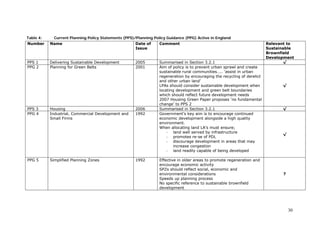
Table 4 indicates the number of PPS documents available and their relationship
and impact on sustainable brownfield redevelopment.
Table 3: Summary of key policy changes in The Planning and Compulsory Purchase Act, 2004 and
their relevance to sustainable brownfield development
Title Change from previous policy Relevance to Sustainable Brownfield Development
Local
Development
Orders
Enables Local Planning Authorities (LPAs) to grant
planning permission in advance for certain types of
development removing need for individual planning
applications
Will speed up the number of sites coming forward for redevelopment.
Could be used to promote ‘hardcore’ sites or brownfield sites to make
them more attractive to developers. No specific sustainability criteria
Duration of
Planning
Consent
Reduced from 5 years to 3 years Has prevented long term landbanking of sites with valid consent which
should have increased supply. Not specifically associated with
brownfield sites or sustainable development
Statutory
Consultees
These are now required to respond within 21 days Increases speed of application determination. Ensures concerns of
Consultees are adequately considered. Not specifically concerned with
brownfield sites or sustainable development
Plan
Development
Duty on plan making to contribute to the
achievement of sustainable development having
regard to national policies (Section 39, P & CPA,
2004)
Principles of sustainable development incorporated into all spatial
development strategies which could be expected to include brownfield
sites. No specific requirement to use development techniques to
achieve sustainable brownfield development
Simplified
Planning
Zones
Designation as SPZ grants planning permission for
the types of development it specifies within the
zone without the need for planning applications
Designed to promote urban regeneration by deregulating the planning
process in particular areas. Can be used to promote ‘hardcore’ sites
or areas of dereliction to make them more attractive to developers.
Strategic
Environmental
Assessment
(SEA)
All plans affecting the environment are required to
have an SEA which details the existing
environment and the potential impact of the
proposals on the development
Promotes sustainable development however does not specifically
promote the use of brownfield sites
29
Number Name Date of
Issue
Comment
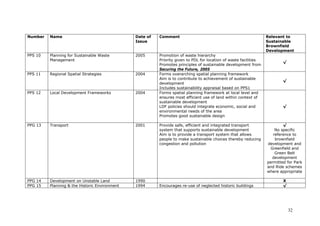
Table 4: Current Planning Policy Statements (PPS)/Planning Policy Guidance (PPG) Active in England
Relevant to
Sustainable
Brownfield
Development
PPS 1 Delivering Sustainable Development 2005 Summarised in Section 3.2.1 √
PPG 2 Planning for Green Belts 2001 Aim of policy is to prevent urban sprawl and create
sustainable rural communities….. ‘assist in urban
regeneration by encouraging the recycling of derelict
and other urban land’
LPAs should consider sustainable development when
locating development and green belt boundaries
which should reflect future development needs
2007 Housing Green Paper proposes ‘no fundamental
change’ to PPS 2
√
PPS 3 Housing 2006 Summarised in Section 3.2.1 √
PPG 4 Industrial, Commercial Development and
Small Firms
1992 Government’s key aim is to encourage continued
economic development alongside a high quality
environment.
When allocating land LA’s must ensure;
- land well served by infrastructure
- promotes re-se of PDL
- discourage development in areas that may
increase congestion
- land readily capable of being developed
√
PPG 5 Simplified Planning Zones 1992 Effective in older areas to promote regeneration and
encourage economic activity
SPZs should reflect social, economic and
environmental considerations
Speeds up planning process
No specific reference to sustainable brownfield
development
?
30
Number Name Date of
Issue
Comment Relevant to
Sustainable
Brownfield
Development
PPS 6 Planning for Town Centres 2005 LA’s should focus development in existing centres
and provide high quality and safe environment.
- encourages use of PDL
- locate development with existing public
transport
- undertake Local Needs Assessment
- provide spaces and buildings that are fit for
purpose, comfortable, safe, attractive,
accessible
√
PPS 7 Sustainable Development in Rural Areas 2004 Re-use or convert existing buildings whilst
preserving architectural or historic interests
Support farm diversification to maintain local
economies
√
PPG 8 Telecommunications 2001 Governments policy is to facilitate the growth of
telecommunications whilst minimising environmental
impact and protecting public health
No sustainability criteria are specifically included
Development likely to be required on greenfield sites
X
PPS 9 Biodiversity and Geological Conservation 2005 Promotes sustainable development by ensuring that
biological and geological diversity are conserved and
enhanced
Policy contributes to rural renewal and urban
renaissance
√
(Potential conflict
with PDL re-use
policy for new
developments –
balance required to
ensure fully
sustainable
development)
31
Number Name Date of
Issue
Comment Relevant to
Sustainable
Brownfield
Development
PPS 10 Planning for Sustainable Waste
Management
2005 Promotion of waste hierarchy
Priority given to PDL for location of waste facilities
Promotes principles of sustainable development from
Securing the Future, 2005
√
PPS 11 Regional Spatial Strategies 2004 Forms overarching spatial planning framework
Aim is to contribute to achievement of sustainable
development
Includes sustainability appraisal based on PPS1
√
PPS 12 Local Development Frameworks 2004 Forms spatial planning framework at local level and
ensures most efficient use of land within context of
sustainable development
LDF policies should integrate economic, social and
environmental needs of the area
Promotes good sustainable design
√
PPG 13 Transport 2001 Provide safe, efficient and integrated transport
system that supports sustainable development
Aim is to provide a transport system that allows
people to make sustainable choices thereby reducing
congestion and pollution
√
No specific
reference to
brownfield
development and
Greenfield and
Green Belt
development
permitted for Park
and Ride schemes
where appropriate
PPG 14 Development on Unstable Land 1990 X
PPG 15 Planning & the Historic Environment 1994 Encourages re-use of neglected historic buildings √
32
Number Name Date of
Issue
Comment Relevant to
Sustainable
Brownfield
Development
PPG 16 Archaeology and Planning 1990 X
PPG 17 Planning for Open Space, Sport and
Recreation
2002 Open spaces, recreation and sport underpin people’s
quality of life. New space should meet the
regeneration needs of areas using brownfield in
preference to greenfield. Effective open space
ensures;
- needs of local communities are known
- good design to prevent crime
- promote compatibility with adjoining land
uses
- promote social inclusion and community
cohesion
√
PPG 18 Enforcing Planning Control 1991 X
PPG 19 Outdoor Advertisement Control 1992 X
PPG 20 Coastal Planning 1992 Undeveloped coast should not be used for new
development
Developed coast can be used for restructuring and
regeneration of rundown towns and ports whilst
taking account of erosion and flooding
√
PPS 22 Renewable Energy 2004 Does not have sequential approach for locating
renewable energy developments however promotes
use of PDL even when site may be unsustainable for
other uses
Development can be located in Green Belt where
environmental benefits of energy resource outweigh
loss of green space
√
33
34
Number Name Date of
Issue
Comment Relevant to
Sustainable
Brownfield
Development
PPS 23 Planning and Pollution Control 2004 Allocation of potentially polluting activities away
from sensitive land uses
Deals with land affected by contamination as
development offers opportunity and resources to
deal with remediation
√
PPG 24 Planning and Noise 1994
PPS 25 Development and Flood Risk 2006 Sequential risk based approach to allocate land in
low flood risk areas especially vulnerable
development
Promotes principles of sustainable development
including allowance for climate change and use of
Sustainable Urban Drainage systems
Conflicts with PDL re-use requirements for new
development as PDL is often within the flood zones.
Development only permitted when exception test is
passed
√
The Barker Review of Land Use Planning in 2006 consisted of a review of the
planning system in England (Barker, 2006). It identified that local, regional,
national interests, environmental issues and economic growth need to be
considered when making planning policies and determining applications (Barker,
2006) therefore considering the four pillars of sustainability outlined in section
2.3.2.
The Review made key recommendations:
- Streamlining of policy and processes
- Updating national policy on planning for economic development
- Introduce a new system for dealing with major infrastructure projects
- Promote a positive planning culture with the plan-led system
- In the context of the Lyons inquiry into Local Government to consider
enhancing fiscal incentives to ensure an efficient use of land
- Ensure new development beyond towns and cities occurs in the most
sustainable way, taking a more positive approach to applications that will
enhance the quality of their green belts.
- A more risk-based and proportionate approach to regulation
- Remove the need for minor commercial development to require planning
- Support ‘town centre first’ policy but remove requirement to demonstrate
need for development.
- Consider how fiscal incentives can be better aligned to ensure local benefit
of economic growth.
- Reduce Secretary of State call-ins.
- Ensure sufficient resources for planning available and linked to
performance
- Enhance efficiencies in processing applications
- Speed up appeals system
- Improve skills
(Barker Review, 2006)
Following the Barker Review the Prime Minister in July 2007 declared an increase
in the annual house building target from 200,000 to 240,000 in an attempt to
tackle the housing crisis (Brown, 11 July 2007).
The Prime Ministers statement from 11th
July 2007 proposed 3 new bills to
increase housing supply and implement the recommendations of the Barker and
Eddington Transport Reviews (Brown, 11 July 2007):
35
• Housing Bill – proposed merger between English Partnerships and the
Housing Corporation to create new homes agency. The agency will be
tasked with bringing forward surplus public sector land for housing and
specifically increase the supply of affordable housing.
• The Planning Bill – Speed up the planning process thereby increasing the
amount of development and specifically major infrastructure projects
required to ensure the creation of sustainable communities
• The Planning Gain Supplement Bill – to ensure the local community
receive benefit from planning gain
Planning and Housing Development
PPS3 provides the national planning framework for the development of housing in
England. It amends Planning Policy Guidance (PPG) 3 and was developed partly
in response to the Barker Review of Housing Supply in 2004 and specifically in
regard to the delivery of more homes whilst providing local authorities with
greater flexibility.
PPS3 is the key piece of planning policy that dictates how, where and what type
of housing is developed in England. Its interpretation into Local and regional
planning strategies and policies is fundamentally crucial to the successful
redevelopment and regeneration of sites and communities.
This policy has maintained the 60% target for new development to be delivered
on PDL that was first indicated by the Government in 1998. The original proposal
was to achieve this target by 2008, a target that has been achieved in England
for the last 5 years as indicated by Figure 4 in Chapter 2.
Concern has been raised by organisations such as Campaign for the Rural
Protection of England (CPRE) that this target should be raised to 80% to further
encourage developers and planning authorities to direct their attention firmly on
PDL and reduce the pressure on greenfield sites.
A key element within PPS3 which stemmed from the Barker Review of Housing
Supply 2004 is that it has re-opened the greenfield argument and has in fact
allowed greenfield development to be explored to enable housing targets to be
met should there be an identified lack of PDL available. A critical factor is that
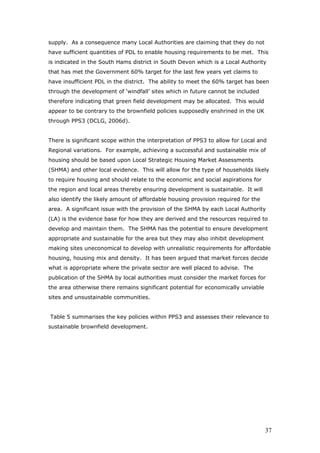
PPS3 does not allow ‘windfall’ sites to be included within the first 10 years of land
36
supply. As a consequence many Local Authorities are claiming that they do not
have sufficient quantities of PDL to enable housing requirements to be met. This
is indicated in the South Hams district in South Devon which is a Local Authority
that has met the Government 60% target for the last few years yet claims to
have insufficient PDL in the district. The ability to meet the 60% target has been
through the development of ‘windfall’ sites which in future cannot be included
therefore indicating that green field development may be allocated. This would
appear to be contrary to the brownfield policies supposedly enshrined in the UK
through PPS3 (DCLG, 2006d).
There is significant scope within the interpretation of PPS3 to allow for Local and
Regional variations. For example, achieving a successful and sustainable mix of
housing should be based upon Local Strategic Housing Market Assessments
(SHMA) and other local evidence. This will allow for the type of households likely
to require housing and should relate to the economic and social aspirations for
the region and local areas thereby ensuring development is sustainable. It will
also identify the likely amount of affordable housing provision required for the
area. A significant issue with the provision of the SHMA by each Local Authority
(LA) is the evidence base for how they are derived and the resources required to
develop and maintain them. The SHMA has the potential to ensure development
appropriate and sustainable for the area but they may also inhibit development
making sites uneconomical to develop with unrealistic requirements for affordable
housing, housing mix and density. It has been argued that market forces decide
what is appropriate where the private sector are well placed to advise. The
publication of the SHMA by local authorities must consider the market forces for
the area otherwise there remains significant potential for economically unviable
sites and unsustainable communities.
Table 5 summarises the key policies within PPS3 and assesses their relevance to
sustainable brownfield development.
37
Table 5: Key Policies and objectives of PPS3 and their relevance to
Sustainable Brownfield Development (SBD) (Summarised from DCLG,
2006d)
Policy Objectives Relevant
to SBD
Achieve High Quality
Housing
Ensure development reflects the planning
guidance for Climate Change and the Code for
Sustainable Homes
√
Promote Design Codes √
Achieve a Mix of
Housing
Determine the likely percentage of affordable
and market housing √
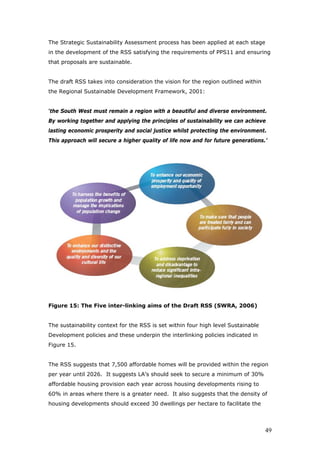
Identify likely profile of householder types
Identify size and type of affordable housing
Ensure proposed mix on strategic sites
achieves local aspirations and on smaller sites
it contributes to wider area aspirations
Market Housing Identify the need for low-cost market housing
Affordable Housing Set the local target for amount of affordable
provision
Set local targets for social-rented and
intermediate affordable housing
Specify size and type of housing for areas and
if necessary on site-specific basis √
Set minimum site size thresholds
Determine the approach for seeking developer
contribution ie. On-site, off-site or financial
provision
√
Making Effective Use of
existing Housing stock
Provide an Empty Homes Strategy
√
Where appropriate utilise Compulsory Purchase
powers √
Assessing an
appropriate level of
housing
PPS 3 suggests that Regional Spatial Strategies should dictate the regional
approach to addressing affordable housing needs. This should include an
affordable housing target for the region and each housing market area.
PPS3 has set a national indicative minimum site size threshold of 15 dwellings
before affordable housing provision is required (DCLG, 2006d). However there is
further scope for Local Planning Authorities (LPA’s) to set lower minimum
thresholds if there is an identified local need. Within the Local Development
documents, LPA’s should set an overall target for the amount of affordable
housing to be provided (DCLG, 2006d).
Figure 14 indicates an example of the costs associated with the provision of
affordable housing using a current case study.
38
Affordable Housing Provision Case Study
Site Use Existing Fuel Filling Station and Car Sales
Commercial Site Value £750,000
Proposed Use 24 Speculative Units
Planning Status Planning Application Registered May 2007
LA Affordable Housing Threshold 25 units May 2007
LA Affordable Housing Threshold 15 units July 2007
________________________________________________
Scenario 1 – 24 Speculative Units
No Affordable Provision
Gross Land Value £1,036,509.31
Abnormal Costs £129,475.00
Net Land Value £928,976.85
________________________________________________
Scenario 2 – 28 Speculative Units
40% Affordable Housing Provision (Shared Equity)
Gross Land Value £1,233,582.42
Loss of sales revenue on non-spec £1,159,819.52
Non-spec Incomes/costs £845.500.47
Abnormal Costs £129,475.00
Net Land Value £767,650.37
________________________________________________
Scenario 3 - 28 Speculative Units
20% Affordable Housing Provision (Shared Equity)
20% Affordable Housing Provision (Rent)
Gross Land Value £1,241,089.31
Loss of sales revenue on non-spec £1,159,819.52
Non-spec Incomes/costs £709,000.47
Abnormal Costs £129,475.00
Net Land Value £655,607.26
_______________________________________________
Scenario 4 - 14 Speculative Units
No Affordable Provision
Gross Land Value £804,423.20
Abnormal Costs £129,475.00
Net Land Value £693,488.15
Figure 14: Case Study Example of the Costs of providing Affordable
Housing
39
The planning application was submitted while the LA planning policy had a
affordable housing threshold of 25 units. Prior to the determination of the
application the LA changed their policy to 15 units and as it was in line with PPS3
they were able to introduce it as Supplementary Planning Guidance without
consultation with stakeholders. Figure 14 demonstrates the financial effects of
this policy change and the effect on land value. The preferred option is for
affordable provision is 50/50 shared equity and rental housing; however Figure
13 indicates the difference in costs of providing 100% shared equity and 50/50
split on flats.
As a result of the change in affordable housing policy the site is unlikely to be
sold for residential development as the vendor is able to sell the site as an
existing business for £750,000. This could therefore impact on the amount of
development land being made available for residential development and will
therefore reduce the amount of brownfield development.
Planning and the Principles of Sustainable Development
In 1992 world governments committed to sustainable development at the Rio
summit with the UK producing a national strategy in 1994 known as Sustainable
Development, the UK Strategy (DOE, 1994c). This was consolidated in 1999 with
the publication of A Better Quality of Life (DETR, 1999a) which outlined the
processes and proposals to deliver sustainable development measured using
economic, social and environmental indicators. This also incorporated the key
objectives of the European Unions Sustainable Development Strategy.
The four central aims of the 1999 strategy were:
Social progress which recognises the needs of everyone
Effective protection of the environment
Prudent use of natural resources
Maintenance of high and stable levels of economic growth and
employment (DETR, 1999a)
The aims and indicators of the 1999 Strategy have been reviewed in the UK
Governments 2005 strategy Securing the Future; Delivering the UK sustainable
development strategy (HM Government, 2005) with specific indicators for the use
of PDL and density of new developments.
40
The overarching policy on delivering sustainable development through the
planning system is Planning Policy Statement (PPS) 1: Delivering Sustainable
Communities (DCLG, 2005b). Planning has a key role to play in the development
of sustainable brownfield sites and the creation of sustainable communities as it
forms a core principle underpinning the planning system.
Specific requirements within PPS1 relevant to sustainable brownfield development
in Cornwall are;
Development plans should promote socially cohesive development
designed for the diverse needs of the community
Protect and enhance historic and natural environment with re-use of PDL
at higher densities and mitigation of pollution/contamination
Ensure suitable locations for high quality, sustainable housing, retail,
tourism, commercial and leisure facilities with sustainability concepts
enshrined in their design and construction and availability of appropriate
infrastructure
Integrate concepts of sustainable development within Regional Spatial
Strategies and Local Development Documents which provide the
framework for delivering sustainable development
Promote high quality inclusive design to create attractive and useable
spaces that will last and can adapt to changing needs of the community
Increasing community involvement at each stage of the planning system
to ensure proposals reflect the needs and aspirations of the communities
(DCLG, 2005b)
Sustainable development is intrinsically linked to PPS3 and a significant objective
within PPS3 is to “create sustainable, inclusive, mixed communities in all areas,
both urban and rural” (DCLG, 2006d).
Planning Obligations/S106 Agreements
The Regional Spatial Strategy defines the planning obligations policies at the
regional and sub-regional level. Local Development Documents must generally
conform to the regional policy which allows developers to plan for likely planning
obligations prior to submission of applications.
41
A large proportion of land acquisitions where no planning agreement is in place,
tend to be accepted on a ‘subject to securing positive planning agreement’ and
therefore planning obligations are unlikely to be an issue prior to acquisition of
land. They do however impact on the economic viability of site development.
Planning obligations are private agreements between Local Authorities and land
owners or developers. They are used to:
Prescribe the nature of the development
- Affordable Housing Provision
- Presumption is to provide on-site affordable provision
• Compensate for loss/damage caused by a development
- provision of green space within the development
- financial provision for green space off-site
- provision for loss of ‘rights of way’
• Mitigate a developments impact
- increased public transport provision
- provision for local schools
- provision for children’s play areas
- additional community facilities
(ODPM, 2005a)
Contributions to satisfy the planning obligation can be in kind or a financial
contribution. They can also include single payments, phased payments,
maintenance payments and pooled payments involving contributions from a
number of developments. Pooled payments are often used for large
infrastructure provision such as significant highway development or flood
mitigation measures.
Section 106 agreements are often financially significant and Local Planning
Authorities need to balance the local need for development and the local need for
any contributions. LPA’s must not be unreasonable in their requests. Obligations
can be reduced to reflect the abnormal costs often associated with brownfield
sites but they do not directly reflect any sustainability criteria in the method they
are collected or allocated within the community. They are however used to
deliver infrastructure such as transport networks, schools etc and are therefore
42
being applied to ensure new development is more likely to be sustainable. Their
allocation should be restricted within the zone of influence of new development.
If Planning Gain Supplements are introduced then s106 agreements will be
reduced and relate predominantly to the physical environment of the
development site and affordable housing.
3.2.2 Building Act, 1984 and Building Regulations
The Building Act is the primary legislation under which the Building regulations
are made. The Building regulations have been revised a number of times since
1991 with the most recent revision in 2007 relating to the Energy Performance of
Buildings reflecting the Governments commitment to the climate change agenda.
The Building Regulations 2000 control all building work and therefore a further
tier of regulation that effects sustainable brownfield development.
Table 6 indicates the specific requirements of the Building regulations that relate
to sustainable brownfield development
Table 6: Summarised parts of Building Regulations relating to
sustainable brownfield development
Part Section Relevant to
sustainability
Relevant to
brownfield
Relevant to
development
A: Structure A2 Ground
Movement
√ √
C: Site Preparation
& Resistance to
moisture
C1 Preparation of
site √ √
C2 Dangerous &
Offensive substances
√ √
C3 Subsoil drainage √ √
L: Conservation of
Fuel and Power
L1
√ √
Part L is aimed at improving energy efficiency and delivering significant carbon
savings. The Sustainability and Secure Buildings Act (OPSI, 2004c) is designed
to focus Building Regulations on addressing the sustainability of new buildings
Code for Sustainable Homes
The code has been introduced following the overwhelming evidence regarding
climate change and energy use. Its primary purpose to drive changes in
43
sustainable home building practice and forms the standard for key design and
construction elements which affects how sustainable a new home is following
occupation.
The standard reflects the occupation of new homes and provides for high
standards of sustainable living as society moves towards zero-carbon home. It
will form the basis of developments in the Building Regulations with regards to
energy use and carbon emissions. The costs of implementing the code can be
significant and independent research has demonstrated that bringing new homes
up to Code 5 of the Code for Sustainable Homes costs £26,000 to £36,000
(English Partnerships, 2007).
Although voluntary the Code is a clear political commitment to sustainable
development from the point of occupation. Public-Private partnerships are
designing new schemes in accordance with the Code. There is however a
significant omission in the Code which reflects the sustainability of the building
materials and methods of construction and remediation technologies used to
construct the projected new homes. The Code is also applicable to all
development and does not differentiate between greenfield and brownfield sites.
3.2.3 Waste Management Legislation, Policy and Guidance
The EU Landfill Directive 1999 was transposed in UK legislation as Landfill
Regulations in 2002 (OPSI, 2002). The aim of the Directive and therefore the
Regulations is to reduce the negative effects of landfilling on the environment and
human health.
Under the Regulations there are set procedures and criteria for waste acceptance
at landfills and landfills have been classified into three categories:
• Inert
• Non-hazardous
• Hazardous
The difficulty for brownfield redevelopment is waste disposal for remediation and
construction arisings. The nearest hazardous waste disposal site in the south
west is located in Cheltenham or Swindon, a significant distance from Cornwall.
This is likely to increase development costs on contaminated brownfield sites in
44
Cornwall where landfill disposal is the chosen remedial technique. The fiscal
incentives of Land Remediation Relief and Landfill Tax exemption are available to
off-set these additional costs.
Table 7: List of Waste Management legislation and policy and the impact
on sustainable brownfield redevelopment in England
Name Date
of
Issue
Relevance to Sustainable Brownfield Development
Hazardous Waste (England
and Wales) Regulations
2005 Defines hazardous waste and controls movement and
records
Requirement to notify of removal of hazardous waste
produced on a development site
Relevant to development of brownfield sites where
contaminated however contains no sustainability
provisions
Landfill (England and Wales)
Regulations
2002 Classifies landfills into hazardous, non-hazardous and
inert which is relevant to the remediation of
contaminated sites
Specifies the Waste Acceptance procedures for landfilling
of wastes from brownfield development sites
Landfill (England and
Wales)(Amendment)
Regulations
2004 Replace waste acceptance criteria (WAC) and procedures
which are relevant to remediation of contaminated sites
Landfill (England and
Wales)(Amendment)
Regulations
2005 Sets WAC for monolithic waste – relevant to use of
remediation techniques prior to landfill
Set limits for inert waste for Polyaromatic Hydrocarbons
(PAHs) relevant for landfill disposal
The Environmental
Protection (Duty of Care)
Regulations
1991 Relevant to removal and deposit of waste from
development site
The List of Wastes (England)
Regulations
2005 Classification of waste from brownfield development sites
The provision of the legislation listed in Table 7 promotes sustainable
redevelopment of brownfield sites in that it discourages the use of landfill as a
remediation technique. However there currently remains a need for landfilling of
certain wastes and dependant on individual site circumstances (insufficient time
or space for treatment based technologies).
The Landfill Regulations are likely to increase the development costs for
brownfield sites although it is hoped that they will reduce the dependence on ‘dig
and dump’ and utilise treatment based technologies. Section 3.2.4 discusses the
concerns regarding sustainability of remediation technologies.
There is currently a ban on the re-use of hazardous waste within a site once it
has been excavated therefore forcing this waste to be landfilled.
45
Cluster, Hub sites and soil treatment centres have been proposed as alternatives
to landfill whilst offering removal of liability from sites, increasing the speed of
development and removing the requirement for treatment space within the
development site.
3.2.4 Pollution Control/Remediation Permits and Technical Guidance
These tend to be involved in the redevelopment of contaminated sites and
include:
Mobile Treatment Licences (MTL)
Land Drainage Consents
Waste Management Exemptions
Discharge Consents
They do not have specific sustainability criteria applied such as energy use, waste
generation and therefore form a regulatory control on construction and
remediation activities on brownfield sites but do not contribute to the
sustainability agenda.
The guidance contained within CR11 and specifically Options Appraisal provides
significant control mechanisms for selecting remediation technologies during the
redevelopment of contaminated sites. During the Options Appraisal minimum
consideration is given to the sustainability of each technology for the site through
the setting of site specific objectives. There is scope for this to be further
advanced to ensure that the most appropriate technique for the site is selected
based upon feasibility, cost and time with sustainability criteria applied at each
stage. In the correct circumstances landfill may be the most sustainable
technique due to the ‘real’ costs of operating soil treatment technologies such as
energy usage and particulate and gaseous emissions. There is a growing concern
that the carbon footprint of each technique should be evaluated for each site to
ensure the most sustainable remediation technology is utilised.
Historically the main issues when selecting a remediation technique has been cost
and feasibility and alternatives to ‘dig and dump’ have often been considered as
sustainable as they have reduced impacts from excavation and disposal to
landfill. However, awareness is growing regarding the carbon footprint of each
technique and although environmental impact and cost benefit analyses are used
to assess sustainable brownfield redevelopment, CLAIRE (Contaminated Land:
46
Applications in Real Environments) suggests that a “life-cycle based approach is
necessary in order to fully assess the true impacts of remediation” (CL:AIRE,
2007).
3.3 Regional Documents
3.3.1 Regional Planning Guidance
The South West region needs economic and social growth to provide the housing
and facilities needed by the regional population. The distribution of new
development and infrastructure is indicated within Regional Planning Guidance
(RPG) 10.
The Regional Planning Guidance for the South West is detailed in RPG10 and
recognises that the south west can be broadly divided into 4 spatially defined
areas. The western sub-region represents the majority of Cornwall where there is
a need for strong policies and action to tackle long term and deep seated
economic and social problems, accentuated by the peripherality of the County
(GOSW, 2001).
The document sets out the broad development strategy and provides the spatial
framework for other strategies such as the Regional Housing Strategy. It must
consider the Regional Sustainable Framework which has set the regional vision
for achieving sustainable development.
Sustainability is a continuing thread throughout the Spatial Strategy with the aim
of balancing the social, economic and environmental needs of the region through
the allocation of land.
The Spatial Strategy has a crucial role to play in the sustainable development of
brownfield sites in Cornwall as it is the regional guidance for land allocation and
infrastructure provision. It specifically guides each Local Authority in provision of
their Development Plans and directs the concentration of new development within
the 11 identified Principle Urban Areas (PUA) as the most sustainable method of
ensuring future growth of the area without compromising other needs. It also
encourages LA’s to recognise the needs of the area and the promotion of
‘sustainable patterns of development’ (GOSW, 2001). No PUA has been
designated in Cornwall however the Camborne-Redruth area has been recognised
47
as an area for growth and regeneration and an Urban Regeneration Company has
been created for this area.
In areas of the region outside of Cornwall development has jumped designated
green belt land which has led to unsustainable growth of commuter towns and
villages. The RPG’s view is that to achieve sustainable growth of the region
development should be concentrated within the PUA’s and green belt boundaries
may need to be reviewed. The spatial strategy takes account of the great
diversity of the region in terms of planning, environmental, social and economic
issues (GOSW, 2001) and development and infrastructure is located accordingly.
3.3.2 Regional Spatial Strategy (RSS) for the South West
The RSS is the first stage in the two-tiered plan system currently used in England
and Wales. It was introduced through the Planning and Compulsory Purchase
Act, 2004 and sets out the overarching spatial planning strategy for a region for
the long term future.
The RSS for the South West is currently a draft document but will supersede
RPG10:2001 following its adoption and is therefore relevant when considering the
potential impact of legislation and guidance on future sustainable brownfield
development in Cornwall.
The key challenge within the RSS is to maintain and encourage economic growth
and meet the needs of a growing and changing population whilst ensuring
protection of the diverse environment. The aim is to locate development in
places where jobs and homes can be more in balance (SWRA, 2006) with
appropriate infrastructure thereby reducing the dependence on car travel and
vehicle emissions. The concern within the RSS remains the provision of funding
for social, health, education and transport infrastructure to support the increased
levels of development required for the region and without suitable infrastructure
development, even on brownfield sites is unlikely to be fully sustainable.
The RSS has been developed in parallel with the Regional Economic Strategy as
they are intrinsically linked.
48
The Strategic Sustainability Assessment process has been applied at each stage
in the development of the RSS satisfying the requirements of PPS11 and ensuring
that proposals are sustainable.
The draft RSS takes into consideration the vision for the region outlined within
the Regional Sustainable Development Framework, 2001:
‘the South West must remain a region with a beautiful and diverse environment.
By working together and applying the principles of sustainability we can achieve
lasting economic prosperity and social justice whilst protecting the environment.
This approach will secure a higher quality of life now and for future generations.’
Figure 15: The Five inter-linking aims of the Draft RSS (SWRA, 2006)
The sustainability context for the RSS is set within four high level Sustainable
Development policies and these underpin the interlinking policies indicated in
Figure 15.
The RSS suggests that 7,500 affordable homes will be provided within the region
per year until 2026. It suggests LA’s should seek to secure a minimum of 30%
affordable housing provision each year across housing developments rising to
60% in areas where there is a greater need. It also suggests that the density of
housing developments should exceed 30 dwellings per hectare to facilitate the
49
provision of sustainable transport systems which may be hindered with a lower
development density.
The RSS would appear to contribute to the sustainable development of brownfield
sites within Cornwall though the setting of a framework for managing growth and
change is a sustainable manner and creating sustainable communities.
3.4 Cornwall Documents
3.4.1 Cornwall County Structure Plan, 2004
The Structure Plan forms a key element of a framework of policies that together
form the basis of planning decisions. It sets out the long term strategy for
development in Cornwall and considers local priorities for the economy, transport
and the environment. The County wide priorities and policies are interpretated at
a local level through Local Development Documents.
‘Development should bring about a long term and sustainable improvement to
Cornwall’s economic, social and environmental circumstances without harming
future opportunity’ (CCC, 2004)
The Structure Plan identifies a County housing need of approximately 29,500 new
dwellings between 2001-2016 with an annual average of 1,970 (CCC, 2004). The
Structure Plan and policies contained within it will be replaced by the RSS
currently in preparation.
The priority for Cornwall is to focus development in existing built-up areas of
towns and villages with priority given to previously developed sites. However the
Plan only indicates a target of 40% of Cornwall’s housing development on
brownfield sites which is significantly lower than the national target of 60%. No
brownfield development targets are provided for employment, tourism and
recreation land uses.
A key requirement of development in the Cornwall area is that it must ‘contribute
towards sustainable development and the enhancement of the quality of life in
Cornwall’ and protect the ‘rich and diverse character is the bedrock upon which
sense of place and quality of life is founded’ (CCC, 2004).
50
Table 8 summarises the individual policies from the Plan and assesses their
contribution to sustainable brownfield development in Cornwall;
Table 8: CCC Structure Plan policies and their relevance to sustainable
brownfield development (CCC, 2004)
POLICY NUMBER RELEVANCE TO SBD
3 Use of Resources Promotes use of PDL AND buildings and remediation of
contamination and unstable ground although there is no policy
referring to the use of sustainable remediation practices
Promotes sustainable construction with energy efficient design,
construction, local skills and materials. Encourages siting
development relevant to existing infrastructure, heritage and
culture to reduce congestion and traffic emissions
4 Maritime
Resources
Development should be within or well integrated with existing
developed coast and help enhance quality of environment and
economic regeneration of towns. Undeveloped coast should be
protected
5 Minerals Strong emphasis on continued development of minerals industry in
Cornwall within principles of sustainability. Relevant to
sustainability rather than brownfield.
8, 9, 10
Housing
‘Mix of house type and tenure that meets the needs of the whole
community will be encouraged’ to ensure sustainable development
Re-use PDL and buildings in urban areas
Re-use other sites in urban areas
Extend existing urban areas in locations with good public transport
links or where they can be provided
Minimum provision of new housing on 40% brownfield sites
Release of greenfield land should be balanced with genuine
availability of PDL
11 Urban & Rural
Economy
‘Economic growth and employment will be encouraged through the
regeneration in the Strategic Urban Centres (SUCs) and other
towns and rural restructuring and diversification’
12 Employment No specific requirement to allocate PDL for employment
Addresses sustainability issues with regards to local skills, ‘green’
travel plans and avoiding adverse impacts on natural or built
environment
51
3.4.2 Local Development Documents
The Local Development Framework is the second stage in the two-tiered plan
system and consists of a set of documents that together outline the spatial
planning strategy for the local area. They are prepared by district councils,
unitary authorities or national park authorities.
Each Local Authority is required to produce local development documents that are
now collectively known as the Local Development Framework and replace the
Local Plans. PPS12 provides the Government policy on the preparation of these
documents which “collectively deliver the spatial planning strategy for the local
planning authority’s area” and are designed to “promote a proactive, positive
approach to managing development” (ODPM, 2004).
The Local Authority’s in Cornwall are at varying stages in the production of their
local development documents. The policies and land allocations should reflect the
requirements of the Regional Spatial Strategy and take account of the economic,
social and environmental needs of the local area.
The local development documents include:
• Core Strategy
• Site specific land allocations
• Area Action Plans
These documents outline strategic proposals such as the amount of affordable
housing required, density of development and the amount of development
expected on previously developed land. Whilst reflecting local need and
availability these proposals and targets should consider the requirements of
national policy such as PPS3 and regional policy set out in the RSS.
Table 9 indicates the amount of social housing required for the Local Authorities
in Cornwall and Plymouth (Plymouth has been included for comparison as
Caradon is included in the Plymouth Housing Market Area). A range of affordable
requirements are provided and due to the rural nature of the County distinctions
are made between urban and rural areas. These requirements may potentially
affect the financial viability of development especially on previously developed
sites where the abnormal costs associated with development are high.
52
Table 9: % Affordable Housing Provision per development
Local Authority Area % Affordable Housing Provision per development (Local
Development Framework & Local Plan)
Kerrier 25% (towns) 50% (rural) (Kerrier DC, 2004)
Penwith 50% (towns) 75% (rural) (Penwith DC, 2007)
Carrick Average 40% (Carrick DC, 2003)
North Cornwall 50% (North Cornwall DC, 2005)
Restormel 45% urban areas (66% other areas) (Restormel BC, 2006)
Caradon 30% (Caradon DC, 2002)
Plymouth 25% (Plymouth CC, 2005)
Each development plan document is subject to a sustainability appraisal to
ensure economic, environmental and social effects of the plan contribute to the
achievement of sustainable development.
Each authority is also required to produce a Statement of Community
Involvement which states the involvement of the local community in the
preparation of local development documents.
The local development documents are therefore strategic documents in the
promotion of sustainable brownfield development as they set the framework for
future development within the local area.
53
CHAPTER 4 REVIEW OF THE FINANCIAL INCENTIVES AND PROVISIONS
FOR SUSTAINABLE BROWNFIELD REDEVELOPMENT IN CORNWALL
Financial incentives and provisions for brownfield development are available at a
Local, National and European level. This chapter assesses the availability of
incentives and provisions and whether they contribute to the sustainable
redevelopment of brownfield sites.
The Barker Review of Land Use Planning in 2006 recommended that better use of
fiscal incentives is required to encourage an efficient use of urban land to satisfy
the growing demand for developable sites (Barker, 2006). As Nathanail et al,
2005 confirm incentives are also referred to as indirect regulation and are
relatively new (Nathanail et al, 2005). Environmental policy has previously been
dominated by direct regulatory measures.
The need for incentives has arisen as it has been recognised that there are a
group of previously developed sites that are commercially marginal or non-viable
without public intervention and is demonstrated by Figure 16.
Figure 16: Relationship between remediation costs and end-use value at
economically viable, marginally viable and non-viable brownfield sites
(Nathanail et al, 2005)
54
4.1 European Structural and Cohesion Funds
European Union (EU) structural funding is a significant financial incentive for
sustainable brownfield development and is distributed at the national, regional
and sub-regional level. The aim of this funding programme is to support social
and economic restructuring across the EU and accounts for approximately a third
of its budget.
The Structural and Cohesion Funds are divided into 3 separate funds:
• European Regional Development Fund (ERDF)
• European Social Fund (ESF)
• Cohesion Fund (CF)
Between 2000-2006 the funds were targeted on specific regions identified as
Objective 1, Objective 2 and Objective 3 regions.
• Objective 1 status can be summarised as promoting the development and
structural adjustment of regions whose development is lagging behind.
These regions are entitled to the highest level of EU funding which is
awarded based on the GDP of the region in question. This status was
afforded to Cornwall and the Isles of Scilly for 2000-2006.
• Objective 2 status can be summarised as supporting the economic and
social conversion of areas facing structural difficulties
• Objective 3 status can be summarised as supporting the adaptation and
modernisation of policies and systems of education, training and
employment
There was no sustainability criteria built in to the awarding of grants from the
funding programmes and would therefore indicate that the previous EU funding
regime did not consider how brownfield sites were remediated and redeveloped.
Although enshrined in EU policy sustainable development surprisingly appeared
unimportant at the point of local project delivery even when funded with EU
grants. The individual funding programmes do not allocate to specific projects,
however they set the priorities and parameters which must be achieved by the
individual projects and there was therefore scope to include sustainability criteria.
55
As Nathanail et al, 2005 identified the previous approach ignored and therefore
placed no value on;
• Sustainable reuse of soil/construction waste
• Sustainable maintenance of heritage buildings
• Sustainable land-use and urban design strategies
• Citizen participation processes
As more countries have joined the EU the allocation of funding has been modified
to reflect the additional countries and their economic status. The funds from each
programme are allocated to regions where the Gross Domestic Product (GDP) for
the region is less than 75% of the EU average. The previous status of regions of
Objective 1,2 or 3 has been modified and are now referred to as:
• Objective 1 Convergence Areas
Statistical Phasing Out
• Objective 2 Regional Competitiveness and Employment
Objective 3
2000-2006 Funding
Allocations
2007-2013 Funding
Allocations
Figure 17: Indicates the Funding Status of Regions within the UK
between 2000-2006 and 2007-2013
56
Three regions within the UK were given Objective 1 status during the 2000
allocations, Wales, Cornwall and The Valleys and these have subsequently been
awarded convergent area status in the 2007 allocations as indicated in Figure 17.
Cornwall and the Isles of Scilly’s is the only area to be granted full convergent
funding due to its GDP. Additional regions within the UK would possibly have
qualified had the 2004 expansion of the EU not taken place which introduced
countries with lower GDP than many of the regions in the UK.
EC No 1828/2006 sets out the ‘rules’ for laying down the provisions of ERDF, ESF
and CF. Article 46 of 1828/2006 specifically states that ‘where structural funds
finance urban development funds those funds shall invest in public-private
partnerships or other projects included in an integrated plan for sustainable
urban development’. This is a small indication of the commitment of funds to
sustainable development and although the application for funds requests an
assessment of how the project contributes to the objective of environmental
sustainability there is still a lack of measurable sustainability indicators such as
those defined by RESCUE.
Table 10 indicates the European funding programmes that are specific to Cornwall
and the Isles of Scilly and the fund managing authority in the UK.
Table 10: European Funding Programmes applicable in Cornwall 2007-
2013
Programme
Name
Funding
Source
UK Fund
Managing
Authority
Programme Priorities
Convergence
Programme
ERDF SWRDA Transform the economy where
knowledge, environment and
quality of life underpin
sustainable economic growth
Convergence and
Regional
Competitiveness
& Employment
ESF Department of
Work and Pensions
Develop and retain higher levels
of skills in Cornwall,
Support people from
disadvantaged backgrounds to
enter and remain in sustainable
employment
Territorial
Cooperation
ERDF Promote common solutions for
urban, rural & coastal
57
58
Objective development,
Development of economic
relations,
Creation of networks of small &
medium sized enterprises
The Convergence Programme for Cornwall consists of 75% funding from ERDF
and 25% UK match funding and totals 610 million euros. The Programmes
objective is to ‘establish the momentum for transforming the economy…where
knowledge, environment and quality of life underpin sustainable economic
growth’ (Objective One Partnership, 2007).
The programme has 4 priorities at a local level which consist of;
1. Innovation, Research and Development
2. Enterprise and Investment
3. Transformation Infrastructure
4. Unlocking the Economic Potential of Place
Within the Territorial Cooperation Programme there are a series of additional
programmes for the 2007-2013 programming period which all aim to support the
EU Regional Cohesion policy alongside ERDF and ESF. These programmes
include:
59
Programme/Funding
Institution
Programme Aim South West
eligibility
Relevant to Sustainable
Brownfield Development
Cross-Border
Co-operation
South Area “Development of cross-border economic,
social and environmental activities through
joint strategies for sustainable territorial
development” (SWRDA, 2007b)
Cornwall, Devon,
Plymouth, Torbay,
Dorset, Bournemouth
and Poole
No specific priority for
brownfield development,
Support for principles of
sustainability in areas of
environmental management
North Area As above Cornwall, Devon,
Plymouth, Torbay,
Dorset, Bournemouth
and Poole
No specific priority for
brownfield development,
Support for principles of
sustainability in areas of
environmental management
Transnational
Co-operation
Atlantic Area “….geared towards cohesive, sustainable and
balanced territorial development of the
Atlantic Area and its maritime heritage”
(SWRDA, 2007b)
Whole of the South
West
Sustainable management of
brownfield sites included in
relation to coastal protection
and knowledge transfer
North West
Europe
“Address territorial issues…to contribute to
the economic competitiveness of the area
while promoting regionally balanced and
sustainable development” (SWRDA, 2007b)
No specific priority for
sustainable brownfield
development although
opportunity for knowledge
transfer about best practice
Whole of the South
West
Table 11: Summary of Territorial Cooperation Programme and their Funding Institutions (SWRDA, 2007b)
The National Strategic Reference Framework (NSRF) (DTI, 2006) published by the
Department for Trade and Industry (DTI) outlines the UK’s broad strategy for
using its structural funds allocations in 2007-2013 cycle. This incorporated the
findings of the DCLG Good Practice Guide for English ERDF and ESF Programmes
which was published to highlight good practice and key aspects from the
Objective One Programme. Figure 18 indicates the UK vision for Structural Funds
spending.
INNOVATION
Research, knowledge
transfer,
commercialisation
ENTERPRISE SKILLS
Encouraging
entrepreneurship and
supporting a
thriving, dynamic
A skilled, adaptable
workforce
Figure 18: UK Vision for Structural Funds Spending (DTI, 2006)
The NSRF is clear that ‘all future structural funds programmes will include
integrated strategies for addressing environmental concerns…respecting the
principles of sustainable development…in keeping with the Governments
Sustainable Development Strategy’. Although lacking specific sustainability
criteria there is at least a broad commitment to awarding funds to projects that
respect sustainability principles. This is despite the lack of sustainability specific
criteria from Europe.
SUSTAINABLE
COMMUNITIES
Cohesive and
productive local
economies
ENVIRONMENTAL
SUSTAINABILITY
Sustainable
development,
production and
consumption
Employment
opportunities for all
SUSTAINABLE
ECONOMIC
DEVELOPMENT
EMPLOYMENT
60
4.2 Finance Acts, 1996 & 2001 and Urban White Paper, 2000
The Government originally published its Statement of Intent on Environmental
Taxation in 1997 (HM Treasury, 1997) which was the first indication of the
Governments proposals to utilise taxation as a means to achieve the policy
objectives for the environment.
The Urban White Paper (DETR, 2000b) was the Governments response to the
Lord Rogers report, Towards an Urban Renaissance, (DETR, 1999c).
The package of fiscal measures contained within the Urban White Paper were
designed to make better use of the existing housing stock, provide assistance to
disadvantaged areas and promote the re-use and redevelopment of brownfield
sites. The details of the measures implemented are provided below
There are currently tax benefits available to support the objective of brownfield
redevelopment but it is clear that many do not wholly or partly contribute to the
sustainability agenda.
There are two broad paradigms within which tax based measures may be
deployed. First, either to supplement the regulatory role of planning regimes in
the control of development or second, to provide fiscal incentives that work in
parallel with market mechanisms (Lloyd et al, 2001).
4.2.1 Landfill Tax Exemption (LFTE)
The Landfill Tax system was introduced via the Finance Act 1996 (OPSI, 1996) as
a consequence of the Chancellor Pre-Budget report in 2001 (HM Treasury,
2001a). The aim of the tax was to ‘encourage waste producers and the waste
management industry to switch away from landfill towards waste minimisation,
re-use and recycling’ (HM Treasury, 2001a) to ensure targets defined by the
European Union in the Landfill Directive, 1999 could be achieved. The tax has
been increased each year to provide this encouragement and in the 2006
Chancellors Pre-Budget report (HM Treasury, 2006) Landfill Tax was increased to
£24 per tonne
Reclamation of contaminated land has historically utilised the ‘dig and dump’
philosophy and the landfill tax system had the potential to inhibit reclamation
61
works and therefore redevelopment of contaminated sites. To ensure the landfill
tax system did not prevent the Government objectives of regeneration an
exemption was proposed by Section 43A and 43B of the Finance Act 1996 (OPSI,
1996) as inserted by the Landfill Tax (Contaminated Land) Order (OPSI, 1996a)
for particular wastes arising from the reclamation of contaminated land. This
enabled continued re-use of brownfield sites and in particular contaminated sites.
LFTE has significantly contributed to the Governments brownfield agenda however
it fails to contribute to the sustainability agenda as it promotes the use of landfill
disposal an activity previously demonstrated as unsustainable.
Table B.1 of the Inland Revenue Statistics 2007 estimates that the 2005-06 cost
of providing LFTE for waste from contaminated land is £35million (HMRC, 2007).
This is likely to increase to £45million for 2006-07 tax year and indicates the
reliance placed on this mechanism (HMRC, 2007).
The LFTE is currently under review (HM Treasury, 2007) as it is thought the
provision of the exemption is providing an unfair bias and encouragement
towards landfill disposal of brownfield soil and waste that other remediation
technologies are not afforded. The development of soil and waste treatment
technologies are potentially inhibited whilst ‘dig and dump’ is financially
supported.
4.2.2 Land Remediation Tax Relief (LRTR)
Schedule 22 and 23 of Finance Act 2001 (OPSI, 2001a) detail the current
legislation for LRTR. It formed the introduction of qualifying expenditure and
methods of obtaining the 150% accelerated tax relief for remediation of
contaminated land.
LRTR was provided as a budgetary measure to achieve the Governments Policy
Objective of ‘Regenerating Britain’s Cities’ in the Chancellors Pre-Budget report in
2001 (HM Treasury, 2001a) and has been available since May 2001. The aim was
to promote the re-use of contaminated sites for redevelopment thereby reducing
the increasing pressures on greenfield sites and delivering local environmental,
social and economic benefits.
62
Table B.1 of the Inland Revenue Statistics 2007 estimate that the 2005-06 cost of
providing LRTR is £20million increasing to £30million during the 2006-07 tax year
(HMRC, 2007). These figures are based on the negative tax element for example
the amounts in excess of 100% of the expenditure. They are also lower than the
level of LFTE claimed suggesting a greater reliance on LFTE than LRTR and also
indicating that landfill disposal still contributes a large proportion of the total
remediation carried out in the UK.
The Barker Review of Housing Supply in 2004 (Barker, 2004) recommended that
LRTR be extended to long-term derelict land a suggestion accepted by the
government and included by the Treasury in their March 2007 Tax Consultation
(HM Treasury, 2007).
The provision of LRR has promoted the Governments brownfield agenda and the
re-use and redevelopment of contaminated sites. The provision of LRTR does not
differentiate between sustainable and unsustainable methods of re-using these
sites. To ensure brownfield redevelopment is sustainable then the provision of
LRTR should be linked to sustainability criteria.
It is possible to obtain LFTE and then LRTR on the same site therefore effectively
being financially benefited on two levels.
4.2.3 Stamp Duty Exempt Areas
The Chancellor’s Pre-Budget report in 2001 (HM Treasury, 2001a) outlined the
proposals for stamp duty exempt areas as a measure to increase investment in
deprived areas. It was provided as a budgetary measure to achieve the
Governments Policy Objective of ‘Regenerating Britain’s Cities’.
Part 4 (Section 92) of the Finance Act 2001 details the provision of Stamp Duty
exemptions in disadvantaged areas (OPSI, 2001a). A disadvantaged area is ‘an
area designated as such by regulations made by The Treasury’ (OPSI, 2001a).
The Stamp Duty (Disadvantaged Areas) Regulations 2001 (OPSI, 2001) define
the Local Authority areas and wards identified as being disadvantaged. These
areas were defined by listings on the Index of Multiple Deprivation (ODPM,
2000a).
63
The exemption applies to all conveyances and transfer of land and/or property
where the value does not exceed £150,000.
It can be seen from Table 12 that a number of Cornish authorities are listed as
disadvantaged areas (as defined by the 2001 Regulations).
Table 12 Cornwall wards identified as Disadvantaged Areas and therefore
exempt from Stamp Duty (Table G) (OPSI, 2001)
LOCAL AUTHORITY WARD NAME
Carrick Penwerris
Kerrier Illogan South
Camborne North
Camborne West
Camborne South
Redruth North
Penwith Penzance West
Penzance West
Hayle-Gwithian
Marazion
St Ives North
St Just
Hayle-Gwinear
This provision has promoted brownfield redevelopment within the Stamp Duty
Exempt areas however there are no sustainability criteria applied and the areas
are defined by the Index of Multiple Deprivation (ODPM, 2000a).
4.3 State Aid
There is approval from Europe for public sector support for a variety of property
developments in Tier 1 and Tier 2 Assisted areas, including;
1. Gap-funded Speculative development where the developer benefits from
the grant
2. Gap-funded bespoke development where there is known end-user and the
occupier benefits from the grant
3. Direct development
64
Grant is limited to the minimum amount necessary to enable the development to
proceed. Where limits preclude gap funding support the European approval
allows for projects to be brought forward by acquiring sites and undertaking
reclamation.
No sustainability criteria are applied to the awarding of gap funding. Brownfield
redevelopment using this funding stream is not assessed before, during or
following redevelopment for its sustainability.
The long term sustainability for sites where gap funding has been provided is
questionable as there is usually limited market in the area which is why those
sites have not been developed by the private sector.
4.4 Investment Frameworks for Regeneration
4.4.1 Public Private Partnerships (PPP)
The term PPP is often used to describe a number of different working
arrangements reflecting both formal and informal contractural arrangements.
PPPs bring public and private sectors together in long term partnership for mutual
benefit (HM Treasury, 2000). They are a key element in Government strategy for
delivering modern services (HM Treasury, 2000).
There are a number of types of PPP relevant to brownfield development:
Asset Sales: Involves the sale of surplus public sector assets whilst
sharing in the growth in value of the asset
Wider markets: Introduce private sector finance to enable better use of
public sector assets the sale of which may be difficult
Joint venture: Public and private sectors pool their assets, finance and
expertise under joint management so as to deliver long term growth (HM
Treasury, 2000)
Partnership Investment: Public sector contributes to funding private
sector investment projects that may not otherwise happen. Allows the
taxpayer to share in the financial returns of a project providing the
investment offers value for money
65
Unless it is part of the partnership agreement there is no requirement for
sustainability criteria to be recognised during the reclamation and development
process.
4.4.2 Joint Ventures
Joint ventures are partnerships formed between private sector and public sector
or private sector and private sector. These ventures need to work commercially
and are often based on profit and sharing agreements.
With brownfield and/or contaminated sites these arrangements are effective
where there may be abnormal costs such as remediation or abnormal levels of
risk. Landowners are increasingly choosing to participate in these ventures to
maximise value from the land. They provide the land for development and
receive an agreed proportion of the profit rather than a direct payment for the
land which is often used on heavily contaminated sites. This can be a favourable
arrangement for developers as there is more flexibility in timing of payments and
completion of the land purchase.
Unless it is part of the partnership agreement there is no requirement for
sustainability criteria to be recognised during the reclamation and development
process. The primary purpose of developing land is to make money within the
requirements of the legislation.
4.4.3 English Cities Fund (ECF)
ECF consists of a private sector company which was developed by English
Partnerships, AMEC and Legal and General. The fund is designed to deliver
sustainable area regeneration through long term investment solutions and will
invest in mixed use projects where local economies fall below the EU average.
The aim of the fund is to demonstrate that high quality, mixed-use regeneration
schemes provide a worthwhile investment opportunity alongside the wider
community and environmental improvements. The fund works with local partners
under a profit and risk sharing agreement and ensures that all activities are
aligned with the Governments Sustainable Communities Plan (ODPM, 2003).
66
ECF gives a high priority to the creation of sustainable communities and holds a
portfolio of sites that have complex and challenging problems. Although lacking a
requirement for measured sustainability there appears to be a general
commitment to supporting projects that address the four pillars of sustainability.
ECF are currently supporting the regeneration of the Millbay area in Plymouth and
are working with different private development partners to bring individual sites
forward. The individual developments form part of the Millbay masterplan and
the Mackay ‘Vision for Plymouth’. One of the developments has required the
installation of basement car parking across the majority of the site. The
basements require the excavation of 25,000m3 to facilitate this construction.
Unfortunately due to the previous use of the site as an infilled quarry and
laundrette the material is made ground, and highly variable. Due to the
variability and low levels of a variety of contaminants it has not been feasible to
identify a cost effective alternative to landfill. In this instance the provision of the
development has contributed to the sustainable objective of re-using PDL and
regenerating communities, however the design has created an unsustainable
situation. The design would have been more sustainable if the units had been
built off existing ground levels.
4.4.4 Urban Regeneration Companies
The aim of the URC’s was to raise the profile of areas not able to attract sufficient
private investment. Cornwall’s URC was set up in 2002 to bring back to
Camborne, Pool and Redruth the prosperity the area once had from its mining
and engineering industries. The area has long-term challenges and has suffered
from years of industrial decline and lack of investment. This has led to a
population with high unemployment, low wages and large proportions of land that
have become empty, derelict and contaminated.
The long term vision of CPR is to ensure regeneration of the area in a sustainable
manner combining new homes, employment opportunities and community and
leisure facilities in an improved environment. Their role is to facilitate a range of
projects involving public and private sector funding and community groups and
voluntary groups. Camborne-Pool-Redruth is a strategic priority in Cornwall and
the South West region for regeneration and growth. The regeneration funding
partners of CPR are Cornwall County Council, English Partnerships, Kerrier District
Council, SWRDA and Objective One Partnership Grant.
67
CHAPTER 5 DATA COLLECTION
5.1 Introduction
As chapters 3 and 4 have identified the Government has provided an array of
legislation and policy controlling and regulating the development of previously
developed sites with some promoting sustainable development. They have also
provided and encouraged a number of financial incentives and provisions
specifically for previously developed site development and again with some
promoting sustainable development.
With top down regulation it was important to assess the knowledge,
understanding and use of these policies and provisions at a local level. The use
of a questionnaire was felt to be the most appropriate form of assessing this
issue. As the scope of this research has been limited to residential and mixed-
use developments the questionnaire was limited to residential development
companies. It should be noted that some of these companies also undertake
commercial development but they were asked to reflect only the residential
development part of the Company in their answers.
The literature review raised a number of key questions and issues, which
included:
a. What are the primary reasons for developing or not developing in
Cornwall?
b. To what extent are developers engaging in brownfield development and
utilising remediation techniques alternative to ‘dig and dump’ and is this
dependant on Company size?
c. To what extent are developers using the financial provisions and incentives
available for brownfield development?
d. Are developers seeing the effects of PPS3 at a local level and to what
extent may it affect future land provision for housing development?
5.2 Methodology
Companies were selected based on a search of several internet websites including
the House Builders Federation and were selected if they had a southern or south
west office. It was felt inappropriate to question companies that did not have a
south or south west base as the researcher was keen to establish why Companies
68
with an office base within the region had or had not extended their activities to
Cornwall.
The method of contacting the individual Companies was the next decision based
on the type of questions, response rate and the respondents role within the
Company. A number of studies have concluded that telephone surveys appear to
be more successful with regards to response rate. De Leeuw and Van der
Zouwen, 1992 (cited in Bonnel and Le Nir, 1998) in their analysis of 25
comparative studies gave an “average response rate of 75% for face-to-face
interviews and 69% for telephones interviews”. Through their research Yu and
Cooper, 1983 identified a “heavy reliance on mail surveys” although they appear
to be “half as effective (47.3%) as telephone surveys (72.3%).
Face-to-face interviews were deemed inappropriate due to the number of
Companies and their spatial distribution covering an area from Truro in Cornwall
to Bristol and across to Portsmouth.
Mail surveys were deemed inappropriate based on the results of previous studies
as described above and concerns regarding response times.
Two options were therefore available, telephone surveys or e-mail surveys.
Based on a literature review of previous research and an experiment into the
responses to mail and e-mail surveys, Schaefer and Dillman (1998) suggest that
“e-mail surveys can be done faster than telephone surveys” and is “also
inexpensive….eliminates postage, printing and/or interviewer costs”. However
from their research they also conclude that “e-mail messages should be sent
directly to individual respondents”. It could reasonably be expected that as the
majority of the house builders had websites and all had a company e-mail
address that individuals within the Company had individual e-mail addresses.
However, individual contact details for the most appropriate respondents in each
Company were not available to the researcher despite research of Company
websites. It was therefore determined that a telephone survey would be the
most appropriate.
The reasoning behind individual questions is discussed more fully in section 5.3
however the designing of the individual questions was crucial to addressing the
issues raised in section 5.1.
69
Closed questions limit the respondents to answers provided for each question and
as Moore, 2002 recognises “forcing respondents to answer questions in this way
yields responses that are assumed to be comparable and quantifiable”. Although
their research was centred around work values the findings of Schuman and
Presser, 1979 are relevant in deciding whether open-ended or close-ended
questions are appropriate. They found disadvantages with open questions
“arising from vagueness of expression by respondents….and misunderstanding by
coders”. However, a number of researchers have also raised concern with
potential bias arising from close-ended questions.
The questions were designed to be close-ended questions to enable comparison
between respondents be made.
5.3 Housing Developers Questionnaire
The detailed methodology and reasoning behind this type of survey has already
been described in section 5.2. This section addresses the reasoning behind each
of the questions. A blank copy of the questionnaire is provided in Appendix 1.
The preliminary introductory questions are self explanatory and were designed to
establish the size of the company, proportion of affordable housing they provided,
proportion of brownfield development the company undertook in the last financial
year and the individuals role in the company.
Questions 1-4 are provided in Table 12 and 13 and were designed to establish the
level of development in Cornwall and key reasons for developing in the County or
not developing in the County. Instructions were provided in italics to the
respondents on which question they were to answer depending on previous
answers.
Table 12: Questions 1-2 Taken from Housing Developer Questionnaire
1. Do you develop in Cornwall? YES/ NO
If you answered yes to question 1 please go to question 2
If you answered no to question 1 please go to question 4
2. How much development do you undertake in Cornwall?
(please circle the one that applies)
<10% 11-49% 50-74% 75-100%
70
Table 13: Questions 3-4 Taken from Housing Developer Questionnaire
3. What are your reasons for developing in Cornwall? (please rank your
response with 1 indicating the most important reason)
Geographical location 
High demand for housing 
Low land prices 
Additional funding 
High sales return 
Other 
___________________________________________________________
___________________________________________________________
4. Why don’t you develop sites in Cornwall? (please rank your response with 1
indicating the most important reason)
Geographical location 
Perceived/actual problems with contamination 
Low sales income 
Waste disposal problems (location of haz waste sites) 
Other 
______________________________________________________________
______________________________________________________________
The suggested choices within questions 3-4 and 6-7 were provided by the
researcher and were selected based on personal and professional experience.
This created an opportunity for bias from the researcher and providing the
respondent with the ‘other’ choice presented an opportunity for respondent
vagueness leaving the question slightly open-ended.
Question 5-7 relate to the develop of brownfield and greenfield sites and were
designed to assess each Companies preference and reasons for developing either
type of site.
Table 14: Question 5 Taken from Housing Developer Questionnaire
5.4 Review of House builders Annual Reports and Websites
5. Do you have a preference for developing on greenfield or brownfield
sites (please circle the one you prefer)
Greenfield Brownfield No Preference
If you circled greenfield please go to Question 6
If you circled brownfield please go to Question 7
71
Table 15: Questions 6-7 Taken from Housing Developer Questionnaire
6. With regards to your answer to question 5, why do you prefer those
sites (please rank your response with 1 indicating the most important issue)
Development costs are cheaper 
No remediation issues 
Perception of future purchasers’ 
Legislation/Policy 
Construction process tends to be quicker 
Other 
__________________________________________________________________
__________________________________________________________________
7. With regards to your answer to question 5, what are the main drivers
for your company to build on brownfield sites? (please rank in order of
importance with 1 being very important)
Government policy and legislation 
Competitive advantage 
Brownfield sites more readily available 
Easier to obtain permission to develop brownfield sites 
Greenfield land values prohibitively high 
Internal Company policy 
Better opportunity for profitable development 
Financial incentives available for brownfield redevelopment 
Other 
Question 8 was designed to identify the preferred remediation technique when
developing sites requiring remedial treatment. This question was designed to
assess whether the introduction of the EU Landfill Directive and its transposition
into UK policy has encouraged the use of techniques other than ‘dig and dump’.
Table 16: Question 8 Taken from Housing Developer Questionnaire

__________________________________________________________________
__________________________________________________________________
8. With regards to remediation what techniques have you utilised and
how often? (please tick all that apply)
Always Often Rarely Never Would
e consider
‘Dig and Dump’     
Ex-situ biological techniques     
In-situ biological techniques     
Stabilisation     
Solidification     
Thermal     
Soil Vapour Extraction     
72
It is the aim of the Government to ensure that costs associated with brownfield
development and any required remedial treatment is factored into the land value
(HM Treasury, 2007). Question 9 sought to address this issue.
Table 17: Question 9 Taken from Housing Developer Questionnaire
9. Do you consider land contamination when appraising sites?
Always 
Occasionally 
Never 
They are also keen for Land Remediation Tax Relief (LFTR) to be factored into the
land purchase (HM Treasury, 2007) with the view, correct or otherwise, that
commercially marginal sites as indicated in Figure 15, may become commercially
viable sites thereby reducing the amount of public intervention required.
Question 10 assessed whether the respondent was aware and had used the
financial provisions currently available, including LRTR.
Table 18: Question 10 Taken from Housing Developer Questionnaire

10. Are you aware of the following financial incentives and provisions available for
brownfield redevelopment and have you used them?
Heard Used Use in Future Never Heard
Land Remediation Relief    
Landfill Tax Exemption (waste)    
Stamp Duty Exempt Areas    
VAT Relief for new build dwellings    
GAP funding/ State Aid    
As the Government are currently reviewing the provision of LRTR (HM Treasury,
2007) and Landfill tax exemption (HM Treasury, 2007), questions 11-14 were
provided to assess whether respondents were claming the relief’s and what
impact potential changes might have on future development.
73
Table 19: Questions 11-13 Taken from Housing Developer Questionnaire
11. Has the provision of LRR encouraged your company to develop contaminated
sites that you wouldn’t otherwise have developed?
Yes 
No 
Not sure 
12. If you have not claimed LRR, what are your main reasons for not claiming
(please rank in order of importance with 1 being the most important)
Complicated paperwork 
No guarantee that LRR will be granted 
LRR often not received in the year of expenditure 
Tax return is a small percentage of total expenditure 
13. If the process of obtaining LRR was made easier would this encourage your
company to develop contaminated sites that you wouldn’t otherwise develop?
Yes 
No 
Not sure 
No comment 
Partnerships are schemes designed to encourage private investment into
brownfield development. Question 14 was asked to assess whether private
companies are participating in partnership schemes or whether they would
consider participating.
Table 20: Question 14 Taken from Housing Developer Questionnaire
14. Have you undertaken or would you consider the following
schemes which may facilitate development on sites that would
otherwise be uneconomical?
Have Would Never
Undertaken Consider
Public/Private Partnership   
Joint Venture schemes   
English Cities Fund   
74
The researcher used question 15 to assess whether the respondents held land
banks and whether they were prepared to hold contaminated sites within these
banks. For the purposes of this research a landbank was defined as including
sites that the Company owned and which had an active planning consent. It was
decided not to include land held under option or land subject to planning as it is
unusual for the developer to own the site and therefore any liability from sites at
this point.
Table 21: Question 15 Taken from Housing Developer Questionnaire
15. Are you prepared to hold land that may be affected by
contamination in a land bank for more than 6 months (this
includes land that may meet the statutory definition of
contaminated land)
Yes 
Yes under certain conditions 
No 
No landbank 
Chapter 3 described a number of key pieces of legislation and policy that are
affecting housing development on brownfield sites. Questions 16 and 17 were
designed to assess the respondent’s knowledge of these policies and an open-
ended question was used (17) to assess which pieces are having a significant
impact on the activity of the responding Company.
75
Table 22: Questions 16-17 Taken from Housing Developer Questionnaire
16. Are you aware of the following legislation/policy that affects
brownfield redevelopment in Cornwall? (please tick all those that you
aware of)
Planning Policy Statement 23: Annex 2 
Planning policy Statement 1 
Planning Policy Statement 3: Housing 
Part C Building Regulations 2000 
Code for Sustainable Homes 
Part 2A of the Environmental Protection Act 1990 
Planning Policy Statement 25: Flooding 
Hazardous Waste Regulations 
Landfill Regulations 
Environmental Protection (Duty of Care) Regulations 
Barker Review of Housing Supply 
Towards a National Brownfield Strategy 
Regional Spatial Strategy for the SW 
Regional Planning Guidance 
The SW Regional Housing Strategy 2005-2016 
Cornwall County Structure Plan 
Local Development Documents eg. Local Plan 
Housing Green Paper (July 2007) 
17. Which 3 pieces have the greatest impact on development
undertaken by your company?
__________________________________________________________________
__________________________________________________________________
________________________________________________________________
The object of asking questions 18-20 was to assess the impact of central
government policies on local policies and whether the respondents believe policies
may affect the provision of land and therefore housing in the future.
76
Table 23: Questions 18-20 Taken from Housing Developer Questionnaire
18. Are you seeing the effects of PPS3 at a local level ie. Provision of
affordable housing, densities etc.
Yes 
No 
Not sure 
19. Do you think landowners are aware of the additional
requirements and potential effect on land value?
Yes 
No 
Not sure 
Some 
20. Do you think that this is and will effect the amount of land coming
forward for redevelopment?
Yes 
No 
Not sure 
The findings of the research are analysed in Chapter 6 and discussed in Chapter
7. Limitations with the research are discussed in Chapter 8.
77
CHAPTER 6 ANALYSIS OF SURVEY DATA
6.1 Introduction
This chapter reviews the response rate and compares the responses to the
questions described in Chapter 5.
6.2 Survey Response Rate
Forty five companies were contacted primarily by telephone or by e-mail where
telephone contact could not be made. Individual contact details were available to
the researcher for a number of companies based on personal and professional
knowledge. Twelve responses were received based on telephone calls of which
individual contact details were known for five companies therefore providing a
27% response rate. Based on the review of literature discussed in Chapter 5 this
response rate is lower than could be expected for a telephone based survey and
the main difficulty encountered was the lack of contact details for the relevant
individuals in each company. Where contact details were not known the
Technical Director/Manager was requested as it was believed that this role would
have the capability to answer the range of questions. A proportion of the
companies contacted were too small to have this as a dedicated role and it was
frequently combined with land and planning roles. This added a further difficulty
due to the strategic role played by this individual within the companies and that
they were often difficult to reach, did not return phone calls and often declined to
participate due to the time required.
Non-response is not known for the majority of companies. One respondent
requested the survey by e-mail but did not return the questionnaire as their
company does not undertake any development in Cornwall. Several companies
requested that the questionnaire be e-mailed to ensure it could be directed to the
correct person. These companies failed to respond even with follow-up telephone
calls. One company contacted is currently undertaking 100% commercial
development and therefore was asked not to respond by the researcher.
The annual output of the survey respondents accounts for 13% of annual housing
completions in the south west based on 2006 information provided by the
respondents and the total private housing completions in the south west provided
by DCLG (http://www.communities.gov.uk/pub/53/Table232_id1156053.xls).
78
6.3 Detailed Analysis of Questions
The following section summarises the responses to each of the questions. Table
24 outlines the role of the individual that responded to the survey and a summary
of the annual output for that company. It outlines that the individuals responding
covered a range of roles within the companies from Managing Director to a Land
Buyer and it should be noted that this may influence the answers provided.
Four of the companies that responded were regional branches of national groups
and the responses provided represent regional figures. National figures have
been taken from the house builders most recent Annual Report for these
companies. It should be noted that a number of companies are currently
merging and these figures may not be representative of the current situation.
Table 24: Summaries of the responding companies and their annual
output
Role of the
individual within
the Company
Number of
Completions in 2006
or last financial year
% Brownfield
Development
% Affordable
Housing
provided
Land Buyer 250 (2,852)1
100 (100)1
30 (unknown)1
Technical Manager 235 (4,735)2
40 (75)2
20 (unknown)2
Project Manager 0 (17)3
0 (0)4
0 (0)5
Technical Manager 497 (14,601)6
60 (82)6
15 (19)6
Development
Manager
75 100 0
Group Director 27
100 0
Company Secretary 2 0 0
Managing Director 50 100 50
Planning and
Technical Director
75 45 25
Engineering
Coordinator
140 50 20
Technical
Coordinator
300 50 15
Technical Director 550 (1,054)8
__ (75)8
1
Information provided was based on Regional development. National information taken from the
housing developer’s 2007 Annual Report
79
2
Information provided was based on Regional development. National information taken from the
housing developer’s annual report
3
This Company has only existed for 5years and had no completions for 2006. Projected completions
for 2007 given in brackets provided by the respondent
4
This Company has only existed for 5 years. Information provided by the respondent indicates
projected completions for 2007 are on greenfield sites
5
This Company has only existed for 5 years. Information provided by the respondent indicates that
the required affordable provision for projected 2007 completions is based on an off-site contribution
6
Information provided was based on Regional development. National information taken from the
housing developer’s annual report
7
This represents holiday residential units. This company undertakes predominantly commercial
development
8
Information provided was based on Regional development. National information taken from the
housing developer’s annual report
Results for Questions 1-4
The first four questions were to assess the level of development undertaken in
Cornwall. 77% of responding companies undertook some level of development in
Cornwall. Of the 33% of respondents who did not develop in Cornwall the main
reason provided was geographical location in that the companies in question did
not extend their activities that far west. One respondent’s primary reason was
concern with a fluctuating housing market in Cornwall and as they were a
medium builder of <75 units per year they could not financially withstand any
fluctuations.
With regards to the respondents who did develop within Cornwall:
• 33% recorded that it was due to high sales returns on units,
• 25% claimed it was because they were a local company,
• 25% recorded that it was due to geographical location ie.aesthetics
• 25% believed that there is a high demand for housing predominantly from
purchasers outside of the County
Results for Questions 5-7
Figure 19 indicates the proportion of respondents which had a preference for
either brownfield or greenfield sites. There were several bespoke brownfield
developers who specifically buy brownfield and often contaminated sites whereas
a similar number had no preference for either land type.
80
Greenfield 16%
Brownfield 42%
No Preference 42%
Figure 19: Respondents preference for land type
The respondents who preferred greenfield sites considered that these were
preferable due to quicker construction processes, no future liability and no
unknowns or hidden extras that may be uncovered during construction. The
perception of future purchasers was not considered to be an important reason for
developing greenfield sites.
Comparisons between respondents who preferred to develop brownfield sites is
more difficult as each gave different reasons for developing these sites. Two
respondents agreed that internal company policy was the main driver for their
company developing brownfield sites, a reason that the other respondents did not
consider a priority. One respondent believed that developing brownfield sites
gave their company a competitive advantage over other companies.
Financial incentives offered for brownfield development such as Land Remediation
Relief were not identified by any respondent as a driver for developing on
brownfield sites. In fact 80% of the respondents who developed brownfield sites
believed it wasn’t a consideration in site selection.
One respondent who reported no preference for ether type of site has not
undertaken any brownfield development and therefore although they would
consider it they have yet to experience developing such sites.
81
Results for Question 8-9
Table 25 indicates the respondents preference for remediation techniques. As
one respondent had not developed any brownfield sites they were not able to
complete this question. The once technique of choice, ‘dig and dump’ is
reportedly rarely used by the majority of respondents with only 27% of
respondents reporting that they often use it as a technique. 82% of respondents
often use cover and containment systems to address contamination issues on a
development site. The majority of respondents reported that they would consider
alternative treatment techniques such as stabilisation, soil vapour extraction and
thermal techniques.
Table 25: Respondents preference for Remediation Technique (given as
a percentage of the total number of respondents)
Remediation Technique Always Often Rarely Never Would
consider
Dig and dump 0 27 73 0 0
Ex-situ biological
techniques 0 18 27 0 55
In-situ biological
techniques 0 9 27 0 64
Stabilisation 0 9 45 0 46
Solidification 0 9 27 0 64
Thermal 0 0 9 27 64
Soil vapour extraction 0 0 9 9 82
Soil washing 0 9 9 18 64
Cover/containment system 9 82 9 0 0
One of the responding companies considered themselves to be specialists in the
area of brownfield development and they had experience of and often used a
wider range of techniques.
All respondents reported that they often use a combined approach to remediation
of sites and often used more than one of the techniques in Table 25 to address
contamination issues.
82
100% of respondents consider land contamination when appraising and valuing
sites, therefore ensuring that the land value reflects any abnormal development
costs such as remediation.
Results for Questions 10-15
Figure 20 indicates the respondents knowledge of financial incentives and
provisions that are available for brownfield and contaminated land development.
All respondents had heard of VAT relief for new dwellings although one
respondent was not sure that it was claimed by their company. 25% of
respondents had not heard of LRTR although once it was explained to them by
the researcher they reported that they would consider using it in the future.
0%
10%
20%
30%
40%
50%
60%
70%
80%
90%
100%
Land Remediation Relief Landfill Tax Exemption Stamp Duty Exempt
Areas
VAT Relief Gap funding/State Aid
Never
Heard
Use in
Future
Used
Heard
Figure 20: Respondents knowledge of financial incentives and provision
available for brownfield development (given as a percentage of the total
number of respondents)
At least 50% of respondents had claimed landfill tax exemption during
remediation of development sites. 25% had not heard of the relief which may be
attributed to the individuals role within the company as these respondents
included the Managing Director and Company Secretary of two companies.
83
Interestingly, almost 50% had experience of gap funding with these companies
ranging from volume builders in the south west to smaller bespoke companies.
Yes 17%
No 50%
Not sure
25%
No comment
8%
Figure 21: Response to whether the provision of Land Remediation Tax
Relief has encouraged the responding company to develop contaminated
sites
Figure 21 indicates that 50% of the responding companies do not consider LRTR
to have encouraged them to undertake development on contaminated sites that
they may not otherwise have developed. The majority of respondents
independently reported that sites are required to be financially viable without the
benefit of LRTR. One respondent who believed LRTR had encouraged them to
develop contaminated sites reported that it was an “added extra incentive”.
Response to question 12 was limited as the majority of respondents had either
used LRTR or were not aware of its existence. Where companies were aware of
LRTR but had not yet applied for it the reasons provided were “not sure what
qualifies to receive LRTR”, “not sure it was an option for the sites remediated”
and “the relief is claimed at a Group level rather than at a local level”.
Due to the response to questions 10-12 no responses were recorded for question
13.
84
Not develop contaminated
sites in the future 18%
Develop contaminated
sites using treatment
technologies 18%
It will have no effect 64%
Figure 22: Respondents reaction if Landfill Tax Exemption was removed
One respondent had not developed brownfield sites that therefore did not record
any answer to question 14.
With regards to the provision of Landfill Tax Exemptions 64% of respondents
replied that if it was removed it would have no effect on the type of sites
developed by the company. One respondent suggested that if it was removed it
would decrease land values and would possibly result in some land having a
negative value which would suggest that this company allow for the exemption
when valuing sites.
18% replied that they would continue to develop contaminated sites and utilise
alternative treatment based solutions and 18% said that they would not develop
contaminated sites in the future. A respondent who would not develop
contaminated sites in the future suggested that the reason would be due to
additional timescales required to use alternative remedial technologies.
Table 26: Indicates the type and scale of partnership development
undertaken by respondents (given as a percentage of the total response)
Type of Partnership
Have
Undertaken
Would
Consider
Never
Undertaken
Public/Private
Partnerships 25 17 58
Joint Ventures 75 8 17
English Cities Fund 17 8 75
With regards to developing in partnership only two of the respondents had
worked with English Cities Fund and these represented two of the south west’s
volume house builders.
85
Table 26 demonstrates that a large proportion of respondents indicated that they
had participated in joint venture schemes with the majority indicating that these
were generally undertaken with landowners.
Results for Question 16
No valid assumptions can be drawn from the responses to question 16 regarding
the holding of contaminated sites within landbanks as 67% of the responding
companies do not currently have a landbank.
Results of Question 17-18
As Table 27 indicates the only policy areas that all respondents were aware of
were the Local Development Documents and Planning Policy Statement 25:
Flooding. It is possibly unsurprising that all respondents were aware of the local
documents affecting in development in their areas. PPS 25 is perhaps at the
forefront of regulators and developers minds taking into consideration recent
events in Gloucester.
Table 27: Indicates respondents awareness of legislation and policy
affecting brownfield development
Legislation Percentage Awareness
Planning Policy Statement 23: Annex 2 75
Planning policy Statement 1 83
Planning Policy Statement 3: Housing 92
Part C Building Regulations 2000 83
Code for Sustainable Homes 83
Part 2A of the Environmental Protection Act 1990 67
Planning Policy Statement 25: Flooding 100
Hazardous Waste Regulations 92
Landfill Regulations 92
Environmental Protection (Duty of Care) Regulations 75
Barker Review of Housing Supply 75
Towards a National Brownfield Strategy 25
Regional Spatial Strategy for the SW 75
Regional Planning Guidance 75
The SW Regional Housing Strategy 2005-2016 75
Cornwall County Structure Plan 58
Local Development Documents eg. Local Plan 100
Housing Green Paper (July 2007) 58
86
The legislation that respondents were least aware of was ‘Towards a National
Brownfield Strategy’ and as the full strategy has yet to be published this was
perhaps an unfair question.
Generally where responding companies did not undertake development in
Cornwall they were not aware of the Structure Plan for Cornwall.
Over 50% of respondents were aware of the recently published Housing Green
paper although some were not aware of the full details.
There were no clear correlations between the size of the company and the level of
knowledge about brownfield legislation.
Respondents were asked to record which three pieces of legislation they thought
were currently having the most significant on the development of sites. It should
be noted that not all respondents provided three answers.
0 10 20 30 40 50 60 70 80
Planning Policy Statement 23: Annex 2
Planning policy Statement 1
Planning Policy Statement 3: Housing
Part C Building Regulations 2000
Code for Sustainable Homes
Part 2A of the Environmental Protection Act 1990
Planning Policy Statement 25: Flooding
Hazardous Waste Regulations
Landfill Regulations
Environmental Protection (Duty of Care) Regulations
Barker Review of Housing Supply
Towards a National Brownfield Strategy
Regional Spatial Strategy for the SW
Regional Planning Guidance
The SW Regional Housing Strategy 2005-2016
Cornwall County Structure Plan
Local Development Documents eg. Local Plan
Housing Green Paper (July 2007)
Figure 23: Summary of legislation and policy currently having a
significant impact on development as provided by survey respondents
87
Figure 23 demonstrates that 75% of respondents considered the Planning Policy
Statement for Housing as currently having the most significant impact on
development. This was followed by Local Development documents which
interpret national planning guidance and policy at a local level. Code for
Sustainable Homes and the Planning Policy Statement for sustainability were also
considered to be having a significant impact with 42% and 33% of respondents
respectively citing them.
PPS 25 for flooding was cited by 25% of respondents as having a significant
impact of which two of these were volume house builders in the south west.
Results for Questions 19-21
The results of these questions were interesting when considering the current
house building requirements the Government has requested. Every respondent
considered that the requirements of PPS 3 are now being implemented at a local
level through Local Development documents and Supplementary Planning
Guidance.
When asked ‘if landowners are aware of the additional requirements within PPS 3’
50% of respondents believed that landowners are not aware and therefore not
aware of the potential impact on land values.
Question 21 was concerned with the future availability of land for development
and therefore the potential impact on delivering the required new housing.
Figure 24 indicates the respondent’s views on the future availability of
development land with the additional legislative requirements.
Area specific 17%
NO 17%
Yes 66%
Figure 24: Respondents views on whether additional legislative
requirements will impact on future land availability (given as a
percentage of the total)
88
CHAPTER 7 DISCUSSION OF RESULTS
7.1 Introduction
The previous chapters within this thesis have covered;
a. an evaluation of the legislation and policy currently controlling brownfield
development in England and an assessment of whether it promotes
sustainable development,
b. an evaluation of the financial incentives and provisions available for
brownfield development and an assessment of whether they promote
sustainable development,
c. a survey of current housing development companies to assess their
knowledge, experience and use of a and b.
This chapter seeks to draw together the findings of the previous chapters and
assess whether the overall effect of Government policy is to promote or hinder
sustainable brownfield development in England.
The companies who responded to this survey account for 13% of annual housing
completions in the south and they ranged in size from 2 units per year to the
volume housebuilder who builds 550 units per year. 42% of the respondents
constructed >200 units in 2006 and 25% constructed <10 units in 2006
indicating a reasonable mix of company sizes (table 24, page 81).
7.2 Does the legislation and policy promote sustainable brownfield
development?
The use of brownfield sites for housing redevelopment has existed for a number
of years with national support through the planning policy guidance, regional
support through the regional planning guidance and spatial strategy and locally
through local development plans.
With the publication of PPS3 the planning policy emphasis on brownfield
development has remained and the 60% target for new housing on brownfield
sites has been maintained (DCLG, 2006d). There is however less emphasis on
the formal sequential approach and when combined with the requirement to
identify sufficient deliverable sites within the Local Development documents for 5
years, there will be an opportunity and need for the allocation of greenfield sites
89
in areas where insufficient brownfield sites are available within this timeframe.
These policies compromise and contradict the apparent commitment to brownfield
development in order to meet the Governments annual housing targets. This will
require sufficient infrastructure to be available. The 50% brownfield development
target within the south west RSS (SWRA, 2006) further undermines commitment
to construct on brownfield sites despite urban local authorities in the region such
as Plymouth expecting to exceed the national target of 60% (PCC, 2005).
The reasons driving development on brownfield sites provided by respondents to
the Dixon et al, 2006 survey included “the availability of land” and “government
policy” (Dixon et al, 2006a). This was not recorded as a driver by the
respondents surveyed for this thesis perhaps already a reflection of the changing
policy commitments. Only 8% of respondents considered that “brownfield sites
are more readily available” as the primary reason driving development on
brownfield sites (page 83). 16% recorded that internal company policy was a
primary driving perhaps indicating an increasing commitment at a corporate level
to build on brownfield sites (page 83). Indeed a review of the volume
housebuilders annual reports and websites indicates commitment to sustainable
communities and brownfield development with their Corporate Social
Responsibility policies.
The recommendations within the Barker Review of Land Use Planning (Barker,
2006) provided support for brownfield redevelopment by suggesting the
abolishment of business rate relief on empty properties and a charge on vacant
derelict land. However the long term sustainability of these recommendations is
questionable as charging on derelict and vacant land will not promote
development where there is no market need. The recommendations also
supported greenfield development by suggesting that low value agricultural land
should be considered for development even if located within the green belt
(Barker, 2006). This suggests that Barker considered the value and economic
use of land as the primary driver for development rather than considering the
value of land remaining as ‘green space’.
A further recommendation was to streamline the planning system and improve its
efficiency in processing applications (Barker, 2006). Generally respondents to the
question of drivers for brownfield development agreed that it was not ‘easier to
obtain planning permission on brownfield sites’. This is certainly my experience
in the housebuilding industry with the planning system often delaying or
90
preventing the construction of new housing. This is illustrated in section 3.2.1,
figure 14 where the local planning authority altered their policy on affordable
housing provision while an application was being determined and as a
consequence the contaminated site is unlikely to be developed. Implementing
this recommendation would certainly promote sustainable brownfield
development as it would ensure the value from land is released quicker and
would therefore ensure construction takes place quicker.
As was indicated within section 3.2.1 the financial impact of increased affordable
housing provision can be significant. The social housing system was historically
provided by the Local Authority using general taxes with minor financial
contributions by developers under S106 contributions. The increased use of S106
obligations promoted by the Government combined with the residual land
valuation process used by the majority of developers has left the individual
landowners footing the bill for affordable provision for the settlement. 100% of
the respondents indicated that the implications of PPS3 are now being seen at a
local level with local authorities increasing the amount of affordable housing
required, decreasing the site threshold at which affordable housing must be
provided and increasing the density of development (page 90).
As a result of these additional requirements 66% of respondents believed that the
future availability of housing development land will decrease especially on
brownfield sites where there are often significant abnormal costs associated with
remedial works and build costs (figure 24, page 90). This is therefore likely to
compromise the achievement of the annual housing targets the Government is
hopeful of reaching and is likely to hinder the development of brownfield sites.
75% of respondents cited PPS3 as the policy that is having the most significant
impact and causing the most difficulties (figure 23, page 89). This was followed
by the provisions of Local Development Documents which isn’t surprising as these
are inextricably linked to PPS3 (figure 23, page 89). The third document
significantly impacting on housing development is the code for sustainable homes
(figure 23, page 89).
The documents not cited as causing significant impacts were generally the
regional planning guidance documents which do not directly impact at a local
level, Building Regulations, waste legislation and planning and pollution control
(figure 23, page 89). It can be interpreted from these findings that developers
91
are possibly more comfortable with Building Regulations as they have been in
existence for some time. Developers also appear to be comfortable with the
requirements of PPS23 and the waste legislation and this is supported by the
willingness of most respondents to develop brownfield and therefore
contaminated sites.
The EU Landfill Directive and its transposition into UK law has started to have an
impact with 73% of respondents rarely using ‘dig and dump’ as remedial
technique (table 25, page 84). This contradicts with Dixon et al, 2006 who
identified from their findings that “dig and dump is still the most frequently used
method of dealing with contamination” (Dixon et al, 2006a). Both this survey
and Dixon et al, 2006 recorded that in-situ treatments are being used and the
findings were in agreement that the most common techniques include
containment and barrier methods (Dixon et al, 2006a) (table 25, page 84).
These findings suggest that more sustainable techniques are being used to
remediate contaminated sites where appropriate. Development on brownfield
sites has not obviously decreased since the transposition of the EU Landfill
Directive and although through professional experience ‘cartaway’ from a site can
have significant cost implications 64% of respondents indicated that the removal
of landfill tax exemption would have no effect on their business (figure 22, page
87).
The findings of this survey are generally in agreement with the findings of the
Dixon et al, 2006 survey except the use of ‘dig and dump’ as a remedial method
was not so obvious form the results of this survey (table 25, page 84). The
majority of respondents expressed concern about the current planning system
and from personal experience this is a legislative area that could hinder the
development of brownfield sites.
7.3 Does the provision of financial incentives and provisions promote
sustainable brownfield development?
The survey of housing developers addressed several of the financial incentives
and provisions currently available for development on brownfield sites. The
results of the survey and their relevance to the existing provisions are discussed.
The provision of LRTR and current reform proposals
92
The Government have viewed the provision of LRTR as a significant financial
incentive to promote development on contaminated sites (HM Treasury, 2007).
The majority of respondents who were familiar with the relief reported that
although it is used and does provide an added incentive the financial viability of a
development needs to ‘stack up’ or be commercially robust without the relief.
Based on these findings it could be implied that even where LRR has been
claimed those schemes would have proceeded without the use of the relief. This
is in agreement with the findings of the Ulster University Evaluation of the Urban
White Paper in 2006 which concluded that “most projects for which LRR has been
claimed would have proceeded without the use of the measure” (DCLG, 2006b).
A quarter of the responding companies had not heard of the relief and these
companies ranged in size from 0-300 units (based on 2006 figures) (figure 20,
page 85). This could be attributed to the role of the individual within the
company although from personal experience the tax relief is not actively
promoted and certainly smaller companies may not be aware of LRR unless their
financial advisors are aware of it.
The extension of LRTR to long term derelict sites could potentially have an effect
within Cornwall as the County has a number of persistent or ‘hardcore’ sites that
have been identified on the NLUD. It has been suggested that a method of
defining sites that would qualify could be through long term registration on NLUD
and self-assessment. The extension of the relief could possibly promote the use
of these sites although as previously discussed there is currently no requirement
on the relief for the development to be remediated in a sustainable manner.
There are also a variety of reasons why sites become derelict although economic
reasons such as lack of investment tend to be more widely considered than
environmental reasons such as contamination. In reality it is often a combination
of several reasons that result in sites remaining derelict for any length of time.
As the majority of speculative developers utilise the residual land valuation
process remedial costs are already accounted within the land value and therefore
do not qualify for LRTR in accordance with Inland Revenue CIRD60170.
Therefore simply extending the relief may not have the results the Government
anticipate and redevelopment of these sites is still likely to require some form of
public intervention.
93
The linking of LRTR to a valid consent is unlikely to affect the activities of housing
developers or impact on sustainable brownfield development as it is currently not
possible to submit a claim unless there has been expenditure. In my experience
developers do not undertake remedial action without a valid planning consent due
to the abnormal costs involved. It is common for land purchase contracts to be
linked to achieving consent and therefore no expenditure on remediation will
occur until this consent is received. Therefore in the majority of cases developers
would not be in a position to claim LRTR until a valid consent was in place.
The timing and the type of relief could impact on brownfield development as
based on the current regime the relief is;
a. not guaranteed,
b. is often not received during the year of expenditure,
c. is received at a corporate level rather than the local or site level, and
d. the majority of companies report ‘profit before tax’ and therefore the
provision of a tax relief isn’t beneficial
From the survey it would appear that the provision of the relief is not actively
encouraging companies to develop sites that they wouldn’t otherwise develop.
Whether the provision of LRTR encourages sustainable brownfield development is
questionable based on a review of the relief in section 4.2.2 and the results of
this survey, although the relief undoubtedly supports the development of
contaminated sites.
Provision of Landfill Tax Exemption and current reform proposals
The Government believes that the provision of LFTE is effectively endorsing the
use of ‘dig and dump’ as a remedial technique which they believe is promoting
unsustainable remediation (HM Treasury, 2007). They are considering removing
the exemption which they believe will ensure ‘dig and dump’ is not more
financially beneficial than any other technique.
With regards to the responses of the survey 64% said the removal of the
exemption would not have any effect on the type of sites developed by their
company (figure 22, page 87). This could be attributed to the use of the residual
land valuation process where the costs of remediation are subtracted from the
land value. 18% of respondents suggested they would not undertake
development on contaminated sites which could affect the level of brownfield
94
development taking place in the future. It should be noted that the primary
concern was the length of time required for alternative techniques and therefore
the length of time taken before generating revenue from the site.
The provision of landfill tax was imposed due to the requirements of a variety of
European Waste Directives and the requirement to minimise the volume of waste
disposed at landfill. If the exemption is removed the Government is effectively
taxing disposal of contaminated soil to landfill but no other remedial solutions are
taxed even though other treatment based solutions may not be a sustainable
solution for the individual site.
The Government is reviewing the use of soil hospitals as an alternative solution to
landfill although the waste management licensing system would need to be
refined to facilitate the provision of these facilities. As discussed above this would
possibly encourage development of contaminated sites as impacted material
could be removed quickly from site allowing a development to proceed and capital
to be released from a site.
A quarter of respondents were not aware of the exemption although these
responses included a Managing Director and a Company Secretary who wouldn’t
necessarily be involved in the daily management of sites (page 87).
The Use of Partnerships
The use of partnerships is recognised as a cost-effective way of developing
brownfield sites (HM Treasury, 2000). Within the responding group the most
popular partnership was recorded as joint ventures which were frequently
undertaken with landowners (Table 26, page 87). The experience of my
employer is that joint ventures (JV) with landowners are frequently used where
the abnormal costs of developing the site result in a negligible or negative land
value. Therefore the only option of obtaining value from sites is to enter into a JV
where the landowner provides the land and the development costs and resulting
profit are shared. This promotes brownfield development and allows sites to be
developed that may not otherwise be developed, however it does not necessarily
promote sustainable brownfield development.
Partnerships involving English Partnerships and English Cities Fund have
sustainable criteria for the construction and occupation of units however in my
95
experience they do not specifically request the use of sustainable remedial
techniques. Limited experience of public/private partnerships was reported by
the respondents with the majority never having undertaken this type of
partnership (Table 26, page 87).
Partnerships with Registered Social Landlords (RSLs) that include the provision of
Social Housing Grant promote sustainability as payment of the grant is
conditional upon each unit receiving ecohomes ‘very good’. There is no specific
requirement for the development to be located on brownfield sites as the priority
is the provision of the housing.
96
CHAPTER 8 CONCLUSION
This thesis has comprised of a literature review and evaluation of legislation and
policies controlling development to assess whether it encourages or hinders
sustainable brownfield development and an evaluation of the financial incentives
and provisions provided to assess whether they encourage sustainable brownfield
development. It has also included a survey of residential developers based in the
south west of England to assess their knowledge and use of the legislation and
incentives.
8.1 Limitations of the Research
The questionnaire provided a response rate of 27% which was significantly lower
than could have been expected when compared with the literature research
previously discussed in section 5.2. This had suggested that a response rate of
around 70% could be expected using a telephone survey. A response rate of
50% was expected and would have increased the statistical validity of the
responses. As was indicated in section 6.2 the annual output of the survey
respondents accounts for 13% of annual housing completions in the South West.
As a result of the limited response this created a limited sample size which cannot
be guaranteed to have provided a representative view of the current house
building industry in Cornwall. It also would not be unreasonable to expect the
responses to the questions to have some dependency on the role of the individual
within the company and indeed respondents tended to have either a technical,
planning or land background and therefore were more familiar with some aspects
of the questionnaire than others. It may have been possible to have achieved a
more representative and detailed view if detailed interviews had been conducted
with several individuals within each company.
The main issue with regards to the response rate was non-response from the
majority of companies contacted. This appeared to be largely due to the lack of
contact details for individuals within the companies. In hindsight I believe it
would have been more beneficial to have e-mailed the questionnaire to the
Technical or Land Directors within all companies and then followed up with
telephone calls. The telephone survey was selected as based on the literature
review discussed in section 5.2 it should have provided sufficient responses and
based on the time available to conduct the survey telephone responses would
have provided immediate results.
97
Due to the professional nature of the individuals responding and the time
constraints they were obviously under it was difficult to maintain their focus for
all of the questions and therefore full responses were not always received. It
may have been more beneficial to have left the questions open-ended as a large
proportion of time was taken providing the respondents with the various choices.
This was have made direct comparisons more difficult but would have possibly
been quicker and removed any bias from the researcher who had selected the
various choices within each question.
The questions regarding development in Cornwall did not produce the answers
anticipated and did not add anything significant to the findings of the survey. It
is possible to assess from the responses received to question 8 (which referred to
the preferred remediation techniques) whether sustainable techniques are being
used to remediate contaminated sites. The responses therefore provide any
indication as to whether the effects of Government policies contained in waste
management legislation and guidance discussed in section 3.2.3 or through the
technical guidance and permitting system discussed in section 3.2.4 are
successfully promoting sustainable brownfield development in Cornwall. As
previously discussed in section 7.2 the responses indicate that there is less
reliance on the use of landfill as a remediation technique possibly indicating the
success of Government policy in promoting the use of sustainable techniques.
In reality remedial technique selection is site and contaminant specific and this
question could have been explored further to assess the reasons behind selecting
alternatives to landfill.
8.2 Conclusions of Research
The survey discussed in chapter 7 has certainly demonstrated that development
of brownfield sites has become more acceptable for the majority of housing
developers, regardless of size. The level of brownfield development within the
south west region for companies that are part of national groups indicated a
lower proportion in the south west. The reasons for this can only be surmised as
this question was not asked of the respondents. It possibly relates to the limited
levels of developable brownfield sites in Cornwall when compared to other areas
of the South West such as Plymouth and Exeter. It may also relate to the
requirement within the Cornwall Structure Plan for only 40% (CCC, 2004) of new
98
development to be located on previously developed sites, well below. This is in
comparison with Devon, a similarly rural neighbouring authority, which advocates
the use of 50% within the Devon County Structure plan (DCC, 2004).
The use of the residual land valuation system by the majority of residential
developers results in a development climate where it is the landowner who is
effectively penalised for additional legislative requirements. It is evident from the
responses to questions 18-20 discussed in section 6.3 and 7.2 that the amount of
development land being sold will potentially decrease with the increased
legislative pressures. To maintain the amount of land required for future housing
and affordable housing targets, Local Authorities may need take a more flexible
and pragmatic view while implementing national and regional planning policies.
This could involve reduced affordable housing provisions on sites where abnormal
costs such as contamination, are increased. Permitting high density development
to increase capital return from PDL sites and “relaxing certain planning obligations
in defined locations” (English Partnerships, 2003).
The sustainability of communities developed using financial incentives is
questionable unless significant funding is also provided for infrastructure such as
schools, transport networks and medical facilities. The concept of incentives is
effectively ‘forcing’ the local market where the market can potentially not sustain
itself and perhaps indirect regulation would be more appropriate to make
development in some areas easier than others such as the use of Simplified
Planning Zones discussed in section 3.2.1. As discussed in section 4.3 incentives
have been used to improve the design of new housing and increase the provision
of affordable housing which some sites may not have been able to support
without the provision of incentives.
The research within section 3.2.1 suggests that Government planning policies
have been relatively successful in promoting brownfield development and shifting
the pattern away from greenfield sites, as demonstrated in figure 3 of section
2.4. However following developments in Government policy in the last 12 months
with the publication of PPS 3 and the apparent relaxing in greenfield development
policy it seems likely that developers will increase development on greenfield
sites (previously defined in section 2.3.1). The issue of whether Government
policy promotes sustainable brownfield development is also questionable in a
number of situations and there appears to be some areas that conflict.
99
Based on the limited results of this survey discussed in chapter 7, developers are
anticipating problems with land availability and landowner awareness. This
ultimately could impact on the Governments desire for annual development of
240,000 additional houses. The requirement for additional houses is as a result of
population changes due to in-migration but also due to an increase in the number
of households as described in section 2.2. Also discussed in section 2.2 was the
issue that there are 680,412 empty properties in England (DCLG, 2005) which
could also be utilised to support the requirement for additional housing and the
re-use of existing structures would potentially be more sustainable than
developing new sites, in terms of land use and construction materials. Based on
the 2005 statistics there is almost three years supply of housing already built and
waiting occupation. Taxing empty houses would be an incentive to encourage
owners to ensure their houses have occupants.
It is clear that there still remains (albeit slightly weaker) a policy commitment to
re-use brownfield sites for new housing development however there is a balance
to be struck between the housing needs of today and the future and the
environmental and well-being needs of society today and in the future. The
subject of sustainable brownfield development will continue to be discussed as
the needs of a growing population and/or households are required to be met.
The aim of this thesis was to critically evaluate whether the overall effect of
government policy is to encourage or hinder sustainable brownfield
redevelopment in Cornwall. From the literature reviews in chapters 3 and 4 and
the survey of housing developers in Cornwall it would appear that brownfield
development is encouraged through legislation and policy at a national, regional
and Cornwall level (as indicated by the increasing levels of development shown in
figure 4) although could be stronger with regards to the PDL re-use targets. The
provision of financial incentives can only encourage brownfield development
although are not used that frequently. However, although the existing legislation
and incentives tend to encourage brownfield development they do not appear to
encourage sustainable brownfield development.
The potential impact of this for Cornwall is that unsustainable brownfield
redevelopment is potentially creating the brownfield sites of the future.
100
8.3 Further Research
Further assessment is required about the approach at an individual site level to
assess whether sustainable brownfield development is being achieved. This could
include adoption of sustainability criteria such as those proposed by RESCUE,
2005 and assessment of individual sites in Cornwall.
A more comprehensive national survey would provide a more balance and
representative view of the current housing building climate. Repeating the work
undertaken by Dixon et al, 2006 in light of the recent policy changes would
enable exact comparisons and assess more reliably whether these changes are
significantly impacting on sustainable brownfield development.
The recent tax incentives consultation (HM Treasury, 2007) is due to be published
by the Government late-2007 and it would be useful to re-survey the respondents
following the implementation of these provisions to assess whether any changes
will significantly impact on sustainable brownfield development.
This research should be re-assessed in light of any significant changes such as
the Soil Framework Directive currently proposed by the European Union
(European Commission, 2006).
In August 2007 Cornwall County Council was been granted unitary status known
as ONE Cornwall and will move to a single tier of political regulation. The
provision of Local Development documents will therefore be undertaken by the
single authority rather than the 6 district councils. Following the implementation
of unitary status this research should be reviewed to assess what effects unitary
status has made, if any, on sustainable brownfield development policy in
Cornwall.
8.4 Recommendations
Through the research in this thesis a number of key recommendations can be
made to ensure sustainable brownfield development is undertaken in Cornwall.
1. Introduce a set of sustainability indicators/criteria for the allocation of
funding to focus support towards sustainable brownfield redevelopment.
101
As was discussed in Chapter 4 none of the funding provisions require the
use or measurement of sustainable remediation techniques.
2. The provision of soil treatment centres within Cornwall will reduce the
quantity of contaminated soils being landfilled and will also avoid the
transportation of contaminated soils large distances. This measure would
ensure that contaminated soils requiring treatment prior to development
do not provide a barrier to development in Cornwall.
3. Extend the targets for PDL to cover all end uses in addition to the targets
for residential end use. This would ensure a comprehensive targeted
system of PDL re-use independent of proposed end-use.
4. Phase out the Landfill Tax Exemption scheme as it encourages the use of
landfill disposal and potentially inhibits the use of sustainable remediation
techniques. The result of the survey of developers discussed in section 3
also indicates that the removal of LFTE would have no effect on the
majority of residential developers.
5. Provide incentives to local authorities to ensure they use the Empty
Dwelling Management Orders (DCLG, 2007) to ensure effectiveness use of
existing housing stock. Section 2.2 discussed the number of empty
properties within England. The most sustainable option would be to
ensure these properties are occupied before new housing is constructed.
102
REFERENCES
Adams, D. (2004) The changing regulatory environment for speculative
housebuilding and the construction of core competencies for brownfield
development, Environment and Planning A, Vol 36, pp 601-624,
Alker, S., Joy, V., Roberts, P., Smith, N. (2000) The Definition of Brownfield,
Journal of Environmental Planning and Management, Vol 43, No. 1, pp 49-69
Barlow, J., Bartlett, K., Hooper, A., Whitehead, C. (2002) Land for Housing: Current
Practice and Future Options, Joseph Rowntree Foundation
Barker, K. (2003) Review of Housing Supply – Securing Our Future Needs (Interim
Report – Analysis), HMSO, London
Barker, K. (2004) Review of Housing Supply, Delivering Stability: Securing Our
Future Housing Needs (Final Report – Recommendations), HMSO, London
Barker, K. (2006) Barker Review of Land Use Planning, Final Report:
Recommendations, HMSO, London
Blair, T. (2004) Prime Minister’s Speech on Climate Change, 14th
September 2004,
http://www.number-10.gov.uk/output/page6333.asp
Bonnel, P., Le Nir, M. (1998) The Quality of Survey Data: Telephone versus face-to-
face interviews, Transportation, 25, pp147-167
Booth, P. (1999) From regulation to discretion: The evolution of development
control in the British planning system 1909-1947, Planning Perspectives, 14:3, pp
277-289
Brown, G. In Great Britain. Parliament. House of Commons. (2007). Official
Reports. Parliamentary Debates (Hansard). London. HMSO. 11-07_2007:1449
Bruntland Commission (1987), “Our Common Future”, World Commission on
Environment and Development, New York, NY.
Cabernet (2007a) http://www.cabernet.org.uk/index.asp?c=1134
Cabernet (2007b) http://www.cabernet.org.uk/index.asp?c=1311
Caradon District Council (2002) Housing Needs Survey – Volume II Affordable
Housing to Meet the Housing Need,
http://www.caradon.gov.uk/index.cfm?articleid=12566
Carrick District Council (2003) A Housing Strategy for the Carrick District, Carrick
District Council, Truro
Catney, P., Dixon, T., Henneberry, J. (2006) Navigating the Brownfield Maze:
Making sense of Brownfield Regeneration Policy and Governance, SUBR:IM
Conference.
Chenoweth, J., Pediaditi, K., Wehrmeyer, W. (2005) Monitoring the sustainability of
brownfield redevelopment projects: the Redevelopment Assessment Framework,
Land Contamination and Reclamation, 13(2), pp 173-183
Clark, T., Dilnot, A. (2002) Measuring the UK fiscal stance since the Second World
War, The Institute of Fiscal Studies, Briefing Note No.26
CL:AIRE (2007) Subrim Bulletin: Uncovering the True Impacts of Remediation,
http://www.claire.co.uk/pdf_usr/SUB2_final_amended_figs.pdf
Commission for Architecture and the Built Environment (2007) Housing Audit,
CABE, London.
Cornwall County Council (CCC) (2004) Cornwall County Structure Plan,
http://www.cornwall.gov.uk/index.cfm?articleid=9111
Cornwall County Council (CCC) (2005) Local Transport Plan 2006-2011; Annex 2
Cornwall’s Challenges and Concerns-The Evidence Base
http://db.cornwall.gov.uk/ltp/marchannex2/section_6716503837.html
Cornwall Tourist Board (2005) The Value of Tourism in Cornwall 2005 by County
and District,
http://www.cornwalltouristboard.co.uk/documents/CornwallValueofTourism.pdf
Cornwall County Council (2006) Demographic Change in Cornwall,
http://www.cornwallstatistics.org.uk/media/pdf/r/i/demographic_change_cornwalls
ept06.pdf
Crow, S. (1996) Development control: the child that grew up in the cold, Planning
Perspectives, Vol.11, pp 399-411
Cullingworth, J.B. (1962) New Towns for Old: The problem of urban renewal,
Fabian Society, Fabian Research Series 229
De Leeuw, E., Van der Zouwen (1992) Data Quality and the Mode of Collection:
Methodology and Explanatory Model (cited in Bonnel, P., Le Nir, M. (1998) The
Quality of Survey Data: Telephone versus face-to-face Interviews, Transportation,
25, pp147-167)
Department of Communities and Local Government (DCLG) (2005a) HSSA (Housing
Strategy Statistical Appendix) 2004/05
http://www.communities.gov.uk/pub/922/HSSA2005SectionsAGExcel778Kb_id1162
922.xls
Department of Communities and Local Government (DCLG) (2005b) Planning Policy
Statement 1: Delivering Sustainable Development, DCLG Publications, London.
Department for Communities and Local Government (DCLG) (2006a) Code for
Sustainable Homes: A step-change in sustainable home building practice, DCLG
Publications, London.
Department for Communities and Local Government and University of Ulster
(2006b) Evaluation of the Urban White Paper Fiscal Measures, DCLG and Ulster
University
Department for Communities and Local Government (DCLG) (2006c) Planning
Obligations: Practice Guidance, DCLG Publications, London.
Department for Communities and Local Government (DCLG) (2006d) Planning
Policy Statement 3: Housing, DCLG Publications, London.
Department of Communities and Local Government (DCLG) (2006e) Planning Policy
Statement 25: Development and Flood Risk, The Stationary Office, London.
Department for Communities and Local Government (DCLG) (2006f) Previously-
Developed Land that may be available for Development: England 2005, DCLG
Publications, Yorkshire
Department of Communities and Local Government (DCLG) (2007) Homes for the
future: more affordable, more sustainable, The Stationary Office, London
Department for Communities and Local Government (DCLG) (2007a) Live Tables on
Housebuilding: Table 232, Permanent dwellings completed by tenure and region,
http://www.communities.gov.uk/pub/53/Table232_id1156053.xls
Department of Communities and Local Government (DCLG) (2007b) Statistical
Release: House Price Index, June 2007,
http://www.communities.gov.uk/pub/233/HPIJune07_id1512233.pdf
Department of Communities and Local Government (DCLG) (2007c) Statistical
Release: New Projections of Households for England and the Regions to 2029,
http://www.communities.gov.uk/index.asp?id=1002882&PressNoticeID=2374
Department of Communities and Local Government (DCLG) (2007d) Previously
Developed Land that may be available for development: England 2006, DCLG
Publications, Yorkshire
Department for the Environment, Transport and the Regions (DETR) (1998),
Planning for Communities of the Future, The Stationary Office, London.
Department for the Environment, Transport and the Regions (DETR) (1999a), A
Better Quality of Life: a Strategy for Sustainable Development in the UK, The
Stationary Office, London.
Department for the Environment, Transport and the Regions (DETR) (1999b),
Quality of Life Counts: Indicators for a strategy for sustainable development for the
UK, EPSIM, London
Department for the Environment, Transport and the Regions (DETR) (1999c),
Urban Taskforce Report: Towards an Urban Renaissance, The DETR, London.
Department for the Environment, Transport and the Regions (DETR) (2000a),
Indices of Multiple Deprivation for wards in England, National Statistics Online
(http://www.statistics.gov.uk/StatBase/Product.asp?vlnk=9421&Pos=1&ColRank=2
&Rank=272)
Department for the Environment, Transport and the Regions (DETR) (2000b),
Urban Taskforce Report: Our Towns and Cities: the future – Delivering the Urban
Renaissance, HMSO, London.
Department for the Environment, Transport and the Regions (DETR) (2005), Urban
Taskforce Report: Towards a Strong Urban Renaissance, The DETR, London
Department of the Environment (DOE) (1990a) Planning Policy Guidance 14:
Development on Unstable Land, DOE, London
Department of the Environment (DOE) (1990b) Planning Policy Guidance 16:
Archaeology and Planning, DOE, London
Department of the Environment (DOE) (1991) Planning Policy Guidance 18:
Enforcing Planning Control, DOE, London
Department of the Environment (DOE) (1992a) Planning Policy Guidance 4:
Industrial, commercial development and small firms, DOE, London
Department of the Environment (DOE) (1992b) Planning Policy Guidance 5:
Simplified Planning Zones, DOE, London
Department of the Environment (DOE) (1992c) Planning Policy Guidance 19:
Outdoor Advertisement Control, DOE, London
Department of the Environment (DOE) (1992d) Planning Policy Guidance 20:
Coastal Planning, DOE, London
Department of the Environment (DOE) (1994a) Planning Policy Guidance 15:
Planning and the Historic Environment, DOE, London
Department of the Environment (DOE) (1994b) Planning Policy Guidance 24:
Planning and Noise, DOE, London
Department of the Environment (DOE) (1994c) Sustainable Development, the UK
Strategy, DOE, London
Department of Trade and Industry (DTI) (2006) National Strategic Reference
Framework; EU Structural Funds Programme 2007-2013, DTI, London
Devon County Council (DCC) (2004) Devon Structure Plan 2001-2016: Devon to
2016, Devon County Council, Exeter
Dixon, T., Pocock, Y., Waters, M. (2006a) An analysis of the UK development
industry’s role in brownfield regeneration, Journal of Property Investment, Vol 24,
No.6, pp 521-541
Dixon, T., Pocock, Y., Waters, M. (2006b) The role of the UK Development Industry
in Brownfield Regeneration: Stage 2, Volume 3 (of 3) Case Studies Summary,
Oxford Brookes University
Dixon, T., Pocock, Y., Waters, M. (2006c) The role of the UK Development Industry
in Brownfield Regeneration: Stage 3, Best Practice Checklist for Key Brownfield
Stakeholders, Oxford Brookes University
East of England Regional Assembly (2004) Draft Revision to the Regional Spatial
Strategy for the East of England
English Partnerships (2003) Towards a National Brownfield Strategy, English
Partnerships, London.
English Partnerships (2006) Brownfield Research Summary: The Economic Impact
of Recycling Brownfield Land, English Partnerships, London
English Partnerships, Housing Corporation (2007) A Cost Review of the Code for
Sustainable Homes,
http://www.englishpartnerships.co.uk/publications.htm#sustainablehomes
European Commission, (2006) Proposal for a Directive of the European Parliament
and of the Council Establishing a Framework for the Protection of Soil and
Amending Directive 2004/35/EC: COM (2006) 232 final
http://ec.europa.eu/environment/soil/pdf/com_2006_0232_en.pdf
Franz, M., Nathanail, CP., Pahlen, G., Thornton, G. (2007) The development of a
brownfield-specific framework for regenerating sites: proposing a new definition of
‘sustainable brownfield regeneration’, Land Contamination and Reclamation, 15(1)
Government Office for the East of England (2000) Regional Planning Guidance for
East Anglia (RPG 6) to 2016, The Stationary Office, London
Government Office for the East, South East and London (2001) Regional Planning
Guidance for the South East (RPG 9), The Stationary Office, London
Government Office for the East Midlands (2005) Regional Spatial Strategy for the
East Midlands (RSS 8), The Stationary Office, London
Government Office for the North East (2002) Regional Planning Guidance (RPG 1)
The Stationary Office, London
Government Office for the South West (GOSW) (2001) Regional Planning Guidance
for the South West (RPG 10), The Stationary Office, London
Government Office for the South West (GOSW) (2007) Cornwall and Isles of Scilly
Brief, http://www.gosw.gov.uk/497666/docs/220636/309014/corniosbrf.doc
Government Office for the West Midlands (2004) Regional Planning Guidance (RPG
1), The Stationary Office, London
HBOS (2006) Halifax County House Price Survey of the UK: Press Release
14_04_06, http://www.hbosplc.com/economy/includes/14-04-
06HalifaxCountyHousePriceSurvey_UK.doc
HM Government (2005) Securing the Future: Delivering UK Sustainable
Development Strategy, The Stationary Office, London
HM Government (2007) Planning for a Sustainable Future: White Paper, The
Stationary Office, London
HM Revenue and Customs (HMRC) (2007) Cost of Minor Tax Allowances and
Reliefs, http://www.hmrc.gov.uk/stats/tax_expenditures/table-b1.pdf
HM Treasury (1997) Statement of Intent on Environmental Taxation,
http://www.hm-
treasury.gov.uk/topics/environment/topics_environment_policy.cfm
HM Treasury (2000) Public Private Partnerships; The Governments Approach, The
Stationary Office, London
HM Treasury (2001a) Pre-budget Report; Building a stronger, fairer Britain in an
Uncertain World, HM Treasury, London
HM Treasury (2001b), The Stamp Duty (Disadvantaged Areas) Regulations, The
Stationary Office, London
HM Treasury (2002) Tax and the Environment: using economic instruments, The
Stationary Office, London
HM Treasury (2005) Pre-budget Report; Britain meeting the global challenge:
Enterprise, fairness and responsibility, HM Treasury, London
HM Treasury (2006) Pre-budget Report; Investing in Britain’s Potential: Building
our long-term future, HM Treasury, London
HM Treasury (2007), Tax Incentives for development of brownfield land: a
consultation, HM Treasury, London
Joint Committee on Labour Problems After the War (JCLPW). (1917) A million new
homes after the war, Co-op Printing Society Ltd, London
Kerrier District Council (2004) Kerrier Vision, Strategy and Core Policies (Draft
Development Plan Document) 2005-2026 Kerrier District Council, Camborne
Land Registry (2007) Land Registry House Price Index, April 2007
http://www.landregistry.gov.uk/assets/library/documents/hpir0507.pdf
Lloyd, McCarthy, Berry and McGreal (2001) Fiscal Incentives for Urban
Regeneration, ESRC Report 2001 (cited in Department for Communities and Local
Government and University of Ulster (2006b) Evaluation of the Urban White Paper
Fiscal Measures, DCLG and Ulster University)
Matthews, R.C.O., Feinstein, C.H., Odling-Smee, J.C. (1982) British Economic
Growth 1856-1973-The post war period in historical perspective, Oxford University
Press, Oxford Scholarship Online. 20 August 2007, Chapter 1, p5
(http://www.oxfordscholarship.com/oso/private/content/economicsfinance/978019
8284536/p025.html#acprof-9780198284536-chapter-1)
Moore, R.J. (2004) Managing Troubles in Answering Survey Questions:
Respondents Use of Projective Reporting, Social Psychology Quarterly, Vol.67, No.1,
pp50-69
Nathanail, CP., Thornton, G., Millar, K. (2003) Whats in a word: UK and
International definitions of Brownfield. Sustain, 4 (3), 45-46
Nathanail, CP., Thornton, G. (2005) Are incentives for regenerating UK brownfield
sites sustainable, Land Contamination and Reclamation, 13(4)
National Land Use Database (NLUD) (2005) NLUD-PDL Site Data (Cornwall Local
Authorities), http://62.73.191.157/nlud/nlud_default.asp
North Cornwall District Council (2005) North Cornwall Local Development
Framework; Draft Core Strategy, North Cornwall District Council, Bodmin
North West Regional Assembly (2006) Draft Regional Spatial Strategy for the North
West England, Paver Downes, Liverpool
Objective One Partnership for Cornwall and the Isles of Scilly (2007) Convergence
Programme for Cornwall and the Isles of Scilly: Operational Programme 2007-13,
http://www.objectiveone.com/O1htm/01-convergence/SWConvOPNegotiationDraft-
v1.pdf
Office of the Deputy Prime Minister (ODPM) (1998) Planning for the Communities of
the Future, The Stationary Office, London.
Office of the Deputy Prime Minister (ODPM) (2000) Our Towns and Cities: The
Future – Delivering an Urban Renaissance, The Stationary Office, London.
Office of the Deputy Prime Minister (ODPM) (2000a) Index of Multiple Deprivation,
The Stationary Office, London.
Office of the Deputy Prime Minister (ODPM) (2001a) Planning Policy Guidance 2:
Green Belts, The Stationary Office, London.
Office of the Deputy Prime Minister (ODPM) (2001b) Planning Policy Guidance 8:
Telecommunications, The Stationary Office, London.
Office of the Deputy Prime Minister (ODPM) (2001c) Planning Policy Guidance 13:
Transport, The Stationary Office, London.
Office of the Deputy Prime Minister (ODPM) (2002) Planning Policy Guidance 17:
Planning for open space, sport and recreation, The Stationary Office, London
Office of the Deputy Prime Minister (ODPM) (2003) Sustainable Communities:
Building for the Future, The Stationary Office, London.
Office of the Deputy Prime Minister (ODPM) (2004a) Consultation on Planning Policy
Statement 1: Creating Sustainable Communities, The Stationary Office, London.
Office of the Deputy Prime Minister (ODPM) (2004b) Planning Policy Statement 7:
Sustainable Development in Rural Areas, The Stationary Office, London.
Office of the Deputy Prime Minister (ODPM) (2004c) Planning Policy Statement 11:
Regional Spatial Strategies, The Stationary Office, London.
Office of the Deputy Prime Minister (ODPM) (2004d) Planning Policy Statement 12:
Local Development Frameworks, The Stationary Office, London.
Office of the Deputy Prime Minister (ODPM) (2004ef) Planning Policy Statement 22:
Renewable Energy, The Stationary Office, London.
Office of the Deputy Prime Minister (ODPM) (2004) Planning Policy Statement 23:
Planning and Pollution Control, The Stationary Office, London.
Office of the Deputy Prime Minister (ODPM) (2004g) Planning Policy Statement 23:
Planning and Pollution Control - Annex 2: Development on Land Affected by
Contamination, The Stationary Office, London.
Office of the Deputy Prime Minister (ODPM) (2004h) The English Indices of
Deprivation (Revised), ODPM Publications, West Yorkshire.
Office of the Deputy Prime Minister and English Partnerships (2004) The National
Land Use Database of Previously Developed Land: National and South-west
Summary, ODPM and English Partnerships, London.
Office of the Deputy Prime Minister (ODPM) (2005a) Circular 5/2005 Planning
Obligations, The Stationary Office, London.
Office of the Deputy Prime Minister (ODPM) (2005b) Planning Policy Statement 1:
Delivering Sustainable Development, The Stationary Office, London.
Office of the Deputy Prime Minister (ODPM) (2005c) Planning Policy Statement 6
: Planning for Town Centres, The Stationary Office, London.
Office of the Deputy Prime Minister (ODPM) (2005d) Planning Policy Statement 9:
Biodiversity and Geological Conservation, The Stationary Office, London.
Office of the Deputy Prime Minister (ODPM) (2005e) Planning Policy Statement 10:
Planning for Sustainable Waste Management, The Stationary Office, London.
Office of the Deputy Prime Minister (ODPM) (2005f) Sustainable Communities:
People, Places and Prosperity, HMSO, Norwich.
Office of the Deputy Prime Minister (ODPM) (2006) National Land Use Database:
Land Use and Land Cover Classification Version 4.4, HMSO, Norwich.
Office of National Statistics (ONS) (2004) Summary of 2004-based Sub national
Population Projections,
http://www.statistics.gov.uk/statbase/Expodata/Spreadsheets/D9488.xls
Office of Public Sector Information (OPSI) (1991a) The Finance Act, The Stationary
Office, London
Office of Public Sector Information (OPSI) (1991b) The Environmental Protection
(Duty of Care) Regulations, The Stationary Office, London
Office of Public Sector Information (OPSI) (1996) The Finance Act, The Stationary
Office, London
Office of Public Sector Information (OPSI) (1996a) Landfill Tax (Contaminated
Land) Order (SI 1996 No.1529), The Stationary Office, London
Office of Public Sector Information (OPSI) (2000) The Building Regulations, The
Stationary Office, London
Office of Public Sector Information (OPSI) (2001) The Stamp Duty (Disadvantaged
Areas) Regulations, The Stationary Office, London
Office of Public Sector Information (OPSI) (2001a) The Finance Act, The Stationary
Office, London
Office of Public Sector Information (OPSI) (2002) The Landfill (England and Wales)
Regulations, The Stationary Office, London
Office of Public Sector Information (OPSI) (2004a) Planning and Compulsory
Purchase Act, The Stationary Office, London
Office of Public Sector Information (OPSI) (2004b) The Landfill (England and Wales)
(Amendment) Regulations, The Stationary Office, London
Office of Public Sector Information (OPSI) (2004c) Sustainability and Secure
Buildings Act, The Stationary Office, London
Office of Public Sector Information (OPSI) (2005a) The Landfill (England and Wales)
(Amendment) Regulations, The Stationary Office, London
Office of Public Sector Information (OPSI) (2005b) The Hazardous Waste (England
and Wales) Regulations, The Stationary Office, London
Office of Public Sector Information (OPSI) (2005c) The List of Wastes (England)
Regulations, The Stationary Office, London
Official Journal of the European Union (2006) Commission Regulation (EC) No
1828/2006,
Penwith District Council (2007) Penwith Local Development Framework – Housing
Topic Paper, Penwith District Council, Penzance
Plymouth City Council (PCC) (2005) Local Development Framework; Core Strategy
Preferred Options, Plymouth City Council, Plymouth
RESCUE (2005a) Best Practice Guidance for Sustainable Brownfield Regeneration,
Edwards, D., Pahlen, G., Bertram, C. and Nathanail, C.P. Land Quality Press on
behalf of the RESCUE consortium, Nottingham
RESCUE (2005b) Workpackage 1: Development of an Analytical Framework for the
Context of Brownfield Regeneration in France, Germany, Poland and the UK,
Kogelheide, C., Franz, M., Himmelmann, R., Butzin, B. On behalf of the RESCUE
consortium http://www.rescue-
europe.com/download/reports/1_Analytical%20sustainability%20framework.pdf
Restormel Borough Council (2006) Local Development Framework; Core Strategy
Submission Document, Restormel Borough Council, St Austell
Schaefer, D.R., Dillman, D.A. (1998) Development of a standard e-mail
methodology: Results from an experiment, Public Opinion Quarterly, 62, pp 378-
397
Schuman, H., Presser, S. (1979) The Open and Closed Question, American
Sociological Review, Vol.44, pp692-712
South Hams District Council (1996) South Hams Local Plan 1989-2001
South West Housing Body (2005) South West Regional Housing Strategy
South West Observatory: Environment (2007) Cornwall and the Isles of Scilly
Nature Map, http://www.swenvo.org.uk/nature_map/cornwall.asp
South West Regional Assembly and Sustainability South West (2001) A Sustainable
Future for the South West
South West Regional Assembly (SWRA) (2006) Draft Regional Spatial Strategy for
the South West 2006-2026
South West Regional Development Agency (SWRDA) (2007a) County and Unitary
Authorities Map, http://www.southwestrda.org.uk/about/index.shtm
South West Development Agency (SWRDA) (2007b) Territorial Co-operation
Programmes for 2007-2013,
Syms, P. (1999) Redeveloping brownfield land: The decision making process,
Journal of Property Investment, Vol 17, No.5, pp 481-500
Syms, P.M., Knight, P.E. (2000) Building Homes on Used Land, RICS Books, London
Syms, P.M. (1997) The Redevelopment of Contaminated Land for Housing Use
(Research Report for Joseph Rowntree Foundation), ISVA, London
United States Environmental Protection Agency (2002) Small Business Liability
Relief and Brownfields Revitalization Act, Public Law, 107-118 (H.R. 2869)
Yelling, J. (1999) The development of residential urban renewal policies in England:
Planning for modernisation in the 1960s, Planning Perspectives, 14, pp 1-18
Yelling, J. (2000) The incidence of slum clearance in England and Wales, 1955-85,
Urban History, 27:2, pp 234-254
Yu, J., Cooper, H. (1983) A quantitative review of research design effects on
response rates to questionnaires, Journal of Market Research, 20, pp36-44
APPENDIX 1
EXAMPLE OF THE QUESTIONNAIRE
Housing Developers Questionnaire
This questionnaire forms part of a piece of research assessing whether the overall effect
of Government policy is to encourage or inhibit sustainable brownfield redevelopment.
The results of this survey will be reported in my thesis which contributes to an MRes in
Contaminated Land Management.
The information you provide will be kept in the strictest confidence.
A copy of the aggregated responses can be provided if you are interested in the results.
______________________________________________________________________
Company Reference No…………………………………………………………………………………………………
Position in the company………………………………………………………………………………………………..
Number of completions in 2006……………………………………………………………………………………..
% Affordable housing completed in 2006………………………………………………………………………..
% of completions on brownfield sites……………………………………………………………………………..
1. Do you develop in Cornwall? YES/ NO
If you answered yes to question 1 please go to question 2
If you answered no to question 1 please go to question 4
2. How much development do you undertake in Cornwall?
(please circle the one that applies)
<10% 11-49% 50-74% 75-100%
3. What are your reasons for developing in Cornwall? (please rank your
response with 1 indicating the most important reason)
Geographical location
High demand for housing
Low land prices
Additional funding
High sales return
Other
___________________________________________________________
________________________________________________________________
________________________________________________________________
4. Why don’t you develop sites in Cornwall? (please rank your response with 1
indicating the most important reason)
Geographical location
Perceived/actual problems with contamination
Low sales income
Waste disposal problems (location of haz waste sites)
Fluctuating housing market
Other
________________________________________________________________
________________________________________________________________
________________________________________________________________
5. Do you have a preference for developing on greenfield or brownfield
sites (please circle the one you prefer)
Greenfield Brownfield No Preference
If you circled greenfield please go to Question 6
If you circled brownfield please go to Question 7
6. With regards to your answer to question 5, why do you prefer those
sites (please rank your response with 1 indicating the most importan e)t issu
Development costs are cheaper
No remediation issues
Perception of future purchasers’
Legislation/Policy
Construction process tends to be quicker
Other
________________________________________________________________
________________________________________________________________
________________________________________________________________
________________________________________________________________
7. With regards to your answer to question 5, what are the main drivers for
your company to build on brownfield sites? (please rank in order of
importance with 1 being very important)
Government policy and legislation
Competitive advantage
Brownfield sites more readily available
Easier to obtain permission to develop brownfield sites
Greenfield land values prohibitively high
Internal Company policy
Better opportunity for profitable development
Financial incentives available for brownfield redevelopment
Other
________________________________________________________________
________________________________________________________________
8. With regards to remediation of soil contamination what techniques have
you utilised and how often? (please tick all that apply)
Always Often Rarely Never Would
consider
‘Dig and Dump’
Ex-situ biological techniques
In-situ biological techniques
Stabilisation
Solidification
Thermal
Soil Vapour Extraction
Soil Washing
Cover/containment systems
9. Do you consider land contamination when appraising sites to ensure the
land value reflects environmental considerations?
Always
Occasionally
Never
10. Are you aware of the following financial incentives and provisions
available for brownfield redevelopment and have you used them?
Heard Used Use in Future Never Heard
Land Remediation Relief
Landfill Tax Exemption (waste)
Stamp Duty Exempt Areas
VAT Relief for new build dwellings
GAP funding/ State Aid
11. Has the provision of LRR encouraged your company to develop
contaminated sites that you wouldn’t otherwise have developed?
Yes
No
Not sure
12. If you have not claimed LRR, what are your main reasons for not
claiming (please rank in order of importance with 1 being the most important)
Complicated paperwork
No guarantee that LRR will be granted
LRR often not received in the year of expenditure
Tax return is a small percentage of total expenditure
13. If the process of obtaining LRR was made easier would this encourage
your company to develop contaminated sites that you wouldn’t
otherwise develop?
Yes
No
Not sure
No comment
14. The UK Government is currently reviewing the provision of LFTE, if this
is removed will it encourage your company to…?(please tick all that apply)
Not to develop contaminated sites
Develop contaminated sites & use treatment based technologies
It will have no effect
15. Have you undertaken or would you consider the following schemes
which may facilitate development on sites that would otherwise be
uneconomical?
Have Would Never
Undertaken Consider
Public/Private Partnership
Joint Venture schemes
English Cities Fund
16. Are you prepared to hold land that may be affected by contamination in
a land bank for more than 6 months (this includes land that may meet
the statutory definition of contaminated land)
Yes
Yes under certain conditions
No
No landbank
17. Are you aware of the following legislation/policy that affects brownfield
redevelopment in Cornwall? (please tick all those that you aware of)
Planning Policy Statement 23: Annex 2
Planning policy Statement 1
Planning Policy Statement 3: Housing
Part C Building Regulations 2000
Code for Sustainable Homes
Part 2A of the Environmental Protection Act 1990
Planning Policy Statement 25: Flooding
Hazardous Waste Regulations
Landfill Regulations
Environmental Protection (Duty of Care) Regulations
Barker Review of Housing Supply
Towards a National Brownfield Strategy
Regional Spatial Strategy for the SW
Regional Planning Guidance
The SW Regional Housing Strategy 2005-2016
Cornwall County Structure Plan
Local Development Documents eg. Local Plan
Housing Green Paper (July 2007)
18. Which 3 pieces have the greatest impact on development undertaken by
your company?
________________________________________________________________
________________________________________________________________
________________________________________________________________
19. Do you think the provisions within PPS 3 are being executed at a local
level with changes in local planning policy?
Yes
No
Not sure
20. Do you believe that landowners are aware of these additional
requirements and the potential negative affect on land values?
Yes
No
Some
Not sure
21. Do you think this is starting to affect the amount of land coming forward
for development?
Yes
No
Not sure
APPENDIX 2
QUESTIONNAIRE RESULTS
MRes_2005_POOLE_PROJECT

MRes_2005_POOLE_PROJECT

  • 1.
    A critical evaluationof the financial incentives available for the sustainable redevelopment of brownfield sites and the legislation and policy that governs such development by Glynnis L. K. Poole Dissertation presented for the Degree of MRes in Contaminated Land Management Land Quality Management Group School of Geography University of Nottingham 2007 Approximate number of words 25,500 I am aware of the University’s policy on plagiarism and I confirm that the work presented in this dissertation is entirely my own. Signed.............………..... Date..............
  • 2.
    Acknowledgments I would liketo thank my employer Midas Homes Ltd for their continuing support throughout the last 12 months without which I would not have been able to complete the course. Thanks you also to my tutor Paul Nathanail for his guidance throughout the last 2 years and without which I would not be the hopeful contaminated land professional I have become. Lastly huge thanks must go to my colleagues on the MRes 2005 cohort who have been ‘rocks’ through difficult and stressful times. I have had the pleasure of making some very good friends who I have no doubt will remain good friends in the future. And it goes without saying that my family, friends, long-suffering partner, 2 cats and a dog have made a massive difference and provided the much needed support away from work and university.
  • 3.
    ABSTRACT This thesis aimscritically evaluate whether the overall effect of government policy is to encourage or hinder sustainable brownfield redevelopment in Cornwall. It includes an examination of the views and attitudes of the residential development industry in the South West of England’s towards brownfield development in Cornwall The research consisted of a two-stage process involving: • Literature review of sustainable and brownfield policy, legislation and financial incentives • A survey of residential developers with an office base within South West England carried out in mid-2007 The literature review indicates that brownfield development is encouraged through legislation and policy at a national, regional and Cornwall level. The provision of financial incentives encourages brownfield development although the results of the survey indicate that they are not frequently used and knowledge of them is limited. There does however, seem to be a lack of encouragement for sustainable brownfield development. The results suggest that the housebuilding industry in the South West of England is routinely developing brownfield sites and there does not appear to be any specific barriers to brownfield development in Cornwall. The results suggest that the implications of national policies such PPS 3 for Housing are now being implemented at a local level and due to the use of the residual land valuation process are having an impact on land values. The survey was based on a sample which represents 13% of annual house building completions in the South West of England and the responses were provided by a range of company sizes. Non-response was an issue and further research is required to obtain a truly representative view on this subject from the house building industry. The research suggests that Government policy needs to reinforce the concepts of sustainability in brownfield development. It also recommends that a set of sustainability indicators/criteria should be provided for the allocation of funding to focus support towards sustainable brownfield redevelopment
  • 4.
    i TABLE OF CONTENTS Acknowledgements Abstract Tableof Contents (i) List of Figures (iv) List of Tables (v) Glossary of Terms (vii) 1 Chapter 1 Introduction 1.1 Introduction and Background to this Research……………………………… 1 1.2 Aim of the Project…………………………………………………………………………… 2 1.3 Objectives………………………………………………………………………………………… 3 1.4 Research Methodology……………………………………………………………………… 3 1.5 Report Structure………………………………………………………………………………. 4 2 Chapter 2 The Development of Sustainable Brownfield Development 2.1 Housing Development and the Growth of the Planning System pre- 1940s……………………………………………………………………………………………….. 6 2.2 Housing and the Development of the Planning System post-1940s. 7 2.3 Defining sustainable brownfield development………………………………… 11 2.3.1 Definition of ‘Brownfield’ Land……………………………………………….. 11 2.3.2 Definition and Growth of the term sustainable’…………………….. 13 2.3.3 Definition of ‘Sustainable Brownfield Development’……………… 15 2.4 The Quantity and Use of Previously Developed Land in the UK……. 16 2.5 Sustainable brownfield development in Cornwall…………………………… 18 2.5.1 National Land Use Database Statistics and Cornwall……………. 23 3 Chapter 3 Review of the Legislation, Policy and Guidance controlling Brownfield Development 3.1 Introduction……………………………………………………………………………………… 27 3.2 National Documents………………………………………………………………………… 28 3.2.1 The Role of Planning………………………………………………………………. 28 3.2.2 Building Act, 1984 and Building Regulations………………………… 43 3.2.3 Waste Management Legislation, Policy and Guidance………….. 44 3.2.4 Pollution Control/Remediation Permits and Technical Guidance……………………………………………………………………….. 46 3.3 Regional Documents……………………………………………………………………….. 47
  • 5.
    ii 3.3.1 Regional PlanningGuidance…………………………………………………… 47 3.3.2 Regional Spatial Strategy for the South West……………………… 48 3.4 Cornwall Documents………………………………………………………………………. 50 3.4.1 Cornwall Structure Plan, 2004……………………………………………… 50 3.4.2 Local Development Documents……………………………………………. 52 4 Chapter 4 Review of the Financial Incentives and Provisions available for Sustainable Brownfield Development in Cornwall 4.1 European Structural and Cohesion Funds……………………………………… 55 4.2 Finance Act, 1996 & 2001 and the Urban White Paper, 2000……… 61 4.2.1 Landfill Tax Exemption…………………………………………………………. 61 4.2.2 Land Remediation Tax Relief……………………………………………….. 62 4.2.3 Stamp Duty Exempt Areas…………………………………………………… 63 4.3 State Aid………………………………………………………………………………………… 64 4.4 Investments Frameworks for Regeneration…………………………………… 65 4.4.1 Public Private Partnerships………………………………………….………… 65 4.4.2 Joint Ventures………………………………………………………………………… 66 4.4.3 English Cities Fund…………………………………………………………………. 66 4.4.4 Urban Regeneration Companies……………………………………………. 67 5 Chapter 5 Data Collection 5.1 Introduction……………………………………………………………………………………. 68 5.2 Methodology…………………………………………………………………………………… 68 5.3 Housing Developers Questionnaire………………………………………………… 70 6 Chapter 6 Analysis of Survey Data 6.1 Introduction……………………………………………………………………………………. 78 6.2 Survey Response Rate…………………………………………………………………… 78 6.3 Detailed Analysis of Questions……………………………………………………… 79 7 Chapter 7 Discussion of Survey Results 7.1 Introduction…………………………………………………………………………………… 89 7.2 Does the legislation and policy promote sustainable brownfield development?................................................................... 89 7.3 Does the provision of financial incentives and provisions promote sustainable brownfield development?.................................... 92
  • 6.
    iii 8 Chapter 8Conclusions 8.1 Limitations of Research…………………………………………………………………… 97 8.2 Conclusions of Research…………………………………………………………………. 98 8.3 Further Research……………………………………………………………………………. 101 8.4 Recommendations…………………………………………………………………………… 101 References Appendix 1 Example of the Questionnaire Appendix 2 Questionnaire Results
  • 7.
    iv LIST OF FIGURES Figure1: Number and Composition of Households: England: 1971-2016 (ODPM, 2003) Figure 2: The Dimensions of Sustainability (RESCUE, 2005b) Figure 3: Brownfield Regeneration: Bath Model (Cabernet, 2007) Figure 4: Proportion of new dwellings on previously developed land (DCLG, 2007) Figure 5: Map indicating the location of Cornwall in the South West region and the extent of operations of the SWRDA (SWRDA, 2007a) Figure 6: Map indicating the Local District Authority areas in Cornwall (GOSW, 2007) Figure 7: The Nature Map for Cornwall indicating types and location of habitats (SWENVO, 2007) Figure 8: House building in Cornwall between 1976-2006 (Cornwall County Council, 2006) Figure 9: Spatial distribution of previously developed land in the SW England (English Partnerships, 2004) Figure 10: Previously Developed Land by Type for England 2006 (DCLG, 2007d) Figure 11: Previously Developed Land by Type in Cornwall 2005 (summarised from NLUD, 2005) Figure 12: Previously developed land by type for each Local Authority area in Cornwall in 2005 (summarised from NLUD, 2005) Figure 13: Illustrative map of institutional congestion in the control of sustainable brownfield development (adapted from Catney et al, 2006) Figure 14: Case Study Example of the Costs of providing Affordable Housing Figure 15: The Five inter-linking aims of the Draft RSS (RSS, 2006) Figure 16: Relationship between remediation costs and end-use value at economically viable, marginally viable and non-viable brownfield sites (Nathanail et al, 2005) Figure 17: Indicates the Funding Status of Regions within the UK between 2000-2006 and 2007-2013 Figure 18: UK Vision for Structural Funds Spending (DTI, 2006) Figure 19: Respondents preference for land type Figure 20: Respondents knowledge of financial incentives and provision available for brownfield development (given as a percentage of the total number of respondents) Figure 21: Response to whether the provision of Land Remediation Relief has encouraged the responding company to develop contaminated sites Figure 22: Respondents reaction if Landfill Tax Exemption was removed Figure 23: Summary of legislation and policy currently having a significant impact on development as provided by survey respondents Figure 24: Respondents views on whether additional legislative requirements will impact on future land availability (given as a percentage of the total)
  • 8.
    v LIST OF TABLES Table1: Regional targets for housing on Previously Developed Land Table 2: Indicating the increase in the average house price between 1996-2006 (HBOS, 2006) Table 3: Summary of key policy changes in The Planning and Compulsory Purchase Act, 2004 and their relevance to sustainable brownfield development Table 4: List of Planning Policy Statements/Planning Policy Guidance notes and their relevance to sustainable brownfield development Table 5: Key Policies and objectives of PPS3 and their relevance to Sustainable Brownfield Development (SBD) (summarised from PPS 3:2006) Table 6: Summarised parts of Building Regulations relating to sustainable brownfield development Table 7: List of Waste Management legislation and policy and the impact on sustainable brownfield redevelopment in England Table 8: CCC Structure Plan policies and their relevance to sustainable brownfield development Table 9: % Affordable Housing Provision per development Table 10: European Funding Programmes applicable in Cornwall 2007-2013 Table 11: Summary of Territorial Cooperation Programme and their Funding Institutions (SWRDA, 2007b) Table 12: Cornwall wards identified as Disadvantaged Areas and therefore exempt from Stamp Duty (Table G, The Stamp Duty (Disadvantaged Areas) Regulations 2001) Table 12: Questions 1-2 Taken from Housing Developer Questionnaire Table 13: Questions 3-4 Taken from Housing Developer Questionnaire Table 14: Question 5 Taken from Housing Developer Questionnaire Table 15: Questions 6-7 Taken from Housing Developer Questionnaire Table 16: Question 8 Taken from Housing Developer Questionnaire Table 17: Question 9 Taken from Housing Developer Questionnaire Table 18: Question 10 Taken from Housing Developer Questionnaire Table 19: Questions 11-13 Taken from Housing Developer Questionnaire Table 20: Question 14 Taken from Housing Developer Questionnaire Table 21: Question 15 Taken from Housing Developer Questionnaire Table 22: Questions 16-17 Taken from Housing Developer Questionnaire Table 23: Questions 18-20 Taken from Housing Developer Questionnaire Table 24: Summaries of the responding companies and their annual output Table 25: Respondents preference for Remediation Technique (given as a percentage of the total number of respondents)
  • 9.
    vi Table 26: Indicatesthe type and scale of partnership development undertaken by respondents (given as a percentage of the total response) Table 27: Indicates respondents awareness of legislation and policy affecting brownfield development
  • 10.
    vii GLOSSARY OF TERMS AffordableHousing This includes social rented and intermediate housing, provided to specified eligible households whose needs are not met by the market. CABERNET Concerted Action on Brownfield and Economic Regeneration Network Aim is to enhance the rehabilitation of brownfield sites within the context of sustainable development by sharing experiences across Europe CCC Cornwall County Council CLARINET Contaminated Land Rehabilitation Network for Environmental Technologies in Europe Primary objective is to develop technical recommendations for sound decision making concerning the rehabilitation of contaminated sites in Europe DCLG Department of Communities and Local Government Government department with the vision of prosperous and cohesive communities, offering a safe, healthy and sustainable environment for all DEFRA Department of the Environment, Food and Rural Affairs Government department with the vision of improving the current and future quality of life GOSW Government Office for the South West Represent the work and interests of national Government departments within the South West region of England The Housing Corporation The Government Agency who fund and regulate Registered Social Landlords (including housing associations) in England Non-Speculative Housing See definition of affordable housing Redevelopment The physical process of developing a site that has had a previous use
  • 11.
    viii Regeneration The process ofrenewing or reinvigorating a site or area Regeneration of European Sites in Cities and Urban Environments (RESCUE) European 3 year research project with the intention to improve the quality of derelict land recycling in terms of sustainability of the build environment and the quality of urban life Registered Social Landlord Independent housing organisations that are registered with the Housing Corporation under the Housing Act, 1996 SWRDA South West Regional Development Agency Objective is to increase sustainable prosperity and productivity for the South West region of England Speculative Housing Private housing for sale or rent where the price is set in the open market Volume House Builder A development company that constructs greater than 200 units per annum
  • 12.
    CHAPTER 1 INTRODUCTION 1.1Introduction and Background to this Research This research has been developed due to a personal and professional interest in sustainable brownfield redevelopment. It is a current issue for the following reasons: • Growth of the Government’s sustainable development and environment agenda particularly in relation to climate change which in 2004 was announced as the worlds greatest environmental challenge by the Prime Minister (Blair, 2004), • Proposed reform of the planning system following the Barker Review of Housing Supply (Barker, 2004) and the Barker Review of Land Use Planning (Barker, 2006), • Merger of English Partnerships and the Housing Corporation into ‘Communities England’ to reform the delivery of regeneration and housing programmes, • An increase in housing supply targets proposed by the Government, • Review of the current tax incentive system available for contaminated land remediation (HM Treasury, 2007). Dixon et al, 2006 reviewed the UK development industry’s role in brownfield redevelopment. The research upon which this thesis is based has also included a survey of housebuilders but is specifically targeted at sustainable brownfield development in Cornwall. It evaluates current legislation and policy controlling this type of development and evaluates the financial incentives and provisions available for brownfield development in Cornwall and assesses whether they promote principles of sustainable development. Similar research into financial incentives and provisions available for brownfield development has been undertaken by Ulster University in 2006 (DCLG, 2006b). Cornwall is located in the peninsula of south west England and as a consequence is geographically isolated. It is one of the poorest regions within the UK with a large proportion of district and wards listed on the Index of Multiple Deprivation (DETR, 2000a). Cornwall has historically had a narrow economic base and the strength of the economy of the County has declined with the closure of the tin mining industry and the loss of traditional industries. Within recent years the 1
  • 13.
    County has reliedheavily on the tourism and leisure industry with the growth of attractions such as the Eden Project, National Maritime Museum and Tate St Ives and exploiting the attractive coastline. Based on the 2005 Value of Tourism (Cornwall Tourist Board, 2005), an average of 21% of the total numbers employed in the County were employed in tourism related industry compared with 13% in Devon. The seasonal nature of this industry has resulted in seasonal employment problems and the low wages generated by this type of employment has resulted in low household incomes. It also has the potential to cause environmental problems such as traffic congestion and requires a large proportion of holiday accommodation and second home ownership (80% in some Cornish communities, Cornwall County Council 2006). Although Kerrier is no longer included as one of the top 50 most deprived Local Authorities in the Index of Multiple Deprivation (ODPM, 2004h) the patterns of multiple deprivation are still prevalent in the former tin mining areas such as Penwith, Cornwall (ODPM, 2004h). House prices have continued to rise with the UK annual house price inflation in June 2007 at 12.1% (DCLG, 2007b) and these rises have also been seen in Cornwall where the average house price has increased by 9.5% annual average 2007 to £207,754 (Land Registry, 2007). These issues have combined to create a population with increased requirements for affordable housing in an area where increasing house prices are increasing the value of developable sites. This research considers current policy and will review sustainable brownfield development of residential housing and mixed use communities – it does not therefore consider development with a commercial or industrial land use. 1.2 Aim of the Project Government policies both hinder and encourage brownfield redevelopment and sustainable development. The aim of this thesis is to critically evaluate whether the overall effect of government policy is to encourage or hinder sustainable brownfield redevelopment in Cornwall. 2
  • 14.
    1.3 Objectives a) Todefine the concepts of ‘brownfield’, ‘sustainable’ and sustainable brownfield redevelopment’ in ways that can be measured (if only qualitatively) b) To complete a review of the financial incentives and provisions currently available in England and specifically Cornwall, evaluate whether they encourage or hinder sustainable brownfield redevelopment and consider their effect at an individual project level c) To complete a review and evaluation of the current legislation, policy and technical guidance for England, south-west region and Cornwall responsible for regulating sustainable brownfield development d) To review the current level of brownfield development in Cornwall e) To survey housing development companies who have developed within south west England to assess the level of brownfield development, the amount and reasons for developing or not developing in Cornwall, the use of financial provisions and the knowledge and understanding of the regulating legislation f) To provide recommendations for housing policy in Cornwall and the provision of financial incentives for sustainable brownfield development 1.4 Research Methodology The following methodology has been proposed to achieve the aim and objectives detailed in section 1.3. a. Review the history of housing development, planning policy system and growth of brownfield development utilising internet websites and research papers. b. Undertake a review internet websites such as; Department of Communities and Local Government, Department for Business, Enterprise and Regulatory Reform, 3
  • 15.
    Department for Environment,Food and Rural Affairs, HM Treasury, Office for National Statistics, HM Revenue and Customs, European Union, Environmental Agency, South west Regional Development Agency, Government Office for the South west, Cornwall County Council, Local District Councils in Cornwall, English Partnerships. c. Undertake a review of research papers into the concepts of sustainability, brownfield and sustainable brownfield development. d. Undertake a review of research papers into survey and questionnaire design and implementation to assess the most appropriate type for this thesis. e. Design a questionnaire based on the findings of part c above, to assess the knowledge, understanding and use of financial incentives and legislative controls by the housing development industry. f. Provide graphical and tabular summaries of the responses to the questionnaire using computer packages such as Microsoft Excel. 1.5 Report Structure This Chapter has provided an introduction into the background of this thesis and the aim and objectives hoped to be achieved by undertaking this research. Chapter 2 provides a background to the development of planning policy pre and post-1940s. It proposes definitions for sustainable brownfield development and assesses the quantity and use of brownfield sites in the UK and Cornwall. Chapter 3 is a literature review of the legislation, policy and guidance currently controlling sustainable brownfield development in England with specific reference to Cornwall. This only refers to the development of housing and mixed 4
  • 16.
    communities. It includesan evaluation of the key planning policy documents and assesses whether they are relevant and promote to sustainable brownfield development in Cornwall. Chapter 4 is a literature review of the financial incentives and provisions available to support sustainable brownfield development in England with specific reference to Cornwall. It includes an evaluation of these frameworks and whether they support sustainable brownfield development in Cornwall. Chapter 5 details the methodology used to design the questionnaire and survey housing development companies in south west England. It reviews the theory of questionnaire surveys and details the reasoning behind each question. Chapter 6 comprises of an analysis of the data collected during the survey. It assesses the response rate and provides graphical and tabular summaries of the responses to each of the questions. Chapter 7 is a discussion of the results this thesis and compares the results to previous research and discusses the impact of the responses in light of the literature reviews contained in chapters 3 and 4. Chapter 8 provides conclusions to the research, including limitations and problems associated with the questionnaire design and implementation. It also provides suggestions for further and extended research. 5
  • 17.
    CHAPTER 2 THEDEVELOPMENT OF SUSTAINABLE BROWNFIELD DEVELOPMENT 2.1 Housing Development and the Growth of the Planning System Pre-1940s Urban renewal, redevelopment and regeneration have been occurring for several hundred years in one form or another but have historically lacked forward and strategic planning and control. As Booth, 1999 recognises that with regards to development and redevelopment there was no “proper administration of public control except in the aftermath of the Great Fire of London” (Booth, 1999). Indeed public control over development was not apparent until the 1774 London Building Act which included the “use of dimensional constructional standards” (Booth, 1999) or specific building standards. It was the legislation that followed the Great Fire that informed the development of The London Building Act, 1774 and the Metropolitan Building Act, 1844. Until 1844 control of building and implementation of the previous Acts would appear to have been left largely to the private sector. As Booth, 1999 explains it was the “1848 and 1858 Public Health Acts which enabled Local Authorities to make by- laws to control the construction of new housing” (Booth, 1999) resulting in the public control of building. Britain was a wealthy nation and part of the modern industrial age. It was during this time the economy was strong and as Matthews et al, 1982 note “the highwater mark of Britain’s industrial prosperity was in the boom of 1872-73” (Matthews et al, 1982). Housing construction continued although it would appear that the “preoccupation of the late Victorian period had been the provision of a sufficient quantity of good quality, cheap housing for the working classes” (Booth, 1999). It was during this Victorian period that the concept of ‘unfit for human habitation’ was developed and as Yelling, 2000 suggests the “origins of slum clearance in Britain lie in the Victorian period” (Yelling, 2000). The first specific planning legislation was contained within The Housing, Town Planning etc. Act, 1909 which “allowed (although did not require) Local Authorities to prepare plans for undeveloped land or land in the course of development” (Booth, 1999). However the preparation of these plans was not a 6
  • 18.
    quick process andas a consequence a housing shortage began to manifest throughout the early 1900s. The JCLPW, 1917 suggested that the shortage was due to a number of reasons including, • The Country’s housing was already overcrowded after the war. “The 1901 census indicated that 2,667,506 people in England and Wales were living more than 2 to a room” (JCLPW, 1917). • The speculative house builder had ceased building working class homes therefore “affordable housing decreased” (JCLPW, 1917). • “During the 3 years of war all building ceased – in fact it was prohibited” (JCLPW, 1917). Few schemes were authorised during the first world war although there was an “increasing concern at the number of new houses needed to be built after the war…needs of returning servicemen and their families…remedy the appalling housing legacy of uncontrolled growth” (Crow, 1996). The Town and Country Planning Act, 1932 extended the 1909 plan-making provisions to all parts of local authority areas, built or unbuilt in an attempt to increase the level of controlled development. However, development throughout the 1930s led to “widespread concern about loss of countryside and urban sprawl” (Crow, 1996) which also coincided with the first national slum clearance campaigns. Following the outbreak of war in 1939 the “pre-war loss of agricultural land” (Crow, 1996) began to be regretted. 2.2 Housing and the Development of the Planning System Post-1940s The foundations of post-war planning were laid down in the Town and Country Planning Acts of 1943, 1944 and 1947 (Cullingworth, 1962). These Acts created statutory development plans thereby controlling development by reference to a land use plan and also created the requirement to apply for planning permission. The political control within the Government interchanged between Labour and the Conservatives through the post-war years. Following the end of WWII a Labour government took control and were responsible for the early policies which instigated regeneration following the destruction of the war. Decisions regarding social reform and the production of the Beveridge Report in 1942 were the early 7
  • 19.
    beginnings of regenerationwith the provision of social security, a National Health Service and a full employment policy. Housing was a significant issue especially for the voting public due to the destruction of homes during the war and it therefore became one of the campaign issues for the Labour party during the 1945 election. The New Towns Act, 1947 and The Town and Country Planning Act, 1947 were introduced by the Labour Government as part of the housing and regeneration campaign. The economic situation was remarkably strong considering the aftermath of World War II. During the immediate aftermath “the steady closure over 1946 and 1947 of the huge wartime deficit, producing a few years of surplus as government expenditure was reined in by demobilisation” (Clark and Dilnot, 2002). The growth of the planning system coincided with the renewed slum clearances that had been stopped during the war years. These slum clearances continued vigorously through the 1950s and 1960s, however “the balance between demolitions and public sector building had dangerously narrowed” (Yelling, 2000) and the “higher levels of public sector housing expected in the mid-1960s….could not be achieved” (Yelling, 2000). Yelling, 1999 believes that the revival of the large-scale slum clearance from 1955 was the “most important public intervention in British cities” (Yelling, 1999). Through the 1960s and 1970s areas were re-built with cost-effective housing often including inner city tower blocks and suburban development lacking infrastructure. Unfortunately this contributed to the creation of social problems and urban decay such as those seen in the Gorbals estate in Glasgow. This resulted in the launch of the Urban Aid programme under the Labour Government in the 1970s. This was followed by The Community Development and Urban Programmes to fund social regeneration. It was during the 1970s that demolition was curtailed and Housing Action Areas created in 1974 to take over from slum clearance areas. Regeneration policy continued to evolve with the introduction of Urban Development Corporations and Enterprise Zones by the Conservative Government of the 1980s. They were intended to revive urban markets and promote urban renewal through commercial/industrial activity, creation of attractive environments and provide adequate housing and social facilities. The 1970s and early 1980s involved periods of significant private housing development and were 8
  • 20.
    “accompanied by governmentencouragement of grant-aided improvement” (Yelling, 2000). All regeneration funding programmes were subsequently merged into the Single Regeneration Budget (SRB) in the early 1990s. The aim of the SRB Programme was to improve the quality of life for communities in disadvantaged areas and was the first programme to promote sustainable regeneration. The political ambition of the labour government since 1997 has been to provide a strong economy by reducing unemployment and building sustainable communities. They have driven society towards home ownership and the provision of ‘homes for all’ through affordable and low-cost housing. To facilitate this ambition they have introduced over the last 10 years, Regional Development Agencies, Urban Regeneration Companies and Regional Housing Boards. In 1999 the Urban Task Force, created by the Government, published their Mission Statement: ‘The Urban Task Force will identify causes of urban decline in England and recommend practical solutions to bring people back into our cities, towns and urban neighbourhoods. It will establish a new vision for urban regeneration founded on the principles of design excellence, social well-being an environmental responsibility within a viable economic and legislative framework.’ (DETR Urban Taskforce, 1999c) The report provided radical recommendations as to how provide homes whilst creating a quality of life to make towns and cities desirable. This agenda-setting report was independently revised in 2005 with the publication of Towards a Strong Urban Renaissance (DETR, 2005). Lord Rogers believed the revision was required as the Government had overlooked several key recommendations within the Urban White Paper Our Towns and Cities (ODPM, 2000) and that focusing on sustainable communities had weakened the stance on urban regeneration. Publication of the Sustainable Communities Plan (ODPM, 2003) signalled further evolution of urban policy. This has been followed by the Barker Reviews of Housing Supply, Delivering Stability: Securing Our Future Housing Needs (Barker, 2004) and Land Use Planning (Barker, 2006). 9
  • 21.
    Following these reportsthe 2005 pre-budget report by the Chancellor set out an ambition to increase housing supply by 200,000 net additional homes per year by 2016. This target was revised in July 2007 to 240,000 net additions by 2016 with the aim of delivering 2 million new homes by 2016 and 3 million by 2020 (Brown, 2007). The requirement for additional housing supply is due to the projected increase of households from 21.1 million in 2004 to 26.0 million in 2026 and to reach 26.5 million in 2029 (DCLGc, 2007). As figure 1 demonstrates the increasing number of households is predominantly as a result of the increasing number of single person households which will affect the type of development and property type required. Figure 1: Number and Composition of Households: England: 1971-2016 (ODPM, 2003) An important issue to consider is the number of empty properties available which could be utilised to minimise the requirement for new development. DLCG suggest that in England there are 680,412 empty properties with 585,539 owned by the private sector (DCLG, 2005a) which could be occupied. Since 2006 local authorities have been able to issue Empty Dwelling Management Orders (DCLG, 2007) which allows them to manage the property. No statistics are currently available to assess whether this policy has been applied or successful in reducing the number of empty properties. 10
  • 22.
    Redevelopment and widerregeneration processes are inevitable and reflect the changing needs and requirements of society and the creation of brownfield sites is a product of this change. 2.3 Defining Sustainable Brownfield Development 2.3.1 Definition of ‘Brownfield’ Land It is crucial to define the term ‘brownfield’ as the interpretation is often dependant on the users’ role in society and there currently remains no agreed common European definition. Alker et al, 2000 discussed the growing need for a robust and accepted definition of ‘brownfield’ and noted that the term ‘brownland’ had been used in the UK since the early 1990s by a group of landowners with sites requiring some form of clean-up. Various organisations and individuals have provided their definitions of ‘brownfield’ with each skewed by the perspective of the group or individual. Alker et al (2000) proposed the following definition for brownfield sites: ‘any land or premises which has previously been used or developed and is not currently fully in use, although it may be partially occupied or utilised. It may also be vacant, derelict or contaminated. Therefore a brownfield site is not necessarily available for immediate use without intervention.’ (Alker et al, 2000) No formal or statutory definition of brownfield has been proposed in England although a similar term that has political significance is ‘previously developed land’ which was introduced by the Government in 1998 (ODPM, 1998). This document also set the national target for PDL re-use at 60% (ODPM, 1998). The term PDL is therefore used within policy in England and Wales and is effectively the statutory equivalent of brownfield although the definition of PDL makes no reference to ‘contamination’ or ‘potential contamination’. PDL was defined in Planning Policy Guidance 3: Housing, and again in Planning Policy Statement 3: Housing, 2006. This ‘previously developed land’ (PDL) is further defined as ‘…land which is or was occupied by a permanent structure, including the curtilage of the developed land and any associated fixed surface infrastructure’ (DCLG, 2006d). There is no presumption in this definition that 11
  • 23.
    land which isPDL is necessarily suitable for housing development or that the land is contaminated. The definition of PDL specifically states that it includes defence buildings, but excludes: • Land that is or has been occupied by agricultural or forestry buildings, • Land that has been developed for minerals extraction or waste disposal by landfill purposes where provision for restoration has been made through development control procedures, • Land in built-up areas such as parks, recreation grounds and allotments, which, although it may feature paths, pavilions and other buildings, has not previously been developed, • Land that was previously developed but where the remains of the permanent structure or fixed surface structures have blended into the landscape in the process of time (to the extent that it can reasonably be considered as part of the natural surroundings. (DCLG, 2006d) It is important to consider what is not included in the definition of PDL when considering the definition of greenfield. There is no formal definition of greenfield land however, for development purposes in England this should be considered to be any land not considered to be PDL (as defined in PPS 3). This will therefore be used through this thesis although it should be noted that a number of sites meeting the exclusion test of PDL will have other designations and may therefore not be available for development such as the protection of allotments under the Allotments Act, 1925. CABERNET (Concerted Action on Economic and Brownfield Regeneration Network) was established in 2002 and is an EC funded multi-stakeholder network created to investigate, identify and raise the profile of brownfield issues across members of the EC. The network has developed the earlier CLARINET definition for brownfield sites which indicates that the term brownfield does not necessarily indicate contaminated and it doesn’t contain bias towards the end-use. It should also be noted that the interpretation of this definition also includes garden areas of existing residential properties. 12
  • 24.
    Brownfields are siteswhich; Have been affected by former uses of the site or surrounding land, Are derelict or underused, Are mainly in full or partly developed urban areas, Require intervention to bring them back to beneficial use, May have real or perceived contamination problems. (Cabernet, 2007a) The US Environmental Protection Agency (EPA) has also provided a definition of ‘brownfield’ which was developed as a result of the inception of the US Brownfields Programme in 1995. The definition of brownfields is; “With certain legal exclusions and additions, the term ‘brownfield site’ means real property, the expansion, redevelopment or reuse of which may be complicated by the presence or potential presence of a hazardous substance, pollutant or contaminant.” (USEPA, 2002) The USEPA definition of brownfield therefore specifically includes contamination. There are therefore three distinct definitions proposed with varying inclusion of contamination. For the purposes of this thesis it is proposed to use the CABERNET definition of brownfield. 2.3.2 Definition and Growth of the Term ‘Sustainable’ The second term that requires defining is ‘sustainable’ or sustainability’ in specific relation to development. The concept of sustainability is open to interpretation but provides a statement of intent that the needs of the present will be met without compromising future generations in meeting their needs. It is generally agreed the there are three ‘pillars’ of sustainability are, Environment, Social and Economy with RESCUE suggesting a fourth institutional dimension (RESCUE, 2005b). Figure 2 indicates the relationship between each dimension 13
  • 25.
    Figure 2: TheDimensions of Sustainability (RESCUE, 2005b) Differences in the interpretation of this definition originate from how each of the four ‘pillars’ of sustainable development, Environment, Social, Economy and institutional, are emphasised. Of the four pillars of sustainability the institutional dimension is a significant driver for regeneration through the legislative framework. Social and economic concerns drive regeneration through private sector investment with the environmental element often left as a regulatory control measure rather than a driver such as the Wildlife and Countryside Act, 1981, Groundwater Regulations, 1998 and Landfill Regulations, 2002. With regards to sustainable development here is a level of international and national agreement on a definition which is taken from the Brundtland Report Our common Future (Brundtland Commission, 1987). This definition does raise concern about balancing the needs of current and future generations when their needs cannot be accurately predicted or assumed. “development which meets the needs of the present without compromising the ability of future generations to meet their own needs” (Brundtland Commission, 1987) The Brundtland definition is accepted into UK policy through the 1999 UK commitment in ‘A Better Quality of Life: a Strategy for Sustainable Development in the UK’ (DETR, 1999a) which as well as using the Brundtland definition makes 14
  • 26.
    it clear thatsustainable development also means ‘a better quality of life for everyone, now and for generations to come’ (DETR, 1999a). It is recognised that sustainable regeneration is crucial to the continued success of the UK as a major developed country whilst also ensuring we create a society that we can pass on to our children and their children. The objective of re-using PDL for protecting the countryside and encouraging urban regeneration was sited in Quality of Life Counts (DETR, 1999b). This also measured the sustainability indicators H14 New Homes built on PDL and K1 Proportion of Vacant Land and Buildings and Derelict Land. The reuse of previously developed sites became a core objective for the achievement of sustainable communities through the Sustainable Communities: Building for the Future (ODPM, 2003). However it is not simply the re-use of these sites that contributes to the sustainability agenda it is also the methods of reclamation, location of the site, infrastructure provision, methods of construction and the proposed use that must be considered. It is important to recognise the growing importance of the sustainability agenda and its impact on brownfield redevelopment. However the question of how to quantify and measure sustainable brownfield redevelopment is not assessed within the scope of this research. 2.3.3 Definition of ‘Sustainable Brownfield Development’ A clear concise definition of sustainable brownfield development is difficult to locate and there has been limited research to adequately define a term that is used so frequently by a number of areas of society. A key definition has been provided by RESCUE in their 2005 Best Practice Manual: “Sustainable Brownfield Regeneration is the management, rehabilitation and return to beneficial use of brownfields in such a manner as to ensure the attainment and continued satisfaction of human needs for present and future generations in environmentally sensitive, economically viable, institutionally robust and socially acceptable ways within the particular regional context” (RESCUE, 2005a). 15
  • 27.
    Dixon et al(2006a) provide a similar definition and suggest that sustainable brownfield regeneration is based upon the “principle of recycling land for development in ways that are economically, environmentally and socially sustainable” (Dixon et al, 2006a). The RESCUE (2005a) definition of sustainable brownfield regeneration will be adopted for the purposes this thesis although will be referred to as sustainable brownfield development. 2.4 The Quantity and Use of Previously Developed Land in the UK In 2006 there was an estimated 62,700 hectares of previously developed land (PDL) compare with 63,500 hectares in 2005 (DCLG, 2007d). An estimated 34,900 hectares of this is vacant or derelict compared to 36,600 in 2005 (DCLG, 2007d). UK government planning policy for housing is reflected in Planning Policy Statement (PPS) 3 and dictates that at least 60% of new housing should be provided on previously developed land (PDL) (DCLG, 2006d). This was further reinforced by the Homes for the Future: more affordable, more sustainable (DCLG, 2007) published for consultation by the Government. Figure 3 indicates the Bath Model produced by CABERNET (2007b) and is indicative of the cyclical system that involves the creation and regeneration of brownfield sites. Within the Bath model there are the ‘sludge’ of persistent sites at the bottom of the Bath which represent difficult sites to develop due to a variety of reasons including location, contamination and local market conditions. In accordance with the Cabernet definition of brownfield sites presented in section 2.3.1 intervention of some form is required to facilitate development of brownfield sites. However it is likely that the intervention required for persistent sites will involve the public sector. 16
  • 28.
    Figure 3: BrownfieldRegeneration: Bath Model (Cabernet, 2007b) Figures 4 indicates the number of dwellings built on PDL in England since 1995 and demonstrates the increasing use of PDL for new housing in accordance with Government policy Planning for the Communities of the Future (ODPM, 1998). Figure 4 demonstrates that at least 60% of new dwellings have been constructed on brownfield sites every year since 2000. 0 10 20 30 40 50 60 70 80 1995 1996 1997 1998 1999 2000 2001 2002 2003 2004 2005P 2006 %ofnewdwellingsbuiltonpreviouslydevelopedland England South West Figure 4: Proportion of New Dwellings on Previously Developed Land (DCLG, 2007) 17
  • 29.
    Based on provisionalestimates 77% of new dwellings in 2005 were provided on previously developed land increasing from 56% in 1997. Figures 2 and 3 demonstrate that there is commitment to the use of PDL for housing development, however it should be noted that included within this are conversions and development within existing rear gardens which are often suggested not to be PDL. There are currently no targets for non-residential development on PDL. The Governments proposal is that Local Planning Authorities should identify and plan for the most appropriate land allocations, including housing through the Local Development Framework process. This should reflect the local land availability and support the 60% national target. The Regional Planning Guidance for the Southwest (RPG10), 2001 identifies a commitment to achieving 50% of new development on PDL (although this again includes conversions of existing dwellings) significantly less than the national target reflecting regional availability of PDL (GOSW, 2001). Table 1 indicates the proposed PDL targets for each of the regions with variations between 50%-80% perhaps reflecting local availability but also the date of the publication. Table 1: Regional Targets for Housing on Previously Developed Land Region Housing Target on Previously Developed Land Source South West 50% GOSW, 2001 North East England 65% GONE, 2002 East England 50% GOE, 2000 North West England 80% NW Regional Assembly, 2006 East Midlands 60% GOEM, 2005 West Midlands 75% GOWM, 2004 South East England 60% GOESEL, 2001 2.5 Sustainable Brownfield Development in Cornwall Cornwall is a County located in the south-west peninsula of England as indicated in Figures 5 and 6. The governing political structure of the County consists of Cornwall County Council overlying the 6 District Councils indicated on Figure 6. The County is included within the South West Regional Development Agency (SWRDA) and Government Office for the South West (GOSW). 18
  • 30.
    Figure 5: Mapindicating the location of Cornwall in the South West region and the extent of operations of the SWRDA (SWRDA, 2007a) DEVON Figure 6: Map indicating the Local District Authority areas in Cornwall (GOSW, 2007) 19
  • 31.
    The Cornish landscapeillustrates the industrial heritage of the County with the most obvious relicts being the numerous engine houses of old mines and the stark stockpiles of china clay waste. Mining undoubtedly formed the main employer especially during the 18th and 19th centuries when the steam engine was developed progressing the County to the forefront on the industrialised world. As tin prices decreased and other countries mining activities were less costly, the mining industry in Cornwall declined with the closure of the last mine, South Crofty, in 1998. The move away from manufacturing based industry to light and service based industry caused a decline in the economic climate in Cornwall. It has also created a large number of previously developed sites often affected by contamination (see Figure 9). Employment growth has increased but remains “dominated by lower value added service sector or sectors dependant on the public sector and/or with a tendency to offer low paid and part time employment” (Objective One Partnership, 2007). The quality of the environment is one of Cornwall’s greatest assets with 958km2 of Area of outstanding Beauty covering 27% of its total land area and 1582 scheduled monuments (CCC, 2005). Figure 7 indicates the nature map for Cornwall with the types of habitats found in the County and their location. These allocations may inhibit brownfield redevelopment as previously developed sites and urban land often also represent areas of valuable biodiversity. It may be more sustainable to develop agricultural ‘greenfield’ sites rather than losing the biodiversity value of previously developed land. 20
  • 32.
    Figure 7: TheNature Map for Cornwall indicating types and location of habitats (SWENVO, 2007) Housebuilding in Cornwall is variable between districts but as figure 8 indicates the total amount of new housebuilding has fluctuated between 2000-2500 in the last 10 years. The population within Cornwall is projected to increase from 517,500 in 2004 to 565,900 in 2014 (ONS, 2004). The increase in local population can affect the social and physical fabric of an area and combined with an increase in household growth has created pressure on the house building market. 21
  • 33.
    Figure 8: Housebuilding in Cornwall between 1976-2006 (Cornwall County Council, 2006) Cornwall has also experienced the biggest increases in house prices between 1996-2006 as indicated by Table 2. This has affected the affordability of housing for the majority of the local population. Table 2: Indicating the increase in the average house price between 1996-2006 (HBOS, 2006) County Region 1996 Average Price 2006 Average Price % change Cornwall South West 53,081 195,388 268% Isle Of Anglesey Wales 44,998 158,527 252% Ceredigion Wales 48,137 165,663 244% Carmarthenshire Wales 44,348 152,049 243% Caerphilly Wales 37,052 121,975 229% Powys Wales 53,463 172,199 222% Isle Of Wight South East 53,192 170,156 220% Figure 9 indicates the spatial distribution of PDL sites in the South West of England. 22
  • 34.
    Figure 9: SpatialDistribution of Previously Developed Land in the South West England (ODPM and English Partnerships, 2004) Clustering of PDL can be seen around the urbanised areas of Bristol, Bournemouth, Torbay, Plymouth and Redruth-Camborne-Penzance. Cornwall is perceived to be a highly rural authority with the majority of the PDL sites likely to be attributed to historic mining activities but Figure 5 indicates that they are distributed throughout the County. Cornwall has a sizeable proportion of ‘hardcore’ sites compared to the other Counties in the South West. The clustering of ‘hardcore’ sites in Cornwall is shown in Figure 6 and appears to be around the Redruth-Camborne-Penzance areas which are located at the south westerly point of the main trunk road of the A30. These areas have historically been actively mined and heavily industrialised. 2.5.1 National Land Use Database Statistics and Cornwall The NLUD project provides a framework for land use research and the development of a comprehensive, complete and consistent source of land use 23
  • 35.
    information at thenational level based on a standard land use classification (ODPM, 2006). NLUD has progressed from National Land Use Classification (NLUC) in the 1970s through Land Use Change Statistics (LUCS) in the 1980s to the current system. The NLUD classification is the current system used to classify the previous and existing land uses of sites recorded within the NLUD PDL data collection exercise. The NLUD-PDL exercise is undertaken on an annual basis by each Local Planning Authority. The full NLUD has not yet been fully enacted. Figure 10 indicates the relative proportion of sites allocated by type based on data collected during 2006. Since 2001 the relative proportion of PDL has declined by 4% with vacant and derelict land decreased by 15% (DCLG, 2007d). Figure 10: Previously Developed Land by Type for England 2006 (DCLG, 2007d) Figure 11 indicates the relative proportion of sites allocated by type based on a summary of data collected during 2005. In comparison with Figure 10 the data for Cornwall indicates that a significantly large proportion of PDL consists of derelict land and buildings, 88% compared to the national average of 28%. 24
  • 36.
    Derelict land and buildings 88% VacantBuildings 2% Previously- developed vacant land 2% Currently in Use with permission or allocation for development 7% Figure 11: Previously Developed Land by Type in Cornwall 2005 (summarised from NLUD, 2005) Figure 12 clearly indicates the proportion of derelict land in each of the LA areas in Cornwall with Restormel having the least and Kerrier and North Cornwall retaining the largest proportions. Kerrier, along with Penwith, is located at the Western peninsula of the County. Redruth, Camborne and Pool are within the Kerrier district and several of the wards are listed on the Index of Multiple Deprivation, 2000. RESTORMERKERRIE L 25
  • 37.
    CARRICK PENWITH CARADON NORTHCORNWALL LEGEND Classification of Land Derelict Land & Buildings Currently in use with permission or allocation for redevelopment Vacant Buildings Previously-developed vacant land Figure 12: Previously Developed Land by type for each Local Authority area in Cornwall in 2005 (summarised from NLUD, 2005) Figure 12 indicates the type of PDL located in each Local Authority in Cornwall and demonstrates that each authority contains a high proportion of derelict land and buildings and limited sites with permission or allocation for redevelopment. “Derelict land and buildings have a strong negative impact on an area and can hasten its downwards spiral” (English Partnerships, 2006) and regenerating these sites can “improve environmental conditions, reduce antisocial behaviour, improve visual amenity and improve sense of place” (English Partnerships, 2006). 26
  • 38.
    CHAPTER 3 REVIEWOF THE LEGISLATION, POLICY AND GUIDANCE CONTROLLING BROWNFIELD REDEVELOPMENT 3.1 Introduction The principle legislation controlling sustainable brownfield redevelopment is contained within the planning system in terms of spatial distribution and development of sites and infrastructure combined with the sustainable development policies promoted by the Government. The planning system in England operates on a number of levels and can be complex when considering development at an individual site level. National legislation and guidance form the overarching documents which are then underlain by regional documents such as the South West Spatial Strategy, Economic Strategy, Housing Strategy and Sustainable Development Framework. This is followed by the County Structure Plan and Local Development documents. Figure 13 is illustrative and demonstrates the number of institutional controls and authorities that can affect sustainable brownfield development in Cornwall. Figure 13: Illustrative map of institutional congestion in the control of sustainable brownfield development (adapted from Catney et al, 2006) 27
  • 39.
    28 The concept ofsustainability is enshrined in European and UK political policy alongside a commitment to re-use brownfield sites or previously developed land (PDL). However how sustainable are the requirements of these policies at a local level in Cornwall. This chapter evaluates the requirements of European, national, regional and local policy with regards to sustainable brownfield development. 3.2 National Documents 3.2.1 The Role of Planning The current planning legislation in England and Wales is the Planning and Compulsory Purchase Act, 2004 (P & CP Act) which amended the Town and Country Planning Act, 1990. Table 3 summarises the key aspects of the P & CP Act, 2004 and whether they support sustainable brownfield development. Planning Policy Statements (PPS) are prepared by Government and after public consultation form the policy guidance documents that; a. explain statutory provisions, b. provide guidance to Local Authorities and others on planning policy, c. provide guidance to Local Authorities and others on the operation of the planning system. They are significant documents as Local Authorities must take their contents into consideration when preparing development plans and determining applications. Table 4 indicates the number of PPS documents available and their relationship and impact on sustainable brownfield redevelopment.
  • 40.
    Table 3: Summaryof key policy changes in The Planning and Compulsory Purchase Act, 2004 and their relevance to sustainable brownfield development Title Change from previous policy Relevance to Sustainable Brownfield Development Local Development Orders Enables Local Planning Authorities (LPAs) to grant planning permission in advance for certain types of development removing need for individual planning applications Will speed up the number of sites coming forward for redevelopment. Could be used to promote ‘hardcore’ sites or brownfield sites to make them more attractive to developers. No specific sustainability criteria Duration of Planning Consent Reduced from 5 years to 3 years Has prevented long term landbanking of sites with valid consent which should have increased supply. Not specifically associated with brownfield sites or sustainable development Statutory Consultees These are now required to respond within 21 days Increases speed of application determination. Ensures concerns of Consultees are adequately considered. Not specifically concerned with brownfield sites or sustainable development Plan Development Duty on plan making to contribute to the achievement of sustainable development having regard to national policies (Section 39, P & CPA, 2004) Principles of sustainable development incorporated into all spatial development strategies which could be expected to include brownfield sites. No specific requirement to use development techniques to achieve sustainable brownfield development Simplified Planning Zones Designation as SPZ grants planning permission for the types of development it specifies within the zone without the need for planning applications Designed to promote urban regeneration by deregulating the planning process in particular areas. Can be used to promote ‘hardcore’ sites or areas of dereliction to make them more attractive to developers. Strategic Environmental Assessment (SEA) All plans affecting the environment are required to have an SEA which details the existing environment and the potential impact of the proposals on the development Promotes sustainable development however does not specifically promote the use of brownfield sites 29
  • 41.
    Number Name Dateof Issue Comment Table 4: Current Planning Policy Statements (PPS)/Planning Policy Guidance (PPG) Active in England Relevant to Sustainable Brownfield Development PPS 1 Delivering Sustainable Development 2005 Summarised in Section 3.2.1 √ PPG 2 Planning for Green Belts 2001 Aim of policy is to prevent urban sprawl and create sustainable rural communities….. ‘assist in urban regeneration by encouraging the recycling of derelict and other urban land’ LPAs should consider sustainable development when locating development and green belt boundaries which should reflect future development needs 2007 Housing Green Paper proposes ‘no fundamental change’ to PPS 2 √ PPS 3 Housing 2006 Summarised in Section 3.2.1 √ PPG 4 Industrial, Commercial Development and Small Firms 1992 Government’s key aim is to encourage continued economic development alongside a high quality environment. When allocating land LA’s must ensure; - land well served by infrastructure - promotes re-se of PDL - discourage development in areas that may increase congestion - land readily capable of being developed √ PPG 5 Simplified Planning Zones 1992 Effective in older areas to promote regeneration and encourage economic activity SPZs should reflect social, economic and environmental considerations Speeds up planning process No specific reference to sustainable brownfield development ? 30
  • 42.
    Number Name Dateof Issue Comment Relevant to Sustainable Brownfield Development PPS 6 Planning for Town Centres 2005 LA’s should focus development in existing centres and provide high quality and safe environment. - encourages use of PDL - locate development with existing public transport - undertake Local Needs Assessment - provide spaces and buildings that are fit for purpose, comfortable, safe, attractive, accessible √ PPS 7 Sustainable Development in Rural Areas 2004 Re-use or convert existing buildings whilst preserving architectural or historic interests Support farm diversification to maintain local economies √ PPG 8 Telecommunications 2001 Governments policy is to facilitate the growth of telecommunications whilst minimising environmental impact and protecting public health No sustainability criteria are specifically included Development likely to be required on greenfield sites X PPS 9 Biodiversity and Geological Conservation 2005 Promotes sustainable development by ensuring that biological and geological diversity are conserved and enhanced Policy contributes to rural renewal and urban renaissance √ (Potential conflict with PDL re-use policy for new developments – balance required to ensure fully sustainable development) 31
  • 43.
    Number Name Dateof Issue Comment Relevant to Sustainable Brownfield Development PPS 10 Planning for Sustainable Waste Management 2005 Promotion of waste hierarchy Priority given to PDL for location of waste facilities Promotes principles of sustainable development from Securing the Future, 2005 √ PPS 11 Regional Spatial Strategies 2004 Forms overarching spatial planning framework Aim is to contribute to achievement of sustainable development Includes sustainability appraisal based on PPS1 √ PPS 12 Local Development Frameworks 2004 Forms spatial planning framework at local level and ensures most efficient use of land within context of sustainable development LDF policies should integrate economic, social and environmental needs of the area Promotes good sustainable design √ PPG 13 Transport 2001 Provide safe, efficient and integrated transport system that supports sustainable development Aim is to provide a transport system that allows people to make sustainable choices thereby reducing congestion and pollution √ No specific reference to brownfield development and Greenfield and Green Belt development permitted for Park and Ride schemes where appropriate PPG 14 Development on Unstable Land 1990 X PPG 15 Planning & the Historic Environment 1994 Encourages re-use of neglected historic buildings √ 32
  • 44.
    Number Name Dateof Issue Comment Relevant to Sustainable Brownfield Development PPG 16 Archaeology and Planning 1990 X PPG 17 Planning for Open Space, Sport and Recreation 2002 Open spaces, recreation and sport underpin people’s quality of life. New space should meet the regeneration needs of areas using brownfield in preference to greenfield. Effective open space ensures; - needs of local communities are known - good design to prevent crime - promote compatibility with adjoining land uses - promote social inclusion and community cohesion √ PPG 18 Enforcing Planning Control 1991 X PPG 19 Outdoor Advertisement Control 1992 X PPG 20 Coastal Planning 1992 Undeveloped coast should not be used for new development Developed coast can be used for restructuring and regeneration of rundown towns and ports whilst taking account of erosion and flooding √ PPS 22 Renewable Energy 2004 Does not have sequential approach for locating renewable energy developments however promotes use of PDL even when site may be unsustainable for other uses Development can be located in Green Belt where environmental benefits of energy resource outweigh loss of green space √ 33
  • 45.
    34 Number Name Dateof Issue Comment Relevant to Sustainable Brownfield Development PPS 23 Planning and Pollution Control 2004 Allocation of potentially polluting activities away from sensitive land uses Deals with land affected by contamination as development offers opportunity and resources to deal with remediation √ PPG 24 Planning and Noise 1994 PPS 25 Development and Flood Risk 2006 Sequential risk based approach to allocate land in low flood risk areas especially vulnerable development Promotes principles of sustainable development including allowance for climate change and use of Sustainable Urban Drainage systems Conflicts with PDL re-use requirements for new development as PDL is often within the flood zones. Development only permitted when exception test is passed √
  • 46.
    The Barker Reviewof Land Use Planning in 2006 consisted of a review of the planning system in England (Barker, 2006). It identified that local, regional, national interests, environmental issues and economic growth need to be considered when making planning policies and determining applications (Barker, 2006) therefore considering the four pillars of sustainability outlined in section 2.3.2. The Review made key recommendations: - Streamlining of policy and processes - Updating national policy on planning for economic development - Introduce a new system for dealing with major infrastructure projects - Promote a positive planning culture with the plan-led system - In the context of the Lyons inquiry into Local Government to consider enhancing fiscal incentives to ensure an efficient use of land - Ensure new development beyond towns and cities occurs in the most sustainable way, taking a more positive approach to applications that will enhance the quality of their green belts. - A more risk-based and proportionate approach to regulation - Remove the need for minor commercial development to require planning - Support ‘town centre first’ policy but remove requirement to demonstrate need for development. - Consider how fiscal incentives can be better aligned to ensure local benefit of economic growth. - Reduce Secretary of State call-ins. - Ensure sufficient resources for planning available and linked to performance - Enhance efficiencies in processing applications - Speed up appeals system - Improve skills (Barker Review, 2006) Following the Barker Review the Prime Minister in July 2007 declared an increase in the annual house building target from 200,000 to 240,000 in an attempt to tackle the housing crisis (Brown, 11 July 2007). The Prime Ministers statement from 11th July 2007 proposed 3 new bills to increase housing supply and implement the recommendations of the Barker and Eddington Transport Reviews (Brown, 11 July 2007): 35
  • 47.
    • Housing Bill– proposed merger between English Partnerships and the Housing Corporation to create new homes agency. The agency will be tasked with bringing forward surplus public sector land for housing and specifically increase the supply of affordable housing. • The Planning Bill – Speed up the planning process thereby increasing the amount of development and specifically major infrastructure projects required to ensure the creation of sustainable communities • The Planning Gain Supplement Bill – to ensure the local community receive benefit from planning gain Planning and Housing Development PPS3 provides the national planning framework for the development of housing in England. It amends Planning Policy Guidance (PPG) 3 and was developed partly in response to the Barker Review of Housing Supply in 2004 and specifically in regard to the delivery of more homes whilst providing local authorities with greater flexibility. PPS3 is the key piece of planning policy that dictates how, where and what type of housing is developed in England. Its interpretation into Local and regional planning strategies and policies is fundamentally crucial to the successful redevelopment and regeneration of sites and communities. This policy has maintained the 60% target for new development to be delivered on PDL that was first indicated by the Government in 1998. The original proposal was to achieve this target by 2008, a target that has been achieved in England for the last 5 years as indicated by Figure 4 in Chapter 2. Concern has been raised by organisations such as Campaign for the Rural Protection of England (CPRE) that this target should be raised to 80% to further encourage developers and planning authorities to direct their attention firmly on PDL and reduce the pressure on greenfield sites. A key element within PPS3 which stemmed from the Barker Review of Housing Supply 2004 is that it has re-opened the greenfield argument and has in fact allowed greenfield development to be explored to enable housing targets to be met should there be an identified lack of PDL available. A critical factor is that PPS3 does not allow ‘windfall’ sites to be included within the first 10 years of land 36
  • 48.
    supply. As aconsequence many Local Authorities are claiming that they do not have sufficient quantities of PDL to enable housing requirements to be met. This is indicated in the South Hams district in South Devon which is a Local Authority that has met the Government 60% target for the last few years yet claims to have insufficient PDL in the district. The ability to meet the 60% target has been through the development of ‘windfall’ sites which in future cannot be included therefore indicating that green field development may be allocated. This would appear to be contrary to the brownfield policies supposedly enshrined in the UK through PPS3 (DCLG, 2006d). There is significant scope within the interpretation of PPS3 to allow for Local and Regional variations. For example, achieving a successful and sustainable mix of housing should be based upon Local Strategic Housing Market Assessments (SHMA) and other local evidence. This will allow for the type of households likely to require housing and should relate to the economic and social aspirations for the region and local areas thereby ensuring development is sustainable. It will also identify the likely amount of affordable housing provision required for the area. A significant issue with the provision of the SHMA by each Local Authority (LA) is the evidence base for how they are derived and the resources required to develop and maintain them. The SHMA has the potential to ensure development appropriate and sustainable for the area but they may also inhibit development making sites uneconomical to develop with unrealistic requirements for affordable housing, housing mix and density. It has been argued that market forces decide what is appropriate where the private sector are well placed to advise. The publication of the SHMA by local authorities must consider the market forces for the area otherwise there remains significant potential for economically unviable sites and unsustainable communities. Table 5 summarises the key policies within PPS3 and assesses their relevance to sustainable brownfield development. 37
  • 49.
    Table 5: KeyPolicies and objectives of PPS3 and their relevance to Sustainable Brownfield Development (SBD) (Summarised from DCLG, 2006d) Policy Objectives Relevant to SBD Achieve High Quality Housing Ensure development reflects the planning guidance for Climate Change and the Code for Sustainable Homes √ Promote Design Codes √ Achieve a Mix of Housing Determine the likely percentage of affordable and market housing √ Identify likely profile of householder types Identify size and type of affordable housing Ensure proposed mix on strategic sites achieves local aspirations and on smaller sites it contributes to wider area aspirations Market Housing Identify the need for low-cost market housing Affordable Housing Set the local target for amount of affordable provision Set local targets for social-rented and intermediate affordable housing Specify size and type of housing for areas and if necessary on site-specific basis √ Set minimum site size thresholds Determine the approach for seeking developer contribution ie. On-site, off-site or financial provision √ Making Effective Use of existing Housing stock Provide an Empty Homes Strategy √ Where appropriate utilise Compulsory Purchase powers √ Assessing an appropriate level of housing PPS 3 suggests that Regional Spatial Strategies should dictate the regional approach to addressing affordable housing needs. This should include an affordable housing target for the region and each housing market area. PPS3 has set a national indicative minimum site size threshold of 15 dwellings before affordable housing provision is required (DCLG, 2006d). However there is further scope for Local Planning Authorities (LPA’s) to set lower minimum thresholds if there is an identified local need. Within the Local Development documents, LPA’s should set an overall target for the amount of affordable housing to be provided (DCLG, 2006d). Figure 14 indicates an example of the costs associated with the provision of affordable housing using a current case study. 38
  • 50.
    Affordable Housing ProvisionCase Study Site Use Existing Fuel Filling Station and Car Sales Commercial Site Value £750,000 Proposed Use 24 Speculative Units Planning Status Planning Application Registered May 2007 LA Affordable Housing Threshold 25 units May 2007 LA Affordable Housing Threshold 15 units July 2007 ________________________________________________ Scenario 1 – 24 Speculative Units No Affordable Provision Gross Land Value £1,036,509.31 Abnormal Costs £129,475.00 Net Land Value £928,976.85 ________________________________________________ Scenario 2 – 28 Speculative Units 40% Affordable Housing Provision (Shared Equity) Gross Land Value £1,233,582.42 Loss of sales revenue on non-spec £1,159,819.52 Non-spec Incomes/costs £845.500.47 Abnormal Costs £129,475.00 Net Land Value £767,650.37 ________________________________________________ Scenario 3 - 28 Speculative Units 20% Affordable Housing Provision (Shared Equity) 20% Affordable Housing Provision (Rent) Gross Land Value £1,241,089.31 Loss of sales revenue on non-spec £1,159,819.52 Non-spec Incomes/costs £709,000.47 Abnormal Costs £129,475.00 Net Land Value £655,607.26 _______________________________________________ Scenario 4 - 14 Speculative Units No Affordable Provision Gross Land Value £804,423.20 Abnormal Costs £129,475.00 Net Land Value £693,488.15 Figure 14: Case Study Example of the Costs of providing Affordable Housing 39
  • 51.
    The planning applicationwas submitted while the LA planning policy had a affordable housing threshold of 25 units. Prior to the determination of the application the LA changed their policy to 15 units and as it was in line with PPS3 they were able to introduce it as Supplementary Planning Guidance without consultation with stakeholders. Figure 14 demonstrates the financial effects of this policy change and the effect on land value. The preferred option is for affordable provision is 50/50 shared equity and rental housing; however Figure 13 indicates the difference in costs of providing 100% shared equity and 50/50 split on flats. As a result of the change in affordable housing policy the site is unlikely to be sold for residential development as the vendor is able to sell the site as an existing business for £750,000. This could therefore impact on the amount of development land being made available for residential development and will therefore reduce the amount of brownfield development. Planning and the Principles of Sustainable Development In 1992 world governments committed to sustainable development at the Rio summit with the UK producing a national strategy in 1994 known as Sustainable Development, the UK Strategy (DOE, 1994c). This was consolidated in 1999 with the publication of A Better Quality of Life (DETR, 1999a) which outlined the processes and proposals to deliver sustainable development measured using economic, social and environmental indicators. This also incorporated the key objectives of the European Unions Sustainable Development Strategy. The four central aims of the 1999 strategy were: Social progress which recognises the needs of everyone Effective protection of the environment Prudent use of natural resources Maintenance of high and stable levels of economic growth and employment (DETR, 1999a) The aims and indicators of the 1999 Strategy have been reviewed in the UK Governments 2005 strategy Securing the Future; Delivering the UK sustainable development strategy (HM Government, 2005) with specific indicators for the use of PDL and density of new developments. 40
  • 52.
    The overarching policyon delivering sustainable development through the planning system is Planning Policy Statement (PPS) 1: Delivering Sustainable Communities (DCLG, 2005b). Planning has a key role to play in the development of sustainable brownfield sites and the creation of sustainable communities as it forms a core principle underpinning the planning system. Specific requirements within PPS1 relevant to sustainable brownfield development in Cornwall are; Development plans should promote socially cohesive development designed for the diverse needs of the community Protect and enhance historic and natural environment with re-use of PDL at higher densities and mitigation of pollution/contamination Ensure suitable locations for high quality, sustainable housing, retail, tourism, commercial and leisure facilities with sustainability concepts enshrined in their design and construction and availability of appropriate infrastructure Integrate concepts of sustainable development within Regional Spatial Strategies and Local Development Documents which provide the framework for delivering sustainable development Promote high quality inclusive design to create attractive and useable spaces that will last and can adapt to changing needs of the community Increasing community involvement at each stage of the planning system to ensure proposals reflect the needs and aspirations of the communities (DCLG, 2005b) Sustainable development is intrinsically linked to PPS3 and a significant objective within PPS3 is to “create sustainable, inclusive, mixed communities in all areas, both urban and rural” (DCLG, 2006d). Planning Obligations/S106 Agreements The Regional Spatial Strategy defines the planning obligations policies at the regional and sub-regional level. Local Development Documents must generally conform to the regional policy which allows developers to plan for likely planning obligations prior to submission of applications. 41
  • 53.
    A large proportionof land acquisitions where no planning agreement is in place, tend to be accepted on a ‘subject to securing positive planning agreement’ and therefore planning obligations are unlikely to be an issue prior to acquisition of land. They do however impact on the economic viability of site development. Planning obligations are private agreements between Local Authorities and land owners or developers. They are used to: Prescribe the nature of the development - Affordable Housing Provision - Presumption is to provide on-site affordable provision • Compensate for loss/damage caused by a development - provision of green space within the development - financial provision for green space off-site - provision for loss of ‘rights of way’ • Mitigate a developments impact - increased public transport provision - provision for local schools - provision for children’s play areas - additional community facilities (ODPM, 2005a) Contributions to satisfy the planning obligation can be in kind or a financial contribution. They can also include single payments, phased payments, maintenance payments and pooled payments involving contributions from a number of developments. Pooled payments are often used for large infrastructure provision such as significant highway development or flood mitigation measures. Section 106 agreements are often financially significant and Local Planning Authorities need to balance the local need for development and the local need for any contributions. LPA’s must not be unreasonable in their requests. Obligations can be reduced to reflect the abnormal costs often associated with brownfield sites but they do not directly reflect any sustainability criteria in the method they are collected or allocated within the community. They are however used to deliver infrastructure such as transport networks, schools etc and are therefore 42
  • 54.
    being applied toensure new development is more likely to be sustainable. Their allocation should be restricted within the zone of influence of new development. If Planning Gain Supplements are introduced then s106 agreements will be reduced and relate predominantly to the physical environment of the development site and affordable housing. 3.2.2 Building Act, 1984 and Building Regulations The Building Act is the primary legislation under which the Building regulations are made. The Building regulations have been revised a number of times since 1991 with the most recent revision in 2007 relating to the Energy Performance of Buildings reflecting the Governments commitment to the climate change agenda. The Building Regulations 2000 control all building work and therefore a further tier of regulation that effects sustainable brownfield development. Table 6 indicates the specific requirements of the Building regulations that relate to sustainable brownfield development Table 6: Summarised parts of Building Regulations relating to sustainable brownfield development Part Section Relevant to sustainability Relevant to brownfield Relevant to development A: Structure A2 Ground Movement √ √ C: Site Preparation & Resistance to moisture C1 Preparation of site √ √ C2 Dangerous & Offensive substances √ √ C3 Subsoil drainage √ √ L: Conservation of Fuel and Power L1 √ √ Part L is aimed at improving energy efficiency and delivering significant carbon savings. The Sustainability and Secure Buildings Act (OPSI, 2004c) is designed to focus Building Regulations on addressing the sustainability of new buildings Code for Sustainable Homes The code has been introduced following the overwhelming evidence regarding climate change and energy use. Its primary purpose to drive changes in 43
  • 55.
    sustainable home buildingpractice and forms the standard for key design and construction elements which affects how sustainable a new home is following occupation. The standard reflects the occupation of new homes and provides for high standards of sustainable living as society moves towards zero-carbon home. It will form the basis of developments in the Building Regulations with regards to energy use and carbon emissions. The costs of implementing the code can be significant and independent research has demonstrated that bringing new homes up to Code 5 of the Code for Sustainable Homes costs £26,000 to £36,000 (English Partnerships, 2007). Although voluntary the Code is a clear political commitment to sustainable development from the point of occupation. Public-Private partnerships are designing new schemes in accordance with the Code. There is however a significant omission in the Code which reflects the sustainability of the building materials and methods of construction and remediation technologies used to construct the projected new homes. The Code is also applicable to all development and does not differentiate between greenfield and brownfield sites. 3.2.3 Waste Management Legislation, Policy and Guidance The EU Landfill Directive 1999 was transposed in UK legislation as Landfill Regulations in 2002 (OPSI, 2002). The aim of the Directive and therefore the Regulations is to reduce the negative effects of landfilling on the environment and human health. Under the Regulations there are set procedures and criteria for waste acceptance at landfills and landfills have been classified into three categories: • Inert • Non-hazardous • Hazardous The difficulty for brownfield redevelopment is waste disposal for remediation and construction arisings. The nearest hazardous waste disposal site in the south west is located in Cheltenham or Swindon, a significant distance from Cornwall. This is likely to increase development costs on contaminated brownfield sites in 44
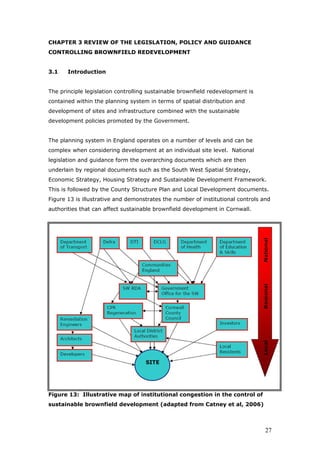
  • 56.
    Cornwall where landfilldisposal is the chosen remedial technique. The fiscal incentives of Land Remediation Relief and Landfill Tax exemption are available to off-set these additional costs. Table 7: List of Waste Management legislation and policy and the impact on sustainable brownfield redevelopment in England Name Date of Issue Relevance to Sustainable Brownfield Development Hazardous Waste (England and Wales) Regulations 2005 Defines hazardous waste and controls movement and records Requirement to notify of removal of hazardous waste produced on a development site Relevant to development of brownfield sites where contaminated however contains no sustainability provisions Landfill (England and Wales) Regulations 2002 Classifies landfills into hazardous, non-hazardous and inert which is relevant to the remediation of contaminated sites Specifies the Waste Acceptance procedures for landfilling of wastes from brownfield development sites Landfill (England and Wales)(Amendment) Regulations 2004 Replace waste acceptance criteria (WAC) and procedures which are relevant to remediation of contaminated sites Landfill (England and Wales)(Amendment) Regulations 2005 Sets WAC for monolithic waste – relevant to use of remediation techniques prior to landfill Set limits for inert waste for Polyaromatic Hydrocarbons (PAHs) relevant for landfill disposal The Environmental Protection (Duty of Care) Regulations 1991 Relevant to removal and deposit of waste from development site The List of Wastes (England) Regulations 2005 Classification of waste from brownfield development sites The provision of the legislation listed in Table 7 promotes sustainable redevelopment of brownfield sites in that it discourages the use of landfill as a remediation technique. However there currently remains a need for landfilling of certain wastes and dependant on individual site circumstances (insufficient time or space for treatment based technologies). The Landfill Regulations are likely to increase the development costs for brownfield sites although it is hoped that they will reduce the dependence on ‘dig and dump’ and utilise treatment based technologies. Section 3.2.4 discusses the concerns regarding sustainability of remediation technologies. There is currently a ban on the re-use of hazardous waste within a site once it has been excavated therefore forcing this waste to be landfilled. 45
  • 57.
    Cluster, Hub sitesand soil treatment centres have been proposed as alternatives to landfill whilst offering removal of liability from sites, increasing the speed of development and removing the requirement for treatment space within the development site. 3.2.4 Pollution Control/Remediation Permits and Technical Guidance These tend to be involved in the redevelopment of contaminated sites and include: Mobile Treatment Licences (MTL) Land Drainage Consents Waste Management Exemptions Discharge Consents They do not have specific sustainability criteria applied such as energy use, waste generation and therefore form a regulatory control on construction and remediation activities on brownfield sites but do not contribute to the sustainability agenda. The guidance contained within CR11 and specifically Options Appraisal provides significant control mechanisms for selecting remediation technologies during the redevelopment of contaminated sites. During the Options Appraisal minimum consideration is given to the sustainability of each technology for the site through the setting of site specific objectives. There is scope for this to be further advanced to ensure that the most appropriate technique for the site is selected based upon feasibility, cost and time with sustainability criteria applied at each stage. In the correct circumstances landfill may be the most sustainable technique due to the ‘real’ costs of operating soil treatment technologies such as energy usage and particulate and gaseous emissions. There is a growing concern that the carbon footprint of each technique should be evaluated for each site to ensure the most sustainable remediation technology is utilised. Historically the main issues when selecting a remediation technique has been cost and feasibility and alternatives to ‘dig and dump’ have often been considered as sustainable as they have reduced impacts from excavation and disposal to landfill. However, awareness is growing regarding the carbon footprint of each technique and although environmental impact and cost benefit analyses are used to assess sustainable brownfield redevelopment, CLAIRE (Contaminated Land: 46
  • 58.
    Applications in RealEnvironments) suggests that a “life-cycle based approach is necessary in order to fully assess the true impacts of remediation” (CL:AIRE, 2007). 3.3 Regional Documents 3.3.1 Regional Planning Guidance The South West region needs economic and social growth to provide the housing and facilities needed by the regional population. The distribution of new development and infrastructure is indicated within Regional Planning Guidance (RPG) 10. The Regional Planning Guidance for the South West is detailed in RPG10 and recognises that the south west can be broadly divided into 4 spatially defined areas. The western sub-region represents the majority of Cornwall where there is a need for strong policies and action to tackle long term and deep seated economic and social problems, accentuated by the peripherality of the County (GOSW, 2001). The document sets out the broad development strategy and provides the spatial framework for other strategies such as the Regional Housing Strategy. It must consider the Regional Sustainable Framework which has set the regional vision for achieving sustainable development. Sustainability is a continuing thread throughout the Spatial Strategy with the aim of balancing the social, economic and environmental needs of the region through the allocation of land. The Spatial Strategy has a crucial role to play in the sustainable development of brownfield sites in Cornwall as it is the regional guidance for land allocation and infrastructure provision. It specifically guides each Local Authority in provision of their Development Plans and directs the concentration of new development within the 11 identified Principle Urban Areas (PUA) as the most sustainable method of ensuring future growth of the area without compromising other needs. It also encourages LA’s to recognise the needs of the area and the promotion of ‘sustainable patterns of development’ (GOSW, 2001). No PUA has been designated in Cornwall however the Camborne-Redruth area has been recognised 47
  • 59.
    as an areafor growth and regeneration and an Urban Regeneration Company has been created for this area. In areas of the region outside of Cornwall development has jumped designated green belt land which has led to unsustainable growth of commuter towns and villages. The RPG’s view is that to achieve sustainable growth of the region development should be concentrated within the PUA’s and green belt boundaries may need to be reviewed. The spatial strategy takes account of the great diversity of the region in terms of planning, environmental, social and economic issues (GOSW, 2001) and development and infrastructure is located accordingly. 3.3.2 Regional Spatial Strategy (RSS) for the South West The RSS is the first stage in the two-tiered plan system currently used in England and Wales. It was introduced through the Planning and Compulsory Purchase Act, 2004 and sets out the overarching spatial planning strategy for a region for the long term future. The RSS for the South West is currently a draft document but will supersede RPG10:2001 following its adoption and is therefore relevant when considering the potential impact of legislation and guidance on future sustainable brownfield development in Cornwall. The key challenge within the RSS is to maintain and encourage economic growth and meet the needs of a growing and changing population whilst ensuring protection of the diverse environment. The aim is to locate development in places where jobs and homes can be more in balance (SWRA, 2006) with appropriate infrastructure thereby reducing the dependence on car travel and vehicle emissions. The concern within the RSS remains the provision of funding for social, health, education and transport infrastructure to support the increased levels of development required for the region and without suitable infrastructure development, even on brownfield sites is unlikely to be fully sustainable. The RSS has been developed in parallel with the Regional Economic Strategy as they are intrinsically linked. 48
  • 60.
    The Strategic SustainabilityAssessment process has been applied at each stage in the development of the RSS satisfying the requirements of PPS11 and ensuring that proposals are sustainable. The draft RSS takes into consideration the vision for the region outlined within the Regional Sustainable Development Framework, 2001: ‘the South West must remain a region with a beautiful and diverse environment. By working together and applying the principles of sustainability we can achieve lasting economic prosperity and social justice whilst protecting the environment. This approach will secure a higher quality of life now and for future generations.’ Figure 15: The Five inter-linking aims of the Draft RSS (SWRA, 2006) The sustainability context for the RSS is set within four high level Sustainable Development policies and these underpin the interlinking policies indicated in Figure 15. The RSS suggests that 7,500 affordable homes will be provided within the region per year until 2026. It suggests LA’s should seek to secure a minimum of 30% affordable housing provision each year across housing developments rising to 60% in areas where there is a greater need. It also suggests that the density of housing developments should exceed 30 dwellings per hectare to facilitate the 49
  • 61.
    provision of sustainabletransport systems which may be hindered with a lower development density. The RSS would appear to contribute to the sustainable development of brownfield sites within Cornwall though the setting of a framework for managing growth and change is a sustainable manner and creating sustainable communities. 3.4 Cornwall Documents 3.4.1 Cornwall County Structure Plan, 2004 The Structure Plan forms a key element of a framework of policies that together form the basis of planning decisions. It sets out the long term strategy for development in Cornwall and considers local priorities for the economy, transport and the environment. The County wide priorities and policies are interpretated at a local level through Local Development Documents. ‘Development should bring about a long term and sustainable improvement to Cornwall’s economic, social and environmental circumstances without harming future opportunity’ (CCC, 2004) The Structure Plan identifies a County housing need of approximately 29,500 new dwellings between 2001-2016 with an annual average of 1,970 (CCC, 2004). The Structure Plan and policies contained within it will be replaced by the RSS currently in preparation. The priority for Cornwall is to focus development in existing built-up areas of towns and villages with priority given to previously developed sites. However the Plan only indicates a target of 40% of Cornwall’s housing development on brownfield sites which is significantly lower than the national target of 60%. No brownfield development targets are provided for employment, tourism and recreation land uses. A key requirement of development in the Cornwall area is that it must ‘contribute towards sustainable development and the enhancement of the quality of life in Cornwall’ and protect the ‘rich and diverse character is the bedrock upon which sense of place and quality of life is founded’ (CCC, 2004). 50
  • 62.
    Table 8 summarisesthe individual policies from the Plan and assesses their contribution to sustainable brownfield development in Cornwall; Table 8: CCC Structure Plan policies and their relevance to sustainable brownfield development (CCC, 2004) POLICY NUMBER RELEVANCE TO SBD 3 Use of Resources Promotes use of PDL AND buildings and remediation of contamination and unstable ground although there is no policy referring to the use of sustainable remediation practices Promotes sustainable construction with energy efficient design, construction, local skills and materials. Encourages siting development relevant to existing infrastructure, heritage and culture to reduce congestion and traffic emissions 4 Maritime Resources Development should be within or well integrated with existing developed coast and help enhance quality of environment and economic regeneration of towns. Undeveloped coast should be protected 5 Minerals Strong emphasis on continued development of minerals industry in Cornwall within principles of sustainability. Relevant to sustainability rather than brownfield. 8, 9, 10 Housing ‘Mix of house type and tenure that meets the needs of the whole community will be encouraged’ to ensure sustainable development Re-use PDL and buildings in urban areas Re-use other sites in urban areas Extend existing urban areas in locations with good public transport links or where they can be provided Minimum provision of new housing on 40% brownfield sites Release of greenfield land should be balanced with genuine availability of PDL 11 Urban & Rural Economy ‘Economic growth and employment will be encouraged through the regeneration in the Strategic Urban Centres (SUCs) and other towns and rural restructuring and diversification’ 12 Employment No specific requirement to allocate PDL for employment Addresses sustainability issues with regards to local skills, ‘green’ travel plans and avoiding adverse impacts on natural or built environment 51
  • 63.
    3.4.2 Local DevelopmentDocuments The Local Development Framework is the second stage in the two-tiered plan system and consists of a set of documents that together outline the spatial planning strategy for the local area. They are prepared by district councils, unitary authorities or national park authorities. Each Local Authority is required to produce local development documents that are now collectively known as the Local Development Framework and replace the Local Plans. PPS12 provides the Government policy on the preparation of these documents which “collectively deliver the spatial planning strategy for the local planning authority’s area” and are designed to “promote a proactive, positive approach to managing development” (ODPM, 2004). The Local Authority’s in Cornwall are at varying stages in the production of their local development documents. The policies and land allocations should reflect the requirements of the Regional Spatial Strategy and take account of the economic, social and environmental needs of the local area. The local development documents include: • Core Strategy • Site specific land allocations • Area Action Plans These documents outline strategic proposals such as the amount of affordable housing required, density of development and the amount of development expected on previously developed land. Whilst reflecting local need and availability these proposals and targets should consider the requirements of national policy such as PPS3 and regional policy set out in the RSS. Table 9 indicates the amount of social housing required for the Local Authorities in Cornwall and Plymouth (Plymouth has been included for comparison as Caradon is included in the Plymouth Housing Market Area). A range of affordable requirements are provided and due to the rural nature of the County distinctions are made between urban and rural areas. These requirements may potentially affect the financial viability of development especially on previously developed sites where the abnormal costs associated with development are high. 52
  • 64.
    Table 9: %Affordable Housing Provision per development Local Authority Area % Affordable Housing Provision per development (Local Development Framework & Local Plan) Kerrier 25% (towns) 50% (rural) (Kerrier DC, 2004) Penwith 50% (towns) 75% (rural) (Penwith DC, 2007) Carrick Average 40% (Carrick DC, 2003) North Cornwall 50% (North Cornwall DC, 2005) Restormel 45% urban areas (66% other areas) (Restormel BC, 2006) Caradon 30% (Caradon DC, 2002) Plymouth 25% (Plymouth CC, 2005) Each development plan document is subject to a sustainability appraisal to ensure economic, environmental and social effects of the plan contribute to the achievement of sustainable development. Each authority is also required to produce a Statement of Community Involvement which states the involvement of the local community in the preparation of local development documents. The local development documents are therefore strategic documents in the promotion of sustainable brownfield development as they set the framework for future development within the local area. 53
  • 65.
    CHAPTER 4 REVIEWOF THE FINANCIAL INCENTIVES AND PROVISIONS FOR SUSTAINABLE BROWNFIELD REDEVELOPMENT IN CORNWALL Financial incentives and provisions for brownfield development are available at a Local, National and European level. This chapter assesses the availability of incentives and provisions and whether they contribute to the sustainable redevelopment of brownfield sites. The Barker Review of Land Use Planning in 2006 recommended that better use of fiscal incentives is required to encourage an efficient use of urban land to satisfy the growing demand for developable sites (Barker, 2006). As Nathanail et al, 2005 confirm incentives are also referred to as indirect regulation and are relatively new (Nathanail et al, 2005). Environmental policy has previously been dominated by direct regulatory measures. The need for incentives has arisen as it has been recognised that there are a group of previously developed sites that are commercially marginal or non-viable without public intervention and is demonstrated by Figure 16. Figure 16: Relationship between remediation costs and end-use value at economically viable, marginally viable and non-viable brownfield sites (Nathanail et al, 2005) 54
  • 66.
    4.1 European Structuraland Cohesion Funds European Union (EU) structural funding is a significant financial incentive for sustainable brownfield development and is distributed at the national, regional and sub-regional level. The aim of this funding programme is to support social and economic restructuring across the EU and accounts for approximately a third of its budget. The Structural and Cohesion Funds are divided into 3 separate funds: • European Regional Development Fund (ERDF) • European Social Fund (ESF) • Cohesion Fund (CF) Between 2000-2006 the funds were targeted on specific regions identified as Objective 1, Objective 2 and Objective 3 regions. • Objective 1 status can be summarised as promoting the development and structural adjustment of regions whose development is lagging behind. These regions are entitled to the highest level of EU funding which is awarded based on the GDP of the region in question. This status was afforded to Cornwall and the Isles of Scilly for 2000-2006. • Objective 2 status can be summarised as supporting the economic and social conversion of areas facing structural difficulties • Objective 3 status can be summarised as supporting the adaptation and modernisation of policies and systems of education, training and employment There was no sustainability criteria built in to the awarding of grants from the funding programmes and would therefore indicate that the previous EU funding regime did not consider how brownfield sites were remediated and redeveloped. Although enshrined in EU policy sustainable development surprisingly appeared unimportant at the point of local project delivery even when funded with EU grants. The individual funding programmes do not allocate to specific projects, however they set the priorities and parameters which must be achieved by the individual projects and there was therefore scope to include sustainability criteria. 55
  • 67.
    As Nathanail etal, 2005 identified the previous approach ignored and therefore placed no value on; • Sustainable reuse of soil/construction waste • Sustainable maintenance of heritage buildings • Sustainable land-use and urban design strategies • Citizen participation processes As more countries have joined the EU the allocation of funding has been modified to reflect the additional countries and their economic status. The funds from each programme are allocated to regions where the Gross Domestic Product (GDP) for the region is less than 75% of the EU average. The previous status of regions of Objective 1,2 or 3 has been modified and are now referred to as: • Objective 1 Convergence Areas Statistical Phasing Out • Objective 2 Regional Competitiveness and Employment Objective 3 2000-2006 Funding Allocations 2007-2013 Funding Allocations Figure 17: Indicates the Funding Status of Regions within the UK between 2000-2006 and 2007-2013 56
  • 68.
    Three regions withinthe UK were given Objective 1 status during the 2000 allocations, Wales, Cornwall and The Valleys and these have subsequently been awarded convergent area status in the 2007 allocations as indicated in Figure 17. Cornwall and the Isles of Scilly’s is the only area to be granted full convergent funding due to its GDP. Additional regions within the UK would possibly have qualified had the 2004 expansion of the EU not taken place which introduced countries with lower GDP than many of the regions in the UK. EC No 1828/2006 sets out the ‘rules’ for laying down the provisions of ERDF, ESF and CF. Article 46 of 1828/2006 specifically states that ‘where structural funds finance urban development funds those funds shall invest in public-private partnerships or other projects included in an integrated plan for sustainable urban development’. This is a small indication of the commitment of funds to sustainable development and although the application for funds requests an assessment of how the project contributes to the objective of environmental sustainability there is still a lack of measurable sustainability indicators such as those defined by RESCUE. Table 10 indicates the European funding programmes that are specific to Cornwall and the Isles of Scilly and the fund managing authority in the UK. Table 10: European Funding Programmes applicable in Cornwall 2007- 2013 Programme Name Funding Source UK Fund Managing Authority Programme Priorities Convergence Programme ERDF SWRDA Transform the economy where knowledge, environment and quality of life underpin sustainable economic growth Convergence and Regional Competitiveness & Employment ESF Department of Work and Pensions Develop and retain higher levels of skills in Cornwall, Support people from disadvantaged backgrounds to enter and remain in sustainable employment Territorial Cooperation ERDF Promote common solutions for urban, rural & coastal 57
  • 69.
    58 Objective development, Development ofeconomic relations, Creation of networks of small & medium sized enterprises The Convergence Programme for Cornwall consists of 75% funding from ERDF and 25% UK match funding and totals 610 million euros. The Programmes objective is to ‘establish the momentum for transforming the economy…where knowledge, environment and quality of life underpin sustainable economic growth’ (Objective One Partnership, 2007). The programme has 4 priorities at a local level which consist of; 1. Innovation, Research and Development 2. Enterprise and Investment 3. Transformation Infrastructure 4. Unlocking the Economic Potential of Place Within the Territorial Cooperation Programme there are a series of additional programmes for the 2007-2013 programming period which all aim to support the EU Regional Cohesion policy alongside ERDF and ESF. These programmes include:
  • 70.
    59 Programme/Funding Institution Programme Aim SouthWest eligibility Relevant to Sustainable Brownfield Development Cross-Border Co-operation South Area “Development of cross-border economic, social and environmental activities through joint strategies for sustainable territorial development” (SWRDA, 2007b) Cornwall, Devon, Plymouth, Torbay, Dorset, Bournemouth and Poole No specific priority for brownfield development, Support for principles of sustainability in areas of environmental management North Area As above Cornwall, Devon, Plymouth, Torbay, Dorset, Bournemouth and Poole No specific priority for brownfield development, Support for principles of sustainability in areas of environmental management Transnational Co-operation Atlantic Area “….geared towards cohesive, sustainable and balanced territorial development of the Atlantic Area and its maritime heritage” (SWRDA, 2007b) Whole of the South West Sustainable management of brownfield sites included in relation to coastal protection and knowledge transfer North West Europe “Address territorial issues…to contribute to the economic competitiveness of the area while promoting regionally balanced and sustainable development” (SWRDA, 2007b) No specific priority for sustainable brownfield development although opportunity for knowledge transfer about best practice Whole of the South West Table 11: Summary of Territorial Cooperation Programme and their Funding Institutions (SWRDA, 2007b)
  • 71.
    The National StrategicReference Framework (NSRF) (DTI, 2006) published by the Department for Trade and Industry (DTI) outlines the UK’s broad strategy for using its structural funds allocations in 2007-2013 cycle. This incorporated the findings of the DCLG Good Practice Guide for English ERDF and ESF Programmes which was published to highlight good practice and key aspects from the Objective One Programme. Figure 18 indicates the UK vision for Structural Funds spending. INNOVATION Research, knowledge transfer, commercialisation ENTERPRISE SKILLS Encouraging entrepreneurship and supporting a thriving, dynamic A skilled, adaptable workforce Figure 18: UK Vision for Structural Funds Spending (DTI, 2006) The NSRF is clear that ‘all future structural funds programmes will include integrated strategies for addressing environmental concerns…respecting the principles of sustainable development…in keeping with the Governments Sustainable Development Strategy’. Although lacking specific sustainability criteria there is at least a broad commitment to awarding funds to projects that respect sustainability principles. This is despite the lack of sustainability specific criteria from Europe. SUSTAINABLE COMMUNITIES Cohesive and productive local economies ENVIRONMENTAL SUSTAINABILITY Sustainable development, production and consumption Employment opportunities for all SUSTAINABLE ECONOMIC DEVELOPMENT EMPLOYMENT 60
  • 72.
    4.2 Finance Acts,1996 & 2001 and Urban White Paper, 2000 The Government originally published its Statement of Intent on Environmental Taxation in 1997 (HM Treasury, 1997) which was the first indication of the Governments proposals to utilise taxation as a means to achieve the policy objectives for the environment. The Urban White Paper (DETR, 2000b) was the Governments response to the Lord Rogers report, Towards an Urban Renaissance, (DETR, 1999c). The package of fiscal measures contained within the Urban White Paper were designed to make better use of the existing housing stock, provide assistance to disadvantaged areas and promote the re-use and redevelopment of brownfield sites. The details of the measures implemented are provided below There are currently tax benefits available to support the objective of brownfield redevelopment but it is clear that many do not wholly or partly contribute to the sustainability agenda. There are two broad paradigms within which tax based measures may be deployed. First, either to supplement the regulatory role of planning regimes in the control of development or second, to provide fiscal incentives that work in parallel with market mechanisms (Lloyd et al, 2001). 4.2.1 Landfill Tax Exemption (LFTE) The Landfill Tax system was introduced via the Finance Act 1996 (OPSI, 1996) as a consequence of the Chancellor Pre-Budget report in 2001 (HM Treasury, 2001a). The aim of the tax was to ‘encourage waste producers and the waste management industry to switch away from landfill towards waste minimisation, re-use and recycling’ (HM Treasury, 2001a) to ensure targets defined by the European Union in the Landfill Directive, 1999 could be achieved. The tax has been increased each year to provide this encouragement and in the 2006 Chancellors Pre-Budget report (HM Treasury, 2006) Landfill Tax was increased to £24 per tonne Reclamation of contaminated land has historically utilised the ‘dig and dump’ philosophy and the landfill tax system had the potential to inhibit reclamation 61
  • 73.
    works and thereforeredevelopment of contaminated sites. To ensure the landfill tax system did not prevent the Government objectives of regeneration an exemption was proposed by Section 43A and 43B of the Finance Act 1996 (OPSI, 1996) as inserted by the Landfill Tax (Contaminated Land) Order (OPSI, 1996a) for particular wastes arising from the reclamation of contaminated land. This enabled continued re-use of brownfield sites and in particular contaminated sites. LFTE has significantly contributed to the Governments brownfield agenda however it fails to contribute to the sustainability agenda as it promotes the use of landfill disposal an activity previously demonstrated as unsustainable. Table B.1 of the Inland Revenue Statistics 2007 estimates that the 2005-06 cost of providing LFTE for waste from contaminated land is £35million (HMRC, 2007). This is likely to increase to £45million for 2006-07 tax year and indicates the reliance placed on this mechanism (HMRC, 2007). The LFTE is currently under review (HM Treasury, 2007) as it is thought the provision of the exemption is providing an unfair bias and encouragement towards landfill disposal of brownfield soil and waste that other remediation technologies are not afforded. The development of soil and waste treatment technologies are potentially inhibited whilst ‘dig and dump’ is financially supported. 4.2.2 Land Remediation Tax Relief (LRTR) Schedule 22 and 23 of Finance Act 2001 (OPSI, 2001a) detail the current legislation for LRTR. It formed the introduction of qualifying expenditure and methods of obtaining the 150% accelerated tax relief for remediation of contaminated land. LRTR was provided as a budgetary measure to achieve the Governments Policy Objective of ‘Regenerating Britain’s Cities’ in the Chancellors Pre-Budget report in 2001 (HM Treasury, 2001a) and has been available since May 2001. The aim was to promote the re-use of contaminated sites for redevelopment thereby reducing the increasing pressures on greenfield sites and delivering local environmental, social and economic benefits. 62
  • 74.
    Table B.1 ofthe Inland Revenue Statistics 2007 estimate that the 2005-06 cost of providing LRTR is £20million increasing to £30million during the 2006-07 tax year (HMRC, 2007). These figures are based on the negative tax element for example the amounts in excess of 100% of the expenditure. They are also lower than the level of LFTE claimed suggesting a greater reliance on LFTE than LRTR and also indicating that landfill disposal still contributes a large proportion of the total remediation carried out in the UK. The Barker Review of Housing Supply in 2004 (Barker, 2004) recommended that LRTR be extended to long-term derelict land a suggestion accepted by the government and included by the Treasury in their March 2007 Tax Consultation (HM Treasury, 2007). The provision of LRR has promoted the Governments brownfield agenda and the re-use and redevelopment of contaminated sites. The provision of LRTR does not differentiate between sustainable and unsustainable methods of re-using these sites. To ensure brownfield redevelopment is sustainable then the provision of LRTR should be linked to sustainability criteria. It is possible to obtain LFTE and then LRTR on the same site therefore effectively being financially benefited on two levels. 4.2.3 Stamp Duty Exempt Areas The Chancellor’s Pre-Budget report in 2001 (HM Treasury, 2001a) outlined the proposals for stamp duty exempt areas as a measure to increase investment in deprived areas. It was provided as a budgetary measure to achieve the Governments Policy Objective of ‘Regenerating Britain’s Cities’. Part 4 (Section 92) of the Finance Act 2001 details the provision of Stamp Duty exemptions in disadvantaged areas (OPSI, 2001a). A disadvantaged area is ‘an area designated as such by regulations made by The Treasury’ (OPSI, 2001a). The Stamp Duty (Disadvantaged Areas) Regulations 2001 (OPSI, 2001) define the Local Authority areas and wards identified as being disadvantaged. These areas were defined by listings on the Index of Multiple Deprivation (ODPM, 2000a). 63
  • 75.
    The exemption appliesto all conveyances and transfer of land and/or property where the value does not exceed £150,000. It can be seen from Table 12 that a number of Cornish authorities are listed as disadvantaged areas (as defined by the 2001 Regulations). Table 12 Cornwall wards identified as Disadvantaged Areas and therefore exempt from Stamp Duty (Table G) (OPSI, 2001) LOCAL AUTHORITY WARD NAME Carrick Penwerris Kerrier Illogan South Camborne North Camborne West Camborne South Redruth North Penwith Penzance West Penzance West Hayle-Gwithian Marazion St Ives North St Just Hayle-Gwinear This provision has promoted brownfield redevelopment within the Stamp Duty Exempt areas however there are no sustainability criteria applied and the areas are defined by the Index of Multiple Deprivation (ODPM, 2000a). 4.3 State Aid There is approval from Europe for public sector support for a variety of property developments in Tier 1 and Tier 2 Assisted areas, including; 1. Gap-funded Speculative development where the developer benefits from the grant 2. Gap-funded bespoke development where there is known end-user and the occupier benefits from the grant 3. Direct development 64
  • 76.
    Grant is limitedto the minimum amount necessary to enable the development to proceed. Where limits preclude gap funding support the European approval allows for projects to be brought forward by acquiring sites and undertaking reclamation. No sustainability criteria are applied to the awarding of gap funding. Brownfield redevelopment using this funding stream is not assessed before, during or following redevelopment for its sustainability. The long term sustainability for sites where gap funding has been provided is questionable as there is usually limited market in the area which is why those sites have not been developed by the private sector. 4.4 Investment Frameworks for Regeneration 4.4.1 Public Private Partnerships (PPP) The term PPP is often used to describe a number of different working arrangements reflecting both formal and informal contractural arrangements. PPPs bring public and private sectors together in long term partnership for mutual benefit (HM Treasury, 2000). They are a key element in Government strategy for delivering modern services (HM Treasury, 2000). There are a number of types of PPP relevant to brownfield development: Asset Sales: Involves the sale of surplus public sector assets whilst sharing in the growth in value of the asset Wider markets: Introduce private sector finance to enable better use of public sector assets the sale of which may be difficult Joint venture: Public and private sectors pool their assets, finance and expertise under joint management so as to deliver long term growth (HM Treasury, 2000) Partnership Investment: Public sector contributes to funding private sector investment projects that may not otherwise happen. Allows the taxpayer to share in the financial returns of a project providing the investment offers value for money 65
  • 77.
    Unless it ispart of the partnership agreement there is no requirement for sustainability criteria to be recognised during the reclamation and development process. 4.4.2 Joint Ventures Joint ventures are partnerships formed between private sector and public sector or private sector and private sector. These ventures need to work commercially and are often based on profit and sharing agreements. With brownfield and/or contaminated sites these arrangements are effective where there may be abnormal costs such as remediation or abnormal levels of risk. Landowners are increasingly choosing to participate in these ventures to maximise value from the land. They provide the land for development and receive an agreed proportion of the profit rather than a direct payment for the land which is often used on heavily contaminated sites. This can be a favourable arrangement for developers as there is more flexibility in timing of payments and completion of the land purchase. Unless it is part of the partnership agreement there is no requirement for sustainability criteria to be recognised during the reclamation and development process. The primary purpose of developing land is to make money within the requirements of the legislation. 4.4.3 English Cities Fund (ECF) ECF consists of a private sector company which was developed by English Partnerships, AMEC and Legal and General. The fund is designed to deliver sustainable area regeneration through long term investment solutions and will invest in mixed use projects where local economies fall below the EU average. The aim of the fund is to demonstrate that high quality, mixed-use regeneration schemes provide a worthwhile investment opportunity alongside the wider community and environmental improvements. The fund works with local partners under a profit and risk sharing agreement and ensures that all activities are aligned with the Governments Sustainable Communities Plan (ODPM, 2003). 66
  • 78.
    ECF gives ahigh priority to the creation of sustainable communities and holds a portfolio of sites that have complex and challenging problems. Although lacking a requirement for measured sustainability there appears to be a general commitment to supporting projects that address the four pillars of sustainability. ECF are currently supporting the regeneration of the Millbay area in Plymouth and are working with different private development partners to bring individual sites forward. The individual developments form part of the Millbay masterplan and the Mackay ‘Vision for Plymouth’. One of the developments has required the installation of basement car parking across the majority of the site. The basements require the excavation of 25,000m3 to facilitate this construction. Unfortunately due to the previous use of the site as an infilled quarry and laundrette the material is made ground, and highly variable. Due to the variability and low levels of a variety of contaminants it has not been feasible to identify a cost effective alternative to landfill. In this instance the provision of the development has contributed to the sustainable objective of re-using PDL and regenerating communities, however the design has created an unsustainable situation. The design would have been more sustainable if the units had been built off existing ground levels. 4.4.4 Urban Regeneration Companies The aim of the URC’s was to raise the profile of areas not able to attract sufficient private investment. Cornwall’s URC was set up in 2002 to bring back to Camborne, Pool and Redruth the prosperity the area once had from its mining and engineering industries. The area has long-term challenges and has suffered from years of industrial decline and lack of investment. This has led to a population with high unemployment, low wages and large proportions of land that have become empty, derelict and contaminated. The long term vision of CPR is to ensure regeneration of the area in a sustainable manner combining new homes, employment opportunities and community and leisure facilities in an improved environment. Their role is to facilitate a range of projects involving public and private sector funding and community groups and voluntary groups. Camborne-Pool-Redruth is a strategic priority in Cornwall and the South West region for regeneration and growth. The regeneration funding partners of CPR are Cornwall County Council, English Partnerships, Kerrier District Council, SWRDA and Objective One Partnership Grant. 67
  • 79.
    CHAPTER 5 DATACOLLECTION 5.1 Introduction As chapters 3 and 4 have identified the Government has provided an array of legislation and policy controlling and regulating the development of previously developed sites with some promoting sustainable development. They have also provided and encouraged a number of financial incentives and provisions specifically for previously developed site development and again with some promoting sustainable development. With top down regulation it was important to assess the knowledge, understanding and use of these policies and provisions at a local level. The use of a questionnaire was felt to be the most appropriate form of assessing this issue. As the scope of this research has been limited to residential and mixed- use developments the questionnaire was limited to residential development companies. It should be noted that some of these companies also undertake commercial development but they were asked to reflect only the residential development part of the Company in their answers. The literature review raised a number of key questions and issues, which included: a. What are the primary reasons for developing or not developing in Cornwall? b. To what extent are developers engaging in brownfield development and utilising remediation techniques alternative to ‘dig and dump’ and is this dependant on Company size? c. To what extent are developers using the financial provisions and incentives available for brownfield development? d. Are developers seeing the effects of PPS3 at a local level and to what extent may it affect future land provision for housing development? 5.2 Methodology Companies were selected based on a search of several internet websites including the House Builders Federation and were selected if they had a southern or south west office. It was felt inappropriate to question companies that did not have a south or south west base as the researcher was keen to establish why Companies 68
  • 80.
    with an officebase within the region had or had not extended their activities to Cornwall. The method of contacting the individual Companies was the next decision based on the type of questions, response rate and the respondents role within the Company. A number of studies have concluded that telephone surveys appear to be more successful with regards to response rate. De Leeuw and Van der Zouwen, 1992 (cited in Bonnel and Le Nir, 1998) in their analysis of 25 comparative studies gave an “average response rate of 75% for face-to-face interviews and 69% for telephones interviews”. Through their research Yu and Cooper, 1983 identified a “heavy reliance on mail surveys” although they appear to be “half as effective (47.3%) as telephone surveys (72.3%). Face-to-face interviews were deemed inappropriate due to the number of Companies and their spatial distribution covering an area from Truro in Cornwall to Bristol and across to Portsmouth. Mail surveys were deemed inappropriate based on the results of previous studies as described above and concerns regarding response times. Two options were therefore available, telephone surveys or e-mail surveys. Based on a literature review of previous research and an experiment into the responses to mail and e-mail surveys, Schaefer and Dillman (1998) suggest that “e-mail surveys can be done faster than telephone surveys” and is “also inexpensive….eliminates postage, printing and/or interviewer costs”. However from their research they also conclude that “e-mail messages should be sent directly to individual respondents”. It could reasonably be expected that as the majority of the house builders had websites and all had a company e-mail address that individuals within the Company had individual e-mail addresses. However, individual contact details for the most appropriate respondents in each Company were not available to the researcher despite research of Company websites. It was therefore determined that a telephone survey would be the most appropriate. The reasoning behind individual questions is discussed more fully in section 5.3 however the designing of the individual questions was crucial to addressing the issues raised in section 5.1. 69
  • 81.
    Closed questions limitthe respondents to answers provided for each question and as Moore, 2002 recognises “forcing respondents to answer questions in this way yields responses that are assumed to be comparable and quantifiable”. Although their research was centred around work values the findings of Schuman and Presser, 1979 are relevant in deciding whether open-ended or close-ended questions are appropriate. They found disadvantages with open questions “arising from vagueness of expression by respondents….and misunderstanding by coders”. However, a number of researchers have also raised concern with potential bias arising from close-ended questions. The questions were designed to be close-ended questions to enable comparison between respondents be made. 5.3 Housing Developers Questionnaire The detailed methodology and reasoning behind this type of survey has already been described in section 5.2. This section addresses the reasoning behind each of the questions. A blank copy of the questionnaire is provided in Appendix 1. The preliminary introductory questions are self explanatory and were designed to establish the size of the company, proportion of affordable housing they provided, proportion of brownfield development the company undertook in the last financial year and the individuals role in the company. Questions 1-4 are provided in Table 12 and 13 and were designed to establish the level of development in Cornwall and key reasons for developing in the County or not developing in the County. Instructions were provided in italics to the respondents on which question they were to answer depending on previous answers. Table 12: Questions 1-2 Taken from Housing Developer Questionnaire 1. Do you develop in Cornwall? YES/ NO If you answered yes to question 1 please go to question 2 If you answered no to question 1 please go to question 4 2. How much development do you undertake in Cornwall? (please circle the one that applies) <10% 11-49% 50-74% 75-100% 70
  • 82.
    Table 13: Questions3-4 Taken from Housing Developer Questionnaire 3. What are your reasons for developing in Cornwall? (please rank your response with 1 indicating the most important reason) Geographical location  High demand for housing  Low land prices  Additional funding  High sales return  Other  ___________________________________________________________ ___________________________________________________________ 4. Why don’t you develop sites in Cornwall? (please rank your response with 1 indicating the most important reason) Geographical location  Perceived/actual problems with contamination  Low sales income  Waste disposal problems (location of haz waste sites)  Other  ______________________________________________________________ ______________________________________________________________ The suggested choices within questions 3-4 and 6-7 were provided by the researcher and were selected based on personal and professional experience. This created an opportunity for bias from the researcher and providing the respondent with the ‘other’ choice presented an opportunity for respondent vagueness leaving the question slightly open-ended. Question 5-7 relate to the develop of brownfield and greenfield sites and were designed to assess each Companies preference and reasons for developing either type of site. Table 14: Question 5 Taken from Housing Developer Questionnaire 5.4 Review of House builders Annual Reports and Websites 5. Do you have a preference for developing on greenfield or brownfield sites (please circle the one you prefer) Greenfield Brownfield No Preference If you circled greenfield please go to Question 6 If you circled brownfield please go to Question 7 71
  • 83.
    Table 15: Questions6-7 Taken from Housing Developer Questionnaire 6. With regards to your answer to question 5, why do you prefer those sites (please rank your response with 1 indicating the most important issue) Development costs are cheaper  No remediation issues  Perception of future purchasers’  Legislation/Policy  Construction process tends to be quicker  Other  __________________________________________________________________ __________________________________________________________________ 7. With regards to your answer to question 5, what are the main drivers for your company to build on brownfield sites? (please rank in order of importance with 1 being very important) Government policy and legislation  Competitive advantage  Brownfield sites more readily available  Easier to obtain permission to develop brownfield sites  Greenfield land values prohibitively high  Internal Company policy  Better opportunity for profitable development  Financial incentives available for brownfield redevelopment  Other  Question 8 was designed to identify the preferred remediation technique when developing sites requiring remedial treatment. This question was designed to assess whether the introduction of the EU Landfill Directive and its transposition into UK policy has encouraged the use of techniques other than ‘dig and dump’. Table 16: Question 8 Taken from Housing Developer Questionnaire  __________________________________________________________________ __________________________________________________________________ 8. With regards to remediation what techniques have you utilised and how often? (please tick all that apply) Always Often Rarely Never Would e consider ‘Dig and Dump’      Ex-situ biological techniques      In-situ biological techniques      Stabilisation      Solidification      Thermal      Soil Vapour Extraction      72
  • 84.
    It is theaim of the Government to ensure that costs associated with brownfield development and any required remedial treatment is factored into the land value (HM Treasury, 2007). Question 9 sought to address this issue. Table 17: Question 9 Taken from Housing Developer Questionnaire 9. Do you consider land contamination when appraising sites? Always  Occasionally  Never  They are also keen for Land Remediation Tax Relief (LFTR) to be factored into the land purchase (HM Treasury, 2007) with the view, correct or otherwise, that commercially marginal sites as indicated in Figure 15, may become commercially viable sites thereby reducing the amount of public intervention required. Question 10 assessed whether the respondent was aware and had used the financial provisions currently available, including LRTR. Table 18: Question 10 Taken from Housing Developer Questionnaire  10. Are you aware of the following financial incentives and provisions available for brownfield redevelopment and have you used them? Heard Used Use in Future Never Heard Land Remediation Relief     Landfill Tax Exemption (waste)     Stamp Duty Exempt Areas     VAT Relief for new build dwellings     GAP funding/ State Aid     As the Government are currently reviewing the provision of LRTR (HM Treasury, 2007) and Landfill tax exemption (HM Treasury, 2007), questions 11-14 were provided to assess whether respondents were claming the relief’s and what impact potential changes might have on future development. 73
  • 85.
    Table 19: Questions11-13 Taken from Housing Developer Questionnaire 11. Has the provision of LRR encouraged your company to develop contaminated sites that you wouldn’t otherwise have developed? Yes  No  Not sure  12. If you have not claimed LRR, what are your main reasons for not claiming (please rank in order of importance with 1 being the most important) Complicated paperwork  No guarantee that LRR will be granted  LRR often not received in the year of expenditure  Tax return is a small percentage of total expenditure  13. If the process of obtaining LRR was made easier would this encourage your company to develop contaminated sites that you wouldn’t otherwise develop? Yes  No  Not sure  No comment  Partnerships are schemes designed to encourage private investment into brownfield development. Question 14 was asked to assess whether private companies are participating in partnership schemes or whether they would consider participating. Table 20: Question 14 Taken from Housing Developer Questionnaire 14. Have you undertaken or would you consider the following schemes which may facilitate development on sites that would otherwise be uneconomical? Have Would Never Undertaken Consider Public/Private Partnership    Joint Venture schemes    English Cities Fund    74
  • 86.
    The researcher usedquestion 15 to assess whether the respondents held land banks and whether they were prepared to hold contaminated sites within these banks. For the purposes of this research a landbank was defined as including sites that the Company owned and which had an active planning consent. It was decided not to include land held under option or land subject to planning as it is unusual for the developer to own the site and therefore any liability from sites at this point. Table 21: Question 15 Taken from Housing Developer Questionnaire 15. Are you prepared to hold land that may be affected by contamination in a land bank for more than 6 months (this includes land that may meet the statutory definition of contaminated land) Yes  Yes under certain conditions  No  No landbank  Chapter 3 described a number of key pieces of legislation and policy that are affecting housing development on brownfield sites. Questions 16 and 17 were designed to assess the respondent’s knowledge of these policies and an open- ended question was used (17) to assess which pieces are having a significant impact on the activity of the responding Company. 75
  • 87.
    Table 22: Questions16-17 Taken from Housing Developer Questionnaire 16. Are you aware of the following legislation/policy that affects brownfield redevelopment in Cornwall? (please tick all those that you aware of) Planning Policy Statement 23: Annex 2  Planning policy Statement 1  Planning Policy Statement 3: Housing  Part C Building Regulations 2000  Code for Sustainable Homes  Part 2A of the Environmental Protection Act 1990  Planning Policy Statement 25: Flooding  Hazardous Waste Regulations  Landfill Regulations  Environmental Protection (Duty of Care) Regulations  Barker Review of Housing Supply  Towards a National Brownfield Strategy  Regional Spatial Strategy for the SW  Regional Planning Guidance  The SW Regional Housing Strategy 2005-2016  Cornwall County Structure Plan  Local Development Documents eg. Local Plan  Housing Green Paper (July 2007)  17. Which 3 pieces have the greatest impact on development undertaken by your company? __________________________________________________________________ __________________________________________________________________ ________________________________________________________________ The object of asking questions 18-20 was to assess the impact of central government policies on local policies and whether the respondents believe policies may affect the provision of land and therefore housing in the future. 76
  • 88.
    Table 23: Questions18-20 Taken from Housing Developer Questionnaire 18. Are you seeing the effects of PPS3 at a local level ie. Provision of affordable housing, densities etc. Yes  No  Not sure  19. Do you think landowners are aware of the additional requirements and potential effect on land value? Yes  No  Not sure  Some  20. Do you think that this is and will effect the amount of land coming forward for redevelopment? Yes  No  Not sure  The findings of the research are analysed in Chapter 6 and discussed in Chapter 7. Limitations with the research are discussed in Chapter 8. 77
  • 89.
    CHAPTER 6 ANALYSISOF SURVEY DATA 6.1 Introduction This chapter reviews the response rate and compares the responses to the questions described in Chapter 5. 6.2 Survey Response Rate Forty five companies were contacted primarily by telephone or by e-mail where telephone contact could not be made. Individual contact details were available to the researcher for a number of companies based on personal and professional knowledge. Twelve responses were received based on telephone calls of which individual contact details were known for five companies therefore providing a 27% response rate. Based on the review of literature discussed in Chapter 5 this response rate is lower than could be expected for a telephone based survey and the main difficulty encountered was the lack of contact details for the relevant individuals in each company. Where contact details were not known the Technical Director/Manager was requested as it was believed that this role would have the capability to answer the range of questions. A proportion of the companies contacted were too small to have this as a dedicated role and it was frequently combined with land and planning roles. This added a further difficulty due to the strategic role played by this individual within the companies and that they were often difficult to reach, did not return phone calls and often declined to participate due to the time required. Non-response is not known for the majority of companies. One respondent requested the survey by e-mail but did not return the questionnaire as their company does not undertake any development in Cornwall. Several companies requested that the questionnaire be e-mailed to ensure it could be directed to the correct person. These companies failed to respond even with follow-up telephone calls. One company contacted is currently undertaking 100% commercial development and therefore was asked not to respond by the researcher. The annual output of the survey respondents accounts for 13% of annual housing completions in the south west based on 2006 information provided by the respondents and the total private housing completions in the south west provided by DCLG (http://www.communities.gov.uk/pub/53/Table232_id1156053.xls). 78
  • 90.
    6.3 Detailed Analysisof Questions The following section summarises the responses to each of the questions. Table 24 outlines the role of the individual that responded to the survey and a summary of the annual output for that company. It outlines that the individuals responding covered a range of roles within the companies from Managing Director to a Land Buyer and it should be noted that this may influence the answers provided. Four of the companies that responded were regional branches of national groups and the responses provided represent regional figures. National figures have been taken from the house builders most recent Annual Report for these companies. It should be noted that a number of companies are currently merging and these figures may not be representative of the current situation. Table 24: Summaries of the responding companies and their annual output Role of the individual within the Company Number of Completions in 2006 or last financial year % Brownfield Development % Affordable Housing provided Land Buyer 250 (2,852)1 100 (100)1 30 (unknown)1 Technical Manager 235 (4,735)2 40 (75)2 20 (unknown)2 Project Manager 0 (17)3 0 (0)4 0 (0)5 Technical Manager 497 (14,601)6 60 (82)6 15 (19)6 Development Manager 75 100 0 Group Director 27 100 0 Company Secretary 2 0 0 Managing Director 50 100 50 Planning and Technical Director 75 45 25 Engineering Coordinator 140 50 20 Technical Coordinator 300 50 15 Technical Director 550 (1,054)8 __ (75)8 1 Information provided was based on Regional development. National information taken from the housing developer’s 2007 Annual Report 79
  • 91.
    2 Information provided wasbased on Regional development. National information taken from the housing developer’s annual report 3 This Company has only existed for 5years and had no completions for 2006. Projected completions for 2007 given in brackets provided by the respondent 4 This Company has only existed for 5 years. Information provided by the respondent indicates projected completions for 2007 are on greenfield sites 5 This Company has only existed for 5 years. Information provided by the respondent indicates that the required affordable provision for projected 2007 completions is based on an off-site contribution 6 Information provided was based on Regional development. National information taken from the housing developer’s annual report 7 This represents holiday residential units. This company undertakes predominantly commercial development 8 Information provided was based on Regional development. National information taken from the housing developer’s annual report Results for Questions 1-4 The first four questions were to assess the level of development undertaken in Cornwall. 77% of responding companies undertook some level of development in Cornwall. Of the 33% of respondents who did not develop in Cornwall the main reason provided was geographical location in that the companies in question did not extend their activities that far west. One respondent’s primary reason was concern with a fluctuating housing market in Cornwall and as they were a medium builder of <75 units per year they could not financially withstand any fluctuations. With regards to the respondents who did develop within Cornwall: • 33% recorded that it was due to high sales returns on units, • 25% claimed it was because they were a local company, • 25% recorded that it was due to geographical location ie.aesthetics • 25% believed that there is a high demand for housing predominantly from purchasers outside of the County Results for Questions 5-7 Figure 19 indicates the proportion of respondents which had a preference for either brownfield or greenfield sites. There were several bespoke brownfield developers who specifically buy brownfield and often contaminated sites whereas a similar number had no preference for either land type. 80
  • 92.
    Greenfield 16% Brownfield 42% NoPreference 42% Figure 19: Respondents preference for land type The respondents who preferred greenfield sites considered that these were preferable due to quicker construction processes, no future liability and no unknowns or hidden extras that may be uncovered during construction. The perception of future purchasers was not considered to be an important reason for developing greenfield sites. Comparisons between respondents who preferred to develop brownfield sites is more difficult as each gave different reasons for developing these sites. Two respondents agreed that internal company policy was the main driver for their company developing brownfield sites, a reason that the other respondents did not consider a priority. One respondent believed that developing brownfield sites gave their company a competitive advantage over other companies. Financial incentives offered for brownfield development such as Land Remediation Relief were not identified by any respondent as a driver for developing on brownfield sites. In fact 80% of the respondents who developed brownfield sites believed it wasn’t a consideration in site selection. One respondent who reported no preference for ether type of site has not undertaken any brownfield development and therefore although they would consider it they have yet to experience developing such sites. 81
  • 93.
    Results for Question8-9 Table 25 indicates the respondents preference for remediation techniques. As one respondent had not developed any brownfield sites they were not able to complete this question. The once technique of choice, ‘dig and dump’ is reportedly rarely used by the majority of respondents with only 27% of respondents reporting that they often use it as a technique. 82% of respondents often use cover and containment systems to address contamination issues on a development site. The majority of respondents reported that they would consider alternative treatment techniques such as stabilisation, soil vapour extraction and thermal techniques. Table 25: Respondents preference for Remediation Technique (given as a percentage of the total number of respondents) Remediation Technique Always Often Rarely Never Would consider Dig and dump 0 27 73 0 0 Ex-situ biological techniques 0 18 27 0 55 In-situ biological techniques 0 9 27 0 64 Stabilisation 0 9 45 0 46 Solidification 0 9 27 0 64 Thermal 0 0 9 27 64 Soil vapour extraction 0 0 9 9 82 Soil washing 0 9 9 18 64 Cover/containment system 9 82 9 0 0 One of the responding companies considered themselves to be specialists in the area of brownfield development and they had experience of and often used a wider range of techniques. All respondents reported that they often use a combined approach to remediation of sites and often used more than one of the techniques in Table 25 to address contamination issues. 82
  • 94.
    100% of respondentsconsider land contamination when appraising and valuing sites, therefore ensuring that the land value reflects any abnormal development costs such as remediation. Results for Questions 10-15 Figure 20 indicates the respondents knowledge of financial incentives and provisions that are available for brownfield and contaminated land development. All respondents had heard of VAT relief for new dwellings although one respondent was not sure that it was claimed by their company. 25% of respondents had not heard of LRTR although once it was explained to them by the researcher they reported that they would consider using it in the future. 0% 10% 20% 30% 40% 50% 60% 70% 80% 90% 100% Land Remediation Relief Landfill Tax Exemption Stamp Duty Exempt Areas VAT Relief Gap funding/State Aid Never Heard Use in Future Used Heard Figure 20: Respondents knowledge of financial incentives and provision available for brownfield development (given as a percentage of the total number of respondents) At least 50% of respondents had claimed landfill tax exemption during remediation of development sites. 25% had not heard of the relief which may be attributed to the individuals role within the company as these respondents included the Managing Director and Company Secretary of two companies. 83
  • 95.
    Interestingly, almost 50%had experience of gap funding with these companies ranging from volume builders in the south west to smaller bespoke companies. Yes 17% No 50% Not sure 25% No comment 8% Figure 21: Response to whether the provision of Land Remediation Tax Relief has encouraged the responding company to develop contaminated sites Figure 21 indicates that 50% of the responding companies do not consider LRTR to have encouraged them to undertake development on contaminated sites that they may not otherwise have developed. The majority of respondents independently reported that sites are required to be financially viable without the benefit of LRTR. One respondent who believed LRTR had encouraged them to develop contaminated sites reported that it was an “added extra incentive”. Response to question 12 was limited as the majority of respondents had either used LRTR or were not aware of its existence. Where companies were aware of LRTR but had not yet applied for it the reasons provided were “not sure what qualifies to receive LRTR”, “not sure it was an option for the sites remediated” and “the relief is claimed at a Group level rather than at a local level”. Due to the response to questions 10-12 no responses were recorded for question 13. 84
  • 96.
    Not develop contaminated sitesin the future 18% Develop contaminated sites using treatment technologies 18% It will have no effect 64% Figure 22: Respondents reaction if Landfill Tax Exemption was removed One respondent had not developed brownfield sites that therefore did not record any answer to question 14. With regards to the provision of Landfill Tax Exemptions 64% of respondents replied that if it was removed it would have no effect on the type of sites developed by the company. One respondent suggested that if it was removed it would decrease land values and would possibly result in some land having a negative value which would suggest that this company allow for the exemption when valuing sites. 18% replied that they would continue to develop contaminated sites and utilise alternative treatment based solutions and 18% said that they would not develop contaminated sites in the future. A respondent who would not develop contaminated sites in the future suggested that the reason would be due to additional timescales required to use alternative remedial technologies. Table 26: Indicates the type and scale of partnership development undertaken by respondents (given as a percentage of the total response) Type of Partnership Have Undertaken Would Consider Never Undertaken Public/Private Partnerships 25 17 58 Joint Ventures 75 8 17 English Cities Fund 17 8 75 With regards to developing in partnership only two of the respondents had worked with English Cities Fund and these represented two of the south west’s volume house builders. 85
  • 97.
    Table 26 demonstratesthat a large proportion of respondents indicated that they had participated in joint venture schemes with the majority indicating that these were generally undertaken with landowners. Results for Question 16 No valid assumptions can be drawn from the responses to question 16 regarding the holding of contaminated sites within landbanks as 67% of the responding companies do not currently have a landbank. Results of Question 17-18 As Table 27 indicates the only policy areas that all respondents were aware of were the Local Development Documents and Planning Policy Statement 25: Flooding. It is possibly unsurprising that all respondents were aware of the local documents affecting in development in their areas. PPS 25 is perhaps at the forefront of regulators and developers minds taking into consideration recent events in Gloucester. Table 27: Indicates respondents awareness of legislation and policy affecting brownfield development Legislation Percentage Awareness Planning Policy Statement 23: Annex 2 75 Planning policy Statement 1 83 Planning Policy Statement 3: Housing 92 Part C Building Regulations 2000 83 Code for Sustainable Homes 83 Part 2A of the Environmental Protection Act 1990 67 Planning Policy Statement 25: Flooding 100 Hazardous Waste Regulations 92 Landfill Regulations 92 Environmental Protection (Duty of Care) Regulations 75 Barker Review of Housing Supply 75 Towards a National Brownfield Strategy 25 Regional Spatial Strategy for the SW 75 Regional Planning Guidance 75 The SW Regional Housing Strategy 2005-2016 75 Cornwall County Structure Plan 58 Local Development Documents eg. Local Plan 100 Housing Green Paper (July 2007) 58 86
  • 98.
    The legislation thatrespondents were least aware of was ‘Towards a National Brownfield Strategy’ and as the full strategy has yet to be published this was perhaps an unfair question. Generally where responding companies did not undertake development in Cornwall they were not aware of the Structure Plan for Cornwall. Over 50% of respondents were aware of the recently published Housing Green paper although some were not aware of the full details. There were no clear correlations between the size of the company and the level of knowledge about brownfield legislation. Respondents were asked to record which three pieces of legislation they thought were currently having the most significant on the development of sites. It should be noted that not all respondents provided three answers. 0 10 20 30 40 50 60 70 80 Planning Policy Statement 23: Annex 2 Planning policy Statement 1 Planning Policy Statement 3: Housing Part C Building Regulations 2000 Code for Sustainable Homes Part 2A of the Environmental Protection Act 1990 Planning Policy Statement 25: Flooding Hazardous Waste Regulations Landfill Regulations Environmental Protection (Duty of Care) Regulations Barker Review of Housing Supply Towards a National Brownfield Strategy Regional Spatial Strategy for the SW Regional Planning Guidance The SW Regional Housing Strategy 2005-2016 Cornwall County Structure Plan Local Development Documents eg. Local Plan Housing Green Paper (July 2007) Figure 23: Summary of legislation and policy currently having a significant impact on development as provided by survey respondents 87
  • 99.
    Figure 23 demonstratesthat 75% of respondents considered the Planning Policy Statement for Housing as currently having the most significant impact on development. This was followed by Local Development documents which interpret national planning guidance and policy at a local level. Code for Sustainable Homes and the Planning Policy Statement for sustainability were also considered to be having a significant impact with 42% and 33% of respondents respectively citing them. PPS 25 for flooding was cited by 25% of respondents as having a significant impact of which two of these were volume house builders in the south west. Results for Questions 19-21 The results of these questions were interesting when considering the current house building requirements the Government has requested. Every respondent considered that the requirements of PPS 3 are now being implemented at a local level through Local Development documents and Supplementary Planning Guidance. When asked ‘if landowners are aware of the additional requirements within PPS 3’ 50% of respondents believed that landowners are not aware and therefore not aware of the potential impact on land values. Question 21 was concerned with the future availability of land for development and therefore the potential impact on delivering the required new housing. Figure 24 indicates the respondent’s views on the future availability of development land with the additional legislative requirements. Area specific 17% NO 17% Yes 66% Figure 24: Respondents views on whether additional legislative requirements will impact on future land availability (given as a percentage of the total) 88
  • 100.
    CHAPTER 7 DISCUSSIONOF RESULTS 7.1 Introduction The previous chapters within this thesis have covered; a. an evaluation of the legislation and policy currently controlling brownfield development in England and an assessment of whether it promotes sustainable development, b. an evaluation of the financial incentives and provisions available for brownfield development and an assessment of whether they promote sustainable development, c. a survey of current housing development companies to assess their knowledge, experience and use of a and b. This chapter seeks to draw together the findings of the previous chapters and assess whether the overall effect of Government policy is to promote or hinder sustainable brownfield development in England. The companies who responded to this survey account for 13% of annual housing completions in the south and they ranged in size from 2 units per year to the volume housebuilder who builds 550 units per year. 42% of the respondents constructed >200 units in 2006 and 25% constructed <10 units in 2006 indicating a reasonable mix of company sizes (table 24, page 81). 7.2 Does the legislation and policy promote sustainable brownfield development? The use of brownfield sites for housing redevelopment has existed for a number of years with national support through the planning policy guidance, regional support through the regional planning guidance and spatial strategy and locally through local development plans. With the publication of PPS3 the planning policy emphasis on brownfield development has remained and the 60% target for new housing on brownfield sites has been maintained (DCLG, 2006d). There is however less emphasis on the formal sequential approach and when combined with the requirement to identify sufficient deliverable sites within the Local Development documents for 5 years, there will be an opportunity and need for the allocation of greenfield sites 89
  • 101.
    in areas whereinsufficient brownfield sites are available within this timeframe. These policies compromise and contradict the apparent commitment to brownfield development in order to meet the Governments annual housing targets. This will require sufficient infrastructure to be available. The 50% brownfield development target within the south west RSS (SWRA, 2006) further undermines commitment to construct on brownfield sites despite urban local authorities in the region such as Plymouth expecting to exceed the national target of 60% (PCC, 2005). The reasons driving development on brownfield sites provided by respondents to the Dixon et al, 2006 survey included “the availability of land” and “government policy” (Dixon et al, 2006a). This was not recorded as a driver by the respondents surveyed for this thesis perhaps already a reflection of the changing policy commitments. Only 8% of respondents considered that “brownfield sites are more readily available” as the primary reason driving development on brownfield sites (page 83). 16% recorded that internal company policy was a primary driving perhaps indicating an increasing commitment at a corporate level to build on brownfield sites (page 83). Indeed a review of the volume housebuilders annual reports and websites indicates commitment to sustainable communities and brownfield development with their Corporate Social Responsibility policies. The recommendations within the Barker Review of Land Use Planning (Barker, 2006) provided support for brownfield redevelopment by suggesting the abolishment of business rate relief on empty properties and a charge on vacant derelict land. However the long term sustainability of these recommendations is questionable as charging on derelict and vacant land will not promote development where there is no market need. The recommendations also supported greenfield development by suggesting that low value agricultural land should be considered for development even if located within the green belt (Barker, 2006). This suggests that Barker considered the value and economic use of land as the primary driver for development rather than considering the value of land remaining as ‘green space’. A further recommendation was to streamline the planning system and improve its efficiency in processing applications (Barker, 2006). Generally respondents to the question of drivers for brownfield development agreed that it was not ‘easier to obtain planning permission on brownfield sites’. This is certainly my experience in the housebuilding industry with the planning system often delaying or 90
  • 102.
    preventing the constructionof new housing. This is illustrated in section 3.2.1, figure 14 where the local planning authority altered their policy on affordable housing provision while an application was being determined and as a consequence the contaminated site is unlikely to be developed. Implementing this recommendation would certainly promote sustainable brownfield development as it would ensure the value from land is released quicker and would therefore ensure construction takes place quicker. As was indicated within section 3.2.1 the financial impact of increased affordable housing provision can be significant. The social housing system was historically provided by the Local Authority using general taxes with minor financial contributions by developers under S106 contributions. The increased use of S106 obligations promoted by the Government combined with the residual land valuation process used by the majority of developers has left the individual landowners footing the bill for affordable provision for the settlement. 100% of the respondents indicated that the implications of PPS3 are now being seen at a local level with local authorities increasing the amount of affordable housing required, decreasing the site threshold at which affordable housing must be provided and increasing the density of development (page 90). As a result of these additional requirements 66% of respondents believed that the future availability of housing development land will decrease especially on brownfield sites where there are often significant abnormal costs associated with remedial works and build costs (figure 24, page 90). This is therefore likely to compromise the achievement of the annual housing targets the Government is hopeful of reaching and is likely to hinder the development of brownfield sites. 75% of respondents cited PPS3 as the policy that is having the most significant impact and causing the most difficulties (figure 23, page 89). This was followed by the provisions of Local Development Documents which isn’t surprising as these are inextricably linked to PPS3 (figure 23, page 89). The third document significantly impacting on housing development is the code for sustainable homes (figure 23, page 89). The documents not cited as causing significant impacts were generally the regional planning guidance documents which do not directly impact at a local level, Building Regulations, waste legislation and planning and pollution control (figure 23, page 89). It can be interpreted from these findings that developers 91
  • 103.
    are possibly morecomfortable with Building Regulations as they have been in existence for some time. Developers also appear to be comfortable with the requirements of PPS23 and the waste legislation and this is supported by the willingness of most respondents to develop brownfield and therefore contaminated sites. The EU Landfill Directive and its transposition into UK law has started to have an impact with 73% of respondents rarely using ‘dig and dump’ as remedial technique (table 25, page 84). This contradicts with Dixon et al, 2006 who identified from their findings that “dig and dump is still the most frequently used method of dealing with contamination” (Dixon et al, 2006a). Both this survey and Dixon et al, 2006 recorded that in-situ treatments are being used and the findings were in agreement that the most common techniques include containment and barrier methods (Dixon et al, 2006a) (table 25, page 84). These findings suggest that more sustainable techniques are being used to remediate contaminated sites where appropriate. Development on brownfield sites has not obviously decreased since the transposition of the EU Landfill Directive and although through professional experience ‘cartaway’ from a site can have significant cost implications 64% of respondents indicated that the removal of landfill tax exemption would have no effect on their business (figure 22, page 87). The findings of this survey are generally in agreement with the findings of the Dixon et al, 2006 survey except the use of ‘dig and dump’ as a remedial method was not so obvious form the results of this survey (table 25, page 84). The majority of respondents expressed concern about the current planning system and from personal experience this is a legislative area that could hinder the development of brownfield sites. 7.3 Does the provision of financial incentives and provisions promote sustainable brownfield development? The survey of housing developers addressed several of the financial incentives and provisions currently available for development on brownfield sites. The results of the survey and their relevance to the existing provisions are discussed. The provision of LRTR and current reform proposals 92
  • 104.
    The Government haveviewed the provision of LRTR as a significant financial incentive to promote development on contaminated sites (HM Treasury, 2007). The majority of respondents who were familiar with the relief reported that although it is used and does provide an added incentive the financial viability of a development needs to ‘stack up’ or be commercially robust without the relief. Based on these findings it could be implied that even where LRR has been claimed those schemes would have proceeded without the use of the relief. This is in agreement with the findings of the Ulster University Evaluation of the Urban White Paper in 2006 which concluded that “most projects for which LRR has been claimed would have proceeded without the use of the measure” (DCLG, 2006b). A quarter of the responding companies had not heard of the relief and these companies ranged in size from 0-300 units (based on 2006 figures) (figure 20, page 85). This could be attributed to the role of the individual within the company although from personal experience the tax relief is not actively promoted and certainly smaller companies may not be aware of LRR unless their financial advisors are aware of it. The extension of LRTR to long term derelict sites could potentially have an effect within Cornwall as the County has a number of persistent or ‘hardcore’ sites that have been identified on the NLUD. It has been suggested that a method of defining sites that would qualify could be through long term registration on NLUD and self-assessment. The extension of the relief could possibly promote the use of these sites although as previously discussed there is currently no requirement on the relief for the development to be remediated in a sustainable manner. There are also a variety of reasons why sites become derelict although economic reasons such as lack of investment tend to be more widely considered than environmental reasons such as contamination. In reality it is often a combination of several reasons that result in sites remaining derelict for any length of time. As the majority of speculative developers utilise the residual land valuation process remedial costs are already accounted within the land value and therefore do not qualify for LRTR in accordance with Inland Revenue CIRD60170. Therefore simply extending the relief may not have the results the Government anticipate and redevelopment of these sites is still likely to require some form of public intervention. 93
  • 105.
    The linking ofLRTR to a valid consent is unlikely to affect the activities of housing developers or impact on sustainable brownfield development as it is currently not possible to submit a claim unless there has been expenditure. In my experience developers do not undertake remedial action without a valid planning consent due to the abnormal costs involved. It is common for land purchase contracts to be linked to achieving consent and therefore no expenditure on remediation will occur until this consent is received. Therefore in the majority of cases developers would not be in a position to claim LRTR until a valid consent was in place. The timing and the type of relief could impact on brownfield development as based on the current regime the relief is; a. not guaranteed, b. is often not received during the year of expenditure, c. is received at a corporate level rather than the local or site level, and d. the majority of companies report ‘profit before tax’ and therefore the provision of a tax relief isn’t beneficial From the survey it would appear that the provision of the relief is not actively encouraging companies to develop sites that they wouldn’t otherwise develop. Whether the provision of LRTR encourages sustainable brownfield development is questionable based on a review of the relief in section 4.2.2 and the results of this survey, although the relief undoubtedly supports the development of contaminated sites. Provision of Landfill Tax Exemption and current reform proposals The Government believes that the provision of LFTE is effectively endorsing the use of ‘dig and dump’ as a remedial technique which they believe is promoting unsustainable remediation (HM Treasury, 2007). They are considering removing the exemption which they believe will ensure ‘dig and dump’ is not more financially beneficial than any other technique. With regards to the responses of the survey 64% said the removal of the exemption would not have any effect on the type of sites developed by their company (figure 22, page 87). This could be attributed to the use of the residual land valuation process where the costs of remediation are subtracted from the land value. 18% of respondents suggested they would not undertake development on contaminated sites which could affect the level of brownfield 94
  • 106.
    development taking placein the future. It should be noted that the primary concern was the length of time required for alternative techniques and therefore the length of time taken before generating revenue from the site. The provision of landfill tax was imposed due to the requirements of a variety of European Waste Directives and the requirement to minimise the volume of waste disposed at landfill. If the exemption is removed the Government is effectively taxing disposal of contaminated soil to landfill but no other remedial solutions are taxed even though other treatment based solutions may not be a sustainable solution for the individual site. The Government is reviewing the use of soil hospitals as an alternative solution to landfill although the waste management licensing system would need to be refined to facilitate the provision of these facilities. As discussed above this would possibly encourage development of contaminated sites as impacted material could be removed quickly from site allowing a development to proceed and capital to be released from a site. A quarter of respondents were not aware of the exemption although these responses included a Managing Director and a Company Secretary who wouldn’t necessarily be involved in the daily management of sites (page 87). The Use of Partnerships The use of partnerships is recognised as a cost-effective way of developing brownfield sites (HM Treasury, 2000). Within the responding group the most popular partnership was recorded as joint ventures which were frequently undertaken with landowners (Table 26, page 87). The experience of my employer is that joint ventures (JV) with landowners are frequently used where the abnormal costs of developing the site result in a negligible or negative land value. Therefore the only option of obtaining value from sites is to enter into a JV where the landowner provides the land and the development costs and resulting profit are shared. This promotes brownfield development and allows sites to be developed that may not otherwise be developed, however it does not necessarily promote sustainable brownfield development. Partnerships involving English Partnerships and English Cities Fund have sustainable criteria for the construction and occupation of units however in my 95
  • 107.
    experience they donot specifically request the use of sustainable remedial techniques. Limited experience of public/private partnerships was reported by the respondents with the majority never having undertaken this type of partnership (Table 26, page 87). Partnerships with Registered Social Landlords (RSLs) that include the provision of Social Housing Grant promote sustainability as payment of the grant is conditional upon each unit receiving ecohomes ‘very good’. There is no specific requirement for the development to be located on brownfield sites as the priority is the provision of the housing. 96
  • 108.
    CHAPTER 8 CONCLUSION Thisthesis has comprised of a literature review and evaluation of legislation and policies controlling development to assess whether it encourages or hinders sustainable brownfield development and an evaluation of the financial incentives and provisions provided to assess whether they encourage sustainable brownfield development. It has also included a survey of residential developers based in the south west of England to assess their knowledge and use of the legislation and incentives. 8.1 Limitations of the Research The questionnaire provided a response rate of 27% which was significantly lower than could have been expected when compared with the literature research previously discussed in section 5.2. This had suggested that a response rate of around 70% could be expected using a telephone survey. A response rate of 50% was expected and would have increased the statistical validity of the responses. As was indicated in section 6.2 the annual output of the survey respondents accounts for 13% of annual housing completions in the South West. As a result of the limited response this created a limited sample size which cannot be guaranteed to have provided a representative view of the current house building industry in Cornwall. It also would not be unreasonable to expect the responses to the questions to have some dependency on the role of the individual within the company and indeed respondents tended to have either a technical, planning or land background and therefore were more familiar with some aspects of the questionnaire than others. It may have been possible to have achieved a more representative and detailed view if detailed interviews had been conducted with several individuals within each company. The main issue with regards to the response rate was non-response from the majority of companies contacted. This appeared to be largely due to the lack of contact details for individuals within the companies. In hindsight I believe it would have been more beneficial to have e-mailed the questionnaire to the Technical or Land Directors within all companies and then followed up with telephone calls. The telephone survey was selected as based on the literature review discussed in section 5.2 it should have provided sufficient responses and based on the time available to conduct the survey telephone responses would have provided immediate results. 97
  • 109.
    Due to theprofessional nature of the individuals responding and the time constraints they were obviously under it was difficult to maintain their focus for all of the questions and therefore full responses were not always received. It may have been more beneficial to have left the questions open-ended as a large proportion of time was taken providing the respondents with the various choices. This was have made direct comparisons more difficult but would have possibly been quicker and removed any bias from the researcher who had selected the various choices within each question. The questions regarding development in Cornwall did not produce the answers anticipated and did not add anything significant to the findings of the survey. It is possible to assess from the responses received to question 8 (which referred to the preferred remediation techniques) whether sustainable techniques are being used to remediate contaminated sites. The responses therefore provide any indication as to whether the effects of Government policies contained in waste management legislation and guidance discussed in section 3.2.3 or through the technical guidance and permitting system discussed in section 3.2.4 are successfully promoting sustainable brownfield development in Cornwall. As previously discussed in section 7.2 the responses indicate that there is less reliance on the use of landfill as a remediation technique possibly indicating the success of Government policy in promoting the use of sustainable techniques. In reality remedial technique selection is site and contaminant specific and this question could have been explored further to assess the reasons behind selecting alternatives to landfill. 8.2 Conclusions of Research The survey discussed in chapter 7 has certainly demonstrated that development of brownfield sites has become more acceptable for the majority of housing developers, regardless of size. The level of brownfield development within the south west region for companies that are part of national groups indicated a lower proportion in the south west. The reasons for this can only be surmised as this question was not asked of the respondents. It possibly relates to the limited levels of developable brownfield sites in Cornwall when compared to other areas of the South West such as Plymouth and Exeter. It may also relate to the requirement within the Cornwall Structure Plan for only 40% (CCC, 2004) of new 98
  • 110.
    development to belocated on previously developed sites, well below. This is in comparison with Devon, a similarly rural neighbouring authority, which advocates the use of 50% within the Devon County Structure plan (DCC, 2004). The use of the residual land valuation system by the majority of residential developers results in a development climate where it is the landowner who is effectively penalised for additional legislative requirements. It is evident from the responses to questions 18-20 discussed in section 6.3 and 7.2 that the amount of development land being sold will potentially decrease with the increased legislative pressures. To maintain the amount of land required for future housing and affordable housing targets, Local Authorities may need take a more flexible and pragmatic view while implementing national and regional planning policies. This could involve reduced affordable housing provisions on sites where abnormal costs such as contamination, are increased. Permitting high density development to increase capital return from PDL sites and “relaxing certain planning obligations in defined locations” (English Partnerships, 2003). The sustainability of communities developed using financial incentives is questionable unless significant funding is also provided for infrastructure such as schools, transport networks and medical facilities. The concept of incentives is effectively ‘forcing’ the local market where the market can potentially not sustain itself and perhaps indirect regulation would be more appropriate to make development in some areas easier than others such as the use of Simplified Planning Zones discussed in section 3.2.1. As discussed in section 4.3 incentives have been used to improve the design of new housing and increase the provision of affordable housing which some sites may not have been able to support without the provision of incentives. The research within section 3.2.1 suggests that Government planning policies have been relatively successful in promoting brownfield development and shifting the pattern away from greenfield sites, as demonstrated in figure 3 of section 2.4. However following developments in Government policy in the last 12 months with the publication of PPS 3 and the apparent relaxing in greenfield development policy it seems likely that developers will increase development on greenfield sites (previously defined in section 2.3.1). The issue of whether Government policy promotes sustainable brownfield development is also questionable in a number of situations and there appears to be some areas that conflict. 99
  • 111.
    Based on thelimited results of this survey discussed in chapter 7, developers are anticipating problems with land availability and landowner awareness. This ultimately could impact on the Governments desire for annual development of 240,000 additional houses. The requirement for additional houses is as a result of population changes due to in-migration but also due to an increase in the number of households as described in section 2.2. Also discussed in section 2.2 was the issue that there are 680,412 empty properties in England (DCLG, 2005) which could also be utilised to support the requirement for additional housing and the re-use of existing structures would potentially be more sustainable than developing new sites, in terms of land use and construction materials. Based on the 2005 statistics there is almost three years supply of housing already built and waiting occupation. Taxing empty houses would be an incentive to encourage owners to ensure their houses have occupants. It is clear that there still remains (albeit slightly weaker) a policy commitment to re-use brownfield sites for new housing development however there is a balance to be struck between the housing needs of today and the future and the environmental and well-being needs of society today and in the future. The subject of sustainable brownfield development will continue to be discussed as the needs of a growing population and/or households are required to be met. The aim of this thesis was to critically evaluate whether the overall effect of government policy is to encourage or hinder sustainable brownfield redevelopment in Cornwall. From the literature reviews in chapters 3 and 4 and the survey of housing developers in Cornwall it would appear that brownfield development is encouraged through legislation and policy at a national, regional and Cornwall level (as indicated by the increasing levels of development shown in figure 4) although could be stronger with regards to the PDL re-use targets. The provision of financial incentives can only encourage brownfield development although are not used that frequently. However, although the existing legislation and incentives tend to encourage brownfield development they do not appear to encourage sustainable brownfield development. The potential impact of this for Cornwall is that unsustainable brownfield redevelopment is potentially creating the brownfield sites of the future. 100
  • 112.
    8.3 Further Research Furtherassessment is required about the approach at an individual site level to assess whether sustainable brownfield development is being achieved. This could include adoption of sustainability criteria such as those proposed by RESCUE, 2005 and assessment of individual sites in Cornwall. A more comprehensive national survey would provide a more balance and representative view of the current housing building climate. Repeating the work undertaken by Dixon et al, 2006 in light of the recent policy changes would enable exact comparisons and assess more reliably whether these changes are significantly impacting on sustainable brownfield development. The recent tax incentives consultation (HM Treasury, 2007) is due to be published by the Government late-2007 and it would be useful to re-survey the respondents following the implementation of these provisions to assess whether any changes will significantly impact on sustainable brownfield development. This research should be re-assessed in light of any significant changes such as the Soil Framework Directive currently proposed by the European Union (European Commission, 2006). In August 2007 Cornwall County Council was been granted unitary status known as ONE Cornwall and will move to a single tier of political regulation. The provision of Local Development documents will therefore be undertaken by the single authority rather than the 6 district councils. Following the implementation of unitary status this research should be reviewed to assess what effects unitary status has made, if any, on sustainable brownfield development policy in Cornwall. 8.4 Recommendations Through the research in this thesis a number of key recommendations can be made to ensure sustainable brownfield development is undertaken in Cornwall. 1. Introduce a set of sustainability indicators/criteria for the allocation of funding to focus support towards sustainable brownfield redevelopment. 101
  • 113.
    As was discussedin Chapter 4 none of the funding provisions require the use or measurement of sustainable remediation techniques. 2. The provision of soil treatment centres within Cornwall will reduce the quantity of contaminated soils being landfilled and will also avoid the transportation of contaminated soils large distances. This measure would ensure that contaminated soils requiring treatment prior to development do not provide a barrier to development in Cornwall. 3. Extend the targets for PDL to cover all end uses in addition to the targets for residential end use. This would ensure a comprehensive targeted system of PDL re-use independent of proposed end-use. 4. Phase out the Landfill Tax Exemption scheme as it encourages the use of landfill disposal and potentially inhibits the use of sustainable remediation techniques. The result of the survey of developers discussed in section 3 also indicates that the removal of LFTE would have no effect on the majority of residential developers. 5. Provide incentives to local authorities to ensure they use the Empty Dwelling Management Orders (DCLG, 2007) to ensure effectiveness use of existing housing stock. Section 2.2 discussed the number of empty properties within England. The most sustainable option would be to ensure these properties are occupied before new housing is constructed. 102
  • 114.
    REFERENCES Adams, D. (2004)The changing regulatory environment for speculative housebuilding and the construction of core competencies for brownfield development, Environment and Planning A, Vol 36, pp 601-624, Alker, S., Joy, V., Roberts, P., Smith, N. (2000) The Definition of Brownfield, Journal of Environmental Planning and Management, Vol 43, No. 1, pp 49-69 Barlow, J., Bartlett, K., Hooper, A., Whitehead, C. (2002) Land for Housing: Current Practice and Future Options, Joseph Rowntree Foundation Barker, K. (2003) Review of Housing Supply – Securing Our Future Needs (Interim Report – Analysis), HMSO, London Barker, K. (2004) Review of Housing Supply, Delivering Stability: Securing Our Future Housing Needs (Final Report – Recommendations), HMSO, London Barker, K. (2006) Barker Review of Land Use Planning, Final Report: Recommendations, HMSO, London Blair, T. (2004) Prime Minister’s Speech on Climate Change, 14th September 2004, http://www.number-10.gov.uk/output/page6333.asp Bonnel, P., Le Nir, M. (1998) The Quality of Survey Data: Telephone versus face-to- face interviews, Transportation, 25, pp147-167 Booth, P. (1999) From regulation to discretion: The evolution of development control in the British planning system 1909-1947, Planning Perspectives, 14:3, pp 277-289 Brown, G. In Great Britain. Parliament. House of Commons. (2007). Official Reports. Parliamentary Debates (Hansard). London. HMSO. 11-07_2007:1449 Bruntland Commission (1987), “Our Common Future”, World Commission on Environment and Development, New York, NY. Cabernet (2007a) http://www.cabernet.org.uk/index.asp?c=1134 Cabernet (2007b) http://www.cabernet.org.uk/index.asp?c=1311 Caradon District Council (2002) Housing Needs Survey – Volume II Affordable Housing to Meet the Housing Need, http://www.caradon.gov.uk/index.cfm?articleid=12566 Carrick District Council (2003) A Housing Strategy for the Carrick District, Carrick District Council, Truro Catney, P., Dixon, T., Henneberry, J. (2006) Navigating the Brownfield Maze: Making sense of Brownfield Regeneration Policy and Governance, SUBR:IM Conference. Chenoweth, J., Pediaditi, K., Wehrmeyer, W. (2005) Monitoring the sustainability of brownfield redevelopment projects: the Redevelopment Assessment Framework, Land Contamination and Reclamation, 13(2), pp 173-183
  • 115.
    Clark, T., Dilnot,A. (2002) Measuring the UK fiscal stance since the Second World War, The Institute of Fiscal Studies, Briefing Note No.26 CL:AIRE (2007) Subrim Bulletin: Uncovering the True Impacts of Remediation, http://www.claire.co.uk/pdf_usr/SUB2_final_amended_figs.pdf Commission for Architecture and the Built Environment (2007) Housing Audit, CABE, London. Cornwall County Council (CCC) (2004) Cornwall County Structure Plan, http://www.cornwall.gov.uk/index.cfm?articleid=9111 Cornwall County Council (CCC) (2005) Local Transport Plan 2006-2011; Annex 2 Cornwall’s Challenges and Concerns-The Evidence Base http://db.cornwall.gov.uk/ltp/marchannex2/section_6716503837.html Cornwall Tourist Board (2005) The Value of Tourism in Cornwall 2005 by County and District, http://www.cornwalltouristboard.co.uk/documents/CornwallValueofTourism.pdf Cornwall County Council (2006) Demographic Change in Cornwall, http://www.cornwallstatistics.org.uk/media/pdf/r/i/demographic_change_cornwalls ept06.pdf Crow, S. (1996) Development control: the child that grew up in the cold, Planning Perspectives, Vol.11, pp 399-411 Cullingworth, J.B. (1962) New Towns for Old: The problem of urban renewal, Fabian Society, Fabian Research Series 229 De Leeuw, E., Van der Zouwen (1992) Data Quality and the Mode of Collection: Methodology and Explanatory Model (cited in Bonnel, P., Le Nir, M. (1998) The Quality of Survey Data: Telephone versus face-to-face Interviews, Transportation, 25, pp147-167) Department of Communities and Local Government (DCLG) (2005a) HSSA (Housing Strategy Statistical Appendix) 2004/05 http://www.communities.gov.uk/pub/922/HSSA2005SectionsAGExcel778Kb_id1162 922.xls Department of Communities and Local Government (DCLG) (2005b) Planning Policy Statement 1: Delivering Sustainable Development, DCLG Publications, London. Department for Communities and Local Government (DCLG) (2006a) Code for Sustainable Homes: A step-change in sustainable home building practice, DCLG Publications, London. Department for Communities and Local Government and University of Ulster (2006b) Evaluation of the Urban White Paper Fiscal Measures, DCLG and Ulster University Department for Communities and Local Government (DCLG) (2006c) Planning Obligations: Practice Guidance, DCLG Publications, London. Department for Communities and Local Government (DCLG) (2006d) Planning Policy Statement 3: Housing, DCLG Publications, London.
  • 116.
    Department of Communitiesand Local Government (DCLG) (2006e) Planning Policy Statement 25: Development and Flood Risk, The Stationary Office, London. Department for Communities and Local Government (DCLG) (2006f) Previously- Developed Land that may be available for Development: England 2005, DCLG Publications, Yorkshire Department of Communities and Local Government (DCLG) (2007) Homes for the future: more affordable, more sustainable, The Stationary Office, London Department for Communities and Local Government (DCLG) (2007a) Live Tables on Housebuilding: Table 232, Permanent dwellings completed by tenure and region, http://www.communities.gov.uk/pub/53/Table232_id1156053.xls Department of Communities and Local Government (DCLG) (2007b) Statistical Release: House Price Index, June 2007, http://www.communities.gov.uk/pub/233/HPIJune07_id1512233.pdf Department of Communities and Local Government (DCLG) (2007c) Statistical Release: New Projections of Households for England and the Regions to 2029, http://www.communities.gov.uk/index.asp?id=1002882&PressNoticeID=2374 Department of Communities and Local Government (DCLG) (2007d) Previously Developed Land that may be available for development: England 2006, DCLG Publications, Yorkshire Department for the Environment, Transport and the Regions (DETR) (1998), Planning for Communities of the Future, The Stationary Office, London. Department for the Environment, Transport and the Regions (DETR) (1999a), A Better Quality of Life: a Strategy for Sustainable Development in the UK, The Stationary Office, London. Department for the Environment, Transport and the Regions (DETR) (1999b), Quality of Life Counts: Indicators for a strategy for sustainable development for the UK, EPSIM, London Department for the Environment, Transport and the Regions (DETR) (1999c), Urban Taskforce Report: Towards an Urban Renaissance, The DETR, London. Department for the Environment, Transport and the Regions (DETR) (2000a), Indices of Multiple Deprivation for wards in England, National Statistics Online (http://www.statistics.gov.uk/StatBase/Product.asp?vlnk=9421&Pos=1&ColRank=2 &Rank=272) Department for the Environment, Transport and the Regions (DETR) (2000b), Urban Taskforce Report: Our Towns and Cities: the future – Delivering the Urban Renaissance, HMSO, London. Department for the Environment, Transport and the Regions (DETR) (2005), Urban Taskforce Report: Towards a Strong Urban Renaissance, The DETR, London Department of the Environment (DOE) (1990a) Planning Policy Guidance 14: Development on Unstable Land, DOE, London Department of the Environment (DOE) (1990b) Planning Policy Guidance 16: Archaeology and Planning, DOE, London
  • 117.
    Department of theEnvironment (DOE) (1991) Planning Policy Guidance 18: Enforcing Planning Control, DOE, London Department of the Environment (DOE) (1992a) Planning Policy Guidance 4: Industrial, commercial development and small firms, DOE, London Department of the Environment (DOE) (1992b) Planning Policy Guidance 5: Simplified Planning Zones, DOE, London Department of the Environment (DOE) (1992c) Planning Policy Guidance 19: Outdoor Advertisement Control, DOE, London Department of the Environment (DOE) (1992d) Planning Policy Guidance 20: Coastal Planning, DOE, London Department of the Environment (DOE) (1994a) Planning Policy Guidance 15: Planning and the Historic Environment, DOE, London Department of the Environment (DOE) (1994b) Planning Policy Guidance 24: Planning and Noise, DOE, London Department of the Environment (DOE) (1994c) Sustainable Development, the UK Strategy, DOE, London Department of Trade and Industry (DTI) (2006) National Strategic Reference Framework; EU Structural Funds Programme 2007-2013, DTI, London Devon County Council (DCC) (2004) Devon Structure Plan 2001-2016: Devon to 2016, Devon County Council, Exeter Dixon, T., Pocock, Y., Waters, M. (2006a) An analysis of the UK development industry’s role in brownfield regeneration, Journal of Property Investment, Vol 24, No.6, pp 521-541 Dixon, T., Pocock, Y., Waters, M. (2006b) The role of the UK Development Industry in Brownfield Regeneration: Stage 2, Volume 3 (of 3) Case Studies Summary, Oxford Brookes University Dixon, T., Pocock, Y., Waters, M. (2006c) The role of the UK Development Industry in Brownfield Regeneration: Stage 3, Best Practice Checklist for Key Brownfield Stakeholders, Oxford Brookes University East of England Regional Assembly (2004) Draft Revision to the Regional Spatial Strategy for the East of England English Partnerships (2003) Towards a National Brownfield Strategy, English Partnerships, London. English Partnerships (2006) Brownfield Research Summary: The Economic Impact of Recycling Brownfield Land, English Partnerships, London English Partnerships, Housing Corporation (2007) A Cost Review of the Code for Sustainable Homes, http://www.englishpartnerships.co.uk/publications.htm#sustainablehomes
  • 118.
    European Commission, (2006)Proposal for a Directive of the European Parliament and of the Council Establishing a Framework for the Protection of Soil and Amending Directive 2004/35/EC: COM (2006) 232 final http://ec.europa.eu/environment/soil/pdf/com_2006_0232_en.pdf Franz, M., Nathanail, CP., Pahlen, G., Thornton, G. (2007) The development of a brownfield-specific framework for regenerating sites: proposing a new definition of ‘sustainable brownfield regeneration’, Land Contamination and Reclamation, 15(1) Government Office for the East of England (2000) Regional Planning Guidance for East Anglia (RPG 6) to 2016, The Stationary Office, London Government Office for the East, South East and London (2001) Regional Planning Guidance for the South East (RPG 9), The Stationary Office, London Government Office for the East Midlands (2005) Regional Spatial Strategy for the East Midlands (RSS 8), The Stationary Office, London Government Office for the North East (2002) Regional Planning Guidance (RPG 1) The Stationary Office, London Government Office for the South West (GOSW) (2001) Regional Planning Guidance for the South West (RPG 10), The Stationary Office, London Government Office for the South West (GOSW) (2007) Cornwall and Isles of Scilly Brief, http://www.gosw.gov.uk/497666/docs/220636/309014/corniosbrf.doc Government Office for the West Midlands (2004) Regional Planning Guidance (RPG 1), The Stationary Office, London HBOS (2006) Halifax County House Price Survey of the UK: Press Release 14_04_06, http://www.hbosplc.com/economy/includes/14-04- 06HalifaxCountyHousePriceSurvey_UK.doc HM Government (2005) Securing the Future: Delivering UK Sustainable Development Strategy, The Stationary Office, London HM Government (2007) Planning for a Sustainable Future: White Paper, The Stationary Office, London HM Revenue and Customs (HMRC) (2007) Cost of Minor Tax Allowances and Reliefs, http://www.hmrc.gov.uk/stats/tax_expenditures/table-b1.pdf HM Treasury (1997) Statement of Intent on Environmental Taxation, http://www.hm- treasury.gov.uk/topics/environment/topics_environment_policy.cfm HM Treasury (2000) Public Private Partnerships; The Governments Approach, The Stationary Office, London HM Treasury (2001a) Pre-budget Report; Building a stronger, fairer Britain in an Uncertain World, HM Treasury, London HM Treasury (2001b), The Stamp Duty (Disadvantaged Areas) Regulations, The Stationary Office, London
  • 119.
    HM Treasury (2002)Tax and the Environment: using economic instruments, The Stationary Office, London HM Treasury (2005) Pre-budget Report; Britain meeting the global challenge: Enterprise, fairness and responsibility, HM Treasury, London HM Treasury (2006) Pre-budget Report; Investing in Britain’s Potential: Building our long-term future, HM Treasury, London HM Treasury (2007), Tax Incentives for development of brownfield land: a consultation, HM Treasury, London Joint Committee on Labour Problems After the War (JCLPW). (1917) A million new homes after the war, Co-op Printing Society Ltd, London Kerrier District Council (2004) Kerrier Vision, Strategy and Core Policies (Draft Development Plan Document) 2005-2026 Kerrier District Council, Camborne Land Registry (2007) Land Registry House Price Index, April 2007 http://www.landregistry.gov.uk/assets/library/documents/hpir0507.pdf Lloyd, McCarthy, Berry and McGreal (2001) Fiscal Incentives for Urban Regeneration, ESRC Report 2001 (cited in Department for Communities and Local Government and University of Ulster (2006b) Evaluation of the Urban White Paper Fiscal Measures, DCLG and Ulster University) Matthews, R.C.O., Feinstein, C.H., Odling-Smee, J.C. (1982) British Economic Growth 1856-1973-The post war period in historical perspective, Oxford University Press, Oxford Scholarship Online. 20 August 2007, Chapter 1, p5 (http://www.oxfordscholarship.com/oso/private/content/economicsfinance/978019 8284536/p025.html#acprof-9780198284536-chapter-1) Moore, R.J. (2004) Managing Troubles in Answering Survey Questions: Respondents Use of Projective Reporting, Social Psychology Quarterly, Vol.67, No.1, pp50-69 Nathanail, CP., Thornton, G., Millar, K. (2003) Whats in a word: UK and International definitions of Brownfield. Sustain, 4 (3), 45-46 Nathanail, CP., Thornton, G. (2005) Are incentives for regenerating UK brownfield sites sustainable, Land Contamination and Reclamation, 13(4) National Land Use Database (NLUD) (2005) NLUD-PDL Site Data (Cornwall Local Authorities), http://62.73.191.157/nlud/nlud_default.asp North Cornwall District Council (2005) North Cornwall Local Development Framework; Draft Core Strategy, North Cornwall District Council, Bodmin North West Regional Assembly (2006) Draft Regional Spatial Strategy for the North West England, Paver Downes, Liverpool Objective One Partnership for Cornwall and the Isles of Scilly (2007) Convergence Programme for Cornwall and the Isles of Scilly: Operational Programme 2007-13, http://www.objectiveone.com/O1htm/01-convergence/SWConvOPNegotiationDraft- v1.pdf
  • 120.
    Office of theDeputy Prime Minister (ODPM) (1998) Planning for the Communities of the Future, The Stationary Office, London. Office of the Deputy Prime Minister (ODPM) (2000) Our Towns and Cities: The Future – Delivering an Urban Renaissance, The Stationary Office, London. Office of the Deputy Prime Minister (ODPM) (2000a) Index of Multiple Deprivation, The Stationary Office, London. Office of the Deputy Prime Minister (ODPM) (2001a) Planning Policy Guidance 2: Green Belts, The Stationary Office, London. Office of the Deputy Prime Minister (ODPM) (2001b) Planning Policy Guidance 8: Telecommunications, The Stationary Office, London. Office of the Deputy Prime Minister (ODPM) (2001c) Planning Policy Guidance 13: Transport, The Stationary Office, London. Office of the Deputy Prime Minister (ODPM) (2002) Planning Policy Guidance 17: Planning for open space, sport and recreation, The Stationary Office, London Office of the Deputy Prime Minister (ODPM) (2003) Sustainable Communities: Building for the Future, The Stationary Office, London. Office of the Deputy Prime Minister (ODPM) (2004a) Consultation on Planning Policy Statement 1: Creating Sustainable Communities, The Stationary Office, London. Office of the Deputy Prime Minister (ODPM) (2004b) Planning Policy Statement 7: Sustainable Development in Rural Areas, The Stationary Office, London. Office of the Deputy Prime Minister (ODPM) (2004c) Planning Policy Statement 11: Regional Spatial Strategies, The Stationary Office, London. Office of the Deputy Prime Minister (ODPM) (2004d) Planning Policy Statement 12: Local Development Frameworks, The Stationary Office, London. Office of the Deputy Prime Minister (ODPM) (2004ef) Planning Policy Statement 22: Renewable Energy, The Stationary Office, London. Office of the Deputy Prime Minister (ODPM) (2004) Planning Policy Statement 23: Planning and Pollution Control, The Stationary Office, London. Office of the Deputy Prime Minister (ODPM) (2004g) Planning Policy Statement 23: Planning and Pollution Control - Annex 2: Development on Land Affected by Contamination, The Stationary Office, London. Office of the Deputy Prime Minister (ODPM) (2004h) The English Indices of Deprivation (Revised), ODPM Publications, West Yorkshire. Office of the Deputy Prime Minister and English Partnerships (2004) The National Land Use Database of Previously Developed Land: National and South-west Summary, ODPM and English Partnerships, London. Office of the Deputy Prime Minister (ODPM) (2005a) Circular 5/2005 Planning Obligations, The Stationary Office, London.
  • 121.
    Office of theDeputy Prime Minister (ODPM) (2005b) Planning Policy Statement 1: Delivering Sustainable Development, The Stationary Office, London. Office of the Deputy Prime Minister (ODPM) (2005c) Planning Policy Statement 6 : Planning for Town Centres, The Stationary Office, London. Office of the Deputy Prime Minister (ODPM) (2005d) Planning Policy Statement 9: Biodiversity and Geological Conservation, The Stationary Office, London. Office of the Deputy Prime Minister (ODPM) (2005e) Planning Policy Statement 10: Planning for Sustainable Waste Management, The Stationary Office, London. Office of the Deputy Prime Minister (ODPM) (2005f) Sustainable Communities: People, Places and Prosperity, HMSO, Norwich. Office of the Deputy Prime Minister (ODPM) (2006) National Land Use Database: Land Use and Land Cover Classification Version 4.4, HMSO, Norwich. Office of National Statistics (ONS) (2004) Summary of 2004-based Sub national Population Projections, http://www.statistics.gov.uk/statbase/Expodata/Spreadsheets/D9488.xls Office of Public Sector Information (OPSI) (1991a) The Finance Act, The Stationary Office, London Office of Public Sector Information (OPSI) (1991b) The Environmental Protection (Duty of Care) Regulations, The Stationary Office, London Office of Public Sector Information (OPSI) (1996) The Finance Act, The Stationary Office, London Office of Public Sector Information (OPSI) (1996a) Landfill Tax (Contaminated Land) Order (SI 1996 No.1529), The Stationary Office, London Office of Public Sector Information (OPSI) (2000) The Building Regulations, The Stationary Office, London Office of Public Sector Information (OPSI) (2001) The Stamp Duty (Disadvantaged Areas) Regulations, The Stationary Office, London Office of Public Sector Information (OPSI) (2001a) The Finance Act, The Stationary Office, London Office of Public Sector Information (OPSI) (2002) The Landfill (England and Wales) Regulations, The Stationary Office, London Office of Public Sector Information (OPSI) (2004a) Planning and Compulsory Purchase Act, The Stationary Office, London Office of Public Sector Information (OPSI) (2004b) The Landfill (England and Wales) (Amendment) Regulations, The Stationary Office, London Office of Public Sector Information (OPSI) (2004c) Sustainability and Secure Buildings Act, The Stationary Office, London Office of Public Sector Information (OPSI) (2005a) The Landfill (England and Wales) (Amendment) Regulations, The Stationary Office, London
  • 122.
    Office of PublicSector Information (OPSI) (2005b) The Hazardous Waste (England and Wales) Regulations, The Stationary Office, London Office of Public Sector Information (OPSI) (2005c) The List of Wastes (England) Regulations, The Stationary Office, London Official Journal of the European Union (2006) Commission Regulation (EC) No 1828/2006, Penwith District Council (2007) Penwith Local Development Framework – Housing Topic Paper, Penwith District Council, Penzance Plymouth City Council (PCC) (2005) Local Development Framework; Core Strategy Preferred Options, Plymouth City Council, Plymouth RESCUE (2005a) Best Practice Guidance for Sustainable Brownfield Regeneration, Edwards, D., Pahlen, G., Bertram, C. and Nathanail, C.P. Land Quality Press on behalf of the RESCUE consortium, Nottingham RESCUE (2005b) Workpackage 1: Development of an Analytical Framework for the Context of Brownfield Regeneration in France, Germany, Poland and the UK, Kogelheide, C., Franz, M., Himmelmann, R., Butzin, B. On behalf of the RESCUE consortium http://www.rescue- europe.com/download/reports/1_Analytical%20sustainability%20framework.pdf Restormel Borough Council (2006) Local Development Framework; Core Strategy Submission Document, Restormel Borough Council, St Austell Schaefer, D.R., Dillman, D.A. (1998) Development of a standard e-mail methodology: Results from an experiment, Public Opinion Quarterly, 62, pp 378- 397 Schuman, H., Presser, S. (1979) The Open and Closed Question, American Sociological Review, Vol.44, pp692-712 South Hams District Council (1996) South Hams Local Plan 1989-2001 South West Housing Body (2005) South West Regional Housing Strategy South West Observatory: Environment (2007) Cornwall and the Isles of Scilly Nature Map, http://www.swenvo.org.uk/nature_map/cornwall.asp South West Regional Assembly and Sustainability South West (2001) A Sustainable Future for the South West South West Regional Assembly (SWRA) (2006) Draft Regional Spatial Strategy for the South West 2006-2026 South West Regional Development Agency (SWRDA) (2007a) County and Unitary Authorities Map, http://www.southwestrda.org.uk/about/index.shtm South West Development Agency (SWRDA) (2007b) Territorial Co-operation Programmes for 2007-2013, Syms, P. (1999) Redeveloping brownfield land: The decision making process, Journal of Property Investment, Vol 17, No.5, pp 481-500
  • 123.
    Syms, P.M., Knight,P.E. (2000) Building Homes on Used Land, RICS Books, London Syms, P.M. (1997) The Redevelopment of Contaminated Land for Housing Use (Research Report for Joseph Rowntree Foundation), ISVA, London United States Environmental Protection Agency (2002) Small Business Liability Relief and Brownfields Revitalization Act, Public Law, 107-118 (H.R. 2869) Yelling, J. (1999) The development of residential urban renewal policies in England: Planning for modernisation in the 1960s, Planning Perspectives, 14, pp 1-18 Yelling, J. (2000) The incidence of slum clearance in England and Wales, 1955-85, Urban History, 27:2, pp 234-254 Yu, J., Cooper, H. (1983) A quantitative review of research design effects on response rates to questionnaires, Journal of Market Research, 20, pp36-44
  • 124.
    APPENDIX 1 EXAMPLE OFTHE QUESTIONNAIRE
  • 125.
    Housing Developers Questionnaire Thisquestionnaire forms part of a piece of research assessing whether the overall effect of Government policy is to encourage or inhibit sustainable brownfield redevelopment. The results of this survey will be reported in my thesis which contributes to an MRes in Contaminated Land Management. The information you provide will be kept in the strictest confidence. A copy of the aggregated responses can be provided if you are interested in the results. ______________________________________________________________________ Company Reference No………………………………………………………………………………………………… Position in the company……………………………………………………………………………………………….. Number of completions in 2006…………………………………………………………………………………….. % Affordable housing completed in 2006……………………………………………………………………….. % of completions on brownfield sites…………………………………………………………………………….. 1. Do you develop in Cornwall? YES/ NO If you answered yes to question 1 please go to question 2 If you answered no to question 1 please go to question 4 2. How much development do you undertake in Cornwall? (please circle the one that applies) <10% 11-49% 50-74% 75-100% 3. What are your reasons for developing in Cornwall? (please rank your response with 1 indicating the most important reason) Geographical location High demand for housing Low land prices Additional funding High sales return Other ___________________________________________________________ ________________________________________________________________ ________________________________________________________________
  • 126.
    4. Why don’tyou develop sites in Cornwall? (please rank your response with 1 indicating the most important reason) Geographical location Perceived/actual problems with contamination Low sales income Waste disposal problems (location of haz waste sites) Fluctuating housing market Other ________________________________________________________________ ________________________________________________________________ ________________________________________________________________ 5. Do you have a preference for developing on greenfield or brownfield sites (please circle the one you prefer) Greenfield Brownfield No Preference If you circled greenfield please go to Question 6 If you circled brownfield please go to Question 7 6. With regards to your answer to question 5, why do you prefer those sites (please rank your response with 1 indicating the most importan e)t issu Development costs are cheaper No remediation issues Perception of future purchasers’ Legislation/Policy Construction process tends to be quicker Other ________________________________________________________________ ________________________________________________________________ ________________________________________________________________ ________________________________________________________________
  • 127.
    7. With regardsto your answer to question 5, what are the main drivers for your company to build on brownfield sites? (please rank in order of importance with 1 being very important) Government policy and legislation Competitive advantage Brownfield sites more readily available Easier to obtain permission to develop brownfield sites Greenfield land values prohibitively high Internal Company policy Better opportunity for profitable development Financial incentives available for brownfield redevelopment Other ________________________________________________________________ ________________________________________________________________ 8. With regards to remediation of soil contamination what techniques have you utilised and how often? (please tick all that apply) Always Often Rarely Never Would consider ‘Dig and Dump’ Ex-situ biological techniques In-situ biological techniques Stabilisation Solidification Thermal Soil Vapour Extraction Soil Washing Cover/containment systems 9. Do you consider land contamination when appraising sites to ensure the land value reflects environmental considerations? Always Occasionally Never
  • 128.
    10. Are youaware of the following financial incentives and provisions available for brownfield redevelopment and have you used them? Heard Used Use in Future Never Heard Land Remediation Relief Landfill Tax Exemption (waste) Stamp Duty Exempt Areas VAT Relief for new build dwellings GAP funding/ State Aid 11. Has the provision of LRR encouraged your company to develop contaminated sites that you wouldn’t otherwise have developed? Yes No Not sure 12. If you have not claimed LRR, what are your main reasons for not claiming (please rank in order of importance with 1 being the most important) Complicated paperwork No guarantee that LRR will be granted LRR often not received in the year of expenditure Tax return is a small percentage of total expenditure 13. If the process of obtaining LRR was made easier would this encourage your company to develop contaminated sites that you wouldn’t otherwise develop? Yes No Not sure No comment 14. The UK Government is currently reviewing the provision of LFTE, if this is removed will it encourage your company to…?(please tick all that apply) Not to develop contaminated sites Develop contaminated sites & use treatment based technologies It will have no effect
  • 129.
    15. Have youundertaken or would you consider the following schemes which may facilitate development on sites that would otherwise be uneconomical? Have Would Never Undertaken Consider Public/Private Partnership Joint Venture schemes English Cities Fund 16. Are you prepared to hold land that may be affected by contamination in a land bank for more than 6 months (this includes land that may meet the statutory definition of contaminated land) Yes Yes under certain conditions No No landbank 17. Are you aware of the following legislation/policy that affects brownfield redevelopment in Cornwall? (please tick all those that you aware of) Planning Policy Statement 23: Annex 2 Planning policy Statement 1 Planning Policy Statement 3: Housing Part C Building Regulations 2000 Code for Sustainable Homes Part 2A of the Environmental Protection Act 1990 Planning Policy Statement 25: Flooding Hazardous Waste Regulations Landfill Regulations Environmental Protection (Duty of Care) Regulations Barker Review of Housing Supply Towards a National Brownfield Strategy Regional Spatial Strategy for the SW Regional Planning Guidance The SW Regional Housing Strategy 2005-2016 Cornwall County Structure Plan Local Development Documents eg. Local Plan Housing Green Paper (July 2007)
  • 130.
    18. Which 3pieces have the greatest impact on development undertaken by your company? ________________________________________________________________ ________________________________________________________________ ________________________________________________________________ 19. Do you think the provisions within PPS 3 are being executed at a local level with changes in local planning policy? Yes No Not sure 20. Do you believe that landowners are aware of these additional requirements and the potential negative affect on land values? Yes No Some Not sure 21. Do you think this is starting to affect the amount of land coming forward for development? Yes No Not sure
  • 131.