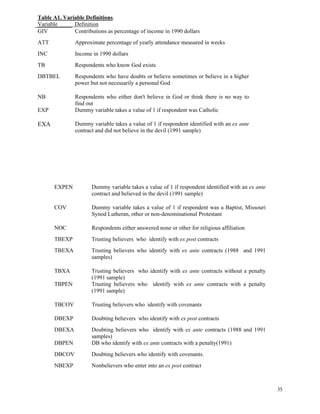
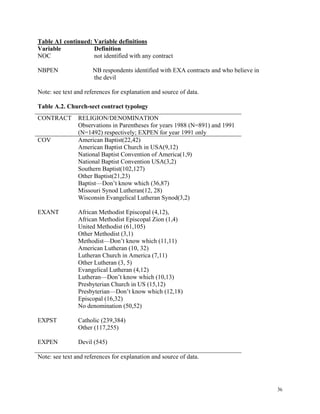
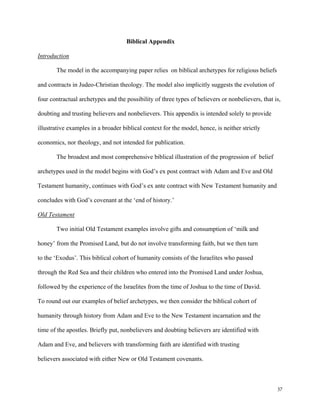
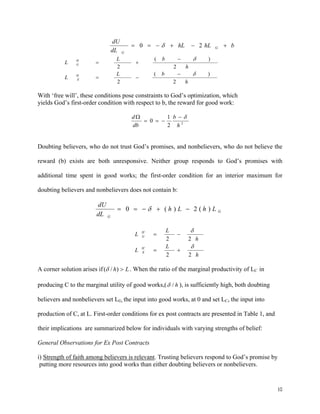
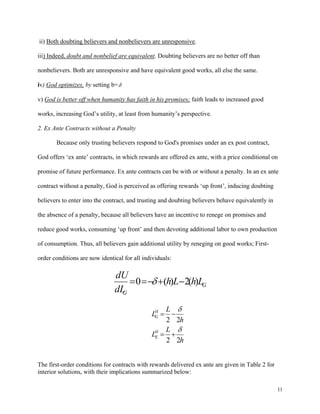
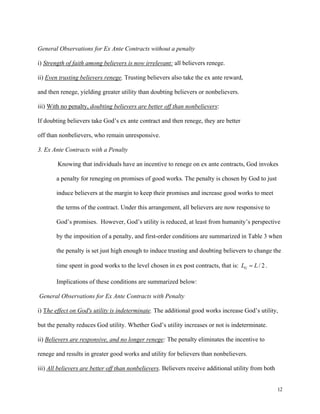
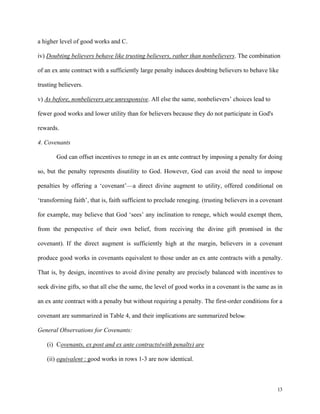
The document presents an economic model of God and humanity as optimizing agents within the context of Judeo-Christian religious beliefs. It analyzes four primary belief archetypes or "contracts" between God and humanity: 1) Ex post contracts where rewards are conditional on observed good works, 2) Ex ante contracts without penalties for reneging, 3) Ex ante contracts with penalties, and 4) Transformed faith contracts emphasizing divine gifts over works or penalties. The model generates testable predictions about how these contracts differentially affect individuals' incentives and behavior based on their strength of faith or doubt. Empirical analysis of individual survey data provides some support for the model's counterintuitive predictions.

![25
References (continued)
Iannaccone, Laurence R., Rodney Stark, and Roger Finke. 1997. “Deregulating Religion: The
Economics of Church and State”. Economic Inquiry 35 (April): 350-364.
Johnson, Benton. 1957. A “Critical Appraisal of Church-Sect Typology”. American
Sociological Review 22:88-92.
Johnson. Benton. 2009 Interviews with authors.
Johnson, Benton. 1963. “On Church and Sect”. American Sociological Review 28:539-549.
Johnson, Benton. 1971. “Church and Sect Revisited”. Journal for the Scientific Study of
Religion 10:124-137.
Lehrer, Evelyn L. 2004. “Religion as a Determinant of Economic and Demographic Behavior in
the United States”. IZADP, no.1390.
Lipford, Jody, and Robert Tollison. 2003. “Religious Participation and Income”. Journal of
Economic Behavior and Organization 51:249-260.
Long, Stephen H., and Russell F. Settle. 1977. “Household Allocation of Time and Church
Attendance: Some Additional Evidence”. The Journal of Political Economy 85 (2):409-413.
Mangeloja, Esa. 2003. “Application of Economic Concepts on Religious Behavior”. EconWPA:
Others, no. 0310003.
Meeks, M.D. 1989. God the Economist: The Doctrine of God and Political Economy.
Minneapolis: Fortress Press.
Neuman, S. 1986. “Religious Observance within a Human Capital Framework: Theory and
Application”. Applied Economics 18:1193-1202.
Oslington, Paul. Deus Economicus. MRPA, 102:1-13.
Sherkat, Darren E. “Counterculture or Continuity? Competing Influences on Baby Boomers’
Religious Orientations and Participation”. Social Forces 76, no. 3 (March): 1087-1115.
Sherkat, Darren E. “Tracking the Restructuring of American Religion: Religious Affiliation and
Patterns of Religious Mobility, 1973-1998”. Social Forces 79, no.4 (June): 1459-1493.
Sherkat, Darren E. and John Wilson. “Preferences, Constraints, and Choices in Religious
Markets: An Examination of Religious Switching and Apostasy”. Social Forces 73, no.3
(March): 993-1026.
Smith, Adam. [1776] 1965. An Inquiry into the Nature and Causes of the Wealth of Nations.
New York: Modern Library.
Stark, Rodney, Laurence R.](https://image.slidesharecdn.com/f3cfcc2c-63d4-4ec5-acfd-c9ed8064b226-150220105818-conversion-gate01/85/MPRA_paper_22539-26-320.jpg)