June 22,2016
Introduction to
Managed Pressure Drilling
Tushar Dmonte
MPD wellsite supervisor
Secure Drilling Services
Weatherford Oil Tool Middle East Ltd
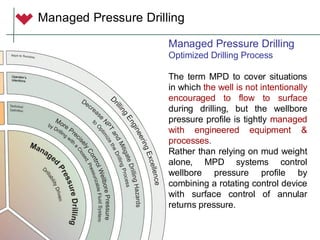
Managed Pressure Drilling
Optimized Drilling Process
The term MPD to cover situations
in which the well is not intentionally
encouraged to flow to surface
during drilling, but the wellbore
pressure profile is tightly managed
with engineered equipment &
processes.
Rather than relying on mud weight
alone, MPD systems control
wellbore pressure profile by
combining a rotating control device
with surface control of annular
returns pressure.
3
MPD Definition
MPD - An adaptive drilling process used to precisely control the
annular pressure profile throughout the wellbore. The objectives
are to ascertain the downhole pressure environment limits and to
manage the annular hydraulic pressure profile accordingly. The
intention of MPD is to avoid continuous influx of formation fluids to
the surface. Any influx incidental to the operation will be safely
contained using an appropriate process.
Reactive vs Proactive MPD
The technique is effectively on
“standby” as an enhanced
form of passive well control to
help manage unexpected
downhole pressure.
The technique is used to its
maximum effectiveness to
mitigate a wide range of
drilling hazards. Proactive
MPD radically reduces drilling
NPT by enabling fundamental
changes to fluid casing and
openhole programs
Reactive Proactive
Managed Pressure Drilling - Introduction
Drivers for Apply MPD – where is it applicable?
What is not MPD?
Summary of advantages
The cost – benefit ratio
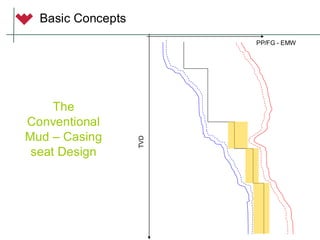
PP/FG - EMW
TVD
The
Conventional
Mud – Casing
seat Design
Basic Concepts
7
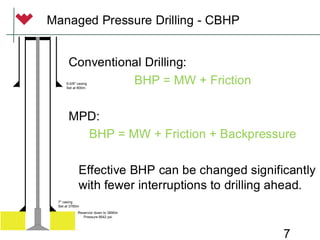
Managed Pressure Drilling - CBHP
Conventional Drilling:
BHP = MW + Friction
MPD:
BHP = MW + Friction + Backpressure
Effective BHP can be changed significantly
with fewer interruptions to drilling ahead.
9-5/8" casing
Set at 800m
7" casing
Set at 3785m
Reservoir down to 3890m
Pressure 6642 psi
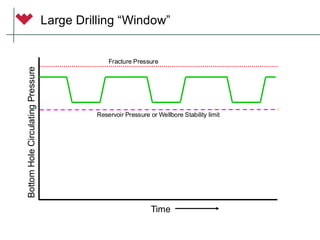
Large Drilling “Window”
Bottom
Hole
Circulating
Pressure
Time
Fracture Pressure
Reservoir Pressure or Wellbore Stability limit
Bottom
Hole
Circulating
Pressure
Time
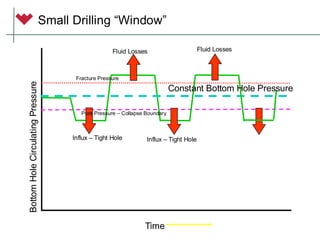
Small Drilling “Window”
Fluid Losses
Influx – Tight Hole Influx – Tight Hole
Fluid Losses
Constant Bottom Hole Pressure
Fracture Pressure
Pore Pressure – Collapse Boundary
10
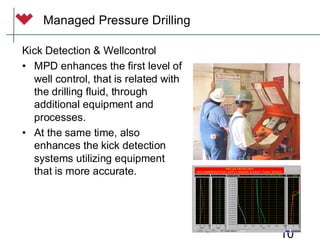
Kick Detection & Wellcontrol
• MPD enhances the first level of
well control, that is related with
the drilling fluid, through
additional equipment and
processes.
• At the same time, also
enhances the kick detection
systems utilizing equipment
that is more accurate.
Managed Pressure Drilling
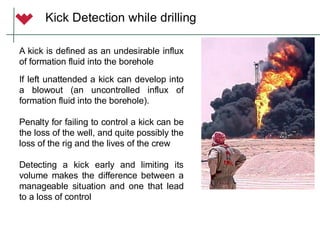
Kick Detection while drilling
A kick is defined as an undesirable influx
of formation fluid into the borehole
If left unattended a kick can develop into
a blowout (an uncontrolled influx of
formation fluid into the borehole).
Penalty for failing to control a kick can be
the loss of the well, and quite possibly the
loss of the rig and the lives of the crew
Detecting a kick early and limiting its
volume makes the difference between a
manageable situation and one that lead
to a loss of control
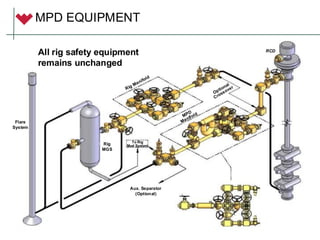
All rig safety equipment
remains unchanged
Flare
System
Rig
MGS
To Rig
Mud System
Aux. Separator
(Optional)
RCD
MPD EQUIPMENT
Formation Evaluation – Dynamic FIT
The application of MPD will allow the determination
the performance of “Dynamic FIT” by the increase
of the bottom hole pressure through a controlled
annular backpressure.
Managed Pressure Drilling
Formation Evaluation – Formation Pressure
The application of MPD will allow the
determination the performance of “ascertain”
the formation pressure
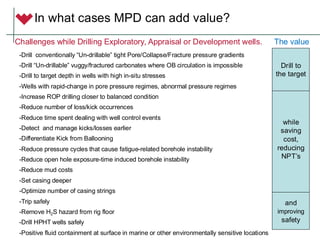
In what cases MPD can add value?
-Drill conventionally “Un-drillable” tight Pore/Collapse/Fracture pressure gradients
-Drill “Un-drillable” vuggy/fractured carbonates where OB circulation is impossible
-Drill to target depth in wells with high in-situ stresses
-Wells with rapid-change in pore pressure regimes, abnormal pressure regimes
-Increase ROP drilling closer to balanced condition
-Reduce number of loss/kick occurrences
-Reduce time spent dealing with well control events
-Detect and manage kicks/losses earlier
-Differentiate Kick from Ballooning
-Reduce pressure cycles that cause fatigue-related borehole instability
-Reduce open hole exposure-time induced borehole instability
-Reduce mud costs
-Set casing deeper
-Optimize number of casing strings
-Trip safely
-Remove H2S hazard from rig floor
-Drill HPHT wells safely
-Positive fluid containment at surface in marine or other environmentally sensitive locations
Challenges while Drilling Exploratory, Appraisal or Development wells.
while
saving
cost,
reducing
NPT’s
and
improving
safety
Drill to
the target
The value
MPD SYSTEM CAPABILITIES
• A variety of options:
– Controlling pressure (manual or automatic): BHP, surface
back-pressure, stand pipe pressure, ….
– Automatic kick detection and control: pore pressure
determination
– Automatic loss detection and control: frac pressure
determination
• Option selection based on well design, well problems and well
objectives.
MPD Variants
Pressurize Mud Cap Drilling (PMCD)
Dual Gradient
HPHT
CBHP
MPD Variants
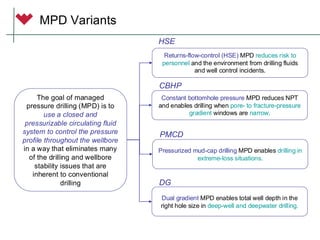
The goal of managed
pressure drilling (MPD) is to
use a closed and
pressurizable circulating fluid
system to control the pressure
profile throughout the wellbore
in a way that eliminates many
of the drilling and wellbore
stability issues that are
inherent to conventional
drilling
Pressurized mud-cap drilling MPD enables drilling in
extreme-loss situations.
Constant bottomhole pressure MPD reduces NPT
and enables drilling when pore- to fracture-pressure
gradient windows are narrow,
Dual gradient MPD enables total well depth in the
right hole size in deep-well and deepwater drilling.
Returns-flow-control (HSE) MPD reduces risk to
personnel and the environment from drilling fluids
and well control incidents.
PMCD
CBHP
DG
HSE
Constant Bottom Hole Pressure (CBHP)
Challenge
Narrow pore- to fracture-pressure gradient windows present a drilling hazard.
When the hole is being drilled ahead or circulated clean the formation fractures
and losses are incurred. When circulation is ceased a kick occurs. A kick-loss
situation ensues, and nonproductive time (NPT), lost fluid costs and HSE
escalate.
Constraints
Reservoir hydrocarbon returns to surface are not desirable and may be
prohibited. Target total well depth must be reached with a certain hole size if
well productivity is to be optimized. A conventional ,drilling fluids program—and
associated number of casing strings—is jeopardizing these objectives.
Answer - Constant Bottom Hole Pressure (CBHP)
Applied annulus backpressure is controlled by an RCD that allows maintaining
BHP at a constant value that does not exceed formation fracture gradient, even
when circulating.
Constant Bottom Hole Pressure (CBHP)
Features, Advantages and Benefits
• Annulus backpressure is controlled at surface which means that changes in
BHP normally occurring when operating the mud pumps to circulate and
sdrill ahead do not occur.
• Whether the mud column is static or dynamic, BHP is constant and can be
more easily maintained within the bounds of a narrow pore-to fracture-
pressure gradient window.
• The ability to more accurately “walk the line” between pore- and fracture-
pressure gradients means that the hole section can be drilled deeper before
drilling mud density is changed and casing must be set.
• Pore-pressure estimate uncertainty can be easily accommodated by simple
adjustment of applied annulus backpressure.
• Deeper casing shoes help ensure that the well is drilled to TD in the target
hole size.
• Drilling with a fluid that is “lighter than conventional wisdom would
prescribe” significantly imcreases rate of penetration.
• A more constant BHP reduces pressure variations that would otherwise
promote wellbore instability.
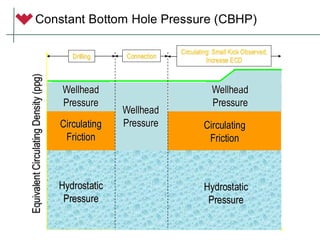
Time
Equivalent
Circulating
Density
(ppg)
Drilling Connection
Hydrostatic
Pressure
Wellhead
Pressure
Circulating
Friction
Wellhead
Pressure Circulating
Friction
Circulating: Small Kick Observed,
Increase ECD
Wellhead
Pressure
Hydrostatic
Pressure
Constant Bottom Hole Pressure (CBHP)
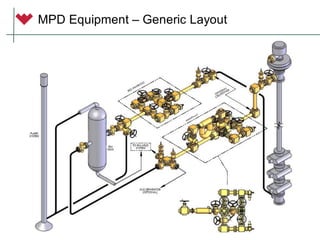
MPD Equipment – Generic Layout
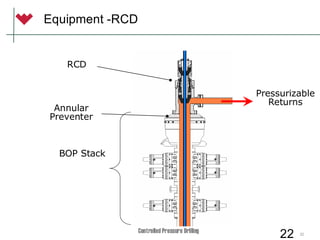
22
Controlled Pressure Drilling 22
BOP Stack
Annular
Preventer
RCD
Pressurizable
Returns
Equipment -RCD
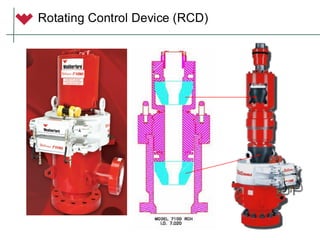
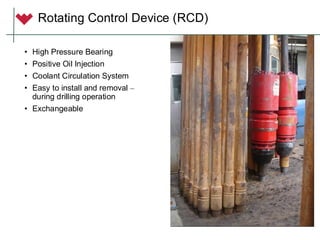
Rotating Control Device (RCD)
• High Pressure Bearing
• Positive Oil Injection
• Coolant Circulation System
• Easy to install and removal –
during drilling operation
• Exchangeable
Rotating Control Device (RCD)
MANUAL: Manual control of the choke position, with monitoring of flow in and
out, remote transmission of data and remote visualization using website, as long
as an internet connection at the well site is provided.
SEMI-AUTOMATIC: Surface back pressure set point control.
AUTOMATIC PRESSURE CONTROL: Automatic control of any pressure
variable desired – BHP, stand pipe pressure, surface back pressure, annular
pressure at reference depth.
AUTOMATIC KICK /LOSS CONTROL: Automatic kick and losses detection and
control.
MPD – System Flexibility
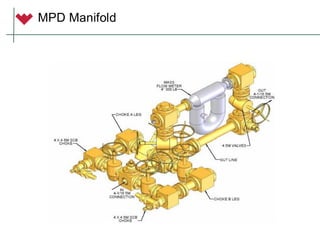
MPD Manifold
MODEL 2700
Coriolis Transmitter
MODEL 2700
Coriolis Transmitter
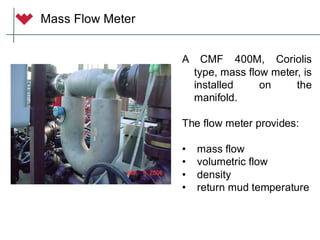
Mass Flow Meter
A CMF 400M, Coriolis
type, mass flow meter, is
installed on the
manifold.
The flow meter provides:
• mass flow
• volumetric flow
• density
• return mud temperature
28
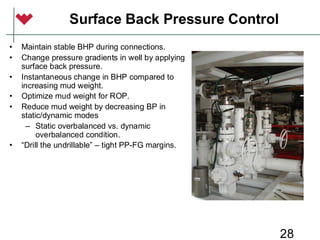
Surface Back Pressure Control
• Maintain stable BHP during connections.
• Change pressure gradients in well by applying
surface back pressure.
• Instantaneous change in BHP compared to
increasing mud weight.
• Optimize mud weight for ROP.
• Reduce mud weight by decreasing BP in
static/dynamic modes
– Static overbalanced vs. dynamic
overbalanced condition.
• “Drill the undrillable” – tight PP-FG margins.
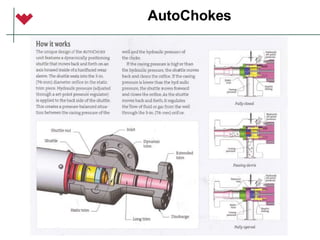
AutoChokes
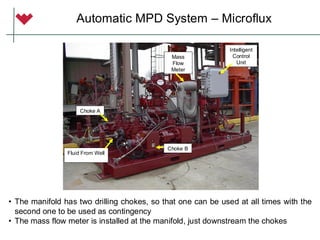
Intelligent
Control
Unit
Mass
Flow
Meter
Choke B
Choke A
Fluid From Well
Automatic MPD System – Microflux
• The manifold has two drilling chokes, so that one can be used at all times with the
second one to be used as contingency
• The mass flow meter is installed at the manifold, just downstream the chokes
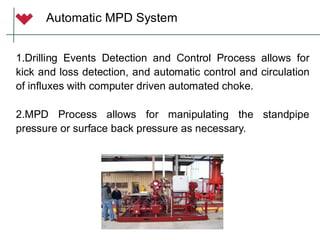
1.Drilling Events Detection and Control Process allows for
kick and loss detection, and automatic control and circulation
of influxes with computer driven automated choke.
2.MPD Process allows for manipulating the standpipe
pressure or surface back pressure as necessary.
Automatic MPD System
Auto-Control On/Off: These modes enable/disable the automatic
reaction of the choke to any detected influx
Auto-Control On: This mode enables the automatic reaction of the
choke to a detected influx. If an influx is detected, then the system will
proceed to “kick modes” to automatically operate the choke to control
and circulate the influx out of the wellbore.
Auto-Control Off: This mode disables the automatic reaction of the
choke. If an influx is in progress, it will still be detected and the operator
will be warned. However, the choke will take no action to stop the influx.
SD Software - Operational Modes
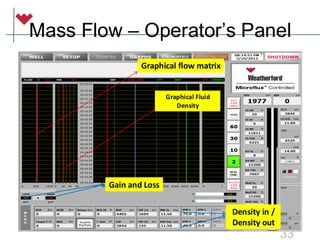
Mass Flow – Operator’s Panel
33
Gain and Loss
Density in /
Density out
Graphical flow matrix
Graphical Fluid
Density
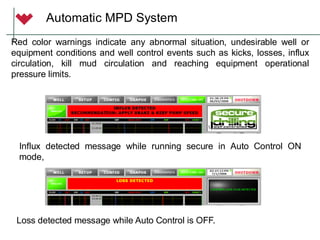
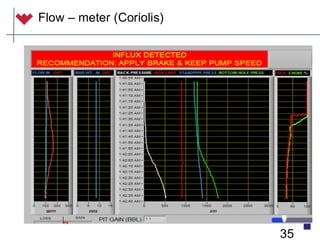
Red color warnings indicate any abnormal situation, undesirable well or
equipment conditions and well control events such as kicks, losses, influx
circulation, kill mud circulation and reaching equipment operational
pressure limits.
Influx detected message while running secure in Auto Control ON
mode,
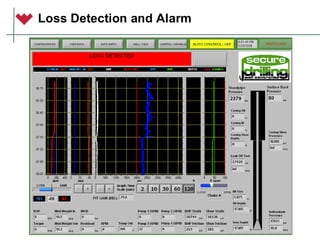
Loss detected message while Auto Control is OFF.
Automatic MPD System
35
Flow – meter (Coriolis)
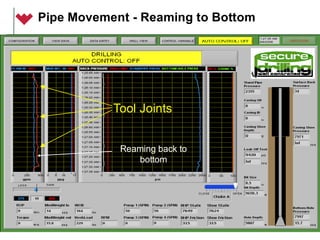
Pipe Movement - Reaming to Bottom
Tool Joints
Reaming back to
bottom
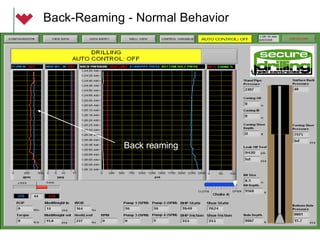
Back reaming
Back-Reaming - Normal Behavior
Loss Detection and Alarm
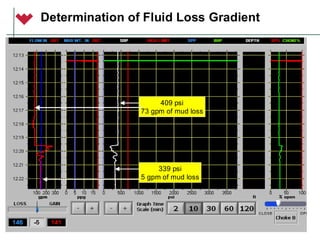
Determination of Fluid Loss Gradient
339 psi
5 gpm of mud loss
409 psi
73 gpm of mud loss

MPD FOUNDATIONAL KNWOLEDGE. Manager Pressure Drilling

  • 1.
    June 22,2016 Introduction to ManagedPressure Drilling Tushar Dmonte MPD wellsite supervisor Secure Drilling Services Weatherford Oil Tool Middle East Ltd
  • 2.
    Managed Pressure Drilling ManagedPressure Drilling Optimized Drilling Process The term MPD to cover situations in which the well is not intentionally encouraged to flow to surface during drilling, but the wellbore pressure profile is tightly managed with engineered equipment & processes. Rather than relying on mud weight alone, MPD systems control wellbore pressure profile by combining a rotating control device with surface control of annular returns pressure.
  • 3.
    3 MPD Definition MPD -An adaptive drilling process used to precisely control the annular pressure profile throughout the wellbore. The objectives are to ascertain the downhole pressure environment limits and to manage the annular hydraulic pressure profile accordingly. The intention of MPD is to avoid continuous influx of formation fluids to the surface. Any influx incidental to the operation will be safely contained using an appropriate process.
  • 4.
    Reactive vs ProactiveMPD The technique is effectively on “standby” as an enhanced form of passive well control to help manage unexpected downhole pressure. The technique is used to its maximum effectiveness to mitigate a wide range of drilling hazards. Proactive MPD radically reduces drilling NPT by enabling fundamental changes to fluid casing and openhole programs Reactive Proactive
  • 5.
    Managed Pressure Drilling- Introduction Drivers for Apply MPD – where is it applicable? What is not MPD? Summary of advantages The cost – benefit ratio
  • 6.
    PP/FG - EMW TVD The Conventional Mud– Casing seat Design Basic Concepts
  • 7.
    7 Managed Pressure Drilling- CBHP Conventional Drilling: BHP = MW + Friction MPD: BHP = MW + Friction + Backpressure Effective BHP can be changed significantly with fewer interruptions to drilling ahead. 9-5/8" casing Set at 800m 7" casing Set at 3785m Reservoir down to 3890m Pressure 6642 psi
  • 8.
    Large Drilling “Window” Bottom Hole Circulating Pressure Time FracturePressure Reservoir Pressure or Wellbore Stability limit
  • 9.
    Bottom Hole Circulating Pressure Time Small Drilling “Window” FluidLosses Influx – Tight Hole Influx – Tight Hole Fluid Losses Constant Bottom Hole Pressure Fracture Pressure Pore Pressure – Collapse Boundary
  • 10.
    10 Kick Detection &Wellcontrol • MPD enhances the first level of well control, that is related with the drilling fluid, through additional equipment and processes. • At the same time, also enhances the kick detection systems utilizing equipment that is more accurate. Managed Pressure Drilling
  • 11.
    Kick Detection whiledrilling A kick is defined as an undesirable influx of formation fluid into the borehole If left unattended a kick can develop into a blowout (an uncontrolled influx of formation fluid into the borehole). Penalty for failing to control a kick can be the loss of the well, and quite possibly the loss of the rig and the lives of the crew Detecting a kick early and limiting its volume makes the difference between a manageable situation and one that lead to a loss of control
  • 12.
    All rig safetyequipment remains unchanged Flare System Rig MGS To Rig Mud System Aux. Separator (Optional) RCD MPD EQUIPMENT
  • 13.
    Formation Evaluation –Dynamic FIT The application of MPD will allow the determination the performance of “Dynamic FIT” by the increase of the bottom hole pressure through a controlled annular backpressure. Managed Pressure Drilling Formation Evaluation – Formation Pressure The application of MPD will allow the determination the performance of “ascertain” the formation pressure
  • 14.
    In what casesMPD can add value? -Drill conventionally “Un-drillable” tight Pore/Collapse/Fracture pressure gradients -Drill “Un-drillable” vuggy/fractured carbonates where OB circulation is impossible -Drill to target depth in wells with high in-situ stresses -Wells with rapid-change in pore pressure regimes, abnormal pressure regimes -Increase ROP drilling closer to balanced condition -Reduce number of loss/kick occurrences -Reduce time spent dealing with well control events -Detect and manage kicks/losses earlier -Differentiate Kick from Ballooning -Reduce pressure cycles that cause fatigue-related borehole instability -Reduce open hole exposure-time induced borehole instability -Reduce mud costs -Set casing deeper -Optimize number of casing strings -Trip safely -Remove H2S hazard from rig floor -Drill HPHT wells safely -Positive fluid containment at surface in marine or other environmentally sensitive locations Challenges while Drilling Exploratory, Appraisal or Development wells. while saving cost, reducing NPT’s and improving safety Drill to the target The value
  • 15.
    MPD SYSTEM CAPABILITIES •A variety of options: – Controlling pressure (manual or automatic): BHP, surface back-pressure, stand pipe pressure, …. – Automatic kick detection and control: pore pressure determination – Automatic loss detection and control: frac pressure determination • Option selection based on well design, well problems and well objectives.
  • 16.
    MPD Variants Pressurize MudCap Drilling (PMCD) Dual Gradient HPHT CBHP
  • 17.
    MPD Variants The goalof managed pressure drilling (MPD) is to use a closed and pressurizable circulating fluid system to control the pressure profile throughout the wellbore in a way that eliminates many of the drilling and wellbore stability issues that are inherent to conventional drilling Pressurized mud-cap drilling MPD enables drilling in extreme-loss situations. Constant bottomhole pressure MPD reduces NPT and enables drilling when pore- to fracture-pressure gradient windows are narrow, Dual gradient MPD enables total well depth in the right hole size in deep-well and deepwater drilling. Returns-flow-control (HSE) MPD reduces risk to personnel and the environment from drilling fluids and well control incidents. PMCD CBHP DG HSE
  • 18.
    Constant Bottom HolePressure (CBHP) Challenge Narrow pore- to fracture-pressure gradient windows present a drilling hazard. When the hole is being drilled ahead or circulated clean the formation fractures and losses are incurred. When circulation is ceased a kick occurs. A kick-loss situation ensues, and nonproductive time (NPT), lost fluid costs and HSE escalate. Constraints Reservoir hydrocarbon returns to surface are not desirable and may be prohibited. Target total well depth must be reached with a certain hole size if well productivity is to be optimized. A conventional ,drilling fluids program—and associated number of casing strings—is jeopardizing these objectives. Answer - Constant Bottom Hole Pressure (CBHP) Applied annulus backpressure is controlled by an RCD that allows maintaining BHP at a constant value that does not exceed formation fracture gradient, even when circulating.
  • 19.
    Constant Bottom HolePressure (CBHP) Features, Advantages and Benefits • Annulus backpressure is controlled at surface which means that changes in BHP normally occurring when operating the mud pumps to circulate and sdrill ahead do not occur. • Whether the mud column is static or dynamic, BHP is constant and can be more easily maintained within the bounds of a narrow pore-to fracture- pressure gradient window. • The ability to more accurately “walk the line” between pore- and fracture- pressure gradients means that the hole section can be drilled deeper before drilling mud density is changed and casing must be set. • Pore-pressure estimate uncertainty can be easily accommodated by simple adjustment of applied annulus backpressure. • Deeper casing shoes help ensure that the well is drilled to TD in the target hole size. • Drilling with a fluid that is “lighter than conventional wisdom would prescribe” significantly imcreases rate of penetration. • A more constant BHP reduces pressure variations that would otherwise promote wellbore instability.
  • 20.
  • 21.
    MPD Equipment –Generic Layout
  • 22.
    22 Controlled Pressure Drilling22 BOP Stack Annular Preventer RCD Pressurizable Returns Equipment -RCD
  • 23.
  • 24.
    • High PressureBearing • Positive Oil Injection • Coolant Circulation System • Easy to install and removal – during drilling operation • Exchangeable Rotating Control Device (RCD)
  • 25.
    MANUAL: Manual controlof the choke position, with monitoring of flow in and out, remote transmission of data and remote visualization using website, as long as an internet connection at the well site is provided. SEMI-AUTOMATIC: Surface back pressure set point control. AUTOMATIC PRESSURE CONTROL: Automatic control of any pressure variable desired – BHP, stand pipe pressure, surface back pressure, annular pressure at reference depth. AUTOMATIC KICK /LOSS CONTROL: Automatic kick and losses detection and control. MPD – System Flexibility
  • 26.
  • 27.
    MODEL 2700 Coriolis Transmitter MODEL2700 Coriolis Transmitter Mass Flow Meter A CMF 400M, Coriolis type, mass flow meter, is installed on the manifold. The flow meter provides: • mass flow • volumetric flow • density • return mud temperature
  • 28.
    28 Surface Back PressureControl • Maintain stable BHP during connections. • Change pressure gradients in well by applying surface back pressure. • Instantaneous change in BHP compared to increasing mud weight. • Optimize mud weight for ROP. • Reduce mud weight by decreasing BP in static/dynamic modes – Static overbalanced vs. dynamic overbalanced condition. • “Drill the undrillable” – tight PP-FG margins.
  • 29.
  • 30.
    Intelligent Control Unit Mass Flow Meter Choke B Choke A FluidFrom Well Automatic MPD System – Microflux • The manifold has two drilling chokes, so that one can be used at all times with the second one to be used as contingency • The mass flow meter is installed at the manifold, just downstream the chokes
  • 31.
    1.Drilling Events Detectionand Control Process allows for kick and loss detection, and automatic control and circulation of influxes with computer driven automated choke. 2.MPD Process allows for manipulating the standpipe pressure or surface back pressure as necessary. Automatic MPD System
  • 32.
    Auto-Control On/Off: Thesemodes enable/disable the automatic reaction of the choke to any detected influx Auto-Control On: This mode enables the automatic reaction of the choke to a detected influx. If an influx is detected, then the system will proceed to “kick modes” to automatically operate the choke to control and circulate the influx out of the wellbore. Auto-Control Off: This mode disables the automatic reaction of the choke. If an influx is in progress, it will still be detected and the operator will be warned. However, the choke will take no action to stop the influx. SD Software - Operational Modes
  • 33.
    Mass Flow –Operator’s Panel 33 Gain and Loss Density in / Density out Graphical flow matrix Graphical Fluid Density
  • 34.
    Red color warningsindicate any abnormal situation, undesirable well or equipment conditions and well control events such as kicks, losses, influx circulation, kill mud circulation and reaching equipment operational pressure limits. Influx detected message while running secure in Auto Control ON mode, Loss detected message while Auto Control is OFF. Automatic MPD System
  • 35.
  • 36.
    Pipe Movement -Reaming to Bottom Tool Joints Reaming back to bottom
  • 37.
  • 38.
  • 39.
    Determination of FluidLoss Gradient 339 psi 5 gpm of mud loss 409 psi 73 gpm of mud loss