International Journal of Artificial Intelligence and Applications (IJAIA), Vol.16, No.1, January 2025
DOI:10.5121/ijaia.2025.16105 59
MOVIE RECOMMENDATION SYSTEM BASED
ON MACHINE LEARNING USING PROFILING
Yacine ZERIKAT 1
and Mokhtar ZERIKAT 2
1
CY Cergy Paris University, Computer Science Department, Cergy, France
2
National Polytechnic School, LAAS research laboratory ,ENP- Oran, Algeria
ABSTRACT
With the increasing amount of data available, recommendation systems are important for helping users
find relevant content. This paper introduces a movie recommendation system that uses user profiles and
machine learning techniques to improve the user experience by offering personalized suggestions. We
tested different machine learning methods, including k nearest neighbors (KNN), support vector machines
(SVM), and neural networks. We used several datasets, such as MovieLens and Netflix Prize, to check how
accurate the recommendations were and how satisfied users were with them.
KEYWORDS
Recommendation System, Machine Learning, User Profiling user recommender system, datasets, deep
learning
1. INTRODUCTION
This paper presents the design and implementation of a robust movie recommendation system
that leverages advanced machine learning techniques and user profiling to deliver highly
personalized suggestions. Recommendation systems play a critical role in enhancing user
experience across digital platforms by filtering vast volumes of data to provide relevant content.
The primary objective of this research is to address key challenges such as scalability, cold-start
problems, and accuracy, which often hinder the performance of recommendation systems.
We begin by examining the background of recommendation systems, focusing on three primary
approaches: content-based filtering, collaborative filtering, and hybrid filtering. Content Based
filtering utilizes item attributes, such as genres and actors, to recommend similar items, while
collaborative filtering leverages user-item interaction data to identify patterns and preferences.
Hybrid filtering combines the strengths of both approaches, enabling improved performance and
flexibility. This paper emphasizes the use of machine learning algorithms to enhance
recommendation accuracy and scalability. Algorithms such as K-Nearest Neighbors (KNN),
Support Vector Machines (SVM), Random Forest (RF), and Deep Neural Networks (DNN) are
implemented and compared to assess their effectiveness. Additionally, hybrid approaches are
explored to leverage both collaborative and content-based filtering for improved accuracy and
robustness. The importance of tailored movie recommendations is underscored, particularly in
improving user satisfaction and engagement. Personalized recommendations not only reduce
search effort but also increase content consumption by aligning suggestions with user preferences.
The paper also highlights the role of preprocessing techniques, such as data cleaning, encoding,
and vectorization, in preparing datasets for effective model training. Moreover, evaluation metrics
including RMSE, MAE, and NDCG are employed to ensure reliable performance assessments.
International Journal of Artificial Intelligence and Applications (IJAIA), Vol.16, No.1, January 2025
60
2. CONCEPT OF ARTIFICIAL INTELLIGENCE
Artificial Intelligence (AI) is a transformative concept that has become a cornerstone of modern
science and technology. At its core, AI involves designing and programming machines to emulate
human-like intelligence and thought processes. This means teaching machines to perform tasks
that typically require human cognition, such as learning, reasoning, problem solving, and
decision-making. Through these processes, machines are not only able to execute complex tasks
but also to evolve and improve their performance over time, mirroring the way humans adapt and
learn.
AI’s applications span a vast array of fields, contributing significantly to advancements across
industries and enhancing the quality of life. In healthcare, AI aids in diagnosing diseases,
predicting patient outcomes, and personalizing treatment plans. In transportation, it powers
autonomous vehicles and optimizes traffic management. Similarly, in education, AI customizes
learning experiences, making education more accessible and effective for diverse learners. AI
also underpins innovations in fields such as finance, agriculture, cybersecurity, and entertainment,
among others.
The integration of AI into these domains underscores its potential to drive progress and bring
about substantial benefits for humanity. By automating repetitive tasks, analyzing vast datasets,
and enabling insights that were previously unattain- able, AI continues to redefine the boundaries
of what is possible in science and technology
2.1. Machine Learning in Artificial Intelligence
In the field of computer science, artificial intelligence (AI) is a widely recognized concept that is
closely linked to machine learning. Machine learning refers to the ability of machines to acquire
knowledge and adapt in a manner similar to human learning. Remarkably, this approach allows
machines to process information and improve their performance over time, mimicking human
cognitive functions.
3. SUGGESTED RECOMMENDATION MODEL
The adoption of a hybrid approach has shown considerable promise in the realm of recommender
systems. By integrating diverse features and capabilities from various systems and technologies,
hybrid models can potentially overcome limitations inherent in traditional methods. This
approach, as we can see in the figure 1, fosters a more comprehensive solution by blending
complementary techniques. However, to achieve a truly refined and highly effective
recommendation model, further research and exploration are essential. This entails employing
innovative feedback mechanisms and diverse methodologies to enhance system accuracy and user
satisfaction. Traditional recommendation systems have predominantly relied on collaborative
filtering. This method focuses on analyzing users’ historical preferences and ratings to predict
their future interests. While effective in certain scenarios, these earlier techniques primarily hinge
on leveraging static user data, which can lead to limitations in adaptability and scalability.In
contrast, modern recommender systems leverage advanced architectural frameworks, particularly
those rooted in neural networks. The advent of deep learning-based recommendation systems
marks a significant leap forward. These systems utilize artificial neural networks to process
complex, multidimensional data, enabling them to deliver more sophisticated and precise
predictions. Deep learning frameworks have opened up new avenues for handling dynamic user
behaviors, contextual information, and large-scale datasets, thereby revolutionizing the landscape
of recommendation technologies . [1]
International Journal of Artificial Intelligence and Applications (IJAIA), Vol.16, No.1, January 2025
61
Figure 1. Recommendation Model.
4. RELATED WORK
This section reviews prior work relevant to recommendation systems, highlighting approaches
that incorporate machine learning and deep learning techniques. We examine methodologies,
strengths, and limitations of these studies and explain how our proposed method builds upon
these advancements.
4.1. Deep Collaborative Filtering via Marginalized Denoising Auto-Encoder
The article ”Deep Matrix Factorization Models for Recommendation” investigates the use of deep
neural networks in matrix factorization techniques to enhance the quality of recommendations. Li
et al. propose a method that combines explicit and implicit user feedback in a low-dimensional
embedding space, allowing the system to capture more intricate user-item relationships. The
approach was evaluated on large datasets, such as MovieLens and Amazon Music, using
performance metrics like Normalized Discounted Cumulative Gain (NDCG).
In their experiments, Li et al. demonstrated that deep matrix factorization provides significant
performance improvements over traditional matrix factorization methods by capturing non-linear
interactions between users and items. The method leverages the deep architecture to represent
complex user preferences more effectively. However, one limitation noted is the computational
demand of training deep learning models, particularly for large-scale datasets. Despite this, the
approach showed improved recommendation accuracy, particularly in settings with sparse data,
making it a promising direction for advanced recommendation systems. [2]
4.2. Collaborative Filtering with Recurrent Neural Networks
This article examines how collaborative filtering can be reformulated as a sequence prediction
problem and investigates the effectiveness of Recurrent Neural Networks (RNNs), particularly
Long Short-Term Memory (LSTM) networks, in modeling sequential user interactions for
recommendations.
International Journal of Artificial Intelligence and Applications (IJAIA), Vol.16, No.1, January 2025
62
By treating user-item interactions as ordered sequences rather than static data points, the study
leverages the ability of LSTMs to capture temporal dependencies and long-term patterns, which
are often overlooked in traditional approaches.
The performance of these deep learning models is compared against conventional methods,
including k-nearest neighbor (kNN) and matrix factorization, which have been widely used in
recommendation systems. Evaluations are conducted on two benchmark movie recommendation
datasets—MovieLens and Netflix—to assess accuracy and predictive performance. The
experimental results highlight the advantages of deep learning models, particularly their ability to
handle complex, sequential patterns in user behaviour, demonstrating superior performance over
traditional collaborative filtering techniques. [3]
4.3. Neural Collaborative Filtering
In this article, they developed a generalized framework using deep learning to directly model the
user-item interaction matrix, rather than applying deep learning solely to auxiliary data.
The proposed approach completely replaces the matrix factorization approach, or expresses
matrix factorization as a special case of the generic model proposed to generate latent user and
item features. The proposed generic model is compared to state-of-the-art matrix factorization
approaches, such as eALS and BPR, as well as baseline methods like ItemPop and ItemKNN, on
the MovieLens and Pinterest datasets.
The proposed approach demonstrated consistent (statistically significant) improvements over all
baselines on both datasets. [4]
4.4. Collaborative Filtering Algorithms Combined with Doc2Vec
The article ”Collaborative Filtering Algorithms Combined with Doc2Vec” explores the
integration of Doc2Vec, a deep learning-based method, with collaborative filtering algorithms to
enhance movie recommendation systems. By leveraging the PV-DM (Distributed Memory
Paragraph Vector) and PVDBOW (Distributed Bag of Words Paragraph Vector) models,
Doc2Vec analyzes movie synopses by converting words into vectors and identifying textual
similarities. The study uses the MovieLens dataset, which includes over 20 million ratings and
synopses for 22,172 films. Presented at the ITNEC 2019 conference, it demonstrates how
combining natural language processing techniques with collaborative filtering improves
recommendation accuracy.. [5]
4.5. Collaborative Filtering and Neural Networks
In the first set of experiments in this article, a model based collaborative filtering approach was
used for prediction. They initially extracted the user’s historical movie ratings to calculate
similarity between users, selected the top K neighbours with the highest similarity to the target
user, and utilized these neighbours' ratings to predict the rating for a movie the target user had not
yet watched. [6]
In Experiment 1, they assumed sufficient data on ratings was available and made predictions
based on this ample rating data.
In Experiment 2, they utilized basic information about users and movies to predict scores in
cases where sufficient rating data was unavailable. They hypothesized that neural networks
International Journal of Artificial Intelligence and Applications (IJAIA), Vol.16, No.1, January 2025
63
should outperform traditional methods in this aspect. Therefore, in Experiment 2, they trained a
neural network to predict ratings.
4.6. Towards a Deep Learning Model for Hybrid Recommendation
This work introduces a deep learning-based architecture for a hybrid recommendation system that
effectively combines content-based and collaborative filtering approaches to deliver more
accurate and personalized recommendations. The content-based component leverages the
Doc2Vec model to create dense vector representations of user and item profiles, capturing
semantic similarities and contextual relationships within the data. These vector embeddings are
then fed into a classifier that predicts the relevance of items for specific users based on their
preferences and past interactions. Complementing this, the collaborative filtering component
utilizes the k-nearest neighbour (k-NN) algorithm to predict item ratings by identifying and
analyzing patterns among users with similar preferences, enabling recommendations based on
shared behavior. To integrate these two approaches, a Feedforward Neural Network is employed,
learning an optimal combination of outputs from the content-based and collaborative models.
This fusion leverages the strengths of both methods, addressing limitations such as data sparsity
and cold-start issues often encountered in traditional recommendation systems. The proposed
approach is rigorously evaluated on the MovieLens dataset, a widely used benchmark in
recommendation system research, and demonstrates superior performance in terms of accuracy
and relevance, highlighting its potential for scalable and real-world applications. [7]
5. METHODOLOGY
This section describes the development, implementation, and evaluation of a movie
recommendation system using machine learning techniques. We provide details on the
environment setup, datasets, algorithms used, experimental process, and results.
5.1. Simulation Environment
To implement and test our recommendation system, we utilized the following environment: a)
Hardware Resources: Machines with Intel Core i7 processors, 16 GB RAM, and NVIDIA GPUs
running Linux (Ubuntu 20.04) to accelerate the training of complex models such as deep neural
networks.
5.2. Datasets and Preprocessing
Several well-known datasets were utilized for training and evaluation, ensuring diversity and
robustness in the experiments. The Netflix Prize Data comprises over 100 million user ratings for
various movies, making it an ideal benchmark for collaborative filtering algorithms and large-
scale recommendation systems. The MovieLens 100k dataset contains 100,000 ratings along with
user and movie metadata. Its compact size facilitates rapid experimentation and model
prototyping. The Rotten Tomatoes dataset features user reviews combined with metadata,
providing rich contextual insights for content-based filtering approaches. Additionally, the Movie
Metadata dataset offers comprehensive information, including genres, actors, directors, and other
attributes, enabling advanced content based recommendations. Data preprocessing involved
multiple steps to prepare datasets for machine learning algorithms. Data cleaning removed
duplicates, handled missing values, and standardized formats. Encoding transformed categorical
attributes such as genres and user demographics into numerical representations using one-hot
encoding and label encoding. Normalization scaled numerical features to ensure uniformity and
prevent bias during training. For textual data, vectorization techniques like Word2Vec and TF-
International Journal of Artificial Intelligence and Applications (IJAIA), Vol.16, No.1, January 2025
64
IDF were employed to convert text into numerical vectors, capturing semantic relationships
effectively. a) Preprocessing: Data preprocessing included cleaning (removing duplicates and
missing values), encoding (transforming categorical attributes), normalization, and applying
vectorization techniques such as Word2Vec for textual data.
5.3. Optimization of the Recommendation Process
To optimize the recommendation process, three machine learning methods were analyzed in
detail:
1. K-Nearest Neighbors (KNN) Principle: Identifies similar movies based on user preferences
using distance measures.
Distance formulas:
• Euclidean Distance
used for continuous data.
• Manhattan Distance
More robust against outliers.
2. Support Vector Machines (SVM) Principle: Classifies movies by creating a hyperplane that
separates data in a multidimensional space.
Optimization function:
Where the coefficients w and b are the adjustable weight and bias respectively
Kernels used:
• Linear: Simple separation in the original space.
• Polynomial: Adds additional dimensions for nonlinear separations.
• RBF (Radial Basis Function): Transforms data into higher-dimensional space to handle
complex relationships.
3. Deep Neural Networks (DNN)
Principle: Uses layers of neurons to capture complex relationships in data.
International Journal of Artificial Intelligence and Applications (IJAIA), Vol.16, No.1, January 2025
65
Architecture:
The figure 2 represent the architecture of our deep Multi-Layer Perceptron MLP
• First hidden layer: 192 neurons with ReLU activation: f(x) = max(0, x) (5) Promotes
sparsity and fast learning.
• Second hidden layer: 300 neurons with TanH activation:
where x are the input features of the neuron in a neural network
Captures nonlinear transformations within a controlled range [-1, 1]. Optimization: Implemented
with TensorFlow for optimal scalability and computational efficiency. features to enhance
recommendation accuracy
Figure 2. Diagram of the deep Multi-Layer Perceptron MLP used
5.4. Experimental Procedure
The experiments adhered to a structured methodology. Each dataset was divided into 80%
training and 20% testing subsets to ensure fair evaluation. Models were trained using
preprocessed data and optimized through hyperparameter tuning. Their performance was
evaluated using three metrics: Root Mean Squared Error (RMSE), which assesses overall
prediction accuracy, Mean Absolute Error (MAE), which measures the average deviation between
predicted and actual values, and Normalized Discounted Cumulative Gain (NDCG), which
evaluates the relevance of recommendations. This systematic approach enabled a thorough and
reliable analysis of model effectiveness.ensured a comprehensive analysis of model effectiveness.
5.5. Experimental Results
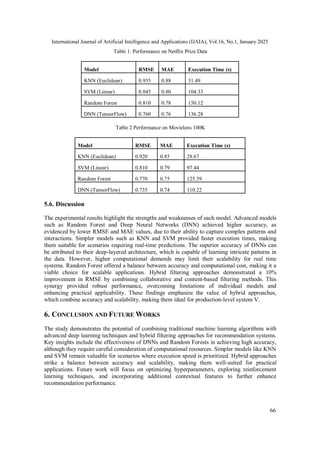
These tables contain the results of our experiment with the Netflix
Prize dataset and MovieLens100k.
International Journal of Artificial Intelligence and Applications (IJAIA), Vol.16, No.1, January 2025
66
Table 1. Performance on Netflix Prize Data
Model RMSE MAE Execution Time (s)
KNN (Euclidean) 0.935 0.88 31.49
SVM (Linear) 0.845 0.80 104.33
Random Forest 0.810 0.78 150.12
DNN (TensorFlow) 0.760 0.76 136.28
Table 2 Performance on Movielens 100K
Model RMSE MAE Execution Time (s)
KNN (Euclidean) 0.920 0.85 28.67
SVM (Linear) 0.810 0.79 97.44
Random Forest 0.770 0.75 125.39
DNN (TensorFlow) 0.735 0.74 110.22
5.6. Discussion
The experimental results highlight the strengths and weaknesses of each model. Advanced models
such as Random Forest and Deep Neural Networks (DNN) achieved higher accuracy, as
evidenced by lower RMSE and MAE values, due to their ability to capture complex patterns and
interactions. Simpler models such as KNN and SVM provided faster execution times, making
them suitable for scenarios requiring real-time predictions. The superior accuracy of DNNs can
be attributed to their deep-layered architecture, which is capable of learning intricate patterns in
the data. However, higher computational demands may limit their scalability for real time
systems. Random Forest offered a balance between accuracy and computational cost, making it a
viable choice for scalable applications. Hybrid filtering approaches demonstrated a 10%
improvement in RMSE by combining collaborative and content-based filtering methods. This
synergy provided robust performance, overcoming limitations of individual models and
enhancing practical applicability. These findings emphasize the value of hybrid approaches,
which combine accuracy and scalability, making them ideal for production-level system V.
6. CONCLUSION AND FUTURE WORKS
The study demonstrates the potential of combining traditional machine learning algorithms with
advanced deep learning techniques and hybrid filtering approaches for recommendation systems.
Key insights include the effectiveness of DNNs and Random Forests in achieving high accuracy,
although they require careful consideration of computational resources. Simpler models like KNN
and SVM remain valuable for scenarios where execution speed is prioritized. Hybrid approaches
strike a balance between accuracy and scalability, making them well-suited for practical
applications. Future work will focus on optimizing hyperparameters, exploring reinforcement
learning techniques, and incorporating additional contextual features to further enhance
recommendation performance.
International Journal of Artificial Intelligence and Applications (IJAIA), Vol.16, No.1, January 2025
67
6.1. Future Works
Looking forward, there are several promising directions for extending this work. One potential
avenue is the integration of reinforcement learning techniques to dynamically adapt
recommendations based on user feedback, enabling continuous improvement over time. Another
area of interest involves leveraging graph-based neural networks to model complex relationships
between users, items, and contextual features, enhancing the quality of recommendations.
Furthermore, incorporating explainability methods, such as SHAP values or attention
mechanisms, can provide insights into model decisions, fostering trust and transparency among
users. Exploring multi-modal data sources, including images, audio, and video metadata, can
further enrich content-based filtering approaches, opening possibilities for multimedia
recommendation systems. Finally, scaling these models to handle real-time, large scale
production environments through distributed computing frameworks like Apache Spark or
Kubernetes clusters will be critical for practical deployment. These advancements will help build
more adaptive, transparent, and scalable recommendation systems, addressing the evolving needs
of modern applications.
REFERENCES
[1] F. Isinkaye, Y. Folajimi, and B. Ojokoh, “Recommendation systems: Principles, methods and
evaluation,” Egyptian Informatics Journal, vol. 16, pp. 261–273, 2015.
[2] S. Cao, N. Yang, and Z. Liu, “Online news recommender based on stacked auto-encoder,”
Proceedings of the 16th IEEE/ACIS International Conference on Computer and Information Science
(ICIS), pp. 721–726, 2017.
[3] R. Devooght and H. Bersini, “Collaborative filtering with recurrent neural networks,” Proceedings
of the 2016 IEEE International Conference on Data Science and Advanced Analytics (DSAA), pp.
1–10, 2016.
[4] X. He, L. Liao, H. Zhang, L. Nie, X. Hu, and T. S. Chua, “Neural collaborative filtering,”
Proceedings of the 26th International World Wide Web Conference (WWW), pp. 173–182, 2017.
[5] G. Liu and X. Wu, “Using collaborative filtering algorithms combined with doc2vec for movie
recommendation,” Proceedings of the 2019 IEEE 3rd Information Technology, Networking,
Electronic and Automation Control Conference (ITNEC), pp. 1461–1464, 2019.
[6] L. Barolli, F. Amato, F. Moscato, T. Enokido, Y. N. Soe, Y. Feng, P. I. Santosa, R. Hartanto, and K.
Sakurai, “Advanced information networking and applications, volume 1,” 2012.
[7] G. Sottocornola, F. Stella, F. Canonaco, and M. Zanker, “Towards a deep learning model for hybrid
recommendation,” Proceedings of the 2017 IEEE/WIC/ACM
International Journal of Artificial Intelligence and Applications (IJAIA), Vol.16, No.1, January 2025
68
AUTHORS
Yacine Zerikat was Born in Oran in 1999, Yacine is a professional passionate about
the field of data science and artificial intelligence. From a young age, he developed a
strong interest in digital technologies and their impact on businesses and society. After
obtaining his degree in a relevant field, system information gained significant
experience working on various data science projects, particularly in developing
recommendation algorithms and data analysis. His ability to transform complex data
into actionable insights has allowed him to contribute to process optimization within
organizations. In addition to his technical skills, Yacine stands out for his intellectual curiosity and constant
desire to learn. He is also recognized for his ability to communicate effectively with multidisciplinary
teams, thus facilitating collaboration between technical and non-technical departments.
Mokhtar Zerikat was born in Tlemcen (Algeria), on March 8, 1957. He received the
B.S degree in electrical engineering and the M.S. and Ph.D degrees in electronics from
the University of Sciences and Technology of Oran (USTO- MB), Algeria, in 1982,
1992, and 2002, respectively. Following graduation, he joined the university as a
lecturer. He is currently a professor in electrical engineering department. He is engaged
in research and in education in the area of automatic control systems. Actually he is
Professor at Electrical Engineering Institute (National Higher Polytechnic School of Oran Maurice Audin).
His current research includes electronics and embedded systems, High-performance motor drives, modeling
and adaptive control systems and Artificial Intelligence Technology. He is regularly reviews papers for
several journals in his area and recently active member of the Technology and Innovation Support Center
(CATI).

MOVIE RECOMMENDATION SYSTEM BASED ON MACHINE LEARNING USING PROFILING

  • 1.
    International Journal ofArtificial Intelligence and Applications (IJAIA), Vol.16, No.1, January 2025 DOI:10.5121/ijaia.2025.16105 59 MOVIE RECOMMENDATION SYSTEM BASED ON MACHINE LEARNING USING PROFILING Yacine ZERIKAT 1 and Mokhtar ZERIKAT 2 1 CY Cergy Paris University, Computer Science Department, Cergy, France 2 National Polytechnic School, LAAS research laboratory ,ENP- Oran, Algeria ABSTRACT With the increasing amount of data available, recommendation systems are important for helping users find relevant content. This paper introduces a movie recommendation system that uses user profiles and machine learning techniques to improve the user experience by offering personalized suggestions. We tested different machine learning methods, including k nearest neighbors (KNN), support vector machines (SVM), and neural networks. We used several datasets, such as MovieLens and Netflix Prize, to check how accurate the recommendations were and how satisfied users were with them. KEYWORDS Recommendation System, Machine Learning, User Profiling user recommender system, datasets, deep learning 1. INTRODUCTION This paper presents the design and implementation of a robust movie recommendation system that leverages advanced machine learning techniques and user profiling to deliver highly personalized suggestions. Recommendation systems play a critical role in enhancing user experience across digital platforms by filtering vast volumes of data to provide relevant content. The primary objective of this research is to address key challenges such as scalability, cold-start problems, and accuracy, which often hinder the performance of recommendation systems. We begin by examining the background of recommendation systems, focusing on three primary approaches: content-based filtering, collaborative filtering, and hybrid filtering. Content Based filtering utilizes item attributes, such as genres and actors, to recommend similar items, while collaborative filtering leverages user-item interaction data to identify patterns and preferences. Hybrid filtering combines the strengths of both approaches, enabling improved performance and flexibility. This paper emphasizes the use of machine learning algorithms to enhance recommendation accuracy and scalability. Algorithms such as K-Nearest Neighbors (KNN), Support Vector Machines (SVM), Random Forest (RF), and Deep Neural Networks (DNN) are implemented and compared to assess their effectiveness. Additionally, hybrid approaches are explored to leverage both collaborative and content-based filtering for improved accuracy and robustness. The importance of tailored movie recommendations is underscored, particularly in improving user satisfaction and engagement. Personalized recommendations not only reduce search effort but also increase content consumption by aligning suggestions with user preferences. The paper also highlights the role of preprocessing techniques, such as data cleaning, encoding, and vectorization, in preparing datasets for effective model training. Moreover, evaluation metrics including RMSE, MAE, and NDCG are employed to ensure reliable performance assessments.
  • 2.
    International Journal ofArtificial Intelligence and Applications (IJAIA), Vol.16, No.1, January 2025 60 2. CONCEPT OF ARTIFICIAL INTELLIGENCE Artificial Intelligence (AI) is a transformative concept that has become a cornerstone of modern science and technology. At its core, AI involves designing and programming machines to emulate human-like intelligence and thought processes. This means teaching machines to perform tasks that typically require human cognition, such as learning, reasoning, problem solving, and decision-making. Through these processes, machines are not only able to execute complex tasks but also to evolve and improve their performance over time, mirroring the way humans adapt and learn. AI’s applications span a vast array of fields, contributing significantly to advancements across industries and enhancing the quality of life. In healthcare, AI aids in diagnosing diseases, predicting patient outcomes, and personalizing treatment plans. In transportation, it powers autonomous vehicles and optimizes traffic management. Similarly, in education, AI customizes learning experiences, making education more accessible and effective for diverse learners. AI also underpins innovations in fields such as finance, agriculture, cybersecurity, and entertainment, among others. The integration of AI into these domains underscores its potential to drive progress and bring about substantial benefits for humanity. By automating repetitive tasks, analyzing vast datasets, and enabling insights that were previously unattain- able, AI continues to redefine the boundaries of what is possible in science and technology 2.1. Machine Learning in Artificial Intelligence In the field of computer science, artificial intelligence (AI) is a widely recognized concept that is closely linked to machine learning. Machine learning refers to the ability of machines to acquire knowledge and adapt in a manner similar to human learning. Remarkably, this approach allows machines to process information and improve their performance over time, mimicking human cognitive functions. 3. SUGGESTED RECOMMENDATION MODEL The adoption of a hybrid approach has shown considerable promise in the realm of recommender systems. By integrating diverse features and capabilities from various systems and technologies, hybrid models can potentially overcome limitations inherent in traditional methods. This approach, as we can see in the figure 1, fosters a more comprehensive solution by blending complementary techniques. However, to achieve a truly refined and highly effective recommendation model, further research and exploration are essential. This entails employing innovative feedback mechanisms and diverse methodologies to enhance system accuracy and user satisfaction. Traditional recommendation systems have predominantly relied on collaborative filtering. This method focuses on analyzing users’ historical preferences and ratings to predict their future interests. While effective in certain scenarios, these earlier techniques primarily hinge on leveraging static user data, which can lead to limitations in adaptability and scalability.In contrast, modern recommender systems leverage advanced architectural frameworks, particularly those rooted in neural networks. The advent of deep learning-based recommendation systems marks a significant leap forward. These systems utilize artificial neural networks to process complex, multidimensional data, enabling them to deliver more sophisticated and precise predictions. Deep learning frameworks have opened up new avenues for handling dynamic user behaviors, contextual information, and large-scale datasets, thereby revolutionizing the landscape of recommendation technologies . [1]
  • 3.
    International Journal ofArtificial Intelligence and Applications (IJAIA), Vol.16, No.1, January 2025 61 Figure 1. Recommendation Model. 4. RELATED WORK This section reviews prior work relevant to recommendation systems, highlighting approaches that incorporate machine learning and deep learning techniques. We examine methodologies, strengths, and limitations of these studies and explain how our proposed method builds upon these advancements. 4.1. Deep Collaborative Filtering via Marginalized Denoising Auto-Encoder The article ”Deep Matrix Factorization Models for Recommendation” investigates the use of deep neural networks in matrix factorization techniques to enhance the quality of recommendations. Li et al. propose a method that combines explicit and implicit user feedback in a low-dimensional embedding space, allowing the system to capture more intricate user-item relationships. The approach was evaluated on large datasets, such as MovieLens and Amazon Music, using performance metrics like Normalized Discounted Cumulative Gain (NDCG). In their experiments, Li et al. demonstrated that deep matrix factorization provides significant performance improvements over traditional matrix factorization methods by capturing non-linear interactions between users and items. The method leverages the deep architecture to represent complex user preferences more effectively. However, one limitation noted is the computational demand of training deep learning models, particularly for large-scale datasets. Despite this, the approach showed improved recommendation accuracy, particularly in settings with sparse data, making it a promising direction for advanced recommendation systems. [2] 4.2. Collaborative Filtering with Recurrent Neural Networks This article examines how collaborative filtering can be reformulated as a sequence prediction problem and investigates the effectiveness of Recurrent Neural Networks (RNNs), particularly Long Short-Term Memory (LSTM) networks, in modeling sequential user interactions for recommendations.
  • 4.
    International Journal ofArtificial Intelligence and Applications (IJAIA), Vol.16, No.1, January 2025 62 By treating user-item interactions as ordered sequences rather than static data points, the study leverages the ability of LSTMs to capture temporal dependencies and long-term patterns, which are often overlooked in traditional approaches. The performance of these deep learning models is compared against conventional methods, including k-nearest neighbor (kNN) and matrix factorization, which have been widely used in recommendation systems. Evaluations are conducted on two benchmark movie recommendation datasets—MovieLens and Netflix—to assess accuracy and predictive performance. The experimental results highlight the advantages of deep learning models, particularly their ability to handle complex, sequential patterns in user behaviour, demonstrating superior performance over traditional collaborative filtering techniques. [3] 4.3. Neural Collaborative Filtering In this article, they developed a generalized framework using deep learning to directly model the user-item interaction matrix, rather than applying deep learning solely to auxiliary data. The proposed approach completely replaces the matrix factorization approach, or expresses matrix factorization as a special case of the generic model proposed to generate latent user and item features. The proposed generic model is compared to state-of-the-art matrix factorization approaches, such as eALS and BPR, as well as baseline methods like ItemPop and ItemKNN, on the MovieLens and Pinterest datasets. The proposed approach demonstrated consistent (statistically significant) improvements over all baselines on both datasets. [4] 4.4. Collaborative Filtering Algorithms Combined with Doc2Vec The article ”Collaborative Filtering Algorithms Combined with Doc2Vec” explores the integration of Doc2Vec, a deep learning-based method, with collaborative filtering algorithms to enhance movie recommendation systems. By leveraging the PV-DM (Distributed Memory Paragraph Vector) and PVDBOW (Distributed Bag of Words Paragraph Vector) models, Doc2Vec analyzes movie synopses by converting words into vectors and identifying textual similarities. The study uses the MovieLens dataset, which includes over 20 million ratings and synopses for 22,172 films. Presented at the ITNEC 2019 conference, it demonstrates how combining natural language processing techniques with collaborative filtering improves recommendation accuracy.. [5] 4.5. Collaborative Filtering and Neural Networks In the first set of experiments in this article, a model based collaborative filtering approach was used for prediction. They initially extracted the user’s historical movie ratings to calculate similarity between users, selected the top K neighbours with the highest similarity to the target user, and utilized these neighbours' ratings to predict the rating for a movie the target user had not yet watched. [6] In Experiment 1, they assumed sufficient data on ratings was available and made predictions based on this ample rating data. In Experiment 2, they utilized basic information about users and movies to predict scores in cases where sufficient rating data was unavailable. They hypothesized that neural networks
  • 5.
    International Journal ofArtificial Intelligence and Applications (IJAIA), Vol.16, No.1, January 2025 63 should outperform traditional methods in this aspect. Therefore, in Experiment 2, they trained a neural network to predict ratings. 4.6. Towards a Deep Learning Model for Hybrid Recommendation This work introduces a deep learning-based architecture for a hybrid recommendation system that effectively combines content-based and collaborative filtering approaches to deliver more accurate and personalized recommendations. The content-based component leverages the Doc2Vec model to create dense vector representations of user and item profiles, capturing semantic similarities and contextual relationships within the data. These vector embeddings are then fed into a classifier that predicts the relevance of items for specific users based on their preferences and past interactions. Complementing this, the collaborative filtering component utilizes the k-nearest neighbour (k-NN) algorithm to predict item ratings by identifying and analyzing patterns among users with similar preferences, enabling recommendations based on shared behavior. To integrate these two approaches, a Feedforward Neural Network is employed, learning an optimal combination of outputs from the content-based and collaborative models. This fusion leverages the strengths of both methods, addressing limitations such as data sparsity and cold-start issues often encountered in traditional recommendation systems. The proposed approach is rigorously evaluated on the MovieLens dataset, a widely used benchmark in recommendation system research, and demonstrates superior performance in terms of accuracy and relevance, highlighting its potential for scalable and real-world applications. [7] 5. METHODOLOGY This section describes the development, implementation, and evaluation of a movie recommendation system using machine learning techniques. We provide details on the environment setup, datasets, algorithms used, experimental process, and results. 5.1. Simulation Environment To implement and test our recommendation system, we utilized the following environment: a) Hardware Resources: Machines with Intel Core i7 processors, 16 GB RAM, and NVIDIA GPUs running Linux (Ubuntu 20.04) to accelerate the training of complex models such as deep neural networks. 5.2. Datasets and Preprocessing Several well-known datasets were utilized for training and evaluation, ensuring diversity and robustness in the experiments. The Netflix Prize Data comprises over 100 million user ratings for various movies, making it an ideal benchmark for collaborative filtering algorithms and large- scale recommendation systems. The MovieLens 100k dataset contains 100,000 ratings along with user and movie metadata. Its compact size facilitates rapid experimentation and model prototyping. The Rotten Tomatoes dataset features user reviews combined with metadata, providing rich contextual insights for content-based filtering approaches. Additionally, the Movie Metadata dataset offers comprehensive information, including genres, actors, directors, and other attributes, enabling advanced content based recommendations. Data preprocessing involved multiple steps to prepare datasets for machine learning algorithms. Data cleaning removed duplicates, handled missing values, and standardized formats. Encoding transformed categorical attributes such as genres and user demographics into numerical representations using one-hot encoding and label encoding. Normalization scaled numerical features to ensure uniformity and prevent bias during training. For textual data, vectorization techniques like Word2Vec and TF-
  • 6.
    International Journal ofArtificial Intelligence and Applications (IJAIA), Vol.16, No.1, January 2025 64 IDF were employed to convert text into numerical vectors, capturing semantic relationships effectively. a) Preprocessing: Data preprocessing included cleaning (removing duplicates and missing values), encoding (transforming categorical attributes), normalization, and applying vectorization techniques such as Word2Vec for textual data. 5.3. Optimization of the Recommendation Process To optimize the recommendation process, three machine learning methods were analyzed in detail: 1. K-Nearest Neighbors (KNN) Principle: Identifies similar movies based on user preferences using distance measures. Distance formulas: • Euclidean Distance used for continuous data. • Manhattan Distance More robust against outliers. 2. Support Vector Machines (SVM) Principle: Classifies movies by creating a hyperplane that separates data in a multidimensional space. Optimization function: Where the coefficients w and b are the adjustable weight and bias respectively Kernels used: • Linear: Simple separation in the original space. • Polynomial: Adds additional dimensions for nonlinear separations. • RBF (Radial Basis Function): Transforms data into higher-dimensional space to handle complex relationships. 3. Deep Neural Networks (DNN) Principle: Uses layers of neurons to capture complex relationships in data.
  • 7.
    International Journal ofArtificial Intelligence and Applications (IJAIA), Vol.16, No.1, January 2025 65 Architecture: The figure 2 represent the architecture of our deep Multi-Layer Perceptron MLP • First hidden layer: 192 neurons with ReLU activation: f(x) = max(0, x) (5) Promotes sparsity and fast learning. • Second hidden layer: 300 neurons with TanH activation: where x are the input features of the neuron in a neural network Captures nonlinear transformations within a controlled range [-1, 1]. Optimization: Implemented with TensorFlow for optimal scalability and computational efficiency. features to enhance recommendation accuracy Figure 2. Diagram of the deep Multi-Layer Perceptron MLP used 5.4. Experimental Procedure The experiments adhered to a structured methodology. Each dataset was divided into 80% training and 20% testing subsets to ensure fair evaluation. Models were trained using preprocessed data and optimized through hyperparameter tuning. Their performance was evaluated using three metrics: Root Mean Squared Error (RMSE), which assesses overall prediction accuracy, Mean Absolute Error (MAE), which measures the average deviation between predicted and actual values, and Normalized Discounted Cumulative Gain (NDCG), which evaluates the relevance of recommendations. This systematic approach enabled a thorough and reliable analysis of model effectiveness.ensured a comprehensive analysis of model effectiveness. 5.5. Experimental Results These tables contain the results of our experiment with the Netflix Prize dataset and MovieLens100k.
  • 8.
    International Journal ofArtificial Intelligence and Applications (IJAIA), Vol.16, No.1, January 2025 66 Table 1. Performance on Netflix Prize Data Model RMSE MAE Execution Time (s) KNN (Euclidean) 0.935 0.88 31.49 SVM (Linear) 0.845 0.80 104.33 Random Forest 0.810 0.78 150.12 DNN (TensorFlow) 0.760 0.76 136.28 Table 2 Performance on Movielens 100K Model RMSE MAE Execution Time (s) KNN (Euclidean) 0.920 0.85 28.67 SVM (Linear) 0.810 0.79 97.44 Random Forest 0.770 0.75 125.39 DNN (TensorFlow) 0.735 0.74 110.22 5.6. Discussion The experimental results highlight the strengths and weaknesses of each model. Advanced models such as Random Forest and Deep Neural Networks (DNN) achieved higher accuracy, as evidenced by lower RMSE and MAE values, due to their ability to capture complex patterns and interactions. Simpler models such as KNN and SVM provided faster execution times, making them suitable for scenarios requiring real-time predictions. The superior accuracy of DNNs can be attributed to their deep-layered architecture, which is capable of learning intricate patterns in the data. However, higher computational demands may limit their scalability for real time systems. Random Forest offered a balance between accuracy and computational cost, making it a viable choice for scalable applications. Hybrid filtering approaches demonstrated a 10% improvement in RMSE by combining collaborative and content-based filtering methods. This synergy provided robust performance, overcoming limitations of individual models and enhancing practical applicability. These findings emphasize the value of hybrid approaches, which combine accuracy and scalability, making them ideal for production-level system V. 6. CONCLUSION AND FUTURE WORKS The study demonstrates the potential of combining traditional machine learning algorithms with advanced deep learning techniques and hybrid filtering approaches for recommendation systems. Key insights include the effectiveness of DNNs and Random Forests in achieving high accuracy, although they require careful consideration of computational resources. Simpler models like KNN and SVM remain valuable for scenarios where execution speed is prioritized. Hybrid approaches strike a balance between accuracy and scalability, making them well-suited for practical applications. Future work will focus on optimizing hyperparameters, exploring reinforcement learning techniques, and incorporating additional contextual features to further enhance recommendation performance.
  • 9.
    International Journal ofArtificial Intelligence and Applications (IJAIA), Vol.16, No.1, January 2025 67 6.1. Future Works Looking forward, there are several promising directions for extending this work. One potential avenue is the integration of reinforcement learning techniques to dynamically adapt recommendations based on user feedback, enabling continuous improvement over time. Another area of interest involves leveraging graph-based neural networks to model complex relationships between users, items, and contextual features, enhancing the quality of recommendations. Furthermore, incorporating explainability methods, such as SHAP values or attention mechanisms, can provide insights into model decisions, fostering trust and transparency among users. Exploring multi-modal data sources, including images, audio, and video metadata, can further enrich content-based filtering approaches, opening possibilities for multimedia recommendation systems. Finally, scaling these models to handle real-time, large scale production environments through distributed computing frameworks like Apache Spark or Kubernetes clusters will be critical for practical deployment. These advancements will help build more adaptive, transparent, and scalable recommendation systems, addressing the evolving needs of modern applications. REFERENCES [1] F. Isinkaye, Y. Folajimi, and B. Ojokoh, “Recommendation systems: Principles, methods and evaluation,” Egyptian Informatics Journal, vol. 16, pp. 261–273, 2015. [2] S. Cao, N. Yang, and Z. Liu, “Online news recommender based on stacked auto-encoder,” Proceedings of the 16th IEEE/ACIS International Conference on Computer and Information Science (ICIS), pp. 721–726, 2017. [3] R. Devooght and H. Bersini, “Collaborative filtering with recurrent neural networks,” Proceedings of the 2016 IEEE International Conference on Data Science and Advanced Analytics (DSAA), pp. 1–10, 2016. [4] X. He, L. Liao, H. Zhang, L. Nie, X. Hu, and T. S. Chua, “Neural collaborative filtering,” Proceedings of the 26th International World Wide Web Conference (WWW), pp. 173–182, 2017. [5] G. Liu and X. Wu, “Using collaborative filtering algorithms combined with doc2vec for movie recommendation,” Proceedings of the 2019 IEEE 3rd Information Technology, Networking, Electronic and Automation Control Conference (ITNEC), pp. 1461–1464, 2019. [6] L. Barolli, F. Amato, F. Moscato, T. Enokido, Y. N. Soe, Y. Feng, P. I. Santosa, R. Hartanto, and K. Sakurai, “Advanced information networking and applications, volume 1,” 2012. [7] G. Sottocornola, F. Stella, F. Canonaco, and M. Zanker, “Towards a deep learning model for hybrid recommendation,” Proceedings of the 2017 IEEE/WIC/ACM
  • 10.
    International Journal ofArtificial Intelligence and Applications (IJAIA), Vol.16, No.1, January 2025 68 AUTHORS Yacine Zerikat was Born in Oran in 1999, Yacine is a professional passionate about the field of data science and artificial intelligence. From a young age, he developed a strong interest in digital technologies and their impact on businesses and society. After obtaining his degree in a relevant field, system information gained significant experience working on various data science projects, particularly in developing recommendation algorithms and data analysis. His ability to transform complex data into actionable insights has allowed him to contribute to process optimization within organizations. In addition to his technical skills, Yacine stands out for his intellectual curiosity and constant desire to learn. He is also recognized for his ability to communicate effectively with multidisciplinary teams, thus facilitating collaboration between technical and non-technical departments. Mokhtar Zerikat was born in Tlemcen (Algeria), on March 8, 1957. He received the B.S degree in electrical engineering and the M.S. and Ph.D degrees in electronics from the University of Sciences and Technology of Oran (USTO- MB), Algeria, in 1982, 1992, and 2002, respectively. Following graduation, he joined the university as a lecturer. He is currently a professor in electrical engineering department. He is engaged in research and in education in the area of automatic control systems. Actually he is Professor at Electrical Engineering Institute (National Higher Polytechnic School of Oran Maurice Audin). His current research includes electronics and embedded systems, High-performance motor drives, modeling and adaptive control systems and Artificial Intelligence Technology. He is regularly reviews papers for several journals in his area and recently active member of the Technology and Innovation Support Center (CATI).