MRP MOTOR RELERNING PROGRAM FOR STROKE INCLUDES DETAILED DESCRIPTION OF MRP AND TECHNIQUES,TREATMENT PATTERNS GIVEN BY CAR AND SHEPHERED DEPENDS ON DEVELIOEMENTAL MILESTONES
MOTOR RELEARNING PROGRAMME2
Introduction
The Motor Relearning Programme (MRP) was developed by Janet carr and Robert
Shepherd, Australian Physical therapists, from their clinical experience and extensive
review of contemporary motor control and motor learning literature.
It is a Task – Oriented Approaches to improve motor control , focusing on the
relearning of daily activities.
Carr and Shepherd believe that treatment directed toward active training of motor
control relevant to daily activities is to preferred and should begin as soon as the
person’s medical condition is stable.
3.
MOTOR RELEARNING PROGRAMME3
Motor learning is a complex process occurring in the brain in response to practice
or experience of a certain skill resulting in changes in the central nervous system. It
allows for the production of a new motor skill. It often involves improving the
smoothness and accuracy of movements and is necessary for developing controlled
movement and calibrating simple movements like reflexes.
Retraining of motor learning requires understanding of normal movement &
analysis of motor dysfunction
Introduction
4.
MOTOR RELEARNING PROGRAMME4
Introduction
The Motor Relearning Programme assume that the brain has the capacity for
reorganization and adaptation.
Based on 3 factors :
1.Elimination of unnecessary muscle activity
2.Feedback
3.Practice
5.
MOTOR RELEARNING PROGRAMME5
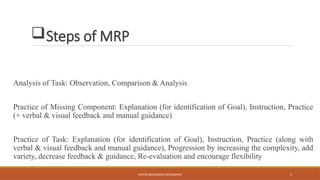
Steps of MRP
Analysis of Task: Observation, Comparison & Analysis
Practice of Missing Component: Explanation (for identification of Goal), Instruction, Practice
(+ verbal & visual feedback and manual guidance)
Practice of Task: Explanation (for identification of Goal), Instruction, Practice (along with
verbal & visual feedback and manual guidance), Progression by increasing the complexity, add
variety, decrease feedback & guidance, Re-evaluation and encourage flexibility
6.
MOTOR RELEARNING PROGRAMME6
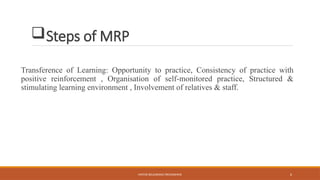
Steps of MRP
Transference of Learning: Opportunity to practice, Consistency of practice with
positive reinforcement , Organisation of self-monitored practice, Structured &
stimulating learning environment , Involvement of relatives & staff.
7.
MOTOR RELEARNING PROGRAMME7
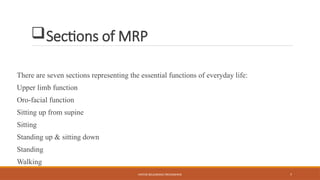
Sections of MRP
There are seven sections representing the essential functions of everyday life:
Upper limb function
Oro-facial function
Sitting up from supine
Sitting
Standing up & sitting down
Standing
Walking
8.
MOTOR RELEARNING PROGRAMME8
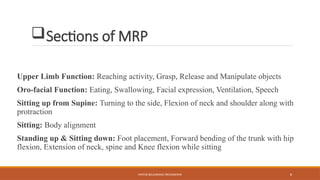
Sections of MRP
Upper Limb Function: Reaching activity, Grasp, Release and Manipulate objects
Oro-facial Function: Eating, Swallowing, Facial expression, Ventilation, Speech
Sitting up from Supine: Turning to the side, Flexion of neck and shoulder along with
protraction
Sitting: Body alignment
Standing up & Sitting down: Foot placement, Forward bending of the trunk with hip
flexion, Extension of neck, spine and Knee flexion while sitting
9.
MOTOR RELEARNING PROGRAMME9
Sections of MRP
Standing: Postural adjustment, Feet position, Erect trunk, Hip in front of ankles
Walking: Pattern, Limb placement, Gait parameters, Arm swing
10.
MOTOR RELEARNING PROGRAMME10
Sections of MRP: Oro-facial Function
Step 1:
Observation of alignment & movement of lips, jaw, tongue, eating and drooling
Analysis of oro-facial muscles
Step 2&3:
Practice of Oral movements
Step 4:
Feedback and transference of movement for daily activity
11.
MOTOR RELEARNING PROGRAMME11
Effects and Uses of MRP
Helps the patient to recognize & analyse the problem
Patient selects the most essential missing component of the task to practice and build it
slowly
Helps to monitors the patients’ performance through self evaluation of the task practiced
Provides positive feedback to the patients on their movements
Provides an enriched environment in which the patient will be motivated towards recovery
of their mental & physical abilities