Motion Notes
Speed, Velocity, and Acceleration!
Motion
 A change in position, over time, relative to
a reference point.
So, What’s a Reference Point?
 http://www.classzone.com/books/ml_scie
nce_share/vis_sim/mfm05_pg7_relmotio
n/mfm05_pg7_relmotion.html
 What we compare all other movement or
locations to!
 Often Earth Features
 Large Objects
 Cities
Reference Point Scenarios
Suppose you are in a train, and you cannot tell if you are
stopped or moving. Outside the window, another train is
slowly moving forward. What could be happening?
 Your train is stopped, and the other train is moving slowly
forward…
 The other train is stopped, and your train is moving slowly
backwards…
 Both trains are moving forward, with the other train moving a
little faster…
 Your train is moving very slowly backward, and the other train
is moving slowly forward…
Could you be sure as to which is actually happening??
Reference Point Examples
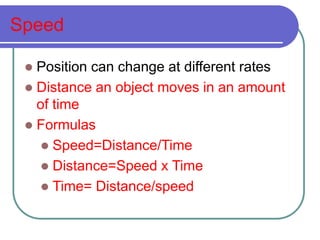
Speed
 Position can change at different rates
 Distance an object moves in an amount
of time
 Formulas
 Speed=Distance/Time
 Distance=Speed x Time
 Time= Distance/speed
Suppose there’s a TORNADO that’s 1 mile
wide, and it’s going 40 mph…
What else is important?!?!?
It’s Direction!
Velocity is a Speed in a Direction!
15 Mph Northwest; 200 m/s South;
40 cm/ms Left
Velocity
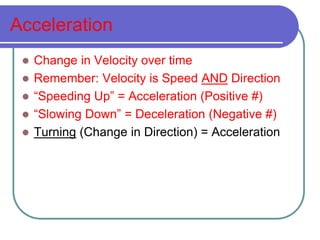
Acceleration
 Change in Velocity over time
 Remember: Velocity is Speed AND Direction
 “Speeding Up” = Acceleration (Positive #)
 “Slowing Down” = Deceleration (Negative #)
 Turning (Change in Direction) = Acceleration
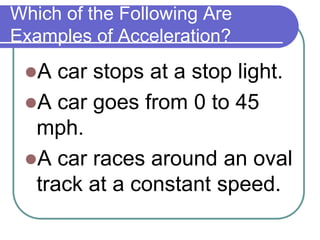
Which of the Following Are
Examples of Acceleration?
A car stops at a stop light.
A car goes from 0 to 45
mph.
A car races around an oval
track at a constant speed.
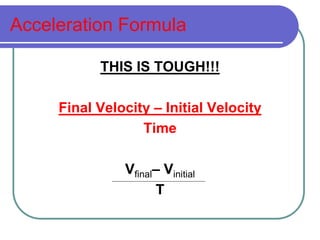
Acceleration Formula
THIS IS TOUGH!!!
Final Velocity – Initial Velocity
Time
Vfinal– Vinitial
T
Acceleration Problem!
Julio starts sliding with a velocity of 1m/s south. After 3 seconds, his
velocity is 7m/s south. What is Julio’s acceleration?
Final Velocity – Initial Velocity
Time
7 m/s – 1 m/s
3s
6 m/s
3s
2 m/s
s
2 m/s2
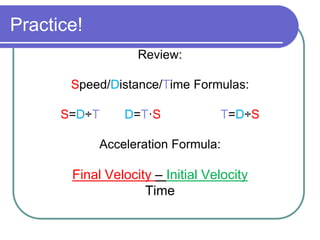
Practice!
Review:
Speed/Distance/Time Formulas:
S=D÷T D=T·S T=D÷S
Acceleration Formula:
Final Velocity – Initial Velocity
Time
Practice
If a runner runs 100 meters in
50 seconds, what is his
speed in meters per second?
How far could this runner run
in 25 seconds?
Calculating Acceleration
John starts running from
rest. After 10 s, his velocity is
20 m/s. What is John’s rate
of acceleration?

Motion Notes.ppt

  • 1.
  • 2.
    Motion  A changein position, over time, relative to a reference point.
  • 3.
    So, What’s aReference Point?  http://www.classzone.com/books/ml_scie nce_share/vis_sim/mfm05_pg7_relmotio n/mfm05_pg7_relmotion.html  What we compare all other movement or locations to!  Often Earth Features  Large Objects  Cities
  • 4.
    Reference Point Scenarios Supposeyou are in a train, and you cannot tell if you are stopped or moving. Outside the window, another train is slowly moving forward. What could be happening?  Your train is stopped, and the other train is moving slowly forward…  The other train is stopped, and your train is moving slowly backwards…  Both trains are moving forward, with the other train moving a little faster…  Your train is moving very slowly backward, and the other train is moving slowly forward… Could you be sure as to which is actually happening??
  • 5.
  • 7.
    Speed  Position canchange at different rates  Distance an object moves in an amount of time  Formulas  Speed=Distance/Time  Distance=Speed x Time  Time= Distance/speed
  • 8.
    Suppose there’s aTORNADO that’s 1 mile wide, and it’s going 40 mph… What else is important?!?!? It’s Direction! Velocity is a Speed in a Direction! 15 Mph Northwest; 200 m/s South; 40 cm/ms Left Velocity
  • 9.
    Acceleration  Change inVelocity over time  Remember: Velocity is Speed AND Direction  “Speeding Up” = Acceleration (Positive #)  “Slowing Down” = Deceleration (Negative #)  Turning (Change in Direction) = Acceleration
  • 10.
    Which of theFollowing Are Examples of Acceleration? A car stops at a stop light. A car goes from 0 to 45 mph. A car races around an oval track at a constant speed.
  • 11.
    Acceleration Formula THIS ISTOUGH!!! Final Velocity – Initial Velocity Time Vfinal– Vinitial T
  • 12.
    Acceleration Problem! Julio startssliding with a velocity of 1m/s south. After 3 seconds, his velocity is 7m/s south. What is Julio’s acceleration? Final Velocity – Initial Velocity Time 7 m/s – 1 m/s 3s 6 m/s 3s 2 m/s s 2 m/s2
  • 13.
    Practice! Review: Speed/Distance/Time Formulas: S=D÷T D=T·ST=D÷S Acceleration Formula: Final Velocity – Initial Velocity Time
  • 14.
    Practice If a runnerruns 100 meters in 50 seconds, what is his speed in meters per second? How far could this runner run in 25 seconds?
  • 15.
    Calculating Acceleration John startsrunning from rest. After 10 s, his velocity is 20 m/s. What is John’s rate of acceleration?