Biên dịch:
Ths. Hoàng Sơn Công

“The hardest thing to see is what is in front of your eyes.”
- Goethe -

“Xa tận chân trời, gần ngay trước mắt”
- Thành ngữ Trung Quốc -
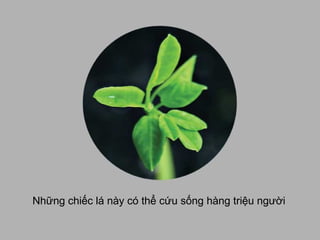
Những chiếc lá này có thể cứu sống hàng triệu người
Cây Độ Sinh –
Chùm ngây

The Moringa Tree
Moringa oleifera
Chủng loại Độ Sinh – Chùm Ngây
Có 13 loài Moringa được biết đến
M. oleifera
M. arborea
M. borziana
M. concanensis
M. drouhardii
M. hildebrandtii
M. longituba
M. ovalifolia
M. peregrina
M. pygmaea
M. rivae
M. ruspoliana
M. stenopetala
Từ thời cổ đại cây Độ Sinh – Chùm ngây đã
có mặt trên nhiều lãnh thổ…
Và với
những kiến
thức khoa
học ngày
nay…
Những giá trị dinh dưỡng
7lần Vitamin C trong Cam
4 lần Vitamin A của Carrot
4 lần Canxi trong SỮA
3 lần Kẽm trong Chuối
Tiny leaves.

Enormous Benefits.

2 lần Protein trong SỮA CHUA
Gram-for-gram comparison of nutritional data1
Không chỉ có vậy, đó còn là một
tổ hợp Vitamin và khoáng chất…

Vitamin A
Vitamin B1
Vitamin B2
Vitamin B3
Vitamin C
Calcium
Chromium
Copper
Iron
Magnesium
Manganese
Phosphorus
Potassium
Protein
Zinc
Rất hiếm có loài
rau nào như Lá
Độ Sinh – Chùm
Ngây
có chứa cả các
axit amin thiết
yếu ...

… giúp tăng trưởng chiều cao,
sức khỏe và đề kháng…
Moringa còn chứa
hai axit amin quan
trọng là Argenine
và Histidine.
Đặc biệt quan
trọng đối với trẻ
sơ sinh.
Các chỉ số dinh dưỡng ở lá tươi và lá khô

Fresh leaves and common foods1, Dried leaves2
Các chỉ số dinh dưỡng ở lá tươi và lá khô

Note: Iron from plants, including spinach and Moringa, is generally difficult for the body to absorb.

Fresh leaves and common foods1, Dried leaves2
Oceania
Tên gọi của Độ Sinh – Chùm Ngây tại các nước
Fiji: Sajina
Guam: Katdes
Palau: Malungkai
Giải pháp chống suy dinh dưỡng…
… với Độ Sinh – Chùm Ngây

Malnutrition map13
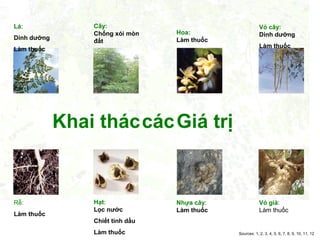
Lá:
Dinh dưỡng

Cây:
Chống xói mòn
đất

Hoa:
Làm thuốc

Làm thuốc

Vỏ cây:
Dinh dưỡng
Làm thuốc

Khai tháccác Giá trị

Rễ:
Làm thuốc

Hạt:
Lọc nước

Nhựa cây:
Làm thuốc

Vỏ già:
Làm thuốc

Chiết tinh dầu
Làm thuốc

Sources: 1, 2, 3, 4, 5, 6, 7, 8, 9, 10, 11, 12
Các tiềm năng khai thác…
• Sức khỏe con người
• Thức ăn chăn nuôi
• Phân bón nông nghiệp
• Xăng sinh học
Sức khỏe con người
Thử nghiệm ở
Senegal
Tiến hành bởi:
• Ông Lowell Fuglie,
Chương trình Giáo hội ở
Dakar
• AGADA
(Chương trình cộng
đồng Phi Châu)
Thử nghiệm ở
Senegal
Kết quả:

• Trẻ em liên tục tăng cân
và cải thiện sức khỏe.
• Với phụ nữ có thai và
con nhỏ:
Giảm nguy cơ thiếu máu
và sinh non

Source: 2
Những nghiên cứu ở Nicaragua
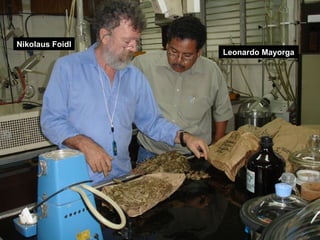
Nikolaus Foidl

Leonardo Mayorga
Dr. Nadir Reyes Sánchez
Lĩnh vực trồng trọt chuyên canh
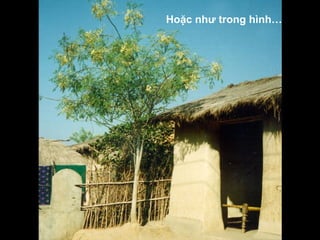
Bình thường, cây Độ Sinh trồng
tự nhiên sẽ như trong hình…
Hoặc như trong hình…
Nhưng với chuyên canh sẽ là…
… sản lượng thu hoạch cao
Và phát triển giống cây trồng…
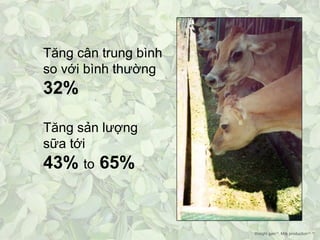
Chăn nuôi
Tăng cân trung bình
so với bình thường

32%
Tăng sản lượng
sữa tới

43% to 65%

Weight gain14, Milk production15, 16
Phân bón nông nghiệp
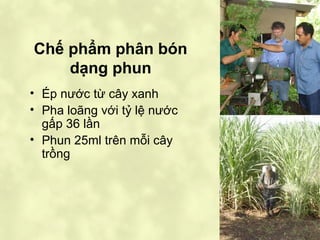
Chế phẩm phân bón
dạng phun
• Ép nước từ cây xanh
• Pha loãng với tỷ lệ nước
gấp 36 lần
• Phun 25ml trên mỗi cây
trồng
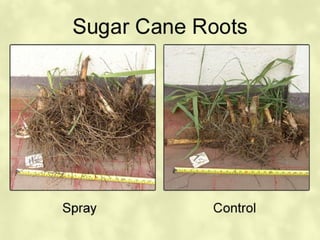
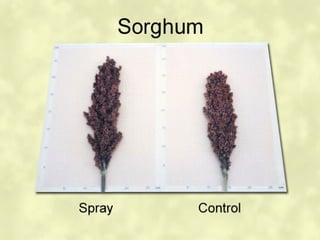
Hiệu quả của việc phun tưới
• Tăng tốc độ tăng trưởng của cây non
• Kháng bệnh, kháng sâu bệnh mạnh
mẽ
• Tăng vòng đời sinh trưởng
• Tăng sản lượng rễ, thân, lá
• Ra hoa, kết quả nhiều hơn
• Quả lớn hơn
• Tăng năng suất 20-35%

Source: 14
Xăng sinh học
Hãy nghiên cứu và tìm hiểu
các giá trị đối với…
• Sức khỏe con người
• Thức ăn chăn nuôi
• Phân bón nông nghiệp
• Xăng sinh học
Hãy giúp đỡ cộng đồng
• Chia sẻ slide trong cộng đồn

• Nghiên cứu và ứng dụng

• Chia sẻ kinh nghiệm và thành
công
Cây Độ Sinh – Chùm ngây
Bản gốc tiếng Anh có tại:

www.TFLJournal.org
Bản tiếng Việt có tại:

Câyhttp://vimotthegioingaymai.com
Độ Sinh –Anh có tại: ngây
Chùm
Bản gốc tiếng
www.TFLJournal.org
Cây Độ Sinh –Anh có tại: ngây
Chùm
Bản gốc tiếng
www.TFLJournal.org

Hân hạnh là đơn vị tài trợ cho chương trình

“MỘT TRIỆU HẠT GIỐNG ĐỘ SINH
CHO CÁC GIA ĐÌNH VIỆT NAM”
Thông tin chi tiết có tại
http://vietliengroup.vn
http://vietlienmart.vn
Hãy khai thác những giá trị…
Tư liệu tham khảo
1.

Gopalan, C., B.V. Rama Sastri, and S.C. Balasubramanian. Nutritive value of Indian foods. Hyderabad, India: (National Institute of
Nutrition), 1971 (revised and updated by B.S. Narasinga Rao, Y.G. Deosthale, and K.C. Pant, 1989).

2.

Fuglie, Lowell J., ed. The Miracle Tree—Moringa oleifera: Natural Nutrition for the Tropics. Training Manual. 2001. Church World
Service, Dakar, Senegal. May 2002.

3.

Price, Martin L. “The Moringa Tree.” Educational Concerns for Hunger Organization (ECHO) Technical Note. 1985 (revised 2002).
May 2002. <www.echotech.org/technical/technotes/moringabiomasa.pdf>.

4.

Saint Sauveur (de), Armelle. “Moringa exploitation in the world: State of knowledge and challenges.” Development Potential for
Moringa Products. International Workshop, Dar es Salaam, Tanzania, 29 Oct. - 2 Nov. 2001.

5.

Morton, Julia F. “The Horseradish Tree, Moringa pterygosperma (Moringaceae)—A Boon to Arid Lands?” Economic Botany. 45 (3),
(1991): 318-333.

6.

IndianGyan: The Source for Alternative Medicines and Holistic Health. Home Remedies for Common Ailments. May 2002.
<www.indiangyan.com/books/healthbooks/remedies/cataract.shtml>.

7.

Bakhru, H.K. Foods That heal: The Natural Way to Good Health. South Asia Books, 1995.

8.

New Crop Resource Online Program (NewCROP). “Moringa Oleifera Lam.” 7 Jan.1998. Purdue U. Jan. 2005.
<www.hort.purdue.edu/newcrop/duke_energy/Moringa_oleifera.html>.

9.

Sairam, T.V. Home remedies, Vol II: A Handbook of Herbal Cures for Commons Ailments. New Delhi, India: Penguin, 1999.

10.

M.S. Swaminathan Research Foundation. Moringa oleifera Lam, Moringaceae. May 2002. <www.mssrf.org./fris9809/
fris1157.html>.

11.

Participatory Development Resource Centre for Africa (PDRCA) Page. United Nations Volunteers. Aug. 2000.
<www.unv.org/projects/pdrca/pdrca22.htm>.

12.

Home Truths Page. Morepen Laboratories. March 2002. <www.morepen.com/morepen/newsletter/hometruths.htm>.

13.

United Nations World Food Programme. Interactive Hunger Map. 2004. December 2004.
<www.wfp.org/country_brief/hunger_map/map/hungermap_popup/map_popup.html>.

14.

Foidl, N., Makkar, H.P.S. and Becker, K. The potential of Moringa oleifera for agricultural and industrial uses. In: L.J. Fuglie (Ed.),
The Miracle Tree: The Multiple Attributes of Moringa (pp. 45-76). Dakar, Senegal: Church World Service, 2001.

15.

Fuglie, L. New Uses of Moringa Studied in Nicaragua. ECHO Development Notes #68, June, 2000.
<http://www.echotech.org/network/modules.php?name=News&file=article&sid=194>.

16.

Reyes, S.N. Moringa oleifera and Cratylia argentea: potential fodder species for ruminants in Nicaragua. Doctoral thesis, Swedish
University of Agricultural Sciences, Uppsala. 2006.

Tài liệu về Độ Sinh - Chùm Ngây - Moringa (Giá trị sức khỏe và kinh tế)

  • 1.
    Biên dịch: Ths. HoàngSơn Công “The hardest thing to see is what is in front of your eyes.” - Goethe - “Xa tận chân trời, gần ngay trước mắt” - Thành ngữ Trung Quốc -
  • 2.
    Những chiếc lánày có thể cứu sống hàng triệu người
  • 3.
    Cây Độ Sinh– Chùm ngây The Moringa Tree Moringa oleifera
  • 5.
    Chủng loại ĐộSinh – Chùm Ngây Có 13 loài Moringa được biết đến M. oleifera M. arborea M. borziana M. concanensis M. drouhardii M. hildebrandtii M. longituba M. ovalifolia M. peregrina M. pygmaea M. rivae M. ruspoliana M. stenopetala
  • 6.
    Từ thời cổđại cây Độ Sinh – Chùm ngây đã có mặt trên nhiều lãnh thổ…
  • 7.
    Và với những kiến thứckhoa học ngày nay…
  • 8.
    Những giá trịdinh dưỡng
  • 9.
    7lần Vitamin Ctrong Cam 4 lần Vitamin A của Carrot 4 lần Canxi trong SỮA 3 lần Kẽm trong Chuối Tiny leaves. Enormous Benefits. 2 lần Protein trong SỮA CHUA Gram-for-gram comparison of nutritional data1
  • 10.
    Không chỉ cóvậy, đó còn là một tổ hợp Vitamin và khoáng chất… Vitamin A Vitamin B1 Vitamin B2 Vitamin B3 Vitamin C Calcium Chromium Copper Iron Magnesium Manganese Phosphorus Potassium Protein Zinc
  • 11.
    Rất hiếm cóloài rau nào như Lá Độ Sinh – Chùm Ngây có chứa cả các axit amin thiết yếu ... … giúp tăng trưởng chiều cao, sức khỏe và đề kháng…
  • 12.
    Moringa còn chứa haiaxit amin quan trọng là Argenine và Histidine. Đặc biệt quan trọng đối với trẻ sơ sinh.
  • 13.
    Các chỉ sốdinh dưỡng ở lá tươi và lá khô Fresh leaves and common foods1, Dried leaves2
  • 14.
    Các chỉ sốdinh dưỡng ở lá tươi và lá khô Note: Iron from plants, including spinach and Moringa, is generally difficult for the body to absorb. Fresh leaves and common foods1, Dried leaves2
  • 15.
    Oceania Tên gọi củaĐộ Sinh – Chùm Ngây tại các nước Fiji: Sajina Guam: Katdes Palau: Malungkai
  • 16.
    Giải pháp chốngsuy dinh dưỡng… … với Độ Sinh – Chùm Ngây Malnutrition map13
  • 17.
    Lá: Dinh dưỡng Cây: Chống xóimòn đất Hoa: Làm thuốc Làm thuốc Vỏ cây: Dinh dưỡng Làm thuốc Khai tháccác Giá trị Rễ: Làm thuốc Hạt: Lọc nước Nhựa cây: Làm thuốc Vỏ già: Làm thuốc Chiết tinh dầu Làm thuốc Sources: 1, 2, 3, 4, 5, 6, 7, 8, 9, 10, 11, 12
  • 18.
    Các tiềm năngkhai thác…
  • 19.
    • Sức khỏecon người • Thức ăn chăn nuôi • Phân bón nông nghiệp • Xăng sinh học
  • 20.
  • 21.
    Thử nghiệm ở Senegal Tiếnhành bởi: • Ông Lowell Fuglie, Chương trình Giáo hội ở Dakar • AGADA (Chương trình cộng đồng Phi Châu)
  • 22.
    Thử nghiệm ở Senegal Kếtquả: • Trẻ em liên tục tăng cân và cải thiện sức khỏe. • Với phụ nữ có thai và con nhỏ: Giảm nguy cơ thiếu máu và sinh non Source: 2
  • 23.
    Những nghiên cứuở Nicaragua
  • 24.
  • 25.
  • 26.
    Lĩnh vực trồngtrọt chuyên canh
  • 27.
    Bình thường, câyĐộ Sinh trồng tự nhiên sẽ như trong hình…
  • 28.
  • 30.
    Nhưng với chuyêncanh sẽ là…
  • 31.
    … sản lượngthu hoạch cao
  • 32.
    Và phát triểngiống cây trồng…
  • 33.
  • 34.
    Tăng cân trungbình so với bình thường 32% Tăng sản lượng sữa tới 43% to 65% Weight gain14, Milk production15, 16
  • 35.
  • 36.
    Chế phẩm phânbón dạng phun • Ép nước từ cây xanh • Pha loãng với tỷ lệ nước gấp 36 lần • Phun 25ml trên mỗi cây trồng
  • 40.
    Hiệu quả củaviệc phun tưới • Tăng tốc độ tăng trưởng của cây non • Kháng bệnh, kháng sâu bệnh mạnh mẽ • Tăng vòng đời sinh trưởng • Tăng sản lượng rễ, thân, lá • Ra hoa, kết quả nhiều hơn • Quả lớn hơn • Tăng năng suất 20-35% Source: 14
  • 45.
  • 47.
    Hãy nghiên cứuvà tìm hiểu các giá trị đối với… • Sức khỏe con người • Thức ăn chăn nuôi • Phân bón nông nghiệp • Xăng sinh học
  • 48.
    Hãy giúp đỡcộng đồng • Chia sẻ slide trong cộng đồn • Nghiên cứu và ứng dụng • Chia sẻ kinh nghiệm và thành công
  • 49.
    Cây Độ Sinh– Chùm ngây Bản gốc tiếng Anh có tại: www.TFLJournal.org
  • 50.
    Bản tiếng Việtcó tại: Câyhttp://vimotthegioingaymai.com Độ Sinh –Anh có tại: ngây Chùm Bản gốc tiếng www.TFLJournal.org
  • 51.
    Cây Độ Sinh–Anh có tại: ngây Chùm Bản gốc tiếng www.TFLJournal.org Hân hạnh là đơn vị tài trợ cho chương trình “MỘT TRIỆU HẠT GIỐNG ĐỘ SINH CHO CÁC GIA ĐÌNH VIỆT NAM” Thông tin chi tiết có tại http://vietliengroup.vn http://vietlienmart.vn
  • 52.
    Hãy khai thácnhững giá trị…
  • 53.
    Tư liệu thamkhảo 1. Gopalan, C., B.V. Rama Sastri, and S.C. Balasubramanian. Nutritive value of Indian foods. Hyderabad, India: (National Institute of Nutrition), 1971 (revised and updated by B.S. Narasinga Rao, Y.G. Deosthale, and K.C. Pant, 1989). 2. Fuglie, Lowell J., ed. The Miracle Tree—Moringa oleifera: Natural Nutrition for the Tropics. Training Manual. 2001. Church World Service, Dakar, Senegal. May 2002. 3. Price, Martin L. “The Moringa Tree.” Educational Concerns for Hunger Organization (ECHO) Technical Note. 1985 (revised 2002). May 2002. <www.echotech.org/technical/technotes/moringabiomasa.pdf>. 4. Saint Sauveur (de), Armelle. “Moringa exploitation in the world: State of knowledge and challenges.” Development Potential for Moringa Products. International Workshop, Dar es Salaam, Tanzania, 29 Oct. - 2 Nov. 2001. 5. Morton, Julia F. “The Horseradish Tree, Moringa pterygosperma (Moringaceae)—A Boon to Arid Lands?” Economic Botany. 45 (3), (1991): 318-333. 6. IndianGyan: The Source for Alternative Medicines and Holistic Health. Home Remedies for Common Ailments. May 2002. <www.indiangyan.com/books/healthbooks/remedies/cataract.shtml>. 7. Bakhru, H.K. Foods That heal: The Natural Way to Good Health. South Asia Books, 1995. 8. New Crop Resource Online Program (NewCROP). “Moringa Oleifera Lam.” 7 Jan.1998. Purdue U. Jan. 2005. <www.hort.purdue.edu/newcrop/duke_energy/Moringa_oleifera.html>. 9. Sairam, T.V. Home remedies, Vol II: A Handbook of Herbal Cures for Commons Ailments. New Delhi, India: Penguin, 1999. 10. M.S. Swaminathan Research Foundation. Moringa oleifera Lam, Moringaceae. May 2002. <www.mssrf.org./fris9809/ fris1157.html>. 11. Participatory Development Resource Centre for Africa (PDRCA) Page. United Nations Volunteers. Aug. 2000. <www.unv.org/projects/pdrca/pdrca22.htm>. 12. Home Truths Page. Morepen Laboratories. March 2002. <www.morepen.com/morepen/newsletter/hometruths.htm>. 13. United Nations World Food Programme. Interactive Hunger Map. 2004. December 2004. <www.wfp.org/country_brief/hunger_map/map/hungermap_popup/map_popup.html>. 14. Foidl, N., Makkar, H.P.S. and Becker, K. The potential of Moringa oleifera for agricultural and industrial uses. In: L.J. Fuglie (Ed.), The Miracle Tree: The Multiple Attributes of Moringa (pp. 45-76). Dakar, Senegal: Church World Service, 2001. 15. Fuglie, L. New Uses of Moringa Studied in Nicaragua. ECHO Development Notes #68, June, 2000. <http://www.echotech.org/network/modules.php?name=News&file=article&sid=194>. 16. Reyes, S.N. Moringa oleifera and Cratylia argentea: potential fodder species for ruminants in Nicaragua. Doctoral thesis, Swedish University of Agricultural Sciences, Uppsala. 2006.

Editor's Notes

  • #8 Slide &amp;lt;number&amp;gt;: Today, scientists are beginning to investigate the traditional claims about Moringa. Let’s take a look at what they have found.
  • #16 Slide &amp;lt;number&amp;gt;: While native to the Indian sub-continent, Moringa has spread throughout the tropical and sub-tropical regions of the world. Here are some of the many common names for Moringa.
  • #17 Slide &amp;lt;number&amp;gt;: We are all well familiar with the problems of malnutrition in our world, and how much suffering and death result. Here are the countries with the highest rates of malnutrition. The amazing thing about Moringa is that . . . [Advance forward] . . . it grows in almost exactly the same places. These are the countries where Moringa grows—exactly where it is needed the most.
  • #20 Slide &amp;lt;number&amp;gt;: They include: improvement of Human Health; use as a Livestock Fodder supplement; use as a Plant Growth Enhancer; and for production of Biogas.
  • #25 Slide &amp;lt;number&amp;gt;: Mr. Nikolaus Foidl and his associate, Leonardo Mayorga, have been researching agricultural uses of Moringa in Nicaragua since the early 1990s. They have collaborated with the University of Hohenheim, Germany and with Dr. Michael Kreuzer of the Swiss Federal Institute of Technology in Zurich.
  • #26 Slide &amp;lt;number&amp;gt;: Dr. Nadir Reyes Sanchez is a scientist on the faculty of the Department of Animal Nutrition and Management at the Swedish University of Agriculture Sciences in Uppsala, Sweden. He is also on the faculty of Animal Sciences at the National University of Agriculture in Managua, Nicaragua. Dr. Reyes has also been conducting Moringa research in Nicaragua, and is shown here on his Moringa plantation.
  • #27 Slide &amp;lt;number&amp;gt;: Some people may wonder how a tree can supply nutrition for a large number of people. Both Foidl and Reyes have experimented with growing Moringa intensively, as a field crop.
  • #28 Slide &amp;lt;number&amp;gt;: Normally, Moringa grows in the typical form of a tree, like this . . .
  • #29 Slide &amp;lt;number&amp;gt;: . . . or like this . . .
  • #31 Slide &amp;lt;number&amp;gt;: But Foidl and Reyes have shown that Moringa trees can also be planted very close together as a field crop, at a spacing as close as ten to fifteen centimeters.
  • #35 Slide &amp;lt;number&amp;gt;: Mr. Foidl found that adding Moringa leaves to cattle feed increased their daily weight gain by up to 32 percent. [Advance forward] Both Foidl and Reyes also experimented with Moringa and milk cows. Foidl supplemented with 15 to 17 kilograms of fresh Moringa leaves daily, and the cattle’s milk production increased by 43 percent. Reyes supplemented his milk cows’ feed with 2 kg dry matter of Moringa per day, and milk production increased by 58 percent. Then he supplemented with 3 kg dry matter per day, and milk production increased by 65 percent. Imagine what would be possible if milk production in developing countries could be increased in this way. It could prevent untold suffering of people with protein deficiency.
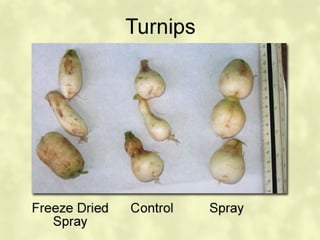
  • #36 Slide &amp;lt;number&amp;gt;: Mr. Foidl has also experimented with a plant growth spray made from the green matter of Moringa.
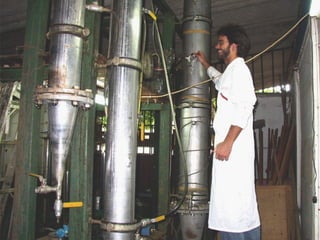
  • #37 Slide &amp;lt;number&amp;gt;: The process of making the Moringa plant growth spray is relatively simple, and can be done with whatever equipment is available for extracting juice from the green matter and applying the spray to plants.
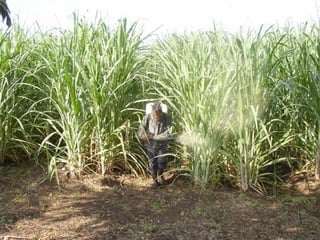
  • #38 Slide &amp;lt;number&amp;gt;: Here the spray is being applied to sugarcane. Foidl has also found the spray to be effective with soybeans, corn, turnips, black beans, red beans, white beans, cow peas, bell peppers, chia, sunflowers, mung beans, onions, coffee, tea, chili peppers, melons and sorghum.
  • #39 Slide &amp;lt;number&amp;gt;: Foidl is now experimening with this plant growth spray on large 25-hectare plots of vegetable crops.
  • #40 Slide &amp;lt;number&amp;gt;: The spray can be applied to individual plants on a small scale, or, where equipment is available, it can be done on a very large scale.
  • #42 Slide &amp;lt;number&amp;gt;: Here you can see the effects of the Moringa plant growth spray on bell peppers. These are average sizes of peppers grown with spray applied, and in the control group that did not get sprayed.
  • #43 Slide &amp;lt;number&amp;gt;: The spray even stimulates the growth of the plant’s roots. Here we see a comparison of roots from sugarcane plants that received the spray with roots from the plants in the control group, which did not receive the spray.
  • #44 Slide &amp;lt;number&amp;gt;: Here is the difference in average sizes of seed heads from sorghum plants grown with spray applied, and from the control group that did not receive spray.
  • #47 Slide &amp;lt;number&amp;gt;: Based on his experiments, Foidl estimates that more than 4,400 cubic meters of methane could be produced per hectare of Moringa per year. That is up to twice as much methane as can be produced per hectare per year from sugar beet leaves, a common plant material for biogas. Further experiments are needed to examine this potential use of Moringa.
  • #48 Slide &amp;lt;number&amp;gt;: These and other uses of Moringa leaves show great potential for benefitting people—especially those who suffer from poverty and malnutrition. Further scientific studies are needed to examine these uses and their benefits, and to determine the techniques that will produce the greatest benefits. We would suggest studies in these four areas: human nutrition and medicinal uses, livestock fodder, crop enhancement with the plant growth spray, and production of biogas. The information just presented comes from the research of only a few scientists. Now these tests need to be replicated by many more people around the world.