Designing for Social Sharing Rashmi Sinha www.uzanto.com www.rashmisinha.com
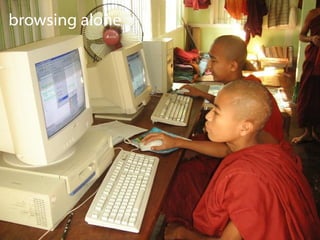
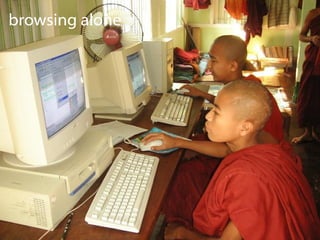
browsing alone
Designing for Social Sharing Rashmi Sinha www.uzanto.com www.rashmisinha.com
browsing alone
Part I: Why NOW?
The web has become a social sphere
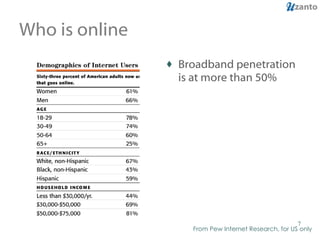
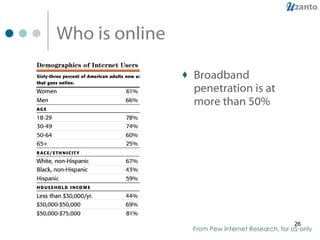
Who is online Broadband penetration is at more than 50% From Pew Internet Research, for US only
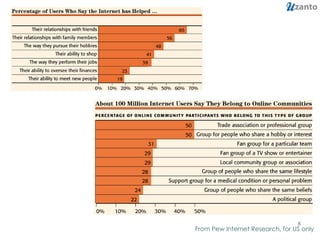
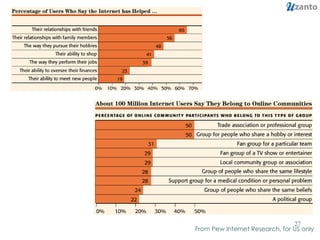
From Pew Internet Research, for US only
Just for fun! 34%  men , 26%  women   37% of  18-29 yrs old , and 20% of  65 and over go online, on any given day, just for fun… From Pew Internet Research, for US only
The web has become a social sphere Massively multiplayer online games
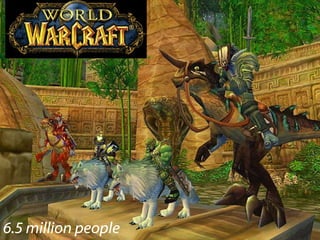
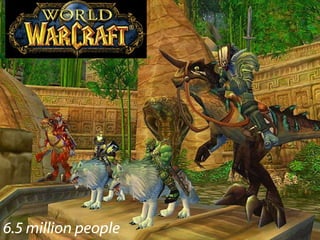
6.5 million people
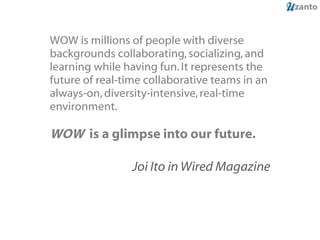
WOW is millions of people with diverse backgrounds collaborating, socializing, and learning while having fun. It represents the future of real-time collaborative teams in an always-on, diversity-intensive, real-time environment.  WOW  is a glimpse into our future.  Joi Ito in Wired Magazine
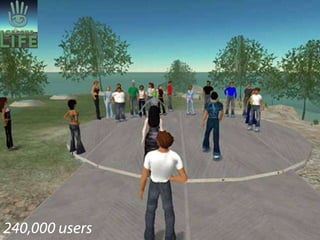
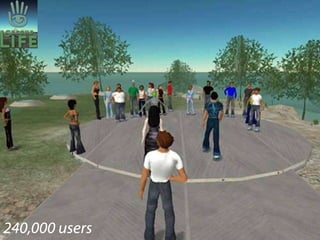
240,000 users
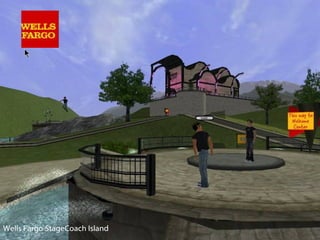
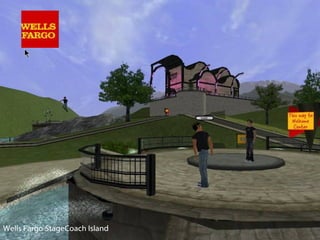
Wells Fargo StageCoach Island
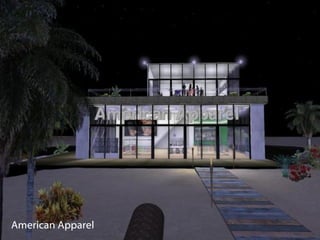
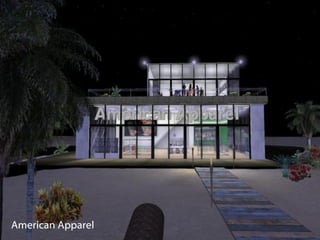
American Apparel
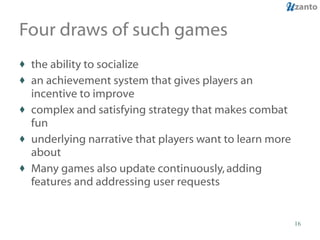
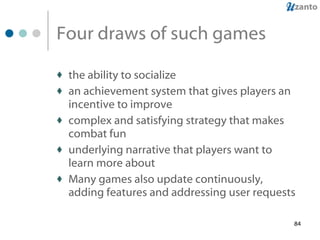
Four draws of such games the ability to socialize an achievement system that gives players an incentive to improve complex and satisfying strategy that makes combat fun underlying narrative that players want to learn more about Many games also update continuously, adding features and addressing user requests
Alone together Social interaction in online gaming (Ducheneaut et al. 2006) Surrounded by others. Feel their presence, not interacting all the time Analogy: Reading book in a cafe Spectacle: Performing for an audience Analogy: Playing pinball with others watching Social facilitation (Zajonc, 1960) Improved performance in presence of others (even if presence is passive) Observed even in cockroaches!
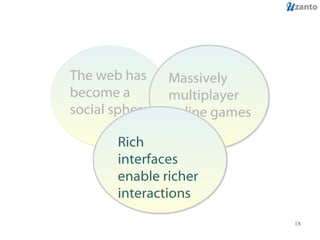
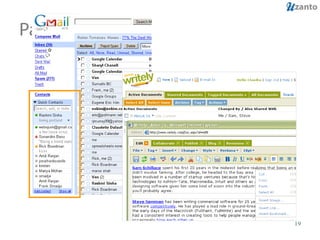
The web has become a social sphere Massively multiplayer online games Rich interfaces enable richer interactions
Part II
Part II: What is social sharing?
 
Hi I found you while I was searching my network at LinkedIn. Let's connect directly, so we can help each other with referrals. If we connect, both of our networks will grow. To add me as your connection, just follow the link below.
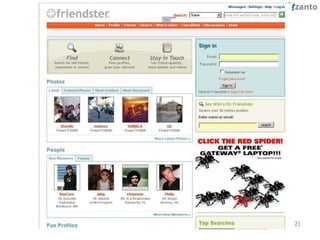
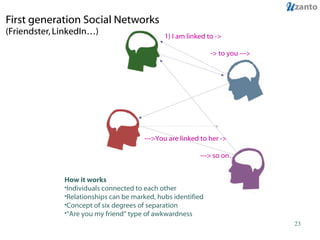
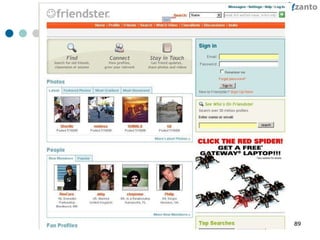
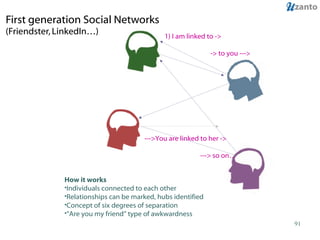
First generation Social Networks (Friendster, LinkedIn…) 1) I am linked to ->   -> to you ---> --->You are linked to her -> ---> so on… How it works Individuals connected to each other Relationships can be marked, hubs identified Concept of six degrees of separation “ Are you my friend” type of awkwardness
Part I: Why NOW?
The web has become a social sphere
Who is online Broadband penetration is at more than 50% From Pew Internet Research, for US only
From Pew Internet Research, for US only
Just for fun! 34%  men , 26%  women   37% of  18-29 yrs old , and 20% of  65 and over go online, on any given day, just for fun… From Pew Internet Research, for US only
The web has become a social sphere Massively multiplayer online games
6.5 million people


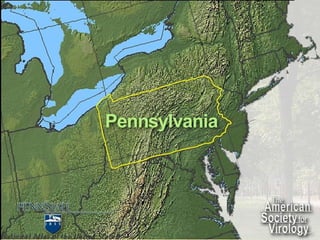
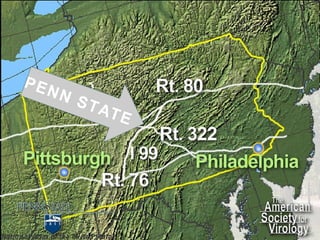
PENN STATE
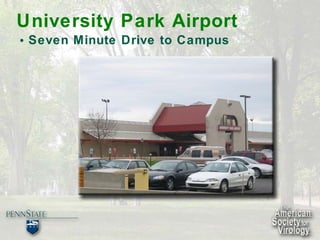
University Park Airport •  Seven Minute Drive to Campus
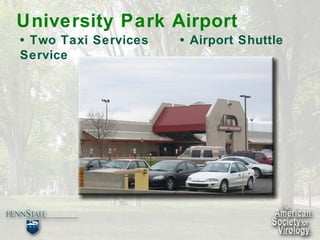
University Park Airport •  Two Taxi Services  • Airport Shuttle Service
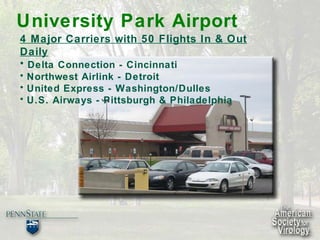
University Park Airport 4 Major Carriers with 50 Flights In & Out Daily Delta Connection - Cincinnati Northwest Airlink - Detroit United Express - Washington/Dulles U.S. Airways - Pittsburgh & Philadelphia
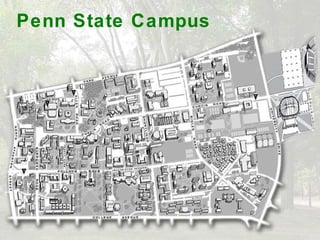
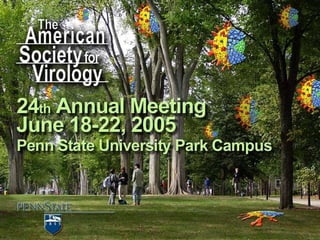
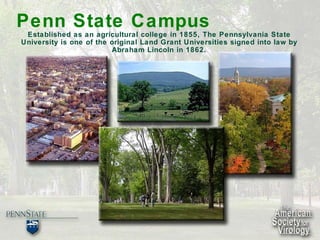
Penn State Campus Established as an agricultural college in 1855, The Pennsylvania State University is one of the original Land Grant Universities signed into law by Abraham Lincoln in 1862.
Penn State Campus
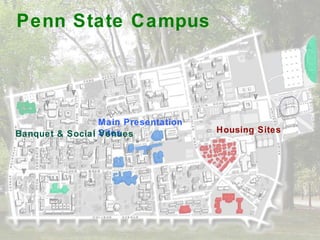
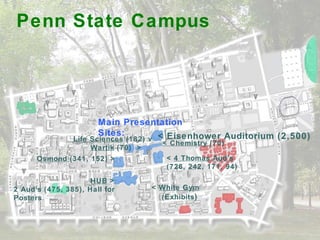
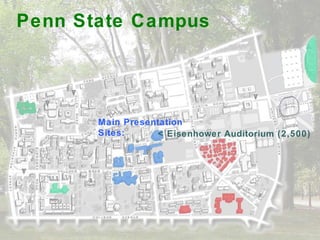
Main Presentation Sites Housing Sites Banquet & Social Venues Penn State Campus
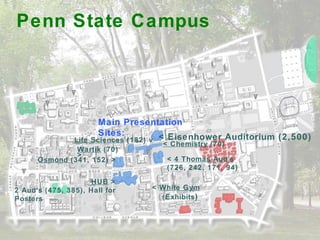
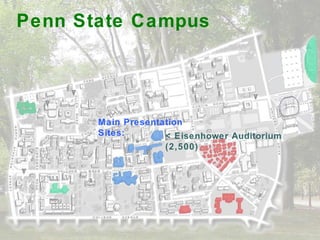
Main Presentation Sites: <  4 Thomas Aud’s (726, 242, 171, 94) Wartik  (70)  > Osmond  (341, 152) >   HUB  > 2 Aud’s (475, 385), Hall for Posters Life Sciences  (182) v <  White Gym (Exhibits ) < Chemistry  (70) < Eisenhower Auditorium (2,500) Penn State Campus
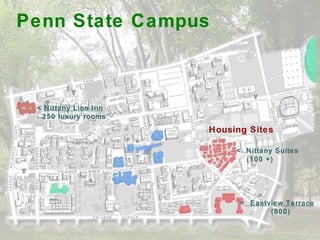
Housing Sites <   Eastview Terrace (800) <  Nittany Suites (100 +) <  Nittany Lion Inn 250 luxury rooms Penn State Campus
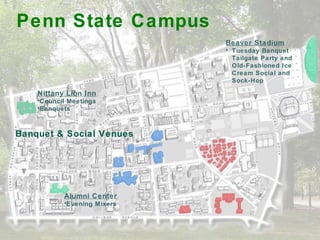
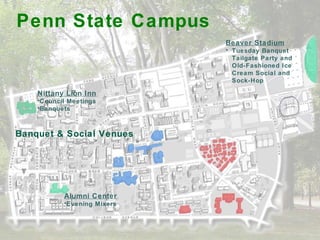
Nittany Lion Inn Council Meetings Banquets Alumni Center Evening Mixers Beaver Stadium Tuesday Banquet  Tailgate Party and  Old-Fashioned Ice Cream Social and  Sock-Hop Banquet & Social Venues Penn State Campus
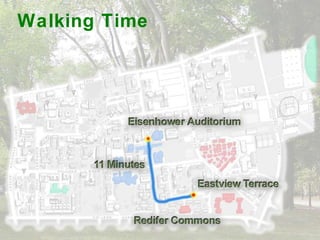
Walking Time
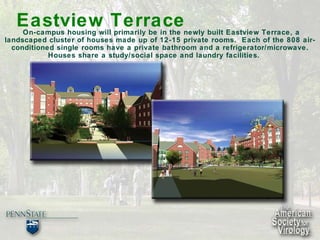
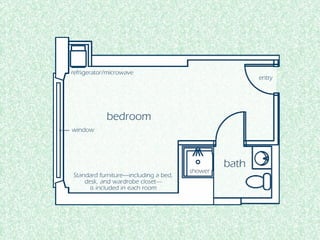
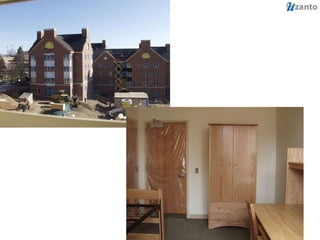
Eastview Terrace   On-campus housing will primarily be in the newly built Eastview Terrace, a landscaped cluster of houses made up of 12-15 private rooms.  Each of the 808 air-conditioned single rooms have a private bathroom and a refrigerator/microwave. Houses share a study/social space and laundry facilities.
 
 
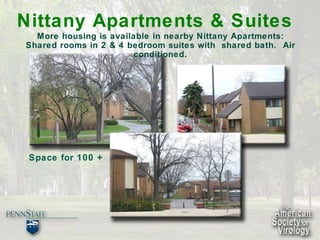
Nittany Apartments & Suites More housing is available in nearby Nittany Apartments: Shared rooms in 2 & 4 bedroom suites with  shared bath.  Air conditioned. Space for 100 +
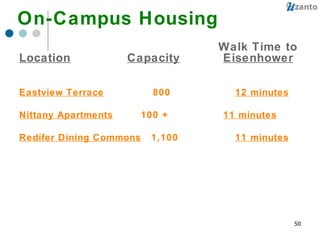
On-Campus Housing     Walk Time to Location Capacity Eisenhower   Eastview Terrace   800 12 minutes Nittany Apartments   100 + 11 minutes Redifer Dining Commons 1,100  11 minutes
Main Presentation Sites: < Eisenhower Auditorium (2,500) Penn State Campus
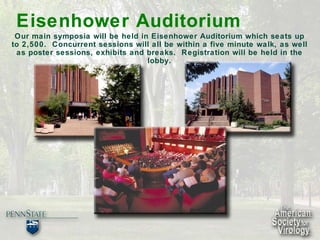
Eisenhower Auditorium Our main symposia will be held in Eisenhower Auditorium which seats up to 2,500.  Concurrent sessions will all be within a five minute walk, as well as poster sessions, exhibits and breaks.  Registration will be held in the lobby.
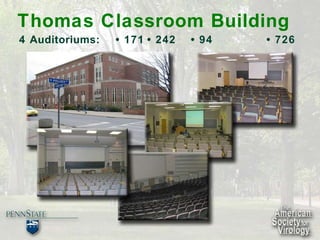
Thomas Classroom Building 4 Auditoriums:  • 171 • 242   • 94   • 726
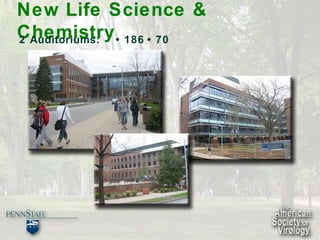
New Life Science & Chemistry 2 Auditoriums:  • 186 • 70
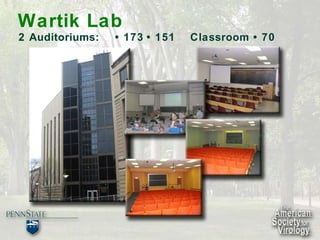
Wartik Lab 2 Auditoriums:  • 173 • 151   Classroom • 70
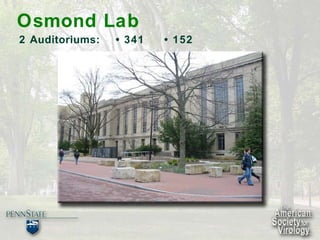
Osmond Lab 2 Auditoriums:  • 341  • 152
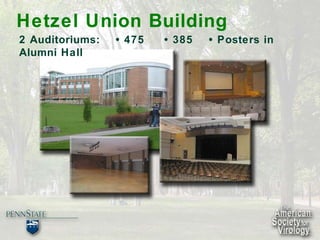
Hetzel Union Building 2 Auditoriums:  • 475  • 385  • Posters in Alumni Hall
Penn State Campus Main Presentation Sites: <  4 Thomas Aud’s (726, 242, 171, 94) Wartik  (70)  > Osmond  (341, 152) >   HUB  > 2 Aud’s (475, 385), Hall for Posters Life Sciences  (182) v <  White Gym (Exhibits ) < Chemistry  (70) < Eisenhower Auditorium (2,500)
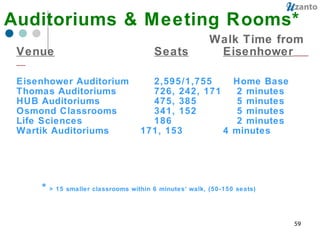
Auditoriums & Meeting Rooms* Walk Time from Venue Seats Eisenhower   Eisenhower Auditorium 2,595 /1,755   Home Base Thomas Auditoriums 726, 242, 171 2 minutes HUB Auditoriums 475, 385  5 minutes Osmond Classrooms 341, 152 5 minutes Life Sciences 186 2 minutes Wartik Auditoriums  171, 153 4 minutes *  > 15 smaller classrooms within 6 minutes’ walk, (50-150 seats)
Penn State Campus Nittany Lion Inn Council Meetings Banquets Alumni Center Evening Mixers Beaver Stadium Tuesday Banquet  Tailgate Party and  Old-Fashioned Ice Cream Social and  Sock-Hop Banquet & Social Venues
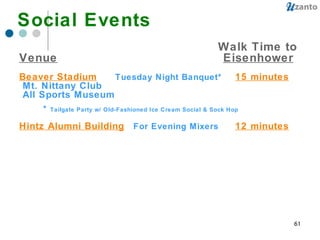
  Walk Time to Venue Eisenhower Beaver Stadium Tuesday Night Banquet* 15 minutes    Mt. Nittany Club  All Sports Museum *  Tailgate Party w/ Old-Fashioned Ice Cream Social & Sock Hop Hintz Alumni Building   For Evening Mixers 12 minutes Social Events
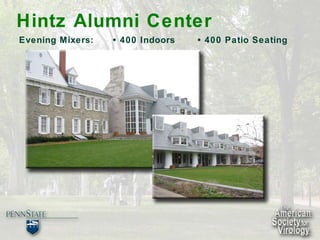
Hintz Alumni Center Evening Mixers:  • 400 Indoors  • 400 Patio Seating
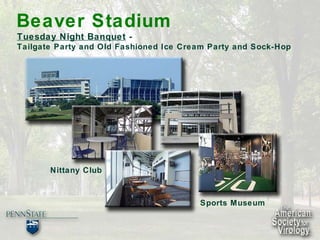
Beaver Stadium Tuesday Night Banquet  -  Tailgate Party and Old Fashioned Ice Cream Party and Sock-Hop Nittany Club Sports Museum
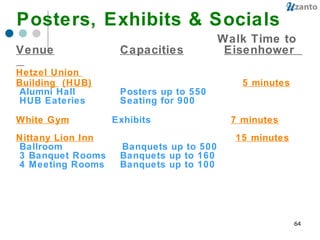
Posters, Exhibits & Socials    Walk Time to Venue Capacities Eisenhower  Hetzel Union  Building  (HUB)     5 minutes   Alumni Hall Posters up to 550 HUB Eateries Seating for 900  White Gym     Exhibits     7 minutes   Nittany Lion Inn 15 minutes  Ballroom     Banquets up to 500   3 Banquet Rooms  Banquets up to 160 4 Meeting Rooms Banquets up to 100
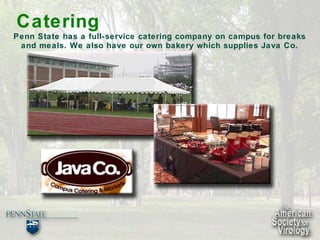
Penn State has a full-service catering company on campus for breaks and meals. We also have our own bakery which supplies Java Co. Catering
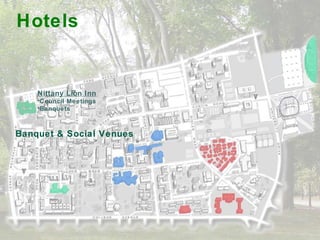
Hotels Nittany Lion Inn Council Meetings Banquets Banquet & Social Venues
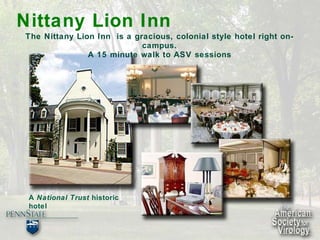
Nittany Lion Inn   The Nittany Lion Inn  is a gracious, colonial style hotel right on-campus. A 15 minute walk to ASV sessions A  National Trust  historic  hotel
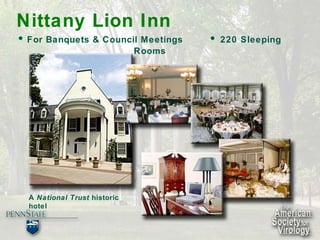
A  National Trust  historic  hotel •   For Banquets & Council Meetings  •  220 Sleeping Rooms Nittany Lion Inn
 
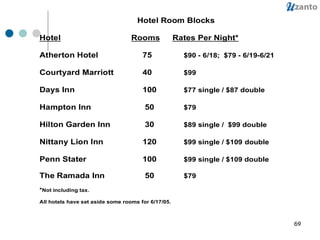
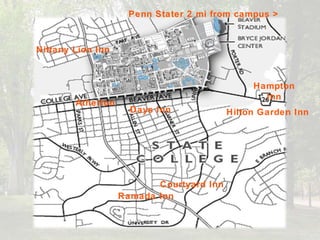
Courtyard Inn Nittany Lion Inn Days Inn Hampton Inn Hilton Garden Inn Ramada Inn Atherton Penn Stater 2 mi from campus >
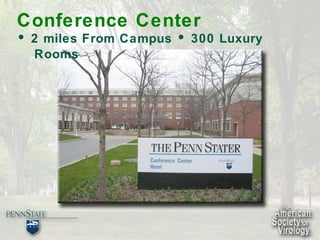
Conference Center •  2 miles From Campus •  300 Luxury Rooms
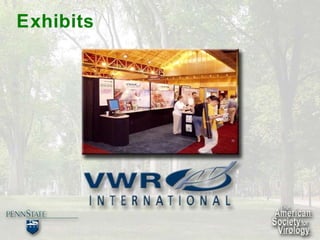
Exhibits
Penn State Campus Main Presentation Sites: < Eisenhower Auditorium (2,500)
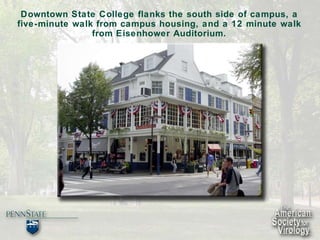
Downtown State College flanks the south side of campus, a five-minute walk from campus housing, and a 12 minute walk from Eisenhower Auditorium.
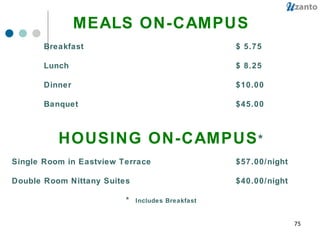
MEALS ON-CAMPUS Breakfast $ 5.75 Lunch  $ 8.25 Dinner $10.00 Banquet  $45.00 HOUSING ON-CAMPUS * Single Room in Eastview Terrace  $57.00/night Double Room Nittany Suites $40.00/night *  Includes Breakfast
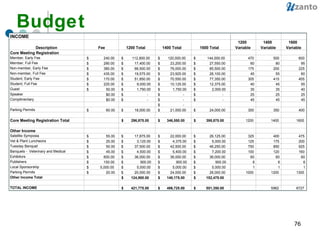
Budget


WOW is millions of people with diverse backgrounds collaborating, socializing, and learning while having fun. It represents the future of real-time collaborative teams in an always-on, diversity-intensive, real-time environment.  WOW  is a glimpse into our future.  Joi Ito in Wired Magazine
240,000 users
Wells Fargo StageCoach Island
American Apparel
Four draws of such games the ability to socialize an achievement system that gives players an incentive to improve complex and satisfying strategy that makes combat fun underlying narrative that players want to learn more about Many games also update continuously, adding features and addressing user requests
Alone together Social interaction in online gaming (Ducheneaut et al. 2006) Surrounded by others. Feel their presence, not interacting all the time Analogy: Reading book in a cafe Spectacle: Performing for an audience Analogy: Playing pinball with others watching Social facilitation (Zajonc, 1960) Improved performance in presence of others (even if presence is passive) Observed even in cockroaches!
The web has become a social sphere Massively multiplayer online games Rich interfaces enable richer interactions
Part II
Part II: What is social sharing?
 
Hi I found you while I was searching my network at LinkedIn. Let's connect directly, so we can help each other with referrals. If we connect, both of our networks will grow. To add me as your connection, just follow the link below.
First generation Social Networks (Friendster, LinkedIn…) 1) I am linked to ->   -> to you ---> --->You are linked to her -> ---> so on… How it works Individuals connected to each other Relationships can be marked, hubs identified Concept of six degrees of separation “ Are you my friend” type of awkwardness
Object mediated social networks “… call for the rethinking of sociality along lines that include objects in the concept of social relations.” Katrin-Knorr Cetina
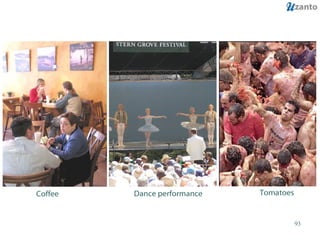
Coffee Dance performance Tomatoes
Second generation social networks  Put objects at the center Social sharing Tagging Viral sharing Social News Creation
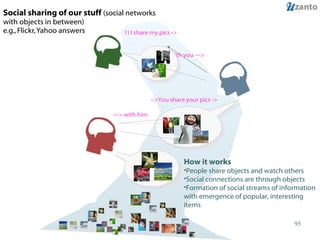
Social sharing of our stuff  (social networks with objects in between) e.g., Flickr, Yahoo answers 1) I share my pics ->   -> with you --->   -->You share your pics -> ---> with him How it works People share objects and watch others Social connections are through objects Formation of social streams of information with emergence of popular, interesting items
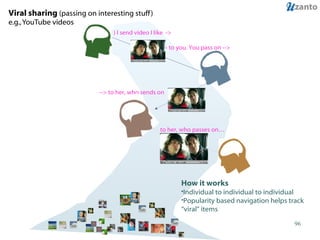
Viral sharing  (passing on interesting stuff) e.g., YouTube videos 1) I send video I like  ->   -> to you. You pass on -->   --> to her, who sends on to her, who passes on… How it works Individual to individual to individual Popularity based navigation helps track “viral” items
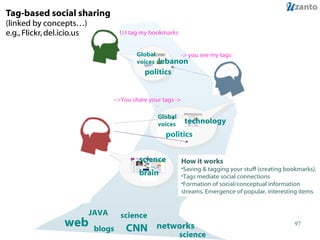
Tag-based social sharing  (linked by concepts…) e.g., Flickr, del.icio.us 1) I tag my bookmarks   -> you see my tags  -->You share your tags -> How it works Saving & tagging your stuff (creating bookmarks). Tags mediate social connections Formation of social/conceptual information streams. Emergence of popular, interesting items  politics lebanon Global voices politics technology Global voices web JAVA CNN networks blogs science science science brain
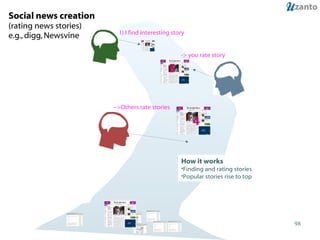
Social news creation  (rating news stories) e.g., digg, Newsvine 1) I find interesting story   -> you rate story  -->Others rate stories How it works Finding and rating stories Popular stories rise to top 5 4
Objects invite us to Connect Play React Reach out
Part III: So you want to design for social sharing?
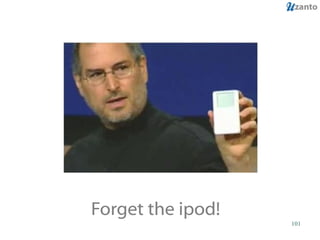
Forget the ipod!
Web 2.0 and Virtual Worlds Roo Reynolds Metaverse Evangelist [email_address]
Your innocent laughter was so pure
To my pain it was the cure
My heart fills with pain so much
To see all the lives of people that you have touched..
memories of you are so sweet …
But sometimes they make me weep …
A story of an African Safari An adventure experienced by three little boys. PART ONE
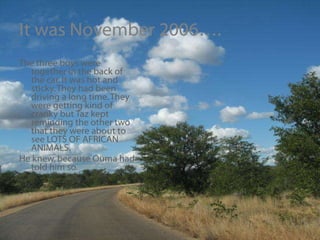
It was November 2006…. The three boys were together in the back of the car. It was hot and sticky. They had been driving a long time. They were getting kind of cranky but Taz kept reminding the other two that they were about to see LOTS OF AFRICAN ANIMALS.  He knew, because Ouma had told him so.
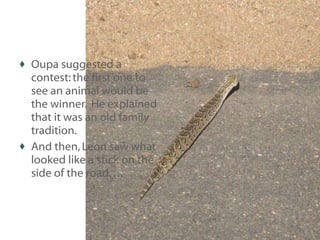
Oupa suggested a contest: the first one to see an animal would be the winner.  He explained that it was an old family tradition. And then, Leon saw what looked like a stick on the side of the road….
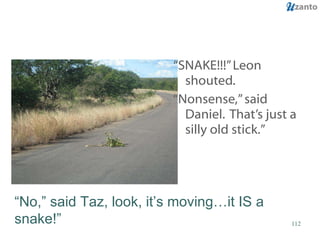
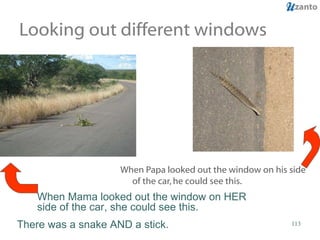
“ SNAKE!!!” Leon shouted.  “ Nonsense,” said Daniel.  That’s just a silly old stick.” “ No,” said Taz, look, it’s moving…it IS a snake!”
Looking out different windows When Papa looked out the window on his side of the car, he could see this.   When Mama looked out the window on HER side of the car, she could see this. There was a snake AND a stick.
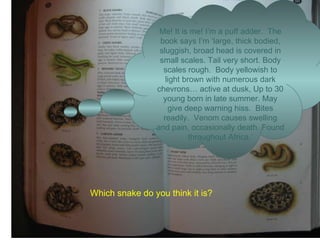
Which snake do you think it is? Me! It is me! I’m a puff adder.  The book says I’m ‘large, thick bodied, sluggish, broad head is covered in small scales. Tail very short. Body scales rough.  Body yellowish to light brown with numerous dark chevrons… active at dusk, Up to 30 young born in late summer. May give deep warning hiss.  Bites readily.  Venom causes swelling and pain, occasionally death. Found throughout Africa.’
The snake in the picture was the first puffadder that Ouma had ever seen. She had to ask her brother, Guillaume, what kind of snake it was.  Guillaume is a hiker and a mountaineer so he knows more about snakes than she does.  He immediately knew the answer.
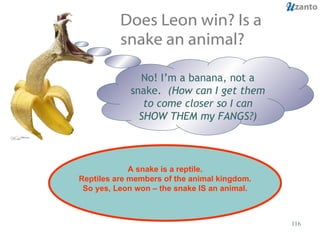
Does Leon win? Is a snake an animal? No! I’m a banana, not a snake.  (How can I get them to come closer so I can SHOW THEM my FANGS?) A snake is a reptile. Reptiles are members of the animal kingdom. So yes, Leon won – the snake IS an animal.
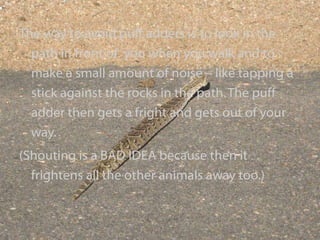
The way to avoid puff adders is to look in the path in front of  you when you walk and to make a small amount of noise – like tapping a stick against the rocks in the path. The puff adder then gets a fright and gets out of your way.  (Shouting is a BAD IDEA because then it frightens all the other animals away too.)
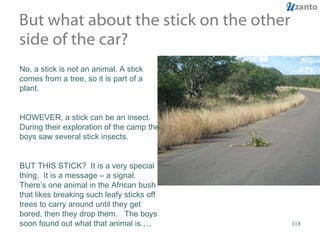
But what about the stick on the other side of the car? No, a stick is not an animal. A stick comes from a tree, so it is part of a plant. HOWEVER, a stick can be an insect.  During their exploration of the camp the boys saw several stick insects. BUT THIS STICK?  It is a very special thing.  It is a message – a signal.  There’s one animal in the African bush that likes breaking such leafy sticks off trees to carry around until they get bored, then they drop them.  The boys soon found out what that animal is….
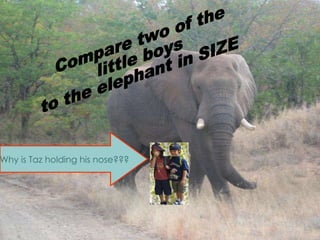
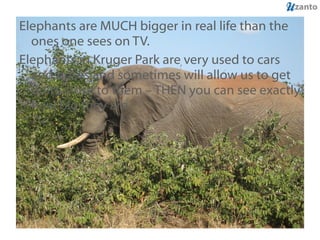
Compare two of the  little boys  to the elephant in SIZE Why is Taz holding his nose???
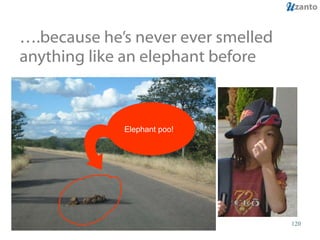
… .because he’s never ever smelled anything like an elephant before Elephant poo!
Elephants are MUCH bigger in real life than the ones one sees on TV.  Elephants in Kruger Park are very used to cars and buses and sometimes will allow us to get quite close to them – THEN you can see exactly how big they are.
You can tell how recently an elephant passed by, based on the elephant dung. Can you guess how? Or Maybe you already know? If you don’t and would like to, ask your father.
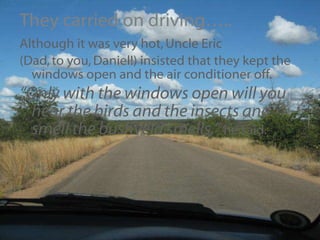
They carried on driving….. Although it was very hot, Uncle Eric  (Dad, to you, Daniel!) insisted that they kept the windows open and the air conditioner off. “ Only with the windows open will you hear the birds and the insects and smell the bushveld smells,”  he said.
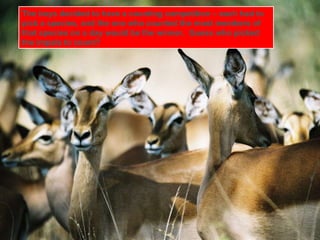
The boys decided to have a counting competition – each had to pick a species, and the one who counted the most members of that species on a day would be the winner.  Guess who picked the impala to count?
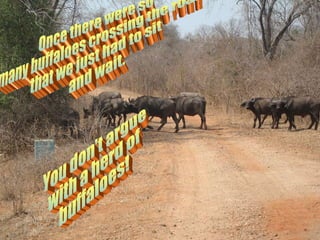
Once there were so  many buffaloes crossing the road  that we just had to sit and wait.  You don't argue  with a herd of  buffaloes!
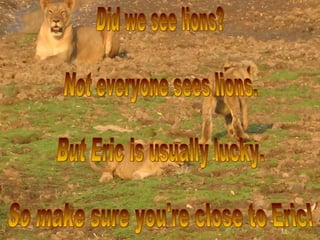
Did we see lions? Not everyone sees lions. But Eric is usually lucky.  So make sure you're close to Eric!
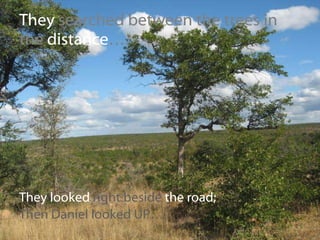
They  searched between the trees in the  distance …. They looked  right beside  the road; Then Daniel looked UP…..
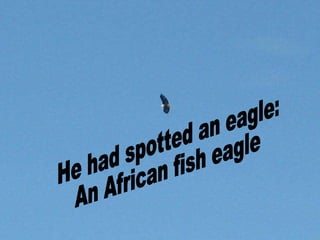
He had spotted an eagle: An African fish eagle
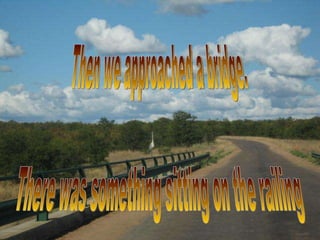
Then we approached a bridge. There was something sitting on the railing
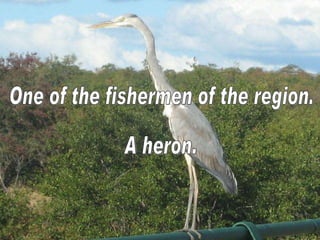
One of the fishermen of the region. A heron.
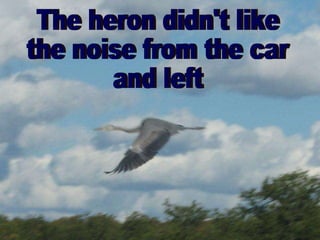
The heron didn't like  the noise from the car  and left
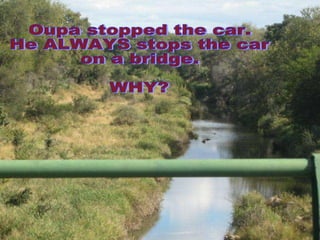
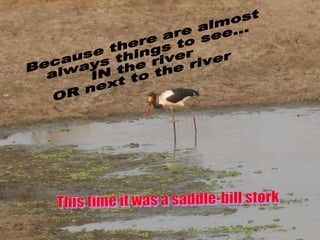
Oupa stopped the car.  He ALWAYS stops the car  on a bridge. WHY?
Because there are almost always things to see... IN the river  OR next to the river This time it was a saddle-bill stork
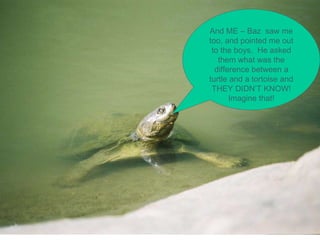
And ME – Baz  saw me too, and pointed me out to the boys.  He asked them what was the difference between a turtle and a tortoise and THEY DIDN’T KNOW! Imagine that!
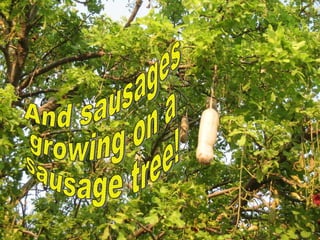
And sausages growing on a sausage tree!
Check emails regularly for the next exciting instalment of A STORY OF AN AFRICAN SAFARI
I’m sorry … for the bad times  we had to share
I’m thankful … for the sad times you’ve helped me bare.
that have known you. i am proud to be one amongst tons of others
So many people you have helped with just a smile
you were the type that was worth waiting for a while … so many memories  filled with laughter
if only they keep going forever after
years went by it seems so long ago but at the same time i can’t let you go i can’t seem to get over the fact that you’re gone i keep expecting you to show up for more laughs and fun
you were such a young person and you opened my eyes Always a legend you will be in my eyes
Web 2.0
Web 2.0 examples (then and now) Personal websites  ->  blogs  Britannica Online  ->  Wikipedia  DoubleClick  ->  Google AdSense  Domain name speculation ->  search engine optimisation  Screen scraping  ->  web services  Content management systems  ->  wikis  Directories (taxonomy)  ->  tagging (&quot;folksonomy&quot;)
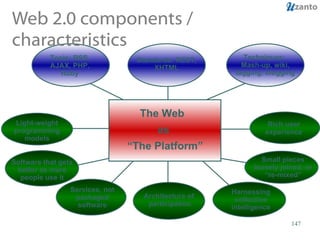
Web 2.0 components / characteristics The Web  as “ The Platform” Tools: RSS, AJAX, PHP, Ruby Services, not packaged software Architecture of  participation Small pieces loosely joined, or “re-mixed” Harnessing collective intelligence Software that gets better as more people use it Standards: REST, XHTML Techniques:  Mash-up, wiki, tagging, blogging Rich user experience Light-weight programming models
Key themes to remember Social networking User-generated content
Web 2.0 attitude “  Web 2.0 is an attitude not a technology.  It’s about enabling and encouraging  participation through open applications and services .   By open I mean technically open with appropriate APIs but also, more importantly,  socially open , with rights granted to use the content in new and exciting contexts.”  Ian Davis   http://iandavis.com/blog/2005/07/talis-web-20-and-all-that
Web 2.0  is understood – so what’s next?
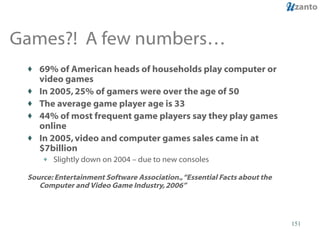
Games?!  A few numbers… 69% of American heads of households play computer or video games In 2005, 25% of gamers were over the age of 50 The average game player age is 33 44% of most frequent game players say they play games online In 2005, video and computer games sales came in at $7billion Slightly down on 2004 – due to new consoles Source: Entertainment Software Association., “Essential Facts about the Computer and Video Game Industry, 2006”
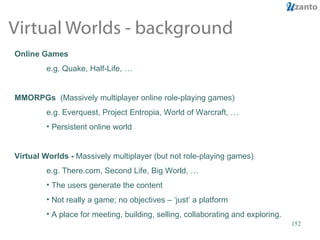
Virtual Worlds - background Online Games e.g. Quake, Half-Life, … MMORPGs  (Massively multiplayer online role-playing games) e.g. Everquest, Project Entropia, World of Warcraft, … Persistent online world Virtual Worlds -  Massively multiplayer (but not role-playing games) e.g. There.com, Second Life, Big World, … The users generate the content Not really a game; no objectives – ‘just’ a platform A place for meeting, building, selling, collaborating and exploring.
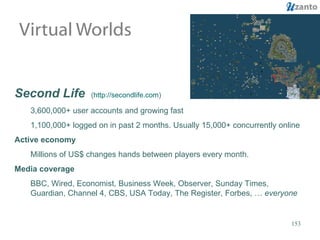
Virtual Worlds Second Life   ( http://secondlife.com ) 3,600,000+ user accounts and growing fast 1,100,000+ logged on in past 2 months. Usually 15,000+ concurrently online Active economy Millions of US$ changes hands between players every month. Media coverage BBC, Wired, Economist, Business Week, Observer, Sunday Times, Guardian, Channel 4, CBS, USA Today, The Register, Forbes, …  everyone
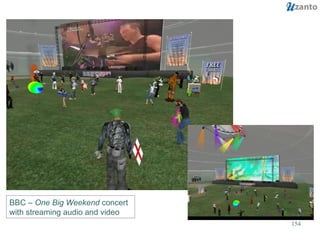
BBC –  One Big Weekend  concert with streaming audio and video
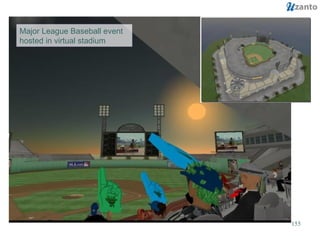
Major League Baseball event hosted in virtual stadium
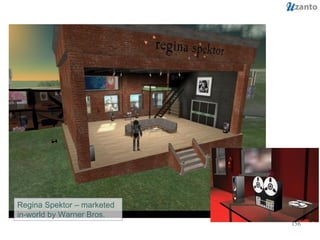
Regina Spektor – marketed in-world by Warner Bros.
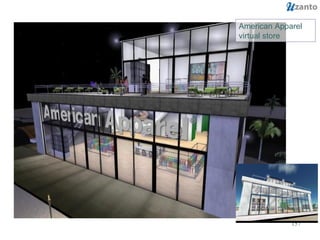
American Apparel  virtual store
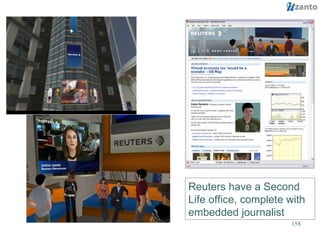
Reuters have a Second Life office, complete with embedded journalist
Why does IBM care?
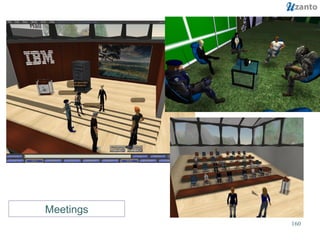
Meetings
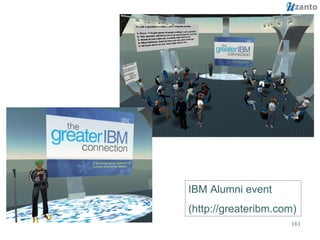
IBM Alumni event (http://greateribm.com)
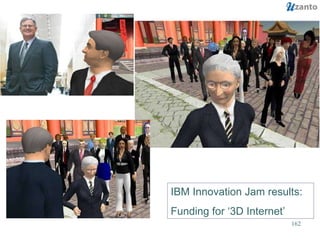
IBM Innovation Jam results: Funding for ‘3D Internet’
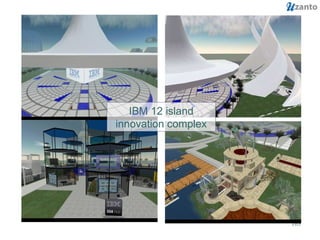
IBM 12 island innovation complex
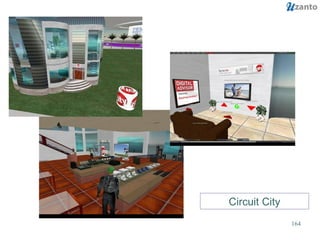
Circuit City
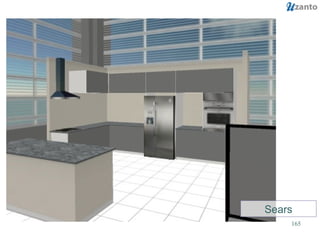
Sears
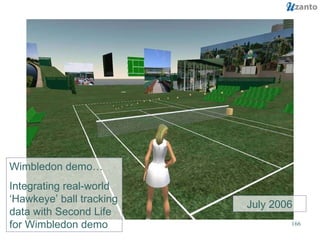
Wimbledon demo… Integrating real-world ‘Hawkeye’ ball tracking data with Second Life for Wimbledon demo July 2006
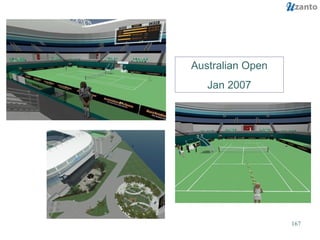
Australian Open Jan 2007
More possibilities Marketing, brand promotion Retail Hardware / Storage  Media and entertainment (TV?) Modelling (visualisation, simulation, …) Research, including monitoring (and data-mining) Education (e-learning, blended learning, …) Conferences Community events …
What’s next? rooreynolds.com eightbar.co.uk
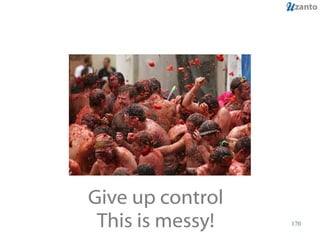
Give up control This is messy!
Some principles…
1: Make system personally useful For end-user system should have strong personal use Memorable Personal Snippets (e.g., Del.icio.us & Flickr) Self-expression (e.g., Newsvine) Social status: Digg Don’t count on altruism System should thrive on people’s selfishness
Bite-sized self-expression Creative self-expression Artistic expression (Flickr, YouTube) Humor (YouTube) Individual piece should be small Can create sets & lists Do Mashups Simple, guessable URLs for everything  Leave room for games & social play Appreciation Stalking (some!) Gossip
2: Identify symbiotic relationship between personal & social Personal snippets > Social stream Pictures > Organized by Events Music > Organized by Playlists
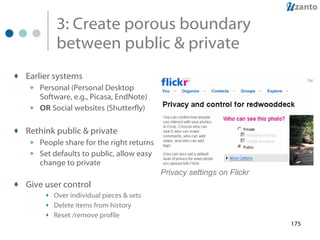
3: Create porous boundary between public & private Earlier systems Personal (Personal Desktop Software, e.g., Picasa, EndNote) OR  Social websites (Shutterfly) Rethink public & private People share for the right returns Set defaults to public, allow easy change to private Give user control Over individual pieces & sets Delete items from history Reset /remove profile  Privacy settings on Flickr
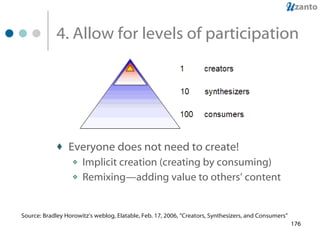
4. Allow for levels of participation Everyone does not need to create! Implicit creation (creating by consuming) Remixing—adding value to others’ content Source: Bradley Horowitz’s weblog, Elatable, Feb. 17, 2006, “Creators, Synthesizers, and Consumers”
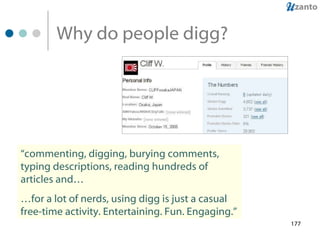
Why do people digg? “ commenting, digging, burying comments, typing descriptions, reading hundreds of articles and… … for a lot of nerds, using digg is just a casual free-time activity. Entertaining. Fun. Engaging.”
how to encourage participation Insights from Social Psychology Highlight unique contribution Allow for smaller local groups Highlight benefit to self from Highlight benefit to group Source: Using social psychology to motivate contributions to online communities, Ling et al. 2005
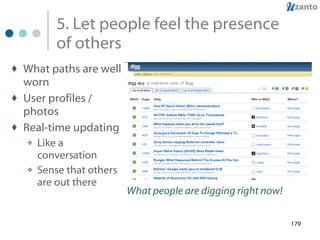
5. Let people feel the presence of others What paths are well worn User profiles / photos Real-time updating Like a conversation Sense that others are out there What people are digging right now!
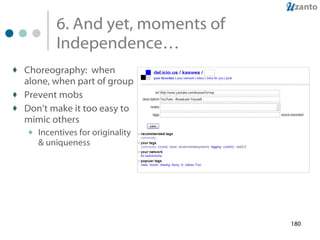
6. And yet, moments of Independence… Choreography:  when alone, when part of group Prevent mobs Don’t make it too easy to mimic others Incentives for originality & uniqueness
Allow for alternative viewpoints & perspectives Social sharing can lead to tyranny of dominant view People of a group agree Viewpoint rises to top (popularity lists, tag clouds)
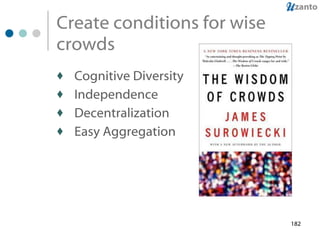
Create conditions for wise crowds Cognitive Diversity Independence Decentralization Easy Aggregation
Wise Crowds: Cognitive Diversity Need many perspectives for good answers Groups become homogenous Members bring lesser new information in Diversity reduces groupthink Groupthink works by shielding members from outside opinions Diversity reduces conformity Chance that you will change opinion to match group
Wise Crowds: Independence Keeps people’s mistakes from getting correlated (uncorrelated mistakes averaged out) Encourages people to bring in new viewpoints (diversity) Concept of  Social Proof Milgram experiment People assume that groups know what they are doing Assuming crowd is wise, leads to herd like behavior Can sometimes lead to good decisions Information Cascades Sequence of uninformed choices, building upon each other
Wise Crowds: Decentralization “ A crowd of decentralized people working to solve a problem on their own without any central effort to guide them, come up with better solutions, rather than a top-down driven solution.”   Suroweicki
Wise Crowds: Easy Aggregation A decentralized system can pick right solution  With easy way for information to be aggregated across system Example: votes on Digg
7. Enable Serendipity  Don’t make navigation all about popularity Access to some popular stuff (keep this fast moving) Make the “long tail” accessible Popularity as a jump off point to other ways of exploring Provide personalization Recommendations using collaborative filtering Similar tags, content, others Ad-hoc groups?
8. Most of all, allow for play
Things to try at home! Create an account on myspace.com Read Emergence, Wisdom of Crowds Play a Multiplayer Online Game (WOW, Second Life) Play with an API (try GoogleMaps API) Try a mobile social application (DodgeBall) Ask your friends what they find “fun” on the web
Questions? www.rashmisinha.com www.uzanto.com

More than 50mb

  • 1.
    Designing for SocialSharing Rashmi Sinha www.uzanto.com www.rashmisinha.com
  • 2.
  • 3.
    Designing for SocialSharing Rashmi Sinha www.uzanto.com www.rashmisinha.com
  • 4.
  • 5.
  • 6.
    The web hasbecome a social sphere
  • 7.
    Who is onlineBroadband penetration is at more than 50% From Pew Internet Research, for US only
  • 8.
    From Pew InternetResearch, for US only
  • 9.
    Just for fun!34% men , 26% women 37% of 18-29 yrs old , and 20% of 65 and over go online, on any given day, just for fun… From Pew Internet Research, for US only
  • 10.
    The web hasbecome a social sphere Massively multiplayer online games
  • 11.
  • 12.
    WOW is millionsof people with diverse backgrounds collaborating, socializing, and learning while having fun. It represents the future of real-time collaborative teams in an always-on, diversity-intensive, real-time environment. WOW is a glimpse into our future. Joi Ito in Wired Magazine
  • 13.
  • 14.
  • 15.
  • 16.
    Four draws ofsuch games the ability to socialize an achievement system that gives players an incentive to improve complex and satisfying strategy that makes combat fun underlying narrative that players want to learn more about Many games also update continuously, adding features and addressing user requests
  • 17.
    Alone together Socialinteraction in online gaming (Ducheneaut et al. 2006) Surrounded by others. Feel their presence, not interacting all the time Analogy: Reading book in a cafe Spectacle: Performing for an audience Analogy: Playing pinball with others watching Social facilitation (Zajonc, 1960) Improved performance in presence of others (even if presence is passive) Observed even in cockroaches!
  • 18.
    The web hasbecome a social sphere Massively multiplayer online games Rich interfaces enable richer interactions
  • 19.
  • 20.
    Part II: Whatis social sharing?
  • 21.
  • 22.
    Hi I foundyou while I was searching my network at LinkedIn. Let's connect directly, so we can help each other with referrals. If we connect, both of our networks will grow. To add me as your connection, just follow the link below.
  • 23.
    First generation SocialNetworks (Friendster, LinkedIn…) 1) I am linked to -> -> to you ---> --->You are linked to her -> ---> so on… How it works Individuals connected to each other Relationships can be marked, hubs identified Concept of six degrees of separation “ Are you my friend” type of awkwardness
  • 24.
  • 25.
    The web hasbecome a social sphere
  • 26.
    Who is onlineBroadband penetration is at more than 50% From Pew Internet Research, for US only
  • 27.
    From Pew InternetResearch, for US only
  • 28.
    Just for fun!34% men , 26% women 37% of 18-29 yrs old , and 20% of 65 and over go online, on any given day, just for fun… From Pew Internet Research, for US only
  • 29.
    The web hasbecome a social sphere Massively multiplayer online games
  • 30.
  • 31.
  • 32.
  • 33.
  • 34.
  • 35.
  • 36.
    University Park Airport• Seven Minute Drive to Campus
  • 37.
    University Park Airport• Two Taxi Services • Airport Shuttle Service
  • 38.
    University Park Airport4 Major Carriers with 50 Flights In & Out Daily Delta Connection - Cincinnati Northwest Airlink - Detroit United Express - Washington/Dulles U.S. Airways - Pittsburgh & Philadelphia
  • 39.
    Penn State CampusEstablished as an agricultural college in 1855, The Pennsylvania State University is one of the original Land Grant Universities signed into law by Abraham Lincoln in 1862.
  • 40.
  • 41.
    Main Presentation SitesHousing Sites Banquet & Social Venues Penn State Campus
  • 42.
    Main Presentation Sites:< 4 Thomas Aud’s (726, 242, 171, 94) Wartik (70) > Osmond (341, 152) > HUB > 2 Aud’s (475, 385), Hall for Posters Life Sciences (182) v < White Gym (Exhibits ) < Chemistry (70) < Eisenhower Auditorium (2,500) Penn State Campus
  • 43.
    Housing Sites < Eastview Terrace (800) < Nittany Suites (100 +) < Nittany Lion Inn 250 luxury rooms Penn State Campus
  • 44.
    Nittany Lion InnCouncil Meetings Banquets Alumni Center Evening Mixers Beaver Stadium Tuesday Banquet Tailgate Party and Old-Fashioned Ice Cream Social and Sock-Hop Banquet & Social Venues Penn State Campus
  • 45.
  • 46.
    Eastview Terrace On-campus housing will primarily be in the newly built Eastview Terrace, a landscaped cluster of houses made up of 12-15 private rooms. Each of the 808 air-conditioned single rooms have a private bathroom and a refrigerator/microwave. Houses share a study/social space and laundry facilities.
  • 47.
  • 48.
  • 49.
    Nittany Apartments &Suites More housing is available in nearby Nittany Apartments: Shared rooms in 2 & 4 bedroom suites with shared bath. Air conditioned. Space for 100 +
  • 50.
    On-Campus Housing Walk Time to Location Capacity Eisenhower Eastview Terrace 800 12 minutes Nittany Apartments 100 + 11 minutes Redifer Dining Commons 1,100 11 minutes
  • 51.
    Main Presentation Sites:< Eisenhower Auditorium (2,500) Penn State Campus
  • 52.
    Eisenhower Auditorium Ourmain symposia will be held in Eisenhower Auditorium which seats up to 2,500. Concurrent sessions will all be within a five minute walk, as well as poster sessions, exhibits and breaks. Registration will be held in the lobby.
  • 53.
    Thomas Classroom Building4 Auditoriums: • 171 • 242 • 94 • 726
  • 54.
    New Life Science& Chemistry 2 Auditoriums: • 186 • 70
  • 55.
    Wartik Lab 2Auditoriums: • 173 • 151 Classroom • 70
  • 56.
    Osmond Lab 2Auditoriums: • 341 • 152
  • 57.
    Hetzel Union Building2 Auditoriums: • 475 • 385 • Posters in Alumni Hall
  • 58.
    Penn State CampusMain Presentation Sites: < 4 Thomas Aud’s (726, 242, 171, 94) Wartik (70) > Osmond (341, 152) > HUB > 2 Aud’s (475, 385), Hall for Posters Life Sciences (182) v < White Gym (Exhibits ) < Chemistry (70) < Eisenhower Auditorium (2,500)
  • 59.
    Auditoriums & MeetingRooms* Walk Time from Venue Seats Eisenhower Eisenhower Auditorium 2,595 /1,755 Home Base Thomas Auditoriums 726, 242, 171 2 minutes HUB Auditoriums 475, 385 5 minutes Osmond Classrooms 341, 152 5 minutes Life Sciences 186 2 minutes Wartik Auditoriums 171, 153 4 minutes * > 15 smaller classrooms within 6 minutes’ walk, (50-150 seats)
  • 60.
    Penn State CampusNittany Lion Inn Council Meetings Banquets Alumni Center Evening Mixers Beaver Stadium Tuesday Banquet Tailgate Party and Old-Fashioned Ice Cream Social and Sock-Hop Banquet & Social Venues
  • 61.
    WalkTime to Venue Eisenhower Beaver Stadium Tuesday Night Banquet* 15 minutes Mt. Nittany Club All Sports Museum * Tailgate Party w/ Old-Fashioned Ice Cream Social & Sock Hop Hintz Alumni Building For Evening Mixers 12 minutes Social Events
  • 62.
    Hintz Alumni CenterEvening Mixers: • 400 Indoors • 400 Patio Seating
  • 63.
    Beaver Stadium TuesdayNight Banquet - Tailgate Party and Old Fashioned Ice Cream Party and Sock-Hop Nittany Club Sports Museum
  • 64.
    Posters, Exhibits &Socials Walk Time to Venue Capacities Eisenhower Hetzel Union Building (HUB) 5 minutes Alumni Hall Posters up to 550 HUB Eateries Seating for 900 White Gym Exhibits 7 minutes Nittany Lion Inn 15 minutes Ballroom Banquets up to 500 3 Banquet Rooms Banquets up to 160 4 Meeting Rooms Banquets up to 100
  • 65.
    Penn State hasa full-service catering company on campus for breaks and meals. We also have our own bakery which supplies Java Co. Catering
  • 66.
    Hotels Nittany LionInn Council Meetings Banquets Banquet & Social Venues
  • 67.
    Nittany Lion Inn The Nittany Lion Inn is a gracious, colonial style hotel right on-campus. A 15 minute walk to ASV sessions A National Trust historic hotel
  • 68.
    A NationalTrust historic hotel • For Banquets & Council Meetings • 220 Sleeping Rooms Nittany Lion Inn
  • 69.
  • 70.
    Courtyard Inn NittanyLion Inn Days Inn Hampton Inn Hilton Garden Inn Ramada Inn Atherton Penn Stater 2 mi from campus >
  • 71.
    Conference Center • 2 miles From Campus • 300 Luxury Rooms
  • 72.
  • 73.
    Penn State CampusMain Presentation Sites: < Eisenhower Auditorium (2,500)
  • 74.
    Downtown State Collegeflanks the south side of campus, a five-minute walk from campus housing, and a 12 minute walk from Eisenhower Auditorium.
  • 75.
    MEALS ON-CAMPUS Breakfast$ 5.75 Lunch $ 8.25 Dinner $10.00 Banquet $45.00 HOUSING ON-CAMPUS * Single Room in Eastview Terrace $57.00/night Double Room Nittany Suites $40.00/night * Includes Breakfast
  • 76.
  • 77.
  • 78.
  • 79.
  • 80.
    WOW is millionsof people with diverse backgrounds collaborating, socializing, and learning while having fun. It represents the future of real-time collaborative teams in an always-on, diversity-intensive, real-time environment. WOW is a glimpse into our future. Joi Ito in Wired Magazine
  • 81.
  • 82.
  • 83.
  • 84.
    Four draws ofsuch games the ability to socialize an achievement system that gives players an incentive to improve complex and satisfying strategy that makes combat fun underlying narrative that players want to learn more about Many games also update continuously, adding features and addressing user requests
  • 85.
    Alone together Socialinteraction in online gaming (Ducheneaut et al. 2006) Surrounded by others. Feel their presence, not interacting all the time Analogy: Reading book in a cafe Spectacle: Performing for an audience Analogy: Playing pinball with others watching Social facilitation (Zajonc, 1960) Improved performance in presence of others (even if presence is passive) Observed even in cockroaches!
  • 86.
    The web hasbecome a social sphere Massively multiplayer online games Rich interfaces enable richer interactions
  • 87.
  • 88.
    Part II: Whatis social sharing?
  • 89.
  • 90.
    Hi I foundyou while I was searching my network at LinkedIn. Let's connect directly, so we can help each other with referrals. If we connect, both of our networks will grow. To add me as your connection, just follow the link below.
  • 91.
    First generation SocialNetworks (Friendster, LinkedIn…) 1) I am linked to -> -> to you ---> --->You are linked to her -> ---> so on… How it works Individuals connected to each other Relationships can be marked, hubs identified Concept of six degrees of separation “ Are you my friend” type of awkwardness
  • 92.
    Object mediated socialnetworks “… call for the rethinking of sociality along lines that include objects in the concept of social relations.” Katrin-Knorr Cetina
  • 93.
  • 94.
    Second generation socialnetworks Put objects at the center Social sharing Tagging Viral sharing Social News Creation
  • 95.
    Social sharing ofour stuff (social networks with objects in between) e.g., Flickr, Yahoo answers 1) I share my pics -> -> with you ---> -->You share your pics -> ---> with him How it works People share objects and watch others Social connections are through objects Formation of social streams of information with emergence of popular, interesting items
  • 96.
    Viral sharing (passing on interesting stuff) e.g., YouTube videos 1) I send video I like -> -> to you. You pass on --> --> to her, who sends on to her, who passes on… How it works Individual to individual to individual Popularity based navigation helps track “viral” items
  • 97.
    Tag-based social sharing (linked by concepts…) e.g., Flickr, del.icio.us 1) I tag my bookmarks -> you see my tags -->You share your tags -> How it works Saving & tagging your stuff (creating bookmarks). Tags mediate social connections Formation of social/conceptual information streams. Emergence of popular, interesting items politics lebanon Global voices politics technology Global voices web JAVA CNN networks blogs science science science brain
  • 98.
    Social news creation (rating news stories) e.g., digg, Newsvine 1) I find interesting story -> you rate story -->Others rate stories How it works Finding and rating stories Popular stories rise to top 5 4
  • 99.
    Objects invite usto Connect Play React Reach out
  • 100.
    Part III: Soyou want to design for social sharing?
  • 101.
  • 102.
    Web 2.0 andVirtual Worlds Roo Reynolds Metaverse Evangelist [email_address]
  • 103.
  • 104.
    To my painit was the cure
  • 105.
    My heart fillswith pain so much
  • 106.
    To see allthe lives of people that you have touched..
  • 107.
    memories of youare so sweet …
  • 108.
    But sometimes theymake me weep …
  • 109.
    A story ofan African Safari An adventure experienced by three little boys. PART ONE
  • 110.
    It was November2006…. The three boys were together in the back of the car. It was hot and sticky. They had been driving a long time. They were getting kind of cranky but Taz kept reminding the other two that they were about to see LOTS OF AFRICAN ANIMALS. He knew, because Ouma had told him so.
  • 111.
    Oupa suggested acontest: the first one to see an animal would be the winner. He explained that it was an old family tradition. And then, Leon saw what looked like a stick on the side of the road….
  • 112.
    “ SNAKE!!!” Leonshouted. “ Nonsense,” said Daniel. That’s just a silly old stick.” “ No,” said Taz, look, it’s moving…it IS a snake!”
  • 113.
    Looking out differentwindows When Papa looked out the window on his side of the car, he could see this. When Mama looked out the window on HER side of the car, she could see this. There was a snake AND a stick.
  • 114.
    Which snake doyou think it is? Me! It is me! I’m a puff adder. The book says I’m ‘large, thick bodied, sluggish, broad head is covered in small scales. Tail very short. Body scales rough. Body yellowish to light brown with numerous dark chevrons… active at dusk, Up to 30 young born in late summer. May give deep warning hiss. Bites readily. Venom causes swelling and pain, occasionally death. Found throughout Africa.’
  • 115.
    The snake inthe picture was the first puffadder that Ouma had ever seen. She had to ask her brother, Guillaume, what kind of snake it was. Guillaume is a hiker and a mountaineer so he knows more about snakes than she does. He immediately knew the answer.
  • 116.
    Does Leon win?Is a snake an animal? No! I’m a banana, not a snake. (How can I get them to come closer so I can SHOW THEM my FANGS?) A snake is a reptile. Reptiles are members of the animal kingdom. So yes, Leon won – the snake IS an animal.
  • 117.
    The way toavoid puff adders is to look in the path in front of you when you walk and to make a small amount of noise – like tapping a stick against the rocks in the path. The puff adder then gets a fright and gets out of your way. (Shouting is a BAD IDEA because then it frightens all the other animals away too.)
  • 118.
    But what aboutthe stick on the other side of the car? No, a stick is not an animal. A stick comes from a tree, so it is part of a plant. HOWEVER, a stick can be an insect. During their exploration of the camp the boys saw several stick insects. BUT THIS STICK? It is a very special thing. It is a message – a signal. There’s one animal in the African bush that likes breaking such leafy sticks off trees to carry around until they get bored, then they drop them. The boys soon found out what that animal is….
  • 119.
    Compare two ofthe little boys to the elephant in SIZE Why is Taz holding his nose???
  • 120.
    … .because he’snever ever smelled anything like an elephant before Elephant poo!
  • 121.
    Elephants are MUCHbigger in real life than the ones one sees on TV. Elephants in Kruger Park are very used to cars and buses and sometimes will allow us to get quite close to them – THEN you can see exactly how big they are.
  • 122.
    You can tellhow recently an elephant passed by, based on the elephant dung. Can you guess how? Or Maybe you already know? If you don’t and would like to, ask your father.
  • 123.
    They carried ondriving….. Although it was very hot, Uncle Eric (Dad, to you, Daniel!) insisted that they kept the windows open and the air conditioner off. “ Only with the windows open will you hear the birds and the insects and smell the bushveld smells,” he said.
  • 124.
    The boys decidedto have a counting competition – each had to pick a species, and the one who counted the most members of that species on a day would be the winner. Guess who picked the impala to count?
  • 125.
    Once there wereso many buffaloes crossing the road that we just had to sit and wait. You don't argue with a herd of buffaloes!
  • 126.
    Did we seelions? Not everyone sees lions. But Eric is usually lucky. So make sure you're close to Eric!
  • 127.
    They searchedbetween the trees in the distance …. They looked right beside the road; Then Daniel looked UP…..
  • 128.
    He had spottedan eagle: An African fish eagle
  • 129.
    Then we approacheda bridge. There was something sitting on the railing
  • 130.
    One of thefishermen of the region. A heron.
  • 131.
    The heron didn'tlike the noise from the car and left
  • 132.
    Oupa stopped thecar. He ALWAYS stops the car on a bridge. WHY?
  • 133.
    Because there arealmost always things to see... IN the river OR next to the river This time it was a saddle-bill stork
  • 134.
    And ME –Baz saw me too, and pointed me out to the boys. He asked them what was the difference between a turtle and a tortoise and THEY DIDN’T KNOW! Imagine that!
  • 135.
    And sausages growingon a sausage tree!
  • 136.
    Check emails regularlyfor the next exciting instalment of A STORY OF AN AFRICAN SAFARI
  • 137.
    I’m sorry …for the bad times we had to share
  • 138.
    I’m thankful …for the sad times you’ve helped me bare.
  • 139.
    that have knownyou. i am proud to be one amongst tons of others
  • 140.
    So many peopleyou have helped with just a smile
  • 141.
    you were thetype that was worth waiting for a while … so many memories filled with laughter
  • 142.
    if only theykeep going forever after
  • 143.
    years went byit seems so long ago but at the same time i can’t let you go i can’t seem to get over the fact that you’re gone i keep expecting you to show up for more laughs and fun
  • 144.
    you were sucha young person and you opened my eyes Always a legend you will be in my eyes
  • 145.
  • 146.
    Web 2.0 examples(then and now) Personal websites -> blogs Britannica Online -> Wikipedia DoubleClick -> Google AdSense Domain name speculation -> search engine optimisation Screen scraping -> web services Content management systems -> wikis Directories (taxonomy) -> tagging (&quot;folksonomy&quot;)
  • 147.
    Web 2.0 components/ characteristics The Web as “ The Platform” Tools: RSS, AJAX, PHP, Ruby Services, not packaged software Architecture of participation Small pieces loosely joined, or “re-mixed” Harnessing collective intelligence Software that gets better as more people use it Standards: REST, XHTML Techniques: Mash-up, wiki, tagging, blogging Rich user experience Light-weight programming models
  • 148.
    Key themes toremember Social networking User-generated content
  • 149.
    Web 2.0 attitude“ Web 2.0 is an attitude not a technology. It’s about enabling and encouraging participation through open applications and services . By open I mean technically open with appropriate APIs but also, more importantly, socially open , with rights granted to use the content in new and exciting contexts.” Ian Davis http://iandavis.com/blog/2005/07/talis-web-20-and-all-that
  • 150.
    Web 2.0 is understood – so what’s next?
  • 151.
    Games?! Afew numbers… 69% of American heads of households play computer or video games In 2005, 25% of gamers were over the age of 50 The average game player age is 33 44% of most frequent game players say they play games online In 2005, video and computer games sales came in at $7billion Slightly down on 2004 – due to new consoles Source: Entertainment Software Association., “Essential Facts about the Computer and Video Game Industry, 2006”
  • 152.
    Virtual Worlds -background Online Games e.g. Quake, Half-Life, … MMORPGs (Massively multiplayer online role-playing games) e.g. Everquest, Project Entropia, World of Warcraft, … Persistent online world Virtual Worlds - Massively multiplayer (but not role-playing games) e.g. There.com, Second Life, Big World, … The users generate the content Not really a game; no objectives – ‘just’ a platform A place for meeting, building, selling, collaborating and exploring.
  • 153.
    Virtual Worlds SecondLife ( http://secondlife.com ) 3,600,000+ user accounts and growing fast 1,100,000+ logged on in past 2 months. Usually 15,000+ concurrently online Active economy Millions of US$ changes hands between players every month. Media coverage BBC, Wired, Economist, Business Week, Observer, Sunday Times, Guardian, Channel 4, CBS, USA Today, The Register, Forbes, … everyone
  • 154.
    BBC – One Big Weekend concert with streaming audio and video
  • 155.
    Major League Baseballevent hosted in virtual stadium
  • 156.
    Regina Spektor –marketed in-world by Warner Bros.
  • 157.
    American Apparel virtual store
  • 158.
    Reuters have aSecond Life office, complete with embedded journalist
  • 159.
  • 160.
  • 161.
    IBM Alumni event(http://greateribm.com)
  • 162.
    IBM Innovation Jamresults: Funding for ‘3D Internet’
  • 163.
    IBM 12 islandinnovation complex
  • 164.
  • 165.
  • 166.
    Wimbledon demo… Integratingreal-world ‘Hawkeye’ ball tracking data with Second Life for Wimbledon demo July 2006
  • 167.
  • 168.
    More possibilities Marketing,brand promotion Retail Hardware / Storage Media and entertainment (TV?) Modelling (visualisation, simulation, …) Research, including monitoring (and data-mining) Education (e-learning, blended learning, …) Conferences Community events …
  • 169.
  • 170.
    Give up controlThis is messy!
  • 171.
  • 172.
    1: Make systempersonally useful For end-user system should have strong personal use Memorable Personal Snippets (e.g., Del.icio.us & Flickr) Self-expression (e.g., Newsvine) Social status: Digg Don’t count on altruism System should thrive on people’s selfishness
  • 173.
    Bite-sized self-expression Creativeself-expression Artistic expression (Flickr, YouTube) Humor (YouTube) Individual piece should be small Can create sets & lists Do Mashups Simple, guessable URLs for everything Leave room for games & social play Appreciation Stalking (some!) Gossip
  • 174.
    2: Identify symbioticrelationship between personal & social Personal snippets > Social stream Pictures > Organized by Events Music > Organized by Playlists
  • 175.
    3: Create porousboundary between public & private Earlier systems Personal (Personal Desktop Software, e.g., Picasa, EndNote) OR Social websites (Shutterfly) Rethink public & private People share for the right returns Set defaults to public, allow easy change to private Give user control Over individual pieces & sets Delete items from history Reset /remove profile Privacy settings on Flickr
  • 176.
    4. Allow forlevels of participation Everyone does not need to create! Implicit creation (creating by consuming) Remixing—adding value to others’ content Source: Bradley Horowitz’s weblog, Elatable, Feb. 17, 2006, “Creators, Synthesizers, and Consumers”
  • 177.
    Why do peopledigg? “ commenting, digging, burying comments, typing descriptions, reading hundreds of articles and… … for a lot of nerds, using digg is just a casual free-time activity. Entertaining. Fun. Engaging.”
  • 178.
    how to encourageparticipation Insights from Social Psychology Highlight unique contribution Allow for smaller local groups Highlight benefit to self from Highlight benefit to group Source: Using social psychology to motivate contributions to online communities, Ling et al. 2005
  • 179.
    5. Let peoplefeel the presence of others What paths are well worn User profiles / photos Real-time updating Like a conversation Sense that others are out there What people are digging right now!
  • 180.
    6. And yet,moments of Independence… Choreography: when alone, when part of group Prevent mobs Don’t make it too easy to mimic others Incentives for originality & uniqueness
  • 181.
    Allow for alternativeviewpoints & perspectives Social sharing can lead to tyranny of dominant view People of a group agree Viewpoint rises to top (popularity lists, tag clouds)
  • 182.
    Create conditions forwise crowds Cognitive Diversity Independence Decentralization Easy Aggregation
  • 183.
    Wise Crowds: CognitiveDiversity Need many perspectives for good answers Groups become homogenous Members bring lesser new information in Diversity reduces groupthink Groupthink works by shielding members from outside opinions Diversity reduces conformity Chance that you will change opinion to match group
  • 184.
    Wise Crowds: IndependenceKeeps people’s mistakes from getting correlated (uncorrelated mistakes averaged out) Encourages people to bring in new viewpoints (diversity) Concept of Social Proof Milgram experiment People assume that groups know what they are doing Assuming crowd is wise, leads to herd like behavior Can sometimes lead to good decisions Information Cascades Sequence of uninformed choices, building upon each other
  • 185.
    Wise Crowds: Decentralization“ A crowd of decentralized people working to solve a problem on their own without any central effort to guide them, come up with better solutions, rather than a top-down driven solution.” Suroweicki
  • 186.
    Wise Crowds: EasyAggregation A decentralized system can pick right solution With easy way for information to be aggregated across system Example: votes on Digg
  • 187.
    7. Enable Serendipity Don’t make navigation all about popularity Access to some popular stuff (keep this fast moving) Make the “long tail” accessible Popularity as a jump off point to other ways of exploring Provide personalization Recommendations using collaborative filtering Similar tags, content, others Ad-hoc groups?
  • 188.
    8. Most ofall, allow for play
  • 189.
    Things to tryat home! Create an account on myspace.com Read Emergence, Wisdom of Crowds Play a Multiplayer Online Game (WOW, Second Life) Play with an API (try GoogleMaps API) Try a mobile social application (DodgeBall) Ask your friends what they find “fun” on the web
  • 190.

Editor's Notes

  • #3 http://www.flickr.com/photo_zoom.gne?id=2939327&amp;size=o Traditionally browsing alone has been the dominant paradigm
  • #5 http://www.flickr.com/photo_zoom.gne?id=2939327&amp;size=o Traditionally browsing alone has been the dominant paradigm
  • #10 Reference: http://www.pewinternet.org/PPF/r/175/report_display.asp
  • #20 Real time collaboration and updating provides a very different feel to the web than static or even dynamic web pages. You feel the social presence of people something we are used to in real life. For example, I am standing here, and I can see, feel, hear all of you. For example, take a look at DiggSpy, where you can watch what people have been digging. This allows a whole new level of socability. It lets you feel the presence of groups of people.
  • #21 So what is social sharing. Lets start with what its not. Its not the social networks of 2001. How many of you are on Frienster and LinkedIN. How many of you have sent that awkward sounding email to your friends. Hi I found you while
  • #22 Lets go back, back to 2001. Back to the beginning of social networks. Remember the excitement. How many of you have seen such a diagram? How many of you are a member of such a network?
  • #24 But how do we really connect?
  • #29 Reference: http://www.pewinternet.org/PPF/r/175/report_display.asp
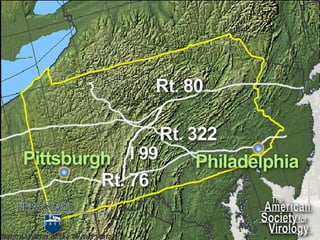
  • #36 You can see that Penn State is in the middle of the state, 25 miles from HWY 80 which goes east-west across the whole of the United States. HWY 80 is intersected by Rt. 76 to the west and 15 to the east. Major road construction is now taking place connecting our local highway 322, to HWY 80 directly, through hWY 99.
  • #37 Universy Park Airport is 5 miles from campus, or ten minute’s drive. ______ commercial flights come in and out daily through four major carriers United Express - Northwest Airlink Delta Connection US Airways Express With hubs in Pittsburgh PHILI Washington DC (Dulles) Cincinnatti
  • #38 Universy Park Airport is 5 miles from campus, or ten minute’s drive. ______ commercial flights come in and out daily through four major carriers United Express - Northwest Airlink Delta Connection US Airways Express With hubs in Pittsburgh PHILI Washington DC (Dulles) Cincinnatti
  • #39 Universy Park Airport is 5 miles from campus, or ten minute’s drive. ______ commercial flights come in and out daily through four major carriers United Express - Northwest Airlink Delta Connection US Airways Express With hubs in Pittsburgh PHILI Washington DC (Dulles) Cincinnatti
  • #41 This is a map of the main campus, though University Park has spread to the north, west and east.
  • #42 This color coded map shows the main venues that we will utilize for ASV
  • #43 This color coded map shows the main venues that we will utilize for ASV
  • #44 The red depicts on-campus lodging sites Eastview Terrace - 800 Nittancy Apartments - 100 Rredifer Dining Commons Nittany Lion Inn
  • #45 This color coded map shows the main venues that we will utilize for ASV
  • #46 This is the walk from campus housing, to breakfast, and to Eisenhower Auditorium for the main symposium each morning. It takes approximately 8 minutes
  • #47 Eastview Terrace is now built and will open for graduate students in the fall of 2004. The summer of 2005 will the first summer open to visitors, and ASV will have the whole of it.
  • #50 As well as some at the Nittany Area, which has two and four bedroom apartments with kitchens and shared bathrooms, as well as two bedroom suites each with one bathroom.
  • #51 Again, on-campus housing is down the street from Eisenhower Auditorium
  • #52 This color coded map shows the main venues that we will utilize for ASV
  • #53 We won’t be using the balcony
  • #54 Thomas building has three auditoriums that we will use.
  • #55 Thomas 100 242 Thomas 101 242 Thomas 102 171 Thomas 104 94 Thomas 201 94
  • #56 One auditorium for 70 Video Conference Room
  • #57 Osmond 117 152 Osmond 119 341
  • #58 HUB Aud 385 Heritage Hall 475 Alumni Hall for posters
  • #59 This color coded map shows the main venues that we will utilize for ASV
  • #60 Approx. walking times from the main meeting venues to and from Eisenhower Aud., our morning symposium site.
  • #61 This color coded map shows the main venues that we will utilize for ASV
  • #62 Beaver Stadium will be where our Tuesday night party will be. Transportation will be avialable for inclement weather, or for those who choose not to walk. Hintz Alumni Center will be where our evening mixers will be
  • #63 Mixers
  • #65 Walking time to and from a couple of satellite venues. NLI where your speakers and council members can stay, and where you can have meetings and banquets Hetzel Union building is where we plan to have poster presentations Eateries and coffee bars are on the upper and lower levels, along with seating, art galleries and lounges Wireless internet access throughout this building Bookstore Copy center
  • #67 This color coded map shows the main venues that we will utilize for ASV
  • #68 Nittany Lion Inn is a gracious, colonial style hotel right on-campus. A 15 minute walk to ASV sessions
  • #69 Nittany Lion Inn is a gracious, colonial style hotel right on-campus. A 15 minute walk to ASV sessions
  • #72 Penn State has a conference center and hotel two miles from campus. We will not be using this facility except for hotel rooms.
  • #74 This color coded map shows the main venues that we will utilize for ASV
  • #75 Downtown skirts the south side of campus, a 7 minute walk from Eisenhower Aud. A 3 minute walk from Eastview Terrace
  • #88 Real time collaboration and updating provides a very different feel to the web than static or even dynamic web pages. You feel the social presence of people something we are used to in real life. For example, I am standing here, and I can see, feel, hear all of you. For example, take a look at DiggSpy, where you can watch what people have been digging. This allows a whole new level of socability. It lets you feel the presence of groups of people.
  • #89 So what is social sharing. Lets start with what its not. Its not the social networks of 2001. How many of you are on Frienster and LinkedIN. How many of you have sent that awkward sounding email to your friends. Hi I found you while
  • #90 Lets go back, back to 2001. Back to the beginning of social networks. Remember the excitement. How many of you have seen such a diagram? How many of you are a member of such a network?
  • #92 But how do we really connect?
  • #103 Overview of Web 2.0 and introduction to Virtual Worlds
  • #146 So what is Web 2.0? A quick overview…
  • #147 http://web2con.com – O’Reilly’s Web 2.0 conference first ran in October 2004 Theme: “The Web as Platform” &amp;quot;While the first wave of the Web was closely tied to the browser, the second wave extends applications across the web and enables a new generation of services and business opportunities.&amp;quot; “ You have to remember that every revolution occurs in stages, and often isn&apos;t recognized till long after the new world is in place.” “ There might be a better name (I tried internet operating system on for size starting back in 2000), but the fact that Web 2.0 has caught on says that it&apos;s as good a term as any.” (Tim O’Reilly - http://radar.oreilly.com/archives/2005/08/not_20.html) See http://www.oreillynet.com/pub/a/oreilly/tim/news/2005/09/30/what-is-web-20.html for the original
  • #148 See http://www.oreillynet.com/pub/a/oreilly/tim/news/2005/09/30/what-is-web-20.htmlfor the original Here is a depiction of Web 2.0 as a growing cultural organism with the tools, standards and techniques enabling it in blue on the top and some of the key characteristics of the organism on the bottom - simplicity (light-weight programming models)  Only easy things will continue to propagate (PHP) - community-development is represented here in “software that gets better with the more people use it” and “harnessing the collective intelligence” - move to web services that are published on the web, not hardened and shrink wrapped - assembly of consumable pieces which enable architectural participation from end-users and the community - again bandwidth, graphics, and graphic app models are driving users to demand rich user experiences - drag and drop, location based visualizations,  the end of command line text windows! ==================== Google, by contrast, began its life as a web application, never sold or packaged, but delivered as a service. Customer paid for the service, directly or indirectly No scheduled software releases, just continuous improvement. No licensing or sale, just usage. No porting to different platforms so that customers can run the software on their own equipment, just a massively scalable collection of commodity PCs running open source operating systems plus homegrown applications and utilities that no one outside the company ever gets to see. At bottom, Google requires a competency: database management, not a collection of software tools, it&apos;s a specialized database. Without the data, the tools are useless; without the software, the data is unmanageable. Software licensing and control over APIs--the lever of power in the previous era--is irrelevant because the software never need be distributed but only performed, and also because without the ability to collect and manage the data, the software is of little use. In fact, the value of the software is proportional to the scale and dynamism of the data it helps to manage. Much like a phone call, which happens not just on the phones at either end of the call, but on the network in between, Google happens in the space between browser and search engine and destination content server, as an enabler or middleman between the user and his or her online experience. Other important Web 2.0 themes: Rich user experience Emergence Play Archicture of participation Harnessing collective intelligence Perpetual beta
  • #150 One opinion of Web 2.0
  • #151 What will come post-web 2.0? Web 3.0 Web3 3D Internet Virtual Worlds ? A lot of attention of Virtual Worlds
  • #152 Gamers are increasing in number, and buying power IBM by no means dominant here, but starting to show a real interest……
  • #153 Virtual Worlds are an emerging opportunity for a wide range of activities, including marketing, online commerce and services. Popular non-game Virtual World platforms (such as Second Life) are expanding fast with thriving economies. We are seeing the beginnings of the exploitation of the market, with the BBC, sporting events, high-street names and web brands announcing their involvement. This continues the shift from a passive audience to an engaged, interactive population Virtual Worlds are the web, rendered in interactive 3D. They could mark the start of the next phase of web technology.
  • #154 Virtual Worlds are an emerging opportunity for a wide range of activities, including marketing, online commerce and services. Popular non-game Virtual World platforms (such as Second Life) are expanding fast with thriving economies. We are seeing the beginnings of the exploitation of the market, with the BBC, sporting events, high-street names and web brands announcing their involvement. This continues the shift from a passive audience to an engaged, interactive population Virtual Worlds are the web, rendered in interactive 3D. They could mark the start of the next phase of web technology. More than 50% users are in Europe 10% of users have remained for 40 hours or more These stats are usually out of date. Try secondlife.com to check the latest figures.
  • #155 The BBC, who are frequently early adopters, announced an event in Second Life in May 2006. The streaming video from the One Big Weekend event (being held in Dundee) was shown in-world to provide people with another means of following the action. The key thing here is the party happening in the foreground. People are dancing, showing off and chatting. http://news.bbc.co.uk/1/hi/technology/4766755.stm The BBC also did a Second Life session for their Newsnight programme around January 2006. (http://news.bbc.co.uk/1/hi/programmes/newsnight/4583924.stm). In 2007, Newsnight caught up with some IBMers for a segment in their show http://news.bbc.co.uk/1/hi/programmes/newsnight/6241879.stm#cyber
  • #156 Major League Baseball ( MLB.com ) paid the Electric Sheep Company for a virtual baseball stadium to host the Home Run Derby event. I’m not a baseball fan, but even I was hooked enough by the lively atmosphere that staying up until 2am UK time was well worth it. http://www.ericrice.com/blog/?p=45 http://eightbar.co.uk/2006/07/11/live-at-mlb-second-life-game/
  • #157 Warner Bros, who promote Regina Spektor, are marketing her latest album within Second Life. They have a New York loft apartment with a tape recorder playing clips of her music, with the mood of the room changing with the music. http://www.marketwire.com/mw/release_html_b1?release_id=130654 http://blackrimglasses.com/archives/2006/05/22/second-life-meets-regina/
  • #158 American Apparel (A large US clothing store) opened a store in Second Life Possibly the first example of a real brand creating a SL store More: read the story at http://news.com.com/2061-10797_3-6084908.html http://www.aimeeweber.com/Portfolio/AmericanApparel.html
  • #159 Reuters have an embedded journalist (Adam Pasick) who writes articles in and about Second Life And more brands… Toyota, Adidas, Reebok, Sun, Sony, Vodafone…
  • #160 IBM is already interested in virtual worlds for several reasons 1.) internal collaboration and communications 2.) external reach to our clients and their customers 3.) research. 3D Internet as a future web-like model. Driving adoption of (and creation of, if necessary) standards
  • #161 IBM already runs various meetings inside SL. We can’t share confidential material using SL (since the servers are not run by IBM), but it’s a useful place to socialise and confidential matters can always be discussed over the telephone while being augmented by avatar interactions Difficulties with conference calls Uncomfortable video conferences Using an avatar gives freedom of expression, and seems to break down barriers.
  • #162 GreaterIBM is an initiative to connect past and present IBMers. We’ve already been using virtual world to augment real world activities — since we can’t always travel to meet with each other, the virtual world allows us to meet in a setting that is more like real life, and collaborating and networking in these immersive environments The IBM Alumni block party (for The Greater IBM Connection, http://greateribm.com) was a great success, and Greater IBM continues to actively explore how to use virtual worlds to bring past and present employees together.
  • #163 Sam Palmisano appeared in avatar form to address IBMers regarding the results of the Innovation Jam. One outcome was funding for a ‘3D Internet’ project (http://www-03.ibm.com/press/us/en/pressrelease/20605.wss)
  • #164 The 12 island complex ( 194 acres of land ) is IBM’s big public presence in Second Life. It has various projects within it, including… three huge meeting spaces (each capable of seating over 200 people) The House of Horizons project: This collaborative project is a Danish initiative from a number of international organisations that seek to experiment with virtual world benefits to real world activities and vice versa. Through a series of Second Life based facilities and a variety of tenants, House of Horizons explores the new opportunities that arise when normal physical factors and geography are suspended and replaced by a digital reality. House of Horizons founding partners are: Danish based Innovation Lab, IBM, and Computerworld Denmark, in association with the Danish architectural firm Arkitema. A meeting place for the IBM ‘Virtual Universe Community’, already over 1000 IBMers. ‘ SOA hub’ is the early stages of a build we plan to fully unveil in January. It is an example of how you can use the 3D, immersive worlds to simplify the complex by “showing” people these concepts and allowing them to experience them through 3D interactions that explain business concepts in a more easy to understand way. The lessons we learn in running this sort of event can be passed on to our clients too; we will apply what we are developing here from an education and training standpoint to all sorts of other areas and for our clients.
  • #165 We’ve partnered with Circuit City to explore and experiment with how we can apply virtual worlds to their business — from doing business inside of virtual worlds to connecting the virtual world with the real world to create a richer, more immersive Web environment. This early build of a virtual Circuit City store is an area where we are experimenting with how to enrich a user experience by using virtual worlds to augment both the Web experience and the real world experience. Other immersive features that IBM and Circuit City are experimenting with include an interactive home theater, where customers can easily recreate their own home environment to do things like setting up a home theater — users can easily move a couch at the proper distance from where they want to put a new TV, and it automatically tells them the optimal size TV to purchase for their room dimensions, and eventually will add other features like where to place speakers for a surround sound system. As with everything in the IBM complex, we’re keen to get client and public feedback so it can improve over time.
  • #166 Build for Sears (see http://www.3pointd.com/20070108/ibm-brings-sears-to-second-life-at-ces)
  • #167 From July 2006, a quick prototype build by Emerging Technology Services for the Wimbledon tennis championships. It involved displaying the path of the ball (thanks to the ‘Hawkeye’ data captured on-court) as well as clothing and even flying towels.
  • #168 The Australian Open project brings the Hawkeye data feed idea explored for the Wimbledon demo into a full one island (16 acre) build, with all aspects of the Oz Open from the shop to the scoreboard to the tennis court with players which move with the real data feed.
  • #186 Encourages independence Takes advantage of tacit knowledge People have specialized knowledge Need some type of loose coordination