MONITORING AND EVALUATION
Monitoring & Evaluation
OBJECTIVES:
• Differentiate Monitoring from Evaluation
• Discuss the key elements of Monitoring and Evaluation
• Discuss the importance of Monitoring and Evaluation
• Enumerate the functions of Monitoring and Evaluation Committee
Difference between Monitoring and Evaluation
• Monitoring: provides information WHERE a policy,
program, or a project is at any given time relative to
respective targets and outcomes.
• Evaluation: provides evidence of WHY targets and
outcomes are or not being achieved.
Difference between Monitoring and Evaluation
•Monitoring asks WHERE?
•Evaluation asks WHY?
Key Elements of Monitoring
• Continuous, not one time event;
• Systematic, not random research or information
gathering
• Data on specified, pre-set indicators; not just on
anything of interest
• Evidence that targets, outcomes, goals are reached.
KEY ELEMENTS OF EVALUATION
•Covers proposed or completed projects, not just
ongoing
•Systematic, not loose or disorganized
•Objective or evidence-based, not based on
unfounded/baseless assertions/declarations
Why is Monitoring and Evaluation important?
•For decision-making: information/feedback to
managers needed for sound decision-making
•For accountability: know how the project and
project personnel are performing. Basis for reward
•For learning and future application: find out what
works or not and apply the lessons in the future
endeavors
Typology of Monitoring:
• Implementation Monitoring
 Compliance Oriented
 Addresses the questions:
 Did they do it?
 Did they do it as planned?
• Results-Based Monitoring
 Answers the question “So what?”
So what if the outputs have been generated or the activities have taken
place?
Typology of Monitoring
Are the outcomes being attained over time?
Is the initiative succeeding or not?
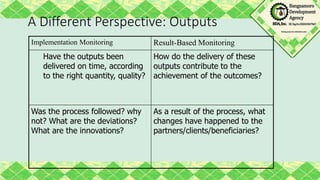
A Different Perspective: Outputs
Implementation Monitoring Result-Based Monitoring
Have the outputs been
delivered on time, according
to the right quantity, quality?
How do the delivery of these
outputs contribute to the
achievement of the outcomes?
Was the process followed? why
not? What are the deviations?
What are the innovations?
As a result of the process, what
changes have happened to the
partners/clients/beneficiaries?
Functions of Monitoring and
Evaluation Committee
• Conduct regular monitoring on the progress of sub-
project implementation
• Formulation / preparation of at least three (3)
indicators for successful participatory decision-
making and sub-project implementation
Functions of Monitoring and Evaluation
Committee
• Conduct monitoring of complaints by individual or groups in
the community and the resolution or grievance redress
• Evaluate the results of the sub-project on the improved
community / LGU capacity to plan and manage project
Remember….
Monitoring and Evaluation is
FEEDBACK ANALYSIS…

Monitoring & Evaluation.pptx

  • 1.
  • 2.
  • 3.
    OBJECTIVES: • Differentiate Monitoringfrom Evaluation • Discuss the key elements of Monitoring and Evaluation • Discuss the importance of Monitoring and Evaluation • Enumerate the functions of Monitoring and Evaluation Committee
  • 4.
    Difference between Monitoringand Evaluation • Monitoring: provides information WHERE a policy, program, or a project is at any given time relative to respective targets and outcomes. • Evaluation: provides evidence of WHY targets and outcomes are or not being achieved.
  • 5.
    Difference between Monitoringand Evaluation •Monitoring asks WHERE? •Evaluation asks WHY?
  • 6.
    Key Elements ofMonitoring • Continuous, not one time event; • Systematic, not random research or information gathering • Data on specified, pre-set indicators; not just on anything of interest • Evidence that targets, outcomes, goals are reached.
  • 7.
    KEY ELEMENTS OFEVALUATION •Covers proposed or completed projects, not just ongoing •Systematic, not loose or disorganized •Objective or evidence-based, not based on unfounded/baseless assertions/declarations
  • 8.
    Why is Monitoringand Evaluation important? •For decision-making: information/feedback to managers needed for sound decision-making •For accountability: know how the project and project personnel are performing. Basis for reward •For learning and future application: find out what works or not and apply the lessons in the future endeavors
  • 9.
    Typology of Monitoring: •Implementation Monitoring  Compliance Oriented  Addresses the questions:  Did they do it?  Did they do it as planned? • Results-Based Monitoring  Answers the question “So what?” So what if the outputs have been generated or the activities have taken place?
  • 10.
    Typology of Monitoring Arethe outcomes being attained over time? Is the initiative succeeding or not?
  • 11.
    A Different Perspective:Outputs Implementation Monitoring Result-Based Monitoring Have the outputs been delivered on time, according to the right quantity, quality? How do the delivery of these outputs contribute to the achievement of the outcomes? Was the process followed? why not? What are the deviations? What are the innovations? As a result of the process, what changes have happened to the partners/clients/beneficiaries?
  • 12.
    Functions of Monitoringand Evaluation Committee • Conduct regular monitoring on the progress of sub- project implementation • Formulation / preparation of at least three (3) indicators for successful participatory decision- making and sub-project implementation
  • 13.
    Functions of Monitoringand Evaluation Committee • Conduct monitoring of complaints by individual or groups in the community and the resolution or grievance redress • Evaluate the results of the sub-project on the improved community / LGU capacity to plan and manage project
  • 14.