Dr.Sadeem
Albarody
3.1 Molecular/Formula Weights
3.2 The Mole Concept
3.3 Mass Percentages
3.4 Elemental Analysis
3.5 Determining Formulas
Presentation of Lecture Outlines, 3–2
Mass and Moles of a Substance
• Chemistry requires a method for determining
the numbers of molecules in a given mass of
a substance.
– This allows the chemist to carry out “recipes” for
compounds based on the relative numbers of
atoms involved.
– The calculation involving the quantities of
reactants and products in a chemical equation is
called stoichiometry.
Presentation of Lecture Outlines, 3–3
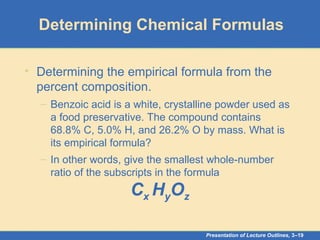
Molecular Weight and Formula
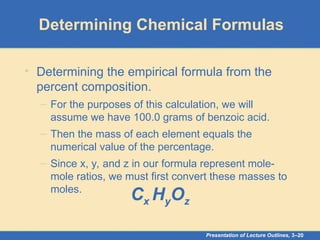
Weight
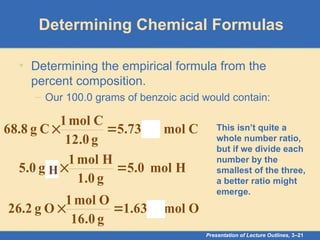
• The molecular weight of a substance is the
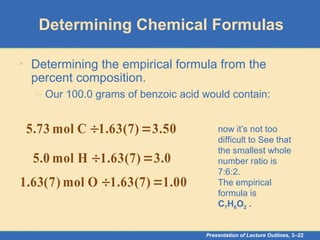
sum of the atomic weights of all the atoms in
a molecule of the substance.
– For, example, a molecule of H2O contains 2
hydrogen atoms (at 1.0 amu each) and 1 oxygen
atom (16.0 amu), giving a molecular weight of
18.0 amu.
Molecular Weight and Formula
Weight
• The formula weight of a substance is the
sum of the atomic weights of all the atoms in
one formula unit of the compound, whether
molecular or not.
– For example, one formula unit of NaCl contains 1
sodium atom (23.0 amu) and one chlorine atom
(35.5 amu), giving a formula weight of 58.5 amu.
Presentation of Lecture Outlines, 3–5
Mass and Moles of a Substance
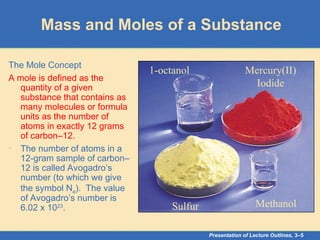
The Mole Concept
A mole is defined as the
quantity of a given
substance that contains as
many molecules or formula
units as the number of
atoms in exactly 12 grams
of carbon–12.
• The number of atoms in a
12-gram sample of carbon–
12 is called Avogadro’s
number (to which we give
the symbol Na). The value
of Avogadro’s number is
6.02 x 10²³
.
1-octanol
Sulfur Methanol
Mercury(II)
Iodide
Presentation of Lecture Outlines, 3–6
Mass and Moles of a Substance
• The molar mass of a substance is the mass
of one mole of a substance.
– For all substances, molar mass, in grams per
mole, is numerically equal to the formula weight in
atomic mass units.
– That is, one mole of any element weighs its atomic
mass in grams.
Presentation of Lecture Outlines, 3–7
Mass and Moles of a Substance
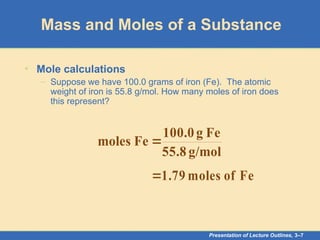
• Mole calculations
– Suppose we have 100.0 grams of iron (Fe). The atomic
weight of iron is 55.8 g/mol. How many moles of iron does
this represent?
g/mol
55.8
Fe
g
100.0
Fe
moles 
Fe
of
moles
1.79

Presentation of Lecture Outlines, 3–8
Mass and Moles of a Substance
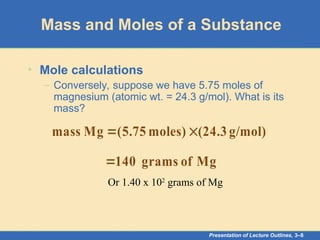
• Mole calculations
– Conversely, suppose we have 5.75 moles of
magnesium (atomic wt. = 24.3 g/mol). What is its
mass?
g/mol)
(24.3
moles)
75
.
5
(
Mg
mass 

Mg
of
grams
140

Or 1.40 x 10²
grams of Mg
Presentation of Lecture Outlines, 3–9
Mass and Moles of a Substance
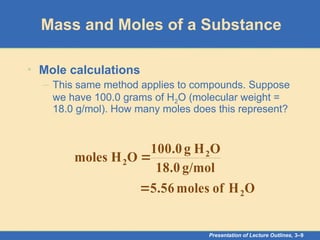
• Mole calculations
– This same method applies to compounds. Suppose
we have 100.0 grams of H2O (molecular weight =
18.0 g/mol). How many moles does this represent?
O
H
of
moles
5.56 2

g/mol
18.0
O
H
g
100.0
O
H
moles 2
2 
Presentation of Lecture Outlines, 3–10
Mass and Moles of a Substance
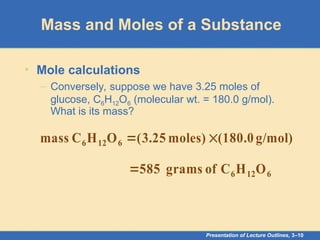
• Mole calculations
– Conversely, suppose we have 3.25 moles of
glucose, C6H12O6 (molecular wt. = 180.0 g/mol).
What is its mass?
g/mol)
(180.0
moles)
25
.
3
(
O
H
C
mass 6
12
6 

6
12
6 O
H
C
of
grams
585

Presentation of Lecture Outlines, 3–11
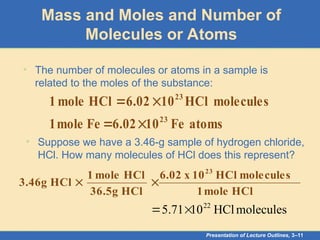
Mass and Moles and Number of
Molecules or Atoms
• The number of molecules or atoms in a sample is
related to the moles of the substance:
atoms
Fe
10
02
.
6
Fe
mole
1
molecules
HCl
10
6.02
HCl
mole
1
23
23




• Suppose we have a 3.46-g sample of hydrogen chloride,
HCl. How many molecules of HCl does this represent?
HCl
mole
1
molecules
HCl
10
x
6.02
HCl
36.5g
HCl
mole
1
HCl
3.46g
23


molecules
HCl
10
71
.
5 22


Presentation of Lecture Outlines, 3–12
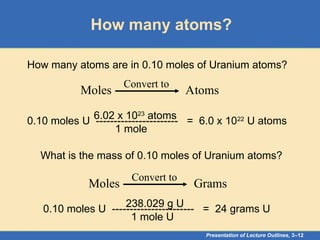
How many atoms?
How many atoms are in 0.10 moles of Uranium atoms?
Moles Atoms
Convert to
0.10 moles U ----------------------- = 6.0 x 10²²
U atoms
1 mole
6.02 x 10²³
atoms
What is the mass of 0.10 moles of Uranium atoms?
Moles Grams
Convert to
0.10 moles U ----------------------- = 24 grams U
1 mole U
238.029 g U
Presentation of Lecture Outlines, 3–13
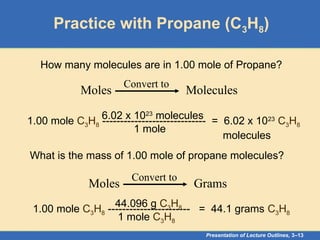
Practice with Propane (C3H8)
How many molecules are in 1.00 mole of Propane?
Moles Molecules
Convert to
1.00 mole C3H8 ----------------------------- = 6.02 x 10²³
C3H8
molecules
1 mole
6.02 x 10²³
molecules
What is the mass of 1.00 mole of propane molecules?
Moles Grams
Convert to
1.00 mole C3H8 ----------------------- = 44.1 grams C3H8
1 mole C3H8
44.096 g C3H8
Presentation of Lecture Outlines, 3–14
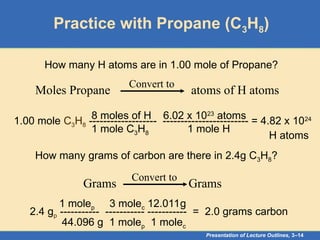
Practice with Propane (C3H8)
How many H atoms are in 1.00 mole of Propane?
Moles Propane atoms of H atoms
Convert to
1.00 mole C3H8 ------------------- ------------------------ = 4.82 x 1024
H atoms
1 mole C3H8 1 mole H
8 moles of H 6.02 x 10²³
atoms
How many grams of carbon are there in 2.4g C3H8?
Grams Grams
Convert to
2.4 gp ----------- ----------- ----------- = 2.0 grams carbon
1 molep 3 molec 12.011g
44.096 g 1 molep 1 molec
Presentation of Lecture Outlines, 3–15
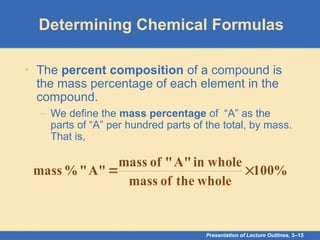
Determining Chemical Formulas
• The percent composition of a compound is
the mass percentage of each element in the
compound.
– We define the mass percentage of “A” as the
parts of “A” per hundred parts of the total, by mass.
That is,
%
100
whole
the
of
mass
whole
in
A"
"
of
mass
A"
"
%
mass 

Presentation of Lecture Outlines, 3–16
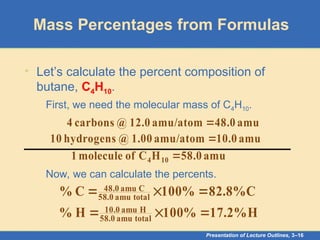
Mass Percentages from Formulas
• Let’s calculate the percent composition of
butane, C4H10.
First, we need the molecular mass of C4H10.
amu
48.0
amu/atom
12.0
@
carbons
4 
amu
10.0
amu/atom
1.00
@
hydrogens
10 
amu
58.0
H
C
of
molecule
1 10
4 
Now, we can calculate the percents.
C
%
8
.
82
%
100
C
% total
amu
0
.
58
C
amu
48.0



H
%
2
.
17
%
100
H
% total
amu
0
.
58
H
amu
10.0



Presentation of Lecture Outlines, 3–17
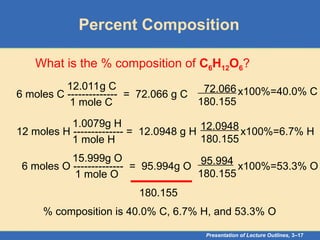
Percent Composition
What is the % composition of C6H12O6?
6 moles C -------------- = 72.066 g C
12.011g C
1 mole C
12 moles H -------------- = 12.0948 g H
1.0079g H
1 mole H
6 moles O -------------- = 95.994g O
15.999g O
1 mole O
180.155
72.066
180.155
12.0948
180.155
95.994
180.155
x100%=40.0% C
x100%=6.7% H
x100%=53.3% O
% composition is 40.0% C, 6.7% H, and 53.3% O
Presentation of Lecture Outlines, 3–18
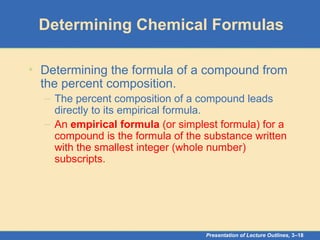
Determining Chemical Formulas
• Determining the formula of a compound from
the percent composition.
– The percent composition of a compound leads
directly to its empirical formula.
– An empirical formula (or simplest formula) for a
compound is the formula of the substance written
with the smallest integer (whole number)
subscripts.
Presentation of Lecture Outlines, 3–19
Determining Chemical Formulas
• Determining the empirical formula from the
percent composition.
– Benzoic acid is a white, crystalline powder used as
a food preservative. The compound contains
68.8% C, 5.0% H, and 26.2% O by mass. What is
its empirical formula?
– In other words, give the smallest whole-number
ratio of the subscripts in the formula
Cx HyOz
Presentation of Lecture Outlines, 3–20
Determining Chemical Formulas
• Determining the empirical formula from the
percent composition.
– For the purposes of this calculation, we will
assume we have 100.0 grams of benzoic acid.
– Then the mass of each element equals the
numerical value of the percentage.
– Since x, y, and z in our formula represent mole-
mole ratios, we must first convert these masses to
moles.
Cx HyOz
Presentation of Lecture Outlines, 3–21
Determining Chemical Formulas
C
mol
)
3
(
73
.
5
g
12.0
C
mol
1
C
g
8
.
68 

H
mol
0
.
5
g
1.0
H
mol
1
C
g
0
.
5 

O
mol
)
7
(
63
.
1
g
16.0
O
mol
1
O
g
2
.
26 

This isn’t quite a
whole number ratio,
but if we divide each
number by the
smallest of the three,
a better ratio might
emerge.
• Determining the empirical formula from the
percent composition.
– Our 100.0 grams of benzoic acid would contain:
H
Presentation of Lecture Outlines, 3–22
Determining Chemical Formulas
• Determining the empirical formula from the
percent composition.
– Our 100.0 grams of benzoic acid would contain:
3.50
1.63(7)
C
mol
73
.
5 

3.0
1.63(7)
H
mol
0
.
5 

1.00
1.63(7)
O
mol
)
7
(
63
.
1 

now it’s not too
difficult to See that
the smallest whole
number ratio is
7:6:2.
The empirical
formula is
C7H6O2 .
Presentation of Lecture Outlines, 3–23
Determining Chemical Formulas
• Determining the molecular formula from the
empirical formula.
– An empirical formula gives only the smallest
whole-number ratio of atoms in a formula.
– The molecular formula should be a multiple of the
empirical formula (since both have the same
percent composition).
– To determine the molecular formula, we must
know the molecular weight of the compound.
Presentation of Lecture Outlines, 3–24
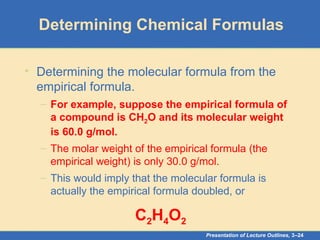
Determining Chemical Formulas
• Determining the molecular formula from the
empirical formula.
– For example, suppose the empirical formula of
a compound is CH2O and its molecular weight
is 60.0 g/mol.
– The molar weight of the empirical formula (the
empirical weight) is only 30.0 g/mol.
– This would imply that the molecular formula is
actually the empirical formula doubled, or
C2H4O2
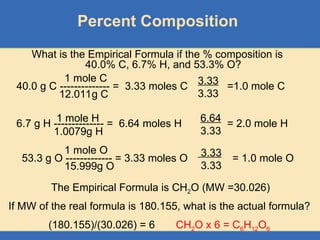
Percent Composition
What is the Empirical Formula if the % composition is
40.0% C, 6.7% H, and 53.3% O?
40.0 g C -------------- = 3.33 moles C
12.011g C
1 mole C
6.7 g H -------------- = 6.64 moles H
1.0079g H
1 mole H
53.3 g O ------------- = 3.33 moles O
15.999g O
1 mole O
3.33
3.33
6.64
3.33
3.33
3.33
=1.0 mole C
= 2.0 mole H
= 1.0 mole O
The Empirical Formula is CH2O (MW =30.026)
If MW of the real formula is 180.155, what is the actual formula?
(180.155)/(30.026) = 6 CH2O x 6 = C6H12O6
Stoichiometry: Quantitative Relations
in Chemical Reactions
• Stoichiometry is the calculation of the
quantities of reactants and products involved
in a chemical reaction.
– It is based on the balanced chemical equation and
on the relationship between mass and moles.
– Such calculations are fundamental to most
quantitative work in chemistry.
Molar Interpretation of a
Chemical Equation
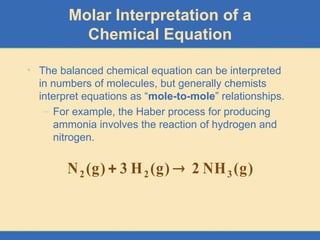
• The balanced chemical equation can be interpreted
in numbers of molecules, but generally chemists
interpret equations as “mole-to-mole” relationships.
– For example, the Haber process for producing
ammonia involves the reaction of hydrogen and
nitrogen.
)
g
(
NH
2
)
g
(
H
3
)
g
(
N 3
2
2 

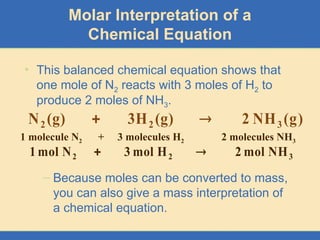
• This balanced chemical equation shows that
one mole of N2 reacts with 3 moles of H2 to
produce 2 moles of NH3.
– Because moles can be converted to mass,
you can also give a mass interpretation of
a chemical equation.
)
g
(
NH
2
(g)
3H
(g)
N 3
2
2 

3
2
2 NH
mol
2
H
mol
3
N
mol
1 

1 molecule N2 + 3 molecules H2 2 molecules NH3
Molar Interpretation of a
Chemical Equation
Molar Interpretation of a Chemical
Equation
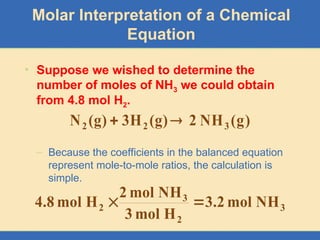
• Suppose we wished to determine the
number of moles of NH3 we could obtain
from 4.8 mol H2.
– Because the coefficients in the balanced equation
represent mole-to-mole ratios, the calculation is
simple.
)
g
(
NH
2
(g)
3H
(g)
N 3
2
2 

3
2
3
2 NH
mol
2
.
3
H
mol
3
NH
mol
2
H
mol
8
.
4 

Mass Relationships in Chemical
Equations
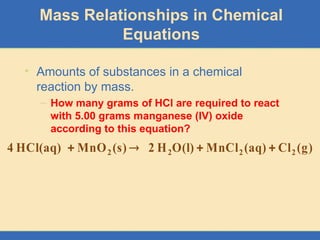
• Amounts of substances in a chemical
reaction by mass.
– How many grams of HCl are required to react
with 5.00 grams manganese (IV) oxide
according to this equation?

 )
s
(
MnO
HCl(aq)
4 2 )
g
(
Cl
(aq)
MnCl
O(l)
H
2 2
2
2 

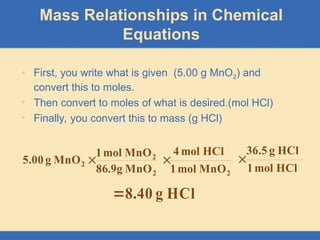
• First, you write what is given (5.00 g MnO2) and
convert this to moles.
• Then convert to moles of what is desired.(mol HCl)
• Finally, you convert this to mass (g HCl)
Mass Relationships in Chemical
Equations
2
2
2
MnO
g
9
.
86
MnO
mol
1
MnO
g
5.00 
2
MnO
mol
1
HCl
mol
4

HCl
mol
1
HCl
g
36.5

HCl
g
40
.
8

Limiting Reagent
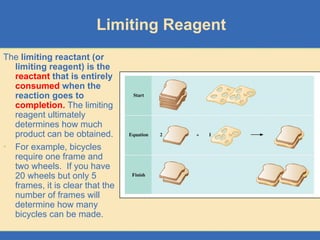
The limiting reactant (or
limiting reagent) is the
reactant that is entirely
consumed when the
reaction goes to
completion. The limiting
reagent ultimately
determines how much
product can be obtained.
• For example, bicycles
require one frame and
two wheels. If you have
20 wheels but only 5
frames, it is clear that the
number of frames will
determine how many
bicycles can be made.
Limiting Reagent
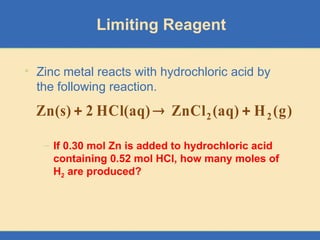
• Zinc metal reacts with hydrochloric acid by
the following reaction.
– If 0.30 mol Zn is added to hydrochloric acid
containing 0.52 mol HCl, how many moles of
H2 are produced?
)
g
(
H
(aq)
ZnCl
HCl(aq)
2
Zn(s) 2
2 


Limiting Reagent
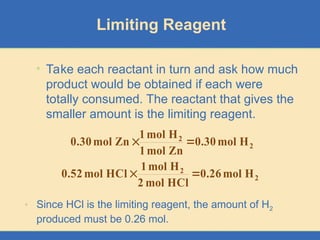
• Take each reactant in turn and ask how much
product would be obtained if each were
totally consumed. The reactant that gives the
smaller amount is the limiting reagent.
• Since HCl is the limiting reagent, the amount of H2
produced must be 0.26 mol.
2
2
H
mol
0.30
Zn
mol
1
H
mol
1
Zn
mol
0.30 

2
2
H
mol
0.26
HCl
mol
2
H
mol
1
HCl
mol
0.52 

Theoretical and Percent Yield
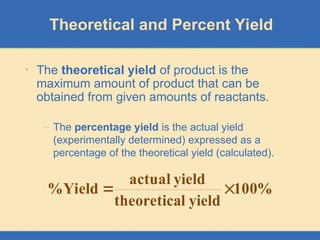
• The theoretical yield of product is the
maximum amount of product that can be
obtained from given amounts of reactants.
– The percentage yield is the actual yield
(experimentally determined) expressed as a
percentage of the theoretical yield (calculated).
%
100
yield
l
theoretica
yield
actual
Yield
% 

Theoretical and Percent Yield
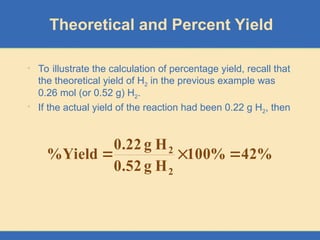
• To illustrate the calculation of percentage yield, recall that
the theoretical yield of H2 in the previous example was
0.26 mol (or 0.52 g) H2.
• If the actual yield of the reaction had been 0.22 g H2, then
%
42
%
100
H
g
0.52
H
g
0.22
Yield
%
2
2



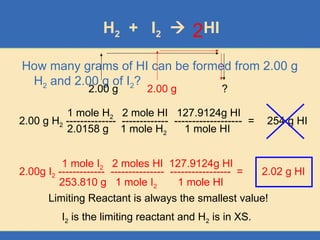
H2 + I2  HI
How many grams of HI can be formed from 2.00 g
H2 and 2.00 g of I2?
2
2.00 g
2.00 g ?
2.00 g H2 -------------- ------------- ------------------- =
1 mole H2 2 mole HI 127.9124g HI
2.0158 g 1 mole H2 1 mole HI
254 g HI
2.00g I2 ------------- --------------- ----------------- =
1 mole I2 2 moles HI 127.9124g HI
253.810 g 1 mole I2 1 mole HI
2.02 g HI
Limiting Reactant is always the smallest value!
I2 is the limiting reactant and H2 is in XS.
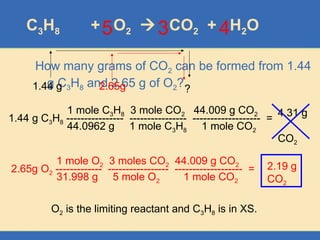
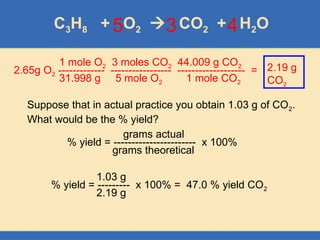
C3H8 + O2  CO2 + H2O
How many grams of CO2 can be formed from 1.44
g C3H8 and 2.65 g of O2?
3
2.65g
1.44 g ?
1.44 g C3H8 ---------------- ---------------- ------------------- =
1 mole C3H8 3 mole CO2 44.009 g CO2
44.0962 g 1 mole C3H8 1 mole CO2
4.31 g
CO2
2.65g O2 ------------- ----------------- ------------------- =
1 mole O2 3 moles CO2 44.009 g CO2
31.998 g 5 mole O2 1 mole CO2
2.19 g
CO2
4
5
O2 is the limiting reactant and C3H8 is in XS.
C3H8 + O2  CO2 + H2O
3 4
5
Suppose that in actual practice you obtain 1.03 g of CO2.
What would be the % yield?
% yield = ----------------------- x 100%
grams actual
grams theoretical
% yield = --------- x 100% = 47.0 % yield CO2
1.03 g
2.19 g
2.65g O2 ------------- ----------------- ------------------- =
1 mole O2 3 moles CO2 44.009 g CO2
31.998 g 5 mole O2 1 mole CO2
2.19 g
CO2

mole concept and calculation chemistry.ppt

  • 1.
    Dr.Sadeem Albarody 3.1 Molecular/Formula Weights 3.2The Mole Concept 3.3 Mass Percentages 3.4 Elemental Analysis 3.5 Determining Formulas
  • 2.
    Presentation of LectureOutlines, 3–2 Mass and Moles of a Substance • Chemistry requires a method for determining the numbers of molecules in a given mass of a substance. – This allows the chemist to carry out “recipes” for compounds based on the relative numbers of atoms involved. – The calculation involving the quantities of reactants and products in a chemical equation is called stoichiometry.
  • 3.
    Presentation of LectureOutlines, 3–3 Molecular Weight and Formula Weight • The molecular weight of a substance is the sum of the atomic weights of all the atoms in a molecule of the substance. – For, example, a molecule of H2O contains 2 hydrogen atoms (at 1.0 amu each) and 1 oxygen atom (16.0 amu), giving a molecular weight of 18.0 amu.
  • 4.
    Molecular Weight andFormula Weight • The formula weight of a substance is the sum of the atomic weights of all the atoms in one formula unit of the compound, whether molecular or not. – For example, one formula unit of NaCl contains 1 sodium atom (23.0 amu) and one chlorine atom (35.5 amu), giving a formula weight of 58.5 amu.
  • 5.
    Presentation of LectureOutlines, 3–5 Mass and Moles of a Substance The Mole Concept A mole is defined as the quantity of a given substance that contains as many molecules or formula units as the number of atoms in exactly 12 grams of carbon–12. • The number of atoms in a 12-gram sample of carbon– 12 is called Avogadro’s number (to which we give the symbol Na). The value of Avogadro’s number is 6.02 x 10²³ . 1-octanol Sulfur Methanol Mercury(II) Iodide
  • 6.
    Presentation of LectureOutlines, 3–6 Mass and Moles of a Substance • The molar mass of a substance is the mass of one mole of a substance. – For all substances, molar mass, in grams per mole, is numerically equal to the formula weight in atomic mass units. – That is, one mole of any element weighs its atomic mass in grams.
  • 7.
    Presentation of LectureOutlines, 3–7 Mass and Moles of a Substance • Mole calculations – Suppose we have 100.0 grams of iron (Fe). The atomic weight of iron is 55.8 g/mol. How many moles of iron does this represent? g/mol 55.8 Fe g 100.0 Fe moles  Fe of moles 1.79 
  • 8.
    Presentation of LectureOutlines, 3–8 Mass and Moles of a Substance • Mole calculations – Conversely, suppose we have 5.75 moles of magnesium (atomic wt. = 24.3 g/mol). What is its mass? g/mol) (24.3 moles) 75 . 5 ( Mg mass   Mg of grams 140  Or 1.40 x 10² grams of Mg
  • 9.
    Presentation of LectureOutlines, 3–9 Mass and Moles of a Substance • Mole calculations – This same method applies to compounds. Suppose we have 100.0 grams of H2O (molecular weight = 18.0 g/mol). How many moles does this represent? O H of moles 5.56 2  g/mol 18.0 O H g 100.0 O H moles 2 2 
  • 10.
    Presentation of LectureOutlines, 3–10 Mass and Moles of a Substance • Mole calculations – Conversely, suppose we have 3.25 moles of glucose, C6H12O6 (molecular wt. = 180.0 g/mol). What is its mass? g/mol) (180.0 moles) 25 . 3 ( O H C mass 6 12 6   6 12 6 O H C of grams 585 
  • 11.
    Presentation of LectureOutlines, 3–11 Mass and Moles and Number of Molecules or Atoms • The number of molecules or atoms in a sample is related to the moles of the substance: atoms Fe 10 02 . 6 Fe mole 1 molecules HCl 10 6.02 HCl mole 1 23 23     • Suppose we have a 3.46-g sample of hydrogen chloride, HCl. How many molecules of HCl does this represent? HCl mole 1 molecules HCl 10 x 6.02 HCl 36.5g HCl mole 1 HCl 3.46g 23   molecules HCl 10 71 . 5 22  
  • 12.
    Presentation of LectureOutlines, 3–12 How many atoms? How many atoms are in 0.10 moles of Uranium atoms? Moles Atoms Convert to 0.10 moles U ----------------------- = 6.0 x 10²² U atoms 1 mole 6.02 x 10²³ atoms What is the mass of 0.10 moles of Uranium atoms? Moles Grams Convert to 0.10 moles U ----------------------- = 24 grams U 1 mole U 238.029 g U
  • 13.
    Presentation of LectureOutlines, 3–13 Practice with Propane (C3H8) How many molecules are in 1.00 mole of Propane? Moles Molecules Convert to 1.00 mole C3H8 ----------------------------- = 6.02 x 10²³ C3H8 molecules 1 mole 6.02 x 10²³ molecules What is the mass of 1.00 mole of propane molecules? Moles Grams Convert to 1.00 mole C3H8 ----------------------- = 44.1 grams C3H8 1 mole C3H8 44.096 g C3H8
  • 14.
    Presentation of LectureOutlines, 3–14 Practice with Propane (C3H8) How many H atoms are in 1.00 mole of Propane? Moles Propane atoms of H atoms Convert to 1.00 mole C3H8 ------------------- ------------------------ = 4.82 x 1024 H atoms 1 mole C3H8 1 mole H 8 moles of H 6.02 x 10²³ atoms How many grams of carbon are there in 2.4g C3H8? Grams Grams Convert to 2.4 gp ----------- ----------- ----------- = 2.0 grams carbon 1 molep 3 molec 12.011g 44.096 g 1 molep 1 molec
  • 15.
    Presentation of LectureOutlines, 3–15 Determining Chemical Formulas • The percent composition of a compound is the mass percentage of each element in the compound. – We define the mass percentage of “A” as the parts of “A” per hundred parts of the total, by mass. That is, % 100 whole the of mass whole in A" " of mass A" " % mass  
  • 16.
    Presentation of LectureOutlines, 3–16 Mass Percentages from Formulas • Let’s calculate the percent composition of butane, C4H10. First, we need the molecular mass of C4H10. amu 48.0 amu/atom 12.0 @ carbons 4  amu 10.0 amu/atom 1.00 @ hydrogens 10  amu 58.0 H C of molecule 1 10 4  Now, we can calculate the percents. C % 8 . 82 % 100 C % total amu 0 . 58 C amu 48.0    H % 2 . 17 % 100 H % total amu 0 . 58 H amu 10.0   
  • 17.
    Presentation of LectureOutlines, 3–17 Percent Composition What is the % composition of C6H12O6? 6 moles C -------------- = 72.066 g C 12.011g C 1 mole C 12 moles H -------------- = 12.0948 g H 1.0079g H 1 mole H 6 moles O -------------- = 95.994g O 15.999g O 1 mole O 180.155 72.066 180.155 12.0948 180.155 95.994 180.155 x100%=40.0% C x100%=6.7% H x100%=53.3% O % composition is 40.0% C, 6.7% H, and 53.3% O
  • 18.
    Presentation of LectureOutlines, 3–18 Determining Chemical Formulas • Determining the formula of a compound from the percent composition. – The percent composition of a compound leads directly to its empirical formula. – An empirical formula (or simplest formula) for a compound is the formula of the substance written with the smallest integer (whole number) subscripts.
  • 19.
    Presentation of LectureOutlines, 3–19 Determining Chemical Formulas • Determining the empirical formula from the percent composition. – Benzoic acid is a white, crystalline powder used as a food preservative. The compound contains 68.8% C, 5.0% H, and 26.2% O by mass. What is its empirical formula? – In other words, give the smallest whole-number ratio of the subscripts in the formula Cx HyOz
  • 20.
    Presentation of LectureOutlines, 3–20 Determining Chemical Formulas • Determining the empirical formula from the percent composition. – For the purposes of this calculation, we will assume we have 100.0 grams of benzoic acid. – Then the mass of each element equals the numerical value of the percentage. – Since x, y, and z in our formula represent mole- mole ratios, we must first convert these masses to moles. Cx HyOz
  • 21.
    Presentation of LectureOutlines, 3–21 Determining Chemical Formulas C mol ) 3 ( 73 . 5 g 12.0 C mol 1 C g 8 . 68   H mol 0 . 5 g 1.0 H mol 1 C g 0 . 5   O mol ) 7 ( 63 . 1 g 16.0 O mol 1 O g 2 . 26   This isn’t quite a whole number ratio, but if we divide each number by the smallest of the three, a better ratio might emerge. • Determining the empirical formula from the percent composition. – Our 100.0 grams of benzoic acid would contain: H
  • 22.
    Presentation of LectureOutlines, 3–22 Determining Chemical Formulas • Determining the empirical formula from the percent composition. – Our 100.0 grams of benzoic acid would contain: 3.50 1.63(7) C mol 73 . 5   3.0 1.63(7) H mol 0 . 5   1.00 1.63(7) O mol ) 7 ( 63 . 1   now it’s not too difficult to See that the smallest whole number ratio is 7:6:2. The empirical formula is C7H6O2 .
  • 23.
    Presentation of LectureOutlines, 3–23 Determining Chemical Formulas • Determining the molecular formula from the empirical formula. – An empirical formula gives only the smallest whole-number ratio of atoms in a formula. – The molecular formula should be a multiple of the empirical formula (since both have the same percent composition). – To determine the molecular formula, we must know the molecular weight of the compound.
  • 24.
    Presentation of LectureOutlines, 3–24 Determining Chemical Formulas • Determining the molecular formula from the empirical formula. – For example, suppose the empirical formula of a compound is CH2O and its molecular weight is 60.0 g/mol. – The molar weight of the empirical formula (the empirical weight) is only 30.0 g/mol. – This would imply that the molecular formula is actually the empirical formula doubled, or C2H4O2
  • 25.
    Percent Composition What isthe Empirical Formula if the % composition is 40.0% C, 6.7% H, and 53.3% O? 40.0 g C -------------- = 3.33 moles C 12.011g C 1 mole C 6.7 g H -------------- = 6.64 moles H 1.0079g H 1 mole H 53.3 g O ------------- = 3.33 moles O 15.999g O 1 mole O 3.33 3.33 6.64 3.33 3.33 3.33 =1.0 mole C = 2.0 mole H = 1.0 mole O The Empirical Formula is CH2O (MW =30.026) If MW of the real formula is 180.155, what is the actual formula? (180.155)/(30.026) = 6 CH2O x 6 = C6H12O6
  • 26.
    Stoichiometry: Quantitative Relations inChemical Reactions • Stoichiometry is the calculation of the quantities of reactants and products involved in a chemical reaction. – It is based on the balanced chemical equation and on the relationship between mass and moles. – Such calculations are fundamental to most quantitative work in chemistry.
  • 27.
    Molar Interpretation ofa Chemical Equation • The balanced chemical equation can be interpreted in numbers of molecules, but generally chemists interpret equations as “mole-to-mole” relationships. – For example, the Haber process for producing ammonia involves the reaction of hydrogen and nitrogen. ) g ( NH 2 ) g ( H 3 ) g ( N 3 2 2  
  • 28.
    • This balancedchemical equation shows that one mole of N2 reacts with 3 moles of H2 to produce 2 moles of NH3. – Because moles can be converted to mass, you can also give a mass interpretation of a chemical equation. ) g ( NH 2 (g) 3H (g) N 3 2 2   3 2 2 NH mol 2 H mol 3 N mol 1   1 molecule N2 + 3 molecules H2 2 molecules NH3 Molar Interpretation of a Chemical Equation
  • 29.
    Molar Interpretation ofa Chemical Equation • Suppose we wished to determine the number of moles of NH3 we could obtain from 4.8 mol H2. – Because the coefficients in the balanced equation represent mole-to-mole ratios, the calculation is simple. ) g ( NH 2 (g) 3H (g) N 3 2 2   3 2 3 2 NH mol 2 . 3 H mol 3 NH mol 2 H mol 8 . 4  
  • 30.
    Mass Relationships inChemical Equations • Amounts of substances in a chemical reaction by mass. – How many grams of HCl are required to react with 5.00 grams manganese (IV) oxide according to this equation?   ) s ( MnO HCl(aq) 4 2 ) g ( Cl (aq) MnCl O(l) H 2 2 2 2  
  • 31.
    • First, youwrite what is given (5.00 g MnO2) and convert this to moles. • Then convert to moles of what is desired.(mol HCl) • Finally, you convert this to mass (g HCl) Mass Relationships in Chemical Equations 2 2 2 MnO g 9 . 86 MnO mol 1 MnO g 5.00  2 MnO mol 1 HCl mol 4  HCl mol 1 HCl g 36.5  HCl g 40 . 8 
  • 32.
    Limiting Reagent The limitingreactant (or limiting reagent) is the reactant that is entirely consumed when the reaction goes to completion. The limiting reagent ultimately determines how much product can be obtained. • For example, bicycles require one frame and two wheels. If you have 20 wheels but only 5 frames, it is clear that the number of frames will determine how many bicycles can be made.
  • 33.
    Limiting Reagent • Zincmetal reacts with hydrochloric acid by the following reaction. – If 0.30 mol Zn is added to hydrochloric acid containing 0.52 mol HCl, how many moles of H2 are produced? ) g ( H (aq) ZnCl HCl(aq) 2 Zn(s) 2 2   
  • 34.
    Limiting Reagent • Takeeach reactant in turn and ask how much product would be obtained if each were totally consumed. The reactant that gives the smaller amount is the limiting reagent. • Since HCl is the limiting reagent, the amount of H2 produced must be 0.26 mol. 2 2 H mol 0.30 Zn mol 1 H mol 1 Zn mol 0.30   2 2 H mol 0.26 HCl mol 2 H mol 1 HCl mol 0.52  
  • 35.
    Theoretical and PercentYield • The theoretical yield of product is the maximum amount of product that can be obtained from given amounts of reactants. – The percentage yield is the actual yield (experimentally determined) expressed as a percentage of the theoretical yield (calculated). % 100 yield l theoretica yield actual Yield %  
  • 36.
    Theoretical and PercentYield • To illustrate the calculation of percentage yield, recall that the theoretical yield of H2 in the previous example was 0.26 mol (or 0.52 g) H2. • If the actual yield of the reaction had been 0.22 g H2, then % 42 % 100 H g 0.52 H g 0.22 Yield % 2 2   
  • 37.
    H2 + I2 HI How many grams of HI can be formed from 2.00 g H2 and 2.00 g of I2? 2 2.00 g 2.00 g ? 2.00 g H2 -------------- ------------- ------------------- = 1 mole H2 2 mole HI 127.9124g HI 2.0158 g 1 mole H2 1 mole HI 254 g HI 2.00g I2 ------------- --------------- ----------------- = 1 mole I2 2 moles HI 127.9124g HI 253.810 g 1 mole I2 1 mole HI 2.02 g HI Limiting Reactant is always the smallest value! I2 is the limiting reactant and H2 is in XS.
  • 38.
    C3H8 + O2 CO2 + H2O How many grams of CO2 can be formed from 1.44 g C3H8 and 2.65 g of O2? 3 2.65g 1.44 g ? 1.44 g C3H8 ---------------- ---------------- ------------------- = 1 mole C3H8 3 mole CO2 44.009 g CO2 44.0962 g 1 mole C3H8 1 mole CO2 4.31 g CO2 2.65g O2 ------------- ----------------- ------------------- = 1 mole O2 3 moles CO2 44.009 g CO2 31.998 g 5 mole O2 1 mole CO2 2.19 g CO2 4 5 O2 is the limiting reactant and C3H8 is in XS.
  • 39.
    C3H8 + O2 CO2 + H2O 3 4 5 Suppose that in actual practice you obtain 1.03 g of CO2. What would be the % yield? % yield = ----------------------- x 100% grams actual grams theoretical % yield = --------- x 100% = 47.0 % yield CO2 1.03 g 2.19 g 2.65g O2 ------------- ----------------- ------------------- = 1 mole O2 3 moles CO2 44.009 g CO2 31.998 g 5 mole O2 1 mole CO2 2.19 g CO2