Module-1: Introduction &
Growth Curve – The Basics
Bioprocess Technology - Bioprocessing.
• A bioprocess is any process that uses complete
living cells or their components (e.g., whole Cells,
enzymes, chloroplast) to obtain desired products.
• This process is commonly referred to as
Fermentation.
Bioprocess technology & Biotechnology
• Bioprocess technology is a vital part of biotechnology that
deals with processes combining the complete living
matter or its components with nutrients to make specialty
chemicals, reagents, and biotherapeutics.
• The processes form the backbone of translating
discoveries of life sciences into useful industrial products.
• Various stages associated with the bioprocess technology
include substrates and media, biocatalysts, volume
production, downstream processing, purification, and final
processing.
• Over the past few years, the application of bioprocess
technology in the development of a variety of next-
generation biopharmaceutical products is gaining
attraction in the bioprocess technology market.
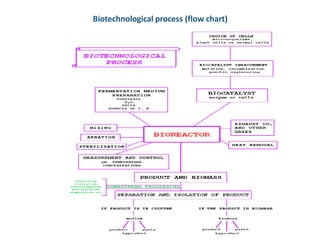
Biotechnological process (flow chart)
5
Stages of Bioprocessing
Stage I : Upstream processing which involves preparation of liquid
medium, separation of particulate and inhibitory chemicals from the
medium, sterilization, air purification etc.
Upstream processes include selection of a microbial strain characterized by the
ability to synthesize a specific product having the desired commercial value.
This strain then is subjected to improvement protocols to maximize the ability of
the strain to synthesize economical amounts of the product. Included in the
upstream phase is the fermentation process itself which usually is carried out in
large tanks known as fermenters or bioreactors. In addition to mechanical parts
which provide proper conditions inside the tank such as aeration, cooling,
agitation, etc., the tank is usually also equipped with complex sets of monitors
and control devices in order to run the microbial growth and product synthesis
under optimized conditions. The processing of the fermentation reactions inside
the fermenter can be done using many modifications of engineering
technologies. One of the most commonly used fermenter types is the stirred-
tank fermenter which utilizes mechanical agitation principles, mainly using
radial-flow impellers, during the fermentation process.
Stages of Bioprocessing (cont.)
• Stage II: Fermentation which involves the conversion of substrates to
desired product with the help of biological agents such as microorganisms.
• Techniques for large-scale production of microbial products. It must both
provide an optimum environment for the microbial synthesis of the desired
product and be economically feasible on a large scale. They can be divided into
surface (emersion) and submersion techniques. The latter may be run in batch,
fed batch, continuous reactors In the surface techniques, the microorganisms
are cultivated on the surface of a liquid or solid substrate. These techniques are
very complicated and rarely used in industry.
• In the submersion processes, the microorganisms grow in a liquid medium.
Except in traditional beer and wine fermentation, the medium is held in
fermenters and stirred to obtain a homogeneous distribution of cells and
medium. Most processes are aerobic, and for these the medium must be
vigorously aerated. All important industrial processes (production of biomass and
protein, antibiotics, enzymes and sewage treatment) are carried out by
submersion processes.
Stages of Bioprocessing (cont.)
• Stage III: Downstream processing which
involves separation of cells from the fermentation
broth, purification and concentration of desired
product and waste disposal or recycle.
• Downstream processing, the various stages that
follow the fermentation process, involves suitable
techniques and methods for recovery, purification,
and characterization of the desired fermentation
product. A vast array of methods for downstream
processing, such as centrifugation, filtration, and
chromatography, may be applied. These methods
vary according to the chemical and physical nature,
as well as the desired grade, of the final product
Fermentation
• Fermentation is the term used by microbiologists to
describe any process for the production of a product by
means of the mass culture of a microorganism.
• The product can either be:
i. The cell itself: referred to as biomass production.
ii. A microorganisms own metabolite: referred to as a product
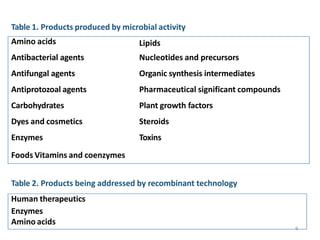
from a natural or genetically improved strain. See Table 1.
iii. A microorganisms foreign product: referred to as a product
from recombinant DNA technology or genetically engineered
strain, i.e. recombinant strain. See Table 2.
Table 1. Products produced by microbial activity
Lipids
Nucleotides and precursors
Organic synthesis intermediates
Pharmaceutical significant compounds
Plant growth factors
Steroids
Toxins
Amino acids
Antibacterial agents
Antifungal agents
Antiprotozoal agents
Carbohydrates
Dyes and cosmetics
Enzymes
Foods Vitamins and coenzymes
Table 2. Products being addressed by recombinant technology
Human therapeutics
Enzymes
Amino acids
9
Primary metabolite
• Kind of metabolite that is directly involved in normal
growth, development, and reproduction. It usually performs
a physiological function in the organism (i.e. an intrinsic
function).
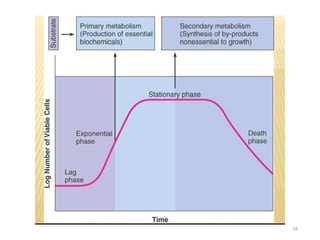
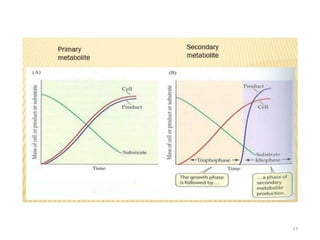
• During the period of an exponential growth of
microorganisms, several metabolic products, will be
produced -collectively referred to as primary metabolites.
• A primary metabolite is typically present in many organisms
or cells. It is also referred to as a central metabolite, which has
an even more restricted meaning (present in any
autonomously growing cell or organism).
• Some common examples of primary metabolites
include: ethanol, lactic acid, and certain amino acids
The primary metabolites are divided into two groups:
1. Primary essential metabolites:
These are the compounds produced in adequate quantizes to sustain cell
growth e.g. vitamins, amino acids, nucleosides.
The native microorganisms usually do not overproduce essential primary
metabolites, since it is a wasteful exercise. However, for industrial
overproduction, the regulatory mechanisms are suitably manipulated.
2. Primary metabolic end products:
These are the normal and traditional end products of fermentation process
of primary metabolism.
The end products may or may not have any significant function to perform in
the microorganisms, although they have many other industrial applications
e.g. ethanol, acetone, lactic acid.
Carbon dioxide is a metabolic end product of Saccharomyces cerevisiae. This
CO2 is essential for leavening of dough in baking industry.
Primary metabolites (cont.)
Limitations in growth:
• Due to insufficient/ limited supply of any nutrient (substrate
or even O2), the growth rate of microorganisms slows down.
However, the metabolism does not stop. It continues as long
as the cell lives, but the formation of products differs.
Overproduction of primary metabolites:
• Excessive production of primary metabolites is very
important for their large scale use for a variety of purposes.
• Overproduction of several metabolites has been
successfully accomplished by eliminating the feedback
inhibition
Secondary metabolites
• These are organic compounds that are not directly involved in the normal
growth, development, or reproduction of an organism.
• Unlike primary metabolites, absence of secondary metabolites does not
result in immediate death, but rather in long-term impairment of the
organism's survivability, fecundity, or aesthetics, or perhaps in no significant
change at all.
• Secondary metabolites are often restricted to a narrow set of species
within a phylogenetic group.
• Humans use secondary metabolites as medicines, flavorings, and
recreational drugs.
• Secondary metabolites aid a plant in important functions such as protection,
competition, and species interactions, but are not necessary for survival.
• One important defining quality of secondary metabolites is their
specificity. Usually, secondary metabolites are specific to individual species
Characteristics of secondary metabolites
• Secondary metabolites are specifically produced by selected
few microorganisms.
• They are not essential for the growth and reproduction of organisms
from which they are produced.
• Environmental factors influence the production of secondary
metabolites.
• Some microorganisms produce secondary metabolites as a group of
compounds (usually structurally related) instead of a single one e.g. about
35 anthracyclines are produced by a single strain of Streptomyces.
• The biosynthetic pathways for most secondary metabolites are not
clearly established.
• The regulation of the formation of secondary metabolites is more
complex and differs from that of primary metabolites.
Functions of secondary metabolites:
15
Secondary metabolites are not essential for growth and
multiplication of cells. Their occurrence and structures vary widely.
Several hypotheses have been put forth to explain the role of
secondary metabolites, two of them are given below.
1. The secondary metabolites may perform certain (unknown)
functions that are beneficial for the cells to survive.
2. The secondary metabolites have absolutely no function. Their
production alone is important for the cell, whatever may be the
product (which is considered to be useless).
16
17
Bioconversions
Microorganisms are also used for chemical transformation of unusual
substrates to desired products.
This process, also referred to as biotransformation, is very important in
producing several compounds e.g. conversion of ethanol to acetic acid (in
vinegar), sorbitol to sorbose, synthesis of steroid hormones and certain
amino acids.
In bioconversion, microorganisms convert a compound to a structurally
related product in one or a few enzymatic reactions.
The bioconversions can be carried out with resting cells, spores or even
killed cells. Non-growing cells are preferred for bioconversions, since high
substrate concentration can be used, besides washing the cells easily (to
make them free from contamination).
Sometimes, mixed cultures are used for bioconversions to carry out
different reactions. In recent years, the yield of bioconversion is increased
by using immobilized cells at a lower cost.
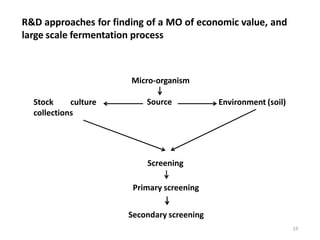
R&D approaches for finding of a MO of economic value, and
large scale fermentation process
19
Micro-organism
Source Environment (soil)
Stock culture
collections
Screening
Primary screening
Secondary screening
Selection of a microorganism
20
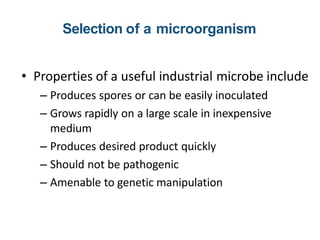
• Properties of a useful industrial microbe include
– Produces spores or can be easily inoculated
– Grows rapidly on a large scale in inexpensive
medium
– Produces desired product quickly
– Should not be pathogenic
– Amenable to genetic manipulation
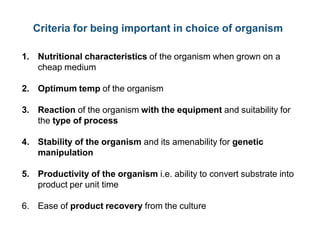
Criteria for being important in choice of organism
1. Nutritional characteristics of the organism when grown on a
cheap medium
2. Optimum temp of the organism
3. Reaction of the organism with the equipment and suitability for
the type of process
4. Stability of the organism and its amenability for genetic
manipulation
5. Productivity of the organism i.e. ability to convert substrate into
product per unit time
6. Ease of product recovery from the culture
Primary screening
• Highly selective procedures for detection and isolation of MO
of interest
• Few steps will allow elimination of valueless MO
Eg. Crowded plate technique for Ab screening, serial dilution, acid base
indicator dyes, CaCO3, sole source carbon or nitrogen, enrichment tech
• Does not give too much information on detail ability of the
micro- organisms
• May yield only a few organisms and few of them may have commercial
value
Common techniques
23
1. Direct wipe or sponge of the soil
2. Soil dilution (10-1 to 10-10)
3. Gradient plate method (streak, pour)
4. Aerosol dilution
5. Flotation
6. Centrifugation
I.
II. Enrichment, screening for metabolites or microbial products
III. Unusual environments
Secondary screening
• Sorting of MO that have real commercial value for
industrial processes and discarding those which
lack potential
• Conducted on agar plates (not sensitive), small
flasks or small fermenters (more sensitive)
containing liquid media or combination of these
approaches.
• Liquid culture provide better info on nutritional,
physical and production responses.
• Can be qualitative or quantitative
24
Preservation of Industrially important MO
• Viable and Free from contamination
• Stored in such a way so as to eliminate
genetic change and retain viability
• Viable by repeated sub-culture (avoid
mutations by keeping stocks and strain
degeneration and contaminations)
Microbiology of Industrial fermentation
26
• The rate of product formation in a given industrial process is directly related to the rate
of biomass formation which in turn is influenced by different environmental factors. For
ex: oxygen supply, pH, temperature, accumulation of inhibitory substances etc.
• Therefore, it isimportant to describe the growth and production in quantitative terms.
• Growth kinetics focuses on the measurement of growth rates during the course of
fermentation,
• Growth dynamics relates to the changes in growth rate and other parameters. Ex: pH,
Temperature,
Growth Cycle
27
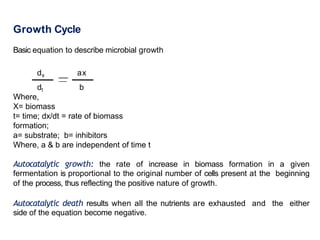
Basic equation to describe microbial growth
dx ax
dt b
Where,
X= biomass
t= time; dx/dt = rate of biomass
formation;
a= substrate; b= inhibitors
Where, a & b are independent of time t
Autocatalytic growth: the rate of increase in biomass formation in a given
fermentation is proportional to the original number of cells present at the beginning
of the process, thus reflecting the positive nature of growth.
Autocatalytic death results when all the nutrients are exhausted and the either
side of the equation become negative.
Growth cycle:
The term growth cycle is used to describe the overall pattern displayed by
microorganisms during growth batch cultures.
The cycle is not a fundamental property of bacterial cell, rather a
consequence of the progressive decrease in food supply or accumulation of
inhibitory intermediates in a closed system to which no additions or
removals are made.
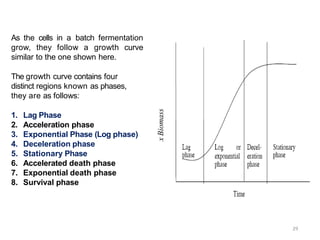
As the cells in a batch fermentation
grow, they follow a growth curve
similar to the one shown here.
The growth curve contains four
distinct regions known as phases,
they are as follows:
1. Lag Phase
2. Acceleration phase
3. Exponential Phase (Log phase)
4. Deceleration phase
5. Stationary Phase
6. Accelerated death phase
7. Exponential death phase
8. Survival phase
x
Biomass
29
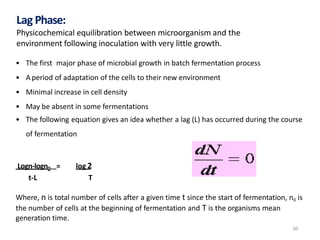
Lag Phase:
Physicochemical equilibration between microorganism and the
environment following inoculation with very little growth.
30
• The first major phase of microbial growth in batch fermentation process
• A period of adaptation of the cells to their new environment
• Minimal increase in cell density
• May be absent in some fermentations
• The following equation gives an idea whether a lag (L) has occurred during the course
of fermentation
Logn-logn0 = log 2
t-L T
Where, n is total number of cells after a given time t since the start of fermentation, n0 is
the number of cells at the beginning of fermentation and T is the organisms mean
generation time.
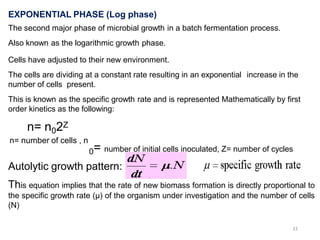
dN/dT = µN
EXPONENTIAL PHASE (Log phase)
The second major phase of microbial growth in a batch fermentation process.
Also known as the logarithmic growth phase.
Cells have adjusted to their new environment.
The cells are dividing at a constant rate resulting in an exponential increase in the
number of cells present.
This is known as the specific growth rate and is represented Mathematically by first
order kinetics as the following:
n= n02Z
n= number of cells , n
0= number of initial cells inoculated, Z= number of cycles
Autolytic growth pattern:
This equation implies that the rate of new biomass formation is directly proportional to
the specific growth rate (µ) of the organism under investigation and the number of cells
(N)
31
Log phase
By the end of the lag phase cells have adapted to the new conditions of
growth.
Growth of the cell mass can now be described quantitatively as a doubling
of cell number per unit time for bacteria and yeast’s, or a doubling of
biomass per unit time for filamentous organisms as fungi.
By plotting the number of cells or biomass against time on a semi
logarithmic graph, a straight line results, hence the term log phase.
Although the cells alter the medium through uptake of substrates and
excretion of metabolic products, the growth rate remains constant during
the log phase.
Growth rate is independent of substrate concentration as long as excess
substrate is present.
Stationary phase
The third major phase of microbial growth in a batch fermentation process
As soon as the substrate is metabolized or toxic substances have been
formed, growth slows down or is completely stopped.
Occurs when the number of cells dividing and dying is in equilibrium and can be
the result of the following:
Depletion of one or more essential growth nutrients
Accumulation of toxic growth associated by by-products
Stress associated with the induction of a recombinant gene
Primary metabolite, or growth associated, production stops
Secondary metabolite, or non growth associated, production may continue
The biomass increases only gradually or remains constant during this
stationary phase, although the composition of the cells may change.
Due to lysis, new substrates are released which then may serve as energy
sources for the slow growth of survivors.
The various metabolites formed in the stationary phase are often of great
biotechnological interest.
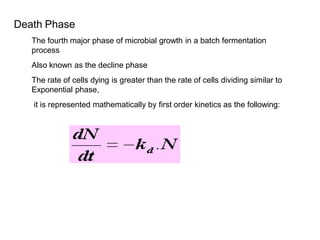
Death Phase
The fourth major phase of microbial growth in a batch fermentation
process
Also known as the decline phase
The rate of cells dying is greater than the rate of cells dividing similar to
Exponential phase,
it is represented mathematically by first order kinetics as the following:
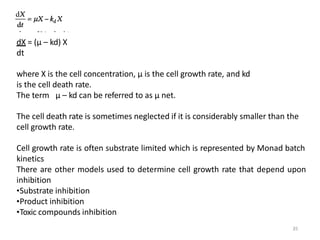
dX = (μ – kd) X
dt
where X is the cell concentration, μ is the cell growth rate, and kd
is the cell death rate.
The term μ – kd can be referred to as μ net.
The cell death rate is sometimes neglected if it is considerably smaller than the
cell growth rate.
Cell growth rate is often substrate limited which is represented by Monad batch
kinetics
There are other models used to determine cell growth rate that depend upon
inhibition
•Substrate inhibition
•Product inhibition
•Toxic compounds inhibition
35
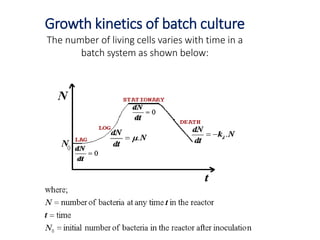
Growth kinetics of batch culture
The number of living cells varies with time in a
batch system as shown below:
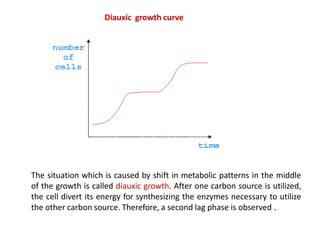
Diauxic growth curve
The situation which is caused by shift in metabolic patterns in the middle
of the growth is called diauxic growth. After one carbon source is utilized,
the cell divert its energy for synthesizing the enzymes necessary to utilize
the other carbon source. Therefore, a second lag phase is observed .
Growth Media
• MO requirenutrients (C,N, P,Minerals), O2
• requirement, temp, pH, salinity etc
• Types of Media -
• Synthetic media
• Semi synthetic media
• Natural media
• Media needs to be economical for large scale productions,
consistent quality and available throughout. Raw material
can be pre-treated if required
• Cheap C and N2 sources can be used
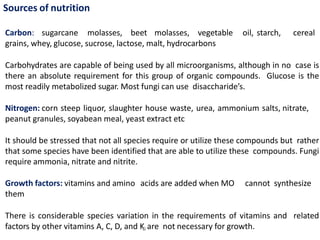
Sources of nutrition
Carbon: sugarcane molasses, beet molasses, vegetable oil, starch, cereal
grains, whey, glucose, sucrose, lactose, malt, hydrocarbons
Carbohydrates are capable of being used by all microorganisms, although in no case is
there an absolute requirement for this group of organic compounds. Glucose is the
most readily metabolized sugar. Most fungi can use disaccharide’s.
Nitrogen: corn steep liquor, slaughter house waste, urea, ammonium salts, nitrate,
peanut granules, soyabean meal, yeast extract etc
It should be stressed that not all species require or utilize these compounds but rather
that some species have been identified that are able to utilize these compounds. Fungi
require ammonia, nitrate and nitrite.
Growth factors: vitamins and amino acids are added when MO cannot synthesize
them
There is considerable species variation in the requirements of vitamins and related
factors by other vitamins A, C, D, and K
6
0 are not necessary for growth.
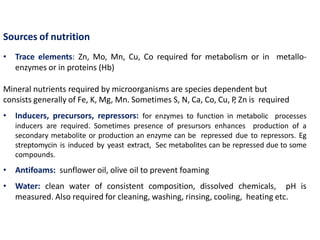
Sources of nutrition
40
• Trace elements: Zn, Mo, Mn, Cu, Co required for metabolism or in metallo-
enzymes or in proteins (Hb)
Mineral nutrients required by microorganisms are species dependent but
consists generally of Fe, K, Mg, Mn. Sometimes S, N, Ca, Co, Cu, P
, Zn is required
• Inducers, precursors, repressors: for enzymes to function in metabolic processes
inducers are required. Sometimes presence of presursors enhances production of a
secondary metabolite or production an enzyme can be repressed due to repressors. Eg
streptomycin is induced by yeast extract, Sec metabolites can be repressed due to some
compounds.
• Antifoams: sunflower oil, olive oil to prevent foaming
• Water: clean water of consistent composition, dissolved chemicals, pH is
measured. Also required for cleaning, washing, rinsing, cooling, heating etc.
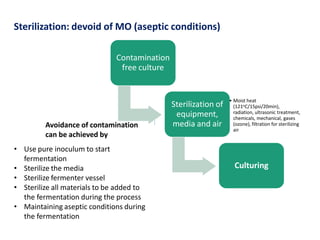
Sterilization: devoid of MO (aseptic conditions)
41
Avoidance of contamination
can be achieved by
• Use pure inoculum to start
fermentation
• Sterilize the media
• Sterilize fermenter vessel
• Sterilize all materials to be added to
the fermentation during the process
• Maintaining aseptic conditions during
the fermentation
Contamination
free culture
Sterilization of
equipment,
media and air
• Moist heat
(121oC/15psi/20min),
radiation, ultrasonic treatment,
chemicals, mechanical, gases
(ozone), filtration for sterilizing
air
Culturing
Sterilization:
Elimination of threads and welding of pipes and tubes to reduce
contamination
Fermenters have pipes which flush steam into the system Media
along with fermenter is sterilized
Among the several factors that influence killing are temperature, pH, osmotic
pressure, shear, mass transport, and concentrations of extraneous substances
that also react with the killing agent.
These factors operate synergistically, and temperature plays roles other than
simply affecting the kinetics of a reaction
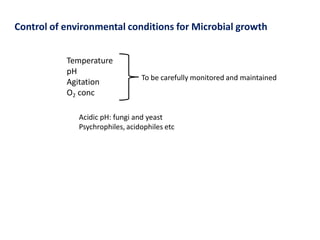
Control of environmental conditions for Microbial growth
Temperature
pH
Agitation
O2 conc
To be carefully monitored and maintained
Acidic pH: fungi and yeast
Psychrophiles, acidophiles etc
Module-1_Introduction & Growth Curve – The Basics.pdf

Module-1_Introduction & Growth Curve – The Basics.pdf

  • 1.
    Module-1: Introduction & GrowthCurve – The Basics
  • 2.
    Bioprocess Technology -Bioprocessing. • A bioprocess is any process that uses complete living cells or their components (e.g., whole Cells, enzymes, chloroplast) to obtain desired products. • This process is commonly referred to as Fermentation.
  • 3.
    Bioprocess technology &Biotechnology • Bioprocess technology is a vital part of biotechnology that deals with processes combining the complete living matter or its components with nutrients to make specialty chemicals, reagents, and biotherapeutics. • The processes form the backbone of translating discoveries of life sciences into useful industrial products. • Various stages associated with the bioprocess technology include substrates and media, biocatalysts, volume production, downstream processing, purification, and final processing. • Over the past few years, the application of bioprocess technology in the development of a variety of next- generation biopharmaceutical products is gaining attraction in the bioprocess technology market.
  • 4.
  • 5.
    5 Stages of Bioprocessing StageI : Upstream processing which involves preparation of liquid medium, separation of particulate and inhibitory chemicals from the medium, sterilization, air purification etc. Upstream processes include selection of a microbial strain characterized by the ability to synthesize a specific product having the desired commercial value. This strain then is subjected to improvement protocols to maximize the ability of the strain to synthesize economical amounts of the product. Included in the upstream phase is the fermentation process itself which usually is carried out in large tanks known as fermenters or bioreactors. In addition to mechanical parts which provide proper conditions inside the tank such as aeration, cooling, agitation, etc., the tank is usually also equipped with complex sets of monitors and control devices in order to run the microbial growth and product synthesis under optimized conditions. The processing of the fermentation reactions inside the fermenter can be done using many modifications of engineering technologies. One of the most commonly used fermenter types is the stirred- tank fermenter which utilizes mechanical agitation principles, mainly using radial-flow impellers, during the fermentation process.
  • 6.
    Stages of Bioprocessing(cont.) • Stage II: Fermentation which involves the conversion of substrates to desired product with the help of biological agents such as microorganisms. • Techniques for large-scale production of microbial products. It must both provide an optimum environment for the microbial synthesis of the desired product and be economically feasible on a large scale. They can be divided into surface (emersion) and submersion techniques. The latter may be run in batch, fed batch, continuous reactors In the surface techniques, the microorganisms are cultivated on the surface of a liquid or solid substrate. These techniques are very complicated and rarely used in industry. • In the submersion processes, the microorganisms grow in a liquid medium. Except in traditional beer and wine fermentation, the medium is held in fermenters and stirred to obtain a homogeneous distribution of cells and medium. Most processes are aerobic, and for these the medium must be vigorously aerated. All important industrial processes (production of biomass and protein, antibiotics, enzymes and sewage treatment) are carried out by submersion processes.
  • 7.
    Stages of Bioprocessing(cont.) • Stage III: Downstream processing which involves separation of cells from the fermentation broth, purification and concentration of desired product and waste disposal or recycle. • Downstream processing, the various stages that follow the fermentation process, involves suitable techniques and methods for recovery, purification, and characterization of the desired fermentation product. A vast array of methods for downstream processing, such as centrifugation, filtration, and chromatography, may be applied. These methods vary according to the chemical and physical nature, as well as the desired grade, of the final product
  • 8.
    Fermentation • Fermentation isthe term used by microbiologists to describe any process for the production of a product by means of the mass culture of a microorganism. • The product can either be: i. The cell itself: referred to as biomass production. ii. A microorganisms own metabolite: referred to as a product from a natural or genetically improved strain. See Table 1. iii. A microorganisms foreign product: referred to as a product from recombinant DNA technology or genetically engineered strain, i.e. recombinant strain. See Table 2.
  • 9.
    Table 1. Productsproduced by microbial activity Lipids Nucleotides and precursors Organic synthesis intermediates Pharmaceutical significant compounds Plant growth factors Steroids Toxins Amino acids Antibacterial agents Antifungal agents Antiprotozoal agents Carbohydrates Dyes and cosmetics Enzymes Foods Vitamins and coenzymes Table 2. Products being addressed by recombinant technology Human therapeutics Enzymes Amino acids 9
  • 10.
    Primary metabolite • Kindof metabolite that is directly involved in normal growth, development, and reproduction. It usually performs a physiological function in the organism (i.e. an intrinsic function). • During the period of an exponential growth of microorganisms, several metabolic products, will be produced -collectively referred to as primary metabolites. • A primary metabolite is typically present in many organisms or cells. It is also referred to as a central metabolite, which has an even more restricted meaning (present in any autonomously growing cell or organism). • Some common examples of primary metabolites include: ethanol, lactic acid, and certain amino acids
  • 11.
    The primary metabolitesare divided into two groups: 1. Primary essential metabolites: These are the compounds produced in adequate quantizes to sustain cell growth e.g. vitamins, amino acids, nucleosides. The native microorganisms usually do not overproduce essential primary metabolites, since it is a wasteful exercise. However, for industrial overproduction, the regulatory mechanisms are suitably manipulated. 2. Primary metabolic end products: These are the normal and traditional end products of fermentation process of primary metabolism. The end products may or may not have any significant function to perform in the microorganisms, although they have many other industrial applications e.g. ethanol, acetone, lactic acid. Carbon dioxide is a metabolic end product of Saccharomyces cerevisiae. This CO2 is essential for leavening of dough in baking industry.
  • 12.
    Primary metabolites (cont.) Limitationsin growth: • Due to insufficient/ limited supply of any nutrient (substrate or even O2), the growth rate of microorganisms slows down. However, the metabolism does not stop. It continues as long as the cell lives, but the formation of products differs. Overproduction of primary metabolites: • Excessive production of primary metabolites is very important for their large scale use for a variety of purposes. • Overproduction of several metabolites has been successfully accomplished by eliminating the feedback inhibition
  • 13.
    Secondary metabolites • Theseare organic compounds that are not directly involved in the normal growth, development, or reproduction of an organism. • Unlike primary metabolites, absence of secondary metabolites does not result in immediate death, but rather in long-term impairment of the organism's survivability, fecundity, or aesthetics, or perhaps in no significant change at all. • Secondary metabolites are often restricted to a narrow set of species within a phylogenetic group. • Humans use secondary metabolites as medicines, flavorings, and recreational drugs. • Secondary metabolites aid a plant in important functions such as protection, competition, and species interactions, but are not necessary for survival. • One important defining quality of secondary metabolites is their specificity. Usually, secondary metabolites are specific to individual species
  • 14.
    Characteristics of secondarymetabolites • Secondary metabolites are specifically produced by selected few microorganisms. • They are not essential for the growth and reproduction of organisms from which they are produced. • Environmental factors influence the production of secondary metabolites. • Some microorganisms produce secondary metabolites as a group of compounds (usually structurally related) instead of a single one e.g. about 35 anthracyclines are produced by a single strain of Streptomyces. • The biosynthetic pathways for most secondary metabolites are not clearly established. • The regulation of the formation of secondary metabolites is more complex and differs from that of primary metabolites.
  • 15.
    Functions of secondarymetabolites: 15 Secondary metabolites are not essential for growth and multiplication of cells. Their occurrence and structures vary widely. Several hypotheses have been put forth to explain the role of secondary metabolites, two of them are given below. 1. The secondary metabolites may perform certain (unknown) functions that are beneficial for the cells to survive. 2. The secondary metabolites have absolutely no function. Their production alone is important for the cell, whatever may be the product (which is considered to be useless).
  • 16.
  • 17.
  • 18.
    Bioconversions Microorganisms are alsoused for chemical transformation of unusual substrates to desired products. This process, also referred to as biotransformation, is very important in producing several compounds e.g. conversion of ethanol to acetic acid (in vinegar), sorbitol to sorbose, synthesis of steroid hormones and certain amino acids. In bioconversion, microorganisms convert a compound to a structurally related product in one or a few enzymatic reactions. The bioconversions can be carried out with resting cells, spores or even killed cells. Non-growing cells are preferred for bioconversions, since high substrate concentration can be used, besides washing the cells easily (to make them free from contamination). Sometimes, mixed cultures are used for bioconversions to carry out different reactions. In recent years, the yield of bioconversion is increased by using immobilized cells at a lower cost.
  • 19.
    R&D approaches forfinding of a MO of economic value, and large scale fermentation process 19 Micro-organism Source Environment (soil) Stock culture collections Screening Primary screening Secondary screening
  • 20.
    Selection of amicroorganism 20 • Properties of a useful industrial microbe include – Produces spores or can be easily inoculated – Grows rapidly on a large scale in inexpensive medium – Produces desired product quickly – Should not be pathogenic – Amenable to genetic manipulation
  • 21.
    Criteria for beingimportant in choice of organism 1. Nutritional characteristics of the organism when grown on a cheap medium 2. Optimum temp of the organism 3. Reaction of the organism with the equipment and suitability for the type of process 4. Stability of the organism and its amenability for genetic manipulation 5. Productivity of the organism i.e. ability to convert substrate into product per unit time 6. Ease of product recovery from the culture
  • 22.
    Primary screening • Highlyselective procedures for detection and isolation of MO of interest • Few steps will allow elimination of valueless MO Eg. Crowded plate technique for Ab screening, serial dilution, acid base indicator dyes, CaCO3, sole source carbon or nitrogen, enrichment tech • Does not give too much information on detail ability of the micro- organisms • May yield only a few organisms and few of them may have commercial value
  • 23.
    Common techniques 23 1. Directwipe or sponge of the soil 2. Soil dilution (10-1 to 10-10) 3. Gradient plate method (streak, pour) 4. Aerosol dilution 5. Flotation 6. Centrifugation I. II. Enrichment, screening for metabolites or microbial products III. Unusual environments
  • 24.
    Secondary screening • Sortingof MO that have real commercial value for industrial processes and discarding those which lack potential • Conducted on agar plates (not sensitive), small flasks or small fermenters (more sensitive) containing liquid media or combination of these approaches. • Liquid culture provide better info on nutritional, physical and production responses. • Can be qualitative or quantitative 24
  • 25.
    Preservation of Industriallyimportant MO • Viable and Free from contamination • Stored in such a way so as to eliminate genetic change and retain viability • Viable by repeated sub-culture (avoid mutations by keeping stocks and strain degeneration and contaminations)
  • 26.
    Microbiology of Industrialfermentation 26 • The rate of product formation in a given industrial process is directly related to the rate of biomass formation which in turn is influenced by different environmental factors. For ex: oxygen supply, pH, temperature, accumulation of inhibitory substances etc. • Therefore, it isimportant to describe the growth and production in quantitative terms. • Growth kinetics focuses on the measurement of growth rates during the course of fermentation, • Growth dynamics relates to the changes in growth rate and other parameters. Ex: pH, Temperature,
  • 27.
    Growth Cycle 27 Basic equationto describe microbial growth dx ax dt b Where, X= biomass t= time; dx/dt = rate of biomass formation; a= substrate; b= inhibitors Where, a & b are independent of time t Autocatalytic growth: the rate of increase in biomass formation in a given fermentation is proportional to the original number of cells present at the beginning of the process, thus reflecting the positive nature of growth. Autocatalytic death results when all the nutrients are exhausted and the either side of the equation become negative.
  • 28.
    Growth cycle: The termgrowth cycle is used to describe the overall pattern displayed by microorganisms during growth batch cultures. The cycle is not a fundamental property of bacterial cell, rather a consequence of the progressive decrease in food supply or accumulation of inhibitory intermediates in a closed system to which no additions or removals are made.
  • 29.
    As the cellsin a batch fermentation grow, they follow a growth curve similar to the one shown here. The growth curve contains four distinct regions known as phases, they are as follows: 1. Lag Phase 2. Acceleration phase 3. Exponential Phase (Log phase) 4. Deceleration phase 5. Stationary Phase 6. Accelerated death phase 7. Exponential death phase 8. Survival phase x Biomass 29
  • 30.
    Lag Phase: Physicochemical equilibrationbetween microorganism and the environment following inoculation with very little growth. 30 • The first major phase of microbial growth in batch fermentation process • A period of adaptation of the cells to their new environment • Minimal increase in cell density • May be absent in some fermentations • The following equation gives an idea whether a lag (L) has occurred during the course of fermentation Logn-logn0 = log 2 t-L T Where, n is total number of cells after a given time t since the start of fermentation, n0 is the number of cells at the beginning of fermentation and T is the organisms mean generation time.
  • 31.
    dN/dT = µN EXPONENTIALPHASE (Log phase) The second major phase of microbial growth in a batch fermentation process. Also known as the logarithmic growth phase. Cells have adjusted to their new environment. The cells are dividing at a constant rate resulting in an exponential increase in the number of cells present. This is known as the specific growth rate and is represented Mathematically by first order kinetics as the following: n= n02Z n= number of cells , n 0= number of initial cells inoculated, Z= number of cycles Autolytic growth pattern: This equation implies that the rate of new biomass formation is directly proportional to the specific growth rate (µ) of the organism under investigation and the number of cells (N) 31
  • 32.
    Log phase By theend of the lag phase cells have adapted to the new conditions of growth. Growth of the cell mass can now be described quantitatively as a doubling of cell number per unit time for bacteria and yeast’s, or a doubling of biomass per unit time for filamentous organisms as fungi. By plotting the number of cells or biomass against time on a semi logarithmic graph, a straight line results, hence the term log phase. Although the cells alter the medium through uptake of substrates and excretion of metabolic products, the growth rate remains constant during the log phase. Growth rate is independent of substrate concentration as long as excess substrate is present.
  • 33.
    Stationary phase The thirdmajor phase of microbial growth in a batch fermentation process As soon as the substrate is metabolized or toxic substances have been formed, growth slows down or is completely stopped. Occurs when the number of cells dividing and dying is in equilibrium and can be the result of the following: Depletion of one or more essential growth nutrients Accumulation of toxic growth associated by by-products Stress associated with the induction of a recombinant gene Primary metabolite, or growth associated, production stops Secondary metabolite, or non growth associated, production may continue The biomass increases only gradually or remains constant during this stationary phase, although the composition of the cells may change. Due to lysis, new substrates are released which then may serve as energy sources for the slow growth of survivors. The various metabolites formed in the stationary phase are often of great biotechnological interest.
  • 34.
    Death Phase The fourthmajor phase of microbial growth in a batch fermentation process Also known as the decline phase The rate of cells dying is greater than the rate of cells dividing similar to Exponential phase, it is represented mathematically by first order kinetics as the following:
  • 35.
    dX = (μ– kd) X dt where X is the cell concentration, μ is the cell growth rate, and kd is the cell death rate. The term μ – kd can be referred to as μ net. The cell death rate is sometimes neglected if it is considerably smaller than the cell growth rate. Cell growth rate is often substrate limited which is represented by Monad batch kinetics There are other models used to determine cell growth rate that depend upon inhibition •Substrate inhibition •Product inhibition •Toxic compounds inhibition 35
  • 36.
    Growth kinetics ofbatch culture The number of living cells varies with time in a batch system as shown below:
  • 37.
    Diauxic growth curve Thesituation which is caused by shift in metabolic patterns in the middle of the growth is called diauxic growth. After one carbon source is utilized, the cell divert its energy for synthesizing the enzymes necessary to utilize the other carbon source. Therefore, a second lag phase is observed .
  • 38.
    Growth Media • MOrequirenutrients (C,N, P,Minerals), O2 • requirement, temp, pH, salinity etc • Types of Media - • Synthetic media • Semi synthetic media • Natural media • Media needs to be economical for large scale productions, consistent quality and available throughout. Raw material can be pre-treated if required • Cheap C and N2 sources can be used
  • 39.
    Sources of nutrition Carbon:sugarcane molasses, beet molasses, vegetable oil, starch, cereal grains, whey, glucose, sucrose, lactose, malt, hydrocarbons Carbohydrates are capable of being used by all microorganisms, although in no case is there an absolute requirement for this group of organic compounds. Glucose is the most readily metabolized sugar. Most fungi can use disaccharide’s. Nitrogen: corn steep liquor, slaughter house waste, urea, ammonium salts, nitrate, peanut granules, soyabean meal, yeast extract etc It should be stressed that not all species require or utilize these compounds but rather that some species have been identified that are able to utilize these compounds. Fungi require ammonia, nitrate and nitrite. Growth factors: vitamins and amino acids are added when MO cannot synthesize them There is considerable species variation in the requirements of vitamins and related factors by other vitamins A, C, D, and K 6 0 are not necessary for growth.
  • 40.
    Sources of nutrition 40 •Trace elements: Zn, Mo, Mn, Cu, Co required for metabolism or in metallo- enzymes or in proteins (Hb) Mineral nutrients required by microorganisms are species dependent but consists generally of Fe, K, Mg, Mn. Sometimes S, N, Ca, Co, Cu, P , Zn is required • Inducers, precursors, repressors: for enzymes to function in metabolic processes inducers are required. Sometimes presence of presursors enhances production of a secondary metabolite or production an enzyme can be repressed due to repressors. Eg streptomycin is induced by yeast extract, Sec metabolites can be repressed due to some compounds. • Antifoams: sunflower oil, olive oil to prevent foaming • Water: clean water of consistent composition, dissolved chemicals, pH is measured. Also required for cleaning, washing, rinsing, cooling, heating etc.
  • 41.
    Sterilization: devoid ofMO (aseptic conditions) 41 Avoidance of contamination can be achieved by • Use pure inoculum to start fermentation • Sterilize the media • Sterilize fermenter vessel • Sterilize all materials to be added to the fermentation during the process • Maintaining aseptic conditions during the fermentation Contamination free culture Sterilization of equipment, media and air • Moist heat (121oC/15psi/20min), radiation, ultrasonic treatment, chemicals, mechanical, gases (ozone), filtration for sterilizing air Culturing
  • 42.
    Sterilization: Elimination of threadsand welding of pipes and tubes to reduce contamination Fermenters have pipes which flush steam into the system Media along with fermenter is sterilized Among the several factors that influence killing are temperature, pH, osmotic pressure, shear, mass transport, and concentrations of extraneous substances that also react with the killing agent. These factors operate synergistically, and temperature plays roles other than simply affecting the kinetics of a reaction
  • 43.
    Control of environmentalconditions for Microbial growth Temperature pH Agitation O2 conc To be carefully monitored and maintained Acidic pH: fungi and yeast Psychrophiles, acidophiles etc