Destination Branding and Marketing
Introduction
According to the United Nations World Tourism
Organization (UNWTO) Tourism Highlights 2019, 1.5 billion
international tourist arrivals were recorded globally. The Middle
East recorded the strongest growth with almost double the
global average (+8%). Asia and the Pacific, however, stalled
but still revealed an above-average growth with arrivals up to
5%. Europe with (+4%) continued to lead in terms of
international arrivals numbers, and the Americas at (+2%)
growth.
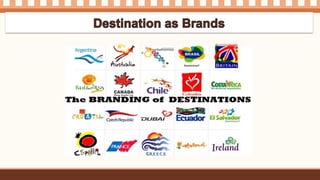
Destinations have become the world’s
biggest brands. Popular destinations
such as France and the United States
have established themselves as must-
see destinations that are in every
tourist’s bucket list of places to see.
• Branding is the process of creating a slogan from a
message and then designing a symbol or logo that
together will communicate to potential visitors the image
of the city along with the features, benefits, and values it
has to offer (kolb 2006).
• Branding is about establishing the identity of a tourism
offering in the minds of consumers visitors (Lumsdown
1997). It is distinctive name or symbol which identifies a
product or set of products that differentiates it from other
competitors (Cooke 1996)
The question that tourism marketers are now
facing is not whether to brand or not but rather,
how to successfully brand a destination (Hannah
and Rowley 2013)
According to Dr. Glenn MacCartney, in a lecture he
presented during the 5th Edukcircle International
Convention on Tourism and Hospitality, image
formation is at the core branding
DESTINATION IMAGE AND BRANDING
 Brand identity refers to the essence of the brand,
the characteristics that make ‘it’ what it is.
 Brand identity is the central aspect of the branding
process.
 Identity provides for overall coherence and,
therefore, serves as a platform for monitoring
means of expression and unity (Kapferer 2004).
BRAND IDENTITY
1. Film tourism (New Zealand, Ireland, etc.)
2. Celebrity endorsement (Psy of “Gangnam’Fame).
3. Hosting of mega-events (Summer Olympics,
Beauty Pageants, etc.)
4. Participation in trade fairs (World Expo)
5. Catchy promotion gimmicks (Australia’s “Best Job
in the World’)
6. TV, radio, and Internet commercials
Strategies for promoting Destination
According to Kotler et al.
(2017), there are four broad strategies
for attracting visitors, residents and
employees, and business and industry
and for increasing exports. These are:
image marketing, attraction marketing,
infrastructure marketing, and people
marketing.
Strategies
for
Attracting
Visitor
• There are thousands of competing destinations that
attract potential buyers by projecting a strong
image. In Southeast Asia alone, the Philippines
may go unnoticed by how our ASEAN neighbors
are projecting themselves on the global realm.
Projecting an image that is both believable and
realistic has been a challenge to the Philippines. In
2022, Tourism Secretary Christina Garcia Frasco
led the launch of the new slogan “Love the
Philippines,” describing it as the country's “love
letter to the world.”
IMAGE MARKETING
ATTRACTION MARKETING
• Improving an image through marketing
communications efforts is not enough to
increase arrivals. Destinations need to invest
in developing attractions, both natural and
man-made.
• After being severely hit by a 7.2 magnitude
earthquake in October 2013, Bohol can still
rise above the ruins and bounce back as
one of the country’s most visited places.
INFRASTRUCTURE MARKETING
• Infrastructure plays a crucial role in the
holistic development of a place. The most
important infrastructure that should be set in
place include streets, highways, effective
transport
PEOPLE MARKETING
• People marketing is centering the marketing
message on its human resources which includes the
locals’ characteristics and culture. Human capital is
what the Philippines has. We are a country of miles.
Our people speak English, the universal language.
We are touted as the world’s most hospitable
people. Our overseas Filipino workers are known as
the best.
CHALLENGE OF DESTINATION
BRANDING
• Morgan and Pritchard (2002) suggest five key
challenges faced by destination marketers as
follows:
1. Limited Budget
2. Politics
3. External Environment
4. Destination product
5. Creating Differentiation
3 Types of Organizing and Tourism
Destination
• National tourism organization
• Regional tourist organization
• Local governments units
National Tourism Organization
• Countries and states have government agencies
that manage and/or market bourb destinations. In
the Philippines, the DOT referred to as our National
Tourism Organization handles all of the Philippines
responsible for the planning and strategic
development in the country as well as marketing
and investments. It has attached agencies that have
specific roles in tourism development such as the
Tourism Promotions Board.
REGIONAL TOURIST ORGANIZATION
• The Philippines, being an archipelago, is
organized into regions. The regional division
helps in the planning, implementation, and
monitoring of tourism plans and projects.
Each region in the Philippines has an active
Regional Development Council and a
Regional Tourism Council for the maximum
participation of the public and private
sectors.
LOCAL GOVERNMENT UNITS
• In the Tourism Act of 2009 (Republic Act 9593),
each province and cities and municipalities under it
are mandated to have a local tourism office and to
appoint local tourism officers to ensure the
governance and oversight of tourism development
in their respective localities. LGUs can partner with
tourism-related government agencies, donor
companies, volunteers, and private organizations in
the design and execution of tourism activities
(Disimulacion 2016).
Module-7-Destination-Branding-and-Marketing.pdf

Module-7-Destination-Branding-and-Marketing.pdf

  • 2.
    Destination Branding andMarketing Introduction According to the United Nations World Tourism Organization (UNWTO) Tourism Highlights 2019, 1.5 billion international tourist arrivals were recorded globally. The Middle East recorded the strongest growth with almost double the global average (+8%). Asia and the Pacific, however, stalled but still revealed an above-average growth with arrivals up to 5%. Europe with (+4%) continued to lead in terms of international arrivals numbers, and the Americas at (+2%) growth.
  • 3.
    Destinations have becomethe world’s biggest brands. Popular destinations such as France and the United States have established themselves as must- see destinations that are in every tourist’s bucket list of places to see.
  • 4.
    • Branding isthe process of creating a slogan from a message and then designing a symbol or logo that together will communicate to potential visitors the image of the city along with the features, benefits, and values it has to offer (kolb 2006). • Branding is about establishing the identity of a tourism offering in the minds of consumers visitors (Lumsdown 1997). It is distinctive name or symbol which identifies a product or set of products that differentiates it from other competitors (Cooke 1996)
  • 6.
    The question thattourism marketers are now facing is not whether to brand or not but rather, how to successfully brand a destination (Hannah and Rowley 2013) According to Dr. Glenn MacCartney, in a lecture he presented during the 5th Edukcircle International Convention on Tourism and Hospitality, image formation is at the core branding DESTINATION IMAGE AND BRANDING
  • 7.
     Brand identityrefers to the essence of the brand, the characteristics that make ‘it’ what it is.  Brand identity is the central aspect of the branding process.  Identity provides for overall coherence and, therefore, serves as a platform for monitoring means of expression and unity (Kapferer 2004). BRAND IDENTITY
  • 8.
    1. Film tourism(New Zealand, Ireland, etc.) 2. Celebrity endorsement (Psy of “Gangnam’Fame). 3. Hosting of mega-events (Summer Olympics, Beauty Pageants, etc.) 4. Participation in trade fairs (World Expo) 5. Catchy promotion gimmicks (Australia’s “Best Job in the World’) 6. TV, radio, and Internet commercials Strategies for promoting Destination
  • 9.
    According to Kotleret al. (2017), there are four broad strategies for attracting visitors, residents and employees, and business and industry and for increasing exports. These are: image marketing, attraction marketing, infrastructure marketing, and people marketing. Strategies for Attracting Visitor
  • 10.
    • There arethousands of competing destinations that attract potential buyers by projecting a strong image. In Southeast Asia alone, the Philippines may go unnoticed by how our ASEAN neighbors are projecting themselves on the global realm. Projecting an image that is both believable and realistic has been a challenge to the Philippines. In 2022, Tourism Secretary Christina Garcia Frasco led the launch of the new slogan “Love the Philippines,” describing it as the country's “love letter to the world.” IMAGE MARKETING
  • 11.
    ATTRACTION MARKETING • Improvingan image through marketing communications efforts is not enough to increase arrivals. Destinations need to invest in developing attractions, both natural and man-made. • After being severely hit by a 7.2 magnitude earthquake in October 2013, Bohol can still rise above the ruins and bounce back as one of the country’s most visited places.
  • 12.
    INFRASTRUCTURE MARKETING • Infrastructureplays a crucial role in the holistic development of a place. The most important infrastructure that should be set in place include streets, highways, effective transport
  • 13.
    PEOPLE MARKETING • Peoplemarketing is centering the marketing message on its human resources which includes the locals’ characteristics and culture. Human capital is what the Philippines has. We are a country of miles. Our people speak English, the universal language. We are touted as the world’s most hospitable people. Our overseas Filipino workers are known as the best.
  • 14.
    CHALLENGE OF DESTINATION BRANDING •Morgan and Pritchard (2002) suggest five key challenges faced by destination marketers as follows: 1. Limited Budget 2. Politics 3. External Environment 4. Destination product 5. Creating Differentiation
  • 15.
    3 Types ofOrganizing and Tourism Destination • National tourism organization • Regional tourist organization • Local governments units
  • 16.
    National Tourism Organization •Countries and states have government agencies that manage and/or market bourb destinations. In the Philippines, the DOT referred to as our National Tourism Organization handles all of the Philippines responsible for the planning and strategic development in the country as well as marketing and investments. It has attached agencies that have specific roles in tourism development such as the Tourism Promotions Board.
  • 17.
    REGIONAL TOURIST ORGANIZATION •The Philippines, being an archipelago, is organized into regions. The regional division helps in the planning, implementation, and monitoring of tourism plans and projects. Each region in the Philippines has an active Regional Development Council and a Regional Tourism Council for the maximum participation of the public and private sectors.
  • 18.
    LOCAL GOVERNMENT UNITS •In the Tourism Act of 2009 (Republic Act 9593), each province and cities and municipalities under it are mandated to have a local tourism office and to appoint local tourism officers to ensure the governance and oversight of tourism development in their respective localities. LGUs can partner with tourism-related government agencies, donor companies, volunteers, and private organizations in the design and execution of tourism activities (Disimulacion 2016).