29/09/2024 JAWAHARLAL NEHRU NEW COLLEGE OF ENGINEERING 1
Introduction to Python Programming
BPLCK205B
COURS E INS T RUCTOR:
MRS. MANASA S M
ASST. PROF., DEPT. OF ISE.
JNNCE, SHIVAMOGGA
MODULE- V
29/09/2024 2
MODULE- V SYLLABUS
CHAPTER - 15
• Classes and Objects
• Programmer-defined types
• Attributes
• Rectangles
• Instances as return values
• Objects are mutable
• Copying
JAWAHARLAL NEHRU NEW COLLEGE OF ENGINEERING
29/09/2024 3
CHAPTER - 16
• Classes and Functions
• Time
• Pure functions
• Modifiers
• Prototyping versus Planning
JAWAHARLAL NEHRU NEW COLLEGE OF ENGINEERING
29/09/2024 4
CHAPTER - 17
• Classes and Methods
• Object-oriented features
• Printing objects
• Another example
• A more complicated example
• The init method
• The __str__ method
• Operator overloading
• Type-based dispatch
• Polymorphism
• Interface and Implementation
JAWAHARLAL NEHRU NEW COLLEGE OF ENGINEERING
29/09/2024 5
Classes and Objects
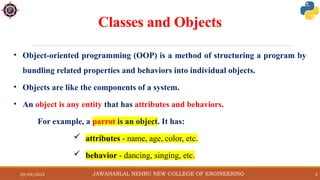
• Object-oriented programming (OOP) is a method of structuring a program by
bundling related properties and behaviors into individual objects.
• Objects are like the components of a system.
• An object is any entity that has attributes and behaviors.
For example, a parrot is an object. It has:
 attributes - name, age, color, etc.
 behavior - dancing, singing, etc.
JAWAHARLAL NEHRU NEW COLLEGE OF ENGINEERING
29/09/2024 6
Classes and Objects
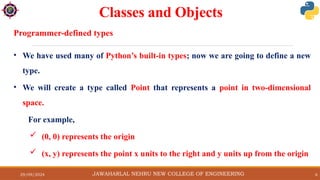
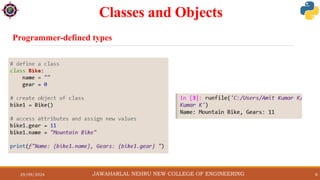
• We have used many of Python’s built-in types; now we are going to define a new
type.
• We will create a type called Point that represents a point in two-dimensional
space.
For example,
 (0, 0) represents the origin
 (x, y) represents the point x units to the right and y units up from the origin
JAWAHARLAL NEHRU NEW COLLEGE OF ENGINEERING
Programmer-defined types
29/09/2024 7
Classes and Objects
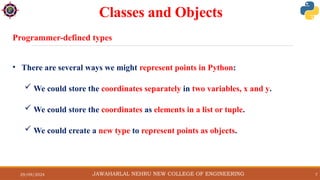
• There are several ways we might represent points in Python:
 We could store the coordinates separately in two variables, x and y.
 We could store the coordinates as elements in a list or tuple.
 We could create a new type to represent points as objects.
JAWAHARLAL NEHRU NEW COLLEGE OF ENGINEERING
Programmer-defined types
29/09/2024 8
Classes and Objects
JAWAHARLAL NEHRU NEW COLLEGE OF ENGINEERING
Programmer-defined types
29/09/2024 9
Classes and Objects
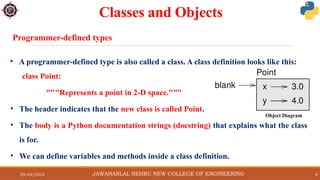
• A programmer-defined type is also called a class. A class definition looks like this:
class Point:
"""Represents a point in 2-D space."""
• The header indicates that the new class is called Point.
• The body is a Python documentation strings (docstring) that explains what the class
is for.
• We can define variables and methods inside a class definition.
JAWAHARLAL NEHRU NEW COLLEGE OF ENGINEERING
Programmer-defined types
Object Diagram
29/09/2024 10
Classes and Objects
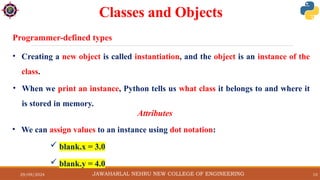
• Creating a new object is called instantiation, and the object is an instance of the
class.
• When we print an instance, Python tells us what class it belongs to and where it
is stored in memory.
JAWAHARLAL NEHRU NEW COLLEGE OF ENGINEERING
Programmer-defined types
Attributes
• We can assign values to an instance using dot notation:
 blank.x = 3.0
 blank.y = 4.0
29/09/2024 11
Classes and Objects
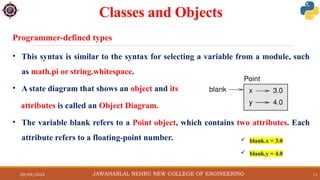
• This syntax is similar to the syntax for selecting a variable from a module, such
as math.pi or string.whitespace.
• A state diagram that shows an object and its
attributes is called an Object Diagram.
• The variable blank refers to a Point object, which contains two attributes. Each
attribute refers to a floating-point number.
JAWAHARLAL NEHRU NEW COLLEGE OF ENGINEERING
Programmer-defined types
 blank.x = 3.0
 blank.y = 4.0
29/09/2024 12
Classes and Objects
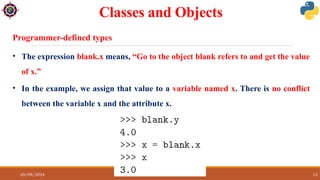
• The expression blank.x means, “Go to the object blank refers to and get the value
of x.”
• In the example, we assign that value to a variable named x. There is no conflict
between the variable x and the attribute x.
Programmer-defined types
29/09/2024 13
Classes and Objects
• The docstring lists the attributes: width and height are numbers; corner is a
Point object that specifies the lower-left corner.
• There are at least two possibilities:
• We could specify one corner of the rectangle (or the center), the width, and
the height.
• We could specify two opposing corners.
JAWAHARLAL NEHRU NEW COLLEGE OF ENGINEERING
Rectangles
29/09/2024 14
Classes and Objects
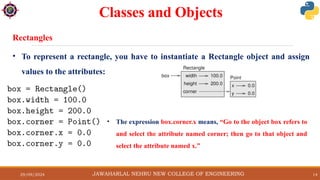
• To represent a rectangle, you have to instantiate a Rectangle object and assign
values to the attributes:
JAWAHARLAL NEHRU NEW COLLEGE OF ENGINEERING
Rectangles
• The expression box.corner.x means, “Go to the object box refers to
and select the attribute named corner; then go to that object and
select the attribute named x.”
29/09/2024 15
Classes and Objects
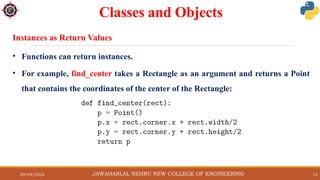
• Functions can return instances.
• For example, find_center takes a Rectangle as an argument and returns a Point
that contains the coordinates of the center of the Rectangle:
JAWAHARLAL NEHRU NEW COLLEGE OF ENGINEERING
Instances as Return Values
29/09/2024 16
Classes and Objects
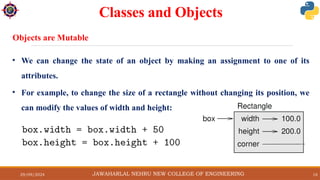
• We can change the state of an object by making an assignment to one of its
attributes.
• For example, to change the size of a rectangle without changing its position, we
can modify the values of width and height:
JAWAHARLAL NEHRU NEW COLLEGE OF ENGINEERING
Objects are Mutable
29/09/2024 17
Classes and Objects
Objects are Mutable
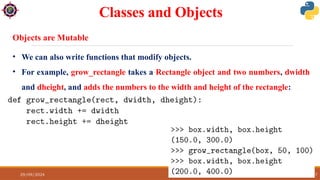
• We can also write functions that modify objects.
• For example, grow_rectangle takes a Rectangle object and two numbers, dwidth
and dheight, and adds the numbers to the width and height of the rectangle:
29/09/2024 18
Classes and Objects
Copying
• Aliasing can make a program difficult to read because changes in one place
might have unexpected effects in another place.
• It is hard to keep track of all the variables that might refer to a given object.
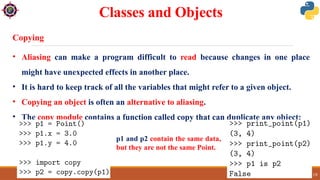
• Copying an object is often an alternative to aliasing.
• The copy module contains a function called copy that can duplicate any object:
p1 and p2 contain the same data,
but they are not the same Point.
29/09/2024 19
Classes and Objects
JAWAHARLAL NEHRU NEW COLLEGE OF ENGINEERING
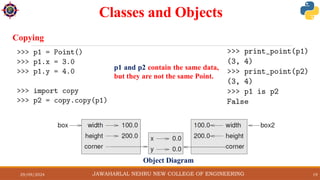
Copying
p1 and p2 contain the same data,
but they are not the same Point.
Object Diagram
29/09/2024 20
Classes and Objects
PES INSTITUTE OF TECHNOLOGY & MANAGEMENT
Copying
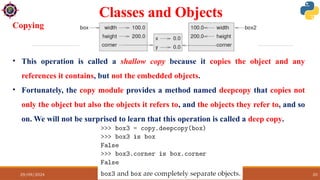
• This operation is called a shallow copy because it copies the object and any
references it contains, but not the embedded objects.
• Fortunately, the copy module provides a method named deepcopy that copies not
only the object but also the objects it refers to, and the objects they refer to, and so
on. We will not be surprised to learn that this operation is called a deep copy.
29/09/2024 21
Classes and Objects
JAWAHARLAL NEHRU NEW COLLEGE OF ENGINEERING
Debugging
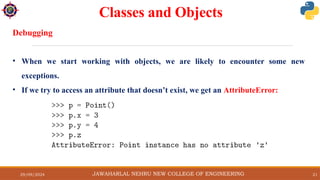
• When we start working with objects, we are likely to encounter some new
exceptions.
• If we try to access an attribute that doesn’t exist, we get an AttributeError:
29/09/2024 22
Classes and Objects
JAWAHARLAL NEHRU NEW COLLEGE OF ENGINEERING
Debugging
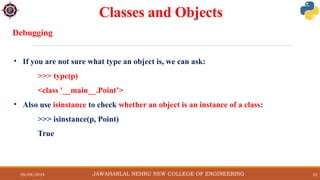
• If you are not sure what type an object is, we can ask:
>>> type(p)
<class '__main__.Point’>
• Also use isinstance to check whether an object is an instance of a class:
>>> isinstance(p, Point)
True
29/09/2024 23
Classes and Objects
JAWAHARLAL NEHRU NEW COLLEGE OF ENGINEERING
Debugging
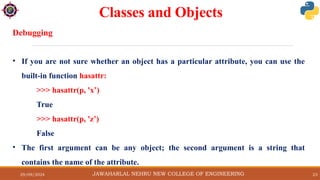
• If you are not sure whether an object has a particular attribute, you can use the
built-in function hasattr:
>>> hasattr(p, 'x’)
True
>>> hasattr(p, 'z’)
False
• The first argument can be any object; the second argument is a string that
contains the name of the attribute.
29/09/2024 24
Classes and Objects
JAWAHARLAL NEHRU NEW COLLEGE OF ENGINEERING
Debugging
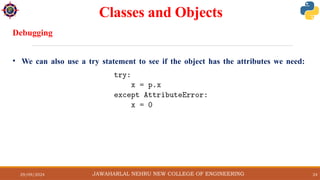
• We can also use a try statement to see if the object has the attributes we need:

Module - 5_TB 2_Chapter 15.pptx classes and objects

  • 1.
    29/09/2024 JAWAHARLAL NEHRUNEW COLLEGE OF ENGINEERING 1 Introduction to Python Programming BPLCK205B COURS E INS T RUCTOR: MRS. MANASA S M ASST. PROF., DEPT. OF ISE. JNNCE, SHIVAMOGGA MODULE- V
  • 2.
    29/09/2024 2 MODULE- VSYLLABUS CHAPTER - 15 • Classes and Objects • Programmer-defined types • Attributes • Rectangles • Instances as return values • Objects are mutable • Copying JAWAHARLAL NEHRU NEW COLLEGE OF ENGINEERING
  • 3.
    29/09/2024 3 CHAPTER -16 • Classes and Functions • Time • Pure functions • Modifiers • Prototyping versus Planning JAWAHARLAL NEHRU NEW COLLEGE OF ENGINEERING
  • 4.
    29/09/2024 4 CHAPTER -17 • Classes and Methods • Object-oriented features • Printing objects • Another example • A more complicated example • The init method • The __str__ method • Operator overloading • Type-based dispatch • Polymorphism • Interface and Implementation JAWAHARLAL NEHRU NEW COLLEGE OF ENGINEERING
  • 5.
    29/09/2024 5 Classes andObjects • Object-oriented programming (OOP) is a method of structuring a program by bundling related properties and behaviors into individual objects. • Objects are like the components of a system. • An object is any entity that has attributes and behaviors. For example, a parrot is an object. It has:  attributes - name, age, color, etc.  behavior - dancing, singing, etc. JAWAHARLAL NEHRU NEW COLLEGE OF ENGINEERING
  • 6.
    29/09/2024 6 Classes andObjects • We have used many of Python’s built-in types; now we are going to define a new type. • We will create a type called Point that represents a point in two-dimensional space. For example,  (0, 0) represents the origin  (x, y) represents the point x units to the right and y units up from the origin JAWAHARLAL NEHRU NEW COLLEGE OF ENGINEERING Programmer-defined types
  • 7.
    29/09/2024 7 Classes andObjects • There are several ways we might represent points in Python:  We could store the coordinates separately in two variables, x and y.  We could store the coordinates as elements in a list or tuple.  We could create a new type to represent points as objects. JAWAHARLAL NEHRU NEW COLLEGE OF ENGINEERING Programmer-defined types
  • 8.
    29/09/2024 8 Classes andObjects JAWAHARLAL NEHRU NEW COLLEGE OF ENGINEERING Programmer-defined types
  • 9.
    29/09/2024 9 Classes andObjects • A programmer-defined type is also called a class. A class definition looks like this: class Point: """Represents a point in 2-D space.""" • The header indicates that the new class is called Point. • The body is a Python documentation strings (docstring) that explains what the class is for. • We can define variables and methods inside a class definition. JAWAHARLAL NEHRU NEW COLLEGE OF ENGINEERING Programmer-defined types Object Diagram
  • 10.
    29/09/2024 10 Classes andObjects • Creating a new object is called instantiation, and the object is an instance of the class. • When we print an instance, Python tells us what class it belongs to and where it is stored in memory. JAWAHARLAL NEHRU NEW COLLEGE OF ENGINEERING Programmer-defined types Attributes • We can assign values to an instance using dot notation:  blank.x = 3.0  blank.y = 4.0
  • 11.
    29/09/2024 11 Classes andObjects • This syntax is similar to the syntax for selecting a variable from a module, such as math.pi or string.whitespace. • A state diagram that shows an object and its attributes is called an Object Diagram. • The variable blank refers to a Point object, which contains two attributes. Each attribute refers to a floating-point number. JAWAHARLAL NEHRU NEW COLLEGE OF ENGINEERING Programmer-defined types  blank.x = 3.0  blank.y = 4.0
  • 12.
    29/09/2024 12 Classes andObjects • The expression blank.x means, “Go to the object blank refers to and get the value of x.” • In the example, we assign that value to a variable named x. There is no conflict between the variable x and the attribute x. Programmer-defined types
  • 13.
    29/09/2024 13 Classes andObjects • The docstring lists the attributes: width and height are numbers; corner is a Point object that specifies the lower-left corner. • There are at least two possibilities: • We could specify one corner of the rectangle (or the center), the width, and the height. • We could specify two opposing corners. JAWAHARLAL NEHRU NEW COLLEGE OF ENGINEERING Rectangles
  • 14.
    29/09/2024 14 Classes andObjects • To represent a rectangle, you have to instantiate a Rectangle object and assign values to the attributes: JAWAHARLAL NEHRU NEW COLLEGE OF ENGINEERING Rectangles • The expression box.corner.x means, “Go to the object box refers to and select the attribute named corner; then go to that object and select the attribute named x.”
  • 15.
    29/09/2024 15 Classes andObjects • Functions can return instances. • For example, find_center takes a Rectangle as an argument and returns a Point that contains the coordinates of the center of the Rectangle: JAWAHARLAL NEHRU NEW COLLEGE OF ENGINEERING Instances as Return Values
  • 16.
    29/09/2024 16 Classes andObjects • We can change the state of an object by making an assignment to one of its attributes. • For example, to change the size of a rectangle without changing its position, we can modify the values of width and height: JAWAHARLAL NEHRU NEW COLLEGE OF ENGINEERING Objects are Mutable
  • 17.
    29/09/2024 17 Classes andObjects Objects are Mutable • We can also write functions that modify objects. • For example, grow_rectangle takes a Rectangle object and two numbers, dwidth and dheight, and adds the numbers to the width and height of the rectangle:
  • 18.
    29/09/2024 18 Classes andObjects Copying • Aliasing can make a program difficult to read because changes in one place might have unexpected effects in another place. • It is hard to keep track of all the variables that might refer to a given object. • Copying an object is often an alternative to aliasing. • The copy module contains a function called copy that can duplicate any object: p1 and p2 contain the same data, but they are not the same Point.
  • 19.
    29/09/2024 19 Classes andObjects JAWAHARLAL NEHRU NEW COLLEGE OF ENGINEERING Copying p1 and p2 contain the same data, but they are not the same Point. Object Diagram
  • 20.
    29/09/2024 20 Classes andObjects PES INSTITUTE OF TECHNOLOGY & MANAGEMENT Copying • This operation is called a shallow copy because it copies the object and any references it contains, but not the embedded objects. • Fortunately, the copy module provides a method named deepcopy that copies not only the object but also the objects it refers to, and the objects they refer to, and so on. We will not be surprised to learn that this operation is called a deep copy.
  • 21.
    29/09/2024 21 Classes andObjects JAWAHARLAL NEHRU NEW COLLEGE OF ENGINEERING Debugging • When we start working with objects, we are likely to encounter some new exceptions. • If we try to access an attribute that doesn’t exist, we get an AttributeError:
  • 22.
    29/09/2024 22 Classes andObjects JAWAHARLAL NEHRU NEW COLLEGE OF ENGINEERING Debugging • If you are not sure what type an object is, we can ask: >>> type(p) <class '__main__.Point’> • Also use isinstance to check whether an object is an instance of a class: >>> isinstance(p, Point) True
  • 23.
    29/09/2024 23 Classes andObjects JAWAHARLAL NEHRU NEW COLLEGE OF ENGINEERING Debugging • If you are not sure whether an object has a particular attribute, you can use the built-in function hasattr: >>> hasattr(p, 'x’) True >>> hasattr(p, 'z’) False • The first argument can be any object; the second argument is a string that contains the name of the attribute.
  • 24.
    29/09/2024 24 Classes andObjects JAWAHARLAL NEHRU NEW COLLEGE OF ENGINEERING Debugging • We can also use a try statement to see if the object has the attributes we need: