Python Objects
Charles Severance
Python for Everybody
www.py4e.com
Warning
• This lecture is very much about definitions and mechanics
for objects
• This lecture is a lot more about “how it works” and less
about “how you use it”
• You won’t get the entire picture until this is all looked at in
the context of a real problem
• So please suspend disbelief and learn technique for the next
40 or so slides…
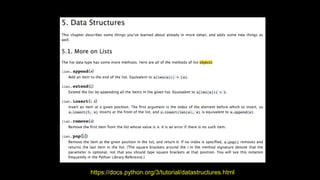
https://docs.python.org/3/tutorial/datastructures.html
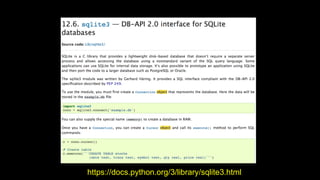
https://docs.python.org/3/library/sqlite3.html
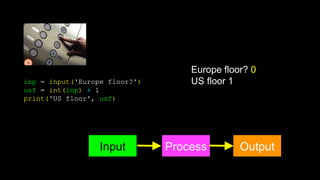
Lets Start with Programs
inp = input('Europe floor?')
usf = int(inp) + 1
print('US floor', usf)
Europe floor? 0
US floor 1
Process
Input Output
Object Oriented
• A program is made up of many cooperating objects
• Instead of being the “whole program” - each object is a
little “island” within the program and cooperatively
working with other objects
• A program is made up of one or more objects working
together - objects make use of each other’s
capabilities
Object
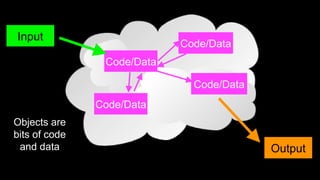
• An Object is a bit of self-contained Code and Data
• A key aspect of the Object approach is to break the
problem into smaller understandable parts (divide and
conquer)
• Objects have boundaries that allow us to ignore un-needed
detail
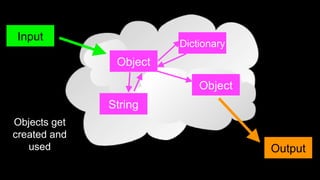
• We have been using objects all along: String Objects,
Integer Objects, Dictionary Objects, List Objects...
Object
Input
Output
String
Object
Dictionary
Objects get
created and
used
Code/Data
Input
Output
Code/Data
Code/Data
Code/Data
Objects are
bits of code
and data
Code/Data
Input
Output
Code/Data
Code/Data
Code/Data
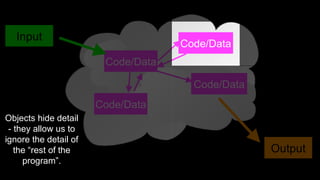
Objects hide detail
- they allow us to
ignore the detail of
the “rest of the
program”.
Code/Data
Input
Output
Code/Data
Code/Data
Code/Data
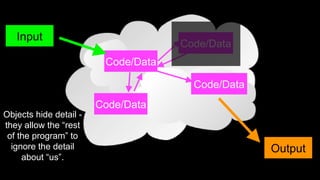
Objects hide detail -
they allow the “rest
of the program” to
ignore the detail
about “us”.
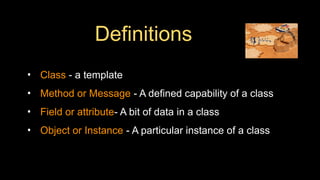
Definitions
• Class - a template
• Method or Message - A defined capability of a class
• Field or attribute- A bit of data in a class
• Object or Instance - A particular instance of a class
Terminology: Class
http://en.wikipedia.org/wiki/Object-oriented_programming
Defines the abstract characteristics of a thing (object), including the
thing's characteristics (its attributes, fields or properties) and the
thing's behaviors (the things it can do, or methods, operations or
features). One might say that a class is a blueprint or factory that
describes the nature of something. For example, the class Dog would
consist of traits shared by all dogs, such as breed and fur color
(characteristics), and the ability to bark and sit (behaviors).
Terminology: Instance
http://en.wikipedia.org/wiki/Object-oriented_programming
One can have an instance of a class or a particular object.
The instance is the actual object created at runtime. In
programmer jargon, the Lassie object is an instance of the
Dog class. The set of values of the attributes of a particular
object is called its state. The object consists of state and the
behavior that's defined in the object's class.
Object and Instance are often used interchangeably.
Terminology: Method
An object's abilities. In language, methods are verbs. Lassie, being a
Dog, has the ability to bark. So bark() is one of Lassie's methods. She
may have other methods as well, for example sit() or eat() or walk() or
save_timmy(). Within the program, using a method usually affects
only one particular object; all Dogs can bark, but you need only one
particular dog to do the barking
Method and Message are often used interchangeably.
http://en.wikipedia.org/wiki/Object-oriented_programming
Some Python Objects
>>> x = 'abc'
>>> type(x)
<class 'str'>
>>> type(2.5)
<class 'float'>
>>> type(2)
<class 'int'>
>>> y = list()
>>> type(y)
<class 'list'>
>>> z = dict()
>>> type(z)
<class 'dict'>
>>> dir(x)
[ … 'capitalize', 'casefold', 'center', 'count',
'encode', 'endswith', 'expandtabs', 'find',
'format', … 'lower', 'lstrip', 'maketrans',
'partition', 'replace', 'rfind', 'rindex', 'rjust',
'rpartition', 'rsplit', 'rstrip', 'split',
'splitlines', 'startswith', 'strip', 'swapcase',
'title', 'translate', 'upper', 'zfill']
>>> dir(y)
[… 'append', 'clear', 'copy', 'count', 'extend',
'index', 'insert', 'pop', 'remove', 'reverse',
'sort']
>>> dir(z)
[…, 'clear', 'copy', 'fromkeys', 'get', 'items',
'keys', 'pop', 'popitem', 'setdefault', 'update',
'values']
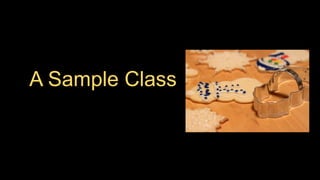
A Sample Class
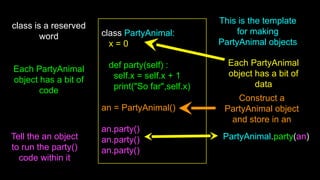
class PartyAnimal:
x = 0
def party(self) :
self.x = self.x + 1
print("So far",self.x)
an = PartyAnimal()
an.party()
an.party()
an.party()
This is the template
for making
PartyAnimal objects
class is a reserved
word
Each PartyAnimal
object has a bit of
data
Each PartyAnimal
object has a bit of
code
Construct a
PartyAnimal object
and store in an
Tell the an object
to run the party()
code within it
PartyAnimal.party(an)
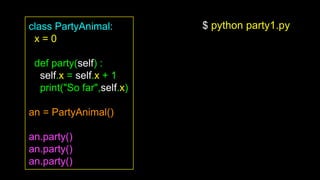
class PartyAnimal:
x = 0
def party(self) :
self.x = self.x + 1
print("So far",self.x)
an = PartyAnimal()
an.party()
an.party()
an.party()
$ python party1.py
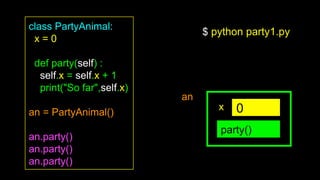
class PartyAnimal:
x = 0
def party(self) :
self.x = self.x + 1
print("So far",self.x)
an = PartyAnimal()
an.party()
an.party()
an.party()
0
party()
an
x
$ python party1.py
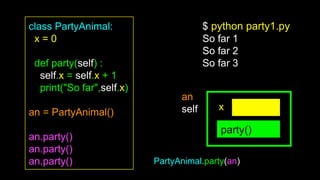
class PartyAnimal:
x = 0
def party(self) :
self.x = self.x + 1
print("So far",self.x)
an = PartyAnimal()
an.party()
an.party()
an.party()
party()
an
self x
$ python party1.py
So far 1
So far 2
So far 3
PartyAnimal.party(an)
Playing with dir() and type()
A Nerdy Way to Find Capabilities
• The dir() command lists
capabilities
• Ignore the ones with underscores
- these are used by Python itself
• The rest are real operations that
the object can perform
• It is like type() - it tells us
something *about* a variable
>>> y = list()
>>> type(y)
<class 'list'>
>>> dir(y)
['__add__', '__class__',
'__contains__', '__delattr__',
'__delitem__', '__delslice__',
'__doc__', … '__setitem__',
'__setslice__', '__str__',
'append', 'clear', 'copy',
'count', 'extend', 'index',
'insert', 'pop', 'remove',
'reverse', 'sort']
>>>
class PartyAnimal:
x = 0
def party(self) :
self.x = self.x + 1
print("So far",self.x)
an = PartyAnimal()
print("Type", type(an))
print("Dir ", dir(an))
$ python party3.py
Type <class '__main__.PartyAnimal'>
Dir ['__class__', ... 'party', 'x']
We can use dir() to find
the “capabilities” of our
newly created class.
Try dir() with a String
>>> x = 'Hello there'
>>> dir(x)
['__add__', '__class__', '__contains__', '__delattr__',
'__doc__', '__eq__', '__ge__', '__getattribute__',
'__getitem__', '__getnewargs__', '__getslice__', '__gt__',
'__hash__', '__init__', '__le__', '__len__', '__lt__',
'__repr__', '__rmod__', '__rmul__', '__setattr__', '__str__',
'capitalize', 'center', 'count', 'decode', 'encode', 'endswith',
'expandtabs', 'find', 'index', 'isalnum', 'isalpha', 'isdigit',
'islower', 'isspace', 'istitle', 'isupper', 'join', 'ljust',
'lower', 'lstrip', 'partition', 'replace', 'rfind', 'rindex',
'rjust', 'rpartition', 'rsplit', 'rstrip', 'split',
'splitlines', 'startswith', 'strip', 'swapcase', 'title',
'translate', 'upper', 'zfill']
Object Lifecycle
http://en.wikipedia.org/wiki/Constructor_(computer_science)
Object Lifecycle
• Objects are created, used, and discarded
• We have special blocks of code (methods) that get called
- At the moment of creation (constructor)
- At the moment of destruction (destructor)
• Constructors are used a lot
• Destructors are seldom used
Constructor
The primary purpose of the constructor is to set up some
instance variables to have the proper initial values when
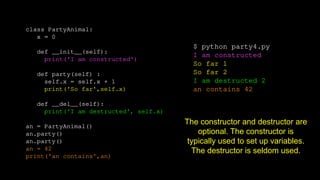
the object is created
class PartyAnimal:
x = 0
def __init__(self):
print('I am constructed')
def party(self) :
self.x = self.x + 1
print('So far',self.x)
def __del__(self):
print('I am destructed', self.x)
an = PartyAnimal()
an.party()
an.party()
an = 42
print('an contains',an)
$ python party4.py
I am constructed
So far 1
So far 2
I am destructed 2
an contains 42
The constructor and destructor are
optional. The constructor is
typically used to set up variables.
The destructor is seldom used.
Constructor
In object oriented programming, a constructor in a class
is a special block of statements called when an object is
created
http://en.wikipedia.org/wiki/Constructor_(computer_science)
Many Instances
• We can create lots of objects - the class is the template
for the object
• We can store each distinct object in its own variable
• We call this having multiple instances of the same class
• Each instance has its own copy of the instance variables
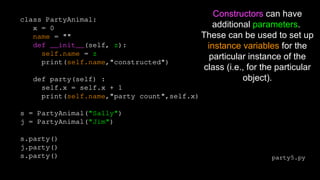
Constructors can have
additional parameters.
These can be used to set up
instance variables for the
particular instance of the
class (i.e., for the particular
object).
party5.py
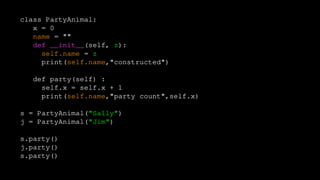
class PartyAnimal:
x = 0
name = ""
def __init__(self, z):
self.name = z
print(self.name,"constructed")
def party(self) :
self.x = self.x + 1
print(self.name,"party count",self.x)
s = PartyAnimal("Sally")
j = PartyAnimal("Jim")
s.party()
j.party()
s.party()
class PartyAnimal:
x = 0
name = ""
def __init__(self, z):
self.name = z
print(self.name,"constructed")
def party(self) :
self.x = self.x + 1
print(self.name,"party count",self.x)
s = PartyAnimal("Sally")
j = PartyAnimal("Jim")
s.party()
j.party()
s.party()
class PartyAnimal:
x = 0
name = ""
def __init__(self, z):
self.name = z
print(self.name,"constructed")
def party(self) :
self.x = self.x + 1
print(self.name,"party count",self.x)
s = PartyAnimal("Sally")
j = PartyAnimal("Jim")
s.party()
j.party()
s.party()
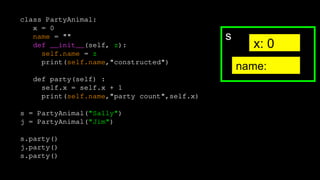
s
x: 0
name:
class PartyAnimal:
x = 0
name = ""
def __init__(self, z):
self.name = z
print(self.name,"constructed")
def party(self) :
self.x = self.x + 1
print(self.name,"party count",self.x)
s = PartyAnimal("Sally")
j = PartyAnimal("Jim")
s.party()
j.party()
s.party()
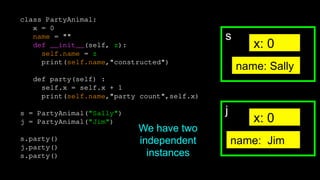
s
x: 0
name: Sally
j
x: 0
name: Jim
We have two
independent
instances
class PartyAnimal:
x = 0
name = ""
def __init__(self, z):
self.name = z
print(self.name,"constructed")
def party(self) :
self.x = self.x + 1
print(self.name,"party count",self.x)
s = PartyAnimal("Sally")
j = PartyAnimal("Jim")
s.party()
j.party()
s.party()
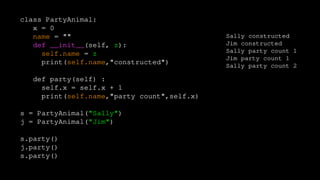
Sally constructed
Jim constructed
Sally party count 1
Jim party count 1
Sally party count 2
Inheritance
http://www.ibiblio.org/g2swap/byteofpython/read/inheritance.html
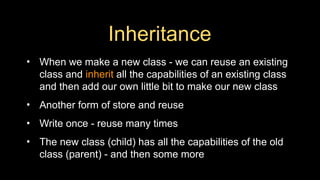
Inheritance
• When we make a new class - we can reuse an existing
class and inherit all the capabilities of an existing class
and then add our own little bit to make our new class
• Another form of store and reuse
• Write once - reuse many times
• The new class (child) has all the capabilities of the old
class (parent) - and then some more
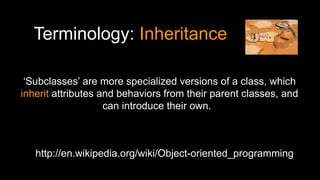
Terminology: Inheritance
http://en.wikipedia.org/wiki/Object-oriented_programming
‘Subclasses’ are more specialized versions of a class, which
inherit attributes and behaviors from their parent classes, and
can introduce their own.
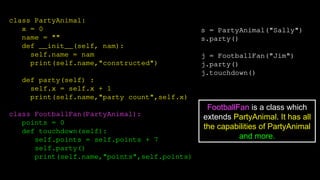
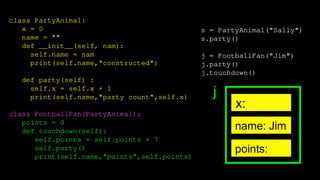
class PartyAnimal:
x = 0
name = ""
def __init__(self, nam):
self.name = nam
print(self.name,"constructed")
def party(self) :
self.x = self.x + 1
print(self.name,"party count",self.x)
class FootballFan(PartyAnimal):
points = 0
def touchdown(self):
self.points = self.points + 7
self.party()
print(self.name,"points",self.points)
s = PartyAnimal("Sally")
s.party()
j = FootballFan("Jim")
j.party()
j.touchdown()
FootballFan is a class which
extends PartyAnimal. It has all
the capabilities of PartyAnimal
and more.
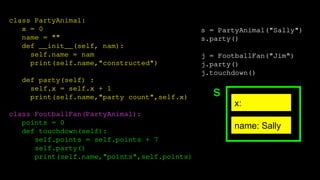
class PartyAnimal:
x = 0
name = ""
def __init__(self, nam):
self.name = nam
print(self.name,"constructed")
def party(self) :
self.x = self.x + 1
print(self.name,"party count",self.x)
class FootballFan(PartyAnimal):
points = 0
def touchdown(self):
self.points = self.points + 7
self.party()
print(self.name,"points",self.points)
s = PartyAnimal("Sally")
s.party()
j = FootballFan("Jim")
j.party()
j.touchdown()
x:
name: Sally
s
class PartyAnimal:
x = 0
name = ""
def __init__(self, nam):
self.name = nam
print(self.name,"constructed")
def party(self) :
self.x = self.x + 1
print(self.name,"party count",self.x)
class FootballFan(PartyAnimal):
points = 0
def touchdown(self):
self.points = self.points + 7
self.party()
print(self.name,"points",self.points)
s = PartyAnimal("Sally")
s.party()
j = FootballFan("Jim")
j.party()
j.touchdown()
x:
name: Jim
points:
j
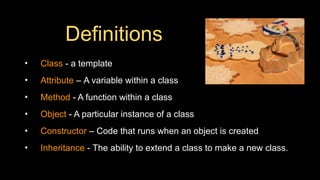
Definitions
• Class - a template
• Attribute – A variable within a class
• Method - A function within a class
• Object - A particular instance of a class
• Constructor – Code that runs when an object is created
• Inheritance - The ability to extend a class to make a new class.
Summary
• Object Oriented programming is a very structured
approach to code reuse
• We can group data and functionality together and create
many independent instances of a class
Acknowledgements / Contributions
Thes slide are Copyright 2010- Charles R. Severance (www.dr-
chuck.com) of the University of Michigan School of Information
and made available under a Creative Commons Attribution 4.0
License. Please maintain this last slide in all copies of the
document to comply with the attribution requirements of the
license. If you make a change, feel free to add your name and
organization to the list of contributors on this page as you
republish the materials.
Initial Development: Charles Severance, University of Michigan
School of Information
… Insert new Contributors here
...
Additional Source Information
• Snowman Cookie Cutter" by Didriks is licensed under CC BY
https://www.flickr.com/photos/dinnerseries/23570475099
• Photo from the television program Lassie. Lassie watches as Jeff (Tommy Rettig) works on his bike is Public
Domain
https://en.wikipedia.org/wiki/Lassie#/media/File:Lassie_and_Tommy_Rettig_1956.JPG

Slide - FPT University - PFP191 - Chapter 11 - Objects

  • 1.
    Python Objects Charles Severance Pythonfor Everybody www.py4e.com
  • 2.
    Warning • This lectureis very much about definitions and mechanics for objects • This lecture is a lot more about “how it works” and less about “how you use it” • You won’t get the entire picture until this is all looked at in the context of a real problem • So please suspend disbelief and learn technique for the next 40 or so slides…
  • 3.
  • 4.
  • 5.
  • 6.
    inp = input('Europefloor?') usf = int(inp) + 1 print('US floor', usf) Europe floor? 0 US floor 1 Process Input Output
  • 7.
    Object Oriented • Aprogram is made up of many cooperating objects • Instead of being the “whole program” - each object is a little “island” within the program and cooperatively working with other objects • A program is made up of one or more objects working together - objects make use of each other’s capabilities
  • 8.
    Object • An Objectis a bit of self-contained Code and Data • A key aspect of the Object approach is to break the problem into smaller understandable parts (divide and conquer) • Objects have boundaries that allow us to ignore un-needed detail • We have been using objects all along: String Objects, Integer Objects, Dictionary Objects, List Objects...
  • 9.
  • 10.
  • 11.
    Code/Data Input Output Code/Data Code/Data Code/Data Objects hide detail -they allow us to ignore the detail of the “rest of the program”.
  • 12.
    Code/Data Input Output Code/Data Code/Data Code/Data Objects hide detail- they allow the “rest of the program” to ignore the detail about “us”.
  • 13.
    Definitions • Class -a template • Method or Message - A defined capability of a class • Field or attribute- A bit of data in a class • Object or Instance - A particular instance of a class
  • 14.
    Terminology: Class http://en.wikipedia.org/wiki/Object-oriented_programming Defines theabstract characteristics of a thing (object), including the thing's characteristics (its attributes, fields or properties) and the thing's behaviors (the things it can do, or methods, operations or features). One might say that a class is a blueprint or factory that describes the nature of something. For example, the class Dog would consist of traits shared by all dogs, such as breed and fur color (characteristics), and the ability to bark and sit (behaviors).
  • 15.
    Terminology: Instance http://en.wikipedia.org/wiki/Object-oriented_programming One canhave an instance of a class or a particular object. The instance is the actual object created at runtime. In programmer jargon, the Lassie object is an instance of the Dog class. The set of values of the attributes of a particular object is called its state. The object consists of state and the behavior that's defined in the object's class. Object and Instance are often used interchangeably.
  • 16.
    Terminology: Method An object'sabilities. In language, methods are verbs. Lassie, being a Dog, has the ability to bark. So bark() is one of Lassie's methods. She may have other methods as well, for example sit() or eat() or walk() or save_timmy(). Within the program, using a method usually affects only one particular object; all Dogs can bark, but you need only one particular dog to do the barking Method and Message are often used interchangeably. http://en.wikipedia.org/wiki/Object-oriented_programming
  • 17.
    Some Python Objects >>>x = 'abc' >>> type(x) <class 'str'> >>> type(2.5) <class 'float'> >>> type(2) <class 'int'> >>> y = list() >>> type(y) <class 'list'> >>> z = dict() >>> type(z) <class 'dict'> >>> dir(x) [ … 'capitalize', 'casefold', 'center', 'count', 'encode', 'endswith', 'expandtabs', 'find', 'format', … 'lower', 'lstrip', 'maketrans', 'partition', 'replace', 'rfind', 'rindex', 'rjust', 'rpartition', 'rsplit', 'rstrip', 'split', 'splitlines', 'startswith', 'strip', 'swapcase', 'title', 'translate', 'upper', 'zfill'] >>> dir(y) [… 'append', 'clear', 'copy', 'count', 'extend', 'index', 'insert', 'pop', 'remove', 'reverse', 'sort'] >>> dir(z) […, 'clear', 'copy', 'fromkeys', 'get', 'items', 'keys', 'pop', 'popitem', 'setdefault', 'update', 'values']
  • 18.
  • 19.
    class PartyAnimal: x =0 def party(self) : self.x = self.x + 1 print("So far",self.x) an = PartyAnimal() an.party() an.party() an.party() This is the template for making PartyAnimal objects class is a reserved word Each PartyAnimal object has a bit of data Each PartyAnimal object has a bit of code Construct a PartyAnimal object and store in an Tell the an object to run the party() code within it PartyAnimal.party(an)
  • 20.
    class PartyAnimal: x =0 def party(self) : self.x = self.x + 1 print("So far",self.x) an = PartyAnimal() an.party() an.party() an.party() $ python party1.py
  • 21.
    class PartyAnimal: x =0 def party(self) : self.x = self.x + 1 print("So far",self.x) an = PartyAnimal() an.party() an.party() an.party() 0 party() an x $ python party1.py
  • 22.
    class PartyAnimal: x =0 def party(self) : self.x = self.x + 1 print("So far",self.x) an = PartyAnimal() an.party() an.party() an.party() party() an self x $ python party1.py So far 1 So far 2 So far 3 PartyAnimal.party(an)
  • 23.
  • 24.
    A Nerdy Wayto Find Capabilities • The dir() command lists capabilities • Ignore the ones with underscores - these are used by Python itself • The rest are real operations that the object can perform • It is like type() - it tells us something *about* a variable >>> y = list() >>> type(y) <class 'list'> >>> dir(y) ['__add__', '__class__', '__contains__', '__delattr__', '__delitem__', '__delslice__', '__doc__', … '__setitem__', '__setslice__', '__str__', 'append', 'clear', 'copy', 'count', 'extend', 'index', 'insert', 'pop', 'remove', 'reverse', 'sort'] >>>
  • 25.
    class PartyAnimal: x =0 def party(self) : self.x = self.x + 1 print("So far",self.x) an = PartyAnimal() print("Type", type(an)) print("Dir ", dir(an)) $ python party3.py Type <class '__main__.PartyAnimal'> Dir ['__class__', ... 'party', 'x'] We can use dir() to find the “capabilities” of our newly created class.
  • 26.
    Try dir() witha String >>> x = 'Hello there' >>> dir(x) ['__add__', '__class__', '__contains__', '__delattr__', '__doc__', '__eq__', '__ge__', '__getattribute__', '__getitem__', '__getnewargs__', '__getslice__', '__gt__', '__hash__', '__init__', '__le__', '__len__', '__lt__', '__repr__', '__rmod__', '__rmul__', '__setattr__', '__str__', 'capitalize', 'center', 'count', 'decode', 'encode', 'endswith', 'expandtabs', 'find', 'index', 'isalnum', 'isalpha', 'isdigit', 'islower', 'isspace', 'istitle', 'isupper', 'join', 'ljust', 'lower', 'lstrip', 'partition', 'replace', 'rfind', 'rindex', 'rjust', 'rpartition', 'rsplit', 'rstrip', 'split', 'splitlines', 'startswith', 'strip', 'swapcase', 'title', 'translate', 'upper', 'zfill']
  • 27.
  • 28.
    Object Lifecycle • Objectsare created, used, and discarded • We have special blocks of code (methods) that get called - At the moment of creation (constructor) - At the moment of destruction (destructor) • Constructors are used a lot • Destructors are seldom used
  • 29.
    Constructor The primary purposeof the constructor is to set up some instance variables to have the proper initial values when the object is created
  • 30.
    class PartyAnimal: x =0 def __init__(self): print('I am constructed') def party(self) : self.x = self.x + 1 print('So far',self.x) def __del__(self): print('I am destructed', self.x) an = PartyAnimal() an.party() an.party() an = 42 print('an contains',an) $ python party4.py I am constructed So far 1 So far 2 I am destructed 2 an contains 42 The constructor and destructor are optional. The constructor is typically used to set up variables. The destructor is seldom used.
  • 31.
    Constructor In object orientedprogramming, a constructor in a class is a special block of statements called when an object is created http://en.wikipedia.org/wiki/Constructor_(computer_science)
  • 32.
    Many Instances • Wecan create lots of objects - the class is the template for the object • We can store each distinct object in its own variable • We call this having multiple instances of the same class • Each instance has its own copy of the instance variables
  • 33.
    Constructors can have additionalparameters. These can be used to set up instance variables for the particular instance of the class (i.e., for the particular object). party5.py class PartyAnimal: x = 0 name = "" def __init__(self, z): self.name = z print(self.name,"constructed") def party(self) : self.x = self.x + 1 print(self.name,"party count",self.x) s = PartyAnimal("Sally") j = PartyAnimal("Jim") s.party() j.party() s.party()
  • 34.
    class PartyAnimal: x =0 name = "" def __init__(self, z): self.name = z print(self.name,"constructed") def party(self) : self.x = self.x + 1 print(self.name,"party count",self.x) s = PartyAnimal("Sally") j = PartyAnimal("Jim") s.party() j.party() s.party()
  • 35.
    class PartyAnimal: x =0 name = "" def __init__(self, z): self.name = z print(self.name,"constructed") def party(self) : self.x = self.x + 1 print(self.name,"party count",self.x) s = PartyAnimal("Sally") j = PartyAnimal("Jim") s.party() j.party() s.party() s x: 0 name:
  • 36.
    class PartyAnimal: x =0 name = "" def __init__(self, z): self.name = z print(self.name,"constructed") def party(self) : self.x = self.x + 1 print(self.name,"party count",self.x) s = PartyAnimal("Sally") j = PartyAnimal("Jim") s.party() j.party() s.party() s x: 0 name: Sally j x: 0 name: Jim We have two independent instances
  • 37.
    class PartyAnimal: x =0 name = "" def __init__(self, z): self.name = z print(self.name,"constructed") def party(self) : self.x = self.x + 1 print(self.name,"party count",self.x) s = PartyAnimal("Sally") j = PartyAnimal("Jim") s.party() j.party() s.party() Sally constructed Jim constructed Sally party count 1 Jim party count 1 Sally party count 2
  • 38.
  • 39.
    Inheritance • When wemake a new class - we can reuse an existing class and inherit all the capabilities of an existing class and then add our own little bit to make our new class • Another form of store and reuse • Write once - reuse many times • The new class (child) has all the capabilities of the old class (parent) - and then some more
  • 40.
    Terminology: Inheritance http://en.wikipedia.org/wiki/Object-oriented_programming ‘Subclasses’ aremore specialized versions of a class, which inherit attributes and behaviors from their parent classes, and can introduce their own.
  • 41.
    class PartyAnimal: x =0 name = "" def __init__(self, nam): self.name = nam print(self.name,"constructed") def party(self) : self.x = self.x + 1 print(self.name,"party count",self.x) class FootballFan(PartyAnimal): points = 0 def touchdown(self): self.points = self.points + 7 self.party() print(self.name,"points",self.points) s = PartyAnimal("Sally") s.party() j = FootballFan("Jim") j.party() j.touchdown() FootballFan is a class which extends PartyAnimal. It has all the capabilities of PartyAnimal and more.
  • 42.
    class PartyAnimal: x =0 name = "" def __init__(self, nam): self.name = nam print(self.name,"constructed") def party(self) : self.x = self.x + 1 print(self.name,"party count",self.x) class FootballFan(PartyAnimal): points = 0 def touchdown(self): self.points = self.points + 7 self.party() print(self.name,"points",self.points) s = PartyAnimal("Sally") s.party() j = FootballFan("Jim") j.party() j.touchdown() x: name: Sally s
  • 43.
    class PartyAnimal: x =0 name = "" def __init__(self, nam): self.name = nam print(self.name,"constructed") def party(self) : self.x = self.x + 1 print(self.name,"party count",self.x) class FootballFan(PartyAnimal): points = 0 def touchdown(self): self.points = self.points + 7 self.party() print(self.name,"points",self.points) s = PartyAnimal("Sally") s.party() j = FootballFan("Jim") j.party() j.touchdown() x: name: Jim points: j
  • 44.
    Definitions • Class -a template • Attribute – A variable within a class • Method - A function within a class • Object - A particular instance of a class • Constructor – Code that runs when an object is created • Inheritance - The ability to extend a class to make a new class.
  • 45.
    Summary • Object Orientedprogramming is a very structured approach to code reuse • We can group data and functionality together and create many independent instances of a class
  • 46.
    Acknowledgements / Contributions Thesslide are Copyright 2010- Charles R. Severance (www.dr- chuck.com) of the University of Michigan School of Information and made available under a Creative Commons Attribution 4.0 License. Please maintain this last slide in all copies of the document to comply with the attribution requirements of the license. If you make a change, feel free to add your name and organization to the list of contributors on this page as you republish the materials. Initial Development: Charles Severance, University of Michigan School of Information … Insert new Contributors here ...
  • 47.
    Additional Source Information •Snowman Cookie Cutter" by Didriks is licensed under CC BY https://www.flickr.com/photos/dinnerseries/23570475099 • Photo from the television program Lassie. Lassie watches as Jeff (Tommy Rettig) works on his bike is Public Domain https://en.wikipedia.org/wiki/Lassie#/media/File:Lassie_and_Tommy_Rettig_1956.JPG

Editor's Notes

  • #1 Note from Chuck. If you are using these materials, you can remove the UM logo and replace it with your own, but please retain the CC-BY logo on the first page as well as the acknowledgement page(s) at the end.