Programming Structure in
MATLAB
MODULE FIVE
Control Structures
Introduction
• Control structures are essential in directing the flow
of execution in a program.
• Are fundamental building blocks of any programming
language
• Facilitate logic implementation and task repetition as
needed
• They allow one to;
make decisions (conditional execution)
repeat code (loops)
select between different sections of code based
on the program state.
Types and Applications
1. Conditional Statements (if, elseif, else):
Execute code based on logical conditions.
2. Switch Statements (switch, case, otherwise):
Executing one block of code among many alternatives
based on the value of a variable or expression.
3. Loops
i. for loop: Repeats a block of code a specified
number of times, iterating over a range of values
ii. while loop: Repeats a block of code as long as a
condition remains true.
4. Control Flow Modifiers
i. break: Exits the loop prematurely when a
condition is met.
5. continue: Skips the remaining code in the
current iteration of a loop and moves to the
Decision Statements
Nested Decision Statements
For Loops
While Loops
Introduction to Programming paradigms
Overview
• Programming paradigms define the ways in which code
is structured, organized, and executed
• Each programming paradigm has its advantages and is
suitable for particular types of tasks.
• Different paradigms have evolved over time to address;
 Various types of problems
 Provide different levels of control
 Modularity and efficiency
• Understanding these types of programming is essential
for selecting the right approach for a problem or
project.
Programming Paradigms Applications
• Unstructured programming is simple but
unsuitable for large programs
• Modular programming and Object-Oriented
Programs enhance reusability and scalability.
• Recursive programming simplifies code for
problems with a self-similar structure
• Dynamic programming optimizes recursive
solutions for more complex problems.
• Functional and declarative programming focus on
expressing the logic of a problem
• Event-driven programming responds to real-time
events.
Types of Programming
Types of Functions
Types of Functions
Recursive Programming
Introduction to Recursion
• A technique where a function calls itself in order to
solve smaller instances of the same problem.
• Each call typically works on a smaller subset of the
original problem
• Terminates when a base case is reached, where the
solution is directly known
• understanding its types and applications can
greatly enhance problem-solving capabilities in
computational tasks.
Characteristics of Recursive Functions
1. Base Case: A condition under which the recursion
stops. Without a base case, the recursion would lead
to an infinite loop.
2. Recursive Case: This is where the function calls itself
with modified arguments, generally simplifying the
problem in each step.
3. Stack Memory Usage: Recursive functions use stack
memory to remember the function calls, leading to a
chain of calls until the base case is met. This can
sometimes lead to a stack overflow if recursion goes
too deep without a base case.
Applications of Recursion
1. Mathematical Problems: Solving problems like
factorial, Fibonacci, Ackermann function
2. Data Structures: Recursive traversals of data
structures like trees and graphs (e.g., depth-first
search, in-order, pre-order, and post-order
traversals).
3. Divide and Conquer Algorithms: Sorting
algorithms like QuickSort and MergeSort utilize
recursion.
4. Dynamic Programming: Recursive solutions can
be optimized using memoization in dynamic
programming.
5. Combinatorics: Generating combinations and
Merits of Recursion
1. Modularity and Reusability: Solutions are often more elegant,
easier to read, maintain and reuse
2. Problem Breakdown: Natural way to model processes involving
repetition or self-similarity.
3. Real-Time Decision Making: Enhances system responsiveness,
accuracy, real-time feedback and adjustments based on changing
inputs
Demerits of Recursion
1. Performance: slower due to the overhead of multiple function
calls and the use of stack memory.
2. Stack Overflow: Too deep recursion can lead to stack overflow if
the base case is not reached quickly or for large inputs.
3. Complexity in Debugging: multi-layered function calls can
sometimes be harder to debug
Types of Recursive Functions
Dynamic Programming
Introduction
• An optimization technique used to solve
complex problems by breaking them down into
simpler subproblems
• Stores the results of these subproblems to avoid
redundant computations.
• Optimizes recursion through storage and reuse
results of subproblems thus avoiding
redundant computations.
• Is effective when a problem exhibits An Optimal
Substructure and Overlapping Subproblems
1. Optimal Substructure: A problem has an optimal substructure
if its solution can be obtained by solving subproblems and
combining their solutions.
This property allows us to recursively define a problem in terms
of its subproblems.
2. Overlapping Subproblems: Many DP problems involve solving
the same subproblem multiple times.
Instead of recalculating the result every time, dynamic
programming stores these results to avoid redundant
calculations.
3. Implemented through either Memoization (Top-down
approach) or Tabulation (Bottom-up approach)
Key Concepts
Memoization (Top-Down Dynamic Programming)
• Memoization involves solving the problem recursively and storing the result of each subproblem in a cache (a data
structure like a table, dictionary, or array).
• This technique starts with the original problem and works its way down to smaller subproblems.
• Once a subproblem is solved, its result is stored to be reused in the future.
Steps in Memoization
1. Start with the original problem and solve it
recursively.
2. Check if the current subproblem has been
solved before (cached).
3. If the result is cached, return it.
4. If not, compute the result, store it in the
cache, and return the result.
Advantages: Ideal for problems with large inputs where only a few
subproblems are necessary.
Only computes the necessary subproblems, leading to potential
savings in space and time when only a portion of the DP table is
needed.
Disadvantages: Recursive nature may cause high memory usage
(stack space) due to deep recursion.
Can be slower due to the overhead of recursive function calls.
Tabulation (Down-Up Dynamic Programming)
• Tabulation is an iterative method where the problem is solved by first solving all the smaller subproblems and storing
their results in a table.
• The solution to the original problem is built by using these precomputed results.
Steps in Tabulation
1. Start by solving the smallest subproblem.
2. Build a table where each entry corresponds
to a subproblem.
3. Use the results of previously solved
subproblems to solve the larger
subproblems.
4. Continue this process until the original
problem is solved.
Advantages:
• Efficient in both time and space, as it avoids recursion.
• More intuitive for problems where all subproblems need to be
computed.
Disadvantages:
• Requires solving all subproblems, even those that may not be
necessary.
• Larger memory footprint for storing the table, even if some entries
are unused.
Approaches Comparison and DP Applications
Example Applications
1. Fibonacci Numbers: A sequence where each number is the sum of the two preceding ones, starting with 0 and 1.
2. 0/1 Knapsack Problem: Given items with specific weights and values, the goal is to maximize the total value without
exceeding a weight limit.
3. Longest Common Subsequence (LCS): Finds the longest sequence common to two strings.
4. Travelling Salesman Problem (TSP): Finds the shortest route that visits all cities exactly once and returns to the
starting point.
Approaches Syntax
Object-Oriented Programming (OOP)
Overview
• A programming paradigm based on the concept
of “objects,” which can contain data in the form
of fields (attributes or properties) and code in
the form of procedures (methods or functions).
• Provides a framework for structuring code in a
way that enhances reusability, scalability, and
clarity.
• Allows programmers to structure software as a
collection of objects that model real-world
entities and their interactions
Key Concepts
• Classes and Objects: Classes are templates, and objects
are instances.
• Encapsulation: Data and methods are bundled in classes;
access is controlled.
• Inheritance: Classes can inherit properties and methods
from other classes.
• Polymorphism: Methods can be overridden in subclasses
to provide specialized behavior.
• Abstraction: Abstract classes define interfaces for
subclasses without implementing methods.
• Handle vs. Value Classes: Handle classes are passed by
reference, while value classes are passed by value
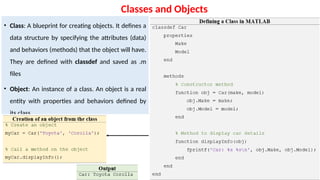
Classes and Objects
• Class: A blueprint for creating objects. It defines a
data structure by specifying the attributes (data)
and behaviors (methods) that the object will have.
They are defined with classdef and saved as .m
files
• Object: An instance of a class. An object is a real
entity with properties and behaviors defined by
its class.
Encapsulation
• Bundling of data (attributes) and methods that operate on the data into a
single unit, or class.
• It restricts access to the inner workings of the object and only exposes
selected methods to interact with the object.
• This promotes data hiding and prevents unauthorized access.
Access Modifiers for Properties or methods:
 Public: Accessible from anywhere.
 Private: Accessible only within the class.
 Protected: Accessible within the class and its subclasses.
Inheritance
• A mechanism by which one class (child or subclass) inherits
properties and methods from another class (parent or superclass).
• This promotes code reuse and establishes a hierarchical relationship
between classes..
Types of Inheritance:
 Single Inheritance: A class inherits from one superclass.
 Multiple Inheritance: A class inherits from more than one superclass.
 Multilevel Inheritance: A class inherits from a class, which is itself a
subclass.
 Hierarchical Inheritance: Multiple subclasses inherit from the same
superclass.
 Hybrid Inheritance: A combination of two or more types of
inheritance.
Polymorphism
• The ability to define a method in the child class that has the same
name as a method in the parent class but behaves differently.
• Allows methods to be defined in multiple forms.
• Inherited methods from parent classes can be overridden or
overloaded to provide specific implementations in child classes.
Polymorphism can be achieved through:
• Method Overloading: Same method name but different
parameters
• Method Overriding: A child class provides a specific
implementation of a method that is already defined in the parent
class.
In the example the sound method is overridden in the Dog Class

Module 5 - Programming Structures in MATLAB.pptx

  • 1.
  • 2.
    Control Structures Introduction • Controlstructures are essential in directing the flow of execution in a program. • Are fundamental building blocks of any programming language • Facilitate logic implementation and task repetition as needed • They allow one to; make decisions (conditional execution) repeat code (loops) select between different sections of code based on the program state. Types and Applications 1. Conditional Statements (if, elseif, else): Execute code based on logical conditions. 2. Switch Statements (switch, case, otherwise): Executing one block of code among many alternatives based on the value of a variable or expression. 3. Loops i. for loop: Repeats a block of code a specified number of times, iterating over a range of values ii. while loop: Repeats a block of code as long as a condition remains true. 4. Control Flow Modifiers i. break: Exits the loop prematurely when a condition is met. 5. continue: Skips the remaining code in the current iteration of a loop and moves to the
  • 3.
  • 4.
  • 5.
  • 6.
  • 7.
    Introduction to Programmingparadigms Overview • Programming paradigms define the ways in which code is structured, organized, and executed • Each programming paradigm has its advantages and is suitable for particular types of tasks. • Different paradigms have evolved over time to address;  Various types of problems  Provide different levels of control  Modularity and efficiency • Understanding these types of programming is essential for selecting the right approach for a problem or project. Programming Paradigms Applications • Unstructured programming is simple but unsuitable for large programs • Modular programming and Object-Oriented Programs enhance reusability and scalability. • Recursive programming simplifies code for problems with a self-similar structure • Dynamic programming optimizes recursive solutions for more complex problems. • Functional and declarative programming focus on expressing the logic of a problem • Event-driven programming responds to real-time events.
  • 8.
  • 9.
  • 10.
  • 11.
  • 12.
    Recursive Programming Introduction toRecursion • A technique where a function calls itself in order to solve smaller instances of the same problem. • Each call typically works on a smaller subset of the original problem • Terminates when a base case is reached, where the solution is directly known • understanding its types and applications can greatly enhance problem-solving capabilities in computational tasks. Characteristics of Recursive Functions 1. Base Case: A condition under which the recursion stops. Without a base case, the recursion would lead to an infinite loop. 2. Recursive Case: This is where the function calls itself with modified arguments, generally simplifying the problem in each step. 3. Stack Memory Usage: Recursive functions use stack memory to remember the function calls, leading to a chain of calls until the base case is met. This can sometimes lead to a stack overflow if recursion goes too deep without a base case.
  • 13.
    Applications of Recursion 1.Mathematical Problems: Solving problems like factorial, Fibonacci, Ackermann function 2. Data Structures: Recursive traversals of data structures like trees and graphs (e.g., depth-first search, in-order, pre-order, and post-order traversals). 3. Divide and Conquer Algorithms: Sorting algorithms like QuickSort and MergeSort utilize recursion. 4. Dynamic Programming: Recursive solutions can be optimized using memoization in dynamic programming. 5. Combinatorics: Generating combinations and Merits of Recursion 1. Modularity and Reusability: Solutions are often more elegant, easier to read, maintain and reuse 2. Problem Breakdown: Natural way to model processes involving repetition or self-similarity. 3. Real-Time Decision Making: Enhances system responsiveness, accuracy, real-time feedback and adjustments based on changing inputs Demerits of Recursion 1. Performance: slower due to the overhead of multiple function calls and the use of stack memory. 2. Stack Overflow: Too deep recursion can lead to stack overflow if the base case is not reached quickly or for large inputs. 3. Complexity in Debugging: multi-layered function calls can sometimes be harder to debug
  • 14.
  • 15.
  • 16.
    Dynamic Programming Introduction • Anoptimization technique used to solve complex problems by breaking them down into simpler subproblems • Stores the results of these subproblems to avoid redundant computations. • Optimizes recursion through storage and reuse results of subproblems thus avoiding redundant computations. • Is effective when a problem exhibits An Optimal Substructure and Overlapping Subproblems 1. Optimal Substructure: A problem has an optimal substructure if its solution can be obtained by solving subproblems and combining their solutions. This property allows us to recursively define a problem in terms of its subproblems. 2. Overlapping Subproblems: Many DP problems involve solving the same subproblem multiple times. Instead of recalculating the result every time, dynamic programming stores these results to avoid redundant calculations. 3. Implemented through either Memoization (Top-down approach) or Tabulation (Bottom-up approach) Key Concepts
  • 17.
    Memoization (Top-Down DynamicProgramming) • Memoization involves solving the problem recursively and storing the result of each subproblem in a cache (a data structure like a table, dictionary, or array). • This technique starts with the original problem and works its way down to smaller subproblems. • Once a subproblem is solved, its result is stored to be reused in the future. Steps in Memoization 1. Start with the original problem and solve it recursively. 2. Check if the current subproblem has been solved before (cached). 3. If the result is cached, return it. 4. If not, compute the result, store it in the cache, and return the result. Advantages: Ideal for problems with large inputs where only a few subproblems are necessary. Only computes the necessary subproblems, leading to potential savings in space and time when only a portion of the DP table is needed. Disadvantages: Recursive nature may cause high memory usage (stack space) due to deep recursion. Can be slower due to the overhead of recursive function calls.
  • 18.
    Tabulation (Down-Up DynamicProgramming) • Tabulation is an iterative method where the problem is solved by first solving all the smaller subproblems and storing their results in a table. • The solution to the original problem is built by using these precomputed results. Steps in Tabulation 1. Start by solving the smallest subproblem. 2. Build a table where each entry corresponds to a subproblem. 3. Use the results of previously solved subproblems to solve the larger subproblems. 4. Continue this process until the original problem is solved. Advantages: • Efficient in both time and space, as it avoids recursion. • More intuitive for problems where all subproblems need to be computed. Disadvantages: • Requires solving all subproblems, even those that may not be necessary. • Larger memory footprint for storing the table, even if some entries are unused.
  • 19.
    Approaches Comparison andDP Applications Example Applications 1. Fibonacci Numbers: A sequence where each number is the sum of the two preceding ones, starting with 0 and 1. 2. 0/1 Knapsack Problem: Given items with specific weights and values, the goal is to maximize the total value without exceeding a weight limit. 3. Longest Common Subsequence (LCS): Finds the longest sequence common to two strings. 4. Travelling Salesman Problem (TSP): Finds the shortest route that visits all cities exactly once and returns to the starting point.
  • 20.
  • 21.
    Object-Oriented Programming (OOP) Overview •A programming paradigm based on the concept of “objects,” which can contain data in the form of fields (attributes or properties) and code in the form of procedures (methods or functions). • Provides a framework for structuring code in a way that enhances reusability, scalability, and clarity. • Allows programmers to structure software as a collection of objects that model real-world entities and their interactions Key Concepts • Classes and Objects: Classes are templates, and objects are instances. • Encapsulation: Data and methods are bundled in classes; access is controlled. • Inheritance: Classes can inherit properties and methods from other classes. • Polymorphism: Methods can be overridden in subclasses to provide specialized behavior. • Abstraction: Abstract classes define interfaces for subclasses without implementing methods. • Handle vs. Value Classes: Handle classes are passed by reference, while value classes are passed by value
  • 22.
    Classes and Objects •Class: A blueprint for creating objects. It defines a data structure by specifying the attributes (data) and behaviors (methods) that the object will have. They are defined with classdef and saved as .m files • Object: An instance of a class. An object is a real entity with properties and behaviors defined by its class.
  • 23.
    Encapsulation • Bundling ofdata (attributes) and methods that operate on the data into a single unit, or class. • It restricts access to the inner workings of the object and only exposes selected methods to interact with the object. • This promotes data hiding and prevents unauthorized access. Access Modifiers for Properties or methods:  Public: Accessible from anywhere.  Private: Accessible only within the class.  Protected: Accessible within the class and its subclasses.
  • 24.
    Inheritance • A mechanismby which one class (child or subclass) inherits properties and methods from another class (parent or superclass). • This promotes code reuse and establishes a hierarchical relationship between classes.. Types of Inheritance:  Single Inheritance: A class inherits from one superclass.  Multiple Inheritance: A class inherits from more than one superclass.  Multilevel Inheritance: A class inherits from a class, which is itself a subclass.  Hierarchical Inheritance: Multiple subclasses inherit from the same superclass.  Hybrid Inheritance: A combination of two or more types of inheritance.
  • 25.
    Polymorphism • The abilityto define a method in the child class that has the same name as a method in the parent class but behaves differently. • Allows methods to be defined in multiple forms. • Inherited methods from parent classes can be overridden or overloaded to provide specific implementations in child classes. Polymorphism can be achieved through: • Method Overloading: Same method name but different parameters • Method Overriding: A child class provides a specific implementation of a method that is already defined in the parent class. In the example the sound method is overridden in the Dog Class