Meaning of Interpretation
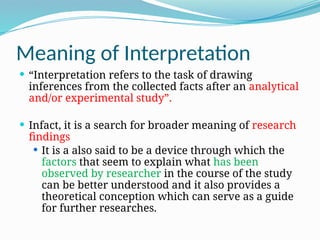
“Interpretation refers to the task of drawing
inferences from the collected facts after an analytical
and/or experimental study”.
Infact, it is a search for broader meaning of research
findings
It is a also said to be a device through which the
factors that seem to explain what has been
observed by researcher in the course of the study
can be better understood and it also provides a
theoretical conception which can serve as a guide
for further researches.
3.
Reasons for requiredInterpretation
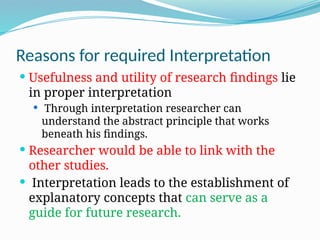
Usefulness and utility of research findings lie
in proper interpretation
Through interpretation researcher can
understand the abstract principle that works
beneath his findings.
Researcher would be able to link with the
other studies.
Interpretation leads to the establishment of
explanatory concepts that can serve as a
guide for future research.
4.
Researcher can betterappreciate
only through interpretation why
his findings are what they are and
can make others to understand the
real significance of his research
findings
5.
Technique of Interpretation
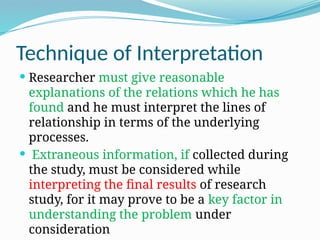
Researcher must give reasonable
explanations of the relations which he has
found and he must interpret the lines of
relationship in terms of the underlying
processes.
Extraneous information, if collected during
the study, must be considered while
interpreting the final results of research
study, for it may prove to be a key factor in
understanding the problem under
consideration
6.
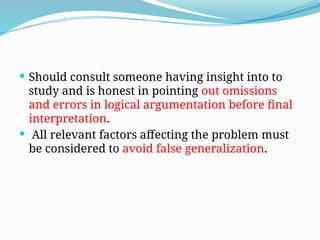
Should consultsomeone having insight into to
study and is honest in pointing out omissions
and errors in logical argumentation before final
interpretation.
All relevant factors affecting the problem must
be considered to avoid false generalization.
7.
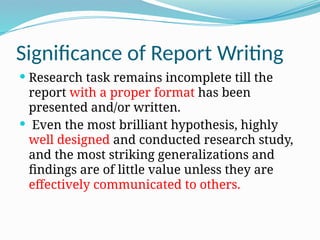
Significance of ReportWriting
Research task remains incomplete till the
report with a proper format has been
presented and/or written.
Even the most brilliant hypothesis, highly
well designed and conducted research study,
and the most striking generalizations and
findings are of little value unless they are
effectively communicated to others.
8.
The purpose ofresearch is not
well served unless the findings
are made known to others for
sharing their views and hence
requires utmost care.
9.
Different steps inWriting Report
Logical analysis of the subject matter
Preparation of the final outline
Preparation of the rough draft
Rewriting and polishing of the rough draft
Preparation of the final bibliography
Writing the final draft
10.
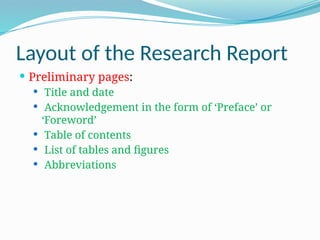
Layout of theResearch Report
Preliminary pages:
Title and date
Acknowledgement in the form of ‘Preface’ or
‘Foreword’
Table of contents
List of tables and figures
Abbreviations
11.
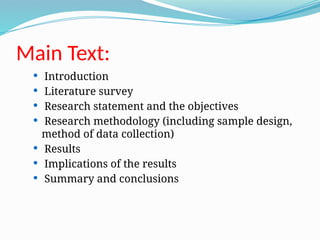
Main Text:
Introduction
Literature survey
Research statement and the objectives
Research methodology (including sample design,
method of data collection)
Results
Implications of the results
Summary and conclusions
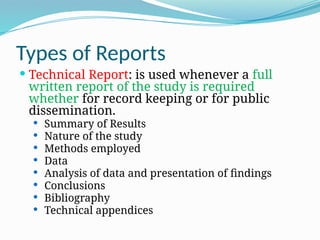
Types of Reports
Technical Report: is used whenever a full
written report of the study is required
whether for record keeping or for public
dissemination.
Summary of Results
Nature of the study
Methods employed
Data
Analysis of data and presentation of findings
Conclusions
Bibliography
Technical appendices
14.
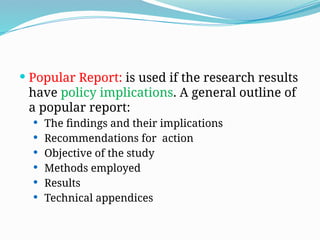
Popular Report:is used if the research results
have policy implications. A general outline of
a popular report:
The findings and their implications
Recommendations for action
Objective of the study
Methods employed
Results
Technical appendices
15.
Oral Presentation
“Oral presentationis useful as it
provides an opportunity for give-
and-take decisions which generally
lead to a better understanding of
the findings and the implications.
But it lacks of any permanent
record concerning the research
details”.
16.
Oral presentationis effective when
supplemented by various visual
devices. Use of slides, wall charts and
blackboards is quite helpful in
contributing to clarity and in reducing
the boredom, if any.
17.
Mechanics of WritingA Research Report
Size and physical design
Unruled paper 8 ½” * 11”
Margin of at least one and one & half inch from
the left
Margins of one inch at the top and bottom
Layout and Procedure:
Depends on the objective and nature of the
problem
Treatment of Quotations:
should be quotation marks and double space but
if the quotation is more than 4 lines than should
be single spaced.
18.
The footnotes
Footnotesare meant for cross references, citation
of authorities and sources, acknowledgement and
explanation of a point of view.
Footnote is not an end or a means of the display of
scholarship
Footnotes are placed at the bottom of the page on
which the reference or quotation which they
identify or supplement ends.
Footnotes should be numbered usually begins
with 1 in each chapter
19.
Precautions for writingResearch Reports
A research report should not be dull; it should be
such as to sustain reader’s interest.
2. Abstract terminology and technical terms should
be avoided in a research report. The report should be
able to convey the matter as simply as possible.
3. Report must have a ready availability of the
findings with charts, graphs, statistical tables etc.
4. The layout of the report should be well though out
and must be appropriate and in accordance with the
objective of the research problem.
20.
The reportsshould be free from
grammatical mistakes and must be
prepared strictly in accordance with
the techniques of composition of
report-writing such as the use of
quotations, footnotes, documentation
proper punctuation and use of
abbreviations in footnotes and the like.
21.
The reportmust present the logical analysis of the
subject matter. It must reflect a structure wherein the
different pieces of analysis relating to the research
problem fit well
7. A research report should show originality and
should necessarily be attempt to solve some
intellectual problem.
8. Towards the end, the report must also state the
policy implications relating to the problem under
consideration.
9. Appendices should be enlisted in respect of all the
technical data in the report.
22.
Bibliography ofsources consulted is a must for a
good report and must necessarily be given.
11. Index is also considered an essential part of a
good report and as such must be prepared and
appended at the end.
12. Report must be attractive in appearance, neat
and clean, whether typed or printed