MODULE 4
JAVA CLASSES AND METHODS
CHAPTER 4
Polymorphism and Inheritance
What is Inheritance
4. Java Classes and Methods
•is when an object or class is based on another
object using the same implementation or
specifying a new implementation to maintain
the same behavior
•Such an inherited class is called subclass of its
parent class or super class
•It is a mechanism for code reuse and to allow
independent extensions of the original
software via public classes and interfaces
Types of Inheritance
4. Java Classes and Methods
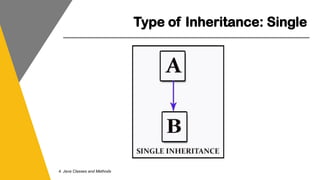
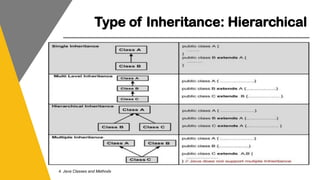
•Single inheritance
where subclasses inherit the features of one superclass.
A class acquires the properties of another class
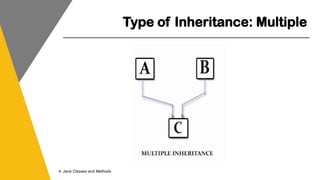
•Multiple inheritance
where one class can have more than one superclass and
inherit features from all parent classes
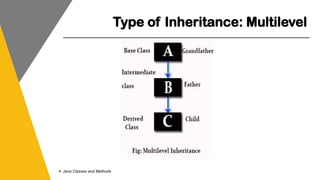
•Multilevel inheritance
where a subclass is inherited from another subclass
Types of Inheritance
4. Java Classes and Methods
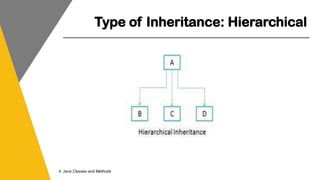
•Hierarchical inheritance
where one class serves as a superclass (base
class) for more than one subclass
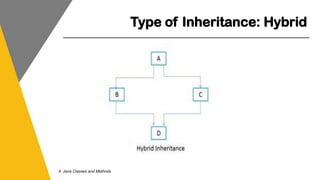
•Hybrid inheritance
a mix of two or more of the above types of
inheritance
Type of Inheritance: Single
4. Java Classes and Methods
Type of Inheritance: Multiple
4. Java Classes and Methods
Type of Inheritance: Multilevel
4. Java Classes and Methods
Type of Inheritance: Hybrid
4. Java Classes and Methods
Type of Inheritance: Hierarchical
4. Java Classes and Methods
Type of Inheritance: Hierarchical
4. Java Classes and Methods
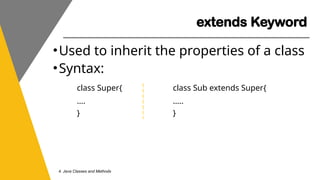
extends Keyword
4. Java Classes and Methods
•Used to inherit the properties of a class
•Syntax:
class Super{ class Sub extends Super{
…. …..
} }
super Keyword
4. Java Classes and Methods
•It is used to differentiate the members
of superclass from the members of
subclass, if they have the same name
•It is used to invoke the superclass
constructor from subclass
Invoking Superclass Constructor
4. Java Classes and Methods
• If a class is inheriting the properties of another
class, the subclass automatically acquires the
default constructor of the superclass. But to call a
parameterized constructor of the superclass,
there is a need to use the super keyword shown
as:
super(values);
Invoking Superclass Constructor
4. Java Classes and Methods
• If a class is inheriting the properties of another
class, the subclass automatically acquires the
default constructor of the superclass. But to call a
parameterized constructor of the superclass,
there is a need to use the super keyword shown
as:
super(values);
IS-A Relationship
4. Java Classes and Methods
•IS-A is way of saying: “this object is a type of
that object”
The instanceof Keyword
4. Java Classes and Methods
•The instanceof operator compares an
object to a specified type. You can use it to
test if an object is an instance of a class, an
instance of a subclass, or an instance of a
class that implements a particular interface.
HAS-A Relationship
4. Java Classes and Methods
•Mainly based on the usage
•Helps to reduce duplication of code as well
as bugs
•Example
public class Vehicle{}
public class Speed{}
public class Van extends Vehicle{
private Speed sp;
}
Polymorphism
4. Java Classes and Methods
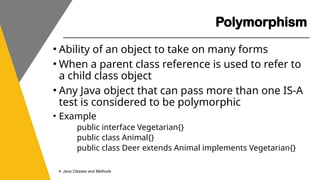
• Ability of an object to take on many forms
• When a parent class reference is used to refer to
a child class object
• Any Java object that can pass more than one IS-A
test is considered to be polymorphic
• Example
public interface Vegetarian{}
public class Animal{}
public class Deer extends Animal implements Vegetarian{}
Polymorphism
4. Java Classes and Methods
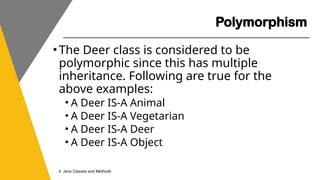
•The Deer class is considered to be
polymorphic since this has multiple
inheritance. Following are true for the
above examples:
• A Deer IS-A Animal
• A Deer IS-A Vegetarian
• A Deer IS-A Deer
• A Deer IS-A Object
Polymorphism
4. Java Classes and Methods
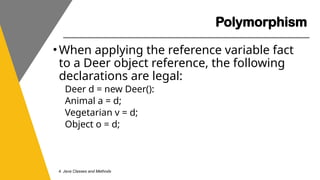
•When applying the reference variable fact
to a Deer object reference, the following
declarations are legal:
Deer d = new Deer():
Animal a = d;
Vegetarian v = d;
Object o = d;
Coding Simulation
4. Java Classes and Methods
Sources
● https://www.tutorialspoint.com/java/index.htm
● https://www.javatpoint.com/java-tutorial
● https://dev.java/learn/getting-started/
● https://www.w3schools.com/java/default.asp
Next Module: File Handling and Exceptions in Java
4. Java Classes and Methods

Module 4_Ch4 - Polymorphism and Inheritance.pptx

  • 1.
    MODULE 4 JAVA CLASSESAND METHODS CHAPTER 4 Polymorphism and Inheritance
  • 2.
    What is Inheritance 4.Java Classes and Methods •is when an object or class is based on another object using the same implementation or specifying a new implementation to maintain the same behavior •Such an inherited class is called subclass of its parent class or super class •It is a mechanism for code reuse and to allow independent extensions of the original software via public classes and interfaces
  • 3.
    Types of Inheritance 4.Java Classes and Methods •Single inheritance where subclasses inherit the features of one superclass. A class acquires the properties of another class •Multiple inheritance where one class can have more than one superclass and inherit features from all parent classes •Multilevel inheritance where a subclass is inherited from another subclass
  • 4.
    Types of Inheritance 4.Java Classes and Methods •Hierarchical inheritance where one class serves as a superclass (base class) for more than one subclass •Hybrid inheritance a mix of two or more of the above types of inheritance
  • 5.
    Type of Inheritance:Single 4. Java Classes and Methods
  • 6.
    Type of Inheritance:Multiple 4. Java Classes and Methods
  • 7.
    Type of Inheritance:Multilevel 4. Java Classes and Methods
  • 8.
    Type of Inheritance:Hybrid 4. Java Classes and Methods
  • 9.
    Type of Inheritance:Hierarchical 4. Java Classes and Methods
  • 10.
    Type of Inheritance:Hierarchical 4. Java Classes and Methods
  • 11.
    extends Keyword 4. JavaClasses and Methods •Used to inherit the properties of a class •Syntax: class Super{ class Sub extends Super{ …. ….. } }
  • 12.
    super Keyword 4. JavaClasses and Methods •It is used to differentiate the members of superclass from the members of subclass, if they have the same name •It is used to invoke the superclass constructor from subclass
  • 13.
    Invoking Superclass Constructor 4.Java Classes and Methods • If a class is inheriting the properties of another class, the subclass automatically acquires the default constructor of the superclass. But to call a parameterized constructor of the superclass, there is a need to use the super keyword shown as: super(values);
  • 14.
    Invoking Superclass Constructor 4.Java Classes and Methods • If a class is inheriting the properties of another class, the subclass automatically acquires the default constructor of the superclass. But to call a parameterized constructor of the superclass, there is a need to use the super keyword shown as: super(values);
  • 15.
    IS-A Relationship 4. JavaClasses and Methods •IS-A is way of saying: “this object is a type of that object”
  • 16.
    The instanceof Keyword 4.Java Classes and Methods •The instanceof operator compares an object to a specified type. You can use it to test if an object is an instance of a class, an instance of a subclass, or an instance of a class that implements a particular interface.
  • 17.
    HAS-A Relationship 4. JavaClasses and Methods •Mainly based on the usage •Helps to reduce duplication of code as well as bugs •Example public class Vehicle{} public class Speed{} public class Van extends Vehicle{ private Speed sp; }
  • 18.
    Polymorphism 4. Java Classesand Methods • Ability of an object to take on many forms • When a parent class reference is used to refer to a child class object • Any Java object that can pass more than one IS-A test is considered to be polymorphic • Example public interface Vegetarian{} public class Animal{} public class Deer extends Animal implements Vegetarian{}
  • 19.
    Polymorphism 4. Java Classesand Methods •The Deer class is considered to be polymorphic since this has multiple inheritance. Following are true for the above examples: • A Deer IS-A Animal • A Deer IS-A Vegetarian • A Deer IS-A Deer • A Deer IS-A Object
  • 20.
    Polymorphism 4. Java Classesand Methods •When applying the reference variable fact to a Deer object reference, the following declarations are legal: Deer d = new Deer(): Animal a = d; Vegetarian v = d; Object o = d;
  • 21.
    Coding Simulation 4. JavaClasses and Methods
  • 22.
    Sources ● https://www.tutorialspoint.com/java/index.htm ● https://www.javatpoint.com/java-tutorial ●https://dev.java/learn/getting-started/ ● https://www.w3schools.com/java/default.asp Next Module: File Handling and Exceptions in Java 4. Java Classes and Methods