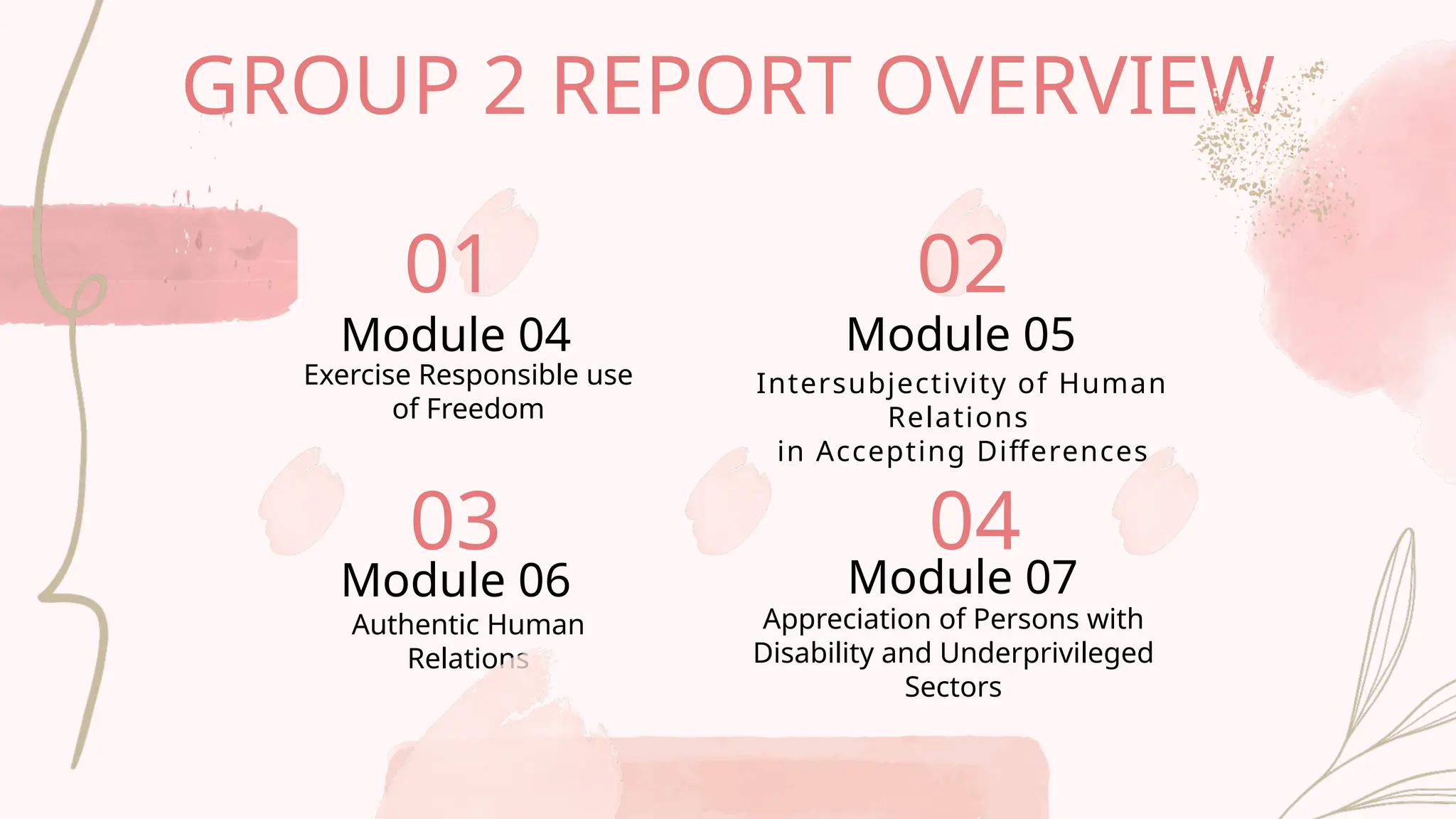
GROUP 2 REPORTOVERVIEW
Module 04 Module 05
Module 06 Module 07
Exercise Responsible use
of Freedom
Intersubjectivity of Human
Relations
in Accepting Differences
Authentic Human
Relations
Appreciation of Persons with
Disability and Underprivileged
Sectors
01 02
03 04
• refers tothe accountability of a
person in consequences of his
actions
RESPONSIBLE USE OF FREEDOM
4.
Example of Responsibleuse of
freedom
a.) A person must have freedom
while
doing an act or omitting to do an
act:
b.) A person must have Intelligence
while
doing the act or omitting to do the
act;
Every day, weencounter different people and recognize
them based on our perceptions and relationships. These
relationships whether with family, friends, neighbors, or
the community vary in nature, including personal,
intimate, or casual interactions.
As social beings, we naturally seek meaningful
connections and strive to build harmonious relationships.
Maintaining productive and beneficial relationships is
essential for personal and social well-being (Abella, 2016).
INTRODUCTION
7.
MEANING
Edmund Husserl's conceptof
intersubjectivity refers to the
exchange of thoughts and
feelings between individuals,
fostering empathy and mutual
recognition of each other as
unique, equal beings. This
concept is best described as a
8.
According to MartinBuber, he said that
man experiences his world. This means
that man travels over the surface of things
and experiences them. “Man extracts
knowledge about his constitution from
them and he wins an experience from
them. He experiences what belongs to the
things”. Human nature drives us to
interact, relate, establish attachment, and
seek close relationships.
MEANING
9.
Intersubjectivity in socialscience refers to
agreement between people in specific
situations. It involves self-awareness and
transcendence, allowing us to engage
meaningfully with others and
surroundings. In everyday life, we can
observe how the awareness of the
existence of the “other”, and the
awareness of the “self” as being seen by
MEANING
10.
||| Human Interactions:
Acceptance
Intersubjectivityrequires acceptance of differences and avoiding
the imposition of beliefs on others. Human interactions involve
recognizing both the self and the other as unique individuals with
subjective experiences. Authentic dialogue happens when people
accept each other despite differences, fostering deeper and more
meaningful relationships.
Since human nature values dignity and goodness, our interactions
should aim for mutual benefit. Recognizing others as genuine
individuals allows for authentic relationships and sincere
communication. This presence and willingness to connect also lead
to care and moral responsibility, especially toward those in need.
11.
However, not allinteractions are positive.
Some reduce others to mere objects for
personal gain, which hinders genuine
relationships and disregards societal moral
values. True acceptance requires
acknowledging others as distinct individuals,
not just as means to satisfy personal interests.
||| Human Interactions:
Acceptance
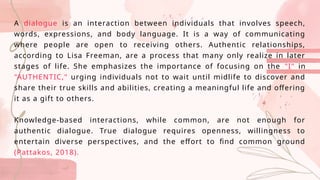
A dialogue isan interaction between individuals that involves speech,
words, expressions, and body language. It is a way of communicating
where people are open to receiving others. Authentic relationships,
according to Lisa Freeman, are a process that many only realize in later
stages of life. She emphasizes the importance of focusing on the "I" in
"AUTHENTIC," urging individuals not to wait until midlife to discover and
share their true skills and abilities, creating a meaningful life and offering
it as a gift to others.
Knowledge-based interactions, while common, are not enough for
authentic dialogue. True dialogue requires openness, willingness to
entertain diverse perspectives, and the effort to find common ground
(Pattakos, 2018).
14.
Heidegger suggests thatin conversation, a stammer may occur
when attempting to express the unnamable, reflecting our
struggle to articulate our true human nature. This highlights
that as human beings, we care about more than just information
and gratification. The concept of dialogue becomes clearer when
considering how conversations with casual acquaintances differ
from those with people we are closest to.
Casual conversations typically focus on news or events, while
discussions with friends and family tend to be more personal,
covering topics like life goals, emotional issues, or moral
dilemmas.
15.
While independence isvaluable, we were not meant
to do life alone. None of us are perfect, and we often
need others. Authentic relationships are crucial,
providing companionship, perspective, growth, and
wisdom. These relationships help us feel connected
and understood, and the different viewpoints of
others can aid in our personal growth and decision-
making (Catherine, 2019).
When two individualsbegin to view
each other as an other- that is, truly
acknowledging each other's presence -
then that is the beginning of an authentic
relationship and a dialogue, (Abella, 2016).
21.
ALEX PATTACKOS,
former ASPANational Council Global Meaning Institute
"Authentic dialogue enables individuals toacknowledge that
they each are part of a greater whole, that they naturally
resonate with others within this whole
and that the whole is, indeed, greater than the sum of its
various parts. As participants in such a holistic process,
together they can produce greater results than they would
just as individuals without this meaningful connection".
22.
"Authentic relationships areimportant
because they bring us joy and help us get
through tough times. They offer support
when things are hard and make good times
even better. No material thing can replace
the happiness we get from connecting with
others."
The Importance of Authentic Relationships
23.
The Impact ofTechnology on Our
Connections
In today’s digital age, it’s common to see people
distracted by their devices even during face-to-
face conversations. While technology provides
instant access to information and helps us stay
connected, it can also lower the quality of our
personal interactions. The pandemic has, in
many ways, pushed us further into this habit—
and we are, in a sense, guilty of it.
24.
As mentioned bythe "Internet and Television
Association in Washington D.C.," as we move
into innovative times in the new media age,
we must proceed with caution so as not to
lose what is called human empathy—an
essential trait that enables us to connect
with others face-to-face and be fully present,
understanding their tone, struggles, and
emotions.
25.
Turkle, a professorof social studies of science and
technology at MIT, reminds us that "technology is
there to help us connect in smarter ways. It's our
responsibility not to isolate ourselves from the
human relationships that make us succeed as a
society." As she writes in Reclaiming Conversation,
"Every new technology offers an opportunity to ask
if it serves our human purposes. From there begins
the work of making technology better serve these
Technology and Human
Connection
A disability isa social imposition on people who have
impairments, making it more difficult for people to do certain
activities or interact with the world around them. Due to
cognitive, developmental, intellectual, mental, physical, and/or
sensory differences, disabled people are "unnecessarily isolated
and excluded from full participation in society, (Wikipedia).
28.
The meanings ofPersons with Disability and Underprivileged Sectors
United Nations the term persons with disabilities or PWDs are used to apply
to all persons with disabilities including those who have long-term physical,
mental, intellectual, or sensory impairments which, in interaction with
various attitudinal and environmental barriers, hinders their full and effective
participation in society on an equal basis with others. However, this minimum
list of persons who may claim protections under the Convention does not
exhaust the categories of the disabilities which fall within the it or not intend
to undermine or stand in the way of wider definition of disabilities under
national law (such as persons with short-term disability in one society or
setting, but not in another, depending on the role that person is assumed to
take in his or her community.
29.
- are peoplewho have less in financial and possessions
and opportunities compared to other people in the
society. They were deprived or disadvantaged to learn
and read or even government cuts.
They are families who usually live in poverty because they
don’t have place to live, money, education or food to
survive in daily basis.
UNDERPRIVILEGED
SECTORS
30.
In the previouslesson about intersubjectivity, one of the important values
related to the subject matter is the acceptance of differences and
embracing diversity. Each person is unique, and differences exists among
groups of people, therefore we understood that when we look at physical
traits and even behavior of others, we can see that no two persons looks
and think the same. The Convention on the Rights of Persons with
Disabilities (CRPD), states that all persons with all types of disabilities must
enjoy all humanrights and fundamental freedoms.
How can philosophy help you evaluate your
appreciation to persons with
disability and underprivileged sectors?
31.
The recognition ofour shared humanity and dignity is what drives us to
extend assistance and act with concern towards others, especially toward
individuals or groups that experiences hardships and discrimination. For
instance, those who are physically and mentally challenged often
experience hardships because of their condition. We have to realize,
however, that these individuals, despite their limitations, can have the
same skills as those who are fully able in mind and body.
Another group of people who experience hardship and discrimination are
the underprivileged. They have the less in terms of material possessions.
Despite the differences in lifestyle, social class and experiences, our shared
humanity allows us to engage with each other respectfully and render
assistance to each other. The act of assistance or giving, however, must be
done on the spirit of mutual respect. One must extend help
wholeheartedly, without reservation or a patronizing attitude.
32.
Bellen, Joe Ross
Ajedo,Karen
Shane
Dely, John Ropert Eugenio, Natalie Hernandez,
Vallerie
Nepomuceno,
Jherwin
Peñaflorida,
Jericho
Sarong, Kristine
Claire
Seron, Kyle
Kristan
Villa, Jen
✧ REPORTERS ✧