Module 2_ Entrepreneurship.pdf entrepreneurship development
1.
MODULE - II
Microand small Enterprises: Meaning and Definition, Essentials
Features and Characteristics, Relationship between Micro and Macro
Enterprises, Role of Micro Enterprises in Economic development.
Opportunity Identification and selection: Environmental Dynamics and
changes, Identification of business opportunity. Steps in setting up of a
small Business enterprise.
2.
Micro and smallEnterprises: Meaning and Definition
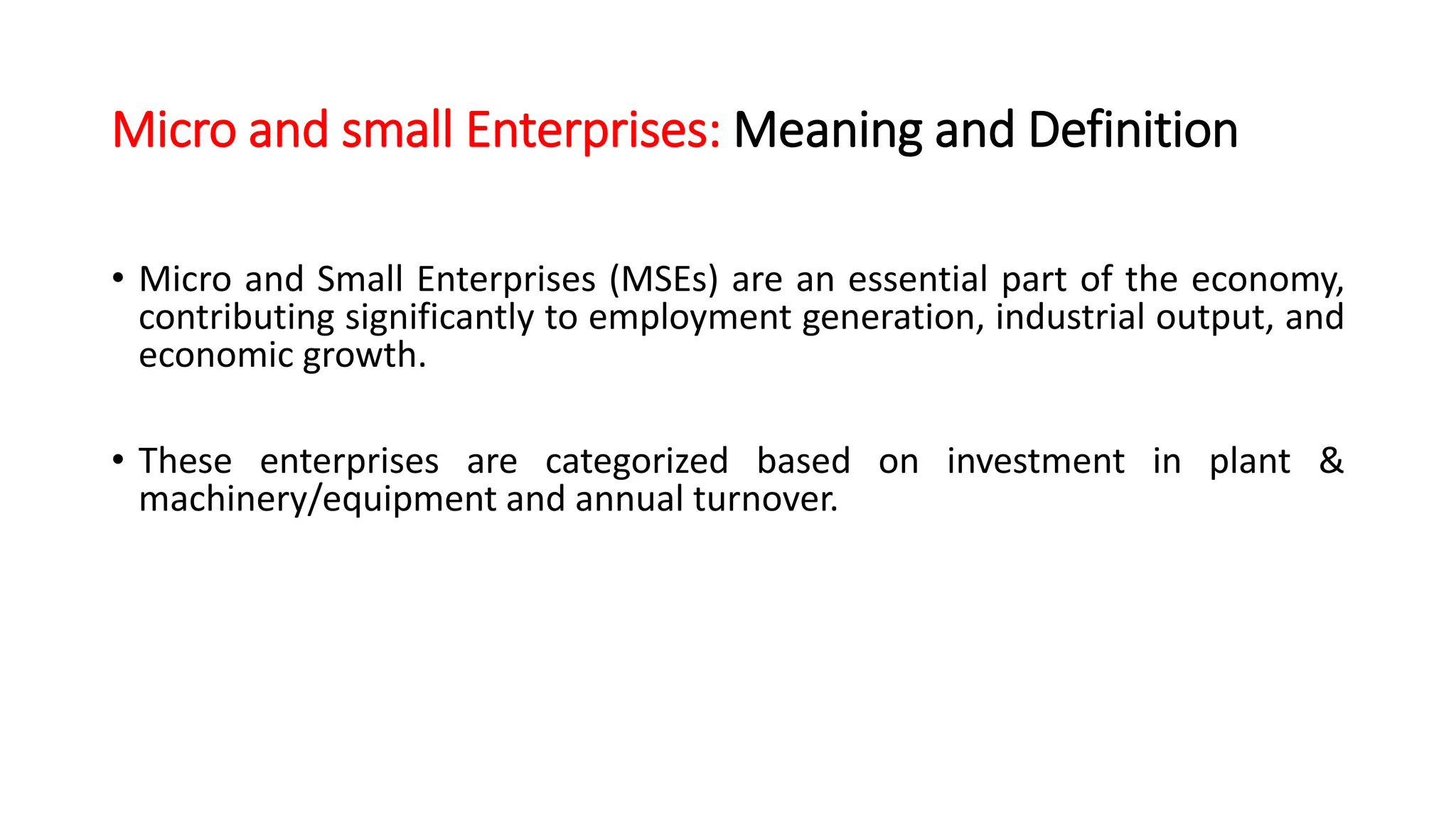
• Micro and Small Enterprises (MSEs) are an essential part of the economy,
contributing significantly to employment generation, industrial output, and
economic growth.
• These enterprises are categorized based on investment in plant &
machinery/equipment and annual turnover.
3.
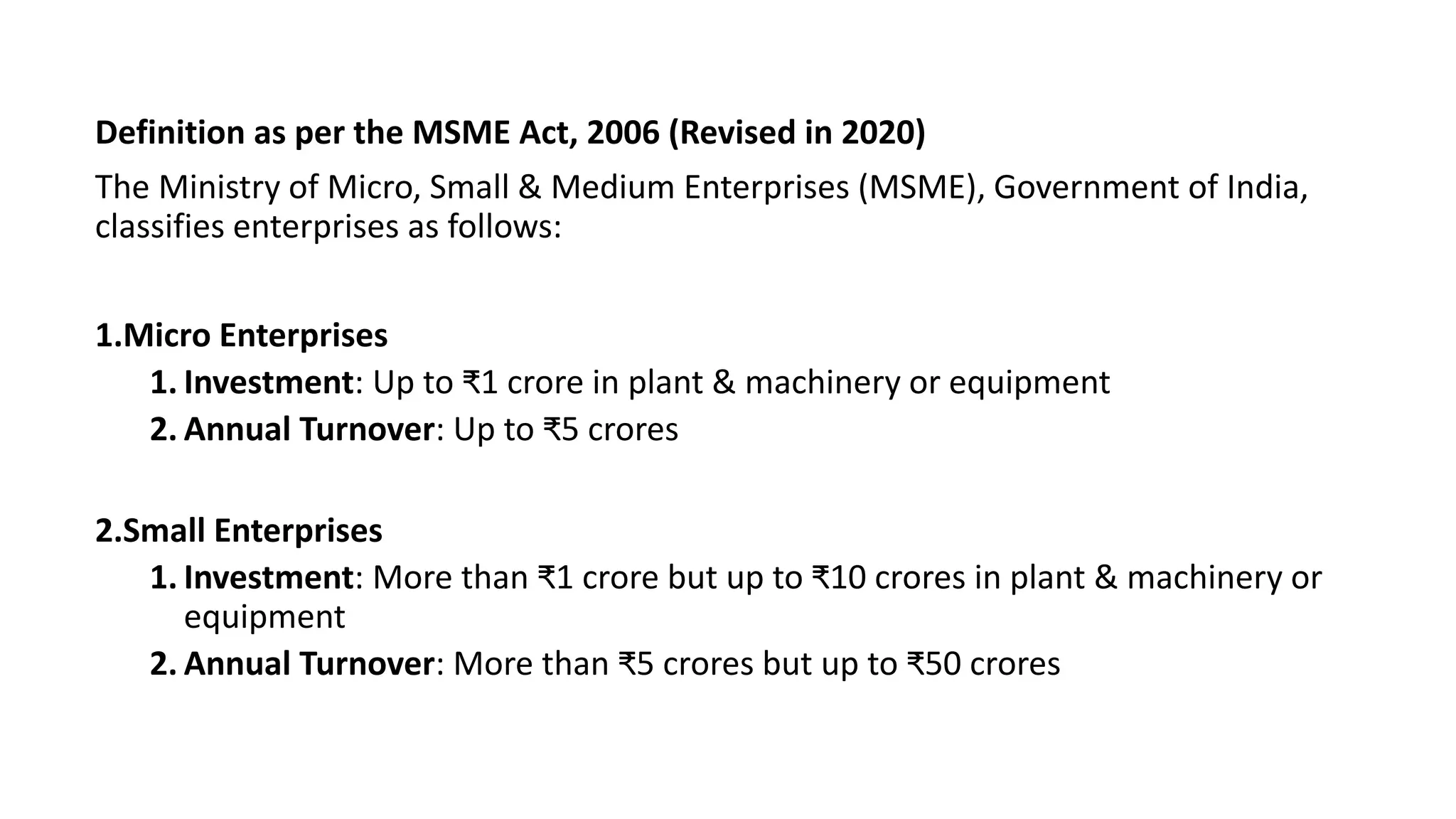
Definition as perthe MSME Act, 2006 (Revised in 2020)
The Ministry of Micro, Small & Medium Enterprises (MSME), Government of India,
classifies enterprises as follows:
1.Micro Enterprises
1. Investment: Up to ₹1 crore in plant & machinery or equipment
2. Annual Turnover: Up to ₹5 crores
2.Small Enterprises
1. Investment: More than ₹1 crore but up to ₹10 crores in plant & machinery or
equipment
2. Annual Turnover: More than ₹5 crores but up to ₹50 crores
4.
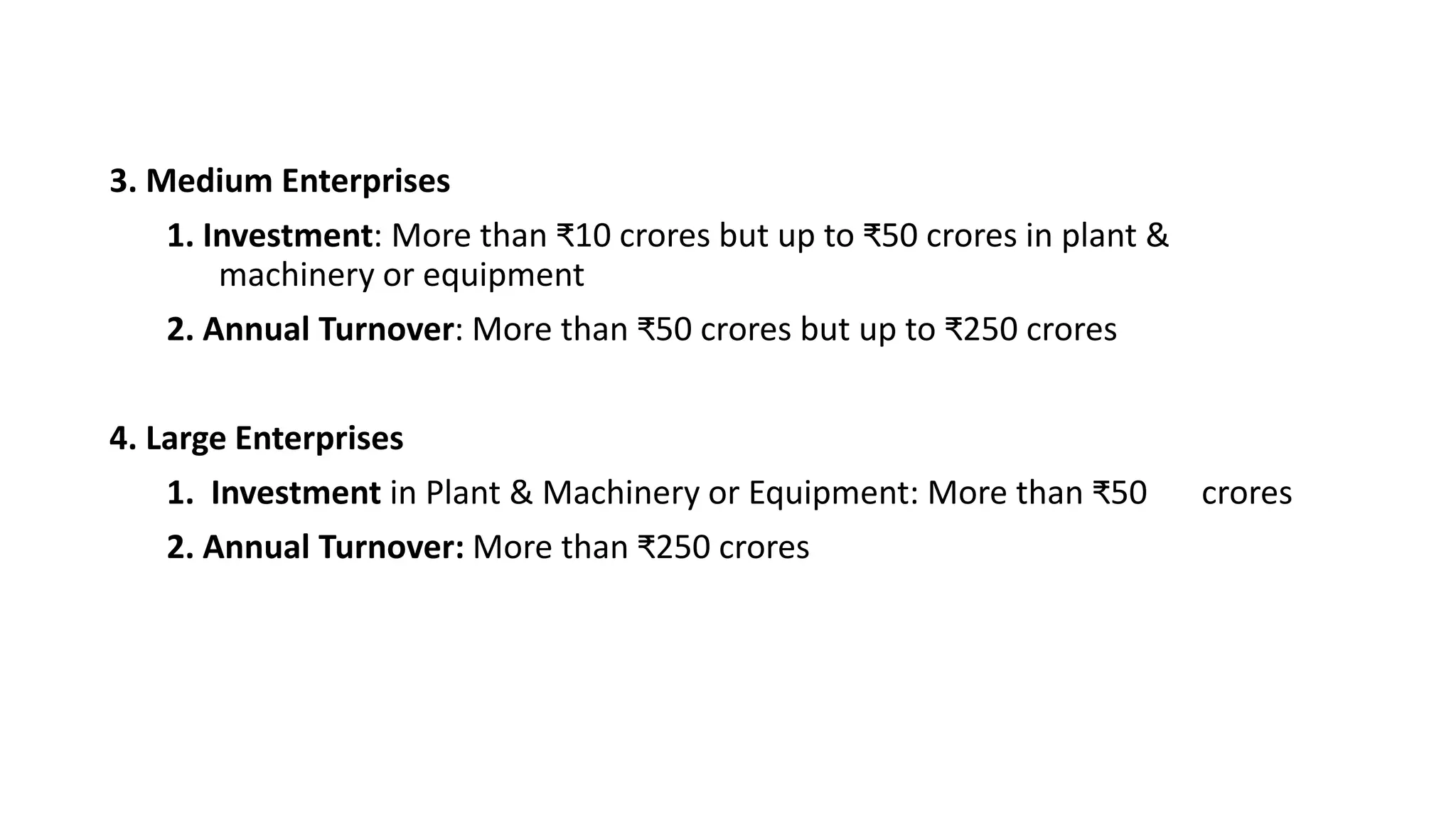
3. Medium Enterprises
1.Investment: More than ₹10 crores but up to ₹50 crores in plant &
machinery or equipment
2. Annual Turnover: More than ₹50 crores but up to ₹250 crores
4. Large Enterprises
1. Investment in Plant & Machinery or Equipment: More than ₹50 crores
2. Annual Turnover: More than ₹250 crores
5.
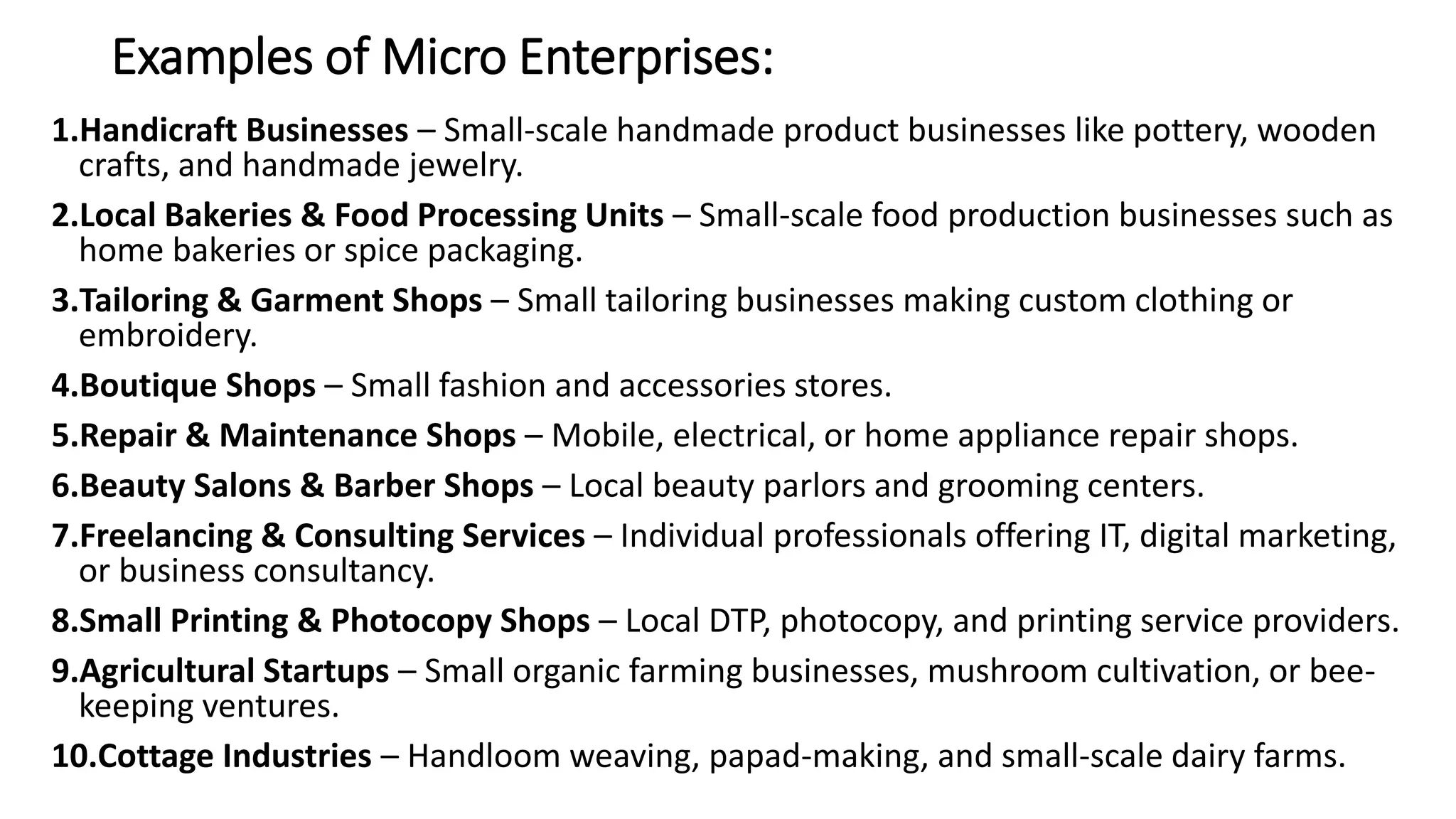
Examples of MicroEnterprises:
1.Handicraft Businesses – Small-scale handmade product businesses like pottery, wooden
crafts, and handmade jewelry.
2.Local Bakeries & Food Processing Units – Small-scale food production businesses such as
home bakeries or spice packaging.
3.Tailoring & Garment Shops – Small tailoring businesses making custom clothing or
embroidery.
4.Boutique Shops – Small fashion and accessories stores.
5.Repair & Maintenance Shops – Mobile, electrical, or home appliance repair shops.
6.Beauty Salons & Barber Shops – Local beauty parlors and grooming centers.
7.Freelancing & Consulting Services – Individual professionals offering IT, digital marketing,
or business consultancy.
8.Small Printing & Photocopy Shops – Local DTP, photocopy, and printing service providers.
9.Agricultural Startups – Small organic farming businesses, mushroom cultivation, or bee-
keeping ventures.
10.Cottage Industries – Handloom weaving, papad-making, and small-scale dairy farms.
6.
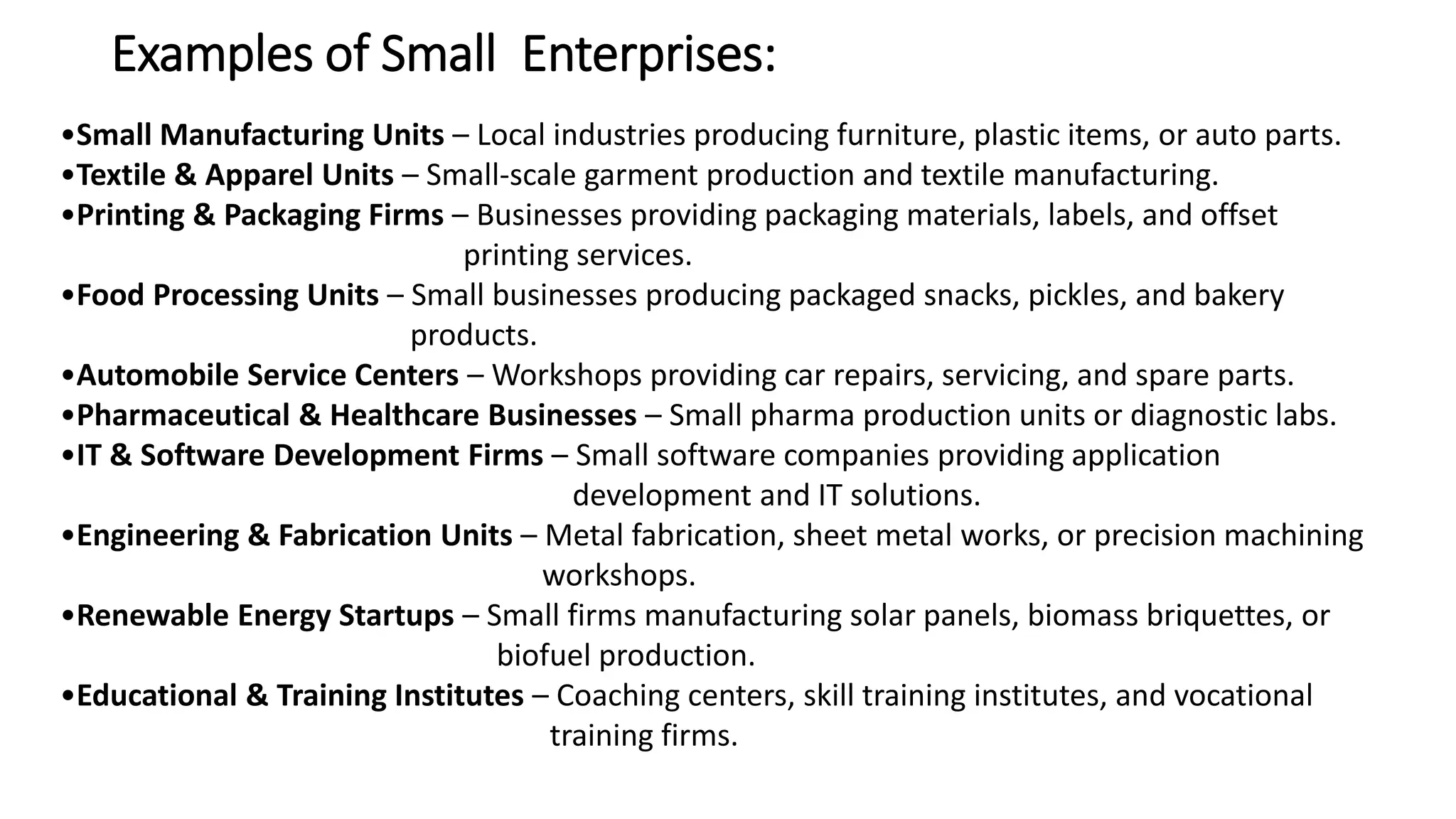
Examples of SmallEnterprises:
•Small Manufacturing Units – Local industries producing furniture, plastic items, or auto parts.
•Textile & Apparel Units – Small-scale garment production and textile manufacturing.
•Printing & Packaging Firms – Businesses providing packaging materials, labels, and offset
printing services.
•Food Processing Units – Small businesses producing packaged snacks, pickles, and bakery
products.
•Automobile Service Centers – Workshops providing car repairs, servicing, and spare parts.
•Pharmaceutical & Healthcare Businesses – Small pharma production units or diagnostic labs.
•IT & Software Development Firms – Small software companies providing application
development and IT solutions.
•Engineering & Fabrication Units – Metal fabrication, sheet metal works, or precision machining
workshops.
•Renewable Energy Startups – Small firms manufacturing solar panels, biomass briquettes, or
biofuel production.
•Educational & Training Institutes – Coaching centers, skill training institutes, and vocational
training firms.
7.
Essential Features ofMicro and Small Enterprises
1.Low Investment Requirement
2.Limited Workforce
3.Local Market Focus
4.Flexible Operations
5.Innovation and Entrepreneurship
6.Government Support and Incentives
7.Contribution to Employment Generation
8.Quick Decision-Making Process
8.
Characteristics of Microand Small Enterprises
• Ownership: Sole proprietorship or partnership is common
• Labor-Intensive: Generates employment opportunities
• Technology Usage: Uses basic to moderate level technology
• Market Scope: Mostly serves local and regional markets
• Financial Dependency: Relies on government schemes, loans, and subsidies
• Competitive Advantage: Cost-effective production and personalized customer
service
9.
Importance of MSEsin the Economy
• Contribution to GDP
• Enhancing Regional Development
• Reducing Urban-Rural Economic Gap
• Encouraging Entrepreneurship and Innovation
• Promoting Export and Industrial Growth
10.
Government Schemes forMSEs
1.Pradhan Mantri Mudra Yojana (PMMY)
2.Credit Guarantee Fund Scheme (CGTMSE)
3.Prime Minister’s Employment Generation Programme (PMEGP)
4.Technology Upgradation Fund Scheme (TUFS)
5.MSME Innovative Scheme
11.
Challenges Faced byMSEs
• Limited Access to Finance
• Lack of Skilled Workforce
• Market Competition
• Technology and Infrastructure Constraints
• Regulatory and Compliance Issues
12.
Relationship between Microand Macro Enterprises
• Supply Chain Linkages – Micro enterprises often supply raw materials, components, or
services to large-scale (macro) enterprises.
• Job Creation – Micro enterprises absorb local labor, while macro enterprises generate
large-scale employment.
• Innovation & Flexibility – Micro enterprises drive innovation at the grassroots level,
while macro enterprises scale innovations to mass production.
• Market Expansion – Micro enterprises cater to niche markets, while macro enterprises
focus on global and national markets.
• Financial Dependence – Large enterprises may fund or support micro businesses
through corporate social responsibility (CSR) programs, partnerships, and supply chains.
13.
Role of MicroEnterprises in Economic Development
1. Employment Generation
• Provides self-employment and jobs to semi-skilled and unskilled labor.
• Reduces unemployment and underemployment in rural and urban areas.
2. Poverty Alleviation
• Enables low-income individuals to generate sustainable income.
• Encourages economic independence and financial inclusion.
3. Industrial Growth & Supply Chain Development
• Supports the growth of larger industries by providing essential raw materials and
services.
• Enhances the efficiency of supply chains in various sectors.
14.
4. Regional Development& Balanced Growth
• Encourages economic activity in rural and semi-urban areas.
• Reduces migration from rural to urban centers by providing local employment.
5. Contribution to GDP & Export Growth
• Increases the country's Gross Domestic Product (GDP) by adding value to goods and
services.
• Many micro enterprises contribute to exports, enhancing foreign exchange earnings.
6. Encouraging Innovation & Entrepreneurship
• Facilitates new business ideas and low-cost innovations.
• Acts as a breeding ground for entrepreneurs, some of whom scale up to become larger
enterprises.
7. Support for Women & Social Development
• Provides opportunities for women entrepreneurs and marginalized communities.
• Promotes gender equality and inclusive economic participation.