The Life, Times, and Career of
the Professional Salesperson
By Dr. Lena Cavusoglu
Based on:
ABCs of Relationship Selling Through Service, 13e, SAGE Publishing, 2019
Selling & Sales Management: Developing Skills for Success, SAGE Publishing, 2021
PERSONAL SELLING
AND SALES
MANAGEMENT
©McGraw-Hill Education
1-2
Learning Objectives
Module 1: The Life, Times, and Career of the Professional Salesperson
1. Define and explain the term selling.
2. Explain why everybody sells, even you.
3. Explain the relationship between the traditional definition of selling and the core
principles of professional selling.
4. List and explain the 10 steps in the sales process.
©McGraw-Hill Education
1-3
Nothing Happens Until Someone Sells Something!
Salespeople’s efforts have impact across
the firm:
• Success of new products
• Keep existing products on the
retailer’s shelf
• Constructing manufacturing facilities
• Opening new businesses
• Generating sales orders
©Eric Audras/Getty Images
©McGraw-Hill Education
1-4
What’s the Relationship Between Marketing & Selling?
©McGraw-Hill Education
1-5
©McGraw-Hill Education
1-6
Marketing and Sales Have The Same Goals
©McGraw-Hill Education
1-7
What is Selling?
Selling is one of many
marketing components
• Personal communication of
information
• Persuasion
• Helping others
What is critical to selling?
• Examine the customer’s needs
• Provide information and solutions
• Provide after-the-sale service
©McGraw-Hill Education
1-8
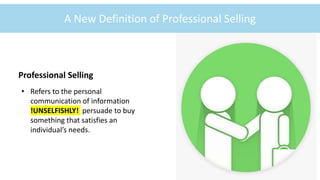
A New Definition of Professional Selling
Professional Selling
• Refers to the personal
communication of information
!UNSELFISHLY! persuade to buy
something that satisfies an
individual’s needs.
©skynesher/Getty Images
©McGraw-Hill Education
1-9
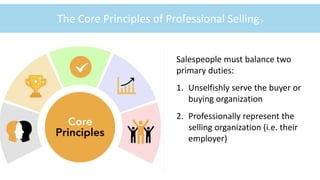
The Core Principles of Professional Selling1
©ESB Professional/Shutterstock
Salespeople must balance two
primary duties:
1. Unselfishly serve the buyer or
buying organization
2. Professionally represent the
selling organization (i.e. their
employer)
©McGraw-Hill Education
1-10
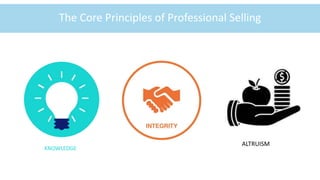
The Core Principles of Professional Selling
KNOWLEDGE
ALTRUISM
©McGraw-Hill Education
1-11
How Do Salespeople Demonstrate the Core Principles?
To customers:
• Understand the needs of their customers
• Develop ideas and solutions to help their customers:
• Serve as a resource for their customers, which allows the customer to
focus on their most valuable processes
To the selling organization:
• Represent the company professionally
• Represent the company’s brand image
• Understand how the firm’s processes, products, and services can
potentially assist customers (knowledge)
©McGraw-Hill Education
1-12
©Erik Isakson/Blend Images LLC
©McGraw-Hill Education
1-13
Traditional Salesperson
Perceived as guided by self-
interests
Professional
Salesperson
Takes care of customers
SALESPEOPLE DIFFERENCES
©McGraw-Hill Education
1-14
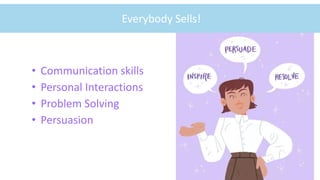
Everybody Sells!
• Communication skills
• Personal Interactions
• Problem Solving
• Persuasion
©McGraw-Hill Education
1-15
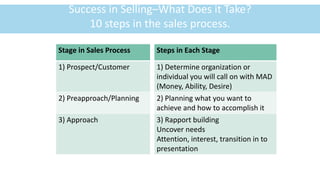
Success in Selling–What Does it Take?
10 steps in the sales process.
Stage in Sales Process
1) Prospect/Customer
2) Preapproach/Planning
3) Approach
Steps in Each Stage
1) Determine organization or
individual you will call on with MAD
(Money, Ability, Desire)
2) Planning what you want to
achieve and how to accomplish it
3) Rapport building
Uncover needs
Attention, interest, transition in to
presentation
©McGraw-Hill Education
1-16
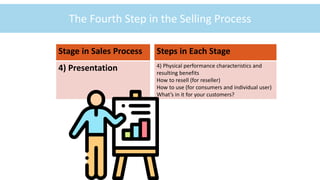
The Fourth Step in the Selling Process
Stage in Sales Process
4) Presentation
Steps in Each Stage
4) Physical performance characteristics and
resulting benefits
How to resell (for reseller)
How to use (for consumers and individual user)
What’s in it for your customers?
©McGraw-Hill Education
1-17
After the Presentation
Stage in Sales Process
5. Trial close
6. Determine objections
7. Meet objections
8. Trial close
Steps in Each Stage
5) Check attitude toward what was said in
presentation
6) Opposition or resistance to information
or salesperson
7) Respond using techniques for meeting
objection
8) Check attitude toward resolution if
overcame objection
©McGraw-Hill Education
1-18
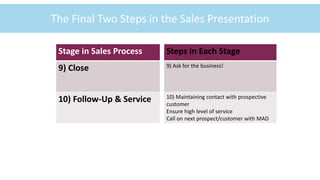
The Final Two Steps in the Sales Presentation
Stage in Sales Process
9) Close
10) Follow-Up & Service
Steps in Each Stage
9) Ask for the business!
10) Maintaining contact with prospective
customer
Ensure high level of service
Call on next prospect/customer with MAD
©McGraw-Hill Education
1-19
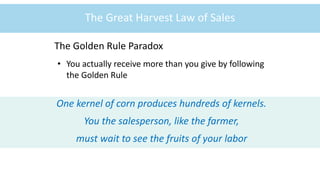
The Great Harvest Law of Sales
The Golden Rule Paradox
• You actually receive more than you give by following
the Golden Rule
One kernel of corn produces hundreds of kernels.
You the salesperson, like the farmer,
must wait to see the fruits of your labor
©McGraw-Hill Education
1-20
The Common Denominator of
Sales Success
The common denominator of a
successful salesperson is
unselfishly and sacrificially
“caring” for prospects, customers,
and others.
©monkev business images/Getty Images
©McGraw-Hill Education
1-21
QUESTIONS?
LENA.CAVUSOGLU@UNCP.EDU

Module 1_Sales management.pptx

  • 1.
    The Life, Times,and Career of the Professional Salesperson By Dr. Lena Cavusoglu Based on: ABCs of Relationship Selling Through Service, 13e, SAGE Publishing, 2019 Selling & Sales Management: Developing Skills for Success, SAGE Publishing, 2021 PERSONAL SELLING AND SALES MANAGEMENT
  • 2.
    ©McGraw-Hill Education 1-2 Learning Objectives Module1: The Life, Times, and Career of the Professional Salesperson 1. Define and explain the term selling. 2. Explain why everybody sells, even you. 3. Explain the relationship between the traditional definition of selling and the core principles of professional selling. 4. List and explain the 10 steps in the sales process.
  • 3.
    ©McGraw-Hill Education 1-3 Nothing HappensUntil Someone Sells Something! Salespeople’s efforts have impact across the firm: • Success of new products • Keep existing products on the retailer’s shelf • Constructing manufacturing facilities • Opening new businesses • Generating sales orders ©Eric Audras/Getty Images
  • 4.
    ©McGraw-Hill Education 1-4 What’s theRelationship Between Marketing & Selling?
  • 5.
  • 6.
  • 7.
    ©McGraw-Hill Education 1-7 What isSelling? Selling is one of many marketing components • Personal communication of information • Persuasion • Helping others What is critical to selling? • Examine the customer’s needs • Provide information and solutions • Provide after-the-sale service
  • 8.
    ©McGraw-Hill Education 1-8 A NewDefinition of Professional Selling Professional Selling • Refers to the personal communication of information !UNSELFISHLY! persuade to buy something that satisfies an individual’s needs. ©skynesher/Getty Images
  • 9.
    ©McGraw-Hill Education 1-9 The CorePrinciples of Professional Selling1 ©ESB Professional/Shutterstock Salespeople must balance two primary duties: 1. Unselfishly serve the buyer or buying organization 2. Professionally represent the selling organization (i.e. their employer)
  • 10.
    ©McGraw-Hill Education 1-10 The CorePrinciples of Professional Selling KNOWLEDGE ALTRUISM
  • 11.
    ©McGraw-Hill Education 1-11 How DoSalespeople Demonstrate the Core Principles? To customers: • Understand the needs of their customers • Develop ideas and solutions to help their customers: • Serve as a resource for their customers, which allows the customer to focus on their most valuable processes To the selling organization: • Represent the company professionally • Represent the company’s brand image • Understand how the firm’s processes, products, and services can potentially assist customers (knowledge)
  • 12.
  • 13.
    ©McGraw-Hill Education 1-13 Traditional Salesperson Perceivedas guided by self- interests Professional Salesperson Takes care of customers SALESPEOPLE DIFFERENCES
  • 14.
    ©McGraw-Hill Education 1-14 Everybody Sells! •Communication skills • Personal Interactions • Problem Solving • Persuasion
  • 15.
    ©McGraw-Hill Education 1-15 Success inSelling–What Does it Take? 10 steps in the sales process. Stage in Sales Process 1) Prospect/Customer 2) Preapproach/Planning 3) Approach Steps in Each Stage 1) Determine organization or individual you will call on with MAD (Money, Ability, Desire) 2) Planning what you want to achieve and how to accomplish it 3) Rapport building Uncover needs Attention, interest, transition in to presentation
  • 16.
    ©McGraw-Hill Education 1-16 The FourthStep in the Selling Process Stage in Sales Process 4) Presentation Steps in Each Stage 4) Physical performance characteristics and resulting benefits How to resell (for reseller) How to use (for consumers and individual user) What’s in it for your customers?
  • 17.
    ©McGraw-Hill Education 1-17 After thePresentation Stage in Sales Process 5. Trial close 6. Determine objections 7. Meet objections 8. Trial close Steps in Each Stage 5) Check attitude toward what was said in presentation 6) Opposition or resistance to information or salesperson 7) Respond using techniques for meeting objection 8) Check attitude toward resolution if overcame objection
  • 18.
    ©McGraw-Hill Education 1-18 The FinalTwo Steps in the Sales Presentation Stage in Sales Process 9) Close 10) Follow-Up & Service Steps in Each Stage 9) Ask for the business! 10) Maintaining contact with prospective customer Ensure high level of service Call on next prospect/customer with MAD
  • 19.
    ©McGraw-Hill Education 1-19 The GreatHarvest Law of Sales The Golden Rule Paradox • You actually receive more than you give by following the Golden Rule One kernel of corn produces hundreds of kernels. You the salesperson, like the farmer, must wait to see the fruits of your labor
  • 20.
    ©McGraw-Hill Education 1-20 The CommonDenominator of Sales Success The common denominator of a successful salesperson is unselfishly and sacrificially “caring” for prospects, customers, and others. ©monkev business images/Getty Images
  • 21.

Editor's Notes

  • #3 In this chapter, we will Define and explain the term selling, learn the core principles of selling and briefly explain 10 steps sales process.
  • #4 More than ever, today’s salespeople are a dynamic power in the business world. They play key roles in an organization They ensure the success of new products. They keep existing products on the retailer’s shelf. They constructing manufacturing facilities. They open new businesses, branched, and create subdealers and of course they keep them open. They generating sales orders that result in the loading of, trains, ships, and they create pipelines that carry goods to customers all over the world.
  • #5 What is Marketing? Marketing is the activity and processes for creating, communicating, delivering, and exchanging offerings that have value for all stakeholders. Who are the stakeholders. They are customers, clients, partners, and society at large. Here it is important to understand that a product can be tangible or intangible. A tangible product is a physical good that can be purchased. A radio, a house, and a car are examples of a good. A service is a intangible good … it is is an action or activity done for others for a fee. Lawyers, plumbers, teachers, and taxicab drivers perform services. The term product
  • #6 refers to both goods and services. Selling is one of the many marketing components along with: Product Place Price Promotion Professional Selling Is Commonly Considered An Element of Promotion (Communication)
  • #7 Many people consider selling and marketing synonymous terms. However, selling is actually only one of many marketing components. However, it is important to note that Marketing and Sales Have The Same Goals! The essentials of a company’s marketing effort include its ability to: Determine the needs of its customers Create and maintain an effective marketing mix that satisfies customer needs. Similarly, professional selling focuses on: Understanding the needs of your customers Developing a solution that satisfy your customer.
  • #8 Professional selling includes: Personal communication of information persuasion a prospective customer to buy something—a good, service, idea, or something else—that satisfies that individual’s needs. selling involves a person helping another person with Goods, Services, Ideas What is critical to selling? Examine the customer’s needs Provide information and solutions to meet the customer’s needs Provide after-the-sale service to ensure long-term satisfaction.
  • #9 The new definition inserts the word unselfish into the traditional definition discussed earlier. Professional Selling Refers to the personal communication of information To unselfishly persuade someone To buy something – a good, service, idea, or something else – that satisfies an individual’s needs.
  • #10 Salespeople must balance two primary duties which are the Core Principles of Professional Selling Unselfishly serve the buyer or buying organization Professionally represent the selling organization (i.e. their employer) I want to share with you what a salesperson said about The unselfishly helping another person aspect… Unselfishly treating refers to treating others as you would like to be treated without expecting something in return Do not think of your occupation as work but more like helping others to find solutions to their problems. Only through service (helping others) you find fulfillment in your job and life if you are going to pursue a career in sales.
  • #11 The Core Principles of Professional Selling To Serve, You Need Knowledge Being knowledgeable on products and selling skills allows you to provide is a high level and very important customer service Customers Notice Integrity Your customer’s should be able to trust that you are looking out for their best interest And… Altruism Personal Gain is Not Your Goal Do not be concerned about sales goals – just your customer’s Others Come First
  • #12 To customers: Understand the needs of their customers Develop ideas and solutions to help their customers: Grow their business Overcome their challenges Serve as a resource for their customers, which allows the customer to focus on their most valuable processes To the selling organization: Represent the company professionally Represent the company’s brand image Understand how the firm’s processes, products, and services can potentially assist customers (knowledge)
  • #13 We need to Overcome Common negative Perceptions of Sales Some people view traditional salespeople as: Self-interested, focused on their own well-being Selfish Only focused on making money Not trustworthy However, salespeople following the Core Principles of Professional Selling focus upon: Interests of others before self-interest Considers and understands the customer needs Customer solutions and customer service
  • #14 SALESPEOPLE DIFFERENCES Traditional Salesperson Perceived as guided by self-interests Professional Salesperson…. Takes care of customers Follows the Core Principles of Professional Selling Salesperson Focus on solving problems, providing solutions
  • #15 If you think about it, everyone sells. From an early age, you develop communication techniques for trying to get your way in life. You are involved in selling when you want someone to do something. For example, if you want to get a date, ask for a pay increase, return merchandise, urge your professor to raise your grade, or apply for a new job, you are selling. You use personal communication skills to persuade someone to act. Your ability to communicate effectively is a key to success in life. Sales is a skill that you will use throughout their career…and your life. Communication: Sales help you in developing your communication skills (i.e. verbal and nonverbal communication and listening) Personal Interactions You are involved in selling when you negotiate with someone or ask someone for something Problem Solving Selling teaches you to listen, understand needs, and craft solutions Persuasion: You use persuasion skills to persuade someone to act, to move forward, to make a decision
  • #16 the sales process refers to a series of actions by the salesperson that leads toward the customer taking a desired action and ends with a follow-up to ensure purchase satisfaction. Although many factors may influence how a salesperson makes a presentation in any one situation, a logical, series of actions exists that, if followed, it can greatly increase the chances of making a sale. all steps are discussed in greater detail in the following weeks. Each step is a module actually. Prospecting is the first step in the selling process. A prospect is a qualified person or organization that has the potential to buy your good or service. Prospecting is the lifeblood of sales because it identifies potential customers.
  • #20 How you treat others will often determine how you will be treated
  • #21 Denominator: A common trait The common denominator of a successful salesperson is unselfishly and sacrificially “caring” for prospects, customers, and others.